

Contact MEB Today To Get The Best
High-performance computing (HPC) Tutoring Online
Email: [email protected]



~1 min
Average Reply Time
~1 hour
To Be Matched With A Tutor
30 Min Trial
75% Find Their Tutor On The 1st Trial
$20-35+/hr
Premium Yet Affordable Learning
Hire The Best High-performance computing (HPC) Tutor

Most HPC students hit a wall at parallelism. Not because they’re not smart — because no textbook walks you through debugging an MPI deadlock at 2 a.m.
High-Performance Computing (HPC) Tutor Online
High-performance computing (HPC) is the use of parallel processing, distributed systems, and high-speed interconnects to solve computationally intensive problems that exceed the capacity of standard desktop hardware.
If you’re searching for an HPC tutor near me, MEB connects you with a verified computer science expert who knows the exact stack you’re working with — whether that’s OpenMPI on a university cluster, CUDA on GPU nodes, or a cloud-based HPC environment. Our 1:1 online HPC tutor sessions are built around your course, your deadline, and the specific bug or concept that’s blocking you right now.
- 1:1 online sessions tailored to your university course or research project
- Expert-verified tutors with HPC-specific subject knowledge — parallel algorithms, MPI, OpenMP, CUDA, job schedulers
- Flexible time zones — US, UK, Canada, Australia, Gulf
- Structured learning plan built after a first diagnostic session
- Ethical homework and assignment guidance — you understand the work, then submit it yourself
52,000+ students across the US, UK, Canada, Australia, and the Gulf have used MEB since 2008 — including students in Computer Science subjects like HPC, parallel computing, and distributed systems.
Source: My Engineering Buddy, 2008–2025.
How Much Does an HPC Tutor Cost?
HPC tutoring starts at $20–$40/hr for undergraduate course support. Graduate-level and research-focused sessions — covering CUDA optimisation, MPI collective communication tuning, or HPC cluster administration — run up to $100/hr depending on depth and tutor background. You can start with the $1 trial: 30 minutes of live tutoring or one full homework question explained.
| Level / Need | Typical Rate | What’s Included |
|---|---|---|
| Undergraduate (most levels) | $20–$40/hr | 1:1 sessions, homework guidance, concept walkthroughs |
| Graduate / Research-level | $40–$100/hr | Expert tutor, CUDA/MPI depth, thesis-level support |
| $1 Trial | $1 flat | 30 min live session or one full homework question explained |
Tutor availability tightens around end-of-semester project deadlines and graduate exam periods — book early if your timeline is fixed.
WhatsApp MEB for a quick quote — average response time under 1 minute.
Who This HPC Tutoring Is For
HPC sits at the overlap of algorithms, systems programming, and hardware architecture. It’s a course where students who were comfortable in their earlier CS modules suddenly find the ground has shifted.
- Undergraduate CS or engineering students tackling their first parallel programming assignment — OpenMP loops that don’t scale, MPI programs that deadlock
- Graduate students whose research involves cluster computing, GPU acceleration, or large-scale simulation and who need to get productive fast
- Students retaking after a failed first attempt who need to rebuild their mental model of memory hierarchy and synchronisation from scratch
- Students with a coursework submission deadline approaching and a performance bottleneck they can’t explain
- PhD students running jobs on HPC clusters at institutions like MIT, ETH Zürich, Imperial College London, or Carnegie Mellon who need guidance on job scheduling, profiling, and optimisation
- Parents watching a child’s confidence drop as the gap between what they understood in CS101 and what HPC demands becomes clear
If the course involves writing code that actually runs faster by using more processors — or understanding why it doesn’t — MEB has a tutor for that. The $1 trial is the lowest-risk way to find out if the match works.
1:1 Tutoring vs Self-Study vs AI vs YouTube vs Online Courses
Self-study works if you’re disciplined, but HPC bugs are brutally hard to diagnose alone. AI tools give fast explanations yet can’t watch your code run on a real cluster and tell you why your MPI ranks are serialising. YouTube covers OpenMP basics well but stops when your specific job scheduler configuration breaks. Online courses move at a fixed pace and skip your university’s exact assignment constraints. 1:1 tutoring with MEB is live, calibrated to your exact syllabus and cluster environment, and corrects the specific error in your code — not a generic version of it.
Outcomes: What You’ll Be Able To Do in HPC
After working with an MEB HPC tutor, you’ll be able to write and debug MPI programs using point-to-point and collective communication without introducing deadlocks or race conditions. You’ll analyse parallel algorithm performance using Amdahl’s Law and Gustafson’s Law, and apply that analysis to real benchmark results from your own runs. You’ll optimise OpenMP-parallelised loops for cache coherence and false sharing. You’ll explain memory hierarchy trade-offs — from registers to L3 cache to distributed memory — and design your data layout accordingly. You’ll submit jobs to SLURM or PBS schedulers with appropriate resource requests, and you’ll profile execution using tools like gprof, Valgrind, or TAU to find and fix bottlenecks.
Based on feedback from 40,000+ sessions collected by MEB from 2022 to 2025, 58% of students improved by one full grade after approximately 20 hours of 1:1 tutoring in subjects like High-performance computing (HPC). A further 23% achieved at least a half-grade improvement.
Source: MEB session feedback data, 2022–2025.
What We Cover in HPC (Syllabus / Topics)

Track 1: Parallel Programming Models
- Shared-memory parallelism with OpenMP — directives, clauses, thread management
- Distributed-memory parallelism with MPI — send/receive, collective ops, communicators
- Hybrid MPI+OpenMP programming for multi-node, multi-core clusters
- GPU programming with CUDA — kernels, thread blocks, warps, global vs shared memory
- Task-based parallelism and OpenCL fundamentals
- Debugging parallel programs: race conditions, deadlocks, load imbalance
Core texts: Parallel Programming in C with MPI and OpenMP by Quinn; CUDA by Example by Sanders & Kandrot; Introduction to Parallel Computing by Ananth Grama et al.
Track 2: Computer Architecture and Memory Systems
- Memory hierarchy: registers, L1/L2/L3 cache, DRAM, distributed memory
- Cache coherence protocols — MESI, MOESI
- False sharing, memory alignment, and data locality optimisation
- NUMA architectures and affinity-aware programming
- Interconnect topologies — fat-tree, torus, InfiniBand
- Performance modelling: Amdahl’s Law, Gustafson’s Law, roofline model
Core texts: Computer Organization and Design by Patterson & Hennessy; High Performance Computing by Dowd & Severance.
Track 3: HPC Environments, Tools, and Scalability
- HPC cluster architecture — login nodes, compute nodes, storage systems
- Job schedulers: SLURM, PBS/Torque — writing job scripts, resource allocation
- Performance profiling: gprof, Valgrind, Intel VTune, TAU
- Scalability analysis — strong scaling, weak scaling, parallel efficiency
- Scientific computing libraries: BLAS, LAPACK, ScaLAPACK, FFTW
- Containerisation for HPC: Singularity/Apptainer
- Version control and reproducibility in HPC workflows
Core texts: Using MPI by Gropp, Lusk & Skjellum; Scientific Parallel Computing by Petzold, Scott & Teruel.
At MEB, we’ve found that HPC students waste the most time not on the hardest concepts — but on environment issues. A misconfigured module load or a wrong MPI binding flag can make correct code look broken. Tutors fix this in the first 15 minutes and free the rest of the session for actual learning.
Platforms, Tools & Textbooks We Support
HPC tutoring at MEB covers the full software and hardware stack students encounter in real university courses and research environments. Tutors are comfortable working across all of the following.
- Languages: C, C++, Fortran (still widely used in scientific HPC), Python (with mpi4py, Numba, CuPy)
- Parallel frameworks: OpenMP, MPI (OpenMPI, MPICH), CUDA, OpenCL, HIP (AMD)
- Job schedulers: SLURM, PBS/Torque, LSF
- Profilers: Intel VTune, TAU, gprof, Nsight (CUDA), Valgrind/Callgrind
- Scientific libraries: BLAS, LAPACK, ScaLAPACK, FFTW, PETSc
- Cloud HPC: AWS ParallelCluster, Google Cloud HPC Toolkit, Azure CycleCloud
- Containers: Singularity/Apptainer, Docker (where permitted on clusters)
What a Typical HPC Session Looks Like
The tutor opens by checking what happened since the last session — specifically whether the OpenMP loop you parallelised actually showed a speedup on your machine, and why it might not have. From there, you share your screen or paste the relevant code section, and the tutor works through it line by line using a digital pen-pad to annotate exactly where the synchronisation problem or false-sharing pattern is occurring. You’re not watching — you replicate the fix yourself, then run the modified version and read the output together. If the session is earlier in the course, you’ll work through problems on Amdahl’s Law calculations or MPI collective communication patterns with the tutor writing out the logic step by step. The session closes with one concrete task — for example, rewriting a scatter/gather routine to reduce communication overhead — and the next topic is noted so the following session picks up without preamble.
How MEB Tutors Help You with HPC (The Learning Loop)
Diagnose: In the first session, the tutor identifies exactly where your understanding breaks down — is it the mental model of how threads share memory, or is it the mechanics of MPI rank communication, or is it something earlier like pointer arithmetic in C that’s making the parallel code unreadable to you?
Explain: The tutor works through a live problem on the digital pen-pad — not a generic textbook example, but one that mirrors your assignment structure. You see the reasoning as it’s built, not just the answer.
Practice: You attempt the next problem while the tutor watches. In HPC this often means writing a short parallel program or tracing through a parallel execution timeline — with the tutor present so errors are caught before they become habits.
Feedback: The tutor explains exactly why marks were lost or why the code doesn’t scale — whether it’s a barrier placement issue, a communication pattern inefficiency, or a misunderstanding of thread-private vs shared variables.
Plan: Each session ends with a specific next step — a topic to read, a profiling exercise to run, or an assignment component to attempt. The tutor notes where you are in the syllabus and what’s coming.
Sessions run over Google Meet with a digital pen-pad or iPad and Apple Pencil. Before your first session, share your course syllabus or assignment brief, any code you’ve already written, and your deadline. The $1 trial — 30 minutes of live tutoring — doubles as your first diagnostic. Whether you need a quick catch-up before a deadline, structured revision over 4–8 weeks, or ongoing weekly support through the semester, the tutor maps the session plan after that first diagnostic.
Students consistently tell us that the moment HPC clicks isn’t when they read about parallelism — it’s when they watch someone trace a race condition through their own code and explain exactly which line caused it. That’s what live 1:1 tutoring makes possible.
Tutor Match Criteria (How We Pick Your Tutor)
Not every strong programmer is a strong HPC tutor. MEB vets specifically for subject depth at the level you need.
Subject depth: Tutors are matched based on the specific HPC track you need — parallel programming models, architecture and memory systems, or scalability and profiling. A CUDA-heavy project gets a tutor with GPU programming experience, not a generalist.
Tools: Every session uses Google Meet with a digital pen-pad or iPad and Apple Pencil — so code annotation, execution trace diagrams, and memory layout sketches are all drawn live in front of you.
Time zone: Matched to your region — US, UK, Gulf, Canada, or Australia — so sessions run at times that fit your schedule, not the tutor’s convenience.
Goals: Whether you need to pass a module exam, debug a specific assignment, build a research codebase, or develop conceptual depth for a PhD course, the tutor is matched to that goal specifically. Need algorithm tutoring alongside HPC? MEB handles the cross-subject overlap.
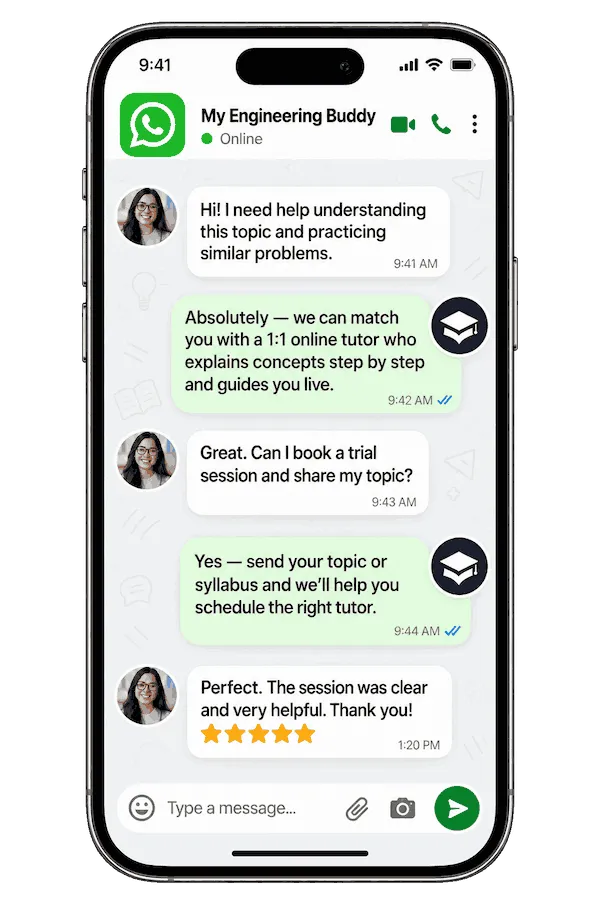
Unlike platforms where you fill out a form and wait, MEB responds in under a minute, 24/7. Tutor match takes under an hour. The $1 trial means you test before you commit. Everything runs over WhatsApp — no logins, no intake forms.
Pricing Guide
Undergraduate HPC tutoring runs $20–$40/hr. Graduate-level support — covering research-grade CUDA optimisation, MPI tuning for large-scale simulations, or cluster job scheduling for thesis work — runs up to $100/hr. Rate factors include your course level, the specific tools involved, your deadline, and tutor availability.
For students targeting top research programmes at institutions like ETH Zürich, MIT, or Imperial College London, tutors with active HPC research backgrounds are available at higher rates — share your specific project goal and MEB will match the right tier.
Availability tightens significantly around end-of-semester submission windows. Book before your deadline becomes urgent.
Start with the $1 trial — 30 minutes, no registration, no commitment. WhatsApp MEB for a quick quote.
MEB has been running since 2008. That’s 18 years of matching students to the right tutor for technically demanding subjects — including HPC, where the gap between knowing C++ and knowing parallel C++ is large enough to fail a module.
Source: My Engineering Buddy, 2008–2025.
FAQ
Is HPC hard?
Yes — more than most CS modules. Students who are strong in sequential programming still struggle because parallel thinking requires a completely different mental model. Race conditions, deadlocks, and memory hierarchy effects don’t appear in standard programming courses. Most students need structured guidance to build that model reliably.
How many sessions do I need?
For a single stuck point — a deadlocking MPI program or a failing OpenMP assignment — one to two sessions often resolves it. To build solid course-wide competence across parallelism, architecture, and profiling, most students use 8–15 sessions spread over the semester.
Can you help with homework and assignments?
MEB tutoring is guided learning — you understand the work, then submit it yourself. The tutor explains the concept, walks through a similar example, and checks your reasoning. See our Academic Integrity policy and Why MEB page for full details on what we help with and what we don’t.
Will the tutor match my exact syllabus or exam board?
Yes. Share your course outline or assignment brief before the first session. MEB matches tutors to your specific university module, programming environment, and tools — not a generic HPC curriculum. CUDA-heavy courses get CUDA-experienced tutors; MPI-heavy courses get MPI-experienced tutors.
What happens in the first session?
The tutor runs a diagnostic — asking you to explain a concept or walk through a piece of code — to locate exactly where your understanding breaks down. The rest of the session works on that specific gap. You’ll leave with a concrete task and a clear plan for the next session.
Is online tutoring as effective as in-person?
For HPC, online is often better. Screen sharing lets the tutor see your actual code, your cluster output, and your error messages in real time. The digital pen-pad handles diagrams and execution traces as clearly as a whiteboard. No travel, no scheduling friction.
What’s the difference between MPI and OpenMP, and which one will my tutor cover?
MPI handles distributed-memory parallelism across separate processes, typically across cluster nodes. OpenMP handles shared-memory parallelism using threads within a single node. Most HPC courses cover both. Your MEB tutor covers whichever your course requires — or both, if your assignment uses a hybrid model.
Can MEB help me debug code that runs on a university HPC cluster I can’t share access to?
Yes. You share your screen showing the code, the job script, and the cluster output or error log. The tutor works from what’s visible — diagnosing the issue, explaining the fix, and walking you through testing it yourself. No direct cluster access is needed on the tutor’s side.
Do you offer group HPC sessions?
No. MEB sessions are 1:1 only. HPC problems are specific enough — your code, your cluster configuration, your assignment constraints — that group sessions aren’t effective. Every session is calibrated to one student’s exact situation.
How do I find an HPC tutor in my city?
You don’t need to. MEB sessions run entirely online via Google Meet. Students in New York, London, Dubai, Sydney, and Toronto all get the same quality of 1:1 HPC tutoring. Time zone matching means your session fits your schedule regardless of location.
Can you help with GPU programming and CUDA specifically?
Yes. CUDA tutoring covers kernel writing, thread hierarchy, shared memory usage, warp divergence, and performance profiling with Nsight. Tutors with GPU programming backgrounds are available for both introductory CUDA coursework and research-grade GPU optimisation projects.
How do I get started?
WhatsApp MEB — share your course or assignment brief, your deadline, and your time zone. MEB matches you with a verified HPC tutor, usually within a few hours. The first session is the $1 trial: 30 minutes of live tutoring that also serves as your diagnostic.
Trust & Quality at My Engineering Buddy
Every MEB tutor goes through subject-specific vetting — not a general aptitude screen. For HPC, that means demonstrating working knowledge of parallel programming models, memory hierarchy, and the specific tools used in university courses. Tutors complete a live demo evaluation before being matched to students, and ongoing session feedback is reviewed to maintain quality. Rated 4.8/5 across 40,000+ verified reviews on Google. MEB has been operating since 2008 — 18 years of subject-specific tutor matching across technically demanding fields.
MEB tutoring is guided learning — you understand the work, then submit it yourself. For full details on what we help with and what we don’t, read our Academic Integrity policy and Why MEB.
MEB serves students across the US, UK, Canada, Australia, the Gulf, and Europe in 2,800+ subjects. Within Computer Science, the platform covers everything from operating systems tutoring and concurrent programming help to advanced HPC and quantum computing tutoring. The IET — the Institution of Engineering and Technology — recognises HPC as a core competency area in professional engineering and computing, underscoring the field’s importance at both academic and industry levels.
MEB tutors are matched to your specific HPC stack — SLURM job scripts, OpenMPI collectives, CUDA kernels — not assigned from a general CS pool. That specificity is why the sessions work where generic tutoring doesn’t.
Source: My Engineering Buddy, 2008–2025.
Try your first session for $1 — 30 minutes of live 1:1 tutoring or one homework question explained in full. No registration. No commitment. WhatsApp MEB now and get matched within the hour.
Explore Related Subjects
Students studying HPC often also need support in:
- Distributed algorithms
- Systems programming
- Memory management and allocation
- Computer organisation and architecture
- Cloud computing
- Data structures and algorithms
- Graph algorithms
Next Steps
Getting started takes less than two minutes.
- Share your exam board or course outline, the specific topic or assignment you’re stuck on, and your deadline
- Share your availability and time zone
- MEB matches you with a verified HPC tutor — usually within a few hours
- The first session starts with a diagnostic so every minute is used on what actually matters
Before your first session, have ready: your course syllabus or assignment brief, any code you’ve already written along with the error output, and your exam or submission deadline. The tutor handles the rest.
Visit www.myengineeringbuddy.com for more on how MEB works.
WhatsApp to get started or email [email protected].
Reviewed by Subject Expert
This page has been carefully reviewed and validated by our subject expert to ensure accuracy and relevance.




