~1 min
Average Reply Time
~1 hour
To Be Matched With A Tutor
30 Min Trial
75% Find Their Tutor On The 1st Trial
$20-35+/hr
Premium Yet Affordable Learning
Hire The Best Discrete Optimization Tutor

Integer programming, branch-and-bound, combinatorics — and you’re three problem sets behind. That’s exactly who MEB built this for.
Discrete Optimization Tutor Online
Discrete Optimization is the mathematical study of finding the best solution from a finite or countable set of feasible options. It covers integer programming, combinatorial problems, graph theory, and algorithmic methods, equipping students to model and solve complex real-world decision problems.
MEB offers 1:1 online tutoring and homework help in 2800+ advanced subjects, including Discrete Optimization. If you’ve searched for a Discrete Optimization tutor near me, the sessions happen over Google Meet — live, screen-shared, with a digital pen-pad for worked problems. You get a tutor matched to your exact course level, whether that’s an undergraduate operations research module, a graduate combinatorial optimization course, or a specialist elective in integer programming. One focused session can close more ground than a week of solo reading.
- 1:1 online sessions tailored to your course syllabus and exam board
- Expert-verified tutors with graduate-level subject knowledge in discrete math and optimization
- Flexible time zones — US, UK, Canada, Australia, Gulf
- Structured learning plan built after a diagnostic session
- Ethical homework and assignment guidance — you understand the work before you submit
52,000+ students across the US, UK, Canada, Australia, and the Gulf have used MEB since 2008 — including students in Operations Research subjects like Discrete Optimization, Linear Programming, and Dynamic Programming.
Source: My Engineering Buddy, 2008–2025.
How Much Does a Discrete Optimization Tutor Cost?
Most Discrete Optimization tutoring sessions run $20–$40/hr. Graduate-level and specialist topics — such as advanced integer programming or NP-hard combinatorics — may reach up to $100/hr depending on tutor expertise and timeline. You can start with the $1 trial: 30 minutes of live 1:1 tutoring or one full homework question explained.
| Level / Need | Typical Rate | What’s Included |
|---|---|---|
| Undergraduate (most levels) | $20–$35/hr | 1:1 sessions, homework guidance |
| Graduate / Specialist | $35–$100/hr | Expert tutor, advanced depth |
| $1 Trial | $1 flat | 30 min live session or 1 homework question |
Tutor availability tightens significantly around end-of-semester exam periods and thesis submission windows. Book early if your deadline is within four weeks.
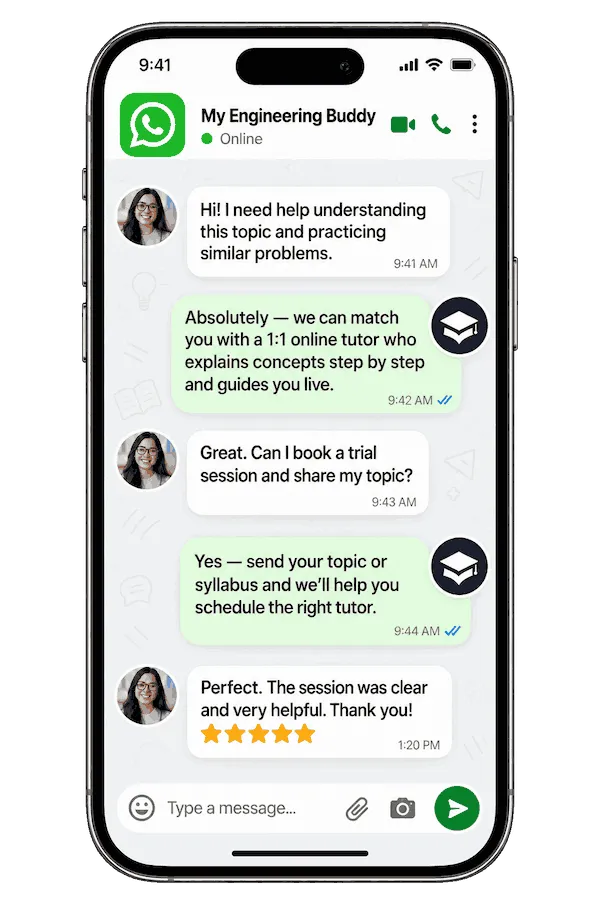
WhatsApp MEB for a quick quote — average response time under 1 minute.
Who This Discrete Optimization Tutoring Is For
Discrete Optimization sits at the intersection of mathematics, computer science, and engineering. It’s technically demanding, proof-heavy in places, and often assessed through problem sets that look nothing like what was covered in lectures. Most students who contact MEB are not failing — they’re competent but stuck on specific formulations or gap areas that compound quickly.
- Undergraduate students in operations research, industrial engineering, or applied mathematics who need help with linear programming tutoring, integer models, or graph algorithms
- Graduate students working through advanced combinatorial optimization, branch-and-price, or column generation
- Students retaking after a failed first attempt — particularly those who lost marks on LP relaxation proofs or branch-and-bound trees
- Students 4–6 weeks from their final exam with significant gaps still to close on NP-completeness or dynamic programming formulations
- Students at universities including MIT, Georgia Tech, Carnegie Mellon, University of Waterloo, Imperial College London, TU Delft, and ETH Zurich taking specialist optimization modules
- Anyone who needs structured help with dynamic programming help as a prerequisite or parallel course
At MEB, we’ve found that the students who struggle most with Discrete Optimization aren’t weak mathematicians — they’re students who never got a clear explanation of how LP relaxation and branch-and-bound connect. One session on that link alone often unlocks three or four topics they thought were separate problems.
1:1 Tutoring vs Self-Study vs AI vs YouTube vs Online Courses
Self-study works if you’re disciplined, but Discrete Optimization problem sets have a way of revealing exactly where your understanding breaks down — and a textbook won’t tell you why. AI tools give fast explanations but can’t watch you set up a branch-and-bound tree and catch the moment you branch on the wrong variable. YouTube covers theory well; it stops when you’re stuck on a specific integer formulation. Online courses move at a fixed pace regardless of whether you’ve actually understood cutting planes. 1:1 tutoring with MEB is live, calibrated to your exact syllabus, and corrects errors in the moment — which matters enormously in a subject where one misunderstood step propagates through an entire solution.
Outcomes: What You’ll Be Able To Do in Discrete Optimization
After working with an MEB tutor, students consistently report clearer command of the subject’s core techniques. You’ll be able to formulate integer programming models for real scheduling and routing problems, not just textbook examples. You’ll analyze LP relaxations correctly and explain why a given relaxation is tight or weak. Students learn to apply branch-and-bound systematically, including how to choose branching variables and interpret the resulting bounds. You’ll model combinatorial problems — bin packing, knapsack, set cover — and select the right algorithmic approach. You’ll also be able to explain NP-completeness arguments in written assignments without losing marks on logic gaps.
Based on feedback from 40,000+ sessions collected by MEB from 2022 to 2025, 58% of students improved by one full grade after approximately 20 hours of 1:1 tutoring in subjects like Discrete Optimization. A further 23% achieved at least a half-grade improvement.
Source: MEB session feedback data, 2022–2025.
Try your first session for $1 — 30 minutes of live 1:1 tutoring or one homework question explained in full. No registration. No commitment. WhatsApp MEB now and get matched within the hour.
What We Cover in Discrete Optimization (Syllabus / Topics)

Integer Programming and LP Relaxation
- Formulating integer linear programs (ILPs) from word problems and case scenarios
- LP relaxation: bounding, feasibility analysis, and integrality gaps
- Branch-and-bound: tree construction, node selection strategies, pruning rules
- Cutting plane methods: Gomory cuts, cover inequalities, valid inequalities
- Branch-and-cut frameworks and when to apply them
- Mixed-integer programming (MIP) models in scheduling and resource allocation
Recommended texts: Integer Programming by Laurence Wolsey; Linear and Integer Programming by Gary Shoup; Integer and Combinatorial Optimization by Nemhauser and Wolsey.
Combinatorial Optimization and Graph Algorithms
- Classic combinatorial problems: knapsack, bin packing, set cover, travelling salesman
- Minimum spanning tree algorithms: Kruskal’s, Prim’s, and correctness proofs
- Shortest path algorithms: Dijkstra, Bellman-Ford, and negative cycle detection
- Network flow: max-flow min-cut theorem, Ford-Fulkerson, applications
- Matching problems: bipartite matching, Hungarian algorithm, weighted matching
- Complexity: P vs NP, NP-completeness proofs, polynomial reductions
- Approximation algorithms and performance guarantees
Recommended texts: Combinatorial Optimization by Papadimitriou and Steiglitz; Algorithm Design by Kleinberg and Tardos; Introduction to Algorithms (CLRS).
Metaheuristics and Advanced Formulations
- Heuristic vs exact methods: when to use each and how to justify the choice
- Simulated annealing, tabu search, and local search frameworks
- Genetic algorithms tutoring as applied to combinatorial search spaces
- Lagrangian relaxation and subgradient optimization
- Column generation and Dantzig-Wolfe decomposition
- Constraint programming and its relationship to integer models — see also constraints tutoring
Recommended texts: Metaheuristics: From Design to Implementation by Talbi; In Pursuit of the Traveling Salesman by Cook; course notes from your specific programme.
What a Typical Discrete Optimization Session Looks Like
The tutor opens by checking the previous topic — usually LP relaxation quality or a branch-and-bound tree the student attempted independently. The student shares their screen or written work. The tutor identifies where the formulation broke down: often it’s a constraint that wasn’t modeled correctly, or a branching decision made without checking the LP bound first. Together, they work through a full integer programming problem on the digital pen-pad — the tutor writing the formulation step by step, asking the student to justify each constraint before moving on. Then the student replicates a similar problem from scratch while the tutor watches, catching errors in real time. The session closes with one or two practice problems set for independent work, and the next topic noted — often network flow or a combinatorial proof, depending on the course timeline.
How MEB Tutors Help You with Discrete Optimization (The Learning Loop)
Diagnose: In the first session, the tutor works through a short diagnostic — typically a mixed-integer formulation problem and one graph algorithm question. This identifies whether the gap is in LP theory, combinatorial intuition, algorithmic reasoning, or proof writing. The sequence of all subsequent sessions follows from this.
Explain: The tutor works problems live on the digital pen-pad, talking through each decision point. For branch-and-bound, this means showing exactly why a node is pruned, not just that it is. For NP-completeness, it means building the reduction argument step by step rather than presenting a finished proof.
Practice: The student attempts a problem with the tutor present — not after the session. This is where most platforms get it wrong. Errors that surface during practice are corrected immediately, before they calcify into habits.
Feedback: The tutor reviews the student’s reasoning at each step: which constraints were set up correctly, where the objective function lost marks, why the branching choice was suboptimal. Feedback is specific — “this constraint doesn’t enforce integrality” beats “check your formulation.”
Plan: Each session ends with a clear next topic and a specific practice task. If the student has a problem set due, that shapes the sequence. If they’re building toward a final exam, the tutor maps the remaining sessions against the syllabus gaps identified in the diagnostic.
Sessions run on Google Meet with a digital pen-pad or iPad and Apple Pencil. Before your first session, share your course syllabus or lecture notes, a recent problem set you struggled with, and your exam or assignment deadline. Start with the $1 trial — 30 minutes of live tutoring that also serves as your first diagnostic.
Students consistently tell us that Discrete Optimization clicked not when they memorised more formulas, but when they understood why branch-and-bound works — the logic of bounding and pruning, not the mechanics. That shift usually happens in the second or third session once the tutor has seen where the student’s mental model breaks down.
Tutor Match Criteria (How We Pick Your Tutor)
Match quality is the difference between a session that moves you forward and one that doesn’t. MEB matches on four criteria.
Subject depth: The tutor must hold graduate-level knowledge in discrete mathematics, combinatorial optimization, or a directly adjacent field. Teaching undergraduate integer programming requires more than surface familiarity — especially for topics like Gomory cuts or Dantzig-Wolfe decomposition.
Tools: Every session runs on Google Meet with a digital pen-pad or iPad and Apple Pencil. The tutor must be set up to write problems out live — Discrete Optimization cannot be taught adequately through slides alone.
Time zone: Matched to the student’s region — US, UK, Gulf, Canada, or Australia. No scheduling across more than a 3–4 hour gap unless the student requests it.
Goals: Whether the student needs exam-score improvement, help with a specific convex optimization overlap topic, conceptual depth for research, or assignment completion — the tutor’s prior session portfolio is checked for fit.
Unlike platforms where you fill out a form and wait, MEB responds in under a minute, 24/7. Tutor match takes under an hour. The $1 trial means you test before you commit. Everything runs over WhatsApp — no logins, no intake forms.
Study Plans (Pick One That Matches Your Goal)
After the first diagnostic session, the tutor builds a specific topic sequence. For students two to three weeks out from a final exam, the plan prioritises the highest-weighted topics — usually integer programming formulations and combinatorial algorithms — and cuts anything that won’t appear on the paper. For students with four to eight weeks, structured revision covers every major track with problem-set practice built in at each stage. Weekly ongoing support aligns to semester deadlines and coursework submissions, with the tutor adjusting the sequence as new material is introduced in lectures. The tutor handles the planning; you handle the work.
Pricing Guide
Discrete Optimization tutoring starts at $20/hr for most undergraduate course levels. Advanced topics — integer programming with Dantzig-Wolfe decomposition, graduate-level combinatorial complexity, or research-support sessions — are typically $50–$100/hr depending on tutor expertise and the depth of preparation required.
Rate factors include: course level, topic complexity, how much advance notice the tutor has, and whether the session is standalone or part of a structured multi-week plan.
Tutor availability tightens sharply in the four weeks before end-of-semester exams. If your deadline is approaching, reach out now rather than in week three of a five-week countdown.
For students targeting top graduate programmes in operations research, industrial engineering, or computer science — or preparing for research roles in combinatorial optimization — tutors with active research or industry backgrounds in mathematical programming are available at higher rates. Share your specific goal and MEB will match the tier to your ambition.
Start with the $1 trial — 30 minutes, no registration, no commitment. WhatsApp MEB for a quick quote.
MEB has been running since 2008. The $1 trial exists because we’d rather earn trust with 30 minutes of real tutoring than a polished sales pitch. 52,000+ students later, that’s still how we start every new relationship.
Source: My Engineering Buddy, 2008–2025.
FAQ
Is Discrete Optimization hard?
Yes — honestly harder than most students expect. The jump from continuous to integer optimization is conceptually steep. Branch-and-bound, NP-completeness proofs, and combinatorial formulations all require different thinking modes. Most students find it manageable once a tutor walks them through the logic rather than just the mechanics.
How many sessions are needed?
For a specific problem set or exam component, two to four sessions often closes the gap. For a full-semester module with multiple tracks — integer programming, graph algorithms, complexity — six to twelve sessions across eight weeks is more realistic. The diagnostic session clarifies what’s needed.
Can you help with homework and assignments?
Yes. MEB tutoring is guided learning — you understand the work, then submit it yourself. See our Academic Integrity policy and Why MEB page for full details on what we help with and what we don’t. The tutor explains the method; the solution you submit is yours.
Will the tutor match my exact syllabus or exam board?
Yes. Before matching, MEB asks for your course name, university, and the specific topics causing difficulty. Tutors are matched based on that detail — not assigned generically. A tutor who knows your programme’s specific formulation style will save significant time.
What happens in the first session?
The first session is a diagnostic. The tutor works through one or two problems with you, identifies where your reasoning breaks down — LP relaxation, branching logic, or graph algorithm application — then maps remaining sessions to address those gaps in priority order.
Is online tutoring as effective as in-person?
For a mathematical subject like Discrete Optimization, yes — the digital pen-pad replicates the whiteboard experience closely. The tutor writes formulations and trees live on screen. Students who’ve tried both consistently report the online format works equally well once they’ve had one session to get comfortable with it.
What’s the difference between branch-and-bound and branch-and-cut, and do MEB tutors cover both?
Branch-and-bound uses LP bounds alone to prune the tree. Branch-and-cut adds cutting planes — Gomory cuts, cover inequalities — to tighten the relaxation before branching. Both are covered in MEB sessions. The tutor explains when each method is appropriate and how to implement the logic in problem-set answers.
My course uses a specific solver — CPLEX, Gurobi, or GLPK. Can tutors help with that?
Yes. MEB tutors with applied optimization backgrounds can work through solver-specific formulation problems, help you interpret solver output, and explain why a model might be running slowly or returning unexpected results. Mention the solver when you contact MEB so the right tutor is assigned.
Can I get Discrete Optimization help at midnight or on weekends?
Yes. MEB operates 24/7 across time zones. Late-night availability is common for students in the US, UK, and Gulf regions. WhatsApp MEB at any hour — average first response is under one minute, and tutor matching typically happens within the hour.
What if I don’t connect with my assigned tutor?
Tell MEB on WhatsApp and a different tutor is assigned — no friction, no explanation required. The $1 trial exists partly for this reason: it’s a genuine test session, not a commitment. If the fit isn’t right, you haven’t lost anything significant.
How do I get started?
Three steps. WhatsApp MEB with your course name, current topic, and deadline. MEB matches you with a verified tutor — usually within the hour. Your first session is the $1 trial: 30 minutes of live 1:1 tutoring or one full homework question explained from start to finish.
Trust & Quality at My Engineering Buddy
Every MEB tutor goes through a subject-specific screening process that includes credential verification, a live demo session assessed for pedagogical clarity, and ongoing review based on student feedback. Tutors covering Discrete Optimization hold graduate degrees in operations research, applied mathematics, computer science, or industrial engineering — and are matched only to sessions where their specific depth aligns to the student’s course level. Rated 4.8/5 across 40,000+ verified reviews on Google.
MEB tutoring is guided learning — you understand the work, then submit it yourself. For full details on what we help with and what we don’t, read our Academic Integrity policy and Why MEB.
MEB has served 52,000+ students across the US, UK, Canada, Australia, the Gulf, and Europe since 2008, covering 2,800+ advanced subjects. Within Operations Research, MEB covers Discrete Optimization alongside subjects including decision modelling tutoring, MCDA/MCDM tutoring, and Simplex Method tutoring. The platform is built around one principle: a student who understands the material submits better work than one who doesn’t — and that understanding is what MEB tutors are here to build. See our tutoring methodology for how sessions are structured.
Our experience across thousands of sessions shows that Discrete Optimization students who book within the first two weeks of struggling — not the last two days before the exam — achieve materially better results. Starting early gives the tutor room to diagnose, correct, and build. Starting late means triage. Both work. One works better.
Explore Related Subjects
Students studying Discrete Optimization often also need support in:
Next Steps
Before your first session, have ready: your course syllabus or lecture outline, a recent problem set or assignment you struggled with, and your exam or deadline date. The tutor handles the rest.
- Share your exam board or university course name, the hardest topic, and your current timeline
- Share your availability and time zone
- MEB matches you with a verified Discrete Optimization tutor — usually within 24 hours
The first session starts with a diagnostic so every minute is used well. There’s no intake form, no waiting room, no delay.
Visit www.myengineeringbuddy.com for more on how MEB works.
WhatsApp to get started or email [email protected].
Reviewed by Subject Expert
This page has been carefully reviewed and validated by our subject expert to ensure accuracy and relevance.