~1 min
Average Reply Time
~1 hour
To Be Matched With A Tutor
30 Min Trial
75% Find Their Tutor On The 1st Trial
$20-35+/hr
Premium Yet Affordable Learning
Psychiatry papers stack up fast. DSM criteria, neuropharmacology, case vignettes — and most students hit a wall weeks before finals with no one to ask.
Psychiatry Tutor Online
Psychiatry is the branch of medicine focused on diagnosing, treating, and preventing mental, emotional, and behavioural disorders, equipping students to apply clinical frameworks such as DSM-5 and ICD-11 across assessment, pharmacology, and therapeutic practice.
MEB offers 1:1 online Neuroscience and psychiatry tutoring and academic guidance across 2,800+ advanced subjects. If you’ve searched for a Psychiatry tutor near me and found only generic platforms with slow response times, MEB works differently — verified tutors, matched within the hour, starting at $20/hr. You get a structured session plan after a diagnostic, not a one-size-fits-all lesson.
- 1:1 online sessions tailored to your course, exam board, and clinical rotation schedule
- Expert-verified tutors with psychiatry-specific academic and clinical backgrounds
- Flexible time zones — sessions available for students in the US, UK, Canada, Australia, and the Gulf
- Structured learning plan built after a first diagnostic session
- Ethical academic guidance — you understand the work, then submit it yourself
52,000+ students across the US, UK, Canada, Australia, and the Gulf have used MEB since 2008 — including students in Neuroscience subjects like Psychiatry, Cognitive Neuroscience, and Neurochemistry.
Source: My Engineering Buddy, 2008–2025.
How Much Does a Psychiatry Tutor Cost?
Rates run $20–$40/hr for most undergraduate and postgraduate psychiatry levels. Specialist clinical or research-focused sessions can reach up to $100/hr. Not sure if it’s worth it yet? Start with the $1 trial — 30 minutes of live 1:1 tutoring or one full homework question explained.
| Level / Need | Typical Rate | What’s Included |
|---|---|---|
| Undergraduate (Years 1–3) | $20–$35/hr | 1:1 sessions, homework guidance, case study review |
| Clinical Years / Postgraduate | $35–$70/hr | Expert tutor, clinical vignette prep, research support |
| $1 Trial | $1 flat | 30 min live session or one full homework question explained |
Tutor availability tightens around USMLE Step prep windows and end-of-year clinical assessment periods. Book early if you’re in a peak cycle.
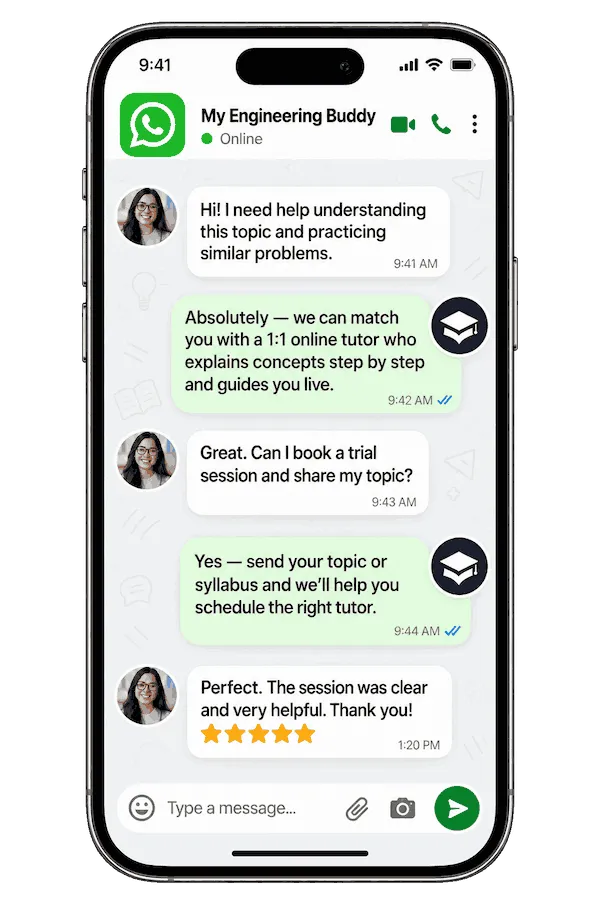
WhatsApp MEB for a quick quote — average response time under 1 minute.
Who This Psychiatry Tutoring Is For
This is for medical and psychology students who are stuck on something specific — not students who want someone to read slides at them. If you can name the topic causing the problem, MEB can find a tutor who knows it cold.
- Medical students preparing for USMLE Step 1 or Step 2 psychiatry sections
- Psychology undergraduates at universities like Columbia, UCL, University of Toronto, University of Melbourne, and ANU struggling with abnormal psychology or psychopathology modules
- Students retaking after a failed first attempt at clinical placements or written exams
- Graduate students in clinical psychology or psychiatry residency programmes needing research and case analysis support
- Students with a conditional university offer that depends on passing a psychiatry-heavy module this semester
- Parents watching a student’s confidence drop week by week as the OSCE or written finals approach
At MEB, we’ve found that students who struggle with psychiatry often know the diagnosis names — they just can’t apply the criteria under exam conditions. That gap between recognition and application is exactly where 1:1 tutoring closes the distance fastest.
1:1 Tutoring vs Self-Study vs AI vs YouTube vs Online Courses
Self-study works if you’re disciplined, but psychiatry’s overlapping diagnostic criteria make it easy to miss distinctions you won’t know you’ve missed. AI tools give fast definitions — they can’t tell you why you keep confusing Bipolar I with Schizoaffective Disorder on vignettes. YouTube covers the basics well and stops there. Online courses are structured but fixed-pace, with no one to catch your specific reasoning errors. With MEB, a psychiatry tutor works through your actual mistakes in real time — DSM differential logic, psychopharmacology mechanisms, mental state examination — calibrated to your exact course and exam format.
Outcomes: What You’ll Be Able To Do in Psychiatry
After consistent 1:1 sessions, you’ll be able to apply DSM-5 and ICD-11 diagnostic criteria accurately across clinical vignettes without confusing overlapping presentations. You’ll explain the mechanism of action of major psychotropic drug classes — SSRIs, antipsychotics, mood stabilisers — in enough depth to answer both MCQ and short-answer exam questions. You’ll analyse a psychiatric case history, identify risk factors, and present a structured management plan. You’ll write reflective clinical reports that meet the standards expected at your programme level.
Based on feedback from 40,000+ sessions collected by MEB from 2022 to 2025, 58% of students improved by one full grade after approximately 20 hours of 1:1 tutoring in subjects like Psychiatry. A further 23% achieved at least a half-grade improvement.
Source: MEB session feedback data, 2022–2025.
Try your first session for $1 — 30 minutes of live 1:1 tutoring or one homework question explained in full. No registration. No commitment. WhatsApp MEB now and get matched within the hour.
What We Cover in Psychiatry (Syllabus / Topics)

Clinical Psychiatry & Diagnosis
- DSM-5 and ICD-11 diagnostic frameworks — criteria, specifiers, exclusions
- Differential diagnosis for mood disorders: Major Depressive Disorder, Bipolar I and II, Cyclothymia
- Psychotic disorders: Schizophrenia spectrum, Schizoaffective Disorder, Brief Psychotic Disorder
- Anxiety disorders, OCD spectrum, trauma-related conditions including PTSD
- Personality disorders — Cluster A, B, C presentations and diagnostic pitfalls
- Neurodevelopmental conditions: ADHD, Autism Spectrum Disorder, across the lifespan
- Mental state examination (MSE) — structure, documentation, clinical communication
Core texts include DSM-5-TR (APA), Gelder’s Oxford Textbook of Psychiatry, and Sadock’s Kaplan & Sadock’s Synopsis of Psychiatry.
Psychopharmacology
- Mechanism of action: SSRIs, SNRIs, TCAs, MAOIs — receptor-level pharmacology
- Antipsychotics: typical vs atypical, dopamine pathways, side-effect profiles
- Mood stabilisers: lithium pharmacokinetics, valproate, lamotrigine monitoring
- Anxiolytics and hypnotics: benzodiazepine mechanisms, risks, alternatives
- Drug interactions and contraindications relevant to clinical prescribing contexts
- Evidence base for pharmacological vs psychotherapeutic approaches by disorder
Recommended texts: Stahl’s Essential Psychopharmacology, Rang & Dale’s Pharmacology, and the Maudsley Prescribing Guidelines.
Psychological Therapies & Research Methods
- CBT theory and application — cognitive model, behavioural activation, exposure hierarchies
- Psychodynamic approaches, attachment theory, and their clinical evidence base
- DBT, ACT, and third-wave therapies — principles and target populations
- Research design in psychiatry: RCTs, systematic reviews, outcome measures
- Ethics in psychiatric research: consent, capacity, confidentiality
- Critical appraisal of psychiatric literature for essay and dissertation work
Key references: Beck’s Cognitive Therapy of Depression, APA’s Publication Manual, and the BMJ Best Practice clinical decision resource.
What a Typical Psychiatry Session Looks Like
The tutor opens by reviewing the previous session — often a psychopharmacology mechanism or a differential diagnosis the student was shaky on. From there, the student and tutor work through a clinical vignette together on screen: the tutor uses a digital pen-pad to annotate the DSM criteria in real time while the student talks through their reasoning aloud. When the reasoning breaks down — say, confusing the diagnostic hierarchy for Schizoaffective Disorder — the tutor stops, resets the logic, and has the student try a parallel case immediately. The session closes with one practice vignette the student works through independently before the next meeting, and the next topic is logged so no session starts cold.
How MEB Tutors Help You with Psychiatry (The Learning Loop)
Diagnose: In the first session, the tutor identifies exactly where your reasoning breaks down — not just what you got wrong, but whether the error is in diagnostic criteria recall, clinical reasoning sequencing, or pharmacology application. Most students are surprised how specific the gaps turn out to be.
Explain: The tutor works through live problems using a digital pen-pad. For psychiatry, this means annotating case vignettes, drawing out neurotransmitter pathways, and building differential diagnosis trees on screen so you can see the logic, not just the answer.
Practice: You attempt the next case with the tutor present. Not later. Right there. This is where the learning actually happens — the first attempt under real pressure, with support available if you freeze.
Feedback: The tutor goes through your reasoning step by step, identifying where marks were lost and why. In psychiatry, one misread specifier in a vignette can flip an entire diagnosis. That precision matters and the feedback reflects it.
Plan: Each session ends with a clear next topic, a practice task, and an accountability checkpoint. No vague “review your notes.” Specific, sequenced, tracked.
Sessions run on Google Meet. The tutor uses a digital pen-pad or iPad with Apple Pencil. Before your first session, have your course syllabus or exam board specification ready, along with any past papers or assignments you’ve struggled with. The $1 trial — 30 minutes live — also serves as your first diagnostic. Whether you need a two-week catch-up before an OSCE, structured revision over six weeks for a written final, or ongoing weekly support through the clinical year, the tutor maps the session plan after that first conversation.
Students consistently tell us that psychiatry feels easier to study once someone shows them the decision tree rather than the definition. The diagnostic logic in DSM-5 is structured — once you see the hierarchy clearly, the criteria stop feeling like a list to memorise.
Tutor Match Criteria (How We Pick Your Tutor)
MEB matches on four criteria, in this order.
Subject depth: The tutor must have worked at your specific level — undergraduate clinical years, postgraduate psychiatry programmes, or USMLE Step preparation. A general psychology background is not enough for clinical psychopathology or Neurophysiology overlap topics.
Tools: Every MEB psychiatry tutor works on Google Meet with a digital pen-pad or iPad and Apple Pencil. Annotating a vignette in real time is not optional for this subject.
Time zone: Matched to your region — US, UK, Gulf, Canada, or Australia. No 3am sessions unless you want them.
Goals: Exam score targets, conceptual depth for clinical placements, homework completion, or dissertation research support. The tutor brief changes depending on what you actually need.
Unlike platforms where you fill out a form and wait, MEB responds in under a minute, 24/7. Tutor match takes under an hour. The $1 trial means you test before you commit. Everything runs over WhatsApp — no logins, no intake forms.
Pricing Guide
Standard psychiatry tutoring runs $20–$40/hr. Postgraduate clinical, research, and USMLE-focused sessions with specialist tutors go up to $100/hr. Rate factors include your level, topic complexity, how close your exam date is, and tutor availability in your time zone.
For students targeting top medical schools at Johns Hopkins, Imperial College London, University of Edinburgh, McGill, or the University of Sydney, tutors with clinical psychiatry or research backgrounds are available at higher rates — share your specific goal and MEB will match the tier to your target.
Availability tightens during USMLE Step windows, OSCE seasons, and university finals periods. Start with the $1 trial — 30 minutes, no registration, no commitment. WhatsApp MEB for a quick quote.
MEB has been matching students with verified subject tutors since 2008. Response time under one minute. First session starts for $1. No intake forms, no waiting list — just WhatsApp.
Source: My Engineering Buddy, 2008–2025.
FAQ
Is Psychiatry hard?
Psychiatry is demanding because overlapping diagnostic criteria require precise clinical reasoning, not just memorisation. Students who struggle most are usually applying criteria in isolation rather than working through the diagnostic hierarchy. That’s a fixable problem with the right guidance.
How many sessions are needed?
Most students see clear improvement in 8–12 sessions of focused 1:1 work. Students with significant gaps before a major exam often need 15–20 hours. The tutor sets a realistic target after the first diagnostic session — not before.
Can you help with homework and assignments?
Yes. MEB tutoring is guided learning — you understand the work, then submit it yourself. See our Academic Integrity policy and Why MEB page for full details on what we help with and what we don’t.
Will the tutor match my exact syllabus or exam board?
Yes. Whether you’re following a UK MedSci programme, a North American psychiatry clerkship, or an IB/A Level Psychology syllabus with a psychiatry component, the tutor is briefed on your specific course materials before the first session.
What happens in the first session?
The tutor runs a short diagnostic — usually a clinical vignette or concept explanation — to locate your specific gaps. From there, a session plan is built. No generic introduction, no wasted time. The $1 trial is also this first diagnostic session.
Is online tutoring as effective as in-person?
For psychiatry, yes — and in some ways better. Annotating vignettes on screen, building diagnostic trees live, and sharing DSM documents in real time works well on Google Meet. Most MEB students prefer it after the first session.
Can I get Psychiatry help at midnight or on weekends?
Yes. MEB operates 24/7. WhatsApp response time is under a minute at most hours. Tutors are matched across time zones, so a midnight session in New York, London, or Dubai is a regular part of how MEB works.
What if I don’t get along with my assigned tutor?
Tell MEB on WhatsApp. A replacement match happens quickly — usually within the same day. No awkward cancellation process. You’re not locked in to any tutor after the trial session.
How do I distinguish between similar psychiatric diagnoses on an exam?
This is one of the most common problems MEB tutors solve in psychiatry. The key is working through the diagnostic decision tree systematically — duration criteria, exclusion rules, and specifiers — rather than comparing symptom lists side by side. One focused session on differential logic makes a measurable difference.
Does MEB cover USMLE Step 1 and Step 2 psychiatry content specifically?
Yes. MEB tutors with USMLE experience cover the Behavioural Sciences and Psychiatry sections for Step 1, and the full psychiatry clerkship content for Step 2 CK — including high-yield pharmacology, ethics scenarios, and clinical vignette strategy.
Do you offer group Psychiatry sessions?
MEB focuses on 1:1 tutoring. Group sessions are not offered. The personalisation — tutors adapting to your specific diagnostic reasoning gaps — only works one-to-one.
How do I get started?
Start with the $1 trial — 30 minutes of live 1:1 tutoring or one full question explained. Three steps: WhatsApp MEB, get matched with a psychiatry tutor within the hour, start your trial session. No registration required.
Trust & Quality at My Engineering Buddy
Every MEB tutor goes through subject-specific screening — academic credentials, a live demo session review, and ongoing feedback evaluation. For psychiatry, that means tutors with clinical psychology degrees, medical training, or graduate-level psychiatry research backgrounds. Not generalists. Rated 4.8/5 across 40,000+ verified reviews on Google, MEB has been running since 2008 with 52,000+ students served across the US, UK, Canada, Australia, and the Gulf.
MEB tutoring is guided learning — you understand the work, then submit it yourself. For full details on what we help with and what we don’t, read our Academic Integrity policy and Why MEB.
MEB covers 2,800+ subjects in Neuroscience and related disciplines. Students working on Neuroimaging tutoring alongside psychiatry coursework regularly use MEB for both. Students in Neuroanatomy help and those studying Neurosurgery tutoring at postgraduate level have found the platform equally well-matched. The MEB tutoring methodology applies across all of them — diagnostic first, then structured sessions, then review.
Our experience across thousands of psychiatry sessions shows that students who share their actual past paper attempts before the first session make faster progress. It gives the tutor a starting point that’s specific — not a guess at what you need.
Explore Related Subjects
Students studying Psychiatry often also need support in:
Next Steps
Before your first session, have ready: your exam board and syllabus (or course outline), a recent past paper attempt or homework you struggled with, and your exam or deadline date. The tutor handles the rest.
- Share your exam board or programme, your hardest psychiatry topic, and your current timeline
- Share your availability and time zone
- MEB matches you with a verified psychiatry tutor — usually within 24 hours, often within the hour
Your first session starts with a diagnostic so every minute is used well. Visit www.myengineeringbuddy.com for more on how MEB works.
WhatsApp to get started or email [email protected].
Reviewed by Subject Expert
This page has been carefully reviewed and validated by our subject expert to ensure accuracy and relevance.