




~1 min
Average Reply Time
~1 hour
To Be Matched With A Tutor
30 Min Trial
75% Find Their Tutor On The 1st Trial
$20-35+/hr
Premium Yet Affordable Learning
Hire The Best Puppet DevOps Tutor

Your Puppet manifests keep drifting from production. Your CI/CD pipeline breaks at the module boundary. You’ve read the docs three times.
Puppet DevOps Tutor Online
Puppet DevOps is an infrastructure automation discipline using the Puppet configuration management tool to define, enforce, and manage system states across servers and environments, equipping practitioners to build repeatable, version-controlled infrastructure pipelines.
MEB connects you with a specialist Puppet DevOps tutor online who has worked with Puppet in real infrastructure environments — not just read about it. If you’ve searched for a Puppet DevOps tutor near me and found generic results, MEB offers 1:1 sessions built around your exact stack, your course syllabus, or your certification goal. We cover software engineering and its applied tooling at every level, from foundations through to enterprise-scale deployment. One session that connects the theory to your actual environment can change how everything clicks.
- 1:1 online sessions tailored to your specific Puppet version, module structure, and environment
- Expert-verified tutors with hands-on Puppet and DevOps infrastructure experience
- Flexible time zones — US, UK, Canada, Australia, Gulf covered 24/7
- Structured learning plan built after a diagnostic session that identifies your exact gaps
- Guided project support — we explain how Puppet resources, catalogs, and Hiera work; you build the solution
52,000+ students across the US, UK, Canada, Australia, and the Gulf have used MEB since 2008 — including students in Software Engineering subjects like Puppet DevOps, Ansible, Terraform, and Jenkins.
Source: My Engineering Buddy, 2008–2025.
How Much Does a Puppet DevOps Tutor Cost?
Most Puppet DevOps tutoring sessions run $20–$40/hr. Niche enterprise-level work — Puppet Enterprise architecture, large-scale node classification, custom fact development — can reach higher rates. The $1 trial gets you 30 minutes of live 1:1 tutoring or a full explanation of one specific problem you’re stuck on.
| Level / Need | Typical Rate | What’s Included |
|---|---|---|
| Standard (course or certification prep) | $20–$35/hr | 1:1 sessions, guided project support |
| Advanced / Puppet Enterprise specialist | $35–$70/hr | Expert tutor, production-level scenarios |
| $1 Trial | $1 flat | 30 min live session or 1 technical question fully explained |
Tutor availability tightens during university project deadlines and DevOps certification exam windows. Book early if you have a fixed date.
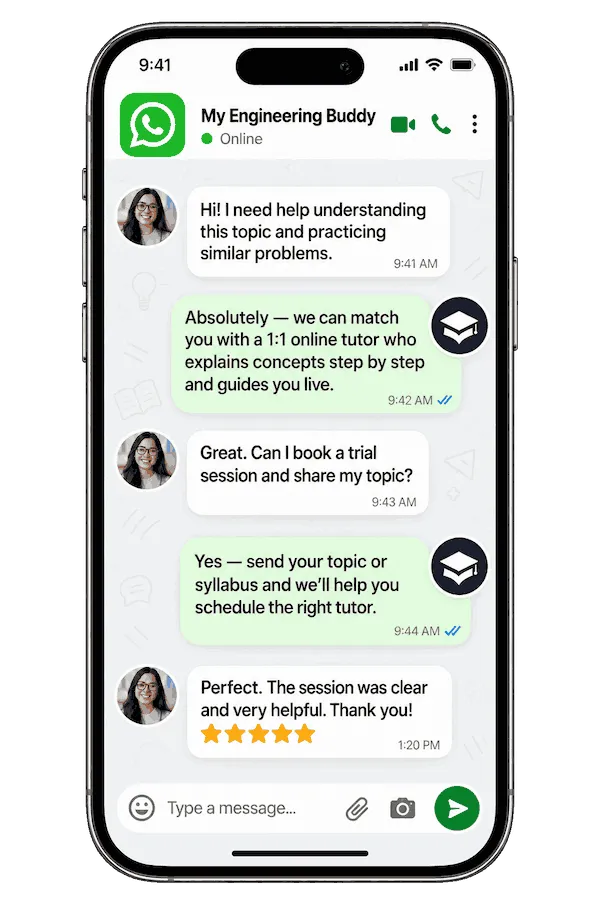
WhatsApp MEB for a quick quote — average response time under 1 minute.
Who This Puppet DevOps Tutoring Is For
Puppet DevOps sits at the intersection of system administration, software development, and cloud infrastructure. The learning curve is real — and it’s steeper if your background is purely theoretical.
- Undergraduate and graduate students taking DevOps, cloud computing, or infrastructure-as-code modules
- Professionals working toward the Puppet Practitioner or Puppet Professional certification
- Engineers who understand the concept of infrastructure-as-code but are getting lost in Puppet’s declarative model, catalog compilation, or Hiera hierarchy
- Students who attempted a Puppet project, got it partially working, and can’t isolate why nodes aren’t converging
- Students who failed a DevOps or infrastructure module on the first attempt and need targeted help before the resit
- Teams at Carnegie Mellon, Georgia Tech, University of Toronto, University of Melbourne, ETH Zurich, Imperial College London, and similar institutions where DevOps tooling features in software engineering programmes
If you’re a student who has a conditional university offer or a job offer contingent on passing a DevOps certification, that’s exactly the situation MEB is built for. Start with the $1 trial — it costs less than a coffee and shows you exactly how the sessions work.
At MEB, we’ve found that the biggest gap for Puppet learners isn’t syntax — it’s the mental model. Students who understand how the Puppet agent/master cycle actually works, how catalogs are compiled, and why idempotency matters write better manifests and debug faster. One session on that model is often worth more than a week of reading docs.
1:1 Tutoring vs Self-Study vs AI vs YouTube vs Online Courses
Self-study works if you’re disciplined, but Puppet’s error messages are notoriously cryptic — no feedback loop means small misconceptions compound. AI tools explain Puppet concepts quickly but can’t watch you debug a broken module in real time or tell you why your node isn’t applying the catalog. YouTube covers Puppet installation and basic manifests well; it stops short when your specific node classification or Hiera lookup is failing. Online courses give you structured Puppet content at a fixed pace with no room for your actual environment. 1:1 tutoring with MEB is live, calibrated to your exact Puppet version and project structure, and corrects errors the moment they appear — including the ones you didn’t know you were making.
Outcomes: What You’ll Be Able To Do in Puppet DevOps
After focused 1:1 sessions with an online Puppet DevOps tutor, you’ll be able to write and debug Puppet manifests that enforce consistent node state across environments, apply Hiera data lookups correctly to separate configuration data from code, explain catalog compilation and why a resource declaration isn’t being applied as expected, build reusable Puppet modules with defined resource types and parameterised classes, and present a working CI/CD integration that triggers Puppet runs on infrastructure change. These aren’t general DevOps skills — they’re specific Puppet competencies that employers and certification examiners test for directly.
Based on feedback from 40,000+ sessions collected by MEB from 2022 to 2025, 58% of students improved by one full grade after approximately 20 hours of 1:1 tutoring in subjects like Puppet DevOps. A further 23% achieved at least a half-grade improvement.
Source: MEB session feedback data, 2022–2025.
Try your first session for $1 — 30 minutes of live 1:1 tutoring or one homework question explained in full. No registration. No commitment. WhatsApp MEB now and get matched within the hour.
What We Cover in Puppet DevOps (Syllabus / Topics)

Track 1: Puppet Fundamentals and Resource Model
- Puppet architecture: agent/master model, PuppetDB, certificate authority
- Resources, types, and providers — the core abstraction layer
- Manifests, catalogs, and the compilation pipeline
- Classes, defined types, and module structure
- Variables, conditionals, and iteration with each()
- Ordering and dependency management: before, require, notify, subscribe
- Writing idempotent resources and testing convergence
Recommended references: Puppet Best Practices by Chris Barbour & Jo Rhett (O’Reilly); Pro Puppet by Spencer Krum et al.
Track 2: Hiera, Roles, Profiles, and Module Design
- Hiera 5 hierarchy configuration and data lookups
- Separating data from code using YAML backends
- Roles and profiles pattern for scalable node classification
- Parameterised classes and data binding
- Puppet Forge: consuming, evaluating, and wrapping community modules
- Custom facts with Facter and structured facts
- Testing modules with PDK (Puppet Development Kit) and rspec-puppet
Recommended references: Puppet Best Practices (O’Reilly); Puppet official documentation at puppet.com.
Track 3: CI/CD Integration, Puppet Enterprise, and Production Operations
- Integrating Puppet with Jenkins and GitLab CI/CD pipelines
- Code Manager and r10k for environment branching
- Puppet Enterprise console: node groups, RBAC, reporting
- Orchestration with Puppet Tasks and Plans (Bolt)
- Monitoring Puppet runs with reports, Puppet Explorer, and Datadog
- Scaling Puppet: compile masters, load balancing, PuppetDB tuning
- Migrating from Puppet 5/6 to Puppet 7/8 — breaking changes and upgrade paths
Recommended references: Puppet Enterprise documentation; Infrastructure as Code by Kief Morris (O’Reilly).
Platforms, Tools & Textbooks We Support
Puppet DevOps work happens across a specific set of tools and environments. MEB tutors are familiar with all of the following and can work through problems in your actual setup:
- Puppet Open Source (Puppet 7, Puppet 8) and Puppet Enterprise
- PDK (Puppet Development Kit) for module scaffolding and testing
- r10k and Code Manager for environment management
- Puppet Bolt for agentless task execution
- Docker and Kubernetes environments where Puppet manages host-level configuration
- Amazon Web Services (AWS), Microsoft Azure, and Google Cloud Platform (GCP) as underlying infrastructure
- Linux distributions: CentOS, Red Hat, Ubuntu
- Git and GitLab for version-controlled Puppet code
- Communications of the ACM — relevant to peer-reviewed DevOps and infrastructure-as-code research: Communications of the ACM
What a Typical Puppet DevOps Session Looks Like
The tutor opens by checking where you left off — usually the Hiera hierarchy you were debugging or the module you were trying to refactor. From there, you pull up your actual Puppet code on screen. The tutor walks through the catalog compilation path with you, pointing out where a resource ordering issue or a missing data key is causing the agent run to fail. You replicate the fix yourself while explaining the logic out loud — the tutor corrects in real time if the reasoning drifts. By the end of the session, you have a working change and a concrete practice task: write a parameterised class for a second service using the same pattern, test it with PDK, and note where the rspec assertions break.
How MEB Tutors Help You with Puppet DevOps (The Learning Loop)
Diagnose: In the first session, the tutor asks you to walk through a manifest or explain why a node isn’t converging. Within ten minutes, the actual gap is clear — whether it’s the agent/master mental model, Hiera lookup order, or module dependency logic.
Explain: The tutor works through a live example on a digital pen-pad — drawing the catalog compilation flow, marking which resources are applied in which order, and showing exactly where your code diverges from the intended state.
Practice: You write the next manifest or Hiera configuration yourself, with the tutor present. No copy-pasting from the example — the tutor wants to see your reasoning, not the result.
Feedback: Every error gets a specific explanation. “This resource isn’t being applied because the require relationship points to a class that hasn’t been declared in this scope” is more useful than “it doesn’t work.”
Plan: At the end of each session, the tutor maps the next topic — whether that’s moving from basic manifests into the roles/profiles pattern, tackling r10k environment branching, or preparing for a specific Puppet certification module.
Sessions run over Google Meet with a shared screen. The tutor uses a digital pen-pad or iPad with Apple Pencil to annotate diagrams live. Before your first session, share your course outline or certification syllabus, the specific error or concept you’re stuck on, and your exam or project deadline. The first session covers a diagnostic and at least one full topic. Start with the $1 trial — 30 minutes of live tutoring that also serves as your first diagnostic. Whether you need a quick catch-up before a project submission, structured revision over 4–8 weeks, or ongoing weekly support through the semester, the tutor maps the session plan after that first diagnostic.
Students consistently tell us that the moment Puppet “clicks” is when they stop thinking about it as a scripting tool and start thinking about it as a state declaration engine. Our tutors have found one focused session on the resource abstraction layer and catalog model shifts that understanding faster than hours of trial and error alone.
Tutor Match Criteria (How We Pick Your Tutor)
Not every DevOps tutor knows Puppet specifically. MEB matches on four criteria:
Subject depth: The tutor has hands-on Puppet experience at the level you need — open-source module development, Puppet Enterprise administration, or certification exam prep.
Tools: Confirmed setup with Google Meet, digital pen-pad or iPad + Apple Pencil for live annotation, and familiarity with your OS environment (Linux, Windows, macOS).
Time zone: Matched to your region — US, UK, Gulf, Canada, Australia. Sessions happen when you can actually attend them.
Goals: Whether you’re targeting a Puppet Professional certification, completing a university infrastructure-as-code module, or debugging a production-blocking issue, the tutor is selected against your specific outcome.
Unlike platforms where you fill out a form and wait, MEB responds in under a minute, 24/7. Tutor match takes under an hour. The $1 trial means you test before you commit. Everything runs over WhatsApp — no logins, no intake forms.
Pricing Guide
Puppet DevOps tutoring starts at $20/hr for standard course and project support. Advanced topics — Puppet Enterprise architecture, custom resource type development, large-scale multi-master deployments — run $35–$100/hr depending on tutor background and session complexity.
Rate factors: topic depth, your timeline, tutor availability, and whether you need generic Puppet help or very specific enterprise-level support. Availability tightens around university semester deadlines and DevOps certification exam windows.
For students targeting roles at infrastructure-heavy organisations, or professionals pursuing Puppet Professional or Puppet Practitioner credentials, tutors with direct enterprise Puppet deployment backgrounds are available at higher rates — share your specific goal and MEB will match the tier to your situation.
Start with the $1 trial — 30 minutes, no registration, no commitment. WhatsApp MEB for a quick quote.
MEB has covered DevOps and infrastructure tooling since 2008. The tutors working in Puppet have also supported students in DevOps, Azure DevOps, and CircleCI — across the same infrastructure automation family.
Source: My Engineering Buddy, 2008–2025.
FAQ
Is Puppet DevOps hard?
Puppet has a steep initial curve, mainly around its declarative model and catalog compilation. Students with a Linux or scripting background typically find the syntax manageable but struggle with Hiera and ordering. A tutor who can explain the agent/master cycle clearly cuts that learning time significantly.
How many sessions are needed?
Most students working on a specific Puppet project or certification module see clear progress in 6–10 sessions. Broader DevOps infrastructure goals may need 15–20 hours. The tutor maps a realistic session count after the diagnostic.
Can you help with projects and portfolio work?
Yes. MEB provides guided project support — the tutor explains how Puppet resources, Hiera lookups, and module patterns work, and you implement the solution yourself. MEB provides guided learning support. All project work is produced and submitted by the student. See our Policies page for details.
Will the tutor match my exact syllabus or exam board?
Yes. Before matching, MEB asks for your course outline, certification target (e.g. Puppet Practitioner, Puppet Professional), or the specific Puppet version you’re working with. The tutor is selected against that, not assigned randomly.
What happens in the first session?
The tutor runs a short diagnostic — asking you to walk through a manifest or explain a Puppet concept. Within 15–20 minutes, the specific gaps are identified. The remaining time covers at least one full topic or problem. You leave with a concrete task for the next session.
Are online lessons as effective as in-person?
For Puppet DevOps specifically, online is often better — the tutor can see your actual terminal, your manifest files, and your error output directly on screen. Live annotation on a digital pen-pad makes the catalog flow visual. There’s nothing a whiteboard adds that a shared screen doesn’t.
What’s the difference between Puppet and Ansible — and can MEB help with both?
Puppet uses a pull-based, declarative model with an agent running on each node; Ansible is agentless and push-based. Both are infrastructure-as-code tools, but they suit different environments. MEB covers both — see Ansible tutoring if you need to work across both tools.
Does MEB cover Puppet Enterprise as well as open-source Puppet?
Yes. MEB tutors have experience with both Puppet open source and Puppet Enterprise, including the PE console, RBAC, node groups, Code Manager, and Orchestrator. Specify which version you’re using when you message MEB and the match will reflect that.
Can I get Puppet DevOps help at midnight?
Yes. MEB operates 24/7 across time zones. WhatsApp response time averages under a minute regardless of when you send the message. Sessions are scheduled around your availability — including late nights before deadlines.
What if I don’t like my assigned tutor?
Request a different match immediately. MEB re-matches without any process or delay. The $1 trial is specifically designed to let you test the tutor fit before committing to a block of sessions.
How do I get started?
Three steps: WhatsApp MEB with your Puppet topic, certification target, or project brief. MEB matches you with a verified tutor — usually within the hour. Your first session starts with a diagnostic for $1, 30 minutes, no registration required.
How do I find a Puppet DevOps tutor if I’m outside the US?
MEB serves students in the UK, Canada, Australia, UAE, Saudi Arabia, Qatar, Germany, France, the Netherlands, and more. Time zone matching is built into the process. Message via WhatsApp from wherever you are — the tutor assigned will work your hours.
Trust & Quality at My Engineering Buddy
Every MEB tutor goes through subject-specific vetting — a live demo session, review of relevant experience, and ongoing feedback monitoring. Tutors covering Puppet DevOps hold degrees in computer science, software engineering, or related disciplines and have direct infrastructure experience, not just academic familiarity with the tool. Rated 4.8/5 across 40,000+ verified reviews on Google. The MEB tutoring methodology is built around diagnostic-first sessions, tracked progress, and structured feedback — not ad-hoc explanations.
MEB tutoring is guided learning — you understand the work, then submit it yourself. For full details on what we help with and what we don’t, read our Academic Integrity policy and Why MEB.
MEB has served 52,000+ students across the US, UK, Canada, Australia, Gulf, and Europe in 2,800+ subjects since 2008. Within Software Engineering and DevOps tooling, the platform covers site reliability engineering, cloud architecture, and software development life cycle — alongside Puppet DevOps at every level from undergraduate coursework to enterprise certification.
Puppet DevOps sits within a broader infrastructure automation discipline. MEB tutors in this area also support work in system design, monitoring, and microservices — all closely connected to how Puppet is used in production.
Source: My Engineering Buddy, 2008–2025.
A common pattern our tutors observe is that students who struggle most with Puppet have a solid understanding of what they want the system to do — they just don’t understand how Puppet decides what to do in what order, and why. That single conceptual piece, once clear, makes every other Puppet problem far easier to solve.
Explore Related Subjects
Students studying Puppet DevOps often also need support in:
Next Steps
Getting started takes two minutes. Share your Puppet version, your course outline or certification target, and your current deadline. Share your availability and time zone. MEB matches you with a verified Puppet DevOps tutor — usually within 24 hours, often within the hour.
Before your first session, have ready:
- Your course syllabus, certification exam guide, or project brief
- The specific manifest, module, or error output you’re stuck on
- Your exam or project deadline date
The tutor handles the rest. First session starts with a diagnostic so every minute counts.
Visit www.myengineeringbuddy.com for more on how MEB works.
WhatsApp to get started or email [email protected].
Reviewed by Subject Expert
This page has been carefully reviewed and validated by our subject expert to ensure accuracy and relevance.




