Connect With Verified & Experienced
PAT (Physics Aptitude Test) Tutors Online
Email: [email protected]



~1 min
Average Reply Time
~1 hour
To Be Matched With A Tutor
1 Trial
75% Find Their Tutor On The 1st Trial
$1
Your First 30 Minutes
Hire The Best PAT (Physics Aptitude Test) Tutor

Related Subjects
Most PAT candidates underestimate the mechanics questions — and that’s usually what costs them the Oxford offer.
PAT (Physics Aptitude Test) Tutor Online
The PAT (Physics Aptitude Test) is a 2-hour admissions assessment set by the University of Oxford for Physics and Physics-related course applicants, testing mathematical reasoning, mechanics, waves, electricity, and problem-solving under exam conditions.
Finding a strong PAT (Physics Aptitude Test) tutor near me — one who actually knows the Oxford admissions format and can work through 2024-style problems live — is harder than it looks. MEB has been matching students with verified test preparation specialists since 2008. A 1:1 PAT tutor online from MEB works through past papers, identifies your weakest mechanics and maths topics, and gives you the kind of step-by-step feedback that moves your score before the November sitting.
- 1:1 online PAT tutoring sessions tailored to the Oxford syllabus and past paper style
- Expert-verified tutors with physics and mathematics depth at Oxford-admission level
- Flexible time zones — US, UK, Canada, Australia, Gulf
- Structured learning plan built after a diagnostic session using recent PAT papers
- Ethical homework and assignment guidance — you understand the work before you submit it
52,000+ students across the US, UK, Canada, Australia, and the Gulf have used MEB since 2008 — including students in Test Preparation subjects like the PAT (Physics Aptitude Test), the MAT (Mathematics Aptitude Test), and the ENGAA (Engineering Admissions Assessment).
Source: My Engineering Buddy, 2008–2025.
How Much Does a PAT (Physics Aptitude Test) Tutor Cost?
Most PAT tutoring sessions at MEB run $20–$40/hr depending on the tutor’s background and the depth of content you need. The $1 trial gives you 30 minutes of live 1:1 tutoring or a full explanation of one past-paper question — no registration needed.
| Level / Need | Typical Rate | What’s Included |
|---|---|---|
| Standard PAT prep | $20–$35/hr | 1:1 sessions, past paper walkthroughs, homework guidance |
| Advanced / specialist | $35–$70/hr | Oxford-experienced tutor, niche topic depth, timed mock sessions |
| $1 Trial | $1 flat | 30 min live session or 1 past-paper question explained in full |
Tutor availability tightens significantly in September and October — the peak PAT preparation window. Book early.
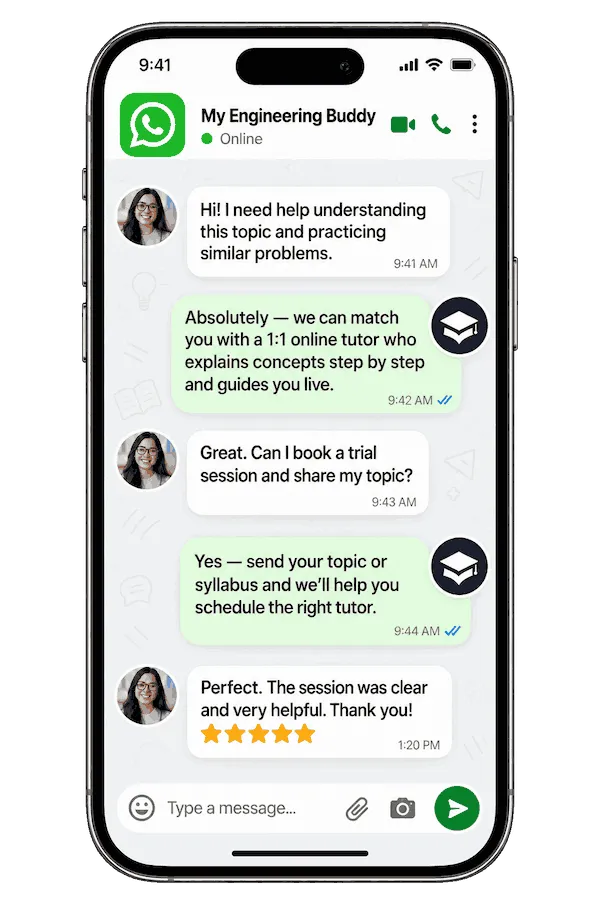
WhatsApp MEB for a quick quote — average response time under 1 minute.
Who This PAT (Physics Aptitude Test) Tutoring Is For
PAT tutoring at MEB is built for students applying to Oxford for Physics, Physics and Philosophy, Earth Sciences, or Materials Science. It’s also used by students working on broader Oxford admissions preparation who need to sharpen their mathematical physics reasoning fast.
- Year 12 and 13 students in the UK sitting the PAT for the first time
- Students with a conditional Oxford offer depending on a strong PAT score — the stakes are high and the window is short
- International applicants from the US, Canada, Australia, and the Gulf who are unfamiliar with the Oxford admissions format
- Students who have attempted past PAT papers and found the mechanics or calculus sections unexpectedly difficult
- Students retaking after a weaker first sitting who need targeted gap-closing before the November exam
- Parents of Year 12–13 students who want structured, accountable weekly progress ahead of the autumn deadline
Students from schools including Eton, Harrow, Westminster, Phillips Exeter, and Scotch College have used MEB for Oxford and Oxbridge admissions test preparation — as have independent learners with no specialist school support at all.
1:1 Tutoring vs Self-Study vs AI vs YouTube vs Online Courses
Self-study works if you’re disciplined — but the PAT’s unusual problem style means most students don’t know what they’re missing until they see the mark scheme. AI tools give fast explanations but can’t adapt when you’ve reasoned something almost-correctly in a way that only a live tutor catches. YouTube covers mechanics and waves well at A Level standard, but stops short of the PAT’s applied problem format. Online courses run at a fixed pace that rarely matches a six-week countdown to November. With 1:1 Oxbridge admissions test tutoring at MEB, every session is calibrated to your current paper scores, your gaps, and the specific Oxford marking approach — errors get caught and corrected in the moment.
Outcomes: What You’ll Be Able To Do in PAT (Physics Aptitude Test)
After consistent 1:1 PAT tutoring, students solve multi-step mechanics problems involving moments, projectile motion, and energy conservation without losing the thread halfway through. They analyze wave behaviour, interference patterns, and electricity circuit questions at the level the Oxford mark scheme actually rewards. They apply calculus reasoning to physics contexts — something most A Level courses don’t push hard enough. They explain their working clearly enough that no marks are dropped to ambiguous notation. They present timed answers under mock-exam pressure without the score collapsing relative to practice.
Supporting a student through PAT (Physics Aptitude Test)? MEB works directly with parents to set up sessions, track progress, and keep preparation on schedule ahead of the November sitting. WhatsApp MEB — average response time is under a minute, 24/7.
Based on feedback from 40,000+ sessions collected by MEB from 2022 to 2025, 58% of students improved by one full grade after approximately 20 hours of 1:1 tutoring in subjects like PAT (Physics Aptitude Test). A further 23% achieved at least a half-grade improvement.
Source: MEB session feedback data, 2022–2025.
At MEB, we’ve found that PAT candidates who spend their first two sessions only on past papers — without going back to plug the mechanics and calculus gaps — tend to plateau. The diagnostic session exists to stop that from happening. It’s 30 minutes that saves weeks of misdirected effort.
What We Cover in PAT (Physics Aptitude Test) (Syllabus / Topics)
| Section | Topics Covered | Approximate Weight |
|---|---|---|
| Mathematics | Algebra, calculus, trigonometry, geometry, logarithms | ~40% |
| Mechanics | Forces, motion, energy, momentum, circular motion, rotation | ~25% |
| Waves & Optics | Wave properties, reflection, refraction, interference, diffraction | ~15% |
| Electricity & Magnetism | Circuits, Ohm’s law, capacitance, magnetic fields | ~10% |
| Modern Physics / Other | Atomic structure, radioactivity, basic quantum concepts | ~10% |
Mathematics for the PAT
- Algebra: simultaneous equations, quadratics, inequalities, functions
- Calculus: differentiation and integration applied to physical contexts
- Trigonometry: identities, wave equations, angular problems
- Geometry: circles, coordinate geometry, vectors
- Logarithms and exponentials in physics equations
- Graph interpretation and sketching under exam conditions
Core texts: A Level Mathematics for OCR A (Cambridge University Press), Understanding Pure Mathematics by Sadler & Thorning. PAT past papers from Cambridge University Engineering Department and Oxford Physics are the primary practice resource.
Mechanics and Newtonian Physics
- Newton’s laws applied to multi-body and inclined-plane problems
- Projectile motion with and without air resistance
- Energy conservation: kinetic, potential, elastic, and thermal
- Momentum and impulse in collisions
- Circular motion and centripetal acceleration
- Rotational mechanics and moments — a consistent high-difficulty PAT topic
- Simple harmonic motion and oscillation
Core texts: Mechanics for A Level Physics (Hodder Education), Physics by Serway & Jewett (for depth beyond A Level).
Waves, Electricity, and Modern Physics
- Wave superposition, path difference, Young’s double-slit
- Refraction and Snell’s law in multi-medium problems
- DC circuit analysis: Kirchhoff’s laws, series/parallel resistors, capacitors
- Electromagnetic induction — conceptual and numerical
- Atomic models, nuclear decay, half-life calculations
- Photoelectric effect and basic quantum reasoning
Core texts: Physics by Giancoli, A Level Physics by Roger Muncaster. PAT past papers (2006–present) are the essential practice source.

What a Typical PAT (Physics Aptitude Test) Session Looks Like
The tutor opens by reviewing whatever the student attempted since the last session — usually a past-paper question on mechanics or a calculus problem. They check not just whether the answer is right but whether the method would earn full marks under the PAT mark scheme. Then the session moves into a specific weak area: if circular motion came up in the diagnostic, that’s where 30–40 minutes go. The tutor writes out worked solutions on a digital pen-pad in real time; the student replicates the reasoning in their own working, which the tutor watches and corrects step by step. Sessions close with a concrete task — two or three problems from a specific past year’s paper — and the next session’s topic is agreed so the student knows what to prepare.
Students consistently tell us that the PAT feels very different from A Level Physics exams — the questions are shorter but demand much more mathematical precision per line of working. Tutors who have worked through the full Oxford past paper archive know exactly where those precision marks get dropped.
How MEB Tutors Help You with PAT (Physics Aptitude Test) (The Learning Loop)
Diagnose: In the first session, the tutor works through a recent past paper with the student — not to grade it, but to map exactly which topics are costing marks. Calculus application, mechanics problem setup, and circuit analysis are the three most common gaps. The tutor records these before the session ends.
Explain: The tutor works through problems on screen using a digital pen-pad, showing every line of reasoning and the logic behind each step. The goal isn’t to give the answer — it’s to make the method visible and reproducible.
Practice: The student attempts a similar problem live, with the tutor present. This is where the real learning happens — working under observation, not alone.
Feedback: The tutor goes through the student’s attempt line by line, identifying exactly where marks would be lost and why. This is specific: “You set up the energy equation correctly but forgot to account for rotational kinetic energy here — that’s two marks.”
Plan: The next two or three topics are agreed at the end of each session based on what the diagnostic and practice revealed. The student knows what to work on before the next session starts.
Sessions run over Google Meet with a digital pen-pad or iPad and Apple Pencil. Before your first session, share your most recent past paper attempt and your Oxford application deadline. The tutor handles everything from there. Start with the $1 trial — 30 minutes of live PAT tutoring that also serves as your first diagnostic.
The PAT is sat by thousands of Oxford applicants each November. Strong preparation in the eight weeks before the exam — specifically on mechanics and applied mathematics — is where MEB tutoring consistently makes the difference.
Source: My Engineering Buddy, 2008–2025.
Try your first session for $1 — 30 minutes of live 1:1 tutoring or one homework question explained in full. No registration. No commitment. WhatsApp MEB now and get matched within the hour.
Tutor Match Criteria (How We Pick Your Tutor)
Not every physics tutor is the right fit for PAT prep. MEB matches specifically on the following:
Subject depth: The tutor needs PAT-specific experience — familiarity with the Oxford format, the past paper archive, and the level of mathematical precision the mark scheme demands. A general A Level Physics tutor is not the same thing.
Tools: All PAT sessions use Google Meet plus a digital pen-pad or iPad with Apple Pencil. Working through calculations in real time, visibly, is non-negotiable for this type of exam.
Time zone: Tutors are matched to your region — UK and Europe students are prioritised for GMT-aligned availability; US, Canadian, Gulf, and Australian students get matched to tutors with corresponding session slots.
Goals: Whether you’re targeting Oxford Physics, Physics and Philosophy, or Earth Sciences — and whether you need conceptual depth or pure exam-speed practice — the tutor match reflects that specific aim.
Unlike platforms where you fill out a form and wait, MEB responds in under a minute, 24/7. Tutor match takes under an hour. The $1 trial means you test before you commit. Everything runs over WhatsApp — no logins, no intake forms.
Study Plans (Pick One That Matches Your Goal)
Most PAT candidates come to MEB in one of three situations. Catch-up (1–3 weeks before the November exam): fast-focus sessions on the highest-yield gaps — usually mechanics and applied calculus — with timed past-paper practice every session. Exam prep (4–8 weeks out): systematic topic-by-topic coverage with a weekly mock paper and mark-scheme review. Weekly support (ongoing from Year 12): aligned to school-term pace, building the mathematical physics depth the PAT rewards. The tutor sets the specific sequence after the first diagnostic session.
Pricing Guide
PAT tutoring runs $20–$40/hr for most levels. Tutors with Oxford physics backgrounds or extensive PAT paper experience sit at the higher end of that range or above it — up to $100/hr for specialist sessions. Rate factors include topic complexity, how close the exam is, and tutor availability.
For students targeting Oxford Physics or Physics and Philosophy, tutors with research or professional physics backgrounds are available at higher rates — share your specific goal and MEB will match the tier to your target course.
Availability shrinks fast in October as PAT candidates ramp up. Start with the $1 trial — 30 minutes, no registration, no commitment. WhatsApp MEB for a quick quote.
FAQ
Is the PAT hard?
Yes — it’s designed to stretch the top A Level Physics students applying to Oxford. The maths content goes beyond standard A Level, and the problems require precise multi-step reasoning. Most students find the mechanics and calculus application sections the most challenging without targeted preparation.
How many sessions are needed?
Most students see meaningful score improvement in 8–15 sessions, depending on their starting point and how far out the exam is. Students with strong A Level Physics foundations but weak applied maths often close their gaps faster. The tutor sets the plan after the first diagnostic.
Can you help with homework and assignments?
MEB tutoring is guided learning — you understand the work, then submit it yourself. Tutors will work through past paper problems and school physics exercises with you, explaining the method step by step. See our Academic Integrity policy and Why MEB page for full details on what we help with and what we don’t.
Will the tutor match my exact syllabus or exam board?
Yes. The PAT has its own specific syllabus published by Oxford. MEB tutors working on PAT preparation are matched based on familiarity with that syllabus — not just general A Level Physics coverage. Your exam board for school subjects is also factored in where relevant.
What happens in the first session?
The tutor works through a recent PAT past paper with you to map your current level and identify specific gaps. They note which topics are costing marks and which are solid. That diagnostic shapes every session that follows — nothing is generic from session two onward.
Is online tutoring as effective as in-person?
For PAT preparation, yes. The digital pen-pad replicates in-person whiteboard work precisely. Tutors write out derivations, diagrams, and problem solutions in real time on screen. Many students find it easier to focus without the logistical overhead of travelling to a tutor’s location.
Can I get PAT help at short notice — even a week before the exam?
Yes. MEB has tutors available for urgent preparation in the final week before the November PAT sitting. Sessions in this window focus on the two or three highest-yield topics and timed practice. WhatsApp MEB and a tutor can usually be matched the same day.
What if I don’t like my assigned tutor?
Tell MEB via WhatsApp and a new match is arranged — usually within hours. The $1 trial is specifically designed so you can test the tutor fit before committing to a longer block of sessions. No awkward conversation required; just message and MEB handles the rest.
Do you cover the PAT for Physics and Philosophy applicants specifically?
Yes. The PAT is the same paper regardless of the specific Oxford physics course — Physics, Physics and Philosophy, Earth Sciences, or Materials Science all use it. Tutors can also help Physics and Philosophy applicants with the philosophy reasoning component of their application if needed.
How is the PAT different from A Level Physics exams?
The PAT tests reasoning and problem-solving agility rather than content recall. Questions are shorter but require more mathematical precision per line of working. There is no formula sheet. The calculus and mechanics content exceeds standard A Level, and the problem formats are unlike anything in A Level exam boards such as AQA or OCR.
How do I get started?
WhatsApp MEB, tell them your exam date and which PAT topics feel weakest. MEB matches you with a verified tutor — usually within the hour. Your first session is the $1 trial: 30 minutes of live tutoring or one past-paper question explained in full. Three steps: WhatsApp, get matched, start the trial.
Do you offer group PAT sessions?
No — all MEB sessions are 1:1. PAT preparation is too individual for group formats; two students sitting the same exam can have completely different gap profiles. Private sessions mean every minute targets your specific weaknesses, not a shared syllabus plan.
Trust & Quality at My Engineering Buddy
Every MEB tutor goes through subject-specific screening — a live demo session, a review of their academic and professional background, and ongoing feedback monitoring after they start teaching. PAT tutors are assessed specifically on their familiarity with the Oxford admissions format, past paper coverage, and their ability to work at the mathematical depth the exam demands. Rated 4.8/5 across 40,000+ verified reviews on Google.
MEB tutoring is guided learning — you understand the work, then submit it yourself. For full details on what we help with and what we don’t, read our Academic Integrity policy and Why MEB.
MEB has been running since 2008, serving 52,000+ students across the US, UK, Canada, Australia, the Gulf, and Europe in 2,800+ subjects. Test preparation is one of the platform’s strongest areas — students working on NSAA (Natural Sciences Admissions Assessment) tutoring, TMUA (Test of Mathematics for University Admission) help, and PAT preparation all go through the same rigorous tutor matching process. Learn more about MEB’s tutoring methodology.
Explore Related Subjects
Students studying PAT (Physics Aptitude Test) often also need support in:
- STEP (Sixth Term Examination Paper)
- BMAT (Biomedical Admissions Test)
- TSA (Thinking Skills Assessment)
- HAT (History Aptitude Tests)
- CAT (Classics Aptitude Test)
- ELAT (English Literature Admission Test)
- LNAT (Law National Aptitude Test)
- ESAT (Engineering Scholastic Aptitude Test)
Next Steps
Ready to start PAT preparation? Here’s what to do:
- Share your Oxford application deadline, your target course (Physics, Physics and Philosophy, Earth Sciences, or Materials Science), and which PAT topics feel furthest from exam-ready
- Share your availability and time zone — UK, US, Gulf, Canada, or Australia
- MEB matches you with a verified PAT tutor — usually within 24 hours
- Your first session opens with a diagnostic so every minute from session one is targeted to your actual gaps
Before your first session, have ready:
- A recent PAT past paper attempt — even a partial one tells the tutor a lot
- Your Oxford application deadline and the specific course you’re applying to
- Any school physics or maths topics you already know are weak
The tutor handles the rest. Visit www.myengineeringbuddy.com for more on how MEB works.
WhatsApp to get started or email [email protected].
A common pattern our tutors observe is this: students who sit the PAT without specific preparation often know the physics — but lose marks on the maths execution. The two subjects need to work together at speed, and that only comes from practice with feedback. That’s exactly what the sessions are for.
MEB has supported test preparation students across Oxford admissions assessments, US standardised exams, and professional certifications in 2,800+ subjects — all through 1:1 live sessions, matched within hours, starting at $20/hr.
Source: My Engineering Buddy, 2008–2025.
52,000+ Happy Students From Various Universities



Reviewed by Subject Expert
This page has been carefully reviewed and validated by our subject expert to ensure accuracy and relevance.