
You Know the Biology. These 5 Technique Errors Are Losing You Marks.

You know the content. You studied hard. But your exam results don’t match your knowledge.
This disconnect frustrates thousands of A Level Biology students every year. Forum posts from November 2024 show students scoring 63% despite knowing the material, with teachers giving one consistent piece of feedback: good knowledge, poor exam technique.
The reality is harsh. Mark schemes are specific. If you miss a key word or misinterpret a command word, you lose marks, even when you understand the biology. This article breaks down the five most common exam technique mistakes that cost students marks, based on mark scheme analysis and student forum discussions from 2024.
Need expert learning support? Check out our online tutoring
What Biology Students Are Saying
Current A Level Biology students report the same frustration across exam boards. The Student Room threads from November 2024 show students with strong content knowledge losing marks on data questions, graph interpretation, and application questions. One Year 12 student wrote, “I struggle when it comes to answering exam questions, especially graphs. My answers are different than expected.”
Teachers and tutors consistently report that students improve dramatically (D to A grades) when they focus on exam technique rather than just reviewing content. The pattern is clear: content knowledge is necessary but not sufficient for high grades.
Mistake 1: Ignoring Command Words
Command words tell you exactly what the examiner wants. Misunderstanding them costs marks immediately.
“Describe” means state what you observe. No explanation needed. If you see a graph showing enzyme activity increasing then plateauing, you write: “Enzyme activity increases from 0 to 40 degrees C, then remains constant from 40 to 60 degrees C.” You quote data from the graph.
“Explain” requires reasoning. You must give biological causes. For the same graph, you would write: “Enzyme activity increases because higher temperature increases kinetic energy, leading to more enzyme-substrate collisions. Activity plateaus because the enzyme has reached maximum velocity, with all active sites occupied.”
The difference matters. AQA’s assessment guidance from 2024 confirms that explaining when asked to describe, or describing when asked to explain, loses marks. Mark schemes are built around these distinctions.
Common command word mistakes:
- Writing “because” statements for “describe” questions
- Stating observations without reasoning for “explain” questions
- Confusing “compare” (identify similarities and differences) with “evaluate” (weigh strengths and weaknesses)
- Responding to “suggest” questions with memorized facts instead of applying knowledge to unfamiliar contexts
For “compare” questions, use linking words like “whereas” or “while” to make direct comparisons. “Plant cells have a cell wall whereas animal cells do not” scores marks. Writing separate statements about each cell type does not.
To make sure you never mix these up again, use this quick reference guide to the three most important command words.
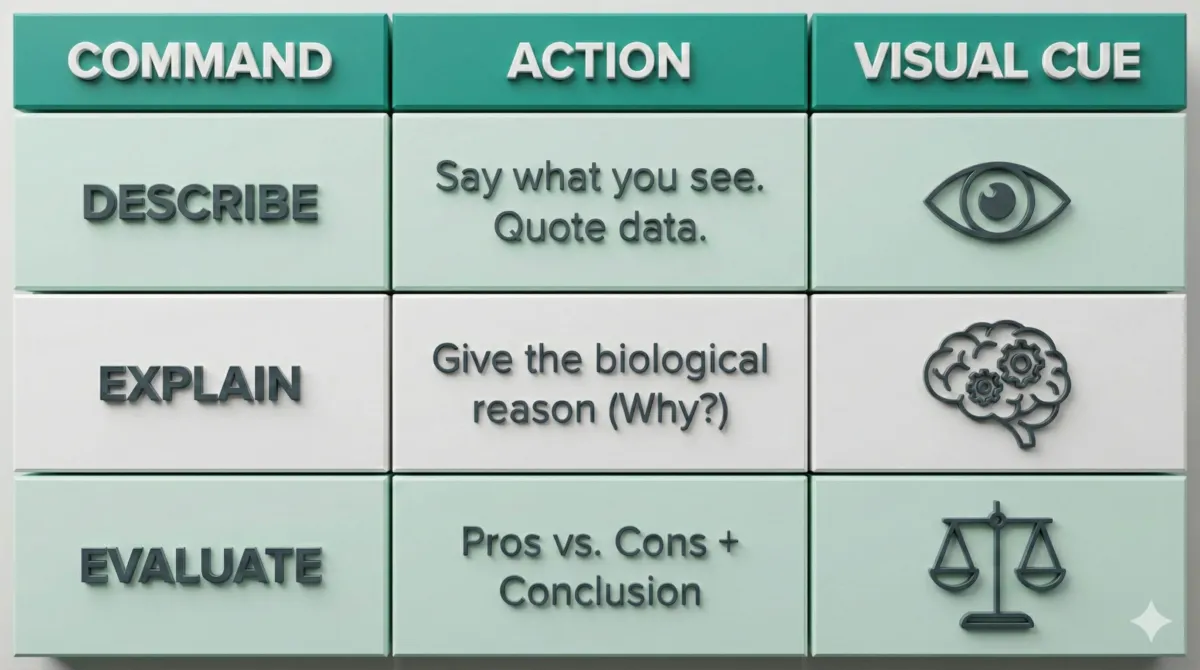
Mastering these three command words is the fastest way to stop losing marks on questions you already know the answer to.
Memorizing these visual cues will stop you from wasting time explaining when you should simply be describing.
Mistake 2: Missing Mark Scheme Key Words
Biology mark schemes are ruthlessly specific. Student forums from 2024 consistently report: “Mark schemes want exact key words. If your answer doesn’t include that one specific term, you won’t get the mark.”
Mark schemes use specific formatting to show what’s required:
- Bold “AND” means both parts are essential for the mark
- Solidus (/) shows acceptable alternatives (smooth/free movement)
- Underlined text is non-negotiable wording
- Brackets indicate acceptable additional detail
The “right + wrong = wrong” rule applies. If you write two statements and one is correct but the other contradicts it or is biologically inaccurate, you score zero for that mark. Mark schemes from AQA June 2024 explicitly state: “Each error or contradiction negates each correct response.”
Example from osmosis questions: Mark scheme requires: “Water moves from high water potential to low water potential.” Student writes: “Water moves from low concentration to high concentration.” Result: Zero marks, despite understanding the concept, because the terminology is imprecise.
This is often called the ‘Negative Marking’ effect. Here is the mathematical reality of how a single contradiction kills your score:
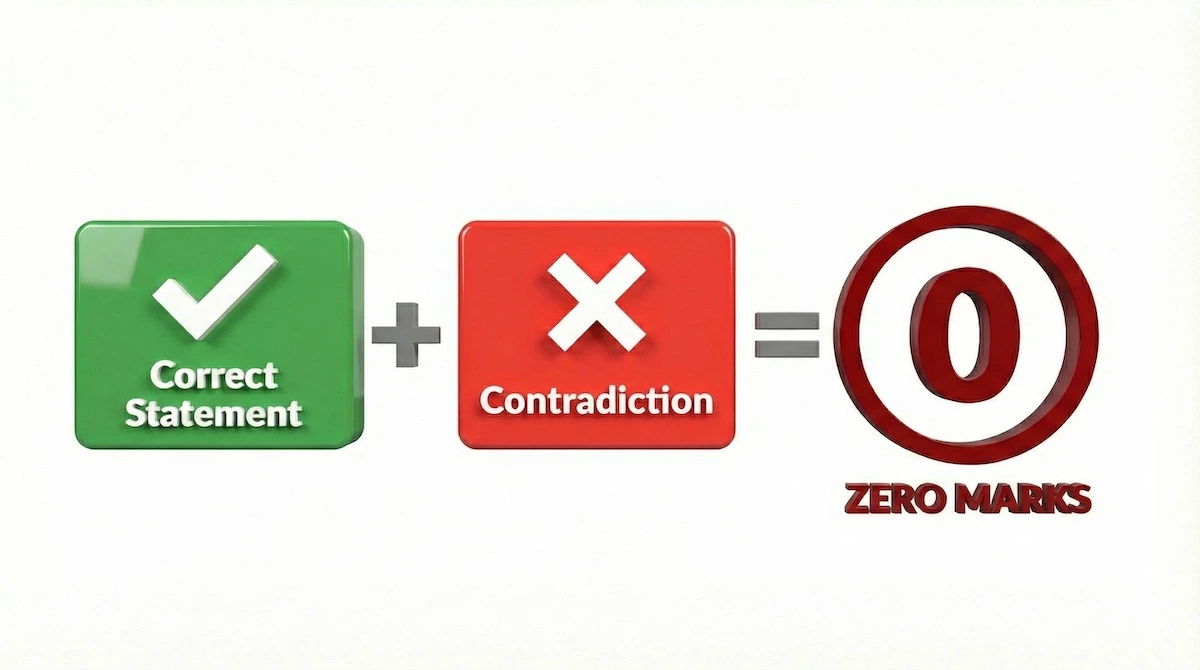
In biology mark schemes, a contradiction negates your correct answer. Never guess if you aren’t sure.
As you can see, adding a ‘guess’ that contradicts your correct answer wipes out the mark entirely. If in doubt, leave the extra detail out.
To avoid this:
- Learn the exact terminology from your specification
- Practice writing answers, then check against mark schemes
- Notice which phrases appear repeatedly in mark schemes
- Use precise biological terms (water potential, not “water concentration”)
- Avoid vague terms like “it,” “this,” or “thing” unless the referent is completely clear
Mark schemes accept phonetic spelling for most terms, but examiners distinguish between glucagon, glucose, and glycogen because mixing these up changes biological meaning entirely.
Mistake 3: Misinterpreting Data and Graphs
Data questions cause the most student complaints. Forum posts from 2024 show students struggling with error bars, statistical significance, and graph interpretation despite understanding the underlying biology.
Error bars show data variability. Standard deviation error bars indicate spread around the mean. The rule for A Level: if error bars do not overlap, the results are significantly different. If they overlap, you cannot conclude a significant difference exists.
Visualizing this rule is the easiest way to remember it. Here is the only check you need to perform when analyzing graph data:
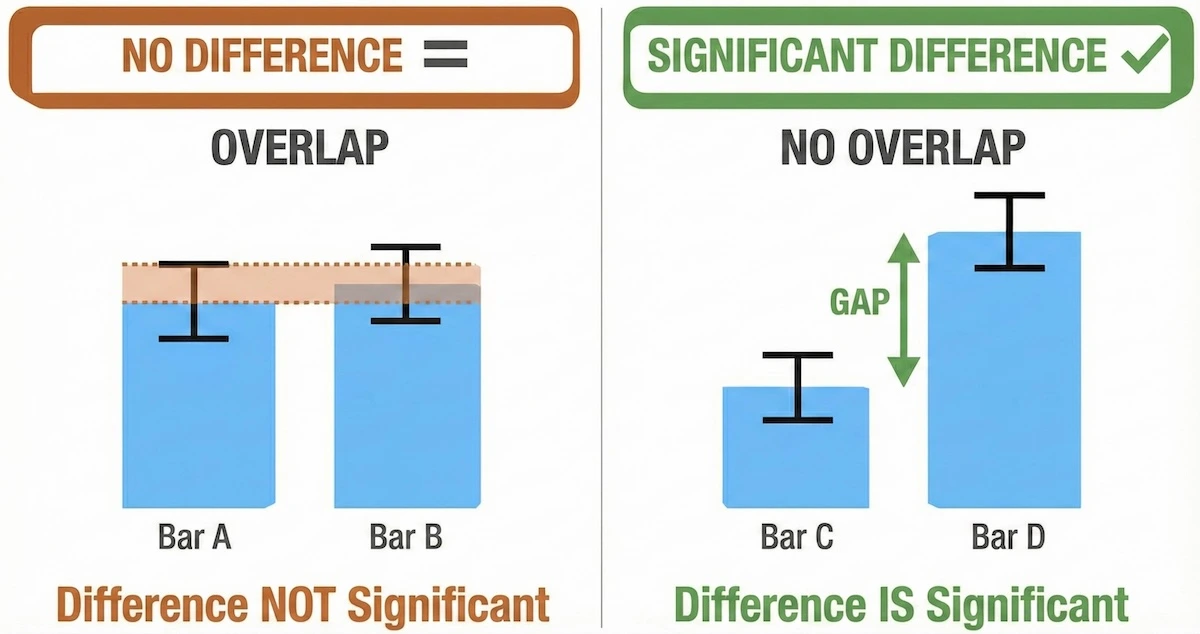
Memorize this visual rule: If the error bars overlap, you cannot claim the data sets are significantly different.
Simply put: If the bars overlap, the difference is likely due to chance. If they don’t, the difference is significant.
This applies to standard deviation bars specifically. The 2019 Pearson A Level Biology Maths Guide confirms this principle. For 95% confidence intervals, the interpretation changes slightly, but A Level questions typically use standard deviation.
Common data interpretation mistakes:
- Stating trends without quoting data (“the rate increases” instead of “the rate increases from 2 to 8 cm³/min between 20 and 40°C”)
- Ignoring units when describing changes
- Confusing correlation with causation
- Not identifying anomalies before calculating means
- Failing to explain biological reasons behind data trends
For graph questions, follow this approach:
- Describe the overall trend with data
- Quote specific values from the graph
- Identify any plateaus, peaks, or unusual features
- If asked to explain, provide biological reasoning for each trend
When comparing data sets, use the structure: “Group A shows [data/observation] whereas Group B shows [data/observation].” Direct comparison in one sentence scores marks.
For calculations, show all working. Mark schemes award method marks even if your final answer is wrong due to an earlier calculation error. Never write only the final answer.
Check out smart test prep solutions to score higher
Mistake 4: Providing Insufficient Detail
Many students write until they run out of space, rather than running out of marks. Use this simple workflow for every 4-6 mark question:
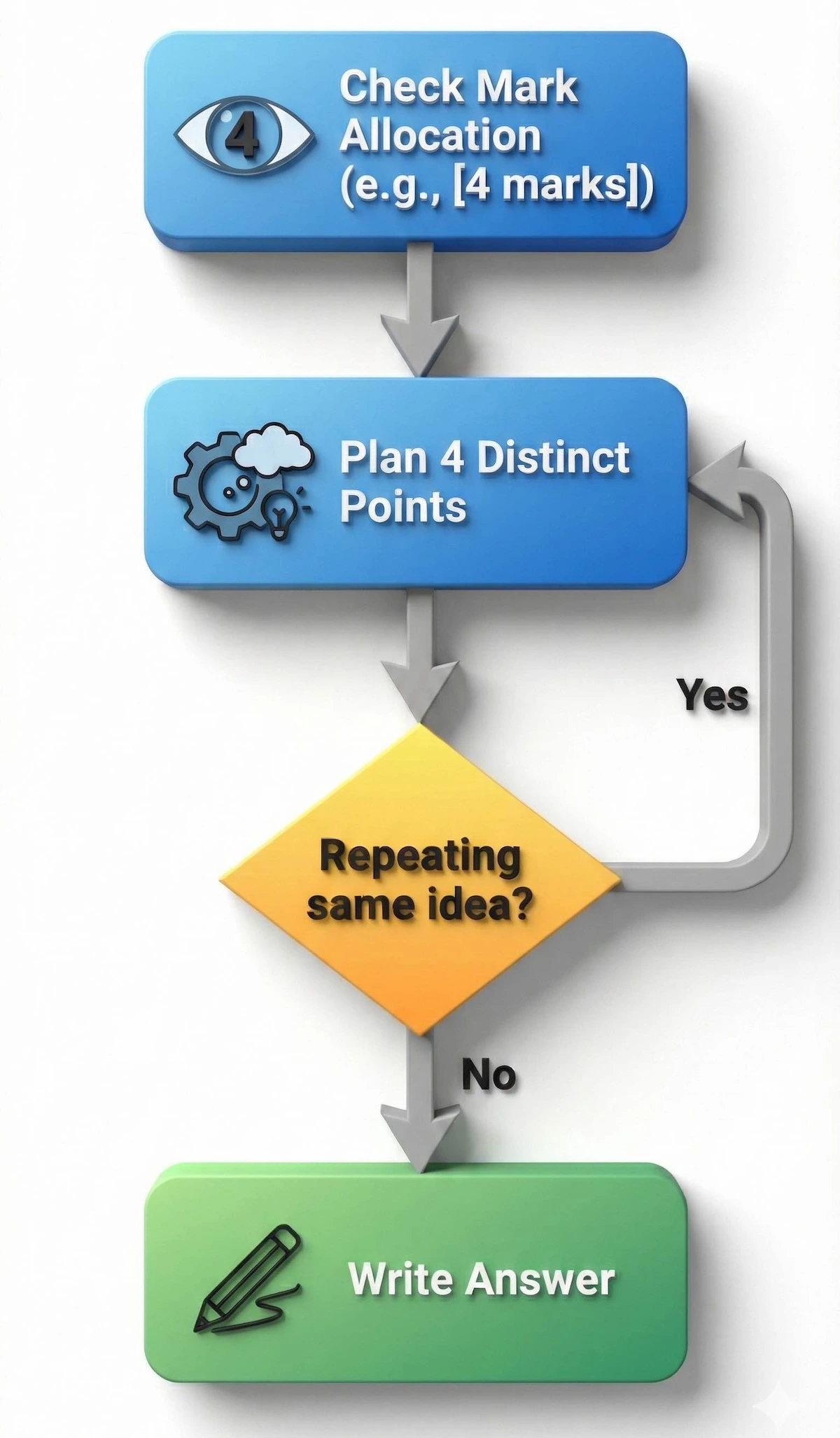
Don’t start writing until you have planned one distinct biological point for every mark available.
Following this loop ensures you generate distinct points rather than just rephrasing the same idea.
A Level Biology mark schemes reward depth, not just breadth. Writing brief, surface-level answers loses marks, especially on longer questions worth 4 to 6 marks.
For a 4-mark question, you need at least four distinct, creditworthy points. These cannot be variations of the same idea. If the question asks you to explain how vaccines provide immunity, you need to trace through multiple biological steps:
- Vaccine contains antigen from pathogen
- B lymphocytes with complementary receptors are activated
- Activated B cells divide by mitosis to form clones
- Some differentiate into plasma cells producing specific antibodies
- Others become memory cells remaining in blood
- Upon reinfection, memory cells rapidly divide and differentiate
- Producing antibodies faster, in greater quantities
Each point above is distinct. Saying “antibodies are produced” and “antibodies kill pathogens” would count as one mark because it’s the same general idea.
The mark allocation guides how much detail is expected. For every mark available, provide at least one specific, detailed point. For 5-mark questions, aim for 6 to 7 points to ensure full marks even if one point doesn’t match the mark scheme perfectly.
Extended response questions require even more. AQA’s June 2024 mark schemes show that for a 6-mark extended response on evaluating experimental design, examiners expect:
- Identification of multiple strengths or limitations
- Explanation of how each factor affects the results
- Reference to statistical validity (sample size, replicates, controls)
- Application of understanding to the specific context
Generic statements like “the sample size is small” score fewer marks than “the sample size of 10 is too small to identify significant differences between groups, as shown by the overlapping error bars, which suggests individual variation is masking treatment effects.”
Mistake 5: Poor Essay Structure for 25-Mark Questions
The Paper 3 essay tests synoptic understanding. It’s not a memory dump. Students who write everything they know about one or two topics score poorly.
Essay questions require:
- Material from four or more different specification topic areas
- Clear links between topics and the essay theme
- A level terminology throughout
- Application of knowledge to illustrate the central concept
Essays are marked using levels of response. To reach the top bands (21 to 25 marks), your essay must show:
- A holistic approach linking several topics to the central theme
- Detailed, comprehensive A Level content
- Appropriate scientific terminology
- Clear explanations with no significant errors
- Evidence of reading beyond specification requirements
Plans don’t add marks unless written as prose. Diagrams only count if heavily annotated to show A Level understanding. Introductions and conclusions waste time that could be spent on content.
The synoptic requirement matters. If you write extensively about respiration but don’t connect it to transport, digestion, and other topics, you cannot score above 15 marks, even if your respiration content is perfect.
Structure your essay as a series of interconnected paragraphs. Each paragraph should:
- Introduce a relevant topic area
- Explain the biological concept in detail
- Explicitly link it to the essay theme
- Use proper A Level terminology
For a title on the importance of membranes, you might cover:
- Cell signaling (reception of hormones at membrane receptors)
- Compartmentalization (organelle membranes maintaining different chemical environments)
- Transport (selective permeability controlling what enters cells)
- Photosynthesis (thylakoid membranes housing electron transport chains)
- Nerve impulse transmission (membrane potential and action potentials)
Think of your essay plan not as a list, but as a web. Your goal is to pull connections from the furthest corners of the syllabus.
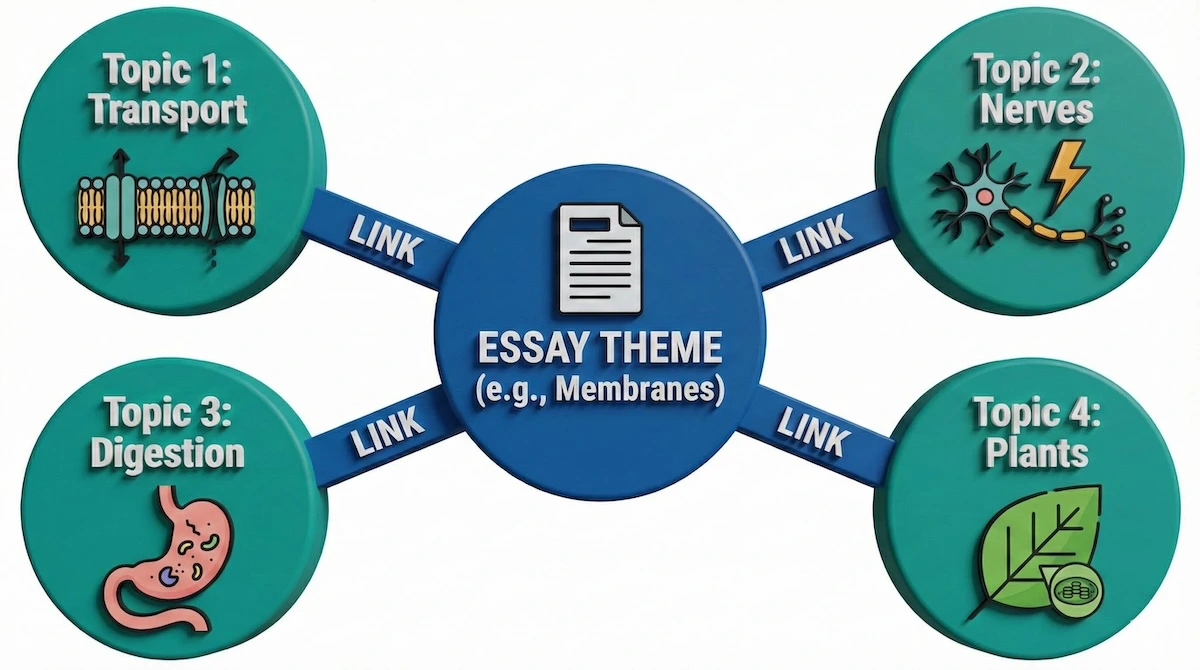
Top-band essays don’t just go deep into one topic—they connect the essay title to at least four different areas of the syllabus.
This ‘Spider Web’ approach forces you to demonstrate the breadth of knowledge required for top-band marks.
Each topic clearly relates to membrane importance while drawing from different specification areas.
Read more to get instant, accurate homework help
The Mark-Saving Checklist
Before submitting your exam paper, use this quick verification:
Command Word — Did I answer what was actually asked? (Describe ≠ Explain ≠ Compare)
Conciseness — Did I deliver only relevant information matching the mark value? (1 mark = 1 point, 5 marks = 5 points)
Completeness — Did I include all mechanism steps, even the “obvious” ones?
Calculations — Do my answers have units? Are significant figures correct? Is working shown?
Question Reading — Did I read the full question and any context? Did I miss a qualifier that changes the answer?
Students who fix these five technique errors typically see a 15-25% mark improvement on papers where their knowledge is already solid. These aren’t knowledge gaps—they’re communication gaps. Close them, and your marks follow.
Practical Application: How to Apply This
Start with past papers. Don’t just answer questions. Study the mark schemes afterward. Notice patterns in how marks are awarded. Create a list of commonly required key words for your specification.
For command words, highlight them in practice questions. Before writing your answer, decide: am I describing, explaining, comparing, or evaluating? Adjust your approach accordingly.
For data questions, practice interpreting graphs and error bars. Take 10 different data questions from past papers. Write your answers, then compare with mark schemes. Notice how mark schemes phrase conclusions about statistical significance.
For essays, practice planning under timed conditions. Give yourself 5 minutes to brainstorm topics from different specification areas that connect to the title. Write abbreviated points for each topic, ensuring each links explicitly to the theme. Then write the full essay.
Track your errors. Keep a log of which types of questions you lose marks on. Are you missing key words? Misinterpreting command words? Not quoting data? Insufficient detail? Once you identify your pattern, focus practice on that specific skill.
Use mark scheme language when studying. Instead of thinking “osmosis is about water movement,” phrase it exactly as mark schemes require: “Water moves by osmosis from a region of higher water potential to a region of lower water potential.” Precision matters.
Key Takeaways
- Command words determine your answer structure. Describe states observations, explain provides reasoning.
- Mark schemes require exact terminology. Missing one key word loses the mark.
- Error bars that don’t overlap indicate significant differences. Always quote data values when describing graphs.
- Longer questions need detailed, distinct points. Aim for one point per mark plus extras.
- Essays require synoptic connections across four or more topic areas, not depth in one area.
You can learn more about how to structure your answers for maximum marks by watching this video: Important Mistakes to Avoid (A-level Bio Exam).
After reading this article, students will be able to identify their exam technique gaps based on actual mark scheme requirements and apply targeted strategies to improve exam performance without needing additional content review.
******************************
This article provides general educational guidance only. It is NOT official exam policy, professional academic advice, or guaranteed results. Always verify information with your school, official exam boards (College Board, Cambridge, IB), or qualified professionals before making decisions. Read Full Policies & Disclaimer , Contact Us To Report An Error