7 A Level Maths Strategies Top Students Use to Score High

- Only 16.9% of students achieve an A* in A Level Maths — strategy matters.
- The RAG system directs study time to genuine weak spots, not comfortable topics.
- Past papers work best as a three-stage diagnostic cycle, not a simple do-and-check.
- Method marks (M marks) are the foundation; showing working is non-negotiable.
- Spaced repetition and progressive difficulty levels build exam-ready understanding.
A Level Maths demands more than memorization. With 83.7% of marks needed for an A* in 2024 (251 out of 300 marks on Edexcel), and only 16.9% of students achieving this grade, success requires strategic preparation. If you are working on the geometry and proof sections of the syllabus, a geometry tutor can help you build the rigorous reasoning those questions demand. The students who score highest don’t just work harder, they work smarter with proven techniques.
What Students Are Asking
Recent forum discussions reveal consistent patterns. Students struggle most with integration and vectors, find past papers easier than actual exams, and often memorize processes without understanding underlying concepts. The June 2024 Edexcel papers highlighted these gaps, with integration questions on Paper 1 causing widespread difficulty.
The key question students ask is not “how many hours should I study?” but “what should I actually do during those hours?” Top scorers have clear answers. For students whose A Level path leads into university-level work, building a strong foundation in precalculus concepts early makes the transition significantly smoother.
Strategy 1: Use the RAG System to Prioritize Weak Topics
High achievers don’t waste time reviewing topics they already understand. They use a Red-Amber-Green (RAG) rating system to identify exactly where effort is needed.
Rate each syllabus topic:
- Red: Cannot solve problems independently, unclear on concepts
- Amber: Can solve with hints, partial understanding
- Green: Confident, can solve variations independently
Start every study session with Red topics. These have the highest return on time invested. Amber topics get secondary focus. Green topics need only maintenance review before exams.
This approach ensures study time targets actual knowledge gaps rather than creating false confidence by repeatedly practicing already-mastered topics.
To make this practical, imagine your syllabus as a traffic light system. Visualizing your revision this way forces you to confront the difficult topics first.
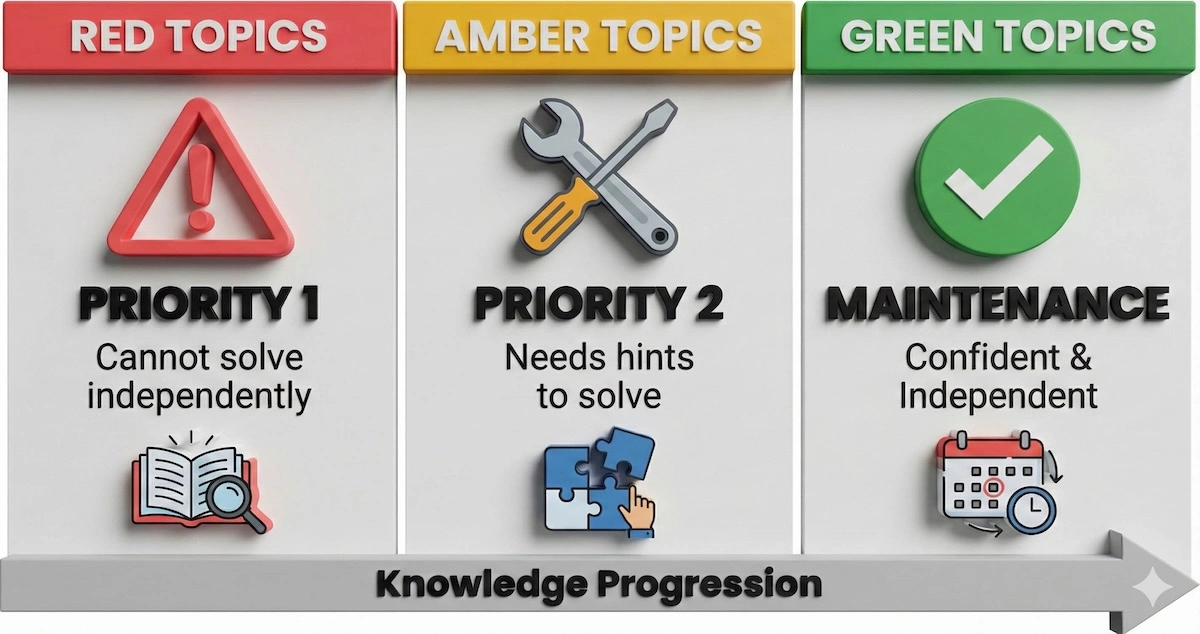
By strictly following this visual priority, you ensure that every hour of study directly targets the areas that will yield the most additional marks.
Strategy 2: Practice Past Papers Under Strict Exam Conditions
Past papers are not just practice, they are diagnostic tools. Top students use them systematically.
The 3-Stage Past Paper Method:
Stage 1 (Untimed): Work through a full paper focusing on method accuracy. Use mark schemes to understand where marks are awarded. Identify which topics cause difficulty.
Stage 2 (Timed): Complete papers in exactly 2 hours. No breaks, no references. This builds exam stamina and time management skills. Track which questions consume excessive time.
Stage 3 (Analysis): After marking, don’t just note the score. Record:
- Topics where marks were lost
- Method errors versus calculation errors
- Time spent per question versus marks available
- Patterns across multiple papers
Data from June 2024 shows that students who completed 10+ timed papers scored significantly higher than those who only reviewed solutions.
Many students treat past papers as a simple ‘do and check’ exercise, but top scorers treat them as a diagnostic cycle. Here is the 3-stage loop you should follow for every paper.
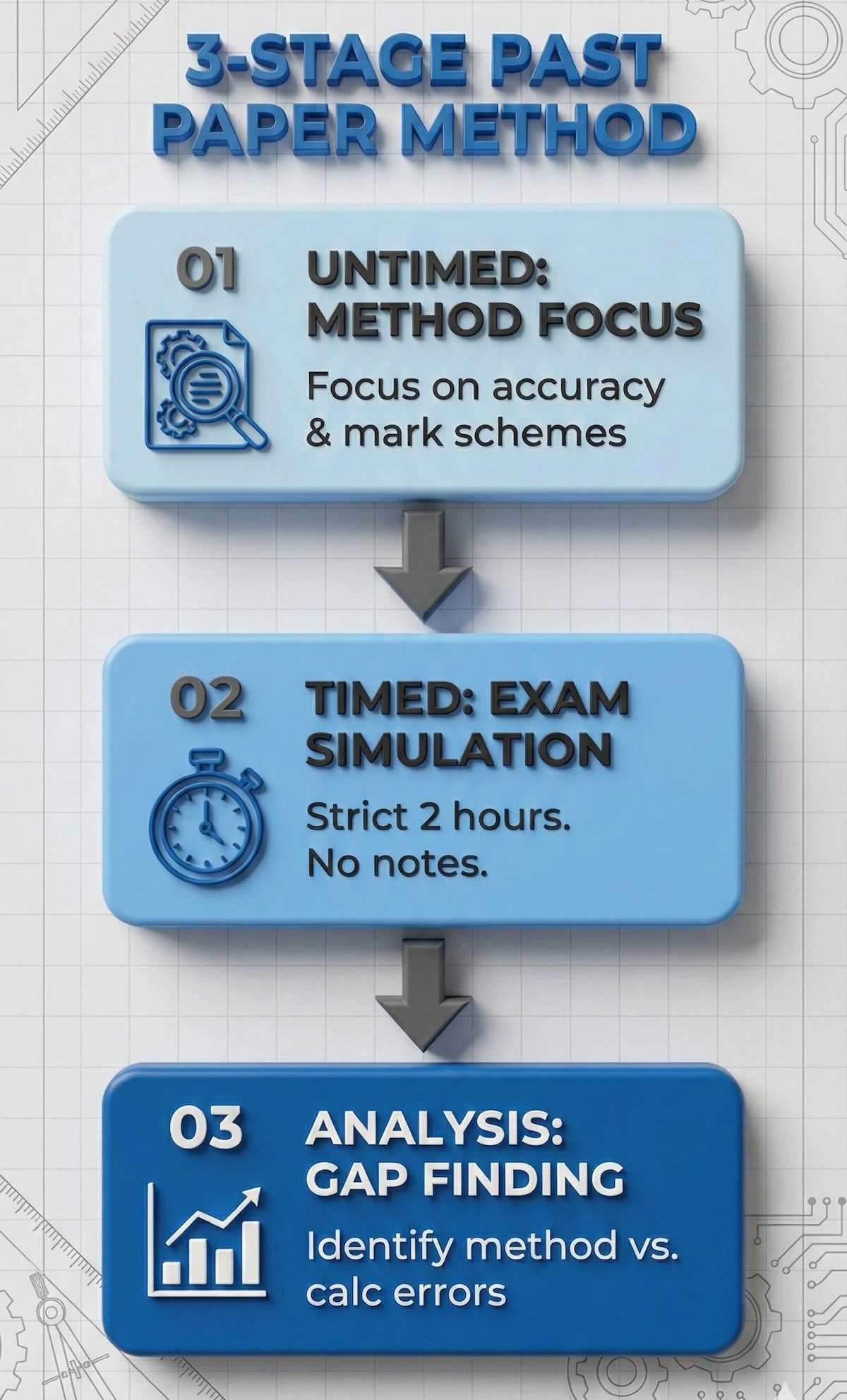
Notice that Stage 3 (Analysis) is just as important as the exam itself; without it, you are likely to repeat the same errors in the real exam.
Students preparing for Cambridge A Level Further Maths can apply the same diagnostic approach — the 5 proven study strategies for Cambridge A Level Further Maths 9231 covers how to adapt these methods for the harder syllabus.
Strategy 3: Master Mark Schemes, Not Just Solutions
Understanding how examiners award marks transforms exam performance. Edexcel mark schemes use:
- M marks: Method marks for correct approach
- A marks: Accuracy marks dependent on earning M marks
- B marks: Unconditional accuracy marks
Top students recognize that showing clear working for method marks matters more than perfect final answers. A complete method with a calculation error might earn 4 out of 5 marks. No working with a correct answer might earn only 1 mark.
It is crucial to understand that not all marks are created equal. The comparison below illustrates why ‘Method’ marks are the foundation of your grade.
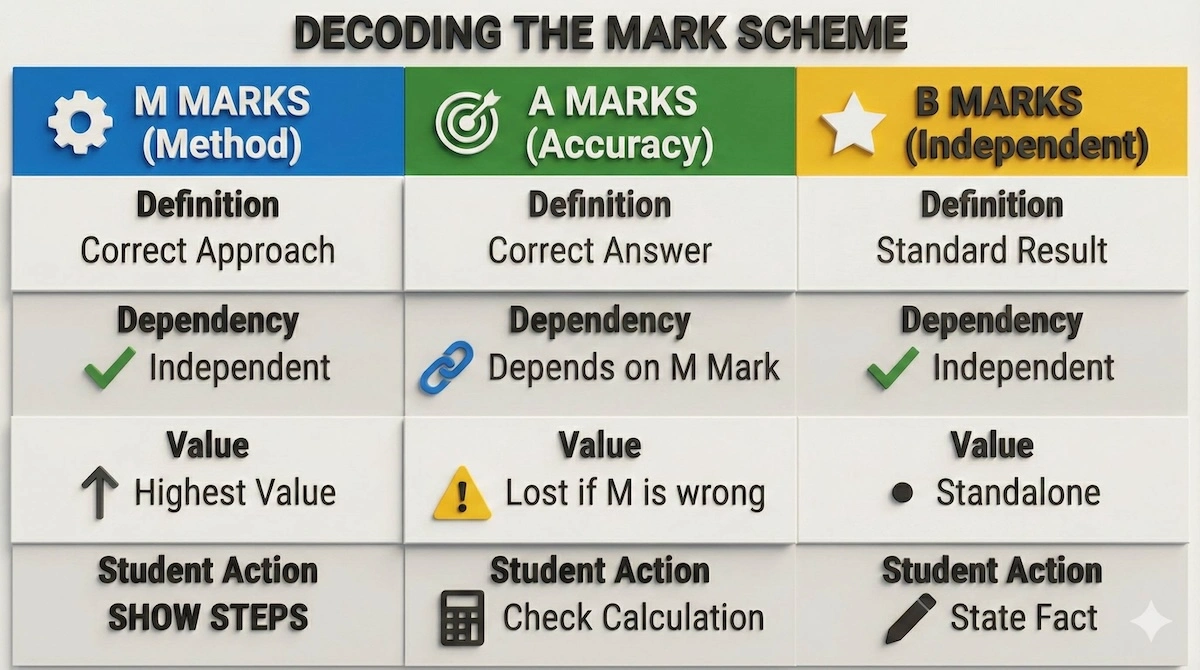
As shown above, ‘Accuracy’ marks often depend entirely on the ‘Method’ marks. If you skip the steps to save time, you risk losing both.
Practical application: When practicing, write every step as if explaining to someone else. Include:
- Formula stated explicitly
- Substitution shown clearly
- Algebraic manipulation steps
- Units and context where relevant
Review mark schemes for questions you answered correctly. Often, you’ll discover you could have earned the same marks with less work, or that your method was unnecessarily risky.
If you are weighing up the cost of extra support to close these gaps, the guide to comparing math tutoring services by cost vs value gives a clear framework for making that decision.
Strategy 4: Implement Spaced Repetition for Formula Retention
Pure memorization fails under exam pressure. Spaced repetition ensures formulas and methods become automatic.
The Spaced Review Schedule:
- Day 1: Learn new topic, complete 5-7 practice problems
- Day 3: Review same topic, attempt 3-4 different problems
- Week 1: Quick review, solve 2 exam-style questions
- Week 2: Mixed practice combining this topic with others
- Week 4: Include in full past paper practice
This schedule matches how memory consolidates. Each review reinforces the material before it’s forgotten. Students using spaced repetition report greater confidence applying formulas in unfamiliar contexts, exactly what 2024 papers demanded.
For integration methods, this means not just practicing substitution and integration by parts separately, but returning to mixed problems that force you to choose the correct method. Students who go on to university-level work will find these habits equally valuable when tackling Calculus 2 topics such as sequences, series, and advanced integration techniques.
Let’s take Integration by Parts as a prime example. Instead of blindly memorizing the sequence, look at the structure of the formula to understand exactly what components you are swapping.
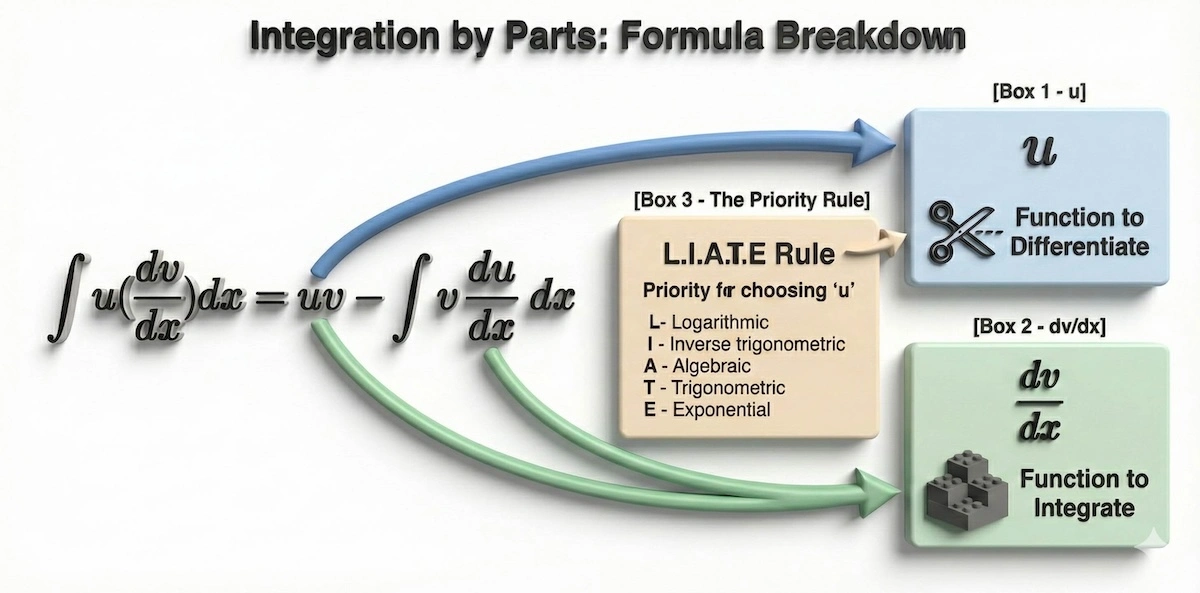
When you visualize the formula this way, the ‘LIATE’ rule for choosing ‘u’ becomes a logical necessity rather than just an arbitrary rule.
Strategy 5: Focus on Process Understanding, Not Pattern Recognition
The biggest complaint about 2024 papers was that “questions didn’t match what we practiced.” Students who memorized specific problem types struggled when examiners presented familiar concepts in new formats.
Building Understanding:
For every method learned, ask three questions:
- Why does this method work? Don’t accept formulas blindly. For SUVAT equations in mechanics, understand that they derive from constant acceleration definitions.
- When does this method apply? Integration by parts works when you can identify u and dv such that du/dx × v is simpler. Recognition comes from understanding, not memorization.
- What variations exist? Exam questions test flexibility. A quadratic equation might need completing the square, the formula, or factorization. Understanding when each applies prevents method confusion.
Work through textbook derivations at least once. Rewrite worked examples in your own words, explaining each step’s purpose. This deeper engagement creates robust knowledge that transfers to unfamiliar problems.
The same principle applies to statistical reasoning — students who understand the logic behind distributions rather than memorising formulas perform far better. If probability is a weak area, working with an online probability tutor can help you build that conceptual foundation.
Strategy 6: Create and Use a Formula/Method Summary Sheet
A single-page reference sheet containing all key formulas and decision flowcharts serves as both study tool and exam confidence booster.
What to include:
- Core formulas with variable definitions
- Method selection flowcharts (when to use which integration method)
- Common mistake reminders specific to you
- Typical problem setups and first steps
Create this sheet in your first term and update it continuously. The act of deciding what makes the cut and how to organize it deepens understanding. Before exams, review this sheet rather than entire textbooks, activating your most critical knowledge.
Students report that physically writing this summary (not typing) improves retention through motor memory.
Strategy 7: Solve Problems in Progressive Difficulty
Random practice creates inconsistent results. Structured progression builds capability.
The Progressive Practice System
For each topic:
Level 1 (Foundation): Textbook examples, single-concept problems. Verify you can execute the basic method correctly.
Level 2 (Application): Past paper questions from older, easier papers. These combine 2-3 concepts but follow familiar patterns.
Level 3 (Integration): Recent past paper questions requiring topic combination. These test whether you can identify which methods to use when problems don’t state “use integration by parts.”
Level 4 (Extension): Predicted papers and harder practice sets (IYGB, Naikermaths). These prepare for above-average difficulty.
Think of your skill development as a pyramid. You cannot build the peak without a solid base, as illustrated in this progression model.
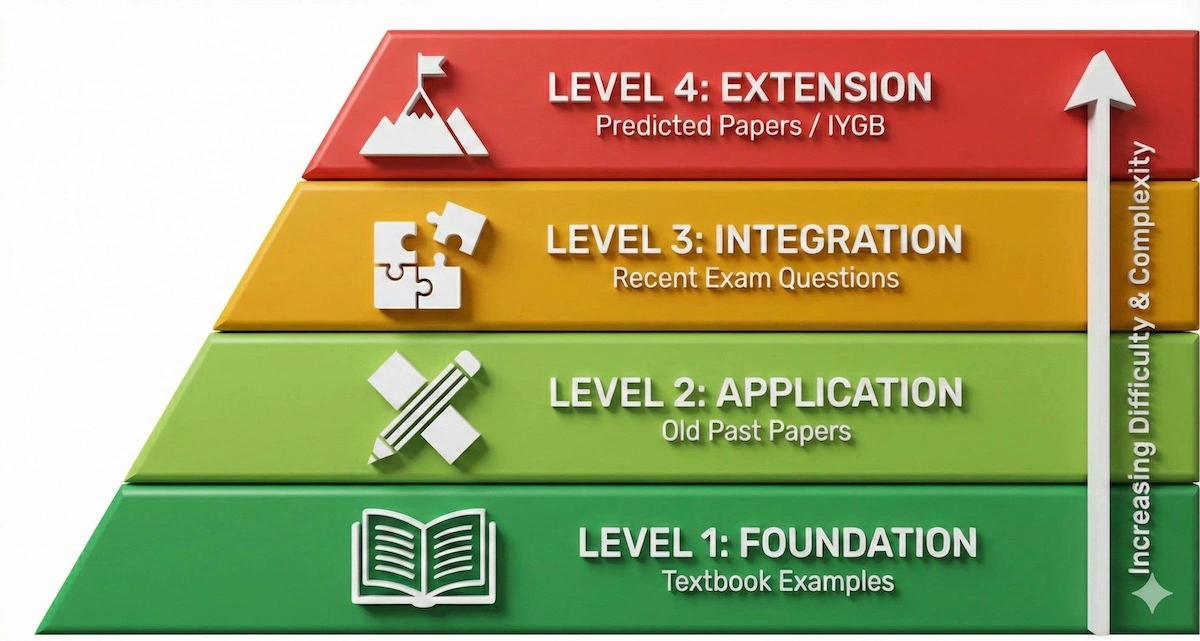
Resist the urge to jump straight to the ‘Extension’ level. Securing the ‘Foundation’ and ‘Application’ layers first is what guarantees a passing grade, while the top layers secure the A*.
Don’t advance to the next level until achieving 90% accuracy at the current level. This ensures foundations are solid before adding complexity. Students who skip levels end up frustrated and demotivated by problems beyond their current capability.
For difficult topics like vectors or trigonometric identities, this systematic progression prevents the “I just don’t get it” mindset that comes from attempting Level 4 problems with Level 1 understanding. Students who also study data-heavy modules will find that the same progressive approach works well when building skills in biostatistics.
Avoiding Common Pitfalls
Even with strong strategies, specific mistakes limit scores:
Time mismanagement: Spending 20 minutes on a 5-mark question while leaving 10-mark questions rushed. Practice allocating roughly one minute per mark.
Calculator dependency: Over-reliance on calculators for algebraic simplification. Exam questions test algebraic manipulation, calculators can’t rescue weak algebra skills.
Incomplete working: Jumping steps to save time usually costs marks. Examiners can only award marks for work shown.
Topic isolation: Studying topics in isolation without practicing mixed problems. Real exam questions rarely announce which topic they’re testing.
If you are considering paid support to address any of these gaps, the complete algebra tutor cost guide for engineering students breaks down what to expect at different price points, and the algebra tutor verification checklist helps you assess whether a tutor is genuinely qualified before you commit.
Practical Application Plan
Translate these strategies into weekly action:
Monday-Wednesday: Identify 2-3 Red/Amber topics via RAG system. Complete progressive practice (Levels 1-3) for these topics. Use spaced repetition schedule.
Thursday-Friday: Complete one full past paper under timed conditions. Analyze results, update formula sheet with any gaps discovered.
Saturday: Review mark schemes for past paper, rework questions where marks were lost. Add common mistakes to formula sheet.
Sunday: Mixed topic practice combining week’s topics with previous weeks. Maintain Green topics.
This schedule balances new learning, application, and review while preventing burnout through varied activities.
After reading this article, students will understand the specific study strategies high-achieving A Level Maths students use and be able to implement these techniques systematically to improve exam performance and target scores of A/A*.
Related Reading
******************************
This article provides general educational guidance only. It is NOT official exam policy, professional academic advice, or guaranteed results. Always verify information with your school, official exam boards (College Board, Cambridge, IB), or qualified professionals before making decisions. Read Full Policies & Disclaimer , Contact Us To Report An Error