Business Management Tutoring: Expert Guidance for Academic Success

As studies show, personalized Business Management tutoring dramatically improves understanding of complex concepts and can significantly boost student performance, often adding several months of learning sometimes up to 15 months.
Whether you are navigating IB Business Management papers, A-Level case studies, or university-level strategy modules in 2026, knowing where to get targeted support and how to use it effectively makes the difference between average results and genuinely competitive grades.
Check Out: Get Personalized Online Tutoring

Why Business Management Tutoring Matters
Students often find Business Management courses challenging. Topics like finance, marketing, and economics can be abstract when covered quickly in class. Imagine a student stuck on a complex marketing case study project with only a textbook; without guidance, it can feel overwhelming. A Business Management tutor provides one-on-one help to bridge these gaps, using real-world examples to make lessons clearer and more relevant.
Business management isn’t just a single subject; it is a complex ecosystem of interconnected disciplines. The visual below maps out how these diverse areas—from finance to strategy fit together.
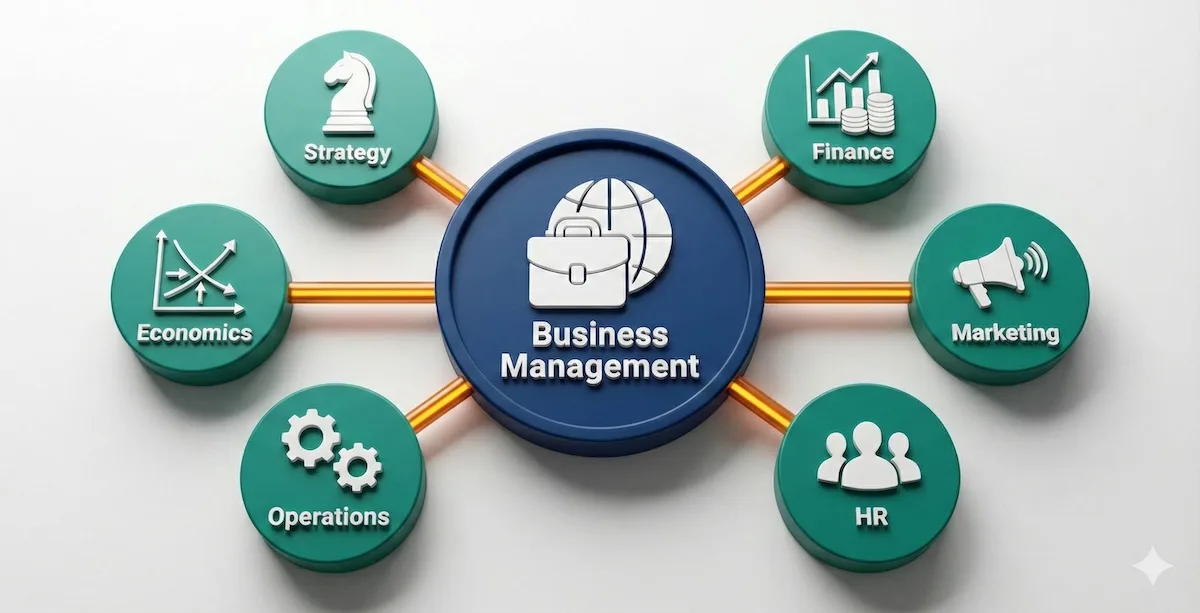
Business management covers a vast array of complex disciplines, from Finance to Strategy, often requiring specialized guidance to master.
Seeing this landscape helps clarify why general study methods often fail; you need targeted support for the specific branch of management where you are struggling.
Research confirms the value of this personalized approach. One famous study found that students receiving one-on-one tutoring performed two standard deviations above their classroom peers. In other words, a student working with a skilled tutor can move from struggling to excelling. This targeted support is what makes Business Management tutoring so effective.
Benefits of Business Management Tutoring
Business Management tutoring offers many benefits for students at all levels. Tutors adapt instruction to each student’s pace and reinforce classroom lessons. These advantages translate into stronger understanding and academic performance. Key benefits include:
- Customized Learning: Tutors tailor lessons to your needs – whether it’s understanding a specific concept or completing a challenging assignment. They explain business theories and terms in clear, simple language.
- Flexible Pacing: Students learn at their own speed. Tutors spend extra time on tough topics, ensuring no one is left behind – something difficult to do in a full classroom.
- Real-World Application: Good tutors use case studies, real examples, and practice problems so you see how business principles apply outside the textbook, making lessons more engaging.
- Better Academic Results: Research shows that high-quality tutoring accelerates learning by 3–15 months, often leading to higher grades and test scores.
The difference personalized instruction makes is not just anecdotal; it is statistically significant. This chart illustrates the ‘2 Sigma Problem,’ showing the dramatic performance gap between classroom learning and one-on-one tutoring.
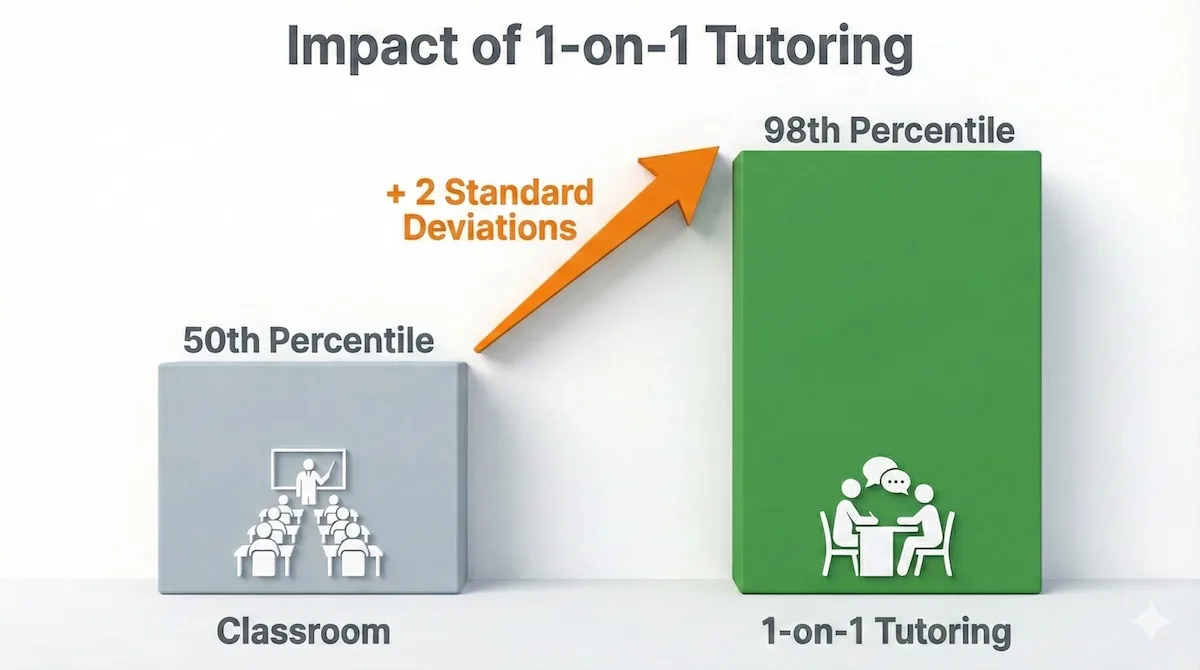
Research shows that one-on-one tutoring can elevate an average student to the top 2% of the class (the 2 Sigma Effect).
Achieving the 98th percentile becomes a realistic goal when learning is tailored specifically to your pace and gaps.
- Confidence and Skills: One-on-one support builds student confidence. As students master difficult material, they become more independent and motivated learners over time.
Business Management Tutoring Online
Online tutoring has transformed how students get help with business courses. Now a student in the USA, UK, or the Gulf can connect with an expert tutor anywhere in the world. Overall, the global online tutoring market was $7.7 billion in 2022. This means flexible scheduling and access to a vast pool of tutors for Business Management. Interactive tools like video chat, shared whiteboards, and screen-sharing make online sessions dynamic and effective. Students can even review recorded lessons later. In this way, Business Management tutoring online combines convenience and quality, letting students learn from experts without travel.
Why are so many students switching to online platforms? Let’s compare the traditional classroom model against online tutoring to see exactly where the advantages lie.

Online tutoring removes geographical barriers, allowing you to access the best experts globally on your own schedule.
As you can see, the flexibility of online learning removes geographical barriers, giving you access to global experts regardless of your location.
- Global Access: Students anywhere can find tutors who match their curriculum (US, UK, IB, etc.) and needs, ensuring the right expertise is just a click away.
- Flexible Scheduling: Online sessions fit busy calendars you can study in the evenings or on weekends without commuting, making tutoring easier to fit in.
- Interactive Tools: Technology (like virtual whiteboards and screen sharing) makes online tutoring interactive and effective, even at a distance.
- Comfortable Setting: Learning from home or a quiet spot helps many students focus better and ask questions freely.
The Ultimate Guide to Online Tutoring 2026: Expert Tips, Pricing & Platform Reviews
How to Choose a Business Management Tutor
Hiring a Business Management tutor requires research. Follow these tips to find the right fit:
- Identify Your Needs: Determine which business topics you need help with (such as accounting, marketing, etc.) so you can find a tutor with the right specialty.
- Check Credentials: Look for tutors with relevant experience or degrees in business, such as a BA in international business. The tutor should be able to explain concepts clearly and have positive feedback.
- Read Reviews and Ask Questions: See what past students say about the tutor. During an initial chat or trial, ask about their experience with your specific business curriculum.
- Try a Sample Session: If possible, start with a trial lesson. This lets you evaluate the tutor’s teaching style and how well you work together.
- Compare Costs and Schedule: Tutors often charge around $25–$50 per hour, but rates vary by location and expertise. Make sure their availability fits your schedule and that the cost fits your budget.
Finding the perfect tutor shouldn’t be a guessing game. Follow this streamlined workflow to ensure you hire a professional who matches your academic needs.
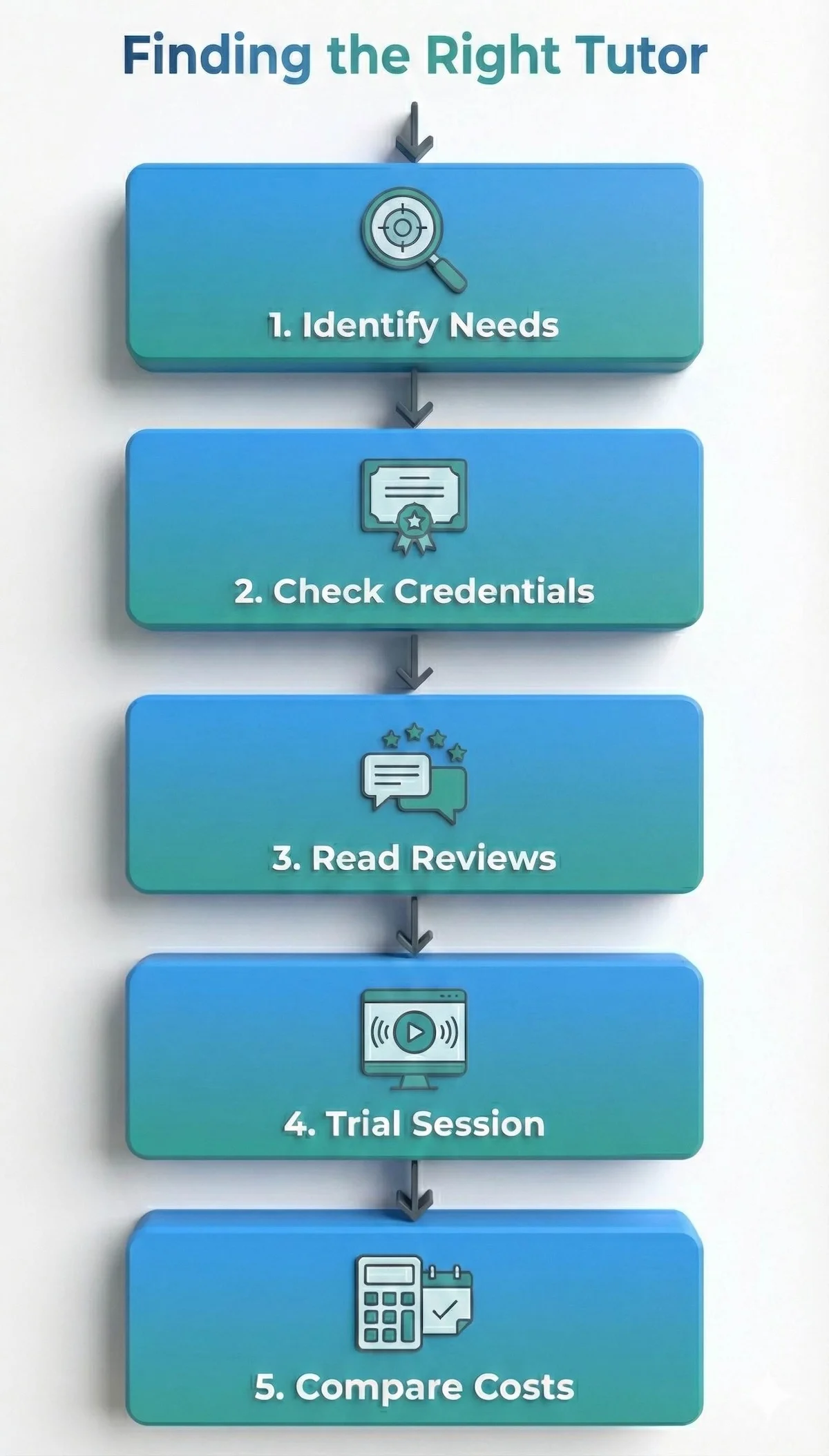
Follow this systematic 5-step process to ensure you hire a tutor who matches your specific academic needs and learning style.
By systematically checking credentials and testing compatibility, you ensure your time and budget are invested in a tutor who can actually deliver results.
Business Management Homework and Assignment Help
Assignments and homework are a big part of business courses, and these can be challenging. Business Management tasks might include case study reports, market analysis projects, or financial calculations.
Tutors are especially helpful here. They clarify instructions and break tasks into manageable steps. For example, a tutor might guide a student through analyzing a marketing case study or building a budget model, explaining each step.
This hands-on help builds real skills rather than just giving answers. As a result, students often complete assignments more efficiently and remember the concepts better. Many tutors even advertise Business Management assignment help or Business Management homework help to indicate they specialize in these tasks.
- Business Management Assignment Help: A tutor can guide you through complex projects, breaking them into smaller tasks (like analyzing market data or writing sections of a report) so you learn while you do the work.
- Business Management HW Help: Tutors review your homework problems, explain mistakes, and reinforce key concepts one-on-one, turning frustrating homework into useful practice.
- Study Skills and Feedback: Beyond specific tasks, a tutor teaches you how to study more effectively for business courses and gives feedback so you avoid repeating errors.
- Exam and Project Prep: Tutors can design practice questions and mock scenarios similar to what you’ll face on exams or major projects, so you enter tests more prepared.
How Online Tutoring Enhances Test Prep for Standardized Exams
Which Business Management Course Modules Are Hardest and Why?
The five core units of Business Management are not equally demanding, and knowing which ones trip up most students helps you allocate tutoring time precisely.
Whether you are studying IB, A-Level, or a university undergraduate programme, the same pattern holds: the modules where abstract theory meets quantitative application consistently produce the lowest scores without targeted support.
The table below ranks the five core modules by typical student difficulty, based on examiner reports, grade-boundary data, and recurring student challenges observed across IB and university programmes.
| Module | Typical Difficulty | Why Students Struggle Most |
| Finance and Accounts | ★★★★★ Hardest | Break-even, investment appraisal, ratio analysis require both calculation accuracy and contextual interpretation |
| Operations Management | ★★★★☆ Hard | Lean production, capacity utilisation, and quality models are easy to memorise but hard to apply to unseen scenarios |
| Human Resource Management | ★★★☆☆ Moderate | Motivation theory is conceptually clear, but linking theories to real business decisions in essays loses marks for most students |
| Marketing | ★★★☆☆ Moderate | Market research, segmentation, and the extended marketing mix are broad; students often cover them too superficially |
| Business Organisation & Environment | ★★☆☆☆ Accessible | Foundational concepts are straightforward, but stakeholder analysis and ethical dimensions require nuanced evaluation skills |
Why Finance and Accounts Trips Up So Many Students
Finance and Accounts is the module where tutoring delivers the most measurable grade improvement.
The challenge is not the arithmetic it is the dual demand of computing correctly and then interpreting the result in the business context of the question. In the IB May 2024 exam session, students needed 73% for a Level 7 at HL, a threshold that rewards speed and depth equally.
A student who calculates the correct net present value but cannot articulate why it supports or undermines the investment decision in the given case study earns partial marks at best.
A tutor helps here by running worked examples that separate the two skills: first the calculation drill, then the contextual write-up. The goal is not to produce a number it is to produce a number that answers a manager’s question.
How to Use a Tutor for Operations Management
Operations Management questions frequently appear with unseen data about production processes, waste ratios, or capacity levels. Students who have only revised definitions and formulae from a textbook are underprepared for this.
Effective tutoring in Operations Management means practising with unfamiliar datasets and asking: what does this number mean for this specific company’s decision? Lean production, just-in-time inventory, and quality assurance are all frameworks that must be applied under time pressure not recited.
One to two sessions per term dedicated specifically to unseen operations scenarios produces measurably better outcomes than general revision.
What Makes Human Resource Management Hard in Essays
HRM module marks are lost almost entirely in extended-response questions. Students can usually define Maslow, Herzberg, or Taylor accurately but when asked to evaluate which motivational approach suits a specific company scenario, they default to listing rather than judging.
Examiners at both IB and A-Level reward the student who picks a position, argues it with evidence from the case, and then qualifies it honestly. A tutor who has marked papers at this level can show you exactly what that looks like in practice far more useful than re-reading a textbook chapter.
Also Read: 24/7 Premium 1:1 Tutoring For Standardized Tests
How Does a Tutor-Guided Approach to Case Study Analysis Work?
Case study analysis is the assessment format most business students find hardest and most tutors handle least effectively. A tutor-guided approach works by building a repeatable analytical protocol, not by reviewing past cases and hoping the next one is similar.
For IB students, this is especially critical: Paper 1 is built around a pre-released case study (for 2026, the Abraca ABC company), but the exam questions themselves are unseen, so familiarity with the company alone is insufficient.
The tutor-guided case analysis method follows a structured sequence that applies across all qualification types.
Step 1 Dissect Before You Analyse
Before applying any business model, a tutor trains the student to map the case: who are the stakeholders, what decision is being considered, what quantitative data is present, and what time pressures exist.
This takes three to five minutes in an exam but prevents the single most common error applying a framework to the wrong aspect of the scenario.
For IB 2026, examiners reward students who use the Abraca ABC case details (such as the e-waste processing expansion or the dual revenue streams from construction concrete and precious-metal recovery) to justify analysis, not students who list frameworks as trivia.
Step 2 Select the Right Tool, Not the Familiar One
Students tend to reach for the framework they revised most recently, not the one best suited to the question. A tutor systematically builds the habit of asking: does this question call for SWOT, Porter’s Five Forces, Ansoff’s Matrix, stakeholder analysis, or a financial ratio? Each has a distinct application context.
Porter’s Five Forces suits competitive positioning questions; Ansoff suits growth strategy questions; ratio analysis suits financial performance questions.
Mixing them up using SWOT when a ratio would be more precise signals to an examiner that the student has not read the question carefully.
Step 3 Separate Define, Apply, Analyse, Evaluate
IB and A-Level mark schemes assign marks to four distinct cognitive moves: defining a term, applying it to the case, analysing its implications, and evaluating competing interpretations.
These are not the same operation, and conflating them is the most common reason students plateau at a mid-range grade.
A tutor walks through each move separately in practice answers, then gradually reduces the scaffolding until the student can execute all four automatically under timed conditions.
Step 4 Conclude With a Judgement, Not a Summary
Extended-response questions at IB Paper 1 (10 marks) and A-Level require a conclusion that makes a reasoned recommendation, not a restatement of what was already argued.
Many students lose two to three marks per question here. A tutor-guided approach practises conclusions as standalone exercises: given these arguments, what is the most defensible position, and why? This is a learnable skill and one that almost no classroom setting has time to develop individually.
Read More: StudyX Online Tutoring Review: Features, Pricing, and Alternatives
What Are the Best Business Management Exam Strategies by Assessment Type?
Exam strategy in Business Management is more qualification-specific than in most subjects.
The skills that earn top marks on an IB Paper 1 differ from those needed for A-Level data-response questions, which in turn differ from university coursework or timed essay assessments.
A tutor who understands your specific assessment format is far more useful than generic exam advice.
The table below maps the main assessment types to the strategies that directly improve scores.
| Assessment Type | Qualification | Top Strategy | Common Mistake to Avoid |
| Paper 1 (Pre-Released Case Study) | IB SL & HL | Deep context mapping of the pre-release material; practise unseen questions on that context | Treating case familiarity as exam preparation — it is only foundation |
| Paper 2 (Unseen Stimulus) | IB SL & HL | Timed practice with unfamiliar data sets; master the define-apply-analyse-evaluate ladder | Writing long definitions at the expense of application and evaluation marks |
| Paper 3 (HL Social Enterprise) | IB HL only | Synthesis of multiple HL topics under 75 minutes; build a bank of evaluation angles | Treating Paper 3 like a longer Paper 2 — it requires multi-topic synthesis |
| Internal Assessment (IA) | IB SL & HL | Choose a real business with accessible data; use a conceptual lens from the toolkit; start early | Broad research questions that prevent depth within the word limit |
| Data-Response & Essays | A-Level | Use business models explicitly by name; structure arguments in three tiers: point, evidence, analysis | Generic answers that apply frameworks without anchoring to the stimulus material |
| Coursework & Reports | University | Demonstrate critical evaluation, not description; cite peer-reviewed sources for theory claims | Descriptive reports that summarise instead of analysing competing positions |
IB Paper 1 What the Pre-Released Statement Actually Asks You to Do
Three months before the IB exam, the organisation releases a pre-statement containing contemporary business topics and the opening paragraphs of the case study. For May 2026, the Abraca (ABC) case involves a company managing two distinct business identities: concrete production and e-waste recycling with precious-metal recovery. The IB’s explicit guidance is to spend a maximum of five hours on pre-release preparation.
Students who over-research become confused; students who under-prepare miss the contextual vocabulary that examiners expect.
A tutor structures that five hours precisely: build a mini glossary of the industry terms, map the four strategic considerations in the case, and write two to three timed practice paragraphs that link the context to the toolkit. The goal is calibrated familiarity, not exhaustive subject expertise.
Read More: Online Tutoring Trends in 2026: The Ultimate Guide
IB Business Management vs A-Level vs University How Does Tutoring Differ?
Tutoring needs for business management students vary significantly depending on the qualification. The IB, A-Level, and university-level approaches each demand different cognitive skills, different assessment formats, and therefore a different kind of expert support.
Understanding these differences before hiring a tutor ensures you get help that is genuinely aligned with what your exams and coursework actually require.
| Feature | IB Business Management | A-Level Business | University (Undergraduate) |
| Depth Focus | Strategic decision-making, global ethics, Internal Assessment | Theory application, structured essays, data response | Critical analysis, research methods, academic argumentation |
| Assessment Mix | Papers 1, 2, (HL: Paper 3) + IA (25% SL, 20% HL) | 100% external written exams (3 papers) | Coursework, group projects, dissertations, timed exams |
| What Tutoring Addresses Most | Case study application, IA research design, Paper 3 synthesis | Exam technique, mark-scheme literacy, structured evaluation | Critical thinking, academic writing, referencing, analytical frameworks |
| Ideal Tutor Profile | Former IB examiner or experienced IB teacher; HL and SL expertise | Experienced A-Level teacher or examiner; board-specific knowledge (AQA/Edexcel/OCR) | Subject specialist with postgraduate research experience |
| Tutoring Priority | IA and Paper 1 preparation | Past-paper practice and timed essay drilling | Coursework structure, argument development, source integration |
What IB Business Management Tutoring Specifically Requires
IB Business Management is taught in approximately 5,800 schools across 160 countries, and the curriculum explicitly integrates global ethics, cultural perspectives, and sustainability into every unit.
A tutor who only knows A-Level Business will not know the IB’s six underpinning concepts Change, Culture, Ethics, Globalisation, Innovation, and Strategy nor how they appear in mark schemes.
For IB students, the Internal Assessment is the single most tutor-responsive element of the course: it involves original research on a real organisation, a focused research question, and the application of the Business Management Toolkit within a strict word limit.
Students who begin their IA with a tutor in Year 1 of the diploma consistently produce stronger work than those who seek help only in the final weeks before submission.
What University-Level Business Tutoring Specifically Requires
University business management students face a different challenge from IB and A-Level students: the move from knowledge recall and framework application to genuine critical analysis, original argument construction, and independent research.
University tutors for business management are most useful when helping students understand the distinction between descriptive writing and analytical writing a gap that many undergraduates do not close without direct feedback.
Group projects and presentations, which carry significant grade weight at most universities, also require a different set of skills that tutors can systematically develop, including how to divide analytical tasks across a team, how to structure a live presentation, and how to respond to challenging questions from a lecturer or panel.
Read More: Top 10 Online Tutoring Websites Worldwide
What Are the Best Business Management Career Paths in 2026?
A business management qualification whether IB, A-Level, or a university degree opens a wide range of career paths with meaningfully different salary profiles and growth trajectories.
Understanding where these paths lead, and what the market is currently paying, helps students make purposeful decisions about which modules and specialisations to prioritise.
The table below covers key 2026 career paths, typical entry-level roles, and verified salary ranges from authoritative sources including the U.S. Bureau of Labor Statistics and the Graduate Management Admission Council (GMAC).
| Career Path | Common Entry Roles | Typical Salary Range (2026) | Growth Outlook |
| Management Consulting | Business Analyst, Junior Consultant | $75,000–$105,000 base; top firms (McKinsey, Bain, BCG) average $192,000 for MBA hires | Strong; AI strategy and digital transformation driving demand |
| Finance and Corporate Banking | Financial Analyst, Corporate Treasurer | $72,000–$130,000; CFO-track roles average $152,724 per PayScale | Stable; financial manager roles projected to grow 16% (2022–2032, BLS) |
| Marketing and Brand Management | Marketing Coordinator, Brand Analyst | $62,000–$90,000 entry-level | Growing; digital marketing and data analytics skills command premiums |
| Operations and Supply Chain | Operations Analyst, Supply Chain Coordinator | $70,000–$95,000 | Steady; logistics optimisation and sustainability roles increasing |
| Human Resources Management | HR Coordinator, Talent Acquisition | $78,000 average (Indeed, 2025); HR manager roles growing 5% (BLS, 2022–2032) | Moderate; DEI and people analytics driving specialist demand |
| Technology and Product Management | Business Analyst, Product Manager | $80,000–$140,000; MBA hires at Amazon ($129,412), Google ($125,218), Microsoft ($140,348) | Fast-growing; AI, Web3, and GreenTech creating new leadership tracks |
| Healthcare Management | Health Services Administrator | $82,774–$106,124 median (BLS 2024); sector growing 28% (2022–2032) | Fastest-growing category; digital health and biotech driving demand |
| Entrepreneurship | Founder, Business Development Lead | Variable; business management knowledge reduces startup failure risk | Expanding; MBA programmes offer strongest entrepreneurial network access |
Does a Business Management Degree Actually Increase Salary?
Yes the evidence is consistent. According to the GMAC Corporate Recruiters Survey (2025), U.S. companies paid new MBA hires a median starting salary of $125,000. MBA graduates report an average salary increase of approximately 46% compared to their pre-degree earnings.
Over a 10-year career arc, MBA earners consistently outperform non-MBA peers, with average annual salaries ranging from $179,000 to $242,000 depending on sector and gender.
For undergraduate business management graduates, the median annual wage for business and financial occupations was $80,920 in 2024 (BLS), with high-level management roles averaging $122,090.
Which Specialisations Command the Highest Salaries in 2026?
Among the most in-demand MBA and business management specialisations in 2026, finance, technology management, and data analytics lead in starting compensation.
Emerging areas ESG (environmental, social, and governance) strategy, AI product management, and digital health are creating new high-value tracks that did not exist in the same form five years ago.
Students who combine core business management knowledge with competence in one of these technical domains are consistently outperforming generalists in the current hiring market.
A tutor who understands your target sector can help you identify which modules and skills to develop most deliberately during your studies.
Read More: Online Tutoring vs. In-Person Tutoring: Which is Right for You in 2026?
How Can a Tutor Help With Business Management Group Projects and Presentations?
Group projects and presentations are among the most consistently underserved areas in business management tutoring.
Most students seek help for exam technique or written assignments but group work and live presentations carry substantial grade weight at university level and are assessed in some IB and A-Level components as well.
A tutor’s role here is different from content instruction: it is about building the structural and communicative skills that allow a student to perform well when the work is collaborative and the audience is live.
How to Structure a Business Management Group Project Effectively
The most common failure mode in business management group projects is unequal contribution combined with poor analytical structure. Students default to dividing the report by section (one person writes the marketing section, another the finance section) without establishing a unifying analytical framework.
The result is a report that describes each function separately rather than evaluating how they interact to address the central business problem.
A tutor helps a group establish that framework before any section is written typically by mapping the central decision or recommendation first, then assigning sections based on how each function contributes evidence toward that conclusion.
University assessments in 2026 increasingly require students to demonstrate live analytical thinking under scrutiny the ability to respond to a challenging question with “that challenge is fair; here’s why our framework still holds given the evidence” is a distinguishing skill. It is also entirely learnable with structured practice.
Frequently Asked Questions
Q1 What is Business Management tutoring?
It is personalized, one-on-one instruction in business subjects that helps students grasp difficult concepts and improve their skills.
Q2 How does Business Management tutoring help students?
It provides one-on-one guidance on tough topics, filling learning gaps and often improving their grades.
Q3 Can Business Management tutoring be done online?
Yes, students can find Business Management tutoring online via video sessions, which provides flexible and remote learning options.
Q4 Who can benefit from Business Management tutoring?
Any student in business-related courses (high school or college, including IB and A-level programs) can benefit, especially those needing extra support or aiming for top grades.
Q5 How much does Business Management tutoring cost?
Rates vary widely, but many Business Management tutors charge about $25–$50 per hour.
Q6 How do I find a qualified Business Management tutor?
Search tutoring platforms or ask for referrals, and choose someone with relevant business credentials and positive reviews.
Related Subjects
Business Analysis
Business Communication
Business Intelligence
Business Process Management
Conflict management
Consumer Behaviour
Corporate Strategy
Cross-cultural management
Design Thinking
E-commerce
Enterprise Resource Planning (ERP)
Entrepreneurship
HR Analytics
Human Resource Management
International Business
Interview Preparation
Knowledge management
Leadership
Management Consulting
Management Science
MBA (Master of Business Administration)
Negotiation
Operations & Production Management
Organizational Behaviour
Organizational development
Organizational Theory
Performance Management
Principles of Management
Product Management
Risk Management
Sales
Salesforce
SAP ERP
Time Management
******************************
This article provides general educational guidance only. It is NOT official exam policy, professional academic advice, or guaranteed results. Always verify information with your school, official exam boards (College Board, Cambridge, IB), or qualified professionals before making decisions. Read Full Policies & Disclaimer , Contact Us To Report An Error