MCAT Prep in 2026: Score Benchmarks, Study Plans, and Course Comparisons

- The national MCAT matriculant average is 511.8; top-tier MD programs average 518+.
- 2026 MCAT registration is open now, with 30 test dates from January through September.
- Each MCAT section requires a fundamentally different preparation and tutoring strategy.
- The AAMC’s retake data shows a median gain of only 2–3 points on a second attempt.
- The 16-week plan maps to the AAMC’s recommended 300 prep hours across four phases.
Every year, roughly 52,400 students apply to US allopathic medical schools. Only about 23,400 matriculate. The most consistent variable separating those two groups across GPA bands, backgrounds, and school tiers is the MCAT score.
The national average for 2025-cycle matriculants was 511.8 (AAMC data), yet top-tier research programs routinely admit classes averaging 518 or above. That gap between “nationally competitive” and “tier-competitive” is where most students get stuck — not because they lack intelligence or dedication, but because they are preparing without a strategy calibrated to their specific target. If you are looking for an MCAT tutor to help close that gap, personalized 1:1 guidance is one of the most effective tools available.
Registration for all 2026 MCAT test dates is now open through the AAMC’s registration system, with 30 exam windows spanning January through September. The decision of when to sit, which section to prioritize, whether to work with a tutor, and which course to choose are not afterthoughts — they are the preparation.
This guide covers all of it: 2026 test dates and registration, section-by-section tutoring strategies, score benchmarks by program tier, a head-to-head course comparison, a 16-week integrated study plan, and a clear framework for deciding whether and how to retake.
Check Out: Get Personalized Online Tutoring
What Are the 2026 MCAT Test Dates and How Do You Register Strategically?
The 2026 MCAT testing year runs from January through September, with 30 scheduled test dates in the US. Registration for all January–September 2026 dates opened on October 21–23, 2025 through the AAMC registration portal, and seats are available on a first-come, first-served basis — popular dates and locations in high-demand cities fill quickly.
How Should You Choose Your 2026 Test Date?
Strategic date selection is one of the highest-leverage decisions in MCAT preparation, yet most students treat it as an afterthought. The right date depends on three factors working together: your application cycle target, your preparation timeline, and whether you need a retake window.
If you are targeting the Fall 2026 application cycle, plan your MCAT for no later than May or early June 2026. Scores are released approximately 30–35 days after your exam date, and AMCAS applications open in May. Testing in May gives you a score by late June — early enough to submit a competitive application in the first weeks of the cycle, which is where acceptance rates are statistically highest. Testing in August or September significantly reduces your odds of rolling-admission consideration at most programs.
Registration fees for 2026 are $345 for standard US registration (plus a $120 international fee for students testing outside the US, Canada, Guam, Puerto Rico, and US Virgin Islands). The AAMC’s Fee Assistance Program reduces the standard fee to $140 for eligible applicants and must be approved before registration — not retroactively applied. The 10-day deadline before each test date is the final window to schedule, reschedule, or cancel a reservation; all fees are non-refundable upon cancellation.
| Application Cycle Target | Recommended Test Window | Score Available By | Retake Window Available |
| Fall 2026 (early cycle) | January–March 2026 | February–April 2026 | Yes — May/June retake possible |
| Fall 2026 (standard) | April–May 2026 | May–June 2026 | Yes — August retake possible |
| Fall 2026 (final) | June 2026 | July 2026 | Limited — September only |
| Fall 2027 | January–June 2026 | February–July 2026 | Strong retake flexibility |
What Should You Know Before Registration Day?
Create your AAMC account in advance — do not create a new account if you have used any AAMC service before, as duplicate accounts create registration problems. Have your MCAT-accepted photo ID available and ensure your name exactly matches your registration.
If applying for Fee Assistance, the AAMC advises a two-week processing window; apply immediately and wait for approval confirmation before registering. On registration opening day, the AAMC recommends selecting two or three backup date preferences in case your primary choice is unavailable. Test centers operate at limited capacity, and the most popular windows (May and August) typically see the fastest seat fill-up.
Students preparing for other high-stakes standardized exams may also find it useful to explore resources on EmSAT tutoring, particularly for those navigating multiple exam timelines.
The Ultimate Guide to Online Tutoring 2026: Expert Tips, Pricing & Platform ReviewsThe MCAT Unpacked: Beyond a Standardized Test
The MCAT (Medical College Admission Test) is not a content recall exam — it is a scientific reasoning and analytical thinking assessment. Understanding this distinction is the most important insight a student can carry into their preparation, and it is the reason that passive content review consistently underperforms relative to active practice and expert-guided strategy.
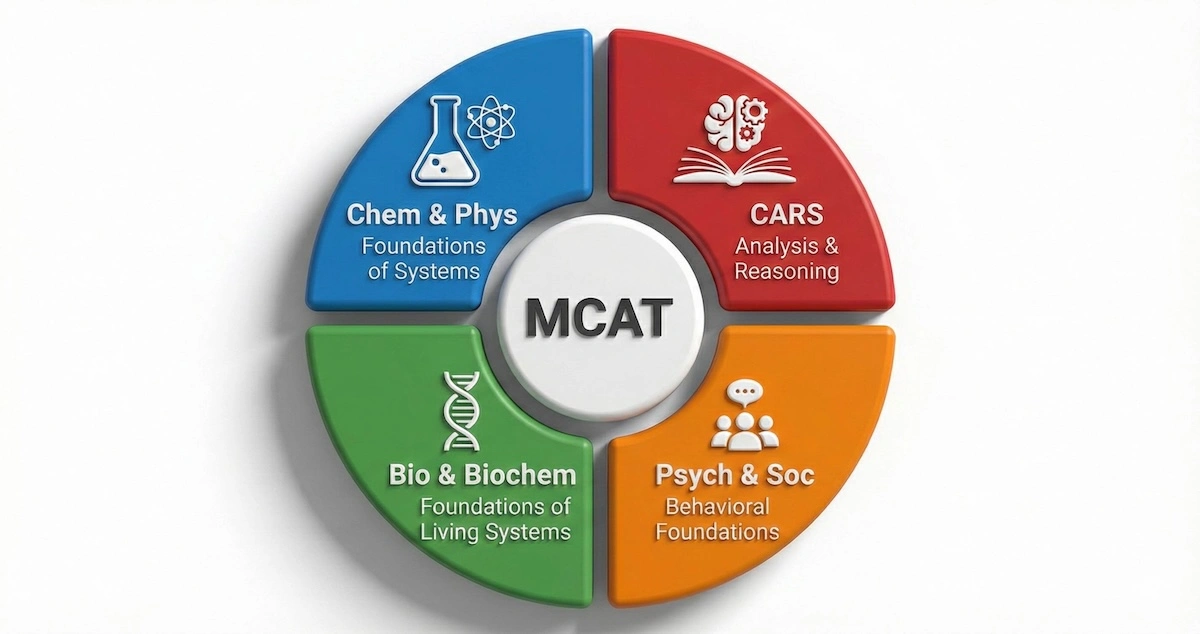
The exam is divided into four sections, each testing a specific reasoning domain across a vast body of knowledge. The visual below outlines how the test is structured.
A Deep Dive into the Four Sections
The four distinct sections of the MCAT each test specific skills across a broad knowledge base. The Biological and Biochemical Foundations of Living Systems section tests cellular and molecular biology, genetics, and biochemistry through data-driven passages that require analysis, not recall.
The Chemical and Physical Foundations of Biological Systems section draws on organic chemistry, inorganic chemistry, and physics in clinical and research contexts.
The Psychological, Social, and Biological Foundations of Behavior section — often underestimated — assesses biochemistry, psychology, and sociology through the lens of healthcare and patient behavior.
The Critical Analysis and Reasoning Skills (CARS) section is unique in that it tests no science content at all — it assesses analytical comprehension through dense humanities and social science passages. CARS cannot be studied the same way science sections can; it requires sustained practice in active reading strategy, often over months.
The real difficulty of the MCAT is interdisciplinary: questions routinely require combining knowledge from multiple disciplines to solve a novel problem — a skill that standard college exams do not typically test and that self-study books rarely teach effectively.
The Scoring System: It’s Not a Curve
Each of the four sections is scored on a scale from 118 to 132, with a midpoint of 125. Combined scores range from 472 to 528, with a midpoint of 500. The MCAT uses equated scoring — not a curve — which means a student’s score is a fixed, absolute measure of their performance relative to the difficulty of their specific test form, independent of other test-takers on the same day.
Why does this matter strategically? Because there is no benefit to being in an easier room on test day. Your score is yours alone. This places the full responsibility — and the full upside — on your individual preparation quality.
 How Online Tutoring Enhances Test Prep for Standardized Exams
What MCAT Score Do You Need for Your Target Medical School Tier?
The single most common MCAT preparation mistake is aiming for “a competitive score” without knowing what competitive means for the specific programs you are targeting.
The AAMC’s most current data (2025 cycle) establishes that the overall acceptance rate for MD programs was just under 45%, with 52,400 applicants competing for 23,400 seats. Among those who matriculated, the average MCAT was 511.8. That number, however, conceals enormous variation across program tiers.
| Program Tier | Typical Avg Matriculant MCAT | Competitive Target Score | Example Programs |
| Top-10 Research (MD) | 521–524 | 520+ | UCSF, Johns Hopkins, Harvard, Columbia |
| Top-25 Research (MD) | 517–520 | 516+ | Georgetown, Case Western, Tufts |
| Mid-Tier MD Programs | 510–516 | 510+ | Many state flagship schools |
| Below-Average MD (still accredited) | 504–509 | 504+ | Regional MD programs |
| Osteopathic (DO) Programs | 499–502 | 500+ | AACOM 2025 data: avg matriculant 500 |
Sources: AAMC 2025 FACTS Data; AACOM 2025 Matriculant Data; Jack Westin MCAT Score Analysis (2025). Individual school medians available via AAMC MSAR database.
A student with a 3.8+ GPA who scores in the 506–509 range — genuinely above the national applicant average of 506 — still sees only a 55.4% acceptance rate across all MD programs (AAMC aggregated 2021–2024 data). The same student with a 514–517 sees that rate climb to 77.1%. Every score band above 510 represents a statistically significant improvement in admission probability, particularly for competitive programs.
The implication is direct: identify your target schools’ 75th-percentile admitted MCAT score — not the 50th — and treat that as your preparation target. A score at the 50th percentile of an admitted class still places you below half of your competition in the application pool. At top-tier programs, that position rarely survives the holistic review process unless the rest of the application is exceptional.
One counterintuitive finding from AAMC student success data: MCAT scores above 517 are not just admissions predictors — they correlate strongly with Step 1 and Step 2 pass rates and on-time progression through medical school, suggesting the exam measures genuine preparedness for the curriculum, not just admissions competitiveness.
The Data That Drives Decisions
The Unmistakable Correlation: Scores and Acceptance Rates
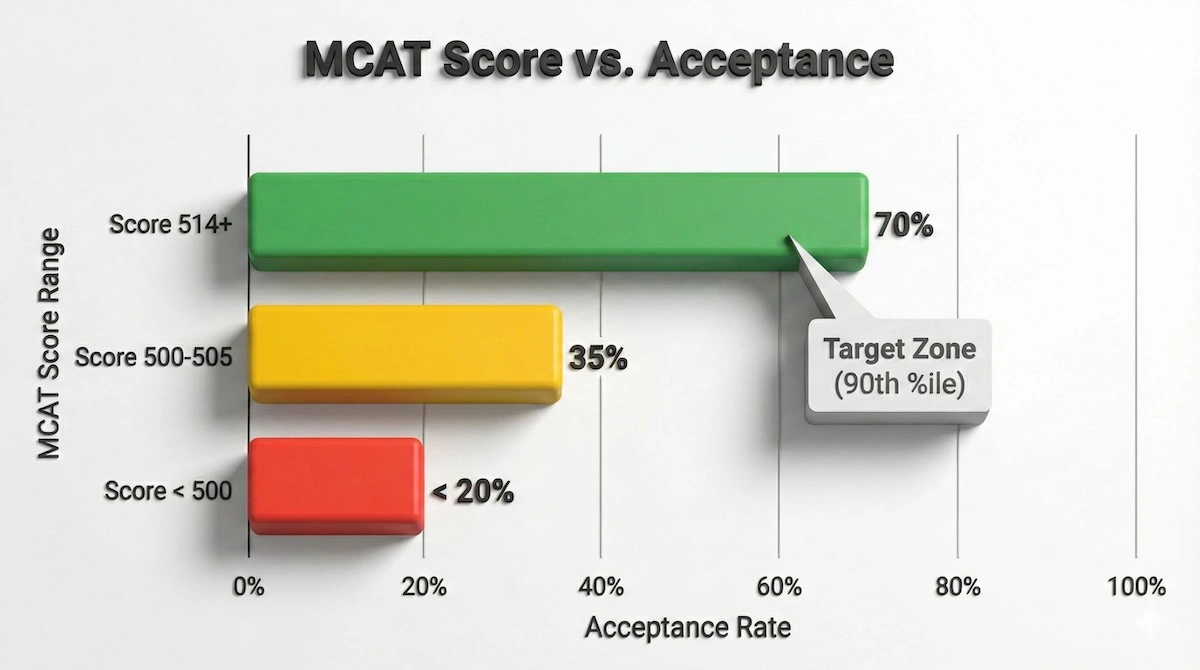
While many factors contribute to a successful medical school application, the MCAT score is one of the most significant. The Association of American Medical Colleges (AAMC) data shows a clear and compelling correlation between MCAT scores and medical school acceptance rates. This is because the score is the single most quantifiable component of an application, providing admissions committees with a reliable, objective metric to assess a candidate’s academic preparedness.
While some applicants with lower scores may be admitted due to exceptional qualifications, they are typically the exception rather than the rule, making a strong score a vital part of a competitive application. This data reinforces that investing in preparation is not just about gaining knowledge; it is a strategic maneuver to increase the probability of a life-changing outcome.
| Total GPA | Total MCAT Score | Acceptance Rate % |
| 3.80–4.00 | 486–489 | 3.3% |
| 3.80–4.00 | 494–497 | 19.2% |
| 3.80–4.00 | 506–509 | 55.4% |
| 3.80–4.00 | 514–517 | 77.1% |
| 3.80–4.00 | 518–528 | 83.6% |
Source: AAMC FACTS Table A-23, aggregated 2021–2024 data
Also Read: 24/7 Premium 1:1 Tutoring For Standardized TestsBeyond the Books: The Real Challenges of MCAT Prep
The Psychological Gauntlet: Anxiety and Procrastination
Preparing for the MCAT is not just an academic challenge; it is a psychological one. Many students find themselves overwhelmed by the sheer volume of material, the time commitment, and the pressure to perform. Procrastination and poor time management are common mistakes that can quickly spiral out of control, leaving a student feeling unprepared and anxious as their test date approaches. Motivation is often an unreliable friend, and relying on it alone can lead to a cycle of stress and self-doubt.
The fear of failure and anxiety about the outcome can be crippling, and a student who feels this way may struggle to see their progress or even begin studying effectively. This is where the human element of a professional MCAT tutor becomes invaluable. A tutor provides crucial accountability, acting as a consistent, encouraging presence that can help a student stay on track and push through tough topics. They offer a judgment-free space to ask questions, no matter how small, and can help a student regain confidence that may have been eroded by the weight of their own expectations.
The Practice Paradox: Memorizing vs. Applying
A common mistake students make is focusing too much on passive content review and not enough on active practice. While building a solid foundation of knowledge is essential, the MCAT is a performance, not a memorization test. A student can read textbooks for months and still feel unprepared because the exam tests the ability to apply and integrate concepts — not simply recall them. When a student hits a plateau in their practice scores, it is often a sign that they have fallen into the trap of passive studying.
One expert recommendation: spend 1.5 to 2 times as long reviewing a practice exam as it took to complete it. This review should focus not just on confirming the correct answer, but on reconstructing why the correct answer is right and precisely why each incorrect option fails. A professional MCAT teacher can help a student shift their study paradigm from rote memorization to active, strategic problem-solving.
The Foundational Gaps: When Basics Become Barriers
Sometimes the greatest barriers to a higher MCAT score are not the complex scientific topics, but fundamental skills taken for granted — reading comprehension and mental math fluency among them. A student might miss a CARS question where the answer is explicitly stated in the passage simply because they are not reading effectively, or lose significant time on calculation questions due to arithmetic hesitation.
This is a particularly frustrating problem because it is a hidden weakness that a self-study book or online course cannot diagnose. A skilled online MCAT tutor can pinpoint these foundational gaps and provide targeted instruction to correct them, helping a student move from knowing the content to performing like a physician — which is what the MCAT truly assesses.
What Is the Best Section-by-Section MCAT Tutoring Strategy?
Each of the four MCAT sections demands a fundamentally different tutoring approach. Students who treat all four sections as interchangeable content-review problems will consistently plateau in at least one area. A qualified MCAT tutor diagnoses section-specific failure modes — and the remediation is never the same twice.
Students preparing for research-focused standardized assessments may also find value in exploring AP Seminar tutoring, which builds the analytical reading and argument-evaluation skills that transfer directly to CARS preparation.
How Do You Improve Your CARS Score With a Tutor?
CARS (Critical Analysis and Reasoning Skills) is the section most students approach incorrectly. Because it contains no science content, many assume it can be improved through general reading. Experienced tutors know this is wrong. CARS improvement comes from learning a specific active reading methodology — tracking the author’s argument structure, identifying the rhetorical purpose of each paragraph, and answering questions based on what is in the passage rather than outside knowledge.
A typical tutor-student CARS session focuses on a single passage: the student reads it aloud, narrates their reasoning on each question, and the tutor identifies which specific reading behaviors are producing errors. Three to four such sessions, with targeted practice between them, typically produce measurable CARS improvement within four to six weeks.
How Do You Improve Your Biological and Biochemical Foundations Score?
The Biological and Biochemical Foundations (Bio/Biochem) section covers the widest content territory on the exam — genetics, molecular biology, physiology, organic chemistry mechanisms, and enzyme kinetics all appear. For most students, the challenge is not content knowledge in isolation but integrating knowledge across disciplines within a single passage. A student who knows enzyme inhibition from biochemistry and knows enzyme kinetics from biology may still miss a passage question that requires both simultaneously.
Tutoring for Bio/Biochem is most effective when focused on passage-based problem solving rather than content review in isolation. The tutor identifies which integration points — which cross-disciplinary reasoning steps — are failing and drills those specifically. Biochemistry pathways (particularly amino acid metabolism and cellular respiration) and experimental design questions are consistently high-yield tutoring targets for students who have mastered individual content areas but are still missing application questions.
How Do You Build Your Chemical and Physical Foundations Score?
The Chemical and Physical Foundations (Chem/Phys) section is the most heavily formula- and calculation-dependent section of the MCAT, but the AAMC explicitly states that the exam does not require advanced mathematical computation — all calculations can be performed through estimation, proportion, and unit analysis. Students who spend hours deriving and memorizing formulas are over-preparing for the wrong skill.
The most effective tutoring focus for Chem/Phys is physics reasoning and dimensional analysis, because these skills transfer across question types regardless of the specific topic. A tutor who watches a student work through a circuits or fluid dynamics passage in real time can identify within minutes whether the student is performing unnecessary computation (a time sink) or misreading the experimental setup (a conceptual gap). Both require completely different remediation.
Students who want to deepen their physics reasoning skills independently may also benefit from working with an AP Physics 2 tutor, as the conceptual overlap with MCAT Chem/Phys is substantial.
How Do You Prepare for the Psychological and Social Foundations Section?
The Psychological, Social, and Biological Foundations of Behavior section — commonly called Psych/Soc — is the most underestimated section among science-oriented pre-med students. It tests a broad range of behavioral science concepts (Freudian theory, social stratification, health disparities, research methods) through a science-reasoning framework identical to the other sections. Students who approach it as a vocabulary memorization exercise typically score below their potential.
Effective Psych/Soc tutoring focuses on two skill sets: building a mental map of the behavioral science content domains (which are systematic and learnable) and applying research design and statistical reasoning to passage-based questions. The research methods and statistics component of Psych/Soc is particularly high-yield for tutoring because errors in this area are almost entirely due to reasoning strategy, not content gaps — making them very fast to fix with targeted diagnosis.
Read More: StudyX Online Tutoring Review: Features, Pricing, and AlternativesThe Undeniable Benefits of Professional MCAT Tutoring
The Power of Personalized Learning
One of the most significant benefits of professional MCAT tutoring is the power of a personalized learning experience. Unlike a generic prep course that follows a fixed curriculum, a professional MCAT tutor conducts an unbiased assessment of a student’s unique strengths and weaknesses to create a customized study plan. This tailored approach ensures that a student’s time is spent most efficiently, focusing on the concepts they need to improve upon while not wasting valuable time on material they have already mastered.
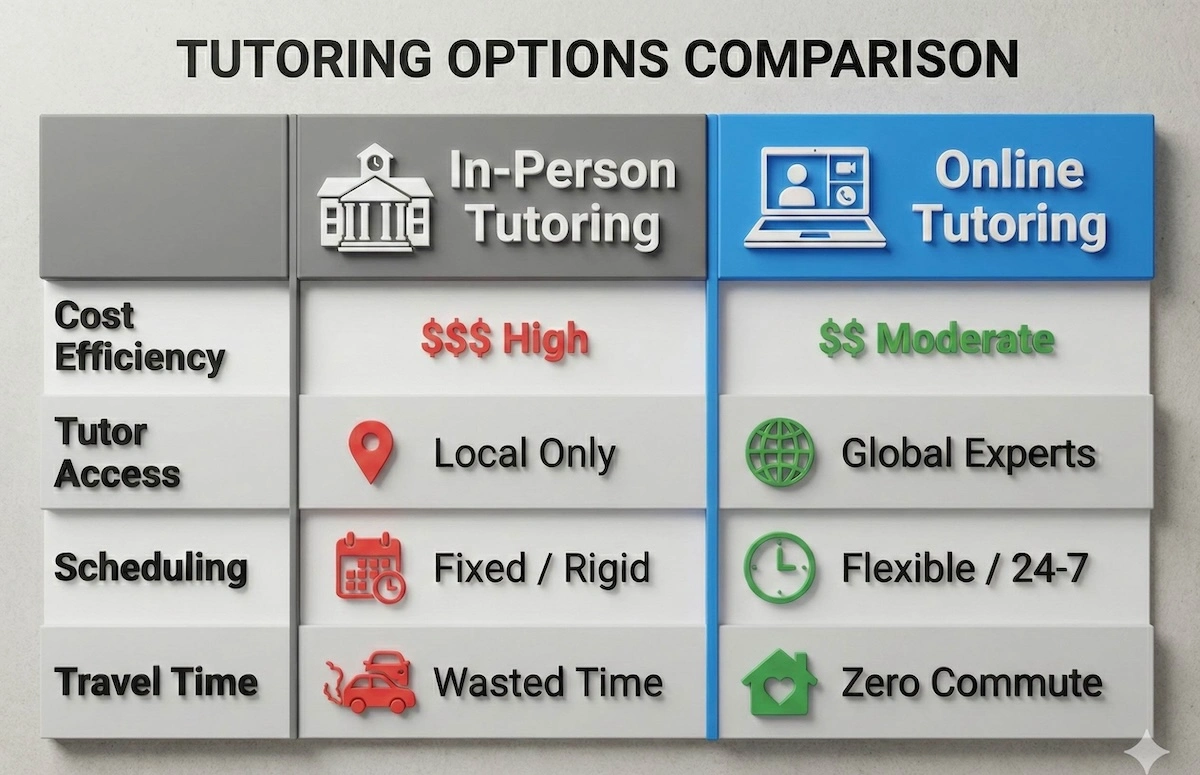
The flexibility of MCAT tutoring online is another major advantage, allowing sessions to be scheduled around a student’s busy life, which may include schoolwork, jobs, or extracurricular activities.
Deciding between a local tutor and an online expert often comes down to value. The comparison below shows the key differences.
More Than Content: Strategy, Efficiency, and Confidence
A great MCAT tutor provides much more than just content review. They are experts in the structure and pacing of the exam and can teach a student effective test-taking strategies to manage time and tackle complex questions. This is where a professional can provide the most powerful guidance — reviewing practice exams, identifying patterns of error, and targeting the specific gaps that are holding the student back.
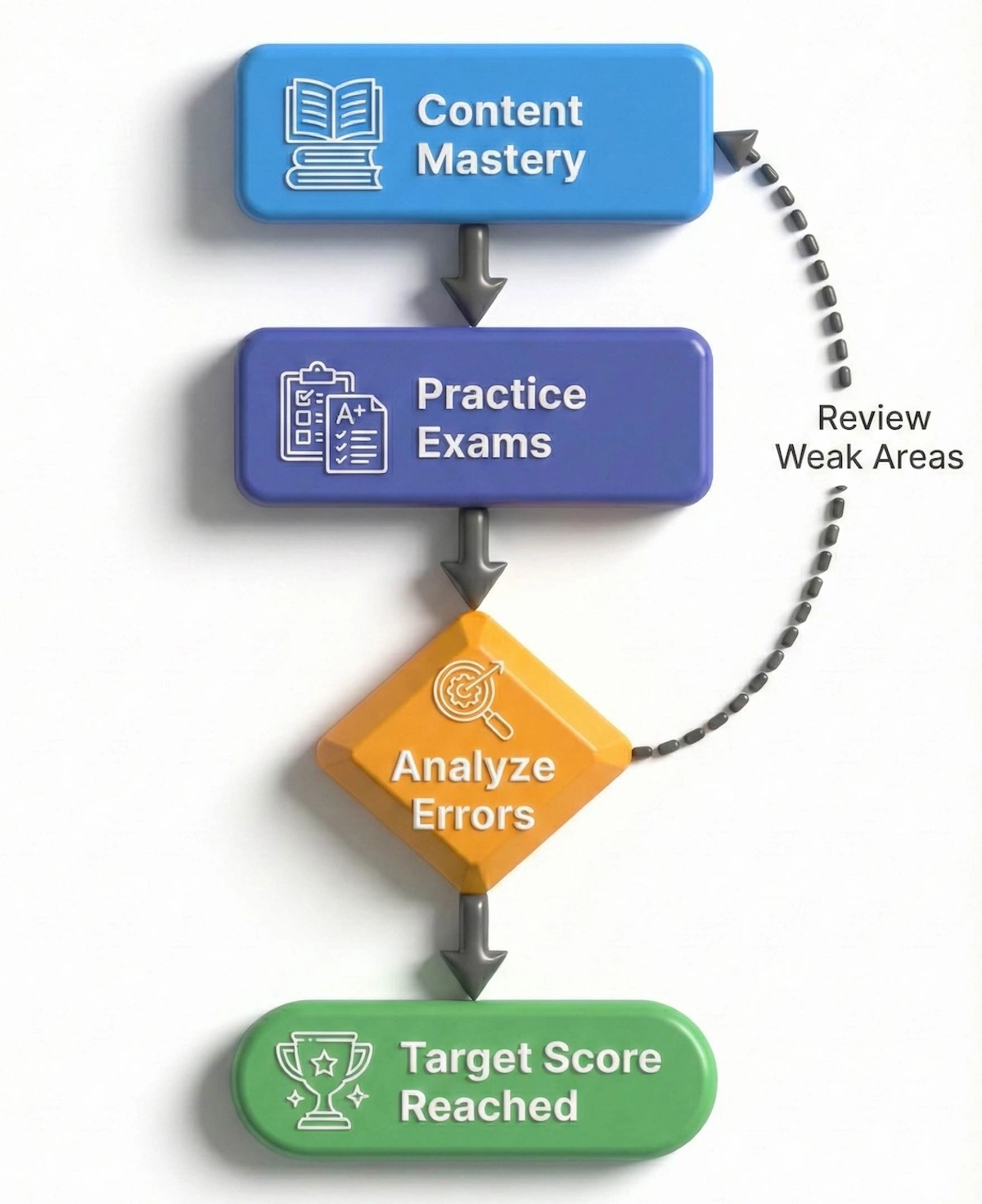
Your study plan shouldn’t be a straight line, but a cycle of improvement. Here is the workflow that leads to top scores.
How Do the Top MCAT Prep Courses Compare: Kaplan, Princeton Review, Blueprint, and MEB?
No single MCAT prep course is objectively best. The right choice depends on your learning style, starting score, budget, and how much structure you need. The table below compares the four most relevant options for 2026.
| Provider | Best For | Format Options | Price Range | Strengths | Limitations |
| Blueprint MCAT | Visual learners; CARS-focused students | Self-paced, Live Online, 1:1 tutoring | $300/mo (self-paced) to ~$3,500 (515+ course) | Best video quality; most AAMC-accurate practice tests; strong analytics | Dense curriculum; practice Qs slightly harder than real MCAT |
| Kaplan | High-volume practice; adaptive learners | Self-paced, Live Online, In-Person | ~$1,500 (self-paced) to $3,000+ (in-person) | 10,000+ practice questions; excellent video lessons; strongest score guarantee | CARS materials weaker than Blueprint; higher per-hour cost |
| Princeton Review | Students needing live instruction; textbook learners | Self-paced, Live Online, In-Person, Immersion | ~$1,999 (self-paced) to $11,000 (tutoring) | 123–195 hrs live instruction; 11 prep books; best CARS workbook; science workbooks | Video production quality lower; most expensive tier |
| MEB 1:1 Tutoring | Students needing targeted diagnostic help; budget-conscious | 1:1 Online Tutoring; Homework Guidance | Starting ~$20–$40/hr | Fully personalized, section-specific; flexible scheduling; no package minimums | No course materials included — best paired with AAMC or Blueprint resources |
Pricing based on published 2025–2026 course rates. All providers run periodic discounts.
How to decide: If you are a visual learner with strong self-discipline and at least three months of lead time, Blueprint’s self-paced course offers the best value per dollar for most students. If you are motivated by live instruction and peer accountability, Princeton Review’s live online courses justify their premium — particularly for students aiming above 513. Kaplan is the strongest choice for students who need high question volume to build pattern recognition.
MEB’s one-to-one tutoring is the highest-ROI option for students who have already invested in a course but are still plateauing in one or two specific sections — using a targeted tutor for 8–12 hours of diagnostic session work is typically far more cost-effective than upgrading to a premium course package.
For MCAT-specific content tutoring across all four sections, MEB also offers MCAT assignment help for students working through specific practice problems or essays between course sessions.
Students who want to sharpen their analytical reasoning skills alongside MCAT prep may also find it useful to explore AP Microeconomics tutoring, which builds the quantitative reasoning and data-interpretation skills that appear across multiple MCAT sections.
A Real-World Investment: Understanding the Value of MCAT Prep
The True Cost of Medical School
Concerns about the cost of MCAT preparation are valid, as tutoring packages can range from hundreds to thousands of dollars depending on the service and number of hours. However, it is important to place this expense in the proper context of the overall investment. The medical school journey itself is a significant financial undertaking, with the total estimated cost of attending a US medical school amounting to an average of around $215,000.
Viewed through this lens, the cost of MCAT preparation becomes a strategic, pre-emptive investment in a much larger financial and career commitment. It is a decision that could very well determine the success of that entire investment.
From Expense to Investment: The ROI of a Higher Score
The cost of a professional MCAT tutor can be viewed not as a simple expense but as a strategic investment with a high return. While self-study and generic prep courses are cheaper, one-on-one coaching offers the most specialized, efficient help available. A low score can necessitate a costly and time-consuming retake of the exam or even a reapplication to medical schools — a significant burden not just financially but in time and emotional energy.
Is a two-hour session really better than two one-hour sessions? The deep work efficiency data is clear.
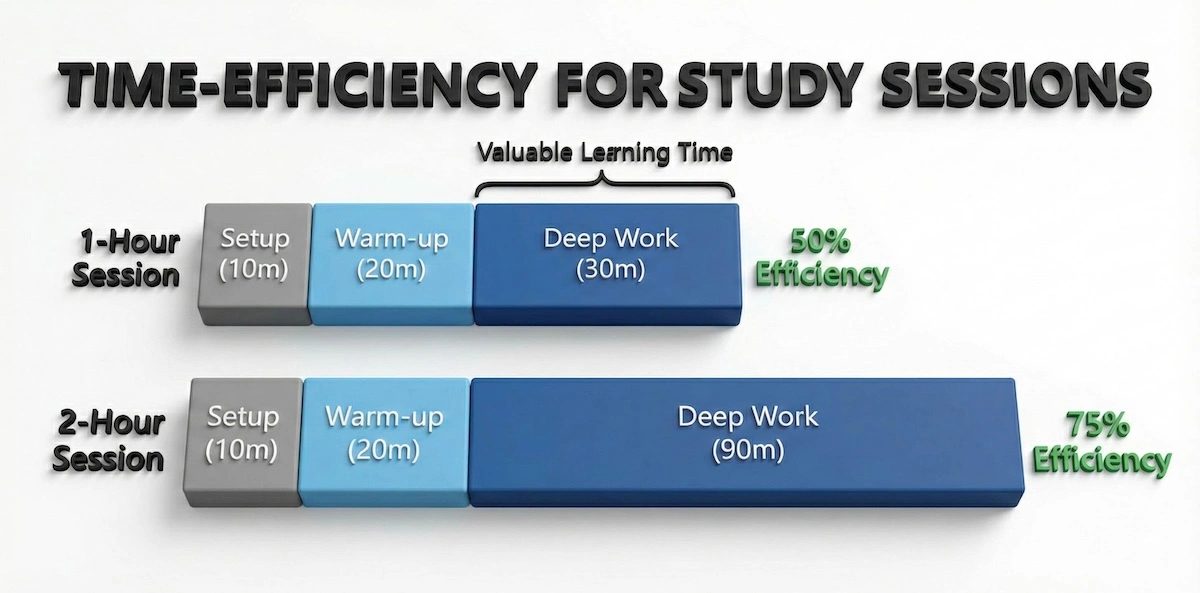
Therefore, the decision to hire a MCAT tutor can be the most cost-effective choice in the long run. By helping a student achieve their target score on the first attempt, a tutor helps them avoid added costs and delays, getting them one step closer to their goal of a medical career.
Read More: Top 10 Online Tutoring Websites WorldwideWhat Is the Best 16-Week MCAT Study Plan With Tutoring Integration?
The AAMC’s own guidance recommends approximately 300 hours of total MCAT preparation. Over 16 weeks, that works out to roughly 19 hours per week — achievable for most full-time students balancing coursework, and manageable (though demanding) for students also working part-time. The key is distribution: front-loading content review, back-loading full-length practice and strategy work, and integrating tutoring at the diagnostic checkpoints where it delivers the most impact.
| Phase | Weeks | Focus | Weekly Hours | Tutoring Role |
| Phase 1: Foundation | Weeks 1–4 | Content review: Bio/Biochem + Chem/Phys. Start CARS daily reading practice (20 min/day). | 15–18 hrs | Diagnostic session (Week 1): baseline practice test + section-level gap analysis |
| Phase 2: Application | Weeks 5–10 | Active passage practice by section. First full-length practice tests (weeks 7, 9). Psych/Soc content integration. | 18–22 hrs | Weekly 90-min sessions: error analysis from full-lengths; CARS strategy calibration |
| Phase 3: Integration | Weeks 11–14 | Full-length exams every 5–7 days. Timed section drills. Identify and address remaining error categories. | 20–25 hrs | Bi-weekly sessions: target final 2–3 error categories; test-day strategy and timing |
| Phase 4: Peak | Weeks 15–16 | Light review only. Final full-length (Week 15). Rest and logistics Week 16. | 10–12 hrs | Optional single session: confidence calibration and test-day protocol review |
Key benchmarks: By the end of Phase 1, you should have completed at least one full-length diagnostic under timed conditions. By the end of Phase 2, your practice test scores should be within 3 points of your target — if not, extend Phase 2 by 2 weeks and delay your test date. By the end of Phase 3, your practice scores should be at or above your target on at least two consecutive full-lengths before you sit for the real exam.
AAMC materials are non-negotiable: The AAMC’s Official Full-Length practice exams are the most accurate predictor of real test performance available. Use them in Phase 3 — not earlier. Third-party practice tests (Blueprint, Kaplan, Princeton Review) are generally harder than the real MCAT and are useful for building stamina and identifying content gaps in Phases 1 and 2; they should not be used to benchmark your actual score expectations.
When to add more tutoring: If your practice test scores stagnate for two or more consecutive tests, treat that as a diagnostic trigger. Contact your tutor before your next attempt — the error is almost certainly not content volume, but a specific reasoning pattern that additional solo practice will not fix.
Maximizing the Benefits of Professional MCAT Tutoring
The Power of Personalized Learning in Practice
A professional MCAT tutor builds on the structured plan above by providing what no course can: observation of your live reasoning. The study cycle flowchart below captures where tutor-guided error analysis fits into the overall prep rhythm.
For students who want to explore how structured analytical writing skills complement MCAT reasoning, the post on 5 high-impact tips to ace the 9093 commentary task offers transferable strategies for argument analysis under timed conditions.
Read More: Online Tutoring vs. In-Person Tutoring: Which is Right for You in 2026?When and How Should You Retake the MCAT?
Retaking the MCAT is common — AAMC data indicates that approximately 39% of MCAT test-takers between 2020 and 2022 were re-testers. But the decision to retake must be strategic, not reactive. A student who retakes without fundamentally changing their preparation method will typically produce a result close to their original score: the AAMC’s own retake analysis shows a median gain of just 2–3 total score points for students scoring in the 472–517 range on their first attempt.
What Are the AAMC Retake Limits and Rules?
The AAMC allows each examinee to take the MCAT:
- Up to 3 times in a single calendar year
- Up to 4 times in any two consecutive calendar years
- Up to 7 times in a lifetime
Every attempt counts toward these limits — including voided exams and no-shows. This is not an exception or edge case; it is AAMC policy. A student who registers and does not appear, or who voids their score on test day, has used one of their limited attempts. Given a 7-attempt lifetime cap, each registration decision carries real weight.
All MCAT scores from every attempt are visible to every medical school you apply to. Admissions committees vary in how they handle multiple scores: some use the highest score, some average all attempts, and some evaluate the trend. Most schools’ policies are not publicly disclosed — contact each admissions office directly if you are uncertain about a specific program’s approach.
When Is Retaking the MCAT Actually the Right Decision?
Retaking is the right decision when all three of the following conditions are met:
- Your most recent score is meaningfully below the 50th-percentile MCAT of your target programs’ admitted class (not just below your personal target).
- You can specifically identify what went wrong — a content gap, a pacing failure, an illness or circumstance on test day, or a strategic error in preparation — and have a concrete plan to address it.
- Your practice test scores, taken under full timed conditions after a new preparation cycle, are consistently at or above your target before you register for the retake.
Retaking is likely the wrong decision when your score is at or above 514, when your practice scores are not higher than your previous actual score, or when you simply feel that “more studying” will produce a different result without changing your approach. A score of 514 or above places a student above the 89th percentile — retaking risks a lower score and is statistically unlikely to produce a meaningful improvement for a student already in that range.
How Should You Prepare Differently for a Retake?
The most important retake rule: a retake is not a repeat. Students who restudy the same content in the same way, using the same materials, produce results close to their original score. An effective retake preparation requires the following steps.
Step 1 — Diagnostic root cause analysis. Pull your AAMC score report from your previous attempt. Identify the specific section(s) and question types that drove the shortfall. This is not about confirming what you already suspected — it requires looking at the data without bias. If CARS was your lowest section, the root cause is almost always reading strategy, not vocabulary. If Bio/Biochem underperformed, identify whether errors clustered in discrete questions or passage-based reasoning.
Step 2 — Change the preparation method, not just the volume. If you self-studied with content books and online courses, the retake preparation should include a tutor who watches you work through problems in real time. If you used a structured course and plateaued, the retake preparation should include targeted one-to-one sessions focused on your specific error categories, not re-covering the full curriculum.
Step 3 — Set a data-based retake threshold. Do not register for your retake date until your full-length practice test scores are consistently at or above your target on at least two consecutive timed exams. Registering before reaching that threshold produces another score below your target and consumes one of your limited attempts.
Most students benefit from waiting a minimum of 3 months between a first attempt and a retake — enough time to complete a second preparation cycle, not just review notes and take a few more practice tests. Students retaking after a gap year may wait longer to ensure content remains fresh; AAMC score validity is three years, though individual school policies may be stricter.
Students who want to understand how structured time management strategies apply to high-stakes exams may find the post on A-Level Geography time management: 5 steps for Paper 4 a useful parallel framework for pacing under exam conditions.
Read More: Online Tutoring Trends in 2026: The Ultimate GuideYour Path to Medical School Starts With the Right Strategy
The MCAT is a unique and challenging exam, but it is not an insurmountable one. By understanding its emphasis on critical thinking and application — and by recognizing that preparation strategy matters as much as preparation volume — applicants can build a realistic, evidence-based path to their target score.
The 2026 registration window is open now. The score data is clear. The course options are distinct and mappable to specific student profiles. The 16-week plan provides a framework. The retake logic is grounded in AAMC evidence. What remains is the decision to approach each of these elements deliberately rather than reactively — to treat MCAT preparation as a strategic project, not an indefinite slog.
A professional MCAT tutoring online provider is a valuable, personalized solution to the academic and psychological hurdles of this high-stakes exam. They offer a tailored approach, expert strategies, and the accountability needed to turn a student’s aspirations into reality.
Students who want to strengthen their essay and analytical writing skills alongside MCAT prep may also find value in the posts on how to write the perfect A-Level English essay from context to conclusion in 6 steps and whether A-Level English Language 9093 is as hard as students expect, both of which address the analytical reading and argument-construction skills that transfer to CARS preparation.
Frequently Asked Questions About the MCAT
How is the MCAT scored?
The MCAT is scored on a scaled system from 472 to 528, with each of the four sections ranging from 118 to 132 (midpoint 125 per section). MCAT scores use equated scaling — not a curve — making each score an absolute measure of performance independent of other test-takers on the same day.
What is a good MCAT score for medical school?
A score of 510 or above is competitive for most MD programs; top-tier research schools (top 10–25) typically admit classes averaging 517–524. The national matriculant average for the 2025 cycle was 511.8. For DO programs, the average matriculant MCAT was 500. Always check the specific 50th and 75th percentile admitted scores of your target programs — not national averages.
When should I register for the 2026 MCAT?
Registration for all 2026 MCAT dates (January–September) opened October 21–23, 2025. Register as early as possible — seats fill quickly in high-demand locations and peak months. If targeting the Fall 2026 medical school application cycle, sit by May or early June 2026 to receive your score before AMCAS rolling review begins.
How many times can you take the MCAT?
The AAMC allows up to 3 MCAT attempts per calendar year, 4 across two consecutive years, and 7 total lifetime attempts. Voided scores and no-shows count toward these limits. All scores from every attempt are visible to every medical school you apply to.
Does an MCAT tutor help with test anxiety?
A professional MCAT tutor provides expert guidance, structured accountability, and a judgment-free space to build competence — and competence is the most effective long-term solution to test anxiety. Students who eliminate specific error categories through targeted practice experience a measurable reduction in anxiety about those question types.
Is online MCAT tutoring effective?
Yes. Online MCAT tutoring offers the same diagnostic and instructional benefits as in-person tutoring, with the added advantages of flexible scheduling, access to tutors regardless of geographic location, and session recording for review. Because the MCAT itself is computer-delivered, preparing on a screen with digital practice materials more closely mirrors real test conditions than working from paper.
Which MCAT prep course is best in 2026 — Kaplan, Blueprint, or Princeton Review?
Blueprint is best for visual learners and students prioritizing CARS accuracy. Kaplan is best for students who need high question volume and adaptive learning tools. Princeton Review is best for students who thrive in structured live instruction with multiple subject-matter experts. MEB 1:1 tutoring is best for students plateauing in specific sections who need targeted diagnostic work rather than a full curriculum re-run. No single course is universally best — match the course to your learning style and specific preparation gap.
When is retaking the MCAT the right decision?
Retaking the MCAT is the right decision when your score is meaningfully below your target programs’ admitted class median, you can identify specifically what went wrong, and your practice scores are consistently at or above your target before you register. Avoid retaking the MCAT if your score is already at 514 or above — the statistical risk of a score decline is not justified unless your practice data clearly supports a higher result.
Related Subjects
MCAT Biological and Biochemical Foundations of Living Systems MCAT Biology MCAT Chemical and Physical Foundations of Biological Systems MCAT Chemistry MCAT Critical Analysis and Reasoning Skills MCAT Physics MCAT Psychological Social and Biological Foundations of Behavior
Related Reading
******************************
This article provides general educational guidance only. It is NOT official exam policy, professional academic advice, or guaranteed results. Always verify information with your school, official exam boards (College Board, Cambridge, IB), or qualified professionals before making decisions. Read Full Policies & Disclaimer , Contact Us To Report An Error