Scottish Advanced Highers Explained: Grades, UCAS Points and University Entry

- Scottish Advanced Highers sit at SCQF Level 7, equivalent to first-year university work.
- An ‘A’ grade earns 56 UCAS tariff points, matching an A-Level A*.
- Strong results can qualify students for second-year direct entry to Scottish degrees.
- Assessment combines a written exam and a coursework component worth 20–30% of the grade.
- Grade boundaries are adjusted annually by Qualifications Scotland based on cohort performance.

What Exactly Are Scottish Advanced Highers?
For students and parents outside of Scotland, particularly in the US, UK, and the Gulf, the educational landscape can seem like a maze of acronyms. You’ve heard of A-Levels, AP courses, and the IB Diploma. So, where do Scottish Advanced Highers fit in?Simply put, they are qualifications at SCQF Level 7, taken typically in the final year of secondary school (S6). They are a significant step up from the Highers (Level 6) and are designed to allow students to specialize in subjects they are passionate about, studying them in greater depth.According to UCAS, the UK’s university admissions service, an ‘A’ grade in an Advanced Higher is considered equivalent to an A* at A-Level in terms of performance. This parity highlights the academic rigor and why universities hold them in such high esteem. They are, in essence, a taste of first-year university-level work, completed while still in school.It can be confusing to understand where these qualifications sit on the academic spectrum. The illustration below visualizes the ‘Step Up’ from standard school exams to university degrees.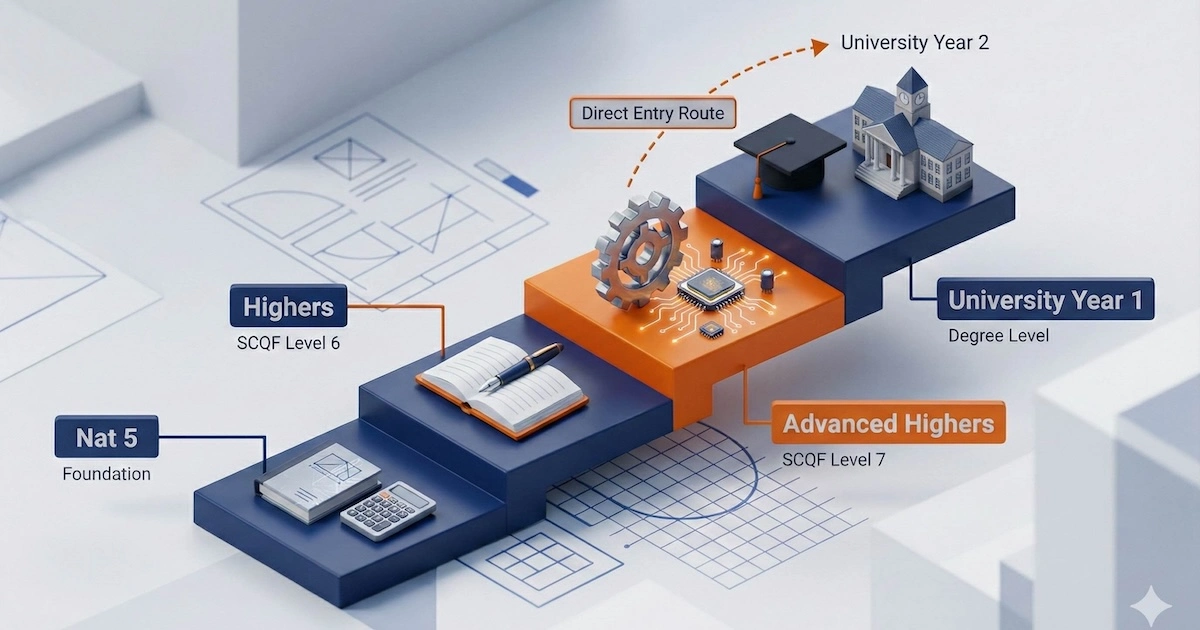
See exactly how Advanced Highers bridge the gap between school exams and university-level engineering degrees.
The Advanced Highers Challenge: More Than Just a Step Up
Cameron’s struggle with that physics problem wasn’t just about a harder formula. The entire philosophy of Scottish Advanced Highers teaching is different. The focus shifts dramatically from guided learning to independent research and critical thinking.Qualifications Scotland (formerly the SQA, which became Scotland’s new national awarding body on 1 February 2026) outlines that these courses encourage candidates to develop “sophisticated skills of analysis and evaluation” and to “work with more complex information and ideas.”This means students are expected to:- Manage their own study schedule effectively.
- Conduct independent research for projects and dissertations, which often form a large part of the final grade.
- Think critically and form their own arguments, rather than just recalling facts.
- Solve multi-layered problems that require knowledge from different parts of the curriculum.
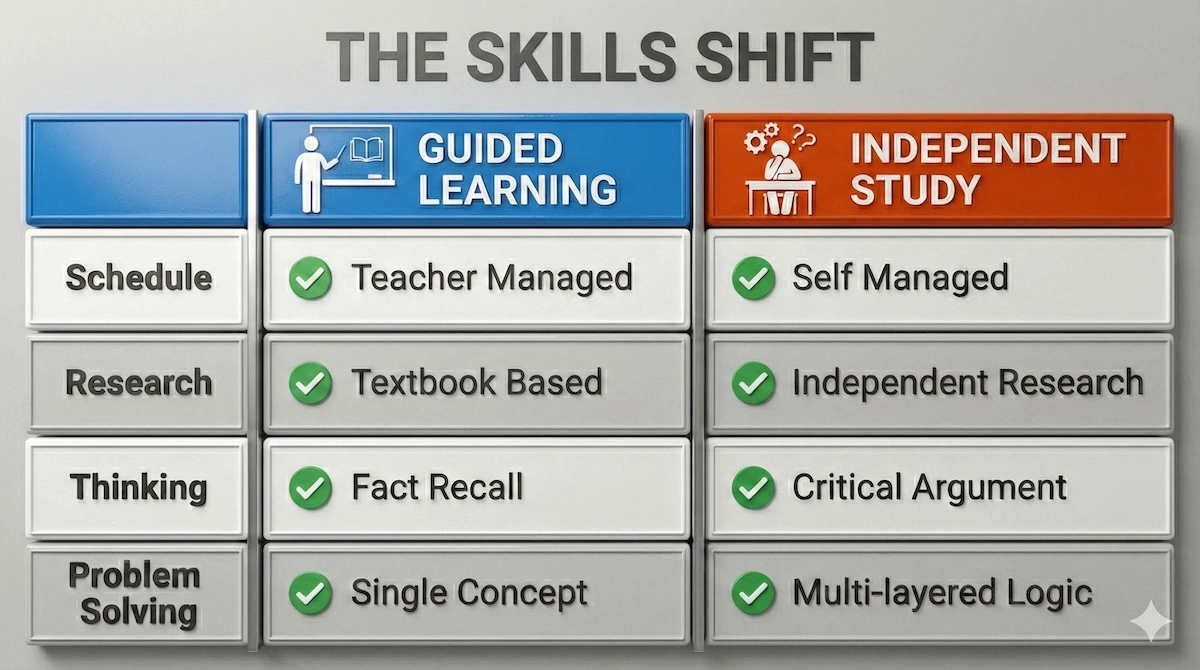 Understand the critical differences in workload and expectation between standard Highers and the rigorous Advanced Higher curriculum. Notice the shift from ‘Teacher Led’ to ‘Independent Study’ — this is often the biggest stumbling block for engineering students.This emphasis on self-directed study is fantastic preparation for university, but it can be a shock to the system. It’s why many students find themselves seeking guidance on homework within tutoring sessions; it’s not about cheating the system, but about learning how to learn at this new, higher level.
Why University Admissions Tutors Value Advanced Highers
When an admissions tutor at a top university sees Advanced Highers on an application, they see proof of readiness. A student who has successfully completed these courses has demonstrated that they possess the skills to thrive in a demanding academic environment.In an increasingly competitive global landscape for university places, this distinction matters. While Highers get you in the door, Advanced Highers can be the key that unlocks offers from the most prestigious institutions, from St Andrews and Edinburgh to Cambridge and beyond. They show a level of commitment and academic maturity that makes an applicant stand out.A strong performance signals to universities that a student can handle complex coursework, manage deadlines, and think for themselves — the very skills they will need from day one of their degree.Should you skip the first year? It’s a big decision with financial and academic pros and cons. Use this decision tree to help evaluate your readiness.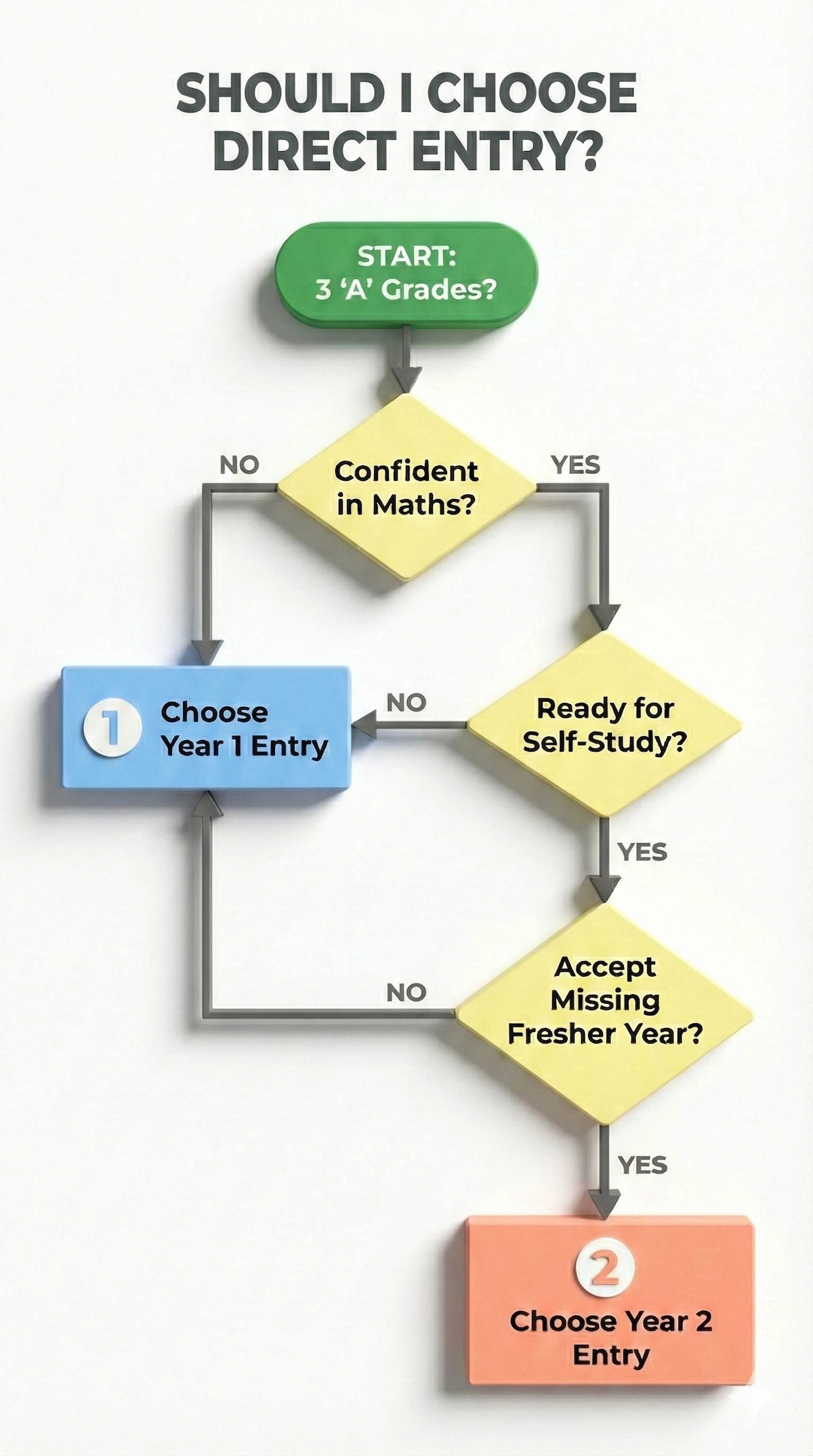
Follow this decision tree to determine if skipping the first year of university is the right strategic move for you.
How Do Scottish Advanced Highers Compare to A-Levels for University Applications?
Scottish Advanced Highers and A-Levels are broadly equivalent for university entry in the UK, but they are not identical qualifications and the differences matter when choosing where and how to apply. Advanced Highers are a SCQF Level 7 qualification taken in one year (S6), while A-Levels are a two-year course culminating in final examinations. Both are accepted for entry to universities across the UK, but the way institutions use them differs by country and by course.The table below maps the key structural and application differences between Advanced Highers and A-Levels for 2026 university applicants.| Feature | Scottish Advanced Highers | A-Levels |
| SCQF / RQF Level | Level 7 (first-year university equivalent) | Level 3 (pre-university) |
| Duration | 1 year (S6) | 2 years (Year 12–13) |
| Subjects typically taken | 2–3 | 3 (sometimes 4) |
| Grade scale | A, B, C, D (no A* available) | A*, A, B, C, D, E |
| UCAS points at top grade | 56 (Advanced Higher A) | 56 (A-Level A*); 48 (A-Level A) |
| University direct entry | Yes — to Year 2 of Scottish degrees with strong AH results | No standard direct entry route |
| Accepted by English universities | Yes, widely accepted; some specify 2–3 AHs instead of A-Levels | Standard for English, Welsh, NI universities |
| Subject breadth | Narrower (fewer AH subjects available — approx. 72) | Broader (approx. 100+ subjects) |
| Coursework/dissertation component | Yes — projects, dissertations carry significant grade weight in many subjects | Varies by subject; coursework reduced since 2017 reforms |
Do English Universities Accept Advanced Highers in Place of A-Levels?
Most English universities accept Advanced Highers directly in place of A-Levels, and the UCAS tariff treats them as equivalent at the same grade — with Advanced Highers actually awarding slightly more points than A-Levels at grades A, B, and C (see the tariff section below). The University of Edinburgh states that for competitive subject areas, Advanced Highers are expected; Edinburgh, Glasgow, and St Andrews all include AH grades in their conditional offers.The one important caveat: students cannot count both a Higher and an Advanced Higher in the same subject towards their UCAS tariff total. Only the higher-level qualification counts for any single subject.Where Advanced Highers Have a Structural Advantage
Advanced Highers carry one significant structural advantage over A-Levels that most students and parents do not fully appreciate: they can qualify students for second-year direct entry to Scottish university degrees. A student who achieves strong Advanced Higher grades — particularly in a subject directly aligned with their intended degree — may enter the second year of a four-year Scottish degree, saving a full year of fees and time.The University of Edinburgh confirms this for biomedical sciences and selected engineering and science degrees. The University of Strathclyde notes that AH Maths and Physics credit can earn first-year exam exemptions for engineering students. This route is not available to A-Level students at English universities, making it a genuinely distinct advantage of the Scottish system.For students also navigating essay-based qualifications, this guide on how to write the perfect A-Level English essay covers analytical writing skills that transfer directly to Advanced Higher humanities coursework.The Ultimate Guide to Online Tutoring 2026: Expert Tips, Pricing & Platform ReviewsWhich Advanced Highers Should You Take for Your University Course?
Subject selection for Advanced Higher is more consequential than for Highers, because universities both in Scotland and England increasingly specify Advanced Higher subjects rather than just grades in their conditional offers. Choosing the wrong combination in S6 can close doors, while the right combination signals academic readiness for competitive and professional courses.The table below maps the most in-demand university destinations to their recommended or required Advanced Higher subjects, based on 2026 entry requirements at leading UK institutions.| University Course | Strongly Recommended / Required Advanced Highers | Notes |
| Medicine / Veterinary Medicine | Advanced Higher Biology + Chemistry | Edinburgh, Glasgow, Aberdeen all require 2 AHs in S6; Biology and Chemistry are the universally recommended subjects |
| Engineering (Mechanical, Civil, Electrical) | Advanced Higher Maths + Physics | University of Strathclyde recommends both for all engineering programmes; Engineering Science AH is also accepted |
| Pharmacy / Chemical Engineering | Advanced Higher Chemistry + Maths | Strathclyde requires AH Chemistry for Pharmacy; AH Maths is recommended for all numerical courses |
| Computer Science / Data Science | Advanced Higher Maths | AH Computing Science beneficial; AH Maths near-universal requirement |
| Law | Not subject-specific; essay-writing subjects valued | Higher/AH English, Modern Studies, or History build the analytical writing skills law programmes expect |
| Business / Management | Not subject-specific; breadth valued | AH Economics, Maths, or Business Management signal commercial reasoning ability |
| Architecture | Maths or Physics at AH recommended | Art & Design at AH is beneficial for design-focused programmes |
| English / Humanities | Advanced Higher English | AH History or Modern Studies can complement and demonstrate analytical depth |
What Happens if Your School Doesn’t Offer the Right Advanced Highers?
This is a real constraint for many students, particularly in rural or smaller schools. Qualifications Scotland currently offers approximately 72 subjects at Higher and Advanced Higher level, and not every school delivers the full range.If your desired Advanced Higher is unavailable at your school, there are three practical options: distance learning through the SQA’s National Progression Awards; studying the subject via college partnership; or — increasingly common for competitive applicants — supplementing classroom teaching with specialist online tutoring to develop the depth of knowledge the university subject expects, even if the formal qualification cannot be obtained.For highly competitive courses like Medicine, universities with specific AH requirements do confirm to students whether alternative pathways are acceptable, so early communication with admissions teams is essential.Students who also sit international qualifications may find it useful to explore IGCSE Economics tutoring as a complementary foundation for Advanced Higher Economics and Business subjects.How Are Advanced Highers Graded and What Do the Grade Boundaries Mean?
Advanced Highers are graded A, B, C, and D — all of which represent a pass — with ‘No Award’ given if the minimum threshold is not reached. Unlike A-Levels, there is no A* grade. This is an important detail for students used to the English grading system: an ‘A’ at Advanced Higher is the top grade achievable, and it is that grade which universities specify in their most competitive conditional offers.The grading thresholds are set by Qualifications Scotland (formerly the SQA) and follow a standard notional framework, though actual grade boundaries are adjusted each year based on cohort performance.| Grade | Notional % Threshold | Description |
| A (Upper) | ≥85% | Outstanding performance across course assessment |
| A | ≥70% | Excellent performance; top-grade pass |
| B | ≥60% | Good performance; clear competence demonstrated |
| C | ≥50% | Satisfactory performance; meets course standard |
| D | ≥40% | Minimum pass; demonstrates sufficient basic knowledge |
| No Award | <40% | Does not meet the threshold for a grade D pass |
Why Grade Boundaries Vary From Year to Year
Qualifications Scotland holds a formal awarding meeting after each exam series, at which senior examiners set the precise mark thresholds for each subject based on that year’s cohort performance and paper difficulty. If a paper is judged to have been harder than usual, the C boundary may drop below 50% to ensure the qualification maintains consistent standards year on year.This is important to understand: the notional boundaries are a planning guide, not a fixed rule. In practice, a student scoring 47% in a particularly challenging Advanced Higher paper may still achieve a grade C. Chemistry, for example, saw adjusted grade boundaries in 2024 to account for paper difficulty, with the Higher Chemistry C-grade cut-off set at 43.3% that year.The grade boundaries for each sitting are published on the Qualifications Scotland website on results day (typically the first Tuesday in August for Scottish results). Students who narrowly miss a grade boundary have the right to appeal free of charge through the Qualifications Scotland appeals service.How Online Tutoring Enhances Test Prep for Standardized ExamsWhat UCAS Tariff Points Do Advanced Highers Earn — Updated Table for 2026 Entry?
Advanced Highers earn UCAS tariff points at rates that are broadly equivalent to — and at grades A, B, and C, slightly higher than — A-Level grades. The UCAS tariff system assigns a numerical value to each qualification grade, which universities use to compare applicants from different educational backgrounds. The values below are confirmed for the 2025/26 and 2026/27 admissions cycles, based on the UCAS tariff framework that has remained current since its 2017 revision.| Qualification | Grade | UCAS Tariff Points |
| Advanced Higher | A | 56 |
| Advanced Higher | B | 48 |
| Advanced Higher | C | 40 |
| Advanced Higher | D | 32 |
| Higher | A | 33 |
| Higher | B | 27 |
| Higher | C | 21 |
| Higher | D | 12 |
| A-Level | A* | 56 |
| A-Level | A | 48 |
| A-Level | B | 40 |
| A-Level | C | 32 |
| A-Level | D | 24 |
| A-Level | E | 16 |
The Critical Rule About Combining Highers and Advanced Highers
A student cannot add together their Higher and Advanced Higher points in the same subject. If you achieved a grade A at Higher Maths (33 points) and then progressed to Advanced Higher Maths with a grade B (48 points), your total from Maths is 48 — not 81. Only the higher-level qualification counts per subject. This is the most common tariff calculation mistake made by Scottish applicants to English universities, and it is worth confirming well before submitting a UCAS application.When UCAS Points Matter and When They Don’t
UCAS tariff points are most relevant for English universities that make offers based on a total points threshold (for example, “minimum 120 UCAS points”). Traditional Scottish universities — Edinburgh, Glasgow, St Andrews, Aberdeen, Dundee, Strathclyde — almost always make offers based on specific grades in specific subjects, not total tariff points.Knowing this distinction prevents two costly mistakes: over-optimizing for tariff accumulation at the expense of the specific grades a Scottish university actually requires, and under-estimating your competitiveness at English universities when your AH points total exceeds what your Highers alone would suggest.Also Read: 24/7 Premium 1:1 Tutoring For Standardized TestsWhat Are the Best Study Strategies Specific to the Advanced Higher Format?
Studying for Advanced Highers requires a fundamentally different approach from Highers. The shift is not one of intensity — it is one of method. At Higher level, structured classroom guidance carries most of the learning load. At Advanced Higher, Qualifications Scotland’s own course design explicitly requires students to work with complex information independently, conduct their own research, and form analytical arguments. Students who continue applying Higher-level study habits in S6 consistently underperform relative to their ability.Separate Your Revision from Your Independent Learning
Advanced Higher assessment is typically split between an external written examination and a coursework component (a project, investigation, or dissertation, depending on the subject). These two components require fundamentally different preparation approaches. Exam preparation follows a pattern that Higher students recognize: past paper practice, mark scheme familiarization, timed essay and problem-solving drills.But the coursework component — which can carry 20–30% of the total grade depending on the subject — is an independent research task that rewards systematic planning from the very start of the course, not revision in the final weeks. The most effective Advanced Higher students separate their weekly study time explicitly: dedicated blocks for coursework development (research reading, drafting, data analysis) and separate blocks for exam technique practice. A tutor can help structure this timetable at the start of S6, before the coursework deadline pressure begins.Use Past Papers Strategically, Not Exhaustively
Past papers are the single most effective exam preparation tool at Advanced Higher level, but students consistently misuse them by treating them as a checklist of done questions rather than a diagnostic tool. The correct approach is to attempt a question under timed conditions, then compare the response against the marking instructions — not just for whether the answer is correct, but for where marks are allocated and why.Advanced Higher marking schemes reveal the specific cognitive moves that earn marks at this level: definition precision, evidence specificity, analytical structure, and evaluative conclusions. A student who can read a marking scheme and self-assess their own answer against it has a significant advantage over one who simply checks “right” or “wrong.”The same principle applies across exam-based qualifications; this post on A-Level Geography time management for Paper 4 demonstrates how structured past-paper technique translates directly to higher marks.Build Independent Research Skills Early in S6
The coursework component at Advanced Higher level — whether a science investigation, a history dissertation, an English portfolio, or a Modern Studies project — rewards students who begin structured research early. The most common failure mode is starting the research question too broadly, then running out of word count or time before any depth is achieved.A focused, specific research question — narrow enough to be genuinely explored within the word limit — is more valuable than an ambitious but unmanageable topic. This is one area where early tutor guidance is consistently high-value: an experienced Advanced Higher tutor can help a student scope their research question effectively before any work is done, saving significant time later.How Does a Tutor Help With Advanced Higher Dissertations and Projects?
The dissertation or research project is the most consistently tutor-responsive component of Advanced Higher assessment. It is the element where independent learning is formally required, where the stakes are high (often 20–30% of the total course grade), and where students most frequently underestimate what is expected of them. A tutor who has taught or examined at Advanced Higher level has direct knowledge of what a top-band project looks like and can guide a student toward it long before the submission deadline.Stage 1: Research Question Design and Scoping
Advanced Higher dissertations across humanities and social sciences subjects (History, Modern Studies, English, Geography, and others) begin with a research question or dissertation title that the student proposes. Qualifications Scotland provides guidance and approved lists of titles for subjects such as Modern Studies and History. A strong research question is specific, arguable, and answerable within the word limit (typically 2,500–3,500 words for humanities subjects).Students commonly choose questions that are too broad — for example, “What caused World War One?” rather than “To what extent did German foreign policy, rather than the alliance system, cause the outbreak of war in 1914?” A tutor helps a student formulate and test their research question before it is submitted, which directly affects the quality of the work produced throughout the course.Stage 2: Research Methodology and Source Evaluation
Advanced Higher projects require students to gather, evaluate, and cite sources at a standard closer to undergraduate research than to Higher coursework. At this level, markers expect students to evaluate the reliability and limitations of their sources — not simply cite them as facts. A student who references a newspaper article as evidence without noting its potential bias will lose marks compared to one who acknowledges the source’s limitations and corroborates the claim with a secondary academic source.This skill — critical source evaluation — is rarely taught explicitly in school settings, but a tutor who has conducted academic research can model and practise it in a way that directly improves dissertation quality.Read More: StudyX Online Tutoring Review: Features, Pricing, and AlternativesThe Rise of Personalized Support: The Role of a Tutor
Let’s leave Scotland for a moment and meet Layla, a student in Dubai. She’s aiming for a competitive medical program in the UK and knows that acing her Advanced Highers in Chemistry and Biology is non-negotiable. While her school provides excellent teaching, she needs someone who can dedicate time to her specific sticking points — those tricky organic chemistry mechanisms or the nuances of her biology dissertation.This is where the modern role of a Scottish Advanced Highers tutor comes into play. It’s not about remedial help for struggling students; it’s about providing high-level, targeted support for ambitious learners. A great tutor acts as an academic mentor, guiding a student through the challenging new terrain of independent study.This one-on-one attention from a dedicated Scottish Advanced Highers teacher can make all the difference, transforming confusion into confidence and B grades into A grades.To survive the ‘sink or swim’ culture, you need a new workflow. The following cycle outlines the daily habits of successful engineering undergraduates.
Mastering this four-step continuous learning cycle is the secret to surviving the transition from Highers to University.
Finding the Right Fit: What to Look for in Scottish Advanced Highers Tutoring
When you decide to seek support, finding the right kind of help is crucial. The unique demands of this qualification mean that not just any tutor will do. You need an expert who understands the curriculum, the assessment style, and the mindset required to excel.The Power of Online Tutoring
For students like Layla in Dubai or even students in rural Scotland, finding a local expert in Advanced Higher Modern Studies or Engineering Science can be impossible. This is where the world of online learning has been a game-changer. Opting for Scottish Advanced Highers tutoring online breaks down geographical barriers. It connects students with a global pool of experts — often university academics, PhD candidates, or experienced educators who specialize in these exact courses. This ensures that you are getting guidance from someone who truly understands the subject at a deep level. A Scottish Advanced Highers tutor online offers flexibility in scheduling, personalized learning plans, and access to the very best minds, no matter where you are.
Beyond Just Answering Questions
The best tutoring sessions are not just about completing that night’s homework. A truly effective tutor will provide comprehensive support. This is where Scottish Advanced Highers assignment guidance within tutoring sessions becomes about skill-building, not just answer-finding.An expert can help a student:- Structure a high-scoring dissertation or project.
- Develop a robust research methodology.
- Master exam techniques and time management skills.
- Navigate the complexities of the SQA marking scheme.
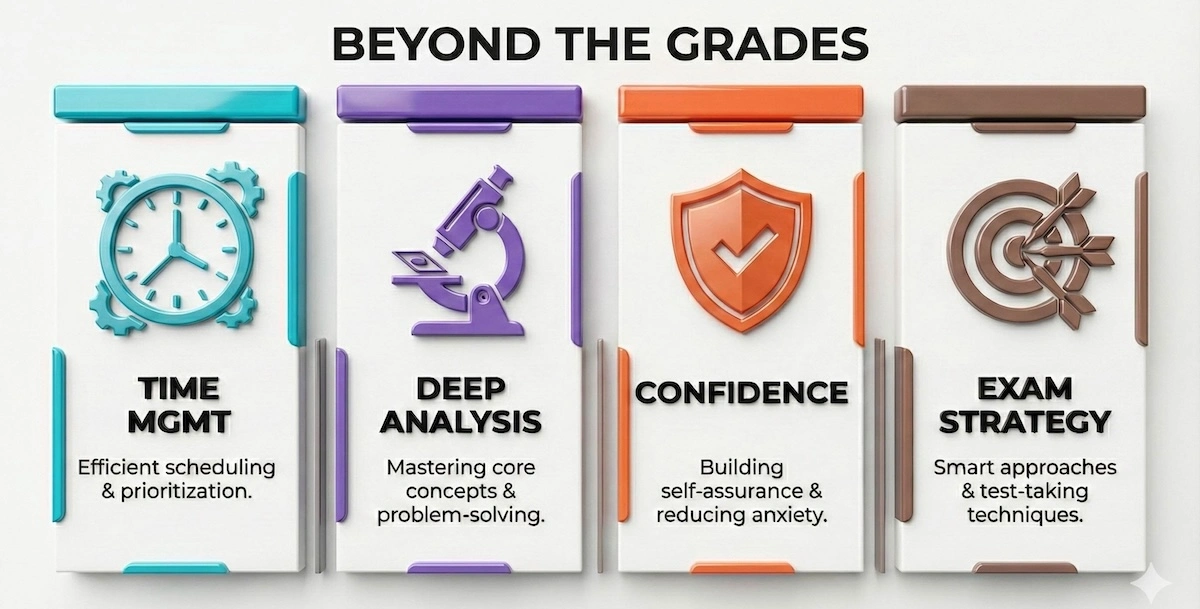
Expert guidance provides more than just answers; it builds the four pillars of engineering success required for university.
Subject-Specific Expertise is Key
The depth required for these courses means that generic academic support is not enough. You need a tutor who is a genuine specialist in their field. A physicist can break down the toughest concepts in Advanced Higher Physics, while a historian can provide invaluable guidance on the dissertation for Advanced Higher History.When you set out to find a Scottish Advanced Highers tutor, prioritize deep subject knowledge and experience with the SQA curriculum. It’s this expertise that provides the true value and leads to the best results.Students exploring environmental science at Advanced Higher level may also benefit from support as an IGCSE Environmental Management teacher can provide foundational grounding in the analytical frameworks that carry through to higher-level study.Read More: Top 10 Online Tutoring Websites WorldwideThe Journey to Success: Real Results
Remember Cameron, our physics student from the beginning? He decided to work with an online tutor who was a postgraduate physics researcher. In their weekly sessions, they didn’t just solve problems; they deconstructed them. His tutor taught him a new way of thinking, helping him see the underlying principles. He learned how to approach his project with the mindset of a real scientist, and his confidence soared. The result? He achieved an ‘A’ and secured his place at his first-choice university for engineering.And Layla in Dubai? Her online biology tutor helped her refine her dissertation topic, guiding her through the research process and providing critical feedback that elevated her work from good to exceptional. This personalized Scottish Advanced Highers tutoring was the strategic edge she needed to stand out in a sea of qualified applicants.For students weighing up different modes of academic support, this comparison of whether A-Level English Language is genuinely hard offers a useful lens on how subject difficulty is often misunderstood — a pattern that applies equally to Advanced Highers.Read More: Online Tutoring vs. In-Person Tutoring: Which is Right for You in 2026?Your Path Forward
The Scottish Advanced Highers are more than just a set of exams; they are a transformative academic experience. They challenge students to become independent, critical thinkers and prepare them for the rigors of higher education in a way few other qualifications can.While the path is demanding, it doesn’t have to be walked alone. With the right support system, every student can rise to the challenge, master their subjects, and unlock the door to their future. Investing in expert guidance is an investment in that future.Students preparing for standardized admissions tests alongside their Advanced Highers can also explore support from an ACT tutor to strengthen their university application profile.Frequently Asked Questions About Scottish Advanced Highers
What are Scottish Advanced Highers?
Scottish Advanced Highers are prestigious pre-university qualifications in Scotland, at SCQF Level 7, equivalent to A-Levels and recognized by top universities worldwide.Are Scottish Advanced Highers harder than A-Levels?
Scottish Advanced Highers are considered of similar academic rigor to A-Levels, with a greater emphasis on independent research and university-style learning.Why is online tutoring effective for Scottish Advanced Highers?
Online tutoring for Scottish Advanced Highers provides access to subject specialists from anywhere in the world, offering flexible and highly targeted academic support aligned with the Qualifications Scotland curriculum.Can a tutor help with the Scottish Advanced Highers final exam?
Yes, a good tutor can provide expert guidance on exam technique, revision strategy, and mastering difficult topics within Scottish Advanced Highers.How do I find a good Scottish Advanced Highers tutor?
Look for a service that offers tutors with specific expertise in the Qualifications Scotland curriculum and a proven track record of success with Scottish Advanced Highers students.Is tutoring for Scottish Advanced Highers only for students who are falling behind?
No, tutoring for Scottish Advanced Highers is a strategic tool for ambitious students aiming to secure top grades and stand out in university applications.Related Subjects
Scottish Advanced Higher French Scottish Advanced Higher Geography Scottish Advanced Higher LatinRelated Reading
******************************
This article provides general educational guidance only. It is NOT official exam policy, professional academic advice, or guaranteed results. Always verify information with your school, official exam boards (College Board, Cambridge, IB), or qualified professionals before making decisions. Read Full Policies & Disclaimer , Contact Us To Report An Error