The 4-Week Engineering Study Plan: Retrieval, Spacing, and Interleaving Explained

- Retrieval practice, spaced repetition, and interleaving outperform passive review methods.
- Week 1 diagnoses real gaps; Week 4 simulates full exam conditions.
- Subject strategies differ: physics needs setup-first; circuits need method selection training.
- Avoiding past papers until the final week is one of the costliest study mistakes.
- A 72-hour rescue plan only works with complete commitment to active methods.
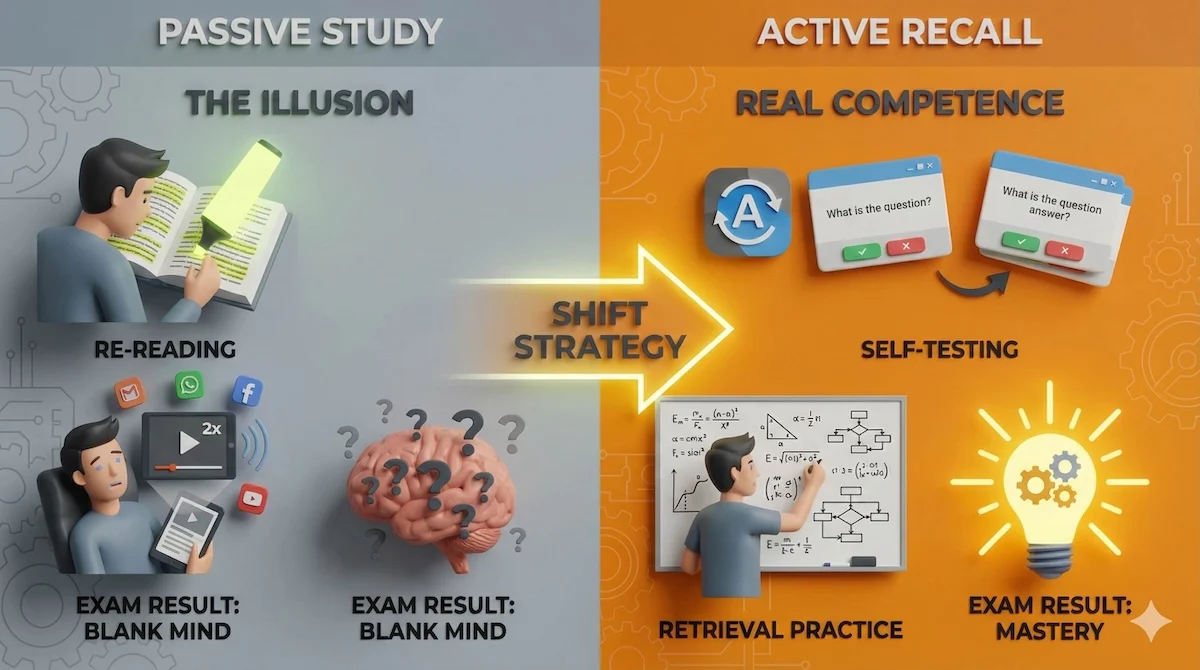
Most engineering students don’t fail exams because they don’t study enough. They fail because they spend those hours on methods that feel productive — re-reading notes, highlighting textbooks, watching recorded lectures at 1.5x speed — but build almost none of the retrievable memory that exam performance actually requires.
Bjork and Bjork’s research on learning describes this as “the illusion of competence”: passive review creates a feeling of familiarity with material that vanishes entirely under exam conditions.
This 4-week plan replaces those passive methods with an approach built on three principles that learning that works consistently validates: retrieval practice, spaced repetition, and interleaved problem types. For students who need structured support alongside this plan, working with an online engineering tutor can help close concept gaps that self-study alone misses.
It includes weekly daily schedules, subject-specific strategies for the core engineering courses where students most frequently struggle, a breakdown of the tools that support this system, and the common mistakes that erase study hours even when effort is high.
Why “Study Harder” Doesn’t Cut It
Engineering involves simultaneous cognitive demands that no other discipline combines in quite the same way: solving differential equations, debugging circuit designs, analyzing fluid systems, understanding thermodynamic cycles, and managing multi-week group projects all in parallel, across courses with high conceptual dependency. Understanding week three’s material is the prerequisite for week six. Falling behind in one thread affects every thread downstream.
The standard advice to “study harder” fails because it conflates time spent with method effectiveness. Karpicke and Roediger’s research demonstrated that students who tested themselves on material after studying retained twice as much as students who re-read the same material for the same amount of time without any additional time investment.
The gain came entirely from switching method, not from adding hours. The engineering students who consistently outperform their peers are not the ones who study longest; they are the ones whose methods generate the type of memory that exam conditions can actually access.
Four methods that feel productive but don’t build lasting exam-ready memory: re-reading lecture notes, highlighting textbooks, copying worked examples without covering the solution, and watching video lectures without pausing to recall.
Four methods that feel uncomfortable but consistently produce better exam results: testing yourself on material before you feel ready, explaining concepts aloud without notes, working problem variations where the method is not given, and studying material before you’ve fully reviewed it to identify gaps.
The 4-Week Study System
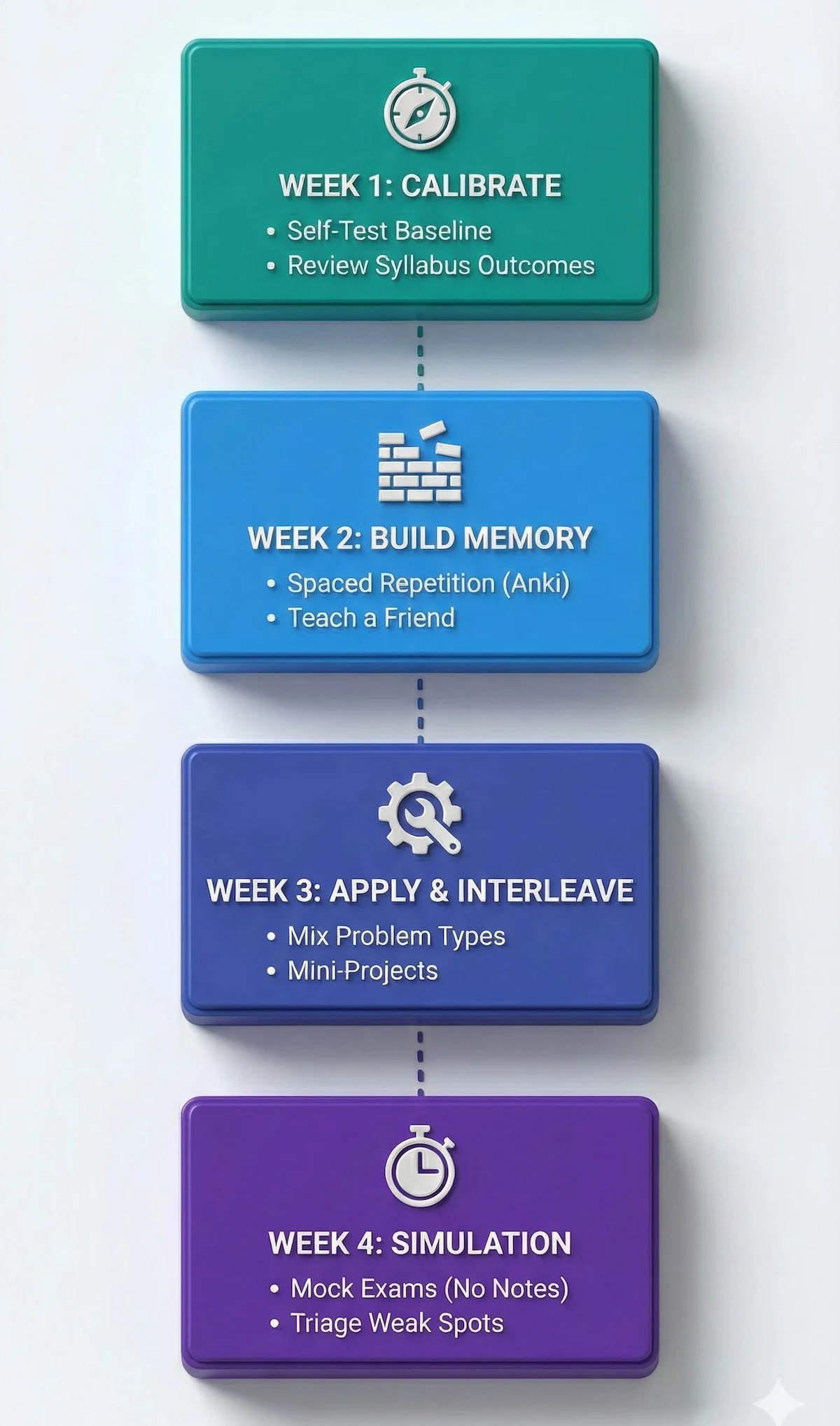
The four-week structure moves from diagnosis to consolidation to application to simulation. Each week builds on the previous one, and the daily schedule is designed to be realistic for engineering students managing simultaneous coursework, labs, and assignments.
Week 1: Calibrate, Don’t Cram
Week 1 is diagnostic. The goal is not to cover maximum material but to accurately identify where your understanding actually is versus where you think it is. Most engineering students overestimate their competence in material they have seen before and underestimate their gaps in foundational material they assumed they understood years ago.
The core method: Self-test before you review. Cover your notes and attempt to explain the key concepts of each topic from memory. What you can explain clearly without prompting is material you know. What produces vague answers or gaps is material you actually need to study. Re-reading material you already know is one of the most common sources of wasted study hours in engineering programs.
The syllabus audit: Re-read the official syllabus and learning outcomes for each course. The learning outcomes describe exactly what you will be assessed on — not everything a lecturer has said, but the specific competencies the examination is designed to measure. Students who study toward learning outcomes consistently outperform those who study toward their notes.
| Day | Morning (60–90 min) | Evening (60 min) | Focus |
|---|---|---|---|
| Monday | Syllabus audit: Course 1 learning outcomes + self-test on core topics | Create gap list: topics where self-test failed | Diagnosis |
| Tuesday | Syllabus audit: Course 2 + self-test on core topics | Create gap list for Course 2 | Diagnosis |
| Wednesday | Begin targeted review of Week 1 gaps from Course 1 using flashcards | Test yourself on reviewed material; record errors | Active recall begins |
| Thursday | Targeted review of Week 1 gaps from Course 2 | Explain key concepts aloud without notes; whiteboard session | Active recall continues |
| Friday | First attempt at past exam questions: 1 question per course without notes | Review errors against source material | Reality check |
| Weekend | Cover any remaining courses; catch up on assignments | Brief self-test review of all Week 1 gaps identified | Consolidation |
Week 2: Build Real Memory Pathways
Week 2 applies the spacing effect at scale. Cepeda et al.’s 2006 research demonstrated that distributing review across multiple sessions separated by time produces significantly better retention than massed review in a single session — even when total study time is identical. Tools like Anki and Quizlet automate this spacing by scheduling each flashcard’s next review at the point where you are about to forget it, maximizing retention per study minute.
The 15-minute self-test rule: Every 15 minutes of reading or problem work, stop and test yourself on what you just covered. Close your notes and attempt to explain the key point, work the next problem without the solution visible, or write down the three most important things you just reviewed. This microtest loop converts passive reading into active encoding at the paragraph level.
Group study that works: Springer et al.’s research confirmed that active group learning improves academic outcomes — but “active” is the critical word. A group study session where everyone reviews notes silently is not collaborative learning. Set a specific question pool to work through, rotate the whiteboard presenter role, and end every group session with a 10-question quiz each member completes independently.
Students preparing for high-stakes assessments may also find it useful to review AP engineering exam preparation strategies alongside the Week 2 spacing schedule.
| Day | Morning (60–90 min) | Evening (60 min) | Focus |
|---|---|---|---|
| Monday | Anki/Quizlet: review due cards (15 min) + new topic: first encounter + 15-min self-test loop | Work 3 practice problems from same topic; no notes | Spacing begins |
| Tuesday | New topic (different course): first encounter + 15-min self-test loop | Review Monday’s topic (first spacing interval); 5 flashcard self-tests | Interleave courses |
| Wednesday–Thursday | Continue topic progression; review Anki due cards each morning | Group study: whiteboard presentation of one topic each; end with quiz | Spaced repetition + group active learning |
| Friday | Past exam: 3 questions (timed, no notes); mark after | Analyze errors: identify which concept gap each error represents | Exam practice + error analysis |
| Weekend | Catch up on assignments; add new flashcards from error analysis | Review week’s new cards; whiteboard explanation of 2 key topics without notes | Consolidation + prep for Week 3 |
Week 3: Think Like an Engineer
Week 3 introduces interleaving and application. Rohrer and Taylor’s research proved that interleaved practice — rotating between different problem types within a single study session — outperforms blocked practice (completing all problems of one type before moving to another) because it trains the skill of problem identification, not just problem execution.
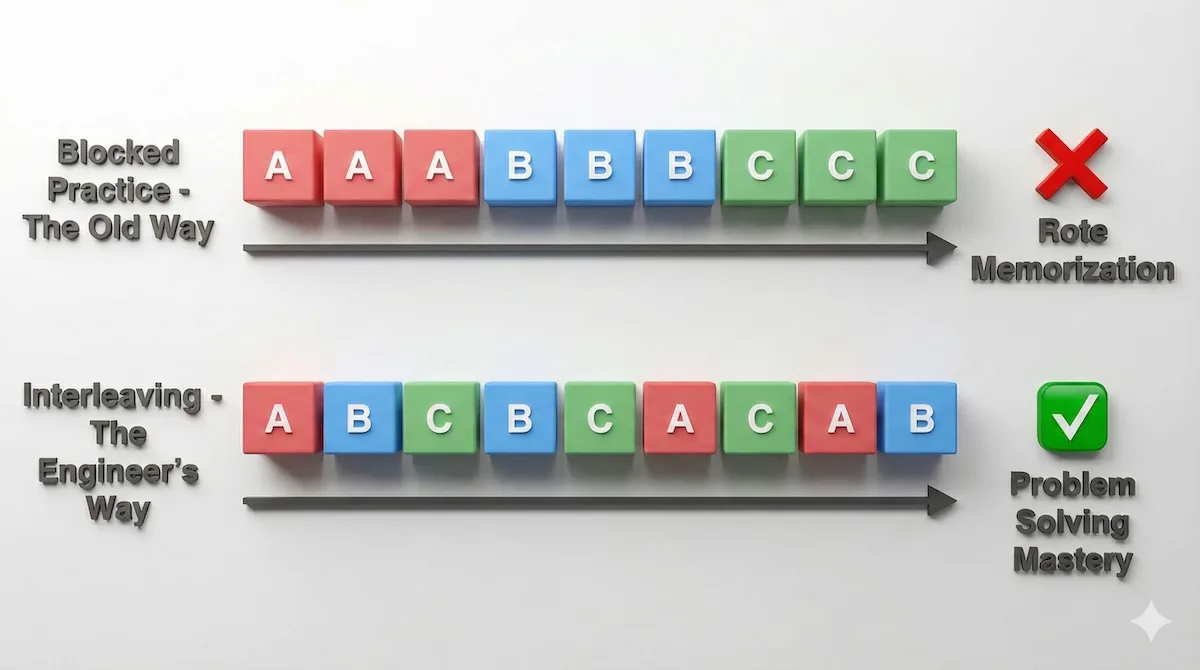
In exam conditions, you are never told which method to use. The exam question itself is the only prompt. Students who practiced only blocked methods — drilling one formula type until proficient, then switching to the next — are trained to apply methods when prompted, not to select methods when unprompted. Interleaved practice builds the identification skill that blocked practice skips entirely.
The application layer: Where possible in Week 3, extend problem practice beyond calculation into prediction and design. Predict the output before calculating it. Design the simplest structure that satisfies a given constraint. Build a prototype or simulation of a concept. Application work produces deeper encoding of underlying principles because it requires understanding the conditions under which formulas apply, not just the formulas themselves.
| Day | Morning (60–90 min) | Evening (60 min) | Focus |
|---|---|---|---|
| Monday–Tuesday | Interleaved problem set: rotate 3 problem types (theory + numerical + design) every 20 minutes | Anki review + explain today’s most difficult problem aloud without notes | Method identification training |
| Wednesday | Application task: mini-design problem or simulation for one topic; predict before calculating | Group session: Kahoot or live quiz on interleaved problem types | Application depth |
| Thursday–Friday | Past exam papers: full sections (not cherry-picked), timed; mark after | Error log: record every error and the specific knowledge gap it reveals | Exam simulation + targeted repair |
| Weekend | Address error log gaps: targeted study on only the specific gaps identified this week | Brief full review of Weeks 1–3 topics through self-test (no re-reading) | Gap repair + consolidation |
Week 4: Simulate the Stress
Week 4 is simulation mode. The only meaningful exam preparation in the final week is working through exam-condition practice under the same constraints you will face in the real examination: timed, closed-book (or open-book if that is the exam format), in a quiet space without interruptions.
The full exam run-through: Select a past paper for each course and complete the entire paper under exam conditions before checking any answers. This exposes the gaps that remained after three weeks of study more reliably than any other method — and it exposes them with enough time remaining to address them. Students who do their first full exam-condition run-through the night before the exam discover gaps with no time to close them.
The weak-spot audit: After marking each practice paper, abandon polishing material you already understand well. The marginal return on improving a 75% topic to 80% is smaller than the return on improving a 40% topic to 60%. Triage your remaining study time to the highest-yield gaps, not the most comfortable review material.
Subject-Specific Study Strategies for Core Engineering Courses
The same study methods apply across engineering subjects in principle, but the specific application of retrieval practice, spacing, and interleaving looks different in calculus than it does in circuit analysis or thermodynamics. The most consistently effective strategies for each core course type are described below.
Mathematics: Calculus, Differential Equations, Linear Algebra
Mathematics learning fails when students confuse recognition with production. Recognizing that a problem is a related rates problem is not the same skill as setting it up correctly from a blank page.
Recognition is built by watching and reading; production is built only by working problems without a visible template. The most important single habit for mathematics improvement is beginning every problem by covering the worked solution before attempting it.
For examinations, the error type that fails most engineering students in mathematics is not conceptual misunderstanding but procedural errors under time pressure — sign mistakes, incorrect integration bounds, miscounted matrix dimensions.
The most effective correction is working more problems faster, not reviewing concepts more carefully. Timed problem sets of 10–15 problems in 20–25 minutes, marked immediately for procedural errors, build the speed and accuracy that closed-book timed exams require.
Physics: Classical Mechanics, Electromagnetism, Thermodynamics
Physics exam performance is determined primarily by problem setup, not calculation. Students who understand the physics but set up the wrong free body diagram, energy system, or circuit loop consistently get wrong answers despite correct calculation.
Study emphasis should be on the setup phase: given a problem description, can you draw the correct diagram, identify the correct system boundaries, and write the governing equations before any calculation begins?
Effective physics practice: cover the problem, read only the setup description, and draw the diagram and write the governing equations before looking at the solution method.
Then check your setup against the solution, not just your final answer. Error analysis focused on setup errors (wrong system identification, incorrect reference frame, missing force components) produces faster improvement than error analysis focused on calculation errors.
Electrical Engineering: Circuit Analysis, Electronics, Signals and Systems
Circuit analysis requires both methodological choice (node voltage versus mesh current versus superposition) and careful bookkeeping (polarity conventions, reference directions). Students who want structured support with these methods can work with a circuit analysis tutor to build fluency in method selection.
The interleaving method is particularly important here: practice selecting the most efficient analysis method for a given circuit before applying it. Students who practice only node voltage methods because it is familiar will fail on circuits where mesh current or Thevenin’s theorem is substantially faster.
For signals and systems, transform methods (Laplace, Fourier, Z-transform) require fluency with transform pairs and properties alongside understanding of when each transform is the appropriate tool. Build a properties reference card from memory (write all Laplace properties from recall, then check), and use it as a self-test rather than as a reference cheat sheet during practice.
Thermodynamics and Fluid Mechanics
Thermodynamics exam performance depends heavily on system identification — correctly identifying the boundaries of the thermodynamic system, the processes occurring, and the appropriate governing equation before any calculation.
The most common failure mode: applying the correct equation but to the wrong system boundaries. Practice system boundary identification as a separate skill from calculation: cover the solution and identify the system, processes, and applicable equations as a first step on every practice problem.
For fluid mechanics, dimensional analysis and unit consistency checks catch a disproportionate share of errors. Develop the habit of checking units at every intermediate calculation step, not just at the final answer. Students who catch unit inconsistencies mid-calculation identify method errors early; those who check only the final answer lose significant partial credit.
Tech Tools That Keep You On Track
The tools below are selected because they directly support retrieval practice, spacing, and interleaving — the methods the four-week plan is built on. A tool that makes passive review easier is not useful; a tool that makes active recall and spaced repetition more convenient is.
- Anki: Spaced repetition flashcard app that schedules each card’s review at the optimal interval for retention. The algorithm is based on the same research (Ebbinghaus forgetting curve, spacing effect) that the Week 2 schedule above applies manually. Free on desktop; paid on iOS.
- Quizlet: Flashcard and practice test tool with sharing capability, useful for building and exchanging engineering-specific card decks with study group members. The Quizlet Live feature supports active group testing.
- Pomodoro Timer: 25 minutes focused study, 5-minute break. Managing focus fatigue is a real constraint in 3–4 hour study sessions — unstructured sessions typically see sharp attention decline after 45–60 minutes. Any simple timer application works; the method matters more than the app.
- Kahoot / Google Forms: Build or access shared quizzes for group study sessions. Collaborative self-testing with a peer accountability structure consistently outperforms solo flashcard review in motivation and retention.
- GoodNotes / Notability: Tablet-based note-taking with handwriting recognition. Useful for STEM subjects where equations and diagrams cannot be typed efficiently. Annotating lecture materials digitally without re-writing them from scratch reduces passive re-copying.
For engineering-specific subject support beyond self-study, a comparison of Wyzant vs Varsity Tutors for engineering students can help identify which platform fits your needs. Students exploring free options may also find a guide to free online tutoring for engineering students useful alongside the paid platforms. For broader context on what online tutoring for engineering in the USA looks like across providers, that resource covers the landscape in detail.
Students in manufacturing or process-heavy programs may also benefit from targeted support — a tutor for industrial engineering can address the operations and systems topics that sit outside the core math-and-physics curriculum. For those whose coursework includes material properties and failure analysis, working with a materials science and engineering teacher can reinforce the conceptual foundations that self-study often leaves incomplete.
Study With Friends, But Make It Count
Group study only outperforms solo study when the group is working actively, not when it is reviewing passively in proximity. Springer et al.’s research confirms the performance advantage of collaborative learning — but that advantage exists specifically for active collaborative learning, not for co-located passive review.
Rule 1: Set goals with timers. “Quiz 30 questions in 45 minutes” is a group goal. “Study Chapter 5 for an hour” is not. Timed goal structures maintain accountability and prevent the gradual slide toward social conversation that kills most group study sessions.
Rule 2: Rotate the teacher role. The Protegé Effect — the observation that teaching others significantly improves the teacher’s own understanding — is most accessible in group study through the whiteboard rotation. Pass the pen, require every group member to present at least one concept per session, and have the group identify errors rather than just affirm the presentation.
Rule 3: No passengers. Every group member must be actively producing — answering questions, working problems, explaining concepts. If a session has become passive for any member, pause and restructure to re-engage active participation. The social comfort of studying in a group is not a substitute for the cognitive engagement that produces retention.
Common Study Mistakes Engineering Students Make
Understanding which study behaviors actively undermine exam performance allows students to diagnose their own patterns before the four-week plan begins.
- Re-reading as the primary review method. Re-reading builds familiarity, not retrievability. Familiarity feels like learning but produces the illusion-of-competence failure pattern — you recognize material when you see it, but cannot produce it under exam conditions. Replace re-reading with flashcard self-testing and whiteboard explanation.
- Studying in topic blocks without interleaving. Completing all calculus problems before moving to circuits trains method application but not method selection. Exams require selection. Interleave problem types within every study session.
- Avoiding past papers until the final week. Past papers are the most precise exam preparation tool available. Students who avoid them because they feel “not ready enough” delay the feedback mechanism that reveals actual gaps. Start past paper practice in Week 1 at partial-attempt level and increase to full-paper simulation by Week 4.
- Polishing strong topics instead of repairing weak ones. Time spent improving a known topic from 80% to 85% has lower ROI than time spent improving a failing topic from 35% to 55%. Triage study time toward the highest-yield gaps identified through error analysis.
- Treating the night before as a study session. Sleep is not a productivity variable that can be traded against study time. The research on memory consolidation is unambiguous: sleep is when declarative and procedural memories are consolidated. Sacrificing sleep for an additional study session before a procedural exam (which most engineering exams are) produces net negative results.
- Passive group study sessions. Sitting with study partners who are reviewing notes silently is not collaborative learning. It is co-located solo study with added social distraction. Group sessions must be structured around active formats: quiz rounds, whiteboard teaching, problem competition with immediate marking.
Last-Minute? Here Is Your 72-Hour Rescue Plan
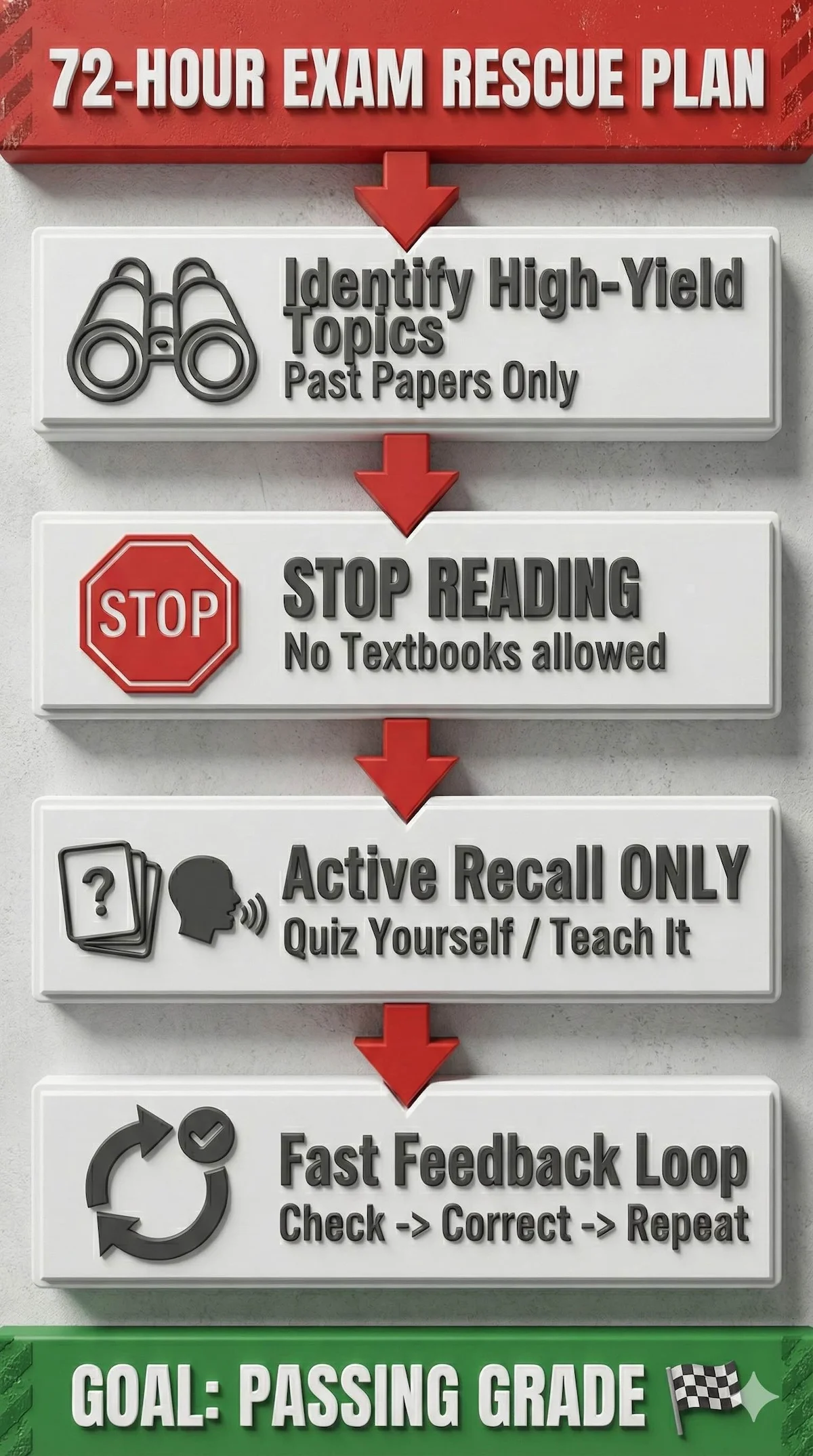
Three days before an exam is not enough time for the four-week system. It is enough time to apply an emergency triage protocol that maximizes what you can reliably retrieve under exam conditions from your current knowledge state.
Step 1 — Identify high-yield topics. Past papers, official learning outcomes, and topics the course lecturer emphasized in revision sessions are your input. Focus only on topics that appear in at least two of the last three past papers. Omit any topic not represented in past papers unless it is explicitly flagged in course materials as certain to appear.
Step 2 — Abandon passive methods entirely. Reading notes, watching videos, and highlighting textbooks are not appropriate activities for a 72-hour window. The only methods appropriate for this time constraint are: flashcard self-testing, worked problem practice without looking at solutions, and verbal explanation of concepts from memory. Every passive hour in this window is an active opportunity cost.
Step 3 — Correct every error immediately. In a 72-hour window, an uncorrected error compounds into a larger gap by exam time. Every mistake in practice: identify the specific conceptual or procedural gap it reveals, address that gap immediately through the shortest path (peer explanation, tutor session, or targeted source material reading), and re-test on the same concept type before moving forward. Never leave a mistake in a 72-hour window without correction and re-test.
Final Takeaways
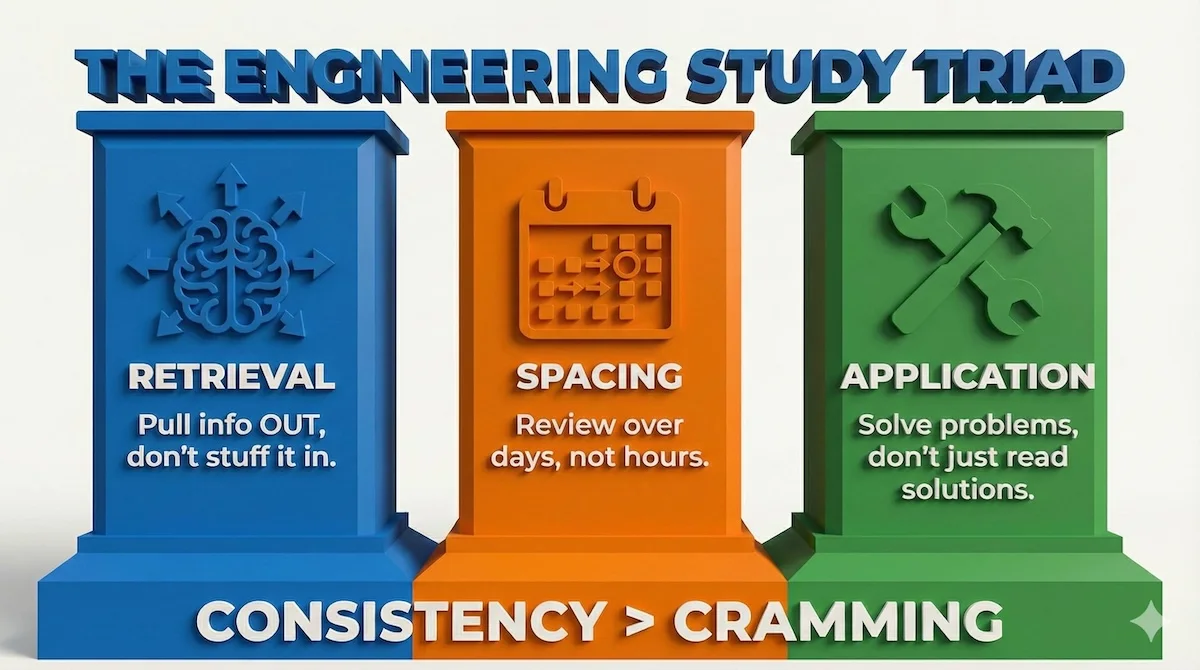
- The three methods that consistently produce better engineering exam results are retrieval practice (self-testing before you feel ready), spaced repetition (distributed review across time), and interleaved problem practice (rotating problem types within sessions). The four-week plan builds on all three.
- Week 1 is diagnostic: use self-testing to identify your actual gaps, not your assumed ones. Week 2 builds memory through spacing and group active learning. Week 3 trains method selection through interleaving and application. Week 4 simulates exam conditions to expose remaining gaps with time to close them.
- Subject-specific strategies matter: mathematics requires production practice (not recognition); physics requires setup-first diagnosis; circuit analysis requires method selection training; thermodynamics requires system identification practice.
- The six most damaging study mistakes are: re-reading as primary review, topic-blocked practice without interleaving, avoiding past papers, polishing strengths instead of repairing weaknesses, sacrificing sleep, and passive group sessions.
- A 72-hour rescue plan works only with full commitment to active methods — every passive hour in that window is a direct opportunity cost against retrievable exam memory.
- Cramming is a confidence trick. It produces a sense of having covered material that evaporates under exam-condition retrieval demands. Smart study means retrieval, spacing, and application consistently, from Week 1.
Related Reading
******************************
This article provides general educational guidance only. It is NOT official exam policy, professional academic advice, or guaranteed results. Always verify information with your school, official exam boards (College Board, Cambridge, IB), or qualified professionals before making decisions. Read Full Policies & Disclaimer , Contact Us To Report An Error