Why Modern Engineers Need More Than Technical Skills: The Real-World Readiness Guide

- Modern engineers need five non-technical skills: emergency response, communication, leadership, business acumen, and critical thinking.
- Major engineering disasters like Challenger and Fukushima trace to non-technical failures, not gaps in technical knowledge.
- First aid and CPR certification costs under $100 and takes one day — highest priority for field and lab engineers.
- T-shaped engineers combining technical depth with business awareness consistently outperform pure specialists at mid-career.
- Students can build all five RWR Stack pillars before graduation with targeted, low-cost investments.
Engineering is fundamentally a human discipline. Every structure, system, and product engineers design is built to serve, protect, or enable real people — which means a purely technical graduate who cannot communicate a risk, lead a team through an unexpected situation, or respond when something goes wrong is only partially prepared for the work that actually gets done on engineering projects. That gap is closing fast. Engineers in 2026 are actively seeking training that extends beyond their degree — including practical skills like First Aid CPR training Mississauga — adding emergency readiness and real-world preparedness to a toolkit that already includes problem-solving, design, and analytical thinking.
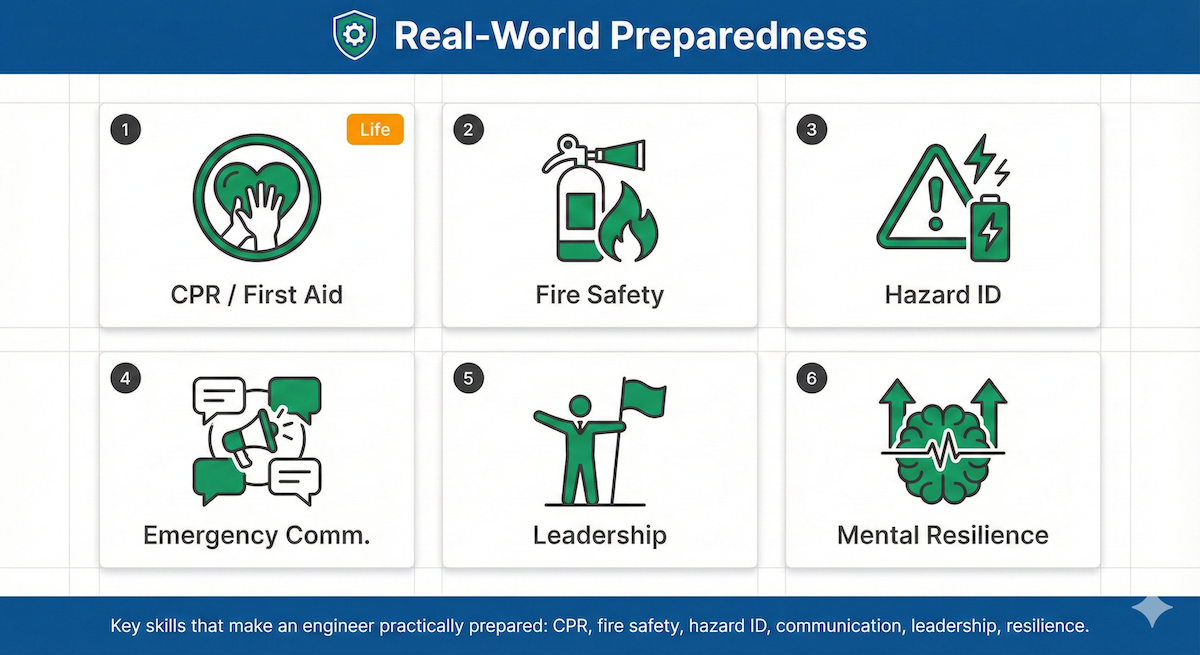
Real-world preparedness covers six specific, teachable skill categories. These are not soft add-ons to a technical career — they are certifiable competencies that engineering employers actively assess, that workplace safety standards increasingly mandate, and that the most career-resilient engineers build systematically before their first job. Students pursuing fields like biomedical engineering tutor support will recognise how quickly these non-technical demands surface in clinical and lab environments.
Which Non-Technical Skills Do Modern Engineers Actually Need?
Modern engineers need five non-technical skill categories to be fully career-ready in 2026: emergency response and safety awareness, communication and stakeholder management, leadership under pressure, business and commercial awareness, and continuous critical thinking — each is teachable, certifiable, and directly observable by engineering employers at every career stage. The most common mismatch I consistently observe in engineering hiring is candidates who can solve complex technical problems but cannot explain their approach to a non-technical manager, or who freeze when a project situation moves outside the planned process.
Those seeking an online computer science tutor will find that communication and leadership gaps appear just as prominently in software-adjacent roles as in traditional engineering fields.
The video above from GCFLearnFree (1.7 million views) breaks down the hard skills vs. soft skills distinction in plain terms — a useful primer that shows why the non-technical layer is not optional, and how both skill types work together in a real professional context. For engineering students who have heard “soft skills matter” but want to understand the practical difference, this is a good 3-minute foundation before diving into the specifics below.
Which Real-World Skill Should You Build First?
Select your primary engineering work context to get a prioritised skill recommendation from the Real-World Readiness Stack.
Field & Lab Environments — Emergency Response First
Your highest-ROI non-technical skill is emergency response readiness. Field, construction, and lab engineers face direct exposure to equipment hazards, chemical risks, electrical faults, and co-worker medical emergencies — and in most of these environments, you are the first responder before emergency services arrive.
- Get certified in first aid and CPR through a recognised provider — certification takes one day and costs under $100 in most regions
- Complete a workplace hazard identification walkthrough in your lab or site and document three potential emergency scenarios specific to your environment
- Practise the five-step emergency response sequence (assess → secure → check → call → stabilise) until the response is automatic — muscle memory matters more than recall under stress
Office & Remote Roles — Communication and Leadership First
Your highest-ROI non-technical skill is structured communication and leadership presence. Office-based and remote engineers face their clearest friction at the technical-to-stakeholder boundary — the ability to brief a non-technical manager, write a clear decision memo, or run a focused team meeting separates engineers who move into senior roles from those who stay in execution mode.
- Practise presenting one technical update per month to a non-technical audience — your manager, a cross-functional team, or a client contact works well for this
- Apply the Pyramid Principle structure in every written update: lead with the conclusion, then the supporting reasoning, then the detail — this one habit changes how colleagues and managers perceive your thinking
- Take on one responsibility that requires coordinating people rather than just completing tasks: a project sub-lead role, a meeting facilitator, or a team onboarding buddy assignment
Mixed & Rotation Roles — Business Acumen First
Your highest-ROI non-technical skill is business and commercial awareness. Engineers in rotation or project-based roles are exposed to multiple technical teams, budget cycles, and stakeholder structures — the professionals who advance fastest in these environments are the ones who learn to see engineering decisions as business decisions early in their career.
- For every project you join, identify the commercial constraint — is the binding limit budget, timeline, or regulatory compliance? Write it down and let it guide your technical trade-offs throughout the project
- Spend two hours each quarter reading your employer’s financial summary or annual report — even if you do not understand every metric, the habit trains you to connect your work to the organisation’s priorities
- Shadow a project manager through one project phase and note every decision that involves cost, time, or stakeholder management — these are the decisions that engineering school does not teach
Engineering Student — Build All Five Pillars Before Graduation
As a student, your goal is systematic exposure to all five pillars of the Real-World Readiness Stack before you graduate. Employers assess graduates on technical ability first, but the first non-technical signal they observe is how candidates describe handling an ambiguous or unexpected situation. Start with emergency response and add one pillar per year of study.
- Get first aid and CPR certified before your third year — it is transferable across every engineering environment, costs under a day of your time, and signals proactivity to employers who review your resume
- Join one student leadership role or engineering society committee per academic year to build communication and leadership evidence you can describe in interviews with specific outcomes
- Seek one industry exposure experience (internship, co-op, or site visit) where you attend team meetings and observe how project decisions are made — note every time cost, timeline, or stakeholder pressure changes a technical choice
The DIM tool above draws from the five-pillar framework below — every recommendation it surfaces is also described in plain prose throughout this article, so you can read the full section relevant to your context after seeing your result.
- Emergency Response & Safety Awareness — First aid, CPR, hazard identification, fire safety, and emergency communication protocols. The baseline safety layer for every engineering workplace.
- Communication & Stakeholder Management — Technical-to-non-technical translation, written clarity, presentation skills, and cross-disciplinary briefing.
- Leadership Under Pressure — Team coordination, decision-making under uncertainty, conflict resolution, and accountability in high-stakes moments.
- Business & Commercial Awareness — Understanding project budgets, stakeholder priorities, cost-benefit reasoning, and the commercial logic behind engineering decisions.
- Continuous Critical Thinking — Adaptability, learning agility, structured problem-solving outside familiar technical domains, and mental resilience under ambiguity.
For students preparing for professional exams, the guide on micro-learning strategies for FE and PE exam prep shows how the same systematic approach applies to technical certification.
Engineering Is Not Just Technical — It Is Human
Engineering is fundamentally about building systems that improve human life — bridges exist to move communities, software exists to support users, equipment exists to keep workers safe. In every engineering domain — electrical, civil, mechanical, software, chemical, aerospace — engineers make decisions that directly affect the wellbeing of real people.
That is why a purely technical failure is rarely just a technical failure: it is almost always also a communication failure, a leadership failure, or a failure to act when the situation demanded it.
The most high-profile engineering failures of the past three decades confirm this pattern. The Challenger disaster involved a decision-making culture that suppressed safety concerns from engineers who knew the risk. The Boeing 737 MAX MCAS oversight traced back to organisational communication breakdowns between engineering and programme management.
The Fukushima nuclear disaster exposed gaps in emergency response protocols that engineers on site had not drilled. None of these catastrophes happened because the engineers involved lacked technical knowledge. They happened because non-technical skills failed at the critical moment.
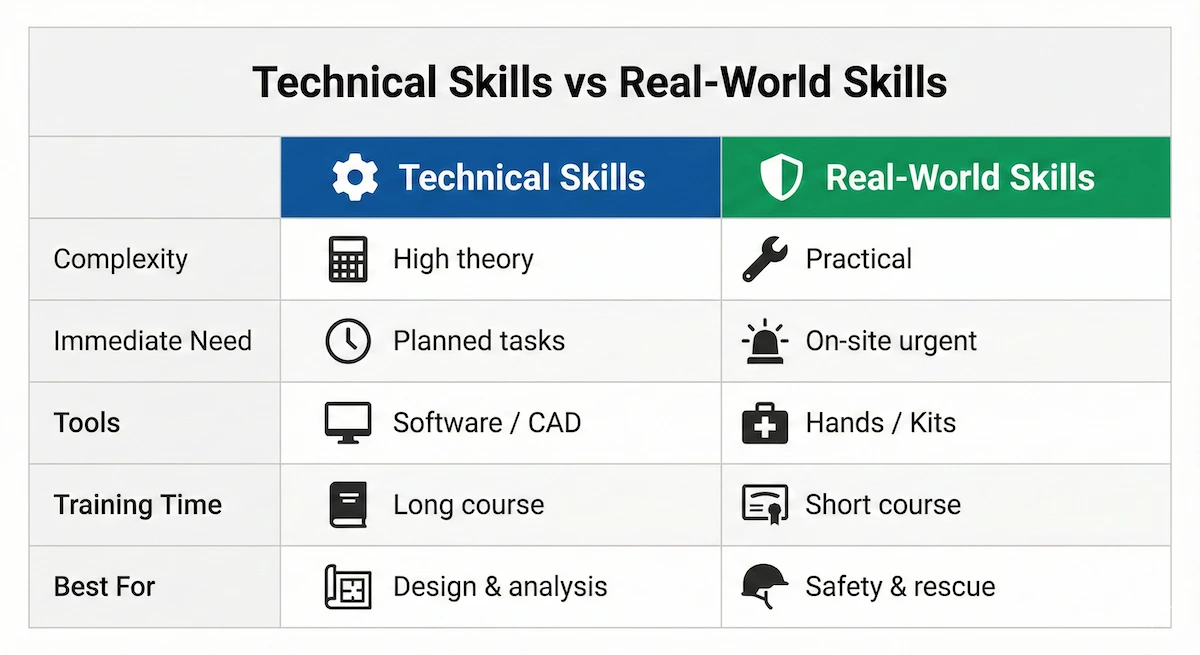
The comparison above illustrates when technical skills and real-world preparedness each apply. Both are necessary — the RWR Stack does not replace technical mastery, it makes technical mastery actionable in real environments with real people and real consequences.
For engineering students and technical professionals: Every engineering programme teaches you to design for the ideal case — the specified load, the expected input, the clean dataset. Real-world engineering is mostly about handling the unexpected: a design assumption that does not hold, a supplier that changes a specification mid-project, a team member who needs support in a moment of high pressure. The non-technical skills in the RWR Stack are precisely what makes you effective when the ideal-case assumptions break down — which is when your value to a team is most visible.
Understanding how to write up technical findings clearly is itself a non-technical skill — the guide on engineering lab report writing covers the communication standards that employers expect from day one.
Why Modern Engineering Environments Demand More Than Technical Training
Modern engineering environments introduce risk categories that technical training does not address: high-voltage equipment, battery fires from lithium-ion systems, chemical exposure, ergonomic injuries from automation-adjacent work, and medical emergencies in any setting where teams collaborate in person. Automation, robotics, AI-driven systems, and increasingly dense physical workplaces have expanded the hazard surface significantly in the past decade — and the training lag in most engineering curricula has not kept pace.
Understanding safety protocols and holding a first aid or CPR certification is particularly high-value for field engineers, lab-based researchers, and manufacturing-adjacent engineers. The training costs under $100 and takes one day, but it fundamentally changes what you are capable of doing in the first four minutes of a workplace incident before emergency services arrive. Those four minutes are where engineering workplaces are most vulnerable, and where a prepared team member makes the largest difference.
If something goes wrong in your engineering workplace, a five-step sequence dramatically reduces harm in the first minutes after the incident begins.
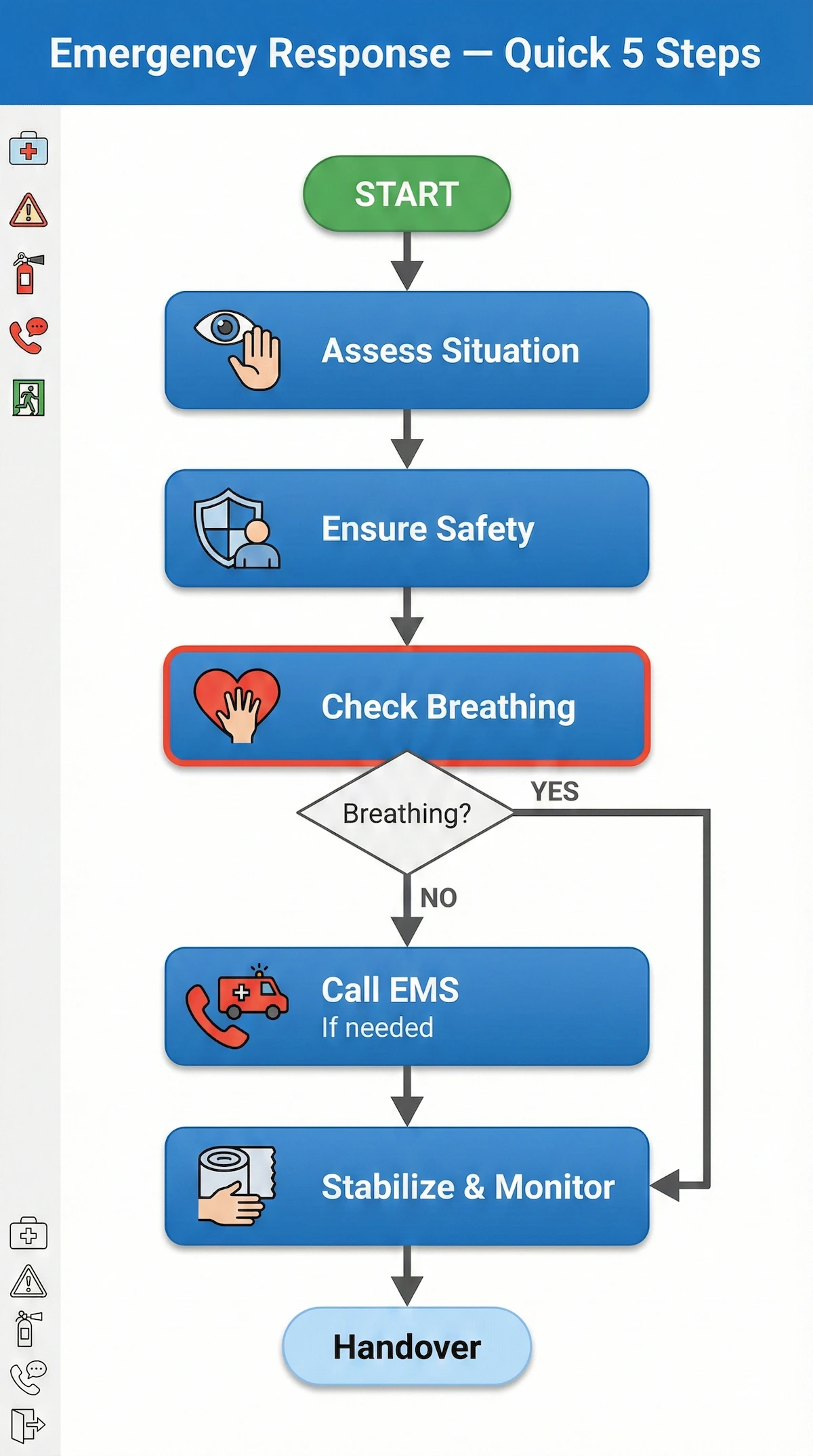
The sequence above — assess, secure, check, call, stabilise — is the same framework used in professional first aid training programmes. Memorise it and practise it; it takes approximately three minutes to run through and becomes automatic after five repetitions. Many engineering students and professionals are already using trusted online resources, including the My Engineering Buddy platform, to strengthen both technical and real-world skills in parallel — because the two reinforce each other at every career stage.
For students building foundational mechanics knowledge alongside these real-world skills, the overview of engineering statics and Mechanics 1 topics is a useful technical companion.
How Real-World Preparedness Builds Stronger Engineering Teams
An engineering team’s non-technical capabilities determine its performance under pressure — not just during emergencies, but during the project delays, scope changes, communication breakdowns, and leadership vacuums that occur on every real engineering project. A team where every member knows their role in an unexpected situation is a team that runs better during predictable situations too, because the underlying habits of clear communication, shared accountability, and calm decision-making transfer directly into day-to-day project work.
Teams where members hold at least one cross-training credential in emergency response report higher confidence under project pressure, better risk identification in the early project phases, and more structured communication during incidents — not just safety incidents, but any unplanned event that forces rapid decision-making. The overlap between safety preparedness and general professional performance is not coincidental: both require the same habits.
- Higher confidence under pressure — prepared team members make faster, calmer decisions when plans change
- Better risk awareness — hazard identification training sharpens pattern recognition across all project risks, not just physical ones
- Improved communication skills — emergency protocols require clear, concise information exchange under stress, which directly improves routine team communication
- Deeper sense of mutual accountability — cross-trained teams demonstrate higher psychological safety and lower attrition on long projects
- Greater resilience during crises — whether the crisis is a safety incident or a project failure, the response habits are transferable
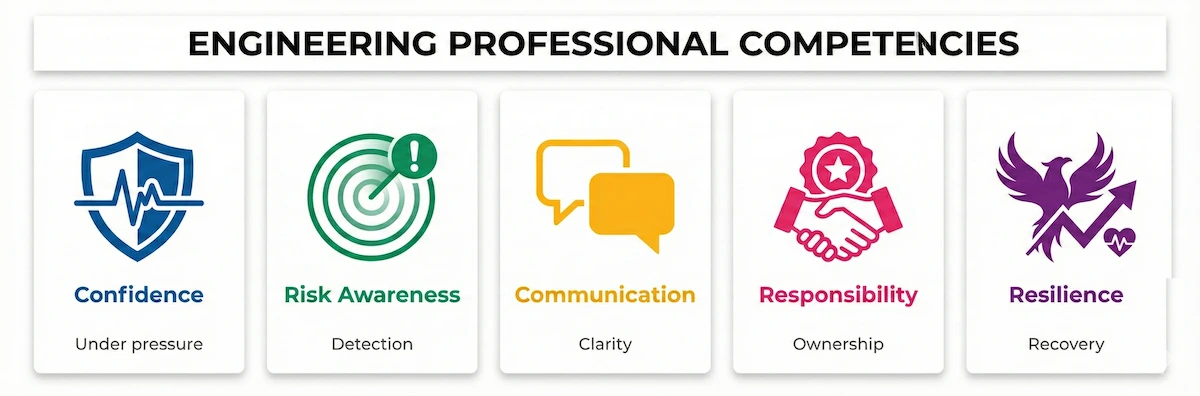
These team outcomes are not soft metrics. They are directly observable in project delivery timelines, incident report rates, and employee retention figures in engineering-intensive organisations. The investment in non-technical training pays back at the team level, not just for the individual who completed the course.
Engineers working in construction and infrastructure contexts will find the step-by-step guide on how to learn engineering dynamics (Mechanics 2) a useful resource for building the technical depth that complements these team-level skills. Those involved in cost and project planning may also benefit from working with a quantity surveying tutor to develop the commercial awareness the RWR Stack demands.
The Generalist Engineer: Why T-Shaped Professionals and Business Acumen Win Long-Term
The T-shaped engineer — technically deep in one discipline and practically broad across communication, leadership, and business reasoning — consistently outperforms the pure specialist at the mid-career inflection point, where promotions and high-impact project assignments depend more on influence and commercial judgement than on technical output.
This is not a recent trend: it has been true since the first generation of engineers moved from individual contributor roles into project leadership, and it is more pronounced now than at any point in the past two decades because engineering projects are more cross-functional and commercially complex than they were before.
The “business side of engineering” is the most consistently underdeveloped area in engineering education, and one of the most consistently cited gaps by engineering hiring managers when evaluating mid-career candidates. Engineers who understand how their technical decisions affect project budgets, delivery timelines, and client relationships advance faster — not because they stopped being technical, but because they became useful to a wider range of decisions.
A senior engineer who can explain the commercial implications of a design trade-off to a non-technical stakeholder is worth significantly more than one who cannot, even if the technical capability is identical.
- Understand the commercial constraint of every project: is the binding limit budget, timeline, or regulatory compliance? Let it shape your technical decisions explicitly.
- Study your employer’s financial context: even two hours per quarter reading the company’s annual summary develops the commercial vocabulary that separates individual contributors from project leaders.
- Build leadership exposure deliberately: seek co-lead or ownership roles on sub-projects — not for the title, but for the experience of making accountable decisions under constraints.
- Practise management essentials: meeting facilitation, project status reporting, and cross-team coordination are skills that engineering students can develop in student society roles before entering the workplace.
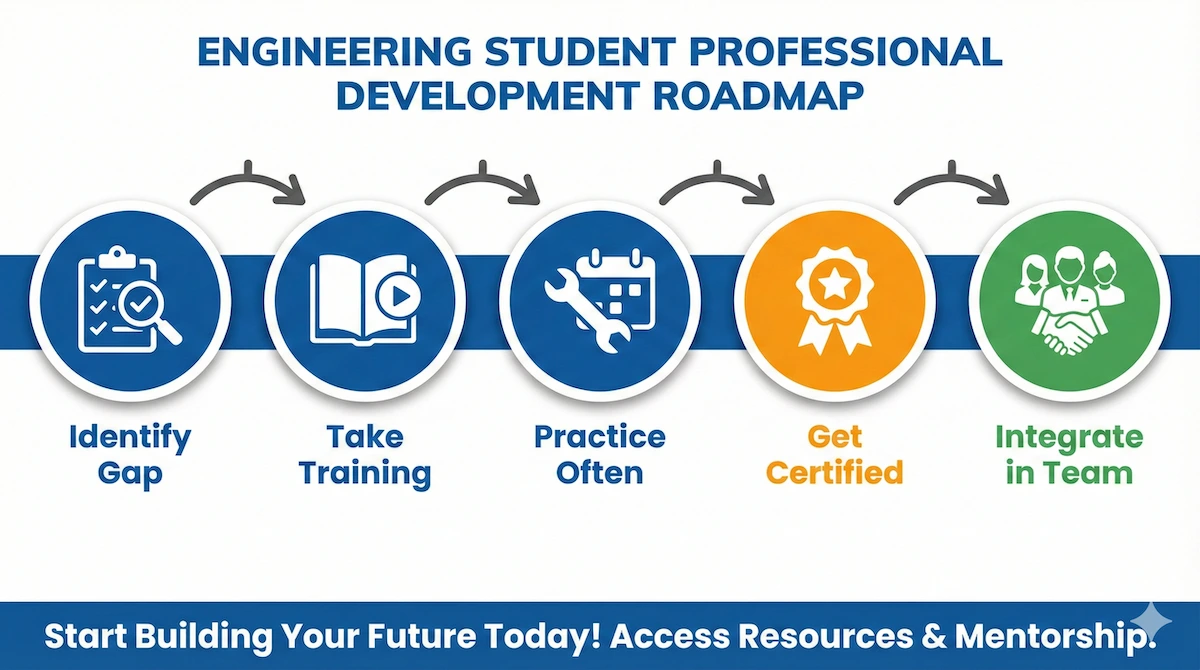
The roadmap above summarises the five-step process: identify your specific gap in the RWR Stack, take targeted training, practise in low-stakes environments, earn a certifiable credential where one exists, and integrate the skill into your professional identity. Start with one gap this week — identify it, then take the next two steps.
Software-focused engineers building the T-shaped profile will find that working with a software engineering tutor can accelerate the technical depth side of the equation while they develop the broader competencies described here. For those in energy-intensive disciplines, strengthening core subject knowledge with a thermodynamics tutor supports the same dual-track development.
How to Start Building Real-World Readiness This Semester
An engineering student can build all five pillars of the Real-World Readiness Stack before graduation with four targeted investments: a first aid and CPR certification (one day, under $100 in most regions), one student leadership role per academic year, one industry exposure experience per degree (internship, co-op, or a structured site visit), and one deliberate business-facing exercise per project (identifying the commercial constraint every time). None of these requires additional tuition fees or a second degree. Each one produces a credential or a story you can describe concretely in an interview.
The most common failure I observe at this stage is treating non-technical skills as a later-career concern — something to develop “after graduation” or “on the job.” The engineers who demonstrate real-world readiness at graduation did not develop it accidentally; they built it systematically during their degree with the same deliberate approach they applied to technical coursework. The window is now, not later.
- This week: identify your weakest pillar from the RWR Stack and book the first concrete step to address it (a first aid course registration, a student society committee application, or one conversation with a project manager in your engineering programme).
- This semester: take on one responsibility outside your technical coursework that requires you to communicate, coordinate, or lead. Document the outcome in your portfolio.
- Before graduation: hold at least one certifiable credential in a non-technical skill (first aid, project management foundation, or a communication/leadership workshop with a completion certificate).
- For technical skill support alongside this: use resources like homework guidance and online tutoring to keep your technical foundation strong while deliberately building the RWR Stack in parallel — both are required, and neither should come at the cost of the other.
For engineering students and technical professionals: The practical outcome of building the RWR Stack before you graduate is that you enter every interview able to answer the most common second-tier engineering question: “Tell me about a time you had to deal with an unexpected situation.” Students who have only technical experience answer with a lab problem or a coursework challenge. Students who have built real-world readiness answer with an emergency response drill they ran, a team disagreement they resolved, or a project where they identified a budget constraint that changed the design decision. The second answer signals a different kind of readiness — and it is the one engineering employers remember.
Related Reading
******************************
This article provides general educational guidance only. It is NOT official exam policy, professional academic advice, or guaranteed results. Always verify information with your school, official exam boards (College Board, Cambridge, IB), or qualified professionals before making decisions. Read Full Policies & Disclaimer , Contact Us To Report An Error