
Cambridge Engineering: What Makes the Course Unique?

Miguel is a Cambridge Physics graduate and university admissions consultant at First Class Education. He has guided students from over a dozen countries through successful applications to Oxford and Cambridge. His consultancy specialises in helping international students navigate the complexities of Oxbridge admissions, from UCAS applications to interview preparation.
Introduction
Engineering courses are already some of the most competitive courses to get on for a combination of reasons, some of which include graduate employability, skills development, and intellectually stimulating work. Engineering at Cambridge is especially well-respected, known for its academic rigour, initial generalist approach, and networking opportunities. If you are unaware of these distinctions, this article will explain the most important features of the Cambridge Engineering course and why it might suit you.
Why Cambridge?
The prestige and world-class reputation that comes with studying Engineering at the University of Cambridge (ranking 4th globally for Engineering according to QS world university rankings) is derived primarily from a combination of its intensive academic environment, long history, unique teaching system, and collegiate arrangement.
The next visual shows how Cambridge Engineering moves from a broad shared core to focused specialisation across the four years.
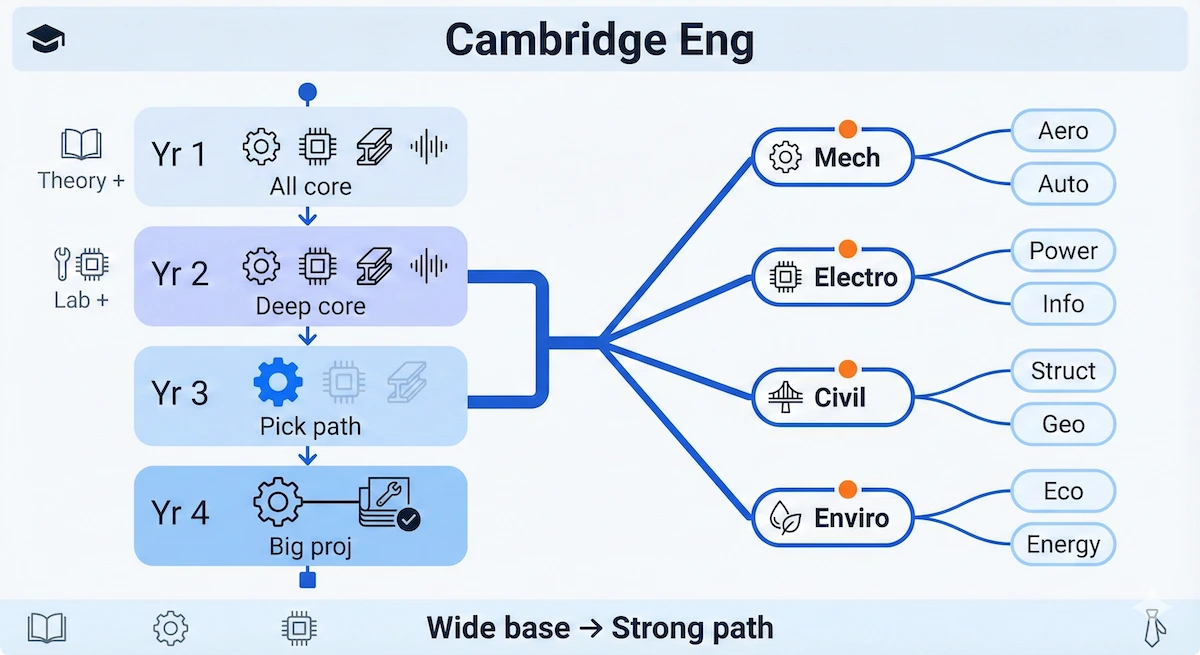
This graphic shows how Cambridge Engineering moves from broad core study to focused specialisation over four years.
From this, readers can see that wide early study leads smoothly into clear specialist paths by Years 3 and 4.
Firstly, the collegiate system ensures that a student is not only part of the wider university, but also a college. The college is responsible for the non-academic parts of a student’s experience like their housing, meals, and laundry. College life is central to the Cambridge experience because you will dine with others in your college, play on the same sports teams as them, and graduate in the same ceremony as them. In contrast, your department is in charge of your teaching and labs, and exists outside of the collegiate system. For example, a student might belong to Trinity College, but be taught by faculty from the Engineering department. This arrangement ensures that Cambridge students have the unique experience of belonging to a smaller and more intimate subset of the university, encouraging strong student and alumni networks.
Furthermore, another appeal of the Cambridge Engineering course is its intensive academic reputation. Cambridge, as a whole, attracts some of the world’s brightest and best talent so if you want to be challenged and thrive with other ambitious people, you would fit in well at Cambridge.
What Makes Cambridge Engineering Different?
Engineering at Cambridge is unique in that students spend the first two years of their course as generalists, and only specialise into their desired engineering discipline from the third year onwards. This is in contrast to engineering courses at other universities, like Imperial College London, where you apply to an engineering course already knowing what discipline you want to specialise in.
This difference in course structure has pros and cons. It suits students who are unsure what engineering discipline they’re interested in and want university-level exposure before they decide on which to pursue. Therefore, students who already know what engineering discipline they want to pursue may choose to apply to a different university where they specialise immediately.
Another defining feature is Cambridge’s supervision system. Supervisions are small-group teaching sessions where 2–3 students sit with one academic or PhD student and work through problem sheets, discuss lecture material, and ask questions about concepts they’re unsure of. Given the small group sizes, supervisions can be intellectually intense because students have more interaction with their supervisor. Some individuals thrive in this fast-paced system while others would prefer learning at a more relaxed pace, so it’s important to understand the teaching style.
Many students fear the course is all theory, but the real mix of talks, labs, and projects looks very different.
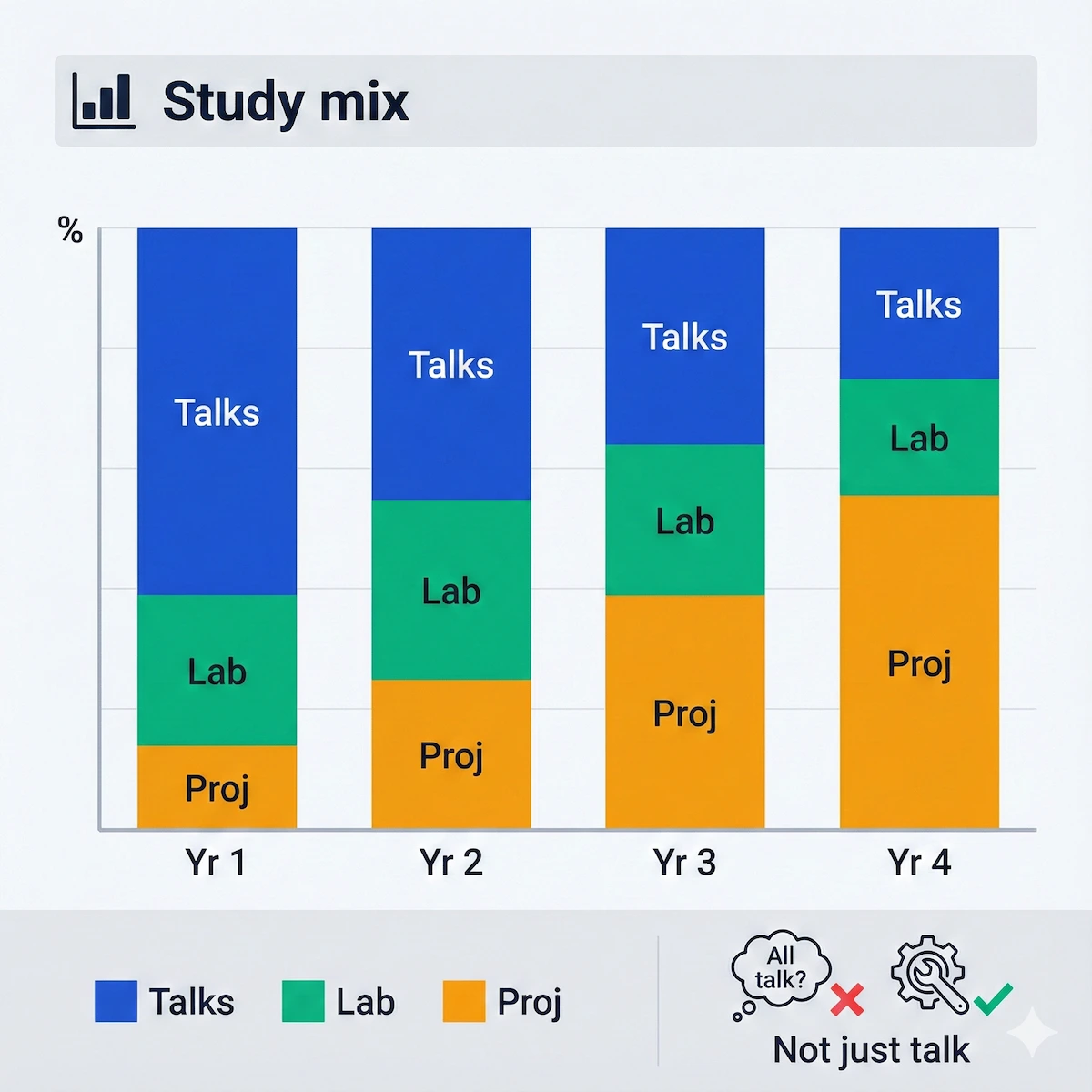
This chart shows Cambridge Engineering is not all theory; labs and projects grow each year.
The rising project share makes clear that hands-on design and build work is central, not an add-on.
To complement supervisions and independent study, many applicants find targeted resources useful — for example, the My Engineering Buddy website collects supervision-style problems, worked examples, and short topic notes that mirror the Cambridge approach.
If you’re preparing for problem sheets or want quick revision prompts between lectures, that kind of focused practice can be a big help.
Graduate Opportunities
Cambridge Engineering graduates move into a wide variety of sectors. According to recent surveys, around 20 percent enter manufacturing, 12 percent consulting, and 9 percent IT, with others branching into energy, research, finance, and emerging technologies. The breadth of first-year and second-year training makes Cambridge graduates adaptable, which employers value.
For those more entrepreneurial, Cambridge is also a startup hub, with the university credited with contributing £30bn to the UK economy. It has been the source of 194 spinout companies and over the years, Cambridge alumni have founded more than 3,300 startups. Students interested in founding their own company will find no shortage of resources, mentors, and collaborators in what many describe as “Europe’s Silicon Valley”.
How to Apply to Cambridge Engineering
Successful applicants to Cambridge Engineering generally take the same A levels (mathematics, further mathematics, and physics, at least). All Cambridge courses (alongside Oxford, medicine, veterinary medicine, and dentistry) have the same UCAS deadline of October 15th where applicants are expected to submit a 4000-character personal statement, predicted grades, achieved grades, and teacher’s reference.
Candidates must also choose four other universities to apply to alongside Cambridge. The personal statement is an opportunity for the candidate to exhibit their genuine enthusiasm for engineering by showcasing their motivations for applying to the course, any relevant extracurricular activities, and any reflections. Successful Cambridge Engineering applicants tend to have partaken in independent projects exploring an engineering discipline outside of their school classes.
Applicants must also sit the Engineering and Science Admissions Test (ESAT), a pre-interview admissions test that takes place around mid-October each year. This test includes two mathematics modules and one physics module and is used alongside a candidate’s grades.
If the applicant scores well in the ESAT, they may be invited to interview. This is often the most challenging part of the admissions process because the interview is unfamiliar for high schoolers. For engineering, the interview involves sitting with up to three academics where you are asked to solve challenging maths and physics questions using concepts taught at high school level (A level, IB, AP). Interviewers assess your ability to navigate unfamiliar scenarios, apply your knowledge effectively, and how you respond to new ideas and perspectives.
Many schools have limited experience preparing students for this type of interview, so applicants often seek additional guidance to better understand what academic interviewers expect. Practical, interview-style practice sessions and ESAT question drills — which you can also find on the My Engineering Buddy website — are a practical way to build confidence before the real thing.
To choose well, it helps to see how Cambridge’s wide-first model compares with a more narrowed course from day one.
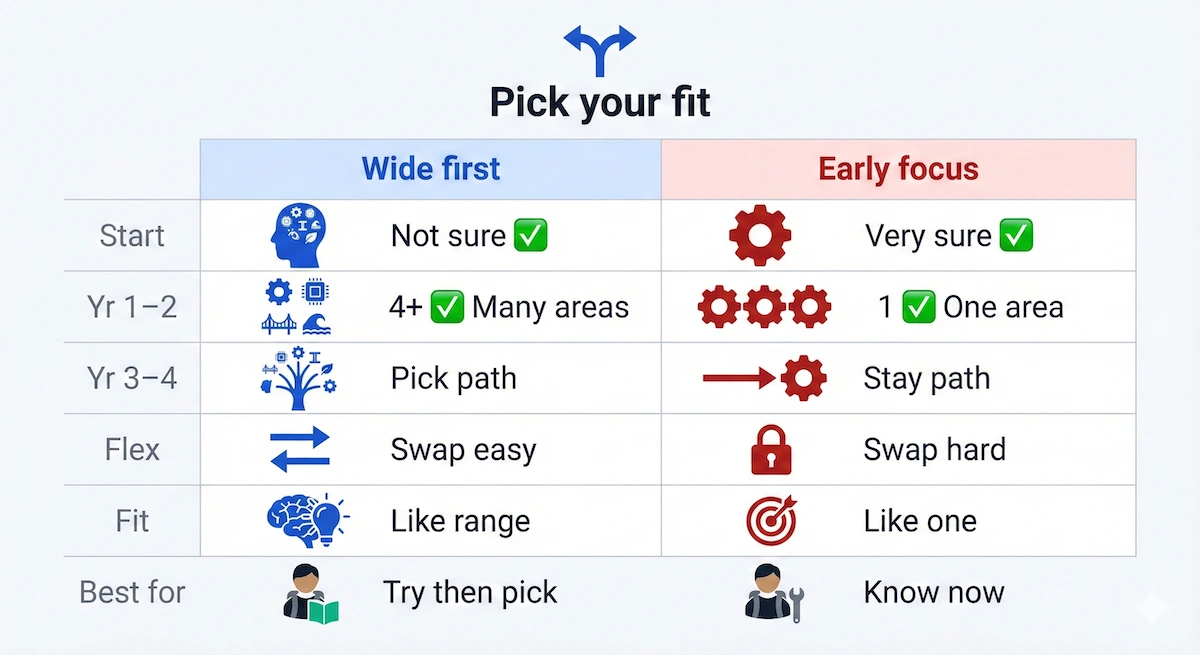
Use this table to see if a wide-first or early-focus engineering degree better matches how you like to learn.
This side-by-side view makes it easier for readers to match each path to their own certainty and style.
Key Takeaways
- Cambridge Engineering offers a unique generalist-first approach. Students spend the first two years as generalists before choosing their engineering discipline in their third year, ideal for those who want to explore different areas first.
- The collegiate system creates distinct advantages. Students belong to both a college and the wider university, leading to strong alumni networks and a more intimate, community-focused experience.
- Supervisions provide intensive small-group teaching. With 2–3 students per session, this method enables deep engagement with academics and challenging intellectual discussions.
- The admissions process is highly competitive. With the early October 15th deadline, the ESAT exam, and rigorous interviews, preparation is essential for success.
******************************
This article provides general educational guidance only. It is NOT official exam policy, professional academic advice, or guaranteed results. Always verify information with your school, official exam boards (College Board, Cambridge, IB), or qualified professionals before making decisions. Read Full Policies & Disclaimer , Contact Us To Report An Error