
Condensed Matter Physics Tutoring Online: A Complete Guide for Students and Parents

Condensed Matter Physics is a broad field critical to modern technology, but its courses can challenge students. Expert tutors (especially via Condensed Matter Physics tutoring online break down complex topics, boosting understanding and grades.
Understanding Condensed Matter Physics
Condensed matter physics explores the physical properties of matter in solid and liquid phases. It studies how a material’s behavior emerges from a large number of interacting atoms and electrons. Because of its depth and math requirements, condensed matter physics is usually taught in advanced college courses (or advanced high-school programs) rather than in basic physics classes. Common topics include crystal structures and lattice arrangements, electron band theory in semiconductors, magnetic materials, and superconductivity. For example, understanding why silicon conducts electricity or how lasers work comes from condensed matter concepts. In fact, advances in this field have enabled technologies like transistors, optical fibers, and magnetic resonance imaging. About one-third of U.S. physicists work in condensed matter, making it the largest division of the American Physical Society.
This field covers a vast array of topics. The visual below outlines the four primary pillars you will encounter in your studies.
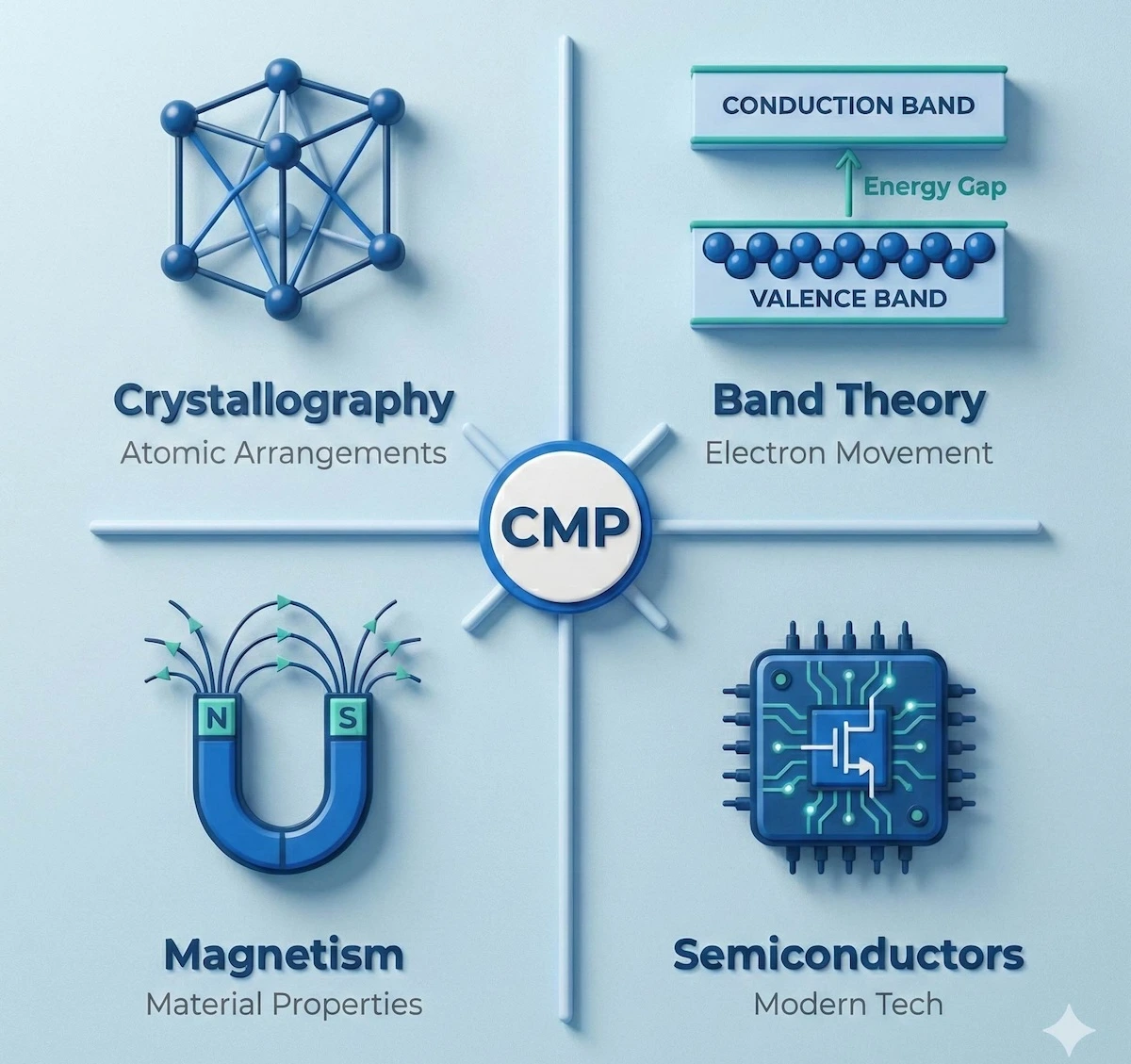
Condensed Matter Physics spans four critical areas that drive modern technology, from microchips to medical imaging.
Mastering these core areas is essential for understanding how modern electronics and materials function.
- Crystallography: Atomic arrangements in solids (e.g. crystals and minerals)
- Band Theory: How electrons move in materials (critical for semiconductors and electronics)
- Magnetism & Superconductivity: Special properties of certain materials (e.g. magnets, superconductors at low temperatures)
- Material Properties: Thermal, electrical and mechanical behavior of metals, polymers and composites
Challenges of Condensed Matter Physics
Imagine a physics student who has just learned about electron bands in class. Facing a homework problem on semiconductors, they might stare blankly at a complex equation, unsure how theory connects to practice. Situations like this underscore the need for personalized help. Condensed matter physics is challenging because it combines advanced mathematics (calculus, partial differential equations) with abstract quantum concepts. For instance, deriving energy levels in a crystal requires careful math and physical intuition. In large lectures or textbooks, many details are glossed over, and students can struggle to apply equations to real materials. This is where targeted tutoring and Condensed Matter Physics teaching play a role: a tutor can fill those gaps and guide the student through the tough spots.
Why exactly is this subject so difficult? It often comes down to the disconnect between theory and practice, as shown here:
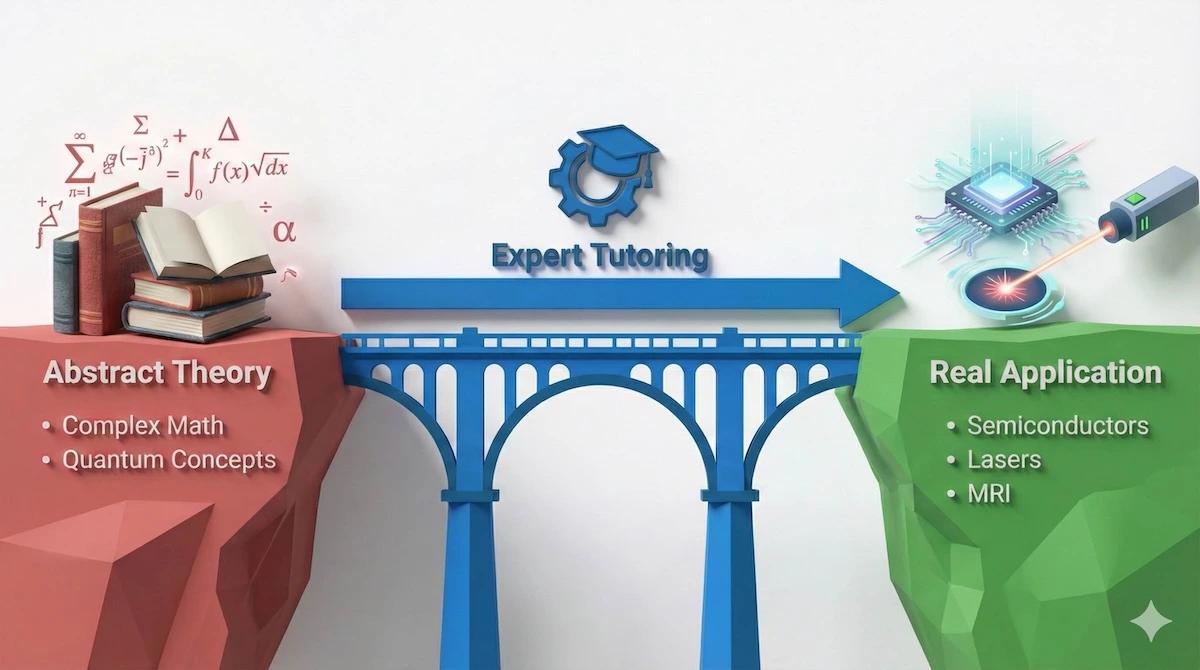
Students often struggle to connect complex math with real-world materials—a gap that expert tutoring effectively bridges.
A tutor acts as this crucial bridge, translating complex equations into understandable concepts.
How Tutoring Helps Students
Personalized tutoring connects students with an expert who can tailor explanations and examples to their needs. Research shows this one-on-one approach dramatically improves learning: high-impact tutoring can be up to 20 times more effective than standard support, and it accelerates learning by several months. Even occasional tutoring makes a difference: students who used tutoring just once per semester performed about 7–13% better than peers who did not. In practice, a skilled tutor breaks down difficult problems, teaches key principles step-by-step, and builds a student’s confidence.
- Individual Attention: Tutors focus on each student’s weak points, giving clear feedback until concepts click.
- Accelerated Progress: One-on-one tutoring has been shown to boost learning by 3–15 months over a school year.
- Homework Support: Tutors guide students through practice problems and assignments step-by-step, preventing confusion and mistakes.
- Adaptive Learning: A tutor can adjust teaching style and pace, using examples and analogies until the student understands the material.
The impact of this personalized support is backed by data. Here is how one-on-one instruction compares to standard learning:
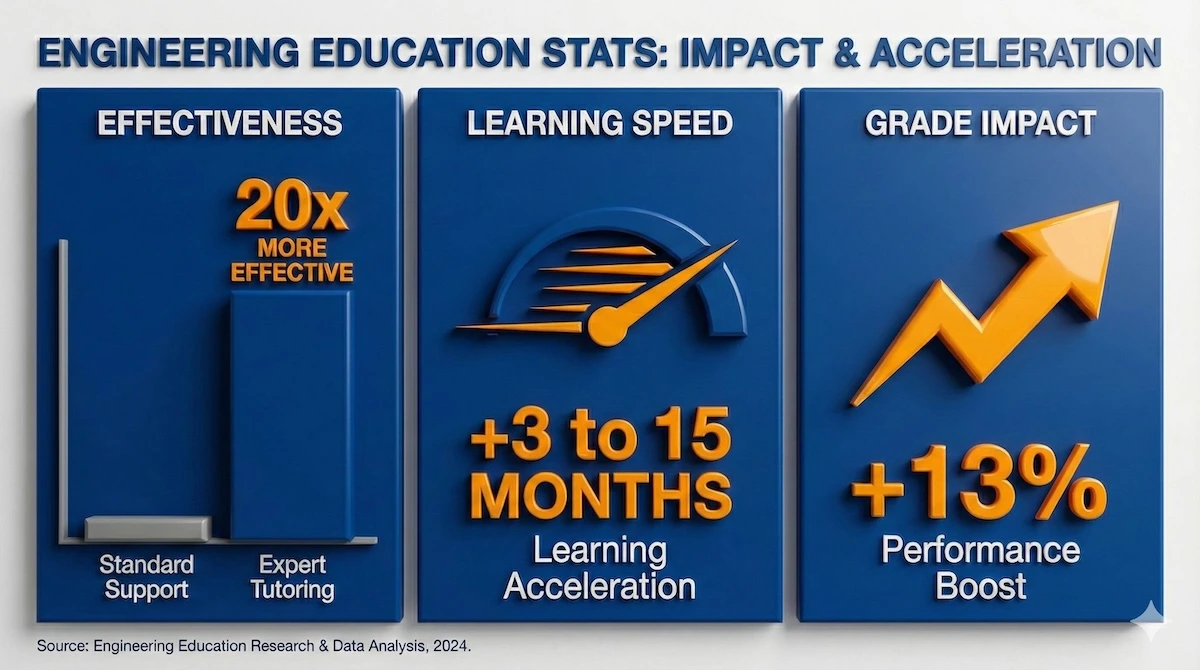
Research confirms that personalized tutoring significantly accelerates learning and boosts academic performance compared to standard study methods.
With such significant gains in learning speed and retention, tutoring is an investment in long-term academic success.
Online Tutoring for Condensed Matter Physics
Online tutoring offers added flexibility and accessibility. Students anywhere (USA, UK, Gulf, etc.) can connect with top Condensed Matter Physics tutors online via video calls and digital whiteboards. Tutors can use online tools (like shared simulations or 3D models of crystals) to make abstract concepts more concrete. This means help is available outside classroom hours and without commuting. In fact, online tutoring is popular for its accessibility, flexibility, and affordable pricing. Many platforms list physics tutors for about $18 to $60 per hour, which is often less than in-person rates. Students can also record sessions and revisit complex topics on their own schedule, making online tutoring a convenient choice for busy learners.
Homework and Assignment Help
Tutors are especially helpful when tackling tough homework problems. They provide real-time homework help, explaining each step of a solution rather than just giving answers. Education experts agree that individualized tutoring for assignments can significantly boost a student’s progress. For example, a tutor might:
- Walk through a difficult calculation (like deriving the band gap of a material) and clarify each concept involved.
- Check a student’s solution and correct misunderstandings on the spot.
- Teach efficient problem-solving strategies (e.g. simplifying assumptions) that the student can use independently.
With this guidance, students not only improve their grades but also deepen their understanding for future exams.
Finding and Hiring a Condensed Matter Physics Tutor
To hire the right tutor, first identify your needs (exam prep, project guidance, or concept review). Search reputable platforms or school networks for tutors with physics or engineering backgrounds. A qualified tutor will often have a degree in physics and experience teaching condensed matter topics. You can interview or have a trial session to ensure their teaching style fits you. Schedule sessions regularly (weekly or biweekly is ideal) to build momentum. Discuss pricing up front: many physics tutors charge $20–$60 per hour, depending on experience and location.
Ready to find help? Follow this simple roadmap to ensure you hire the best qualified tutor:
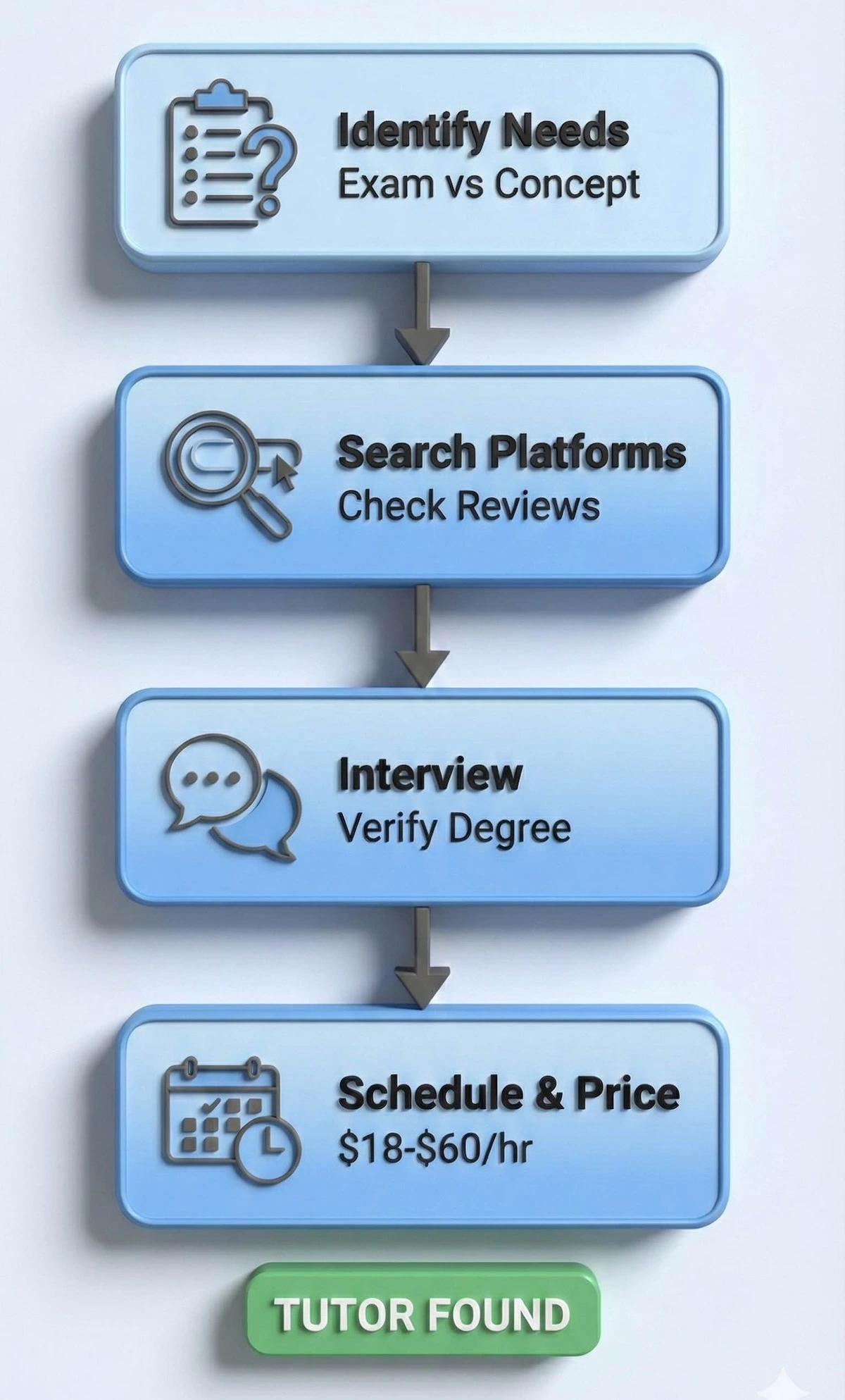
Follow this simple four-step process to find and hire the perfect Condensed Matter Physics tutor for your specific needs.
Taking these systematic steps ensures you don’t just find a tutor, but the right tutor for your specific goals.
Remember, a private tutor complements what you learn from your Condensed Matter Physics teacher in class, offering extra practice and one-on-one focus that is hard to get in large lectures. Consistent tutoring can make the difference between struggling and mastering this subject.
FAQs
- What is condensed matter physics? It is the branch of physics that studies the physical properties of solids and liquids.
- Why is condensed matter physics important? It underpins modern technology (like electronics, LEDs, and MRI) and drives advances in materials and devices.
- How can a condensed matter physics tutor help me? A tutor provides personalized explanations and practice, often accelerating learning by several months and improving understanding of complex topics.
- Is online tutoring effective? Yes – online tutoring offers the same benefits as in-person help, with added flexibility and wider tutor choices.
- What should I look for in a condensed matter physics tutor? Look for a tutor with a strong physics background (usually a physics degree) and good teaching experience.
- How much does a condensed matter physics tutor cost? Rates vary, but many qualified tutors charge roughly $20–$60 per hour depending on expertise.
Related subjects:
Bipolar Junction Transistors (BJT)
Complex systems
Crystallography
Spintronics
Superconductivity
******************************
This article provides general educational guidance only. It is NOT official exam policy, professional academic advice, or guaranteed results. Always verify information with your school, official exam boards (College Board, Cambridge, IB), or qualified professionals before making decisions. Read Full Policies & Disclaimer , Contact Us To Report An Error