
How Tutors Help Students Improve Their Academic Confidence

Do you know that the pressure to succeed is among the top reasons why students cheat? Unconfident in their academic skills and ability to craft A-worthy assignments, our mentees go to AI or a writing service for help.
Can tutors do anything with that?

They can change the way students experience school and consider subjects, tasks, and grades. Supportive and empathetic teachers can make a complex topic understandable, thus influencing how their mentees perceive themselves. Good tutors match tasks to a student’s current level: They set small wins, reshaping classroom performance and attitudes.
Many students feel lost in large lecture halls not because the material is too hard, but because the format doesn’t fit their needs. Let’s compare the traditional classroom environment with the personalized approach of private tutoring.
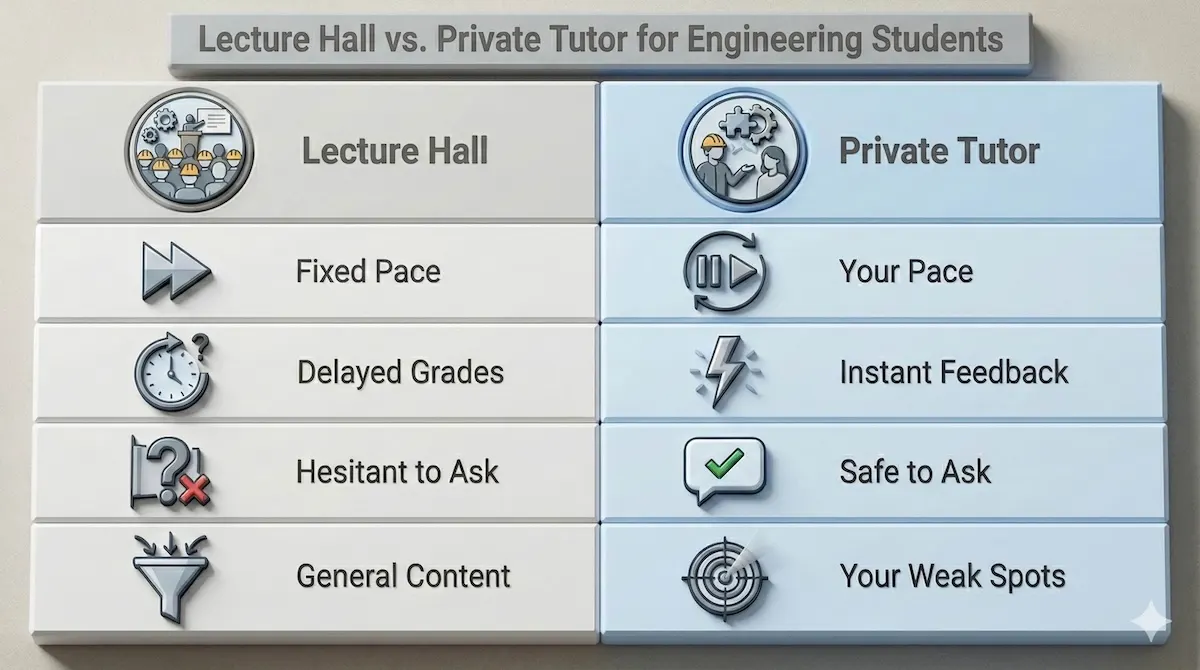
See how personalized tutoring bridges the gaps left by traditional large lecture formats.
As the comparison shows, the shift from a passive, one-size-fits-all lecture to an active, feedback-rich environment is often the missing link to academic success.
For this article, we contacted experts from EssayShark, a writing service that works with students and guides them to better performance. Thanks to their essay about tutoring, we now have practical tips on how tutors boost confidence in students. Let’s move to concrete actions tutors can try.
Strategies Tutors Use to Boost Student Confidence
Good tutors rely on structured approaches that create reliable progress. They don’t guess what a student needs but assess, adapt, and act. When a tutor understands that small successes encourage mentees and clear roadmaps help them see the progress, they plan teaching techniques accordingly.
Below are the core tutor strategies for confidence, serving to support students’ learning path and help them increase academic confidence.
One-On-One Tutoring Confidence Building
A one-on-one setting allows a tutor to customize lesson pace and materials according to a student’s knowledge level and skills:
When you work with each student independently, it helps you catch small misconceptions before they grow into larger gaps. Such targeted attention benefits students, as they start to understand the subject better and experience steady wins in class. Over time, those wins change how students talk about school: They feel capable and motivated, become more proactive, and are not afraid of more complex tasks and projects.
This approach highlights the tutor’s role in self-esteem and academic growth by making achievement immediate and visible.
Feedback Encouragement Confidence Growth
Timely and personalized feedback works best. For tutors, it’s essential to pair critiques with encouragement so their students focus on progress rather than perfection. Here’s the strategy:
When commenting on your student’s work, always point out what they did great and what’s necessary to tweak next. Such an approach promotes risk-taking in learning and reduces the fear of mistakes. The tutor helps students’ confidence by reframing errors as steps, not failures.
Tutoring Interventions on Confidence
Effective interventions target both skills and mindset:
Teachers identify weaknesses and then develop short exercises that highlight and practice those skills. The practices may include study routines, specifically designed according to a student’s needs, or models on how to approach complex tasks (breaking them into smaller parts, assisting a student with time management, etc.).
Such tutoring interventions reduce overwhelm and give students practical tools they can reuse. As your mentees complete the exercises, they see the progress and feel more in control of their learning.
Questioning Techniques
Use questioning to guide, not to quiz. As a tutor, ask scaffolded questions that move your mentees from recall to reasoning and synthesis; this strategy encourages them to think out loud and test their ideas.
In virtual lessons, an online tutor boosts student confidence when designing questions that mentees can answer in small, steady steps. Celebrate correct reasoning and gently guide faulty steps so your student keeps ownership of the answer. They’ll feel encouraged and motivated to develop their idea further, rather than give it up because of the wrong answer.
How Tutors Build Academic Confidence in Students
Tutors don’t teach facts but build habits and mindset:
First, they establish trust and set clear, achievable goals. Then they break down long-term goals into weekly targets, celebrating each milestone. Tutors also model how to plan their work and how to reflect on students’ mistakes. They teach study skills, so students rely less on last-minute cramming and more on steady progress.
Below are ten ways on how tutors do it, aiming to raise academic confidence in students:
- Personalized learning plans that match content and pace to the student: They create quick wins and prevent boredom or frustration.
- Positive reinforcement through praise for effort, strategy, and improvement rather than only outcomes: It shifts focus to process.
- Encouraging independent thinking by asking students to explain solutions and craft their approaches: It builds ownership.
- Developing a growth mindset by reframing mistakes as learning data and showing progress over time: Such an approach reduces fear of failure.
- Scaffolded practice, where tutors break problems into clear steps and reduce cognitive load, allows students to build skills one step at a time.
When faced with a complex thermodynamics or calculus problem, it is easy to panic. Tutors use a technique called ‘scaffolding’ to break that paralysis.
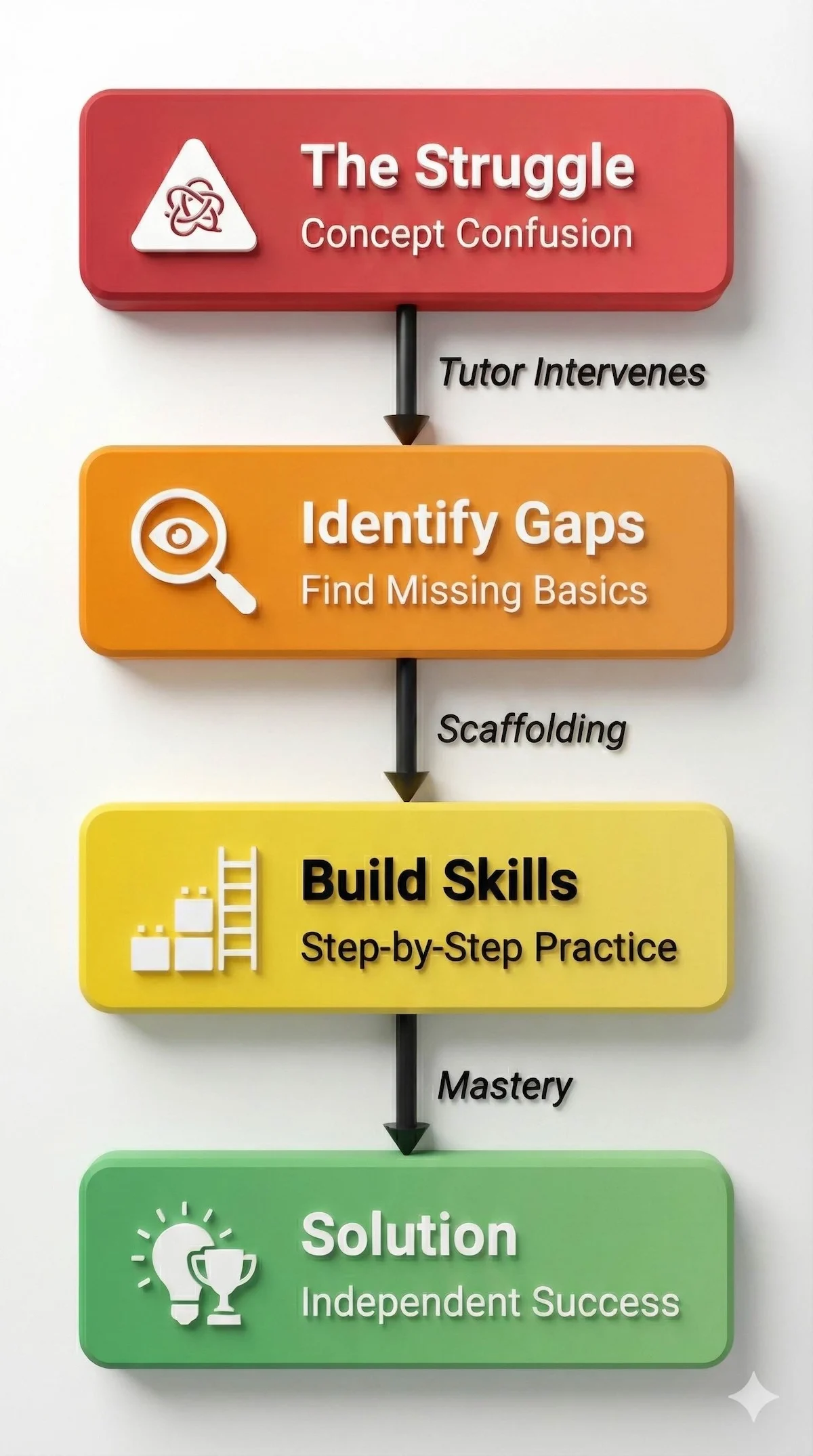
Tutors use ‘scaffolding’ to break down overwhelming engineering problems into manageable steps.
By isolating the specific knowledge gap—rather than trying to tackle the whole problem at once—the insurmountable task becomes a series of manageable steps.
- Study skills coaching that teaches time management, note-taking, and test strategies: These skills transfer across subjects and increase academic control.
- Goal setting and reflection, where tutors set short-term targets and review outcomes with the student: Reflection makes progress visible.
- Modeling problem solving so students adopt effective strategies they can repeat: When they see the method, they’re not afraid of complex tasks.
- A safe space for questions that removes social pressure and allows students to ask, increasing curiosity and reducing embarrassment.
- Regular assessment and adjustment, allowing tutors to adapt plans when students improve or when a strategy fails: Flexibility matters in a learning process.
When combined, all these influences both academic performance and confidence. Your students see their grades grow, and this success inspires and motivates them to participate in the learning process. Connect skill growth to emotional growth, and you’ll encourage a mentee’s long-term change.
Benefits of Tutoring for Confidence and Self-Efficacy
Tutoring is about gains that go beyond grades. You become a mentor for your students, an adult who gives them personalized attention, instructions meeting their learning style and needs, and skills and habits they’ll use for life.
Your mission is to find an approach that improves subject mastery and reduces frustration. Create a positive learning environment that encourages questions and celebrates progress, and your students will believe that they can learn and succeed.
Research and practice show many benefits of tutoring for self-confidence, which is why schools and families invest in extra help:
- One-on-one attention, customized practice, and consistent reinforcement boost self-esteem and academic performance.
- Programs that use targeted assessment to build personalized plans report improvements in confidence and study habits.
- Regular tutoring helps students manage workload, ask questions without fear, and develop strategies for independent learning.
Fear of looking ‘stupid’ is a major barrier to learning in engineering. Tutoring creates a psychological ‘safe zone’ where this pressure is neutralized.
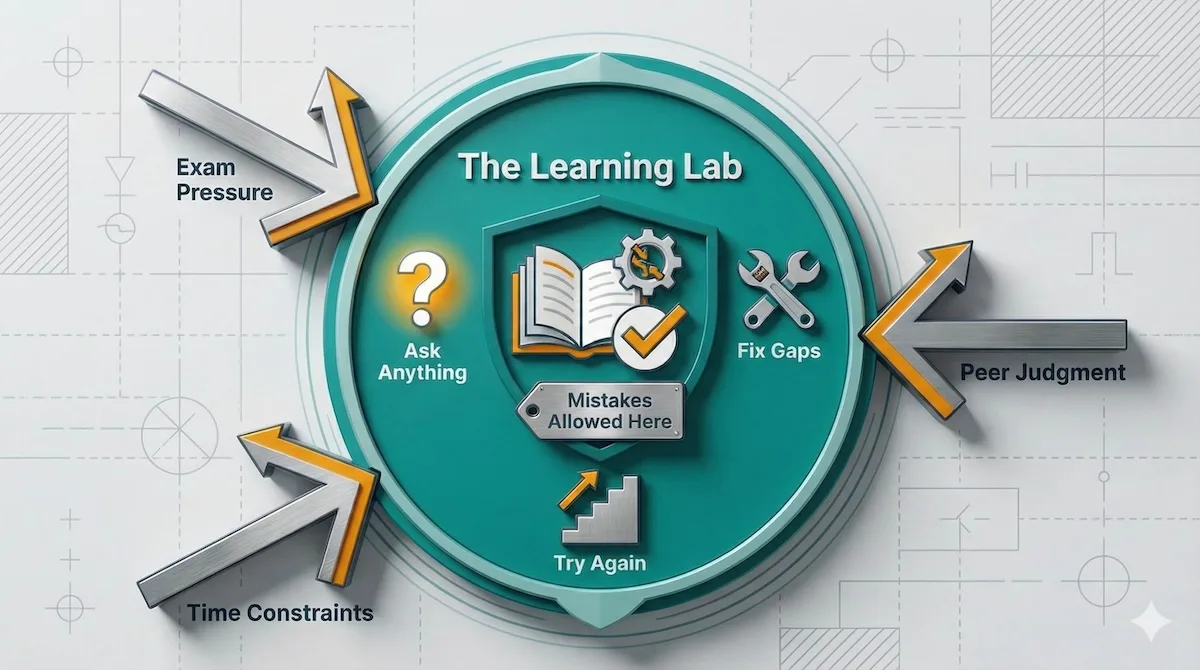
Tutoring creates a judgment-free zone where making mistakes is simply part of the engineering design process.
In this protected environment, mistakes stop being failures and start being valuable data points for your learning process.
- Tutoring grows social skills, helping students become better communicators and build relationships with peers.
Regular tutoring helps students manage workload, ask questions without fear, and develop strategies for independent learning. Tutoring grows social skills, helping students become better communicators and build relationships with peers.
From essay writing tutors who nurture clarity and structure in writing to expert mentors at My Engineering Buddy providing reliable assignment help, personalized tutoring empowers students to overcome academic anxiety and thrive in every subject.
Confidence isn’t just a feeling; it’s the result of competence. This creates a positive feedback loop that extends far beyond a single semester.
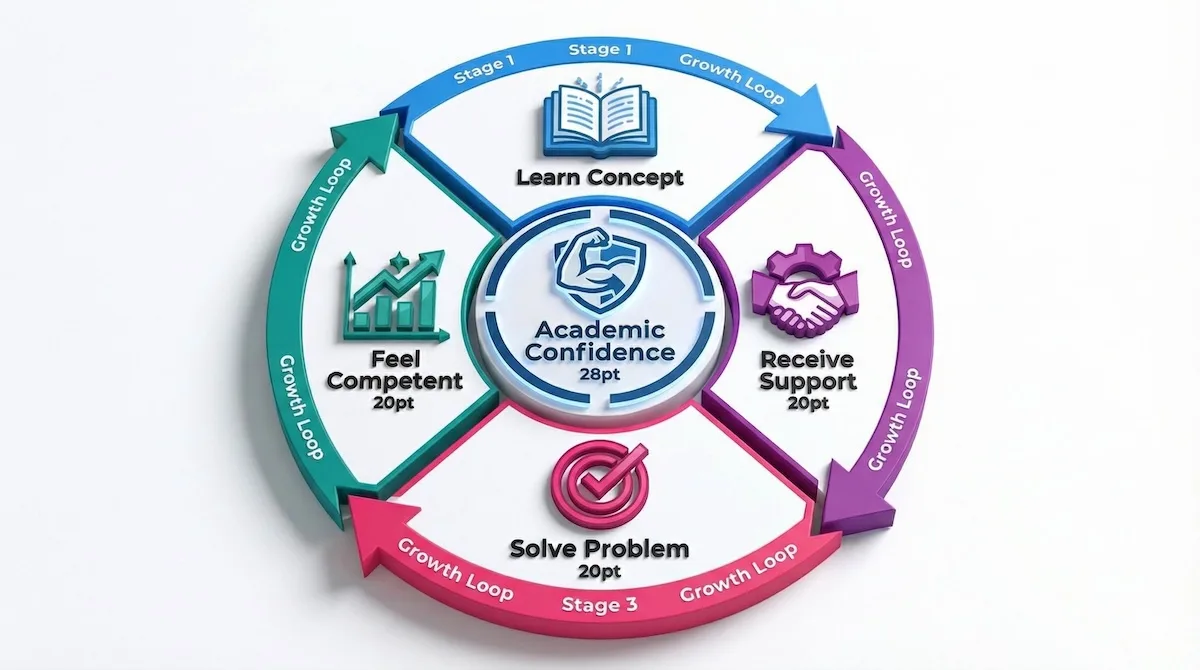
The ‘Confidence Loop’: Small wins with a tutor build the competence needed for long-term self-assurance.
Once this cycle starts turning, students stop needing constant reassurance and begin to trust their own engineering judgment.
In Lieu of Epilogue
Tutoring paves a clear pathway for academic self-confidence improvement. When you pair skill-building with positive habits, your mentees stop avoiding challenging tasks and start to solve them. Confidence follows action, and a tutor designs those actions to guide students on their way to success.
******************************
This article provides general educational guidance only. It is NOT official exam policy, professional academic advice, or guaranteed results. Always verify information with your school, official exam boards (College Board, Cambridge, IB), or qualified professionals before making decisions. Read Full Policies & Disclaimer , Contact Us To Report An Error