How STEM Students Actually Use Studocu AI — Subject-by-Subject Breakdown With Pricing and Alternatives

AI study tools are not uniformly effective for STEM coursework. The features that help a history student memorize concepts and structure essays do not map directly onto what an engineering student needs to work through a thermodynamics problem set or understand the derivation behind a control systems theorem.
Studocu’s AI tools offer genuine capability for STEM students but the students who see the most grade impact are those who use the right features for the right subjects, not those who use all features equally.
This guide covers how each Studocu AI tool performs specifically for STEM coursework, which features are most effective by subject area, how to integrate them into a study workflow, Studocu’s pricing structure, and how it compares to the alternative tools STEM students commonly use alongside or instead of it.
AI for STEM Learning Using Generative Tools to Make Math and Engineering Concepts Easier
The STEM Struggle: Complex Concepts, Tight Deadlines
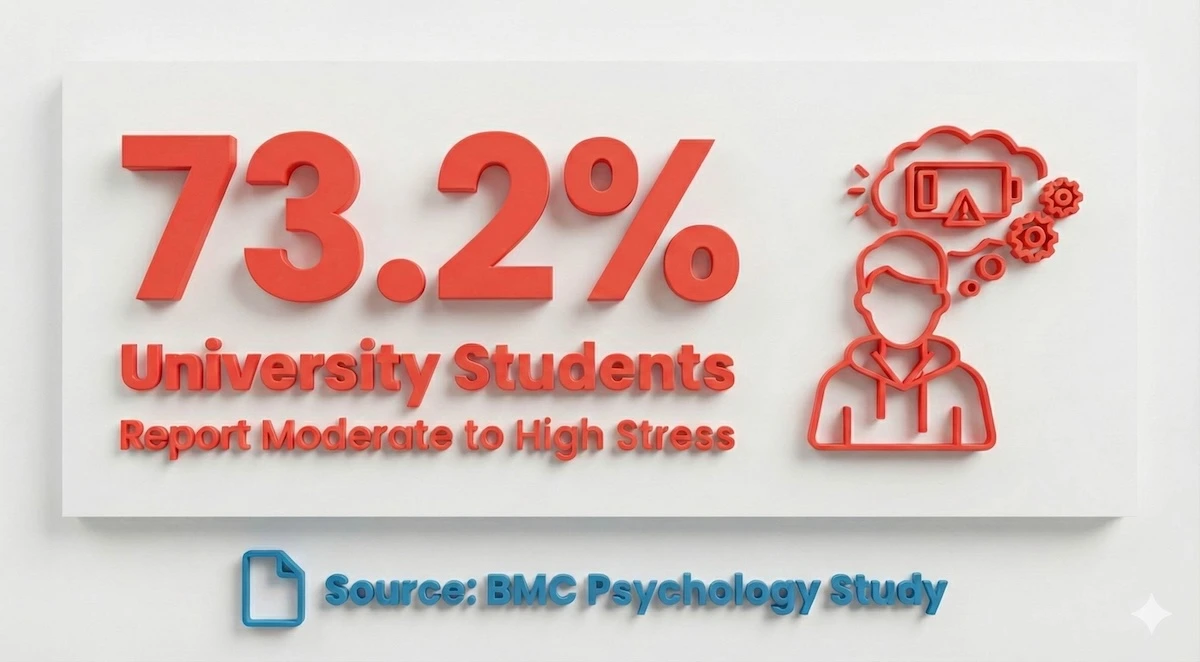
A BMC Psychology study found that 73.2% of university students report moderate-to-high academic stress, with STEM majors showing consistently higher burnout rates than their peers in other disciplines.
The reason is structural, not motivational: STEM coursework combines high intrinsic cognitive load (physics and engineering concepts genuinely require more working-memory resources than many other disciplines) with compressed assessment cycles and sequential subject dependency failing to understand week three means week six becomes inaccessible.
Physics Education Research has documented that high intrinsic cognitive load reduces exam performance when students attempt to process dense material passively. Sitting through lectures or re-reading textbook chapters without active processing produces minimal retention for procedural knowledge the type of knowledge that determines STEM grades.
The response that consistently improves performance is active retrieval practice: working through problems from memory, explaining derivations without notes, and generating questions about material you have studied.
Studocu’s AI tools are most valuable precisely at this interface: they accelerate the transition from passive material review to active retrieval practice, and they do it within the context of your actual course content rather than generic textbook examples.
How Studocu AI Helps STEM Students Succeed
Studocu AI operates on a database trained on over 50 million peer-shared study documents and more than a billion student study sessions which means its AI outputs are calibrated to the types of questions students actually ask about real coursework, not the types of explanations textbook publishers write for comprehensive coverage.
For STEM students, this distinction matters because the failure points in STEM learning are rarely the obvious conceptual definitions they are the subtle procedural steps where students consistently get stuck.
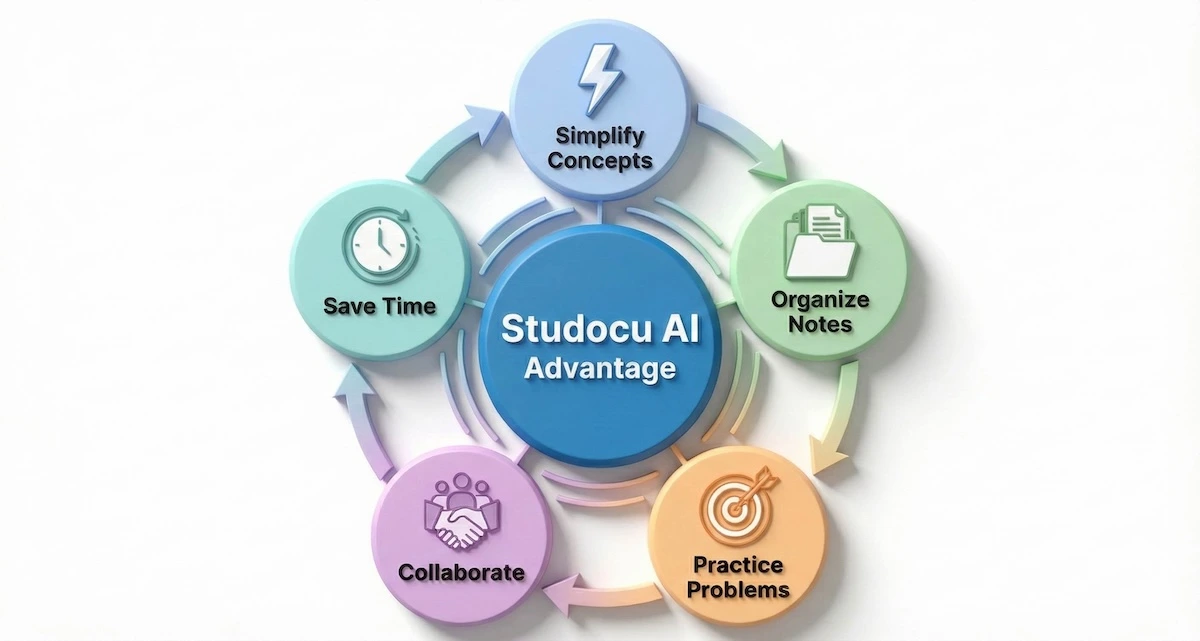
Simplify Complex Concepts Instantly
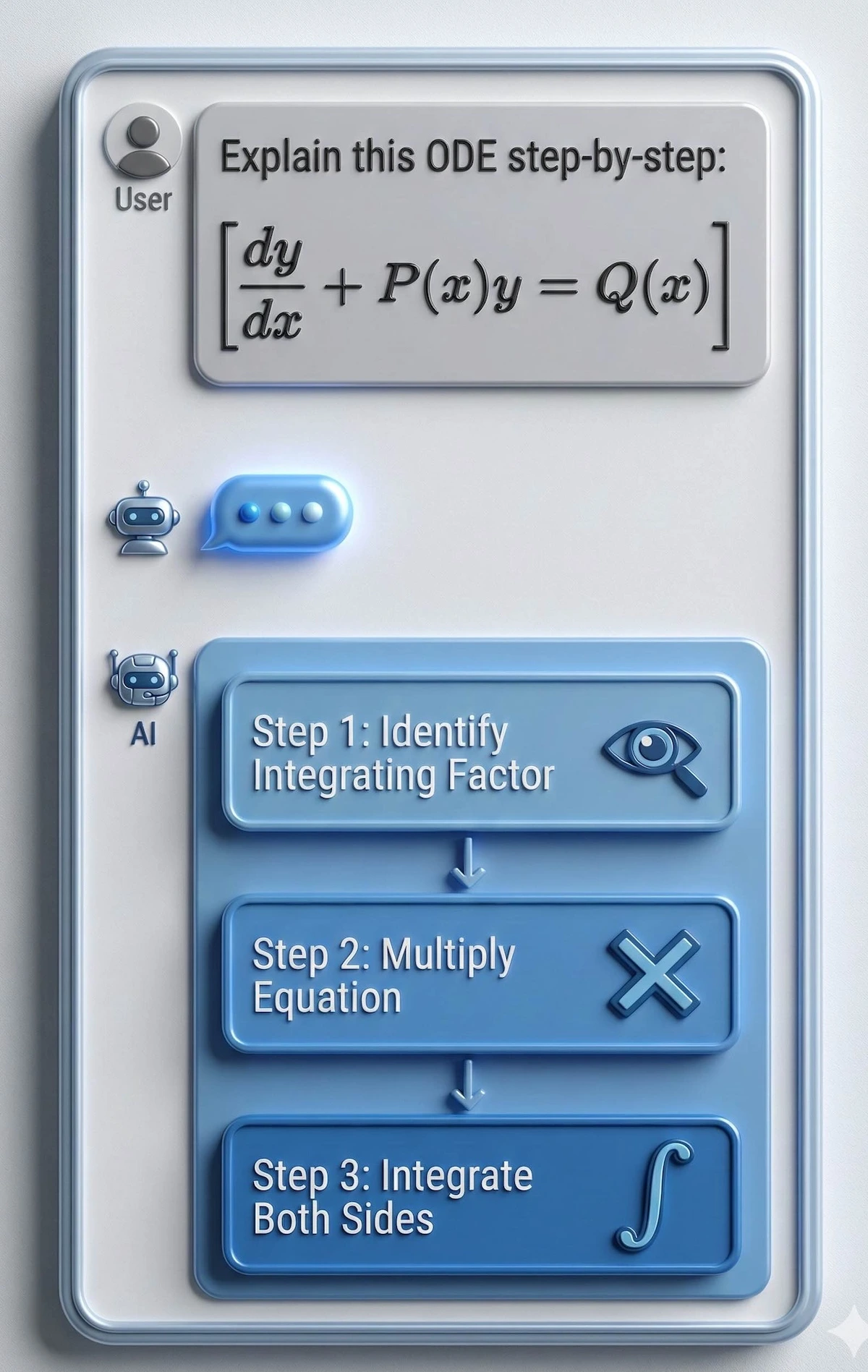
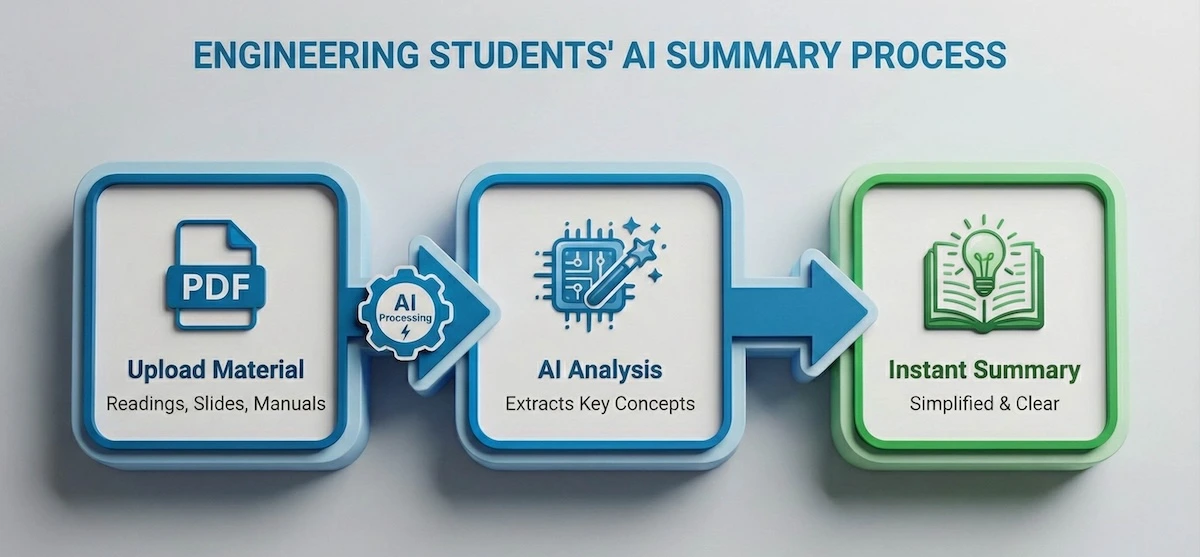
The Ask AI feature accepts course-specific materials lecture slides, textbook excerpts, lab reports and generates explanations calibrated to the level of detail you specify. For a student who understands the physics of thermodynamic cycles but cannot follow the mathematical derivation of entropy in a specific textbook treatment, Ask AI can decompose that derivation into logical sub-steps without requiring the student to locate a different explanation.
This targeted clarification function addresses the specific bottleneck STEM students describe most frequently: understanding the concept but getting lost in a particular author’s notation or derivation path.
Generate Organized Notes and Study Guides
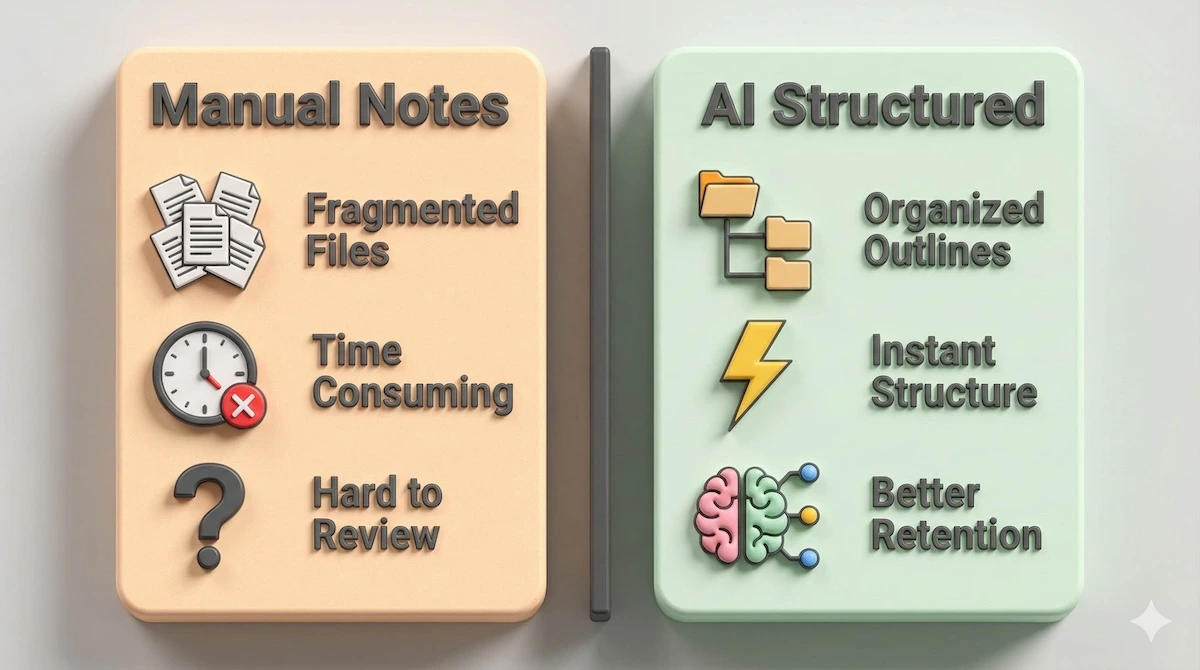
The AI Notes feature transforms uploaded materials into structured outlines with key concepts, definitions, and relationships mapped. A study found that 68% of first-year STEM students struggle with manual note organization from lectures particularly in courses where instructors derive equations in real time and students must simultaneously follow the derivation and record it accurately. AI-generated notes capture the structural logic of material that live notation makes difficult to record comprehensively.
Practice Through AI-Generated Problem Solving
The Quiz Generator converts uploaded study materials into practice problems and assessments. For STEM coursework, the most effective application is uploading problem sets, lecture derivations, or example solution sheets and generating variations of those problems for self-testing.
A Journal of Engineering Education study found that students using AI chat tools for problem-solving showed higher conceptual understanding and engagement than those using traditional review methods.
Collaborate and Learn Together
Research across 425 students found that collaborative learning significantly increased peer support, confidence, and academic performance. Studocu’s shared workspaces allow groups of students to build collective study resources, annotate shared documents, and coordinate on problem sets and lab write-ups.
For STEM students working on group projects with shared computational or experimental components, the collaborative document layer provides structure that general-purpose tools like shared folders do not.
Save Time and Reduce Burnout
A Nature Scientific Reports study confirmed that AI-assisted learning tools reduce the time spent on manual task execution, freeing cognitive capacity for higher-order processing. For STEM students managing concurrent courses in different disciplines, the time recovered from note organization and initial material review can be reallocated to the problem-solving practice that actually produces grade improvements.
Dr. Myungjae Kwak’s 2026 research on AI study tool integration found performance improvements of 15–35% when students applied AI tools to their highest-load courses rather than distributing usage evenly across all subjects.
Lorex vs Hikvision vs Coram: Consumer Cameras vs Enterprise AI Surveillance
What Does Each Studocu AI Feature Actually Do and How Effective Is It for STEM?
Not all Studocu features provide equivalent value for STEM coursework. The effectiveness ranking below reflects STEM-specific application some features that score highly for humanities study score lower here because procedural knowledge acquisition in STEM requires different cognitive processing than conceptual synthesis or vocabulary retention.

| Feature | STEM Rating | Best STEM Use Case | Key Limitation for STEM |
|---|---|---|---|
| Ask AI (Concept Clarification) | ★★★★☆ (4/5) | Derivation breakdown, formula application in unfamiliar contexts | Requires course-specific uploaded material for best accuracy |
| AI Quiz Generator | ★★★★★ (5/5) | Active recall practice, exam simulation with course-specific problem types | Output quality depends on the quality of the input materials |
| AI Notes / Summaries | ★★★★☆ (4/5) | Organizing lecture content from derivation-heavy sessions | Cannot independently verify technical accuracy of source material |
| Flashcards | ★★★☆☆ (3/5) | Terminology, unit definitions, physical constants, formula identification | Poor fit for procedural knowledge — cannot practice calculation steps |
| Lecture Recording | ★★★★☆ (4/5) | Capturing real-time derivations and instructor notation choices | iOS-only; requires explicit recording consent under institutional policy |
| Collaborative Spaces | ★★★☆☆ (3/5) | Lab report coordination, group problem set alignment | Less structured than dedicated collaborative tools for computational work |
How to Use Studocu for Specific STEM Subjects
The features that produce the best results vary significantly by STEM subject. Using the same Studocu workflow for fluid mechanics and for organic chemistry produces inconsistent results because the types of knowledge these courses require are different. Below is a subject-specific guide to the most effective Studocu AI applications.

Engineering (Thermodynamics, Statics, Dynamics, Circuits)
Engineering courses combine conceptual understanding with high-volume procedural application. The most effective Studocu workflow for engineering starts with Ask AI for any derivation or theorem where following the instructor’s notation is causing confusion upload the specific lecture slide or textbook page and request a step-by-step breakdown.
Then use the Quiz Generator on solved example problems to generate variation problems for self-testing. The goal is to arrive at exams having worked through dozens of problem variations, not having re-read the same examples. Flashcards are useful only for formulaic constants, unit conversions, and named theorems limit their use to that narrow scope.
Physics (Classical Mechanics, Electromagnetism, Modern Physics)
Physics learning fails when students understand the principle but cannot connect it to the mathematical formalism. Ask AI performs well here: uploading a specific derivation (Maxwell’s equations from first principles, Hamiltonian mechanics development) and asking for each logical step explained separately produces clarifications that complement rather than replace the textbook.
The AI Notes feature is most useful after lectures where the instructor’s derivation approach differs from the textbook use it to synthesize both sources into a consistent notation system before problem set practice begins.
Mathematics (Calculus, Linear Algebra, Differential Equations)
For mathematics coursework, the Quiz Generator is the highest-leverage Studocu tool. Upload a problem set or example sheet and request varied problem types with the same underlying structure. For differential equations specifically, ask for problems that change boundary conditions or initial conditions on familiar equation types this is where most exam errors originate, not in understanding the method but in applying it under different initial constraints. AI Notes is less useful for pure mathematics because mathematical fluency comes from working problems, not from reading summaries of theorems.
Chemistry (Organic, Physical, Analytical)
Organic chemistry has both a memorization layer (reaction mechanisms, reagent functions, functional group transformations) and a procedural layer (applying mechanisms to predict products for unfamiliar substrates). Flashcards work well for the memorization layer in chemistry more than in most STEM subjects reaction mechanism identification genuinely benefits from spaced repetition. The Quiz Generator is highly effective for the procedural layer: upload mechanism examples and ask for novel substrate problems that require applying the same mechanism in an unfamiliar molecular context.
Computer Science (Algorithms, Data Structures, Systems)
For CS coursework, Studocu’s AI features work best for conceptual understanding rather than code generation. Use Ask AI to clarify algorithmic complexity proofs, data structure invariants, or operating systems concepts where the lecture explanation was unclear.
The collaborative workspaces are particularly useful for CS group projects where multiple students need to maintain shared documentation of design decisions and implementation notes alongside code.
Avoid using AI-generated code summaries as a substitute for reading and tracing through actual implementations the procedural understanding of how code works requires active engagement, not passive summary.

Paraphrasing-tool.ai Reviews, Alternatives, Pricing, & Offerings in 2025
Studocu Pricing: Free vs. Paid Plans for STEM Students
Studocu operates on a freemium model where access to the document library and basic AI features is available without payment, and premium plans unlock expanded document access, unlimited AI tool usage, and additional features. STEM students evaluating whether a paid subscription is justified should make that decision based on their specific use pattern rather than the feature list alone.

| Feature | Free Plan | Paid Plan |
|---|---|---|
| Document Library Access | Limited downloads per month | Unlimited access |
| Ask AI Usage | Limited queries | Unlimited queries |
| AI Quiz Generator | Limited generations | Unlimited generations |
| AI Notes / Summaries | Limited per month | Unlimited |
| Peer Document Uploads | Available (earn credits to download) | Available with premium access |
For STEM students in exam-intensive periods the 4–6 week window before finals when quiz generation and active recall practice are most critical the paid plan provides meaningful value through unlimited AI tool usage. For students in the early weeks of a semester, the free tier is often sufficient for initial concept clarification and note organization.
The most cost-effective approach is using the free tier throughout the semester and upgrading to paid for the final examination period. For current subscription pricing, check the Studocu AI page directly pricing varies by region and is updated periodically.
Studocu vs. Alternative AI Study Tools for STEM Students
STEM students typically use multiple study tools in combination rather than relying on a single platform. Understanding where Studocu performs best relative to its closest alternatives helps construct a study tool stack that covers different need types without redundancy.

| Tool | Strength for STEM | Limitation for STEM | Cost | Best Used For |
|---|---|---|---|---|
| Studocu AI | Course-specific document context + active recall tools | AI accuracy depends on uploaded material quality | Free tier + paid subscription | Quiz generation, concept clarification, note organization |
| Chegg Study | Step-by-step textbook problem solutions | Passive — students view solutions rather than practice independently | ~$15–$20/month | Checking work, understanding specific textbook problems |
| Khan Academy | Free, structured concept explanations with practice | Not calibrated to university-level course content or specific instructors | Free | Foundational concept gaps (precalculus, basic physics, introductory chemistry) |
| Wolfram Alpha | Highly accurate computational answers with step-by-step solutions | No conceptual explanation layer; shows computation, not understanding | Free (limited) + Pro ~$7/month | Verification of mathematical computation results, exploring parametric solutions |
| Photomath | Camera-based equation scanning with step solutions | Limited to computational math; no conceptual context | Free + Plus ~$10/month | Algebra through calculus problem solving verification |
The recommended tool stack for most STEM students is: Studocu AI for course-specific quiz generation and concept clarification (highest-leverage for exam preparation), Wolfram Alpha for computation verification (fastest accuracy check for mathematical work), and Khan Academy for foundational gaps in prerequisite material that the current course assumes without teaching.
Chegg adds value specifically for students working through required textbooks where step-by-step solution access for specific assigned problems is needed, but the passive consumption model makes it a lower priority for active learning than Studocu’s quiz-generation approach.
Too Many Reports, Not Enough Time: How Executives Are Using AI to Digest Long Documents
How Do STEM Students Use Studocu Differently From Humanities Students?
STEM and humanities students leverage Studocu for fundamentally different pedagogical purposes. Humanities disciplines prioritize synthesis, argumentation, and written expression domains where AI note summaries and vocabulary flashcards provide genuine cognitive leverage for course mastery. A history student condensing archival documents or building terminology resources for political philosophy is using the platform for exactly the task it performs well.
STEM education presents structurally different demands. Mastery of thermodynamics, control systems, or synthetic chemistry requires procedural fluency beyond definitional knowledge. “Reading a summary of Bernoulli’s equation does not teach you to use it in an unfamiliar flow problem.” This distinction fundamentally restructures which platform capabilities produce the most grade impact for STEM students.
For STEM practitioners, the feature effectiveness hierarchy differs markedly from humanities applications:
- AI Quiz Generation and problem-solving practice represent the highest-value Studocu features for STEM they support active retrieval practice within domain-specific content contexts, which is the study method most robustly linked to exam performance improvement in procedural subjects.
- Ask AI for derivation clarification addresses the specific bottleneck where STEM students most consistently get stuck: understanding a concept but being unable to follow the mathematical development in a specific textbook or instructor notation.
- Collaborative workspaces support lab coordination and experimental documentation sharing in ways that general-purpose shared folders do not.
- Flashcard systems carry limited utility for core mathematics and physics content, where computational application supersedes vocabulary retention. They work for chemistry reaction mechanisms and unit definitions, but they should not be the primary study method for engineering or physics coursework.
The practical implication is that STEM students who use Studocu primarily for note summarization and flashcard creation are using the platform in the mode optimized for a different learning context.
Shifting the primary usage toward quiz generation and Ask AI for specific derivation clarification with note organization as a secondary function produces significantly better grade outcomes for engineering and science coursework. For guidance on supplementary learning support for STEM subjects, additional resources are available through MyEngineeringBuddy’s subject guides.
Top AI Tools for Students to Write Smarter, Not Harder
Frequently Asked Questions
Is Studocu AI free for STEM students?
Studocu offers a free tier that includes limited monthly access to AI tools including Ask AI, the Quiz Generator, and AI Notes. The free tier allows STEM students to test the platform and use it for lower-intensity study sessions throughout the semester. The paid subscription unlocks unlimited AI tool usage, which becomes most valuable during exam preparation periods when high-volume quiz generation and repeated Ask AI sessions are most useful. The free tier is sufficient for many students outside examination periods.
Is Studocu accurate for STEM subjects like engineering and physics?
Studocu AI accuracy for STEM content depends directly on the quality of the source material uploaded. When students upload specific course materials lecture slides, worked examples, assigned textbook sections the AI operates within the context of verified course-specific content and produces highly relevant outputs. When queries are made without uploaded context, accuracy is more variable and should be verified against the source material. For mathematical derivations specifically, Ask AI breakdowns should be checked against the original derivation rather than treated as independently authoritative.
Can STEM students use Studocu to share their own notes and study materials?
Yes. Studocu’s document sharing model allows students to upload their own notes and earn credits or recognition within the platform. For STEM students, sharing well-organized problem set solutions, derivation walkthroughs, or lab report templates benefits the broader student community and earns download credits that can be used to access other students’ materials. The peer-document layer is part of what makes Studocu’s training data STEM-specific rather than generic the platform has accumulated genuine student study materials from universities worldwide, not publisher-produced content.
How does Studocu AI compare to using ChatGPT for STEM study help?
ChatGPT and similar general-purpose AI tools provide broad mathematical and conceptual support but are not calibrated to your specific course materials, instructor notation preferences, or assessment style. Studocu AI is trained on student-generated content and operates on uploaded course-specific materials, which means the quiz questions and explanations it generates are aligned to how your particular course teaches a subject not how a generic textbook author explains it. For complex derivations and exam-style problem practice specifically tied to your course, Studocu typically outperforms general AI tools. For foundational concept explanations and broad mathematical problem solving, ChatGPT and Wolfram Alpha remain strong complements to course-specific Studocu usage.
Key Takeaways
- The AI Quiz Generator and Ask AI are the highest-impact Studocu features for STEM students flashcards and note summaries, while useful, are secondary tools for procedural subjects like engineering and physics.
- Research by Dr. Myungjae Kwak found AI-assisted study tools improve STEM performance by 15–35% when applied to highest-load courses directing the most Studocu AI usage toward your hardest subject produces the largest grade impact.
- Optimal Studocu workflows are subject-specific: quiz generation from problem sets for engineering and math, derivation clarification via Ask AI for physics, mechanism flashcards plus novel substrate quizzes for chemistry, and collaborative documentation for CS group projects.
- The free tier covers basic AI tool access; the paid subscription is most cost-effective when used during exam preparation periods when unlimited quiz generation provides the most value per session.
- Studocu complements Wolfram Alpha (computation verification) and Khan Academy (foundational gaps) in a STEM student tool stack each covers a different study function without redundancy.
- STEM students who shift from passive summarization to active quiz-based retrieval practice using Studocu consistently report better exam performance than those who use the platform primarily for note organization.
Studocu’s AI tools provide genuine study support for STEM students who apply them intentionally specifically by using quiz generation and targeted concept clarification for the subjects where active retrieval practice produces the most grade improvement.
The platform works best when used as an active practice engine with your own course materials as the input, rather than as a passive summarization tool. The most important shift is behavioral: from reading Studocu outputs to generating and answering practice questions built from your actual coursework.
Browse STEM study guides at MyEngineeringBuddy for additional subject-specific resources that complement your Studocu AI workflow, and for online tutoring support in specific STEM subjects when AI tools need to be combined with instructor-guided sessions for complex topics.
Educational content only. AI tool accuracy should be verified against source materials for exam-critical applications. Feature availability and pricing subject to change verify at Studocu’s official site before purchasing.
******************************
This article provides general educational guidance only. It is NOT official exam policy, professional academic advice, or guaranteed results. Always verify information with your school, official exam boards (College Board, Cambridge, IB), or qualified professionals before making decisions. Read Full Policies & Disclaimer , Contact Us To Report An Error