
Study Tips for Engineering Students’ Final Exams: Comprehensive Guide with AI Tools, Proven Techniques & Anxiety Management

Engineering final exams test both deep conceptual understanding and rapid problem-solving under pressure. Beyond traditional study methods, today’s students have access to AI-powered study tools, research-backed cognitive techniques, and structured anxiety management strategies that can dramatically improve exam performance and retention. This expanded guide integrates all four critical dimensions: AI study companions for personalized learning, the science behind effective studying, proven anxiety management techniques, and practical access to past papers and practice resources.
Hire Verified & Experienced Engineering Tutors
Section 1: AI Study Companions Leverage Technology for Smarter Exam Prep
Quizlet AI: Adaptive Flashcards & Practice Tests from Your Notes
Quizlet’s Magic Notes feature transforms passive note-taking into active study materials instantly. Upload your lecture notes or textbook passages, and Quizlet’s AI automatically generates flashcards, practice quizzes, and study summaries tailored to your learning pace. For engineering students managing formulas and concepts, this is game-changing.sciencedirect+1
How to use it effectively:
- Upload 2–3 chapters of thermodynamics or calculus notes
- Let Quizlet generate flashcards and practice tests
- Use the “Learn” and “Test” modes, which employ spaced repetition algorithms to focus your time on topics you struggle with mostsciencedirect
- Generate difficulty-tiered quizzes (beginner, intermediate, advanced) to simulate exam conditions
Key benefit: Quizlet’s adaptive algorithm tracks performance gaps and resurfaces weak topics at strategic intervals, cutting study time while boosting retention.
Read More: How Engineering Students Can Earn Money Online Using Their Skills
ChatGPT for Generating Custom Practice Problems
ChatGPT can create unlimited, tailored practice problems instantly a resource that textbooks and past papers alone cannot match. This is invaluable for engineering disciplines where drilling problem-solving is essential.
Prompt template for thermodynamics:
“Create 5 university-level thermodynamics problems on the first law of thermodynamics. Include problems on:
- Closed systems with no work
- Adiabatic processes
- Constant pressure expansion
For each problem, provide the setup, solution steps, and final answer. Make them progressively harder.”
Why this works:
- Generates problems matching your exam’s style and difficulty
- You can ask for explanations of wrong answers
- Helps identify knowledge gaps before the exam
- Creates unlimited practice without relying on a fixed set of past papers
Critical caution: Always verify AI-generated physics equations against your textbook or course notes. Errors can reinforce misconceptions. Use AI as a problem source, not an authority on correctness.
Socratic by Google: Step-by-Step Explanations When You’re Stuck
Socratic is a photo-recognition tutor designed specifically for STEM. Snap a photo of a confusing textbook problem or handwritten question, and Socratic provides step-by-step explanations sourced from Khan Academy and other educational resources.peer.asee
When to use Socratic:
- You’re stuck on a practice problem and don’t have immediate access to a tutor
- You want a quick explanation before moving forward
- You need to see multiple solution approaches
Best practice: Use Socratic after attempting the problem yourself. Don’t use it as a shortcut let it clarify your thinking, then solve a similar problem independently.
Anki: Spaced Repetition for Engineering Formulas & Constants
Anki is the gold-standard spaced repetition tool for engineering students juggling thermodynamic equations, circuit theorems, and material properties. Unlike Quizlet, Anki gives you complete control over card creation and uses a more sophisticated algorithm (SM-2 or SuperMemo) to optimize review intervals.michaeleweintraubesqscholarship+1
Engineering-specific Anki decks:
- Download pre-made decks for thermodynamics, electromagnetics, or fluid mechanics
- Or create your own: front = “Bernoulli’s Equation,” back = full derivation + units
- Anki learns your problem areas and resurfaces those cards more frequently
Why Anki wins for formulas: It’s designed to keep knowledge alive over months, not just weeks. Students using Anki for thermodynamics showed a 9-point improvement (70% vs. 61% exam scores) compared to non-users in peer-reviewed research.michaeleweintraubesqscholarship
IB Engineering IA Project Ideas: Concept to Execution for 2026
Section 2: The Science of Effective Studying Active Recall & Spaced Repetition
Active Recall: Test Yourself, Don’t Re-read
The research is unambiguous: Active recall (testing yourself) produces 2–3 times higher long-term retention compared to passive re-reading. Your brain must retrieve information to strengthen memory pathways. Passive review leaves those pathways dormant.library.louisville+1
What passive studying looks like (ineffective):
- Reading lecture notes or textbook passages
- Watching tutorial videos passively
- Making concept maps
- Highlighting
What active recall looks like (effective):
- Closing the textbook and reciting the derivation of kinetic energy from memory
- Solving past exam problems without notes
- Teaching a concept aloud to a friend (or imaginary audience)
- Creating your own flashcards with blank answers before checking
- Answering practice quiz questions in timed conditions
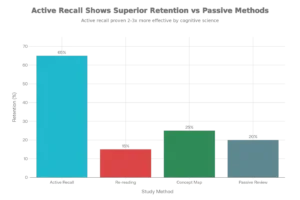
Active Recall vs. Passive Study Methods: Long-term Information Retention
Practical implementation for finals:
- After each study session, spend 10 minutes testing yourself on the material
- Use MCQs, short-answer, and long-form problem solving to vary question types
- If you can’t retrieve the information, mark it for deeper review
- The struggle to recall is where learning happens discomfort is progress
Spaced Repetition: Strategic Intervals Defeat Cramming
The forgetting curve (discovered by Ebbinghaus) shows that we lose information exponentially without reinforcement. Spaced repetition combats this by revisiting material at increasing intervals—just as you’re about to forget it. Each review strengthens memory and extends the forgetting curve.bcu+1
Why cramming fails:
- One intense study session locks information into short-term memory only
- The night before an exam, your brain hasn’t had time to consolidate knowledge
- Under exam stress, short-term memory collapses
Why spaced repetition wins:
- Reviewing material 3–4 times across 2–3 weeks over-programs it into long-term memory
- Each review is easier than the last (reinforcement is satisfying, not exhausting)
- Material is retrievable under pressure
Spaced Repetition Schedule: Optimal Review Intervals for Engineering Exams
Optimal intervals for a 4-week exam prep:
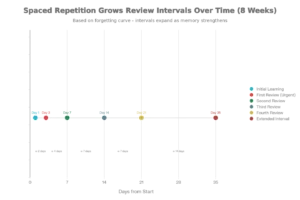
- Day 1: Initial learning (lecture/reading)
- Day 3: First review (test yourself on key concepts)
- Day 7: Second review (solve practice problems)
- Day 14: Third review (tackle harder past exam questions)
- Day 21: Final review (full mock exam under timed conditions)
For an 8-week prep cycle, extend intervals further (Day 35 for your last review before exams).
Read More: Best Digital Tools Engineering Students Need for College & Projects
Interleaving: Mix Problem Types, Don’t Block by Topic
Interleaving means switching between different topics or problem types during a single study session, rather than drilling all “thermodynamics” problems, then all “circuits” problems. Research shows interleaving improves problem-solving skill and transfer to novel exam questions.pmc.ncbi.nlm.nih
Blocked practice (less effective):
- Monday: Solve 20 thermodynamics problems
- Tuesday: Solve 20 fluid mechanics problems
- Wednesday: Solve 20 circuits problems
Interleaved practice (more effective):
- Solve a mix: 5 thermodynamics, 5 fluids, 5 circuits, repeat 3×
- Your brain must identify which type of problem you’re facing before solving
- This mirrors exam conditions, where you won’t see all thermodynamics problems grouped together
Implementation: Use past papers heavily they naturally interleave topics across sections.
Read More: Cambridge Engineering: What Makes the Course Unique?
Section 3: Managing Exam Anxiety Mindfulness, Preparation & Performance Strategies
Exam anxiety affects roughly 1 in 5 college students and carries a significant cost: high anxiety correlates with lower GPAs, poor exam performance, and reduced retention. The good news: mindfulness, targeted preparation, and in-exam strategies can dramatically reduce anxiety and boost performance.growthengineering+1
The Anxiety-Performance Link in Engineering
Engineering students face particularly intense pressure. Research shows that students with higher trait mindfulness score significantly higher on high-intensity exams by lowering cognitive test anxiety. Mindfulness doesn’t eliminate nerves; it helps you manage nervous energy so it doesn’t derail you.pmc.ncbi.nlm.nih
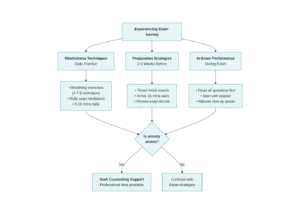
Exam Anxiety Management: Integrated Strategies Framework
Mindfulness Techniques: Building Your Calm Foundation
Daily mindfulness practice (5–10 minutes) measurably reduces test anxiety over weeks of consistent practice.youtube
4-7-8 Breathing Technique (calms your nervous system in 2 minutes):
- Inhale through your nose for a count of 4
- Hold your breath for a count of 7
- Exhale slowly through your mouth for a count of 8
- Repeat 4 times
- Best used: 30 minutes before the exam, or any time anxiety spikes during the exam
Body Scan Meditation (10 minutes):
- Lie down or sit comfortably
- Close your eyes and mentally scan your body from toes to head
- Notice tension without judgment; breathe into tense areas
- Relax each body part consciously
- Best used: Evening before the exam, as part of your wind-down routine
Practice these techniques now, not on exam day. Your brain needs rehearsal; mindfulness is a skill that improves with practice, just like problem-solving.
Preparation Strategies That Reduce Anxiety
The more prepared you are, the calmer you’ll be. Anxiety often stems from uncertainty about exam format, question types, or time limits. Remove that uncertainty.
Mock exams under timed conditions are your anxiety vaccine. When you’ve solved similar problems under similar constraints, your brain recognizes the exam environment as familiar, not threatening.trswarriors
Two weeks before exams:
- Find a past paper matching your exam board/level (Edexcel, AQA, etc.)
- Take it under exam conditions: silent room, no notes, timed
- Score yourself against the mark scheme
- Identify your weak areas and focus remaining study time there
- Repeat with a second past paper one week before
Know the exam format cold:
- How many hours? How many sections? What’s the point allocation?
- Are there choice questions (pick 2 of 3)? Penalty for wrong answers on MCQs?
- Are calculators allowed? Which topics come in which paper?
Arrive 15 minutes early to settle into the room and normalize the environment.
In-Exam Performance Tips
The exam itself is not the place to discover new information—it’s the place to retrieve what you’ve learned. Manage your mindset and time strategically.
Read all questions first (2–3 minutes):
- Skim every question before writing anything
- Identify which you’re confident about, which are unfamiliar
- This reduces anxiety (you now know what’s coming) and lets you allocate time wisely
Start with the easiest questions:
- Build momentum and confidence with quick wins
- Activates your memory networks; recall becomes easier as you engage
- Saves harder questions for when you’re mentally fresh
Allocate time by points:
- If a question is worth 10 points and the exam has 100 points total, spend ~10% of your time (~6 minutes in a 60-minute exam) on it
- Don’t get stuck on one hard question; move on and return if time permits
- Partial credit is better than zero
When anxiety spikes during the exam:
- Pause, close your eyes, and do 3–4 cycles of the 4-7-8 breathing technique
- Remind yourself: “I’ve prepared. I know this material. This is just adrenaline.”
- Return to the problem
When to Seek Professional Support
If anxiety is severe—panic attacks, avoidance of exam situations, overwhelming intrusive thoughts—reach out to your university counseling center. Cognitive-behavioral therapy (CBT) and other evidence-based interventions are effective and often free for students.ijip
Read More: AI for STEM Learning Using Generative Tools to Make Math and Engineering Concepts Easier
Section 4: Practice Exam Platforms & Past Paper Resources
Past papers are your roadmap to success. They reveal which topics examiners prioritize, what problem types appear, and how to allocate time. Combined with worked solutions, they’re the closest you can get to exam authenticity without sitting the real exam.
Official Past Papers by Qualification
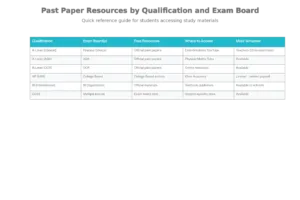
Past Paper & Mark Scheme Resources by Qualification (A-Level, AP, IB, GCSE)
A-Level (Edexcel, AQA, OCR):
- Free access: Pearson Edexcel official portal, AQA, OCR websites
- Worked solutions: ExamSolutions (YouTube channel, 286K+ subscribers, 13+ years active)—free, detailed walkthroughs for math, physics, chemistry
- Mark schemes: Official sites (teachers get access to recent papers; students can request from exam centers)
- Best resource: A-Level Past Papers website (consolidated, topic-sorted free resource)
AP (College Board):
- Free access: College Board archives (AP Central)
- Worked solutions: Khan Academy (official practice partners with College Board; free practice for calculus, physics, chemistry)
- Mark schemes: Rubrics available on College Board
- Best resource: Khan Academy practice problems mirror AP exam style exactly
IB (International Baccalaureate):
- Free access: IB official materials (limited free samples; full past papers behind paywall or through schools)
- Worked solutions: Textbook publishers, IB diploma sites
- Mark schemes: Schools provide; not freely available
GCSE (UK):
- Individual exam boards (Edexcel, AQA, OCR, WJEC) provide free papers and mark schemes
How to Use Past Papers Effectively
Mistake: Doing past papers too early or casually.
- Wait until you’ve learned 70% of the course material
- Treat each paper like the real exam: timed, no notes
Best practice for final 4 weeks:
| Week | Task | Goal |
| Week 1–2 | One full past paper (timed, under exam conditions) | Identify weak topics |
| Week 2–3 | Targeted revision of weak topics + second full paper | Build confidence in problem-solving |
| Week 3–4 | Two more full papers + review of all attempted papers | Reinforce time management and strategies |
| Final week | Mock exams or topic-based timed quizzes | Consolidate and manage anxiety |
YouTube Channels for Worked Solutions & Concept Explanation
ExamSolutions (A-Level, GCSE, IB):
- Channel: 286K+ subscribers, 4,400+ videos
- Content: Worked solutions for Edexcel/AQA/OCR past papers, pure math, statistics, mechanics
- Why use it: Detailed step-by-step walkthroughs; shows why each step happens
- Format: 10–45 minute videos; searchable by exam board and topic
- Link: ExamSolutions (YouTube) or examsolutions.net for organized playlistsyoutube
Khan Academy (AP, GCSE, general concepts):
- Breadth: Math (algebra through calculus), physics, chemistry, engineering
- Official status: College Board partner; free, ad-free
- Practice feature: Unlimited practice problems with hints and feedback
- Why use it: Highly visual; teaches concepts from first principles; practice problems auto-grade
- Link: khanacademy.orgyoutube
Professor Leonard (Calculus, Differential Equations):
- Strength: Exceptionally thorough explanations for calculus sequences (Calc 1, 2, 3, Diff Eq)
- Channel: 1.1M+ subscribers, 13+ years active
- Format: Long videos (1–2.5 hours each) with meticulous detail
- Why use it: If Khan Academy or textbooks feel too rushed, Professor Leonard’s pacing lets concepts sink inmymathscloud
The Organic Chemistry Tutor (Physics, Electronics, Logic):
- Content: Physics (mechanics, electromagnetism, thermodynamics), basic electronics, logic gates
- Strength: Practical problem-solving; formula sheets included in video descriptions
- Why use it: Good for engineering-adjacent topics; complements thermodynamics or circuit courses
Check Out: Solving Real Engineering Problems with AI Math Solvers
Systematic Past Paper Strategy: The Error Analysis Approach
Don’t just solve past papers; analyze your errors ruthlessly.
After each full-length paper:
- Score yourself against the mark scheme
- Categorize each error:
- Conceptual (didn’t understand the topic)
- Procedural (understood concept, made calculation error)
- Time management (ran out of time)
- Misread question
- For conceptual errors: Return to lectures/textbook or Khan Academy video on that topic
- For procedural errors: Drill 5 similar problems
- For time management: Identify which question types slow you down and practice them more
- For misread errors: Note and slow your reading on the next paper
Over 4–5 papers, patterns emerge. You’ll discover which topics need deeper study and which require speed practice.
MEB Resources & Tutoring Support
Internal Links for Deeper Learning
Mastering Study Skills: Key Strategies for Long-Term Retention
- Deep dive into spaced repetition, active learning, self-testing
- Time management frameworks and Pomodoro technique
- Includes visual study schedules
- Personalized test prep strategies
- 1-on-1 tutoring for final exam prep
- Mock exams with expert feedback
A-Level Time Management: 5 Steps for Paper 4
- Time allocation strategies for timed exams
- Applicable to any A-Level subject
MEB Exam Anxiety Resources & Mental Health Support
- Counseling and stress management resources
- Tutoring to build confidence in weak areas
When to Get a Tutor
Consider 1-on-1 tutoring from MEB if:
- You’re struggling with a specific topic (thermodynamics, circuits) despite self-study
- You need personalized mock exam feedback
- Exam anxiety is high and you’d benefit from structured guidance
- You want to optimize your final 2–4 weeks
MEB tutors provide:
- Subject-matter expertise (engineers, exam board specialists)
- Mock exams with detailed feedback
- Targeted revision strategies based on your weak areas
- Confidence-building through repeated practice
Final Exam Week: The Countdown
2 Weeks Before
- Complete 2–3 full past papers under timed exam conditions
- Score and analyze errors (focus on conceptual gaps, not arithmetic)
- Drill weak topics using Khan Academy, Socratic, or ChatGPT practice problems
- Begin daily mindfulness practice (5–10 minutes)
1 Week Before
- Reduce study hours (quality over quantity); aim for 3–4 focused hours per day
- Do one final mock exam or timed topic quizzes
- Organize all formula sheets, key definitions, equation derivations by topic
- Review past paper mark schemes to align your answers with examiner expectations
- Sleep 8 hours; avoid all-nighters
3 Days Before
- Light review: Skim notes, do not re-study new material
- Mindfulness practice: 10–15 minutes daily
- Check exam logistics: time, location, what materials you can bring
- Prepare your exam kit (pens, calculator, ID, etc.)
Day Before
- No studying after noon
- Light meals; stay hydrated
- Evening wind-down: body scan meditation, early bedtime
- Final check: Exam time and location confirmed
Exam Day
- Arrive 15 minutes early; settle into the exam room
- 4-7-8 breathing: 2–3 cycles before the exam starts
- Read all questions first (2–3 minutes)
- Start with easiest questions; build momentum
- Allocate time by points; don’t get stuck
- Review answers if time permits
Summary: Your Exam Success Formula
- Leverage AI tools (Quizlet, ChatGPT, Anki, Socratic) to personalize and accelerate learning
- Apply science-backed techniques (active recall, spaced repetition, interleaving) to cement knowledge into long-term memory
- Manage anxiety proactively (mindfulness, mock exams, preparation checklists) so stress doesn’t derail performance
- Master past papers (official sources, worked solutions, error analysis) to practice under authentic conditions
- Seek support (MEB tutors, university counseling) when you need personalized guidance
Engineering exams reward deep understanding, rapid problem-solving, and composure under pressure. By combining today’s AI tools with decades of learning science, you’re not just studying harder you’re studying smarter.
Key Takeaways
- Active recall beats re-reading by 2–3x. Test yourself constantly; close the book and retrieve information.
- Spaced repetition over cramming. Review material at increasing intervals (Day 1, 3, 7, 14, 21) to cement it into long-term memory.
- Mindfulness reduces exam anxiety measurably. Practice 4-7-8 breathing and body scans now; they’ll calm you on exam day.
- Past papers are your roadmap. Use ExamSolutions (YouTube), Khan Academy, and official past papers to practice under exam conditions.
- AI tools personalize learning. Quizlet generates custom flashcards, ChatGPT creates practice problems, Anki optimizes your review intervals.
- Don’t hesitate to get tutoring. MEB tutors provide mock exam feedback and personalized weak-area coaching—a worthwhile investment for final exams.
Your success is built on consistent, deliberate practice over weeks, not cramming the night before. Start now. Use these tools. Trust the science. You’ve got this.
External Resources (Verified & Active)
- ExamSolutions YouTube Channel: examsolutions.net (A-Level/GCSE worked solutions)
- Khan Academy: khanacademy.org (free AP/GCSE practice and concept videos)
- A-Level Past Papers (consolidated): a-levelpastpapers.co.uk
- Pearson Edexcel Official: qualifications.pearson.com (official past papers and mark schemes)
- AQA Official: aqa.org.uk (past papers by qualification)
- Quizlet: quizlet.com (AI flashcards and practice tests)
- Anki: ankiweb.net (spaced repetition flashcard software)
- Socratic by Google: socratic.org (photo-recognition tutor for STEM)
- ChatGPT: openai.com/chatgpt (practice problem generation)
- MEB Online Tutoring: myengineeringbuddy.com (personalized exam prep tutoring)
******************************
This article provides general educational guidance only. It is NOT official exam policy, professional academic advice, or guaranteed results. Always verify information with your school, official exam boards (College Board, Cambridge, IB), or qualified professionals before making decisions. Read Full Policies & Disclaimer , Contact Us To Report An Error