
The Ultimate Guide to Literature Reviews with AnswerThis in 2025

Contents
Literature reviews are the backbone of credible research, yet they are also where most projects stall. In this guide, you will learn how to plan, search, screen, synthesize, and write a literature review end to end using AnswerThis. I will walk you through practical workflows, field tested filters, and advanced features like citation mapping and bibliometrics, so you finish with a review that is accurate, transparent, and publication ready.
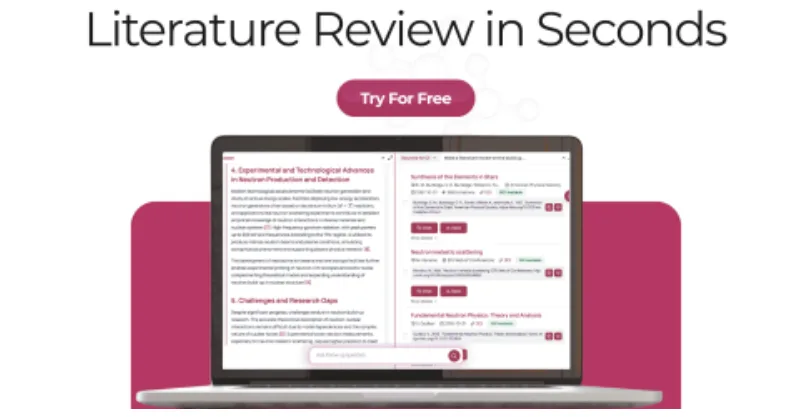
Why Literature Reviews Feel Hard, and How AnswerThis Fixes It
A great literature review demands three things, exhaustive discovery, careful appraisal, and clear synthesis. Most tools focus on just one of these steps. AnswerThis brings the entire workflow into one canvas, so you can search papers, evaluate quality, extract insights, draft paragraphs with citations, and export to your preferred format without switching tabs. The result, less fragmentation, fewer missed papers, and a cleaner, auditable trail from claim to source.
If you’ve ever felt overwhelmed by dozens of open tabs and lost PDFs, you aren’t alone. Here is how switching to a unified platform changes the game.
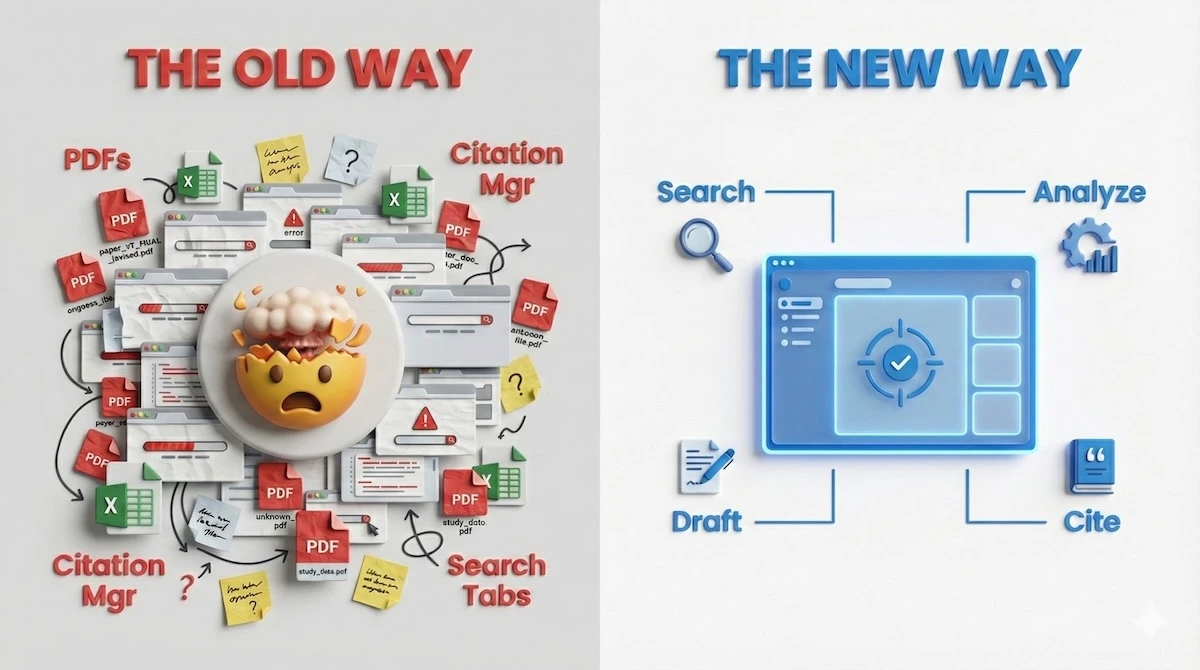
Stop drowning in browser tabs—see how a unified workspace transforms the literature review chaos into clarity.
By consolidating these scattered tools into one dashboard, you reclaim the mental energy needed for actual analysis.
What Counts as a High Quality Literature Review
Before we touch the tooling, anchor on the outcome. Your review should,
- Be comprehensive and recent, cover seminal works and the latest 12 to 36 months
- Be transparent, every claim traceable to a verifiable source
- Be critical, identify methods, limitations, and gaps, not just summaries
- Be structured, move from context to themes to synthesis to future work
- Be citable, exportable in the exact style your venue requires
AnswerThis is built to enforce these behaviors while saving you time.
But what exactly makes a review ‘high quality’? Keep these five core pillars in mind as you structure your work.
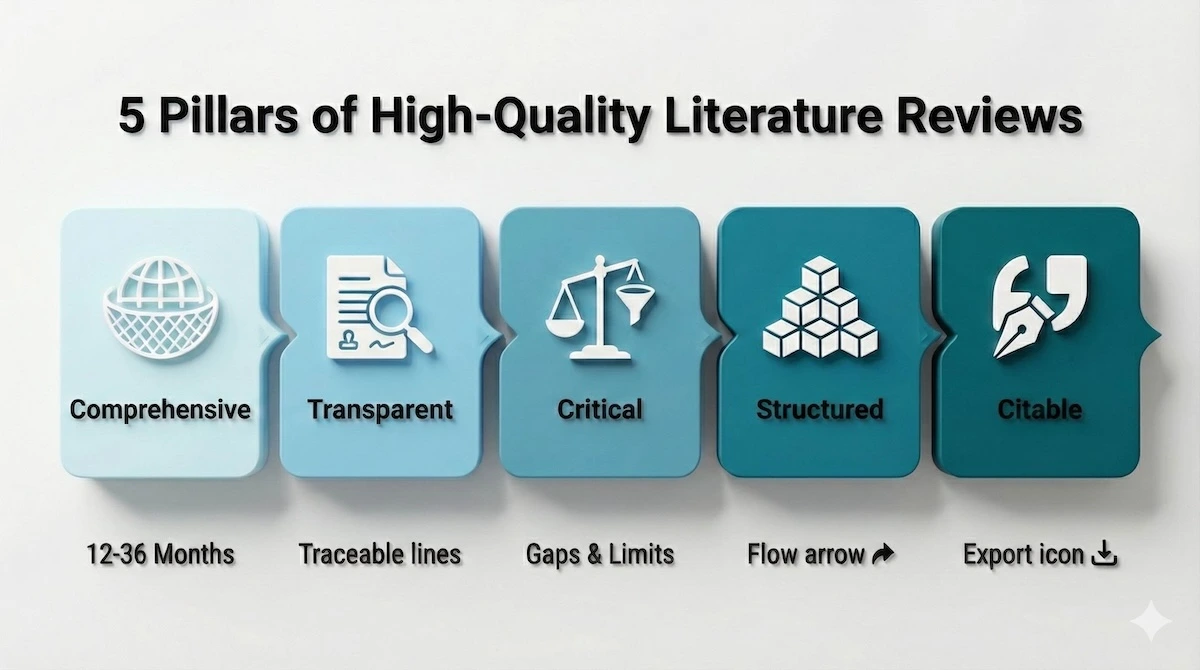
Target these five essential pillars to ensure your literature review meets publication standards.
Answering this helps you hit all five of these targets automatically, ensuring your work is defensible and publication-ready.
Step by Step, How to Build a Literature Review with AnswerThis
Ready to build your review? The following roadmap outlines the seven essential steps we will cover in detail below.
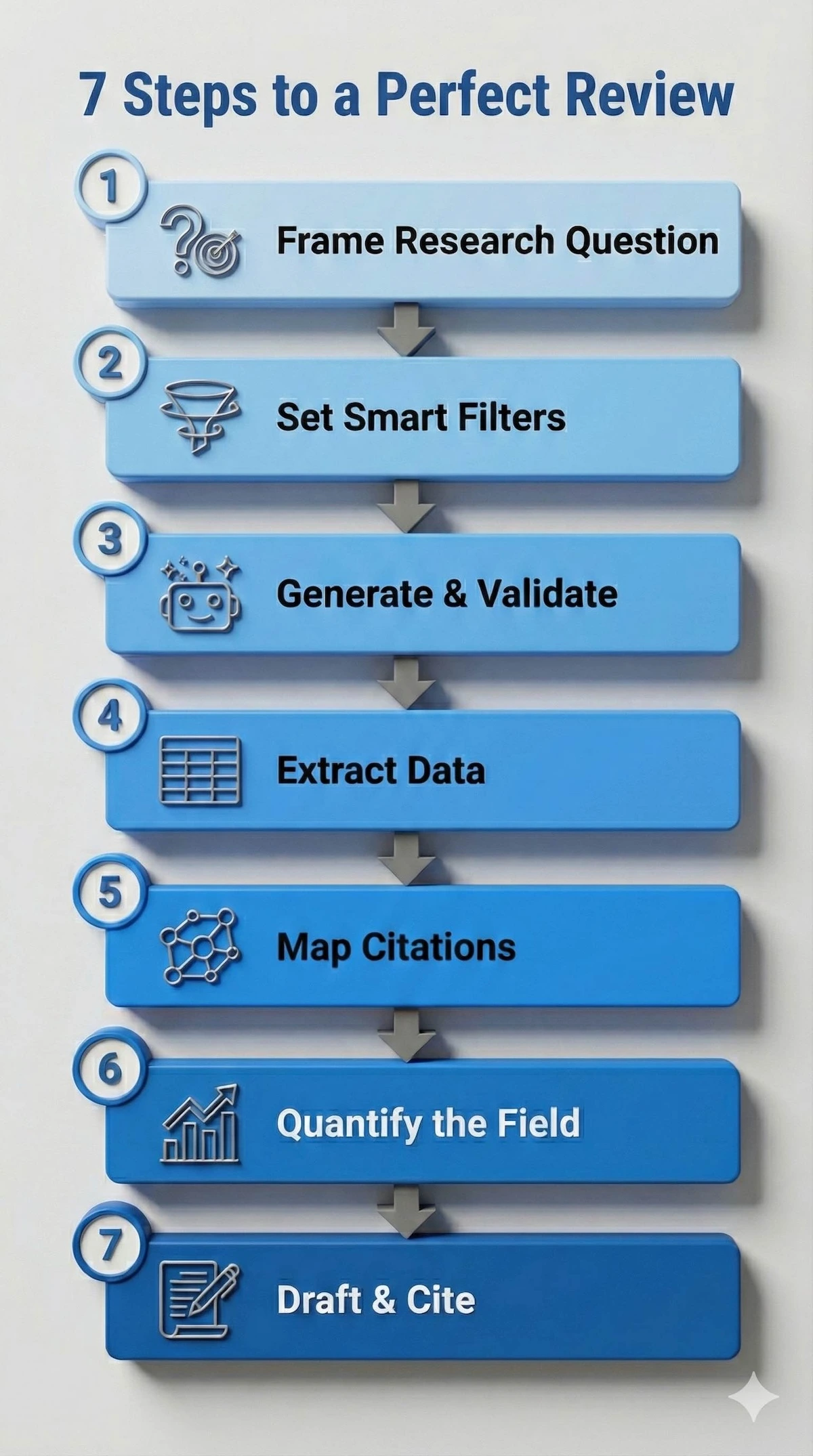
Follow this seven-step roadmap to navigate your literature review from initial question to final draft.
Let’s dive into Step 1 and start framing your research question effectively.
1) Frame a precise research question
Start in the Literature Review canvas, choose Full Review when you need a comprehensive, multi paragraph synthesis with line by line citations. If you want quick scoping answers, choose Quick Q and A. Use the Prompt Helper to select intents like Write a literature review, Find relevant studies, or Identify research gaps.
Pro move, if you are still refining your topic, run a quick “gaps scan” first, then branch into a full review. This is a natural place to link to your research gap finder, anchor text suggestion, find research gaps in your field.
2) Set smart discovery filters
Click More Filters to define your evidence base before you generate,
- Databases, Semantic Scholar, OpenAlex, PubMed for clinical topics, arXiv
- Journal quality, focus on Q1 or include Q1 and Q2 for breadth
- Citation floor, set a minimum paper citation count when you need influence, or turn it off for cutting edge topics
- Dates, many reviews use 2019 to present for recency, or set start year to capture seminal works
- Web sources, optionally include .gov and .edu when policies and guidance matter
Good filters reduce noise, accelerate screening, and strengthen defensibility.
3) Generate the review and validate claims in place
Answer This produces a structured review with sections like context, scope, methods, findings, limitations, and future directions, each sentence is backed by an inline citation. Click any citation to open the sources table, where you will see,
- Paper title, authors, venue, year, DOI
- Abstract and relevant extracts aligned to your question
- One click tools to add columns for key findings, methods, or research gaps
Export the table as CSV, BibTeX, or send citations directly to Zotero and Mendeley.
4) Extract what matters, fast
Use Manage Columns in the sources table to auto extract,
- Methodology, study design, data, sample size, metrics
- Findings, effect sizes, model performance, statistically significant results
- Limitations and biases, threats to validity, dataset issues
- Gaps and opportunities, what is underexplored or missing
This turns screening from a manual copy paste grind into a structured dataset you can analyze and reuse.
5) Map how papers connect
If you suspect you have not seen all the important work, open Citation Map,
- Enter a DOI or title, set as Origin
- Visualize incoming and outgoing citations, trace influence chains
- Use the Metrics panel to surface most cited papers, most connected papers, and top contributing authors
- Add promising papers directly to your library or current table
This is the quickest way to uncover clusters, bridge papers, and hidden classics.
6) Quantify the field, not just describe it
When organizing and structuring a literature review, it’s important to go beyond simple description by incorporating Bibliometric Analysis of your selected sources. This approach provides a more rigorous organizational framework and supports key components typically included in literature reviews, such as identifying trends, patterns, and areas of controversy.
- Analyze publication trends by year to determine if the topic is emerging or maturing, which can inform the introduction and contextual background of your review.
- Examine citation trends to highlight landmark studies, helping to identify turning points and key debates within the field.
- Compare volume versus influence by combining publication and citation data, allowing you to group items into sections based on impact.
- Track keyword frequency to surface recurring themes, terminology shifts, and potential questions that need further research.
- Identify top authors, publication venues, and co-authorship patterns to illustrate the organizational method and synthesis of major contributors and collaborations.
Including a paragraph or figure based on this analysis strengthens the structure of your literature review, clarifies your organizational patterns, and demonstrates a comprehensive summary of what is and is not known.
Visualizing data is often more powerful than describing it. The diagram below shows the four key bibliometric analyses you should include.
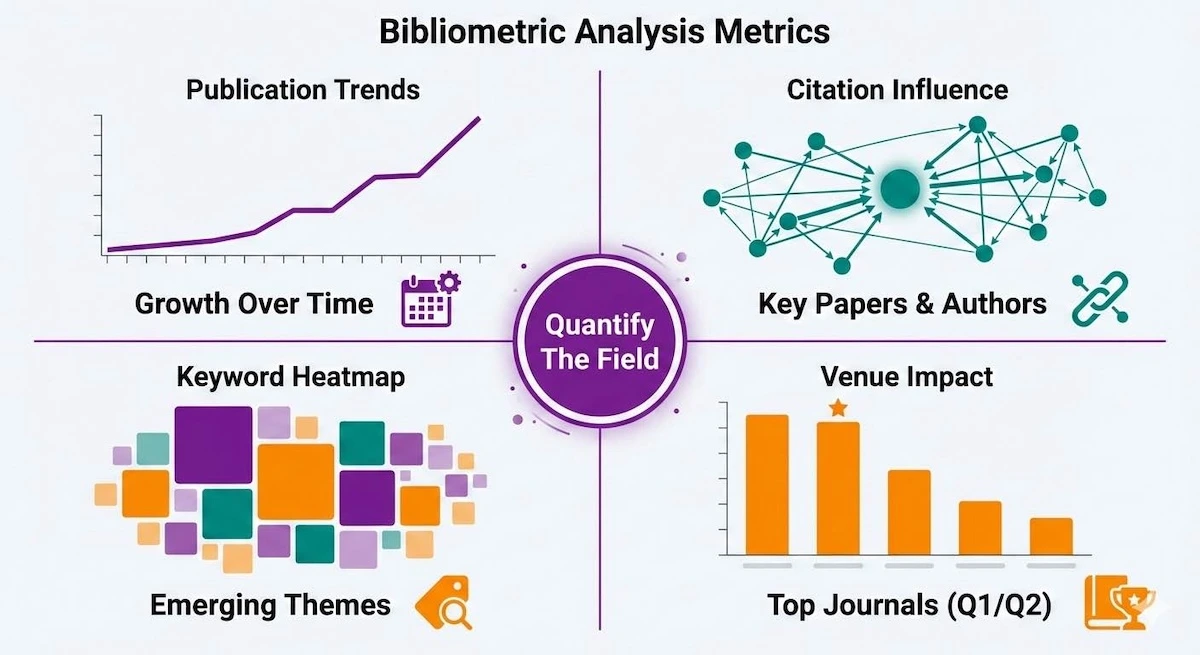
Go beyond reading—use bibliometrics to visualize trends, spot influential papers, and map the research landscape.
Including these visual insights shifts your review from a simple summary to a rigorous field analysis.
This method also supports a clear introduction-body-conclusion structure and helps articulate your thesis or research question within the broader context of the field.
7) Draft, refine, and cite without leaving the canvas
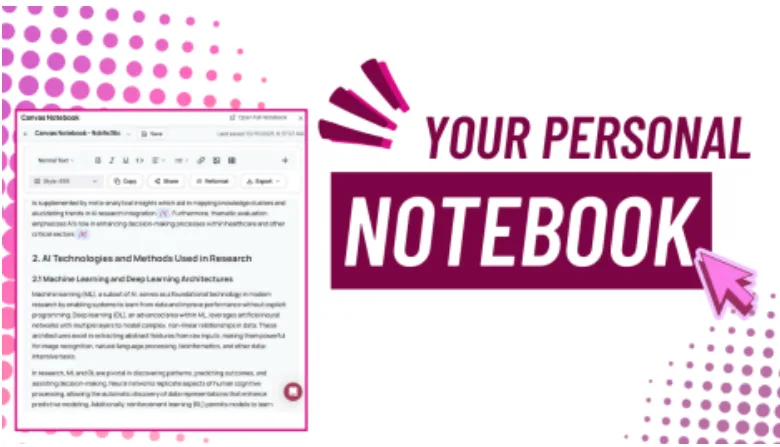
Use Add to Notebook to collect strong passages or your own notes. Open Full Notebook to,
- Edit with AI in context, expand, rephrase, or insert evidence with citations preserved
- Switch citation styles in one click, APA, MLA, Chicago, IEEE, over 2,600 styles
- Run plagiarism and AI content detection checks on demand, so you submit with confidence
- Insert figures, links, and tables, then export to PDF, DOCX, LaTeX, or Markdown
Tip, when re phrasing your own notes or aligning tone for a paragraph, open Paraphrase from Add New Step. This is a natural place to link to your free AI paraphraser, anchor text suggestion, paraphrase academic text clearly.
A Repeatable Literature Review Workflow You Can Trust
Research isn’t a straight line; it’s a cycle. Save this workflow diagram to guide every literature review you conduct in the future.
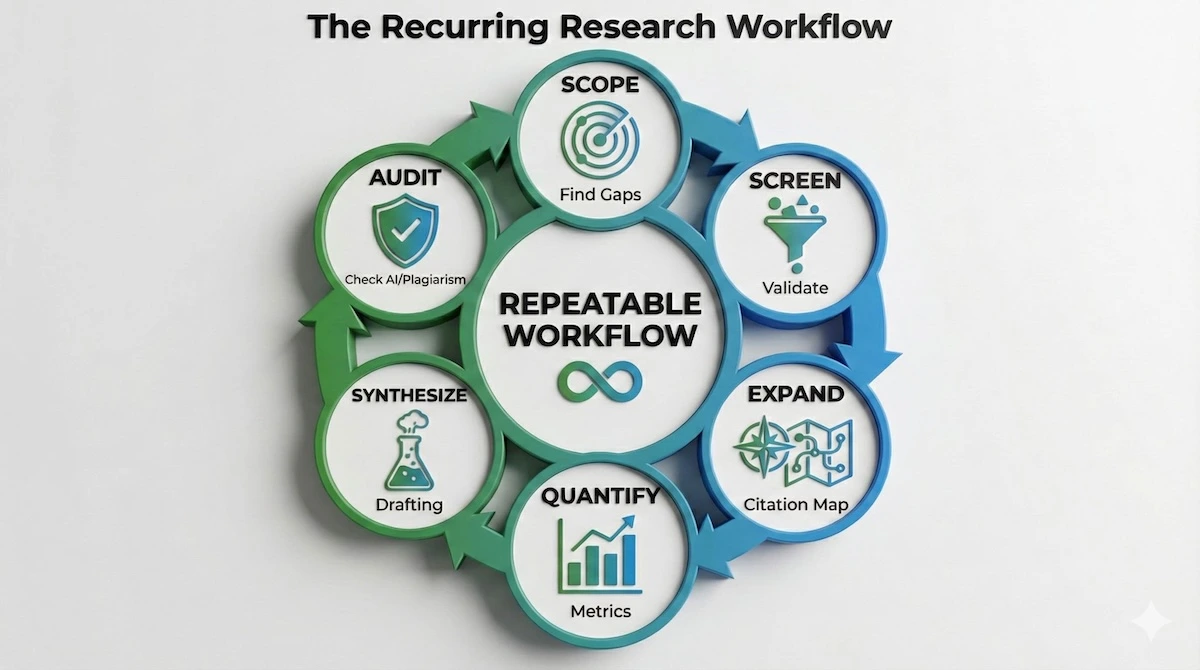
Master this repeatable cycle to produce consistent, high-quality reviews for every research project.
By following this loop, you ensure that no critical paper is missed and every claim is backed by evidence.
- Scope, run a gaps scan, set filters, generate a Full Review
- Screen, validate citations, extract methods and findings into a table
- Expand, search new papers by keyword or author, build a citation map
- Quantify, run bibliometrics to support your field overview
- Synthesize, draft sections in the notebook, keep claims tied to sources
- Audit, switch citation style, check plagiarism and AI signals
- Export and share, PDF for submission, DOCX for supervisors, LaTeX for journals, or share a read only link with collaborators
This loop mirrors how experienced researchers actually work, only with fewer tabs and fewer chances to miss something important.
Best Practices for Stronger Reviews
When conducting a literature review, it is essential to critically evaluate and select sources using clear criteria. Begin by balancing novelty and influence, ensuring that both recent studies and seminal pieces are included to reflect the scholarly conversation. Clearly state your inclusion criteria, such as the databases searched, publication chronology, language, methodological scope, and quality thresholds.
Differentiate between empirical and theoretical scholarship, and consider the relevance of qualitative versus quantitative research. Normalize terminology early by analyzing keyword frequency and paraphrasing consistently.
Every claim should be supported by evidence, with statements tied directly to referenced sources. Maintain transparency by providing a reference section and exporting your source tables, filters, and thematic maps alongside the manuscript. This critical appraisal and thematic review approach will strengthen the quality and reliability of your work.
Who Benefits Most from AnswerThis for Literature Reviews
- Undergraduates, needing structure and verifiable citations for seminar papers
- Master’s and PhD researchers, doing systematic or scoping reviews with method transparency
- Faculty and PIs, preparing grant background and related work sections efficiently
- Industry researchers and clinicians, needing quick, citable syntheses for decisions and audits
Pricing, Try It, Then Scale
This is free for your first five literature reviews, enough to complete a course paper or scope a thesis chapter. The Pro plan is 35 dollars per month or 250 dollars annually, competitively priced for the accuracy, relevance, and end to end workflow you get. Similar tools often cost the same or more while offering less usability for actual academic writing and fewer ways to validate and export your evidence.
Frequently Asked Questions
How does AnswerThis keep citations accurate
Every sentence in the generated review carries an inline citation, click to see the source, abstract, relevant extract, and DOI. You can export references to Zotero, Mendeley, BibTeX, or copy formatted citations in over 2,600 styles.
Can I limit to high quality journals only
Yes, set Journal Quality to Q1 or Q1 and Q2 in filters, and define a publication window, for example, 2021 to present, to focus on recent, high impact work.
What if my topic is interdisciplinary
Include multiple databases in More Filters, for example, PubMed and arXiv and OpenAlex. Then use Citation Map to locate cross domain bridge papers.
How do I find genuine research gaps
Use Manage Columns to auto extract limitations and gaps from your source table, then cluster common themes. When you are ready to formalize, run a fresh review just on those gap themes. You can also point readers to your research gap finder in context.
Will paraphrasing break my citations
No, when you paraphrase inside the notebook or via Add New Step, Paraphrase, AnswerThis preserves, or lets you re attach, citations so your audit trail remains intact.
What export options are supported
PDF for sharing, DOCX for supervisor edits, LaTeX for journals, Markdown for repos, plus CSV, BibTeX, Zotero and Mendeley for references.
Final Thoughts
Strong literature reviews are not just about collecting papers, they are about building a defensible, well structured argument that stands up to scrutiny. AnswerThis was designed to mimic how an experienced researcher thinks, discover widely, evaluate critically, synthesize clearly, and document everything. If you adopt the workflow above, your reviews will get faster, clearer, and more citable, with less stress and far fewer browser tabs.
Also, for engineering-focused templates, reproducible bibliometric scripts, and ready-made source tables that plug into your workflow, check out My Engineering Buddy website — it’s a practical companion to AnswerThis for hands-on examples and code.
If you need downloadable review templates, CSV-ready extraction sheets, or short tutorials that show the exact steps above, you’ll find them on My Engineering Buddy to help you implement the workflow more quickly.
******************************
This article provides general educational guidance only. It is NOT official exam policy, professional academic advice, or guaranteed results. Always verify information with your school, official exam boards (College Board, Cambridge, IB), or qualified professionals before making decisions. Read Full Policies & Disclaimer , Contact Us To Report An Error