


Hire The Best Chemistry Tutor
Top Tutors, Top Grades. Without The Stress!



52,000+ Happy Students From Various Universities





How Much For Private 1:1 Tutoring & Hw Help?
Private 1:1 Tutoring and HW help Cost $20 – 35 per hour* on average.
Stoichiometry doesn’t click in lectures. Organic mechanisms look like a foreign language. And the exam is in six weeks.
Chemistry Tutor Online
Chemistry is the scientific study of matter, its properties, structure, and reactions. Taught across GCSE, A Level, IB, AP, and undergraduate programmes, it equips students to analyse substances, balance equations, and apply chemical principles to real-world problems.
If you’ve searched for a Chemistry tutor near me and ended up here, you’re in the right place. MEB connects you with a verified Chemistry tutor online — matched to your exact syllabus, exam board, and level — from $20/hr. Whether you’re stuck on equilibrium constants, lost in organic synthesis, or staring down a thermochemistry problem set, a 1:1 session is built around what you don’t know yet, not what you already do.
- 1:1 online sessions tailored to your course and exam board
- Expert-verified tutors with subject-specific Chemistry knowledge
- Flexible time zones — US, UK, Canada, Australia, Gulf
- Structured learning plan built after a diagnostic session
- Ethical homework and assignment guidance — you understand before you submit
52,000+ students across the US, UK, Canada, Australia, and the Gulf have used MEB since 2008 — across Chemistry and related subjects including organic chemistry tutoring, physical chemistry help, and inorganic chemistry tutoring.
Source: My Engineering Buddy, 2008–2025.
How Much Does a Chemistry Tutor Cost?
Most Chemistry tutoring with MEB runs $20–$40/hr. Advanced topics — graduate-level physical chemistry, computational methods, spectroscopy — can reach $60–$100/hr depending on tutor background. The $1 trial gives you 30 minutes of live 1:1 tutoring or a full explanation of one homework question before you commit to anything.
| Level / Need | Typical Rate | What’s Included |
|---|---|---|
| GCSE / A Level / AP / IB | $20–$35/hr | 1:1 sessions, homework guidance |
| Undergraduate (Year 1–3) | $30–$55/hr | Concept depth, assignment support |
| Graduate / Specialist | $55–$100/hr | Expert tutor, niche topic depth |
| $1 Trial | $1 flat | 30 min live session or 1 homework question |
Tutor availability tightens fast around AP exam season in May and A Level / IB exam windows in May–June. Book early if those are your dates.
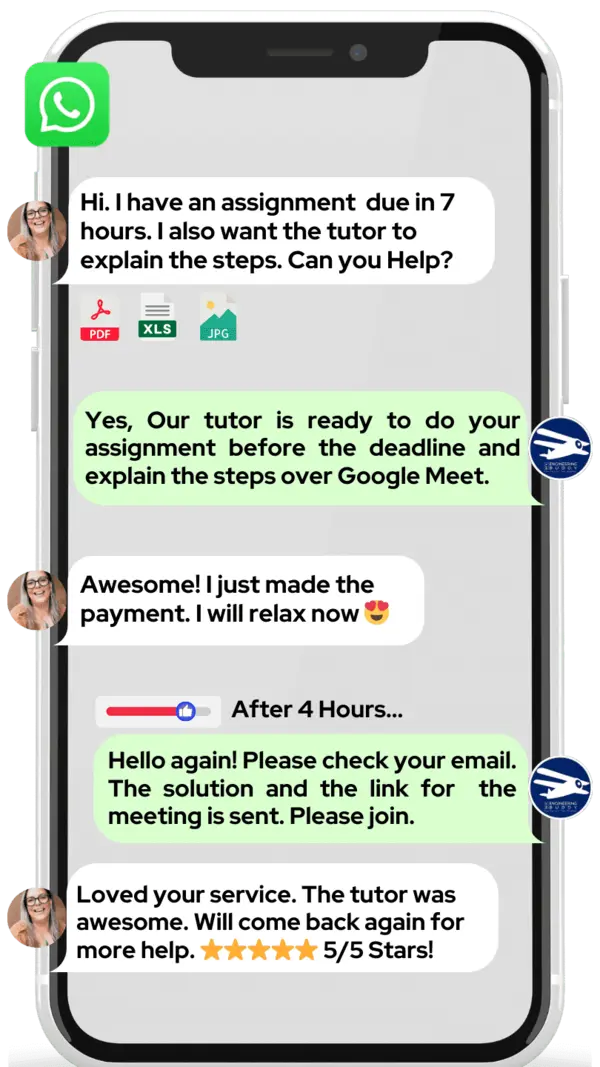
WhatsApp MEB for a quick quote — average response time under 1 minute.
Who This Chemistry Tutoring Is For
Chemistry is wide. The students who come to MEB span A Level, AP, IB, first and second year undergraduate, and graduate programmes — each with a different sticking point. What they share is that lectures alone didn’t get them there.
- Students stuck on organic mechanisms — reactions that seem arbitrary until the electron-pushing logic clicks
- Students with a university conditional offer that depends on their A Level or IB Chemistry grade
- Students 4–6 weeks from an AP or A Level exam with stoichiometry, equilibrium, or electrochemistry still to close
- Parents watching a child’s confidence drop alongside their Chemistry grade
- Undergraduates at universities including MIT, UCL, University of Toronto, UNSW, and TU Delft who need support in physical or analytical chemistry modules
- Graduate students needing targeted help with quantum chemistry, spectroscopic methods, or computational modelling
Not sure if MEB is the right level for your course? WhatsApp MEB — the team will tell you in under a minute whether there’s a tutor matched to your exact module.
At MEB, we’ve found that students who arrive with a specific problem — “I can balance equations but I can’t do acid-base titration calculations” — progress faster than students who say “I just don’t get Chemistry.” Knowing where you’re stuck is half the diagnostic done.
1:1 Tutoring vs Self-Study vs AI vs YouTube vs Online Courses
Self-study works if you’re disciplined — but Chemistry has too many interconnected concepts for gaps to stay small. AI tools explain quickly but can’t watch you draw a mechanism and catch where your arrow-pushing goes wrong. YouTube is great for an overview of Le Chatelier’s Principle; it stops when you need to work through a specific equilibrium calculation. Online courses move at one pace regardless of where you are. A 1:1 Chemistry tutor from MEB works live, corrects errors at the moment they happen, and builds the session around your exact paper — not a generalised curriculum.
Outcomes: What You’ll Be Able To Do in Chemistry
After working with an MEB Chemistry tutor, students consistently report that the subject starts to make sense as a connected system rather than a list of disconnected facts. You’ll be able to solve multi-step stoichiometry problems without reaching for a formula sheet mid-calculation. You’ll analyze reaction mechanisms in organic chemistry — predicting products, identifying nucleophiles and electrophiles, and explaining selectivity. You’ll apply equilibrium principles to buffer calculations, solubility problems, and Hess’s Law thermochemistry. You’ll write and interpret spectroscopic data — IR, NMR, and mass spectrometry — to propose structures for unknown compounds. And you’ll present lab results with the precision markers actually reward, not just a summary of what happened.
Supporting a student through Chemistry? MEB works directly with parents to set up sessions, track progress, and keep coursework on schedule. WhatsApp MEB — average response time is under a minute, 24/7.
Based on feedback from 40,000+ sessions collected by MEB from 2022 to 2025, 58% of students improved by one full grade after approximately 20 hours of 1:1 tutoring in subjects like Chemistry. A further 23% achieved at least a half-grade improvement.
Source: MEB session feedback data, 2022–2025.
What We Cover in Chemistry (Syllabus / Topics)

General & Physical Chemistry
- Atomic structure, electron configuration, and periodic trends
- Stoichiometry tutoring — mole calculations, limiting reagents, yield
- Thermochemistry: enthalpy, entropy, Gibbs free energy, Hess’s Law
- Chemical equilibrium help — Le Chatelier, Kc, Kp, buffer problems
- Chemical kinetics tutoring — rate laws, activation energy, Arrhenius equation
- Electrochemistry: galvanic cells, electrolysis, Nernst equation
- Gas laws and ideal gas law help
- Acids, bases, pH, and titration calculations
Core texts used: Atkins’ Physical Chemistry (Atkins & de Paula), Zumdahl’s Chemical Principles, and Chang’s Chemistry for the AP Course.
Organic Chemistry
- Functional groups, nomenclature (IUPAC), and isomerism
- Reaction mechanisms: SN1, SN2, E1, E2, addition, elimination
- Stereochemistry tutoring — chirality, R/S configuration, diastereomers
- Aldehydes and ketones help — nucleophilic addition, oxidation, reduction
- Aromatic chemistry: benzene, electrophilic aromatic substitution
- Spectroscopic identification using NMR spectroscopy tutoring and IR analysis
- Synthesis planning and retrosynthesis
Core texts: Clayden’s Organic Chemistry, McMurry’s Organic Chemistry, and Klein’s Organic Chemistry as a Second Language.
Inorganic, Analytical & Specialist Chemistry
- Chemical bonding help — VSEPR, molecular orbital theory, hybridisation
- Transition metal chemistry and coordination compounds
- Analytical chemistry tutoring — titration, spectrophotometry, error analysis
- Chromatography help — GC, HPLC, TLC separation and interpretation
- Mass spectrometry tutoring — fragmentation patterns, molecular ion identification
- Environmental and green chemistry tutoring — principles of sustainable synthesis
Core texts: Shriver & Atkins’ Inorganic Chemistry, Harris’s Quantitative Chemical Analysis, and Skoog’s Principles of Instrumental Analysis.
Try your first session for $1 — 30 minutes of live 1:1 tutoring or one homework question explained in full. No registration. No commitment. WhatsApp MEB now and get matched within the hour.
What a Typical Chemistry Session Looks Like
The tutor opens by checking where you left off — say, acid-base equilibria from last time. You share your screen or a photo of the problem set. Together you work through a buffer calculation: the tutor writes out the Henderson-Hasselbalch equation on a digital pen-pad, labels each variable, and asks you to plug in your values before they do. When you get the Ka step wrong, they stop there — not at the end — and work back through the logarithm. Then you attempt a second problem alone while the tutor watches. The session closes with two or three specific problems assigned for solo practice and a note on what’s next: solubility equilibria or electrochemical cells depending on your syllabus sequence.
How MEB Tutors Help You with Chemistry (The Learning Loop)
Diagnose: In the first session, the tutor identifies exactly where your understanding breaks down — not just the topic, but the specific step. A student who “doesn’t understand organic chemistry” usually has a gap in one of three places: electron movement notation, functional group reactivity, or mechanism logic. The tutor finds it.
Explain: Live worked problems on a digital pen-pad — the tutor writes out every step, annotates equations, and talks through the reasoning. Nothing is skipped. You see the full working, not just the answer.
Practice: You attempt the next problem with the tutor present. No waiting for marked homework to come back. You work, you show your reasoning, the tutor watches in real time.
Feedback: Step-by-step error correction. The tutor points to the exact line where the calculation went wrong or where the mechanism arrow is missing a lone pair. You learn why marks are lost, not just that they were.
Plan: At the end of each session, the tutor sets the next topic, assigns specific practice questions, and notes what to revisit before you meet again. No ambiguity about what to do between sessions.
Sessions run over Google Meet with a digital pen-pad or iPad and Apple Pencil. Before your first session, send through your exam board and syllabus (or module outline), a past paper attempt or a homework problem you couldn’t finish, and your exam or deadline date. The first session starts with a diagnostic — so every minute from that point is targeted.
Start with the $1 trial — 30 minutes of live tutoring that also serves as your first diagnostic.
Students consistently tell us that the moment Chemistry starts making sense is when someone shows them — live, on screen — exactly where their reasoning broke down. Reading an explanation in a textbook doesn’t do what a real-time correction does. That’s the gap the learning loop closes.
Tutor Match Criteria (How We Pick Your Tutor)
Not every Chemistry expert is right for every student. Here’s what MEB looks at.
Subject depth: Tutors are matched to your exact level — AP Chemistry, A Level (AQA, OCR, Edexcel, CIE), IB Chemistry HL/SL, or undergraduate and graduate modules. A tutor who knows undergraduate thermodynamics inside out may not be the right fit for GCSE, and vice versa.
Tools: All tutors use Google Meet with a digital pen-pad or iPad and Apple Pencil. Chemistry requires drawn structures, annotated equations, and live mechanism work — not just typed answers.
Time zone: Matched to your region — US, UK, Gulf, Canada, or Australia — so sessions happen at sensible hours without negotiating across 10-hour gaps.
Goals: Whether your goal is exam scores, understanding a specific mechanism, general chemistry help through a tough semester, or support with a research-related module, the tutor match reflects that.
Unlike platforms where you fill out a form and wait, MEB responds in under a minute, 24/7. Tutor match takes under an hour. The $1 trial means you test before you commit. Everything runs over WhatsApp — no logins, no intake forms.
Study Plans (Pick One That Matches Your Goal)
After a diagnostic session, your tutor builds a specific sequence — not a generic plan. Three common shapes: a catch-up plan (1–3 weeks) that closes the most critical gaps before an upcoming exam; a structured revision plan (4–8 weeks) that works through the full syllabus with timed practice; or ongoing weekly support aligned to your semester deadlines and coursework submissions. Which one fits depends on where you are now and when the pressure lands — the tutor works that out in session one.
Pricing Guide
Chemistry tutoring with MEB starts at $20/hr for most GCSE, A Level, AP, and IB levels. Undergraduate and specialist topics typically run $30–$55/hr. Graduate-level work — quantum chemistry, computational methods, advanced spectroscopy — is available from $55 up to $100/hr depending on tutor background and topic depth.
Rate factors include your level, the complexity of the topic, how quickly you need sessions, and tutor availability. Availability tightens around AP exam season (May) and A Level / IB windows (May–June) — if those are your dates, don’t leave it late.
For students targeting places at research-intensive universities or applying to graduate programmes where chemistry fundamentals are tested at interview, tutors with active research backgrounds are available at higher rates. Share your specific goal and MEB will match the tier to what you actually need.
Start with the $1 trial — 30 minutes, no registration, no commitment. WhatsApp MEB for a quick quote.
Chemistry covers more ground than most students realise — from gas law calculations in week three to multi-step organic synthesis by the end of the year. The students who close that range fastest are the ones getting corrected in real time, not reading worked solutions alone at midnight.
Source: My Engineering Buddy, internal session data, 2008–2025.
FAQ
Is Chemistry hard?
Chemistry has a reputation for difficulty because it combines mathematical calculation with conceptual reasoning and spatial thinking — all in the same exam. Most students find one strand manageable and one strand genuinely difficult. A tutor identifies which strand is the problem and works there first.
How many sessions are needed to improve in Chemistry?
It depends on your starting point and timeline. Students closing specific gaps before an exam often see meaningful progress in 4–6 sessions. Students building from a poor foundation typically need 15–25 hours of 1:1 work spread over 6–10 weeks. The tutor gives a realistic estimate after the first diagnostic.
Can you help with Chemistry homework and assignments?
Yes — MEB tutoring is guided learning. You understand the work, then submit it yourself. This applies to problem sets, lab reports, and written assignments. See our Academic Integrity policy and Why MEB page for full details on what we help with and what we don’t.
Will the tutor match my exact syllabus or exam board?
Yes. MEB tutors are matched to your specific board — AQA, OCR, Edexcel, CIE, AP Chemistry, IB Chemistry HL or SL, or your university module. Bring your syllabus or module outline to the first session and the tutor will map sessions to it directly.
What happens in the first Chemistry session?
The tutor starts with a short diagnostic — a few questions across your main topics to find exactly where the gaps are. From that point, every session is targeted. You won’t spend time on material you already know. Bring a past paper attempt or a problem set you’ve struggled with.
Is online Chemistry tutoring as effective as in-person?
For most students, yes. The digital pen-pad replicates the whiteboard — the tutor draws mechanisms, annotates equations, and writes full working in real time. Google Meet handles everything else. The main advantage is access: you get the right tutor for your syllabus, not just whoever lives nearby.
What’s the difference between AP Chemistry and A Level Chemistry — and can MEB tutor both?
AP Chemistry is a single-year US course assessed by a College Board exam in May. A Level Chemistry runs over two years with modular content and varies by board (AQA, OCR, Edexcel). Both are rigorous. MEB tutors both — specify your board and level when you reach out.
Can a Chemistry tutor help me understand spectroscopy — NMR, IR, and mass spec?
Yes. Spectroscopic interpretation is one of the most commonly requested topics at undergraduate level. Tutors work through real spectra with you — assigning peaks, identifying splitting patterns in NMR, and building up to proposing full structures for unknown compounds. Bring a spectrum you’re stuck on.
Do you offer help with organic chemistry reaction mechanisms specifically?
Organic mechanisms are the most common single request MEB Chemistry tutors receive. Tutors cover SN1, SN2, E1, E2, electrophilic addition, nucleophilic acyl substitution, and more — with live arrow-pushing on a pen-pad so you see the electron movement, not just the product. Get organic chemistry help from a tutor who knows exactly where students lose marks.
Can I get Chemistry help at midnight or on weekends?
Yes. MEB operates 24/7 across time zones. Students in the Gulf, Australia, and North America regularly book sessions outside standard office hours. WhatsApp MEB at any hour — average response time under a minute. Weekend slots fill faster during exam season, so book ahead.
What if I’m studying physical chemistry at graduate level — can MEB still help?
Yes. MEB covers graduate-level physical chemistry tutoring including statistical thermodynamics, quantum mechanical models, spectroscopy theory, and computational methods. Rates for graduate specialist work typically run $55–$100/hr. Share your module outline and MEB will confirm tutor availability.
How do I get started?
Start with the $1 trial — 30 minutes of live tutoring or one full Chemistry question explained. Three steps: WhatsApp MEB, get matched with a verified tutor (usually within the hour), then begin your trial session. No registration required.
Trust & Quality at My Engineering Buddy
Every MEB Chemistry tutor goes through subject-specific vetting — not a generic screening. Candidates complete a live demo session evaluated for explanation clarity, error correction technique, and syllabus accuracy. Ongoing session feedback is reviewed, and tutors who consistently receive below-standard ratings are reassigned or removed. Tutors hold degrees in Chemistry, Biochemistry, Chemical Engineering, or closely related disciplines, and many have professional or research experience in analytical, organic, or physical chemistry. Rated 4.8/5 across 40,000+ verified reviews on Google.
MEB tutoring is guided learning — you understand the work, then submit it yourself. For full details on what we help with and what we don’t, read our Academic Integrity policy and Why MEB.
MEB has served 52,000+ students across the US, UK, Canada, Australia, the Gulf, and Europe in 2,800+ subjects since 2008. Within Chemistry, that includes thermochemistry tutoring, computational chemistry help, and quantum chemistry tutoring at undergraduate and graduate level. If the topic exists on a university or school syllabus, there’s likely a tutor for it. Read more about how sessions are structured on our tutoring methodology page.
For peer-reviewed Chemistry research and journal access, ScienceDirect Chemistry is one of the most widely used academic resources across university programmes worldwide.
Source: Elsevier / ScienceDirect.
Explore Related Subjects
Students studying Chemistry often also need support in:
- Atomic Structure
- Chemical Equations
- Covalent Bonding
- Environmental Chemistry
- Medicinal Chemistry
- Polymer Chemistry
- Surface Chemistry
- Biophysical Chemistry
Next Steps
Here’s what to do before your first session:
- Share your exam board and syllabus (or course outline)
- Share a recent past paper attempt or homework problem you couldn’t finish
- Share your exam or deadline date and your time zone
MEB matches you with a verified Chemistry tutor — usually within 24 hours, often within the hour. The first session starts with a diagnostic so nothing is wasted.
Visit www.myengineeringbuddy.com for more on how MEB works.
WhatsApp to get started or email meb@myengineeringbuddy.com.
Reviewed by Subject Expert
This page has been carefully reviewed and validated by our subject expert to ensure accuracy and relevance.