Hire Verified & Experienced
Biophysical Chemistry Tutors
Email: [email protected]
4.8/5 40K+ session ratings collected on the MEB platform



Hire The Best Biophysical Chemistry Tutor
Top Tutors, Top Grades. Without The Stress!
Biophysical Chemistry at the graduate level has a 40–60% drop rate in the first semester. Most students hit the wall at thermodynamic cycles and protein folding kinetics simultaneously.
Biophysical Chemistry Tutor Online
Biophysical Chemistry applies physical chemistry principles — thermodynamics, spectroscopy, and statistical mechanics — to biological macromolecules such as proteins, nucleic acids, and membranes, equipping students to quantitatively analyze biological systems.
MEB provides 1:1 online tutoring and homework help in 2800+ advanced subjects, including Biophysical Chemistry. If you’ve searched for a Biophysical Chemistry tutor near me and found generic results, MEB matches you with a verified specialist — someone who knows Gibbs free energy in protein folding, partition functions, and van’t Hoff analysis, not just general chemistry. Our chemistry tutoring covers the full spectrum from foundational to graduate-level courses, with Biophysical Chemistry sitting at the intersection of physical and life sciences.
- 1:1 online sessions tailored to your exact course syllabus and institution
- Expert-verified tutors with graduate-level subject knowledge in Biophysical Chemistry
- Flexible time zones — US, UK, Canada, Australia, Gulf
- Structured learning plan built after a diagnostic session
- Ethical homework and assignment guidance — you understand the work, then submit it yourself
52,000+ students across the US, UK, Canada, Australia, and the Gulf have used MEB since 2008 — including students in Chemistry subjects like Biophysical Chemistry, Physical Chemistry, and Quantum Chemistry.
Source: My Engineering Buddy, 2008–2025.
How Much Does a Biophysical Chemistry Tutor Cost?
Most Biophysical Chemistry sessions run $20–$40/hr. Graduate-level or highly specialised topics — binding thermodynamics, NMR-based structure determination, single-molecule spectroscopy — can reach up to $100/hr. Start with the $1 trial: 30 minutes of live tutoring or one homework question explained in full.
| Level / Need | Typical Rate | What’s Included |
|---|---|---|
| Undergraduate (intro/mid-level) | $20–$35/hr | 1:1 sessions, homework guidance |
| Advanced / Graduate-level | $35–$100/hr | Expert tutor, niche depth, problem sets |
| $1 Trial | $1 flat | 30 min live session or 1 homework question |
Tutor availability tightens significantly during finals and thesis submission periods. Book early if you’re within six weeks of a deadline.
WhatsApp MEB for a quick quote — average response time under 1 minute.
Who This Biophysical Chemistry Tutoring Is For
Biophysical Chemistry draws students from biochemistry, chemistry, biophysics, and structural biology programmes. The content is mathematically demanding and conceptually dense — most students hit trouble not because they lack ability, but because the maths and the biology arrive at the same time.
- Undergraduate students in biochemistry or chemistry facing their first exposure to partition functions and Boltzmann distributions
- Graduate students whose research involves protein thermodynamics, enzyme kinetics, or spectroscopic techniques
- Students retaking after a failed first attempt — particularly those who passed the biology but failed the physical chemistry sections
- Students with a conditional university offer that depends on their final grade in a Biophysical Chemistry module
- PhD candidates preparing for qualifying exams that include biophysical topics such as calorimetry or fluorescence spectroscopy
- Students at institutions including MIT, Stanford, University of Toronto, University of Edinburgh, ETH Zurich, and the University of Melbourne where Biophysical Chemistry is a required core course
The $1 trial lets you test the tutor match before spending anything significant.
1:1 Tutoring vs Self-Study vs AI vs YouTube vs Online Courses
Self-study works if you’re disciplined — but Biophysical Chemistry problems require someone to catch the error in your partition function derivation before it cascades. AI tools give fast explanations but cannot adapt live when you misapply the Gibbs-Helmholtz equation three steps in. YouTube covers the conceptual overview of protein folding thermodynamics well; it stops when you’re stuck on a specific numerical problem. Online courses move at a fixed pace — useless if your exam is in four weeks. 1:1 tutoring with MEB is calibrated to your exact course, your exact gaps, and corrects errors the moment they happen.
Outcomes: What You’ll Be Able To Do in Biophysical Chemistry
After a structured block of sessions, students consistently report they can solve binding equilibrium problems using Scatchard analysis, apply the van’t Hoff equation to analyse temperature-dependent equilibria, model enzyme kinetics using the Michaelis-Menten framework with confidence, explain the thermodynamic basis of protein stability and denaturation, and interpret NMR or UV-Vis spectroscopy data in the context of molecular structure. These aren’t abstract goals — they’re the specific things that appear on problem sets and written exams at programmes across the US, UK, and Australia.
Based on feedback from 40,000+ sessions collected by MEB from 2022 to 2025, 58% of students improved by one full grade after approximately 20 hours of 1:1 tutoring in subjects like Biophysical Chemistry. A further 23% achieved at least a half-grade improvement.
Source: MEB session feedback data, 2022–2025.
At MEB, we’ve found that Biophysical Chemistry students who struggle with thermodynamics almost always have the same underlying gap: they treat delta-G as a formula to plug numbers into rather than a description of spontaneity. One session on that distinction shifts everything that comes after.
What We Cover in Biophysical Chemistry (Syllabus / Topics)

Thermodynamics and Statistical Mechanics of Biomolecules
- Gibbs free energy and its application to biochemical reactions
- Entropy, enthalpy, and the hydrophobic effect in protein folding
- Boltzmann distribution and partition functions for molecular systems
- van’t Hoff analysis and temperature-dependent equilibria
- Calorimetry: isothermal titration calorimetry (ITC) and differential scanning calorimetry (DSC)
- Linkage thermodynamics and coupled equilibria
Core texts: Physical Biochemistry by Tinoco, Sauer, Wang & Puglisi; Biophysical Chemistry by Cantor & Schimmel (Parts I–III).
Binding, Kinetics, and Enzyme Mechanisms
- Ligand-receptor binding: Scatchard plots, Hill equation, cooperativity
- Michaelis-Menten kinetics and steady-state approximations
- Inhibition mechanisms: competitive, uncompetitive, mixed inhibition
- Transition state theory and Eyring equation applied to enzyme catalysis
- Single-molecule kinetics and stochastic approaches
- Stopped-flow and rapid-mixing techniques for fast reactions
Core texts: Biochemistry by Stryer, Berg & Tymoczko; Enzyme Kinetics by Marangoni.
Spectroscopy and Structural Methods
- UV-Vis absorption spectroscopy: Beer-Lambert law, chromophores in proteins and nucleic acids
- Fluorescence spectroscopy: quantum yield, FRET, anisotropy
- Circular dichroism (CD) and secondary structure analysis
- NMR spectroscopy applied to biomolecular structure — chemical shift, NOE, relaxation
- Dynamic light scattering (DLS) and size determination
- X-ray crystallography and cryo-EM: principles and data interpretation
Core texts: Introduction to Spectroscopy by Pavia et al.; Principles of Physical Biochemistry by van Holde, Johnson & Ho.
Students consistently tell us that spectroscopy is where Biophysical Chemistry clicks or breaks. The maths is not the issue — it’s connecting Beer-Lambert to an actual gel or FRET measurement on a real protein. That connection is exactly what a live session can make in 30 minutes.
What a Typical Biophysical Chemistry Session Looks Like
The tutor opens by checking where the previous session ended — usually a derivation of the partition function for a two-state folding model or an ITC data analysis problem. The student shares their screen or problem set. They work through a Scatchard binding plot together, the tutor writing on a digital pen-pad so every step is visible. When the student misapplies the Hill equation, the tutor pauses, traces the error back to the assumption of independent binding, and has the student re-derive from first principles. By the session’s end, the student attempts a parallel problem alone while the tutor watches. A specific practice question on cooperativity and a short reading on linked equilibria are set for before the next session. You get physical chemistry help embedded inside a biologically meaningful context every time.
How MEB Tutors Help You with Biophysical Chemistry (The Learning Loop)
Diagnose: In the first session, the tutor identifies exactly where the understanding breaks down — whether that’s the statistical mechanics foundations, the spectroscopy data interpretation, or the kinetics formalism. This isn’t a questionnaire; it’s a live problem-solving session.
Explain: The tutor works through problems in real time using a digital pen-pad. Derivations of the Gibbs-Helmholtz equation or Michaelis-Menten rate law are written out step by step — not summarised from a slide.
Practice: The student attempts the next problem while the tutor is present. This is where errors surface. Errors at this stage are useful — they’re caught before the exam.
Feedback: The tutor walks through every wrong step and explains not just what went wrong but why that error costs marks. In Biophysical Chemistry, one sign error in a free energy calculation changes the physical interpretation entirely.
Plan: After each session, the tutor sets the next topic, suggests specific problems from the course text, and notes which concepts to revisit. Progress is tracked across sessions, not left to chance.
Sessions run on Google Meet with a digital pen-pad or iPad and Apple Pencil. Before the first session, share your syllabus or course outline, a recent problem set you struggled with, and your exam or submission date. Start with the $1 trial — 30 minutes of live tutoring that also serves as your first diagnostic.
A common pattern our tutors observe is that students preparing for a Biophysical Chemistry exam spend 80% of their revision time on lecture notes and almost none on working through quantitative problems from scratch. The exam does the opposite — it is almost entirely problem-based.
Tutor Match Criteria (How We Pick Your Tutor)
Not every chemistry tutor can teach Biophysical Chemistry. Here’s what MEB checks before matching.
Subject depth: Tutors must have graduate-level training in biophysical chemistry, physical biochemistry, or a directly related field — a BSc in general chemistry is not sufficient for this subject.
Tools: All tutors use Google Meet with a digital pen-pad or iPad and Apple Pencil. No whiteboard screenshots, no typed-only explanations.
Time zone: Matched to your region — US, UK, Gulf, Canada, or Australia. Night sessions are available.
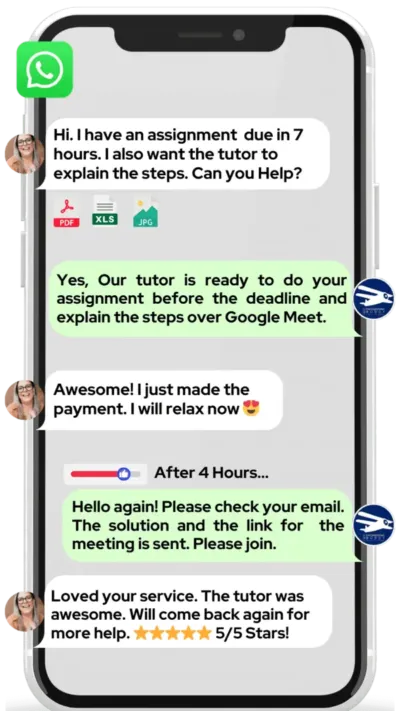
Goals: Tutor briefed on your specific course, exam board or institution, current grade, and deadline. Unlike platforms where you fill out a form and wait, MEB responds in under a minute, 24/7. Tutor match takes under an hour. The $1 trial means you test before you commit. Everything runs over WhatsApp — no logins, no intake forms.
Study Plans (Pick One That Matches Your Goal)
A catch-up plan (1–3 weeks) targets students who are behind on thermodynamics or kinetics with an exam approaching — sessions are daily or every two days, focused on the highest-yield problem types. An exam prep plan (4–8 weeks) builds systematically through all three syllabus areas — thermodynamics, kinetics, and spectroscopy — with past-paper-style questions in the final two weeks. Weekly support runs alongside the semester, timed to coursework deadlines and problem set submissions. The tutor maps the exact sequence after the first diagnostic session, not before.
Pricing Guide
Biophysical Chemistry tutoring starts at $20/hr for undergraduate-level sessions. Graduate-level work — research methods, qualifying exam preparation, thesis-chapter problem sets — typically runs $50–$100/hr depending on topic complexity and tutor availability. Rate factors include level, depth of topic, timeline, and how quickly you need to be matched.
For students targeting PhD programmes at research-intensive universities or roles in structural biology, computational biophysics, or biopharma, tutors with active research backgrounds are available at higher rates — share your specific goal and MEB will match the tier to what you’re working toward.
Availability tightens during finals and qualifying exam periods. Book ahead if you’re within six weeks of a critical deadline. Start with the $1 trial — 30 minutes, no registration, no commitment. WhatsApp MEB for a quick quote.
FAQ
Is Biophysical Chemistry hard?
Yes — it sits at the intersection of physical chemistry mathematics and molecular biology. Most difficulty comes from applying thermodynamic formalism to biological systems, not from either field alone. Students with solid physical chemistry foundations adapt faster, but targeted tutoring closes gaps quickly regardless of starting point.
How many sessions do I need?
Students with specific exam gaps typically need 8–15 sessions. Those building from a weak foundation in thermodynamics or kinetics often need 20 or more. The first diagnostic session gives the tutor enough information to map a realistic timeline for your specific course and deadline.
Can you help with homework and assignments?
MEB tutoring is guided learning — you understand the work, then submit it yourself. The tutor explains the method, works through a comparable example, and checks your reasoning. See our Academic Integrity policy and Why MEB page for full details on what we help with and what we don’t.
Will the tutor match my exact syllabus or exam board?
Yes. When you contact MEB, share your institution, course code, and course text. Tutors are matched to your specific syllabus — not assigned generically. Biophysical Chemistry varies significantly between institutions, and the tutor is briefed on your version before the first session.
What happens in the first session?
The tutor runs a short diagnostic using problems from your actual course or past papers. This identifies exactly which concepts need the most work. The session plan for the following weeks is built from that diagnostic, not from a generic template.
Is online tutoring as effective as in-person?
For a quantitative subject like Biophysical Chemistry, yes — sometimes more so. The digital pen-pad shows every derivation step clearly, screen sharing lets the tutor annotate your problem set directly, and recorded sessions (where agreed) mean you can replay worked examples before an exam.
Can I get Biophysical Chemistry help late at night or on weekends?
Yes. MEB tutors operate across multiple time zones. Students in the US, UK, Gulf, Australia, and Canada regularly book late-evening or weekend sessions. Contact via WhatsApp and MEB will confirm available slots within minutes, any day of the week.
What if I don’t like my assigned tutor?
Request a different tutor via WhatsApp. MEB will reassign within hours. The $1 trial exists specifically so you can evaluate the match before committing to a block of sessions — no pressure, no contracts.
Do I need a strong maths background before starting Biophysical Chemistry tutoring?
Differential equations, logarithms, and basic calculus are used regularly. If your maths is weak, the tutor will flag this in the diagnostic and can address it alongside the Biophysical Chemistry content. Many students find the maths makes more sense when applied to a biological problem they care about.
How does Biophysical Chemistry differ from Biochemistry, and does that affect how it’s taught?
Biochemistry describes what happens in biological systems. Biophysical Chemistry explains why, using physical laws and quantitative models. The tutoring is correspondingly more mathematical — expect derivations, equations, and data analysis rather than pathway memorisation. Tutors are matched for this specific distinction.
What spectroscopic techniques are most commonly tested, and how should I prepare for them?
UV-Vis, fluorescence, CD, and NMR are the most frequently examined in coursework and written exams. Problems typically ask you to extract structural or thermodynamic information from spectral data. Tutors work through real datasets and practise the interpretation step — the part most textbooks skip over.
How do I get started?
Start with the $1 trial — 30 minutes of live tutoring or one problem explained in full. WhatsApp MEB, get matched with a Biophysical Chemistry tutor within the hour, and begin your trial session. No registration required.
Trust & Quality at My Engineering Buddy
Every MEB tutor goes through subject-specific screening before taking any session. For Biophysical Chemistry, that means demonstrated graduate-level knowledge of thermodynamics applied to biomolecular systems, spectroscopic methods, and kinetics — not general chemistry competence. Tutors complete a live demo evaluation, and ongoing session feedback is reviewed regularly. Rated 4.8/5 across 40,000+ verified reviews on Google.
MEB tutoring is guided learning — you understand the work, then submit it yourself. For full details on what we help with and what we don’t, read our Academic Integrity policy and Why MEB.
MEB has served 52,000+ students across the US, UK, Canada, Australia, the Gulf, and Europe since 2008, covering 2,800+ subjects. Chemistry is one of MEB’s largest subject areas — from physical chemistry tutoring and quantum chemistry help to advanced graduate-level Biophysical Chemistry. Tutor methodology is detailed at our tutoring methodology page.
MEB has operated since 2008. 18 years of subject-specific tutor vetting, diagnostic-first sessions, and a $1 trial that removes the risk from the first booking entirely.
Source: My Engineering Buddy, 2008–2025.
Try your first session for $1 — 30 minutes of live 1:1 tutoring or one homework question explained in full. No registration. No commitment. WhatsApp MEB now and get matched within the hour.
Explore Related Subjects
Students studying Biophysical Chemistry often also need support in:
- Thermochemistry
- Chemical Kinetics
- NMR Spectroscopy
- Computational Chemistry
- Analytical Chemistry
- Chemical Equilibrium
- Medicinal Chemistry
Next Steps
When you contact MEB, have the following ready:
- Your institution and course syllabus or course outline
- A recent problem set or homework question you struggled with
- Your exam date or coursework submission deadline
MEB matches you with a verified Biophysical Chemistry tutor — usually within the hour. The first session opens with a diagnostic so every minute is used on what actually needs work. Share your time zone and availability and MEB handles the rest.
Visit www.myengineeringbuddy.com for more on how MEB works.
WhatsApp to get started or email [email protected].
52,000+ Happy Students From Various Universities



How Much For Private 1:1 Tutoring & Hw Help?
Private 1:1 Tutoring and HW help Cost $20 – 35 per hour* on average.
Reviewed by Subject Expert
This page has been carefully reviewed and validated by our subject expert to ensure accuracy and relevance.