




~1 min
Average Reply Time
~1 hour
To Be Matched With A Tutor
1 Trial
75% Find Their Tutor On The 1st Trial
$1
Your First 30 Minutes
Hire The Best Physical Chemistry Tutor
Top Tutors, Top Grades. Without The Stress!
Related Subjects
Thermodynamics at 11 pm, a problem set due at 8 am, and three pages of working that give the wrong answer every time. That’s the moment most Physical Chemistry students find MEB.
Physical Chemistry Tutor Online
Physical Chemistry applies the principles of physics — thermodynamics, quantum mechanics, and statistical mechanics — to chemical systems, equipping students to model molecular behaviour, reaction rates, and energy changes with mathematical precision.
MEB offers 1:1 online tutoring and homework help in 2,800+ advanced subjects, including Physical Chemistry at every level from A Level and AP through to graduate coursework. If you’ve searched for a Physical Chemistry tutor near me and found nothing that fits your schedule or syllabus, MEB works across every time zone — US, UK, Canada, Australia, and the Gulf. Our Chemistry tutoring covers the full discipline, and Physical Chemistry is one of our most requested specialist tracks. A verified tutor, matched to your exact course, can usually be ready within the hour.
- 1:1 online sessions tailored to your specific course or exam board
- Expert-verified tutors with degrees and research experience in Physical Chemistry
- Flexible scheduling across US, UK, Canada, Australia, and Gulf time zones
- Structured session plan built after a diagnostic in your first session
- Ethical homework and assignment guidance — you understand the work, then submit it yourself
52,000+ students across the US, UK, Canada, Australia, and the Gulf have used MEB since 2008 — including students in Chemistry subjects like Physical Chemistry, quantum chemistry, and thermochemistry.
Source: My Engineering Buddy, 2008–2025.
How Much Does a Physical Chemistry Tutor Cost?
Rates run from $20 to $40 per hour for most undergraduate and A Level Physical Chemistry sessions. Graduate and highly specialist topics go up to $100/hr. The $1 trial gives you 30 minutes of live 1:1 tutoring — or a full solution and explanation of one homework question — before you commit to anything.
| Level / Need | Typical Rate | What’s Included |
|---|---|---|
| A Level / AP / Early Undergrad | $20–$35/hr | 1:1 sessions, homework guidance |
| Upper Undergrad / MSc | $35–$70/hr | Expert tutor, specialist depth |
| $1 Trial | $1 flat | 30 min live session or 1 homework question |
Tutor availability tightens sharply in the four weeks before AP exam season and university finals. Book early if your deadline is fixed.
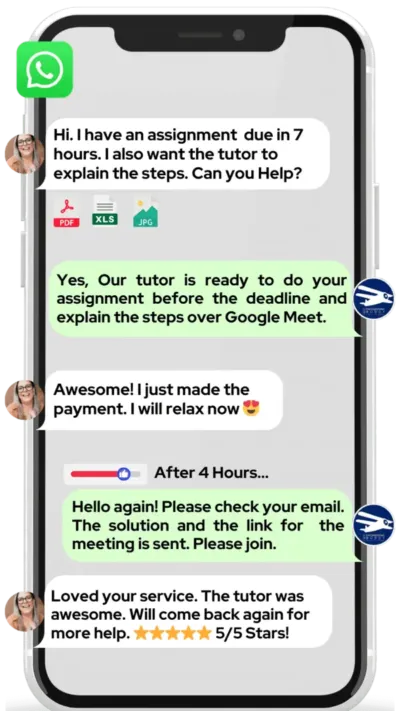
WhatsApp MEB for a quick quote — average response time under 1 minute.
Who This Physical Chemistry Tutoring Is For
Physical Chemistry sits at the intersection of rigorous mathematics and chemical theory. Students hit the wall fast — often not because they lack ability, but because the jump from descriptive chemistry to calculus-based thermodynamics and quantum mechanics is steeper than most courses warn them about.
- A Level and IB students tackling thermodynamics, kinetics, and equilibrium for the first time
- AP Chemistry students who have the content but can’t yet convert it into free-response marks
- First and second year undergraduates at universities like MIT, Imperial College London, University of Toronto, ETH Zürich, University of Melbourne, and Caltech who need to pass Physical Chemistry to progress
- MSc and PhD students revisiting statistical mechanics or quantum chemistry for research prerequisites
- Students retaking after a failed first attempt — a failed Physical Chemistry module is recoverable, but the path back needs structure
- Parents watching a child’s confidence drop as problem sets get harder and grades slip
Sessions work equally well for students who want to close specific gaps and students who want to build from scratch. The $1 trial is the right starting point either way.
At MEB, we’ve found that Physical Chemistry struggles almost always come down to one of three things: weak calculus foundations, skipping the derivations and only memorising formulas, or treating thermodynamics and quantum mechanics as separate subjects when they’re not. One session spent identifying which of those three it is changes how every session after it runs.
1:1 Tutoring vs Self-Study vs AI vs YouTube vs Online Courses
Self-study works if your foundations are already solid — but most Physical Chemistry gaps only surface mid-problem, which self-study doesn’t catch. AI tools explain concepts quickly but can’t watch you derive the Gibbs equation and tell you where your reasoning broke. YouTube is fine for an overview of the Boltzmann distribution; it stops being useful the moment you’re stuck on your own problem set. Online courses give structure but run at a fixed pace regardless of where you are. With a 1:1 Physical Chemistry tutor at MEB, the session adjusts to your actual working — live, on your exact syllabus, with corrections in the moment rather than after the test.
Outcomes: What You’ll Be Able To Do in Physical Chemistry
After a structured run of sessions, you’ll be able to solve multi-step thermodynamics problems — including Hess’s Law and Gibbs free energy calculations — without needing to look up the approach each time. You’ll be able to apply rate law derivations and the Arrhenius equation to kinetics problems under exam conditions. You’ll be able to explain and use quantum mechanical models — particle in a box, the Schrödinger equation at the level your course requires — rather than simply recognising them. You’ll be able to write clearly about molecular spectroscopy, including how IR and NMR data connect to structure. And you’ll be able to work through statistical mechanics and partition functions with the kind of confidence that only comes from having got them wrong, understood why, and then got them right.
Supporting a student through Physical Chemistry? MEB works directly with parents to set up sessions, track progress, and keep coursework on schedule. WhatsApp MEB — average response time is under a minute, 24/7.
Based on feedback from 40,000+ sessions collected by MEB from 2022 to 2025, 58% of students improved by one full grade after approximately 20 hours of 1:1 tutoring in subjects like Physical Chemistry. A further 23% achieved at least a half-grade improvement.
Source: MEB session feedback data, 2022–2025.
What We Cover in Physical Chemistry (Syllabus / Topics)

Thermodynamics and Chemical Equilibrium
- First, second, and third laws of thermodynamics
- Enthalpy, entropy, and Gibbs free energy
- Hess’s Law and Born–Haber cycles
- Chemical potential and phase equilibria
- Colligative properties and solution thermodynamics
- Le Chatelier’s principle and equilibrium constants (Kp, Kc)
Core texts: Atkins’ Physical Chemistry (Atkins & de Paula), Levine’s Physical Chemistry, and Engel & Reid’s Physical Chemistry.
Chemical Kinetics and Reaction Dynamics
- Rate laws — zero, first, second order; integrated rate equations
- Arrhenius equation and activation energy
- Reaction mechanisms and steady-state approximation
- Catalysis — homogeneous, heterogeneous, enzyme kinetics
- Collision theory and transition state theory
- Photochemical reactions and quantum yield
Core texts: Atkins’ Physical Chemistry, Silbey, Alberty & Bawendi’s Physical Chemistry, and Steinfeld, Francisco & Hase’s Chemical Kinetics and Dynamics.
Quantum Chemistry and Molecular Structure
- Wave-particle duality, the Schrödinger equation, and operators
- Particle in a box, harmonic oscillator, rigid rotor
- Atomic orbitals, electron spin, and the Pauli exclusion principle
- Molecular orbital theory and LCAO
- Vibrational and rotational spectroscopy — IR and Raman
- NMR principles and NMR spectroscopy at the physical chemistry level
- Statistical thermodynamics and partition functions
Core texts: Atkins’ Physical Chemistry, McQuarrie & Simon’s Physical Chemistry: A Molecular Approach, and Griffiths’ Introduction to Quantum Mechanics (for deeper quantum treatment).
Electrochemistry and Surface Phenomena
- Electrochemical cells, electrode potentials, and the Nernst equation
- Ionic conductivity, Debye–Hückel theory
- Corrosion and electrolysis
- Surface chemistry — adsorption isotherms, Langmuir and BET models
- Colloids and interfacial phenomena
Core texts: Atkins’ Physical Chemistry, Bard & Faulkner’s Electrochemical Methods, and Adamson & Gast’s Physical Chemistry of Surfaces.
Try your first session for $1 — 30 minutes of live 1:1 tutoring or one homework question explained in full. No registration. No commitment. WhatsApp MEB now and get matched within the hour.
What a Typical Physical Chemistry Session Looks Like
The tutor opens by checking where the previous topic — say, the derivation of the Gibbs–Helmholtz equation — actually landed. Not “did you understand it?” but “write it out for me.” From there, the session moves to the current problem area. If it’s reaction kinetics, the tutor works through an integrated rate law problem on the shared screen using a digital pen-pad, narrating every step. Then the student attempts the next problem while the tutor watches — not prompting unless the reasoning is genuinely stuck, not just slow. Errors get corrected immediately with an explanation of why marks would be lost, not just what the right answer is. The session closes with a specific practice task — three kinetics problems of increasing difficulty — and a note of what comes next.
Physical Chemistry is frequently cited by undergraduates as the hardest compulsory module in a chemistry or biochemistry degree — not because the ideas are impossible, but because the mathematical formalism arrives faster than most courses prepare students for.
Source: arXiv – Physics and chemistry education preprints, arXiv.org.
How MEB Tutors Help You with Physical Chemistry (The Learning Loop)
Diagnose: In the first session, the tutor asks you to attempt a problem unsupported — usually from thermodynamics or kinetics, the two areas where gaps compound fastest. The goal isn’t to catch you out; it’s to find exactly where the reasoning breaks down so the remaining sessions target the real problem, not the symptoms.
Explain: The tutor works through the concept live, using a digital pen-pad on Google Meet — showing the derivation, not just the result. For something like the partition function or the Debye–Hückel equation, seeing the mathematics built line by line changes how it sticks.
Practice: You attempt the next problem with the tutor present. Not watching quietly — actively monitoring your approach. Physical Chemistry is one of those subjects where a wrong sign or a skipped step early in a derivation costs all the marks, and the tutor catches that in real time.
Feedback: Every error gets a specific correction with a reason. “You dropped the negative sign here because you treated ΔG as positive when the reaction is spontaneous — that’s a mark-scheme flag for most exam boards.” That level of specificity is what makes the difference between understanding and repeating the mistake.
Plan: At the end of each session, the tutor sets the next topic and a concrete task. Progress check-ins happen every three to four sessions. If a topic is taking longer than expected, the plan shifts — it’s not a fixed schedule, it’s a working map.
Sessions run over Google Meet. The tutor uses a digital pen-pad or iPad with Apple Pencil. Before your first session, have your exam board or university course outline ready, plus any recent problem set or exam attempt you struggled with. The first session covers the diagnostic and the first real topic — you’ll leave with a clear plan and something that already makes more sense than it did an hour before. Start with the $1 trial — 30 minutes of live tutoring that also serves as your first diagnostic.
Tutor Match Criteria (How We Pick Your Tutor)
Every Physical Chemistry tutor on MEB is matched on four criteria, not just availability.
Subject depth: Degree-level qualification in chemistry, chemical physics, or a directly adjacent field. For graduate-level Physical Chemistry, tutors with postgraduate research backgrounds in thermodynamics, spectroscopy, or quantum chemistry are prioritised.
Tools: All tutors use Google Meet with a digital pen-pad or iPad and Apple Pencil. Handwritten derivations on a shared screen are non-negotiable for a subject this mathematics-heavy.
Time zone: Matched to your region — US, UK, Gulf, Canada, or Australia — so sessions run at a time that doesn’t cost you sleep.
Goals: Whether the aim is exam score improvement, understanding a specific module, homework completion, or research-level depth, the tutor is chosen to match that objective specifically.
Unlike platforms where you fill out a form and wait, MEB responds in under a minute, 24/7. Tutor match takes under an hour. The $1 trial means you test before you commit. Everything runs over WhatsApp — no logins, no intake forms.
Study Plans (Pick One That Matches Your Goal)
Catch-up (1–3 weeks): for students with specific gaps to close before an exam or assessed submission — the tutor focuses entirely on the highest-yield topics for your paper. Exam prep (4–8 weeks): structured revision working through each topic systematically, with past-paper practice built in from week two. Weekly support: ongoing sessions aligned to your lecture schedule, so problem sets and lab reports don’t pile up. After the first diagnostic, the tutor builds the specific sequence — these are starting frameworks, not fixed tracks.
Pricing Guide
Physical Chemistry tutoring at MEB starts at $20/hr for A Level and early undergraduate work. Upper undergraduate and MSc-level sessions run $35–$70/hr. For graduate students targeting highly specialist topics — statistical thermodynamics, advanced quantum chemistry, or computational methods — tutors with professional research backgrounds are available at rates up to $100/hr. Share your specific level and MEB will match the tier to your goal.
Rate factors: topic complexity, tutor seniority, your timeline, and time-zone availability. Availability tightens in the six weeks before AP exam season, UK A Level season, and university semester finals.
Start with the $1 trial — 30 minutes, no registration, no commitment. WhatsApp MEB for a quick quote.
Students consistently tell us that Physical Chemistry felt impossible until someone explained the mathematics behind the chemistry — not just the formula, but where it came from. That’s the difference between memorising the van’t Hoff equation and actually being able to use it when the question changes format.
FAQ
Is Physical Chemistry hard?
It’s one of the most mathematically demanding chemistry subjects. The concepts aren’t abstract — they describe real molecular behaviour — but the calculus and quantum formalism arrive fast. With the right tutor, most students find it clicks once the mathematical foundations are addressed directly.
How many sessions are needed?
Most students targeting a grade improvement work through 10–20 hours over 4–8 weeks. Students with a specific exam in three weeks and targeted gaps can make meaningful progress in 5–8 sessions. The first diagnostic session shapes the plan.
Can you help with homework and assignments?
MEB tutoring is guided learning — you understand the work, then submit it yourself. Tutors explain the method, work through similar problems, and check your reasoning. See our Academic Integrity policy and Why MEB page for full details on what we help with and what we don’t.
Will the tutor match my exact syllabus or exam board?
Yes. MEB tutors are matched to your specific course — AQA, OCR, Edexcel, IB, AP Chemistry, or your university’s Physical Chemistry module. Share your syllabus or course outline when you message and the match reflects that.
What happens in the first session?
The tutor runs a short diagnostic — usually a problem from thermodynamics or kinetics — to locate exactly where your reasoning breaks down. From there, the session covers the first priority topic. You leave with a clear plan and a concrete task for the next session.
Is online tutoring as effective as in-person for Physical Chemistry?
For a subject this mathematical, yes — the digital pen-pad on Google Meet replicates the whiteboard experience closely. Students regularly cover derivations, worked problems, and equation manipulation in real time. Most MEB students prefer the flexibility of online once they’ve tried it.
Can I get Physical Chemistry help late at night?
MEB operates 24/7 across time zones. If you’re in the US and need help at midnight before a morning problem set deadline, tutors in compatible time zones are available. WhatsApp MEB with your timing and a match is arranged fast.
What if I don’t get on with my assigned tutor?
Request a change — no explanation needed. MEB rematch you with another verified Physical Chemistry tutor, usually within an hour. The $1 trial exists partly for this reason: you test the match before committing to a longer block of sessions.
Do you offer group Physical Chemistry sessions?
MEB specialises in 1:1 tutoring. Group sessions are not offered. The individual format is deliberate — Physical Chemistry gaps are rarely identical across students, and the session needs to adapt to the specific person’s working in real time.
What’s the difference between Physical Chemistry and General Chemistry tutoring at MEB?
Physical Chemistry tutoring goes deeper into thermodynamics, quantum mechanics, spectroscopy, and statistical mechanics — areas that require calculus and physics alongside chemistry. If you’re in a course called Physical Chemistry specifically, book that track. If you’re unsure, WhatsApp MEB and describe your course content.
Does MEB cover computational physical chemistry tools like Gaussian or MATLAB?
Yes. Tutors who work with graduate students can support computational methods — Gaussian for quantum chemistry calculations, MATLAB for data analysis in spectroscopy, and Python-based tools for statistical thermodynamics. Mention the software when you get in touch. See our computational chemistry tutoring page for more on that track.
How do I get started?
Start with the $1 trial — 30 minutes of live tutoring or one question explained in full. Three steps: WhatsApp MEB with your subject and level, get matched to a verified Physical Chemistry tutor, then start your trial session. No registration required.
Trust & Quality at My Engineering Buddy
Every MEB tutor goes through a subject-specific screening process: degree verification, a live demo session evaluated by senior staff, and ongoing review based on student feedback. Tutors covering Physical Chemistry are required to demonstrate working knowledge of thermodynamics, quantum chemistry, and kinetics — not just a chemistry degree on paper. MEB has been rated 4.8/5 across 40,000+ verified reviews on Google. The platform has served 52,000+ students since 2008 across the US, UK, Canada, Australia, Gulf, and Europe. For analytical chemistry tutoring and inorganic chemistry tutoring alongside Physical Chemistry, the same vetting standards apply.
MEB tutoring is guided learning — you understand the work, then submit it yourself. For full details on what we help with and what we don’t, read our Academic Integrity policy and Why MEB.
MEB covers 2,800+ subjects, with Chemistry as one of its strongest categories. Physical Chemistry sits alongside chemical kinetics tutoring and chemical equilibrium help as part of a complete Chemistry offering. Learn more about our approach at MEB’s tutoring methodology.
A common pattern our tutors observe is students arriving with the formula sheet memorised but no sense of where each equation comes from. In Physical Chemistry, that breaks down the moment an exam question changes the context. The sessions that work fastest are the ones that go back to the derivation first.
Explore Related Subjects
Students studying Physical Chemistry often also need support in:
- Atomic Structure
- Chemical Bonding
- Quantum Chemistry
- Biophysical Chemistry
- Photochemistry
- Solid-State Chemistry
- Stoichiometry
Next Steps
When you contact MEB, have the following ready:
- Your exam board, university module code, or course outline
- Your hardest topic right now — thermodynamics, quantum mechanics, kinetics, or something else
- Your exam date or deadline and your current level
Before your first session, also have ready: a recent past paper attempt or problem set you struggled with, and your time zone and weekly availability. The tutor handles the rest — diagnostic first, then a session plan built around your actual situation.
MEB matches you with a verified Physical Chemistry tutor usually within 24 hours. The first session starts with a diagnostic so every minute of your time is used well. Visit www.myengineeringbuddy.com for more on how MEB works.
WhatsApp to get started or email [email protected].
52,000+ Happy Students From Various Universities






Reviewed by Subject Expert
This page has been carefully reviewed and validated by our subject expert to ensure accuracy and relevance.
