

Contact MEB Today To Get The Best
Bipolar Junction Transistors (BJT) Tutoring Online
Email: [email protected]



~1 min
Average Reply Time
~1 hour
To Be Matched With A Tutor
30 Min Trial
75% Find Their Tutor On The 1st Trial
$20-35+/hr
Premium Yet Affordable Learning
Most students who struggle with BJT circuits aren’t missing effort — they’re missing someone who can show them exactly where their load line analysis breaks down.
BJT Tutor Online
A Bipolar Junction Transistors (BJT) course covers NPN and PNP transistor operation, biasing configurations, DC and AC analysis, and amplifier design. It equips students to analyse switching and amplification circuits used in analogue and digital electronics.
If you’ve searched for a BJT tutor near me, you’re most likely an electrical engineering or electronics student hitting a wall on operating point analysis, small-signal models, or the difference between active, saturation, and cutoff regions. MEB connects you with an online BJT tutor — someone who has taught this circuit theory dozens of times and knows exactly which steps students get wrong. Our Physics tutoring network covers everything from high school introductions through to advanced semiconductor device courses at graduate level.
- 1:1 online sessions tailored to your course syllabus and exam board
- Expert-verified tutors with hands-on electronics and semiconductor knowledge
- Flexible time zones — US, UK, Canada, Australia, Gulf
- Structured learning plan built after a diagnostic session
- Ethical academic guidance — you understand before you submit
52,000+ students across the US, UK, Canada, Australia, and the Gulf have used MEB since 2008 — including students in Physics subjects like BJT, semiconductor physics, and solid-state physics.
Source: My Engineering Buddy, 2008–2025.
How Much Does a BJT Tutor Cost?
Most BJT tutoring sessions run $20–$40/hr depending on course level — undergraduate circuits courses sit toward the lower end; graduate-level device physics or VLSI design work can reach $100/hr. Start with the $1 trial and see the tutor’s approach before committing to anything longer.
| Level / Need | Typical Rate | What’s Included |
|---|---|---|
| Standard (most undergrad levels) | $20–$35/hr | 1:1 sessions, homework guidance |
| Advanced / Graduate-level | $35–$70/hr | Expert tutor, device physics depth |
| $1 Trial | $1 flat | 30 min live session or 1 homework question |
Tutor availability tightens during finals weeks and end-of-semester lab report periods. Book early if your circuits exam is within four weeks.
WhatsApp MEB for a quick quote — average response time under 1 minute.
Who This BJT Tutoring Is For
BJT is one of those topics where confusion compounds fast. Miss the logic of the Ebers-Moll model in week three, and everything that follows — biasing, amplifier configurations, frequency response — sits on a shaky foundation.
- Undergraduate EE and ECE students stuck on common-emitter, common-base, or common-collector configurations
- Students retaking after a failed first attempt at a circuits or electronics module
- Students with a conditional university offer depending on their electronics grade this semester
- Graduate students entering device physics or microelectronics needing a solid BJT foundation
- Students who passed theory but can’t get SPICE simulations or lab circuits to behave as expected
- Parents watching a child’s confidence drop alongside their electronics grades
Students at programmes such as MIT, Georgia Tech, Imperial College London, ETH Zurich, University of Toronto, University of Sydney, and TU Delft have all come to MEB for BJT support at various points in their undergraduate careers.
1:1 Tutoring vs Self-Study vs AI vs YouTube vs Online Courses
Self-study works if you’re disciplined, but BJT analysis needs someone to catch the sign errors and wrong-region assumptions you can’t see yourself. AI tools give fast formula explanations but can’t watch you draw a load line and tell you where your slope is wrong. YouTube is excellent for conceptual overviews of NPN transistor behaviour — it stops cold when you’re stuck on a specific biasing problem with your course’s exact numbers. Online courses move at a fixed pace regardless of whether you’ve actually internalised the hybrid-pi model. With MEB, a tutor works through your actual problem set, corrects the reasoning live, and adapts the next example to close the gap you just revealed.
Outcomes: What You’ll Be Able To Do in BJT
After focused 1:1 BJT tutoring, you’ll be able to analyse DC biasing networks and determine the Q-point for any four-resistor bias circuit. You’ll apply the small-signal hybrid-pi and T-models to calculate voltage gain, input impedance, and output impedance for common-emitter and common-collector stages. You’ll model BJT switching behaviour to explain saturation and cutoff conditions in digital logic applications. You’ll present a frequency response analysis using the Miller approximation, and solve problems involving current mirrors and differential pair circuits at the level required by most undergraduate EE examinations.
Based on feedback from 40,000+ sessions collected by MEB from 2022 to 2025, 58% of students improved by one full grade after approximately 20 hours of 1:1 tutoring in subjects like Bipolar Junction Transistors (BJT). A further 23% achieved at least a half-grade improvement.
Source: MEB session feedback data, 2022–2025.
What We Cover in BJT (Syllabus / Topics)

Track 1: BJT Fundamentals and DC Analysis
- NPN and PNP transistor structure and carrier injection mechanisms
- Operating regions: active, saturation, cutoff, and reverse-active
- Ebers-Moll model and current equations (IC, IB, IE)
- Fixed-bias, emitter-bias, and voltage-divider bias configurations
- Q-point determination and load line analysis
- Thermal stability and bias stability factor S
- DC equivalent circuit construction and systematic KVL/KCL analysis
Core texts: Sedra & Smith Microelectronic Circuits, Boylestad & Nashelsky Electronic Devices and Circuit Theory, Neamen Semiconductor Device Fundamentals.
Track 2: Small-Signal Models and Amplifier Design
- Hybrid-pi model parameters: gm, rπ, ro
- T-model and its equivalence to the hybrid-pi model
- Common-emitter amplifier: gain, input/output impedance, phase inversion
- Common-base amplifier: high-frequency advantage, low input impedance
- Common-collector (emitter-follower): unity gain, high input impedance, buffering
- Multi-stage amplifier analysis and cascading
- Current mirror and differential pair circuits
Core texts: Razavi Design of Analog CMOS Integrated Circuits, Gray, Hurst, Lewis & Meyer Analysis and Design of Analog Integrated Circuits.
Track 3: Frequency Response, Switching, and Advanced Topics
- High-frequency BJT model with Cπ and Cμ
- Miller approximation and dominant-pole analysis
- Unity-gain bandwidth (fT) and its significance
- BJT as a switch: switching times, storage charge, and overdrive factor
- Transistor-transistor logic (TTL) circuit analysis
- Noise in BJT amplifiers: shot noise and thermal noise contributions
Core texts: Sedra & Smith Microelectronic Circuits, Horowitz & Hill The Art of Electronics, Tsividis Operation and Modeling of the MOS Transistor (for comparative context).
At MEB, we’ve found that most BJT struggles trace back to one thing: students memorise the formula for voltage gain but never draw the small-signal equivalent circuit from scratch. Every session where we make the student construct the model before touching numbers sees a faster breakthrough than sessions that skip straight to calculation.
What a Typical BJT Session Looks Like
The tutor opens by checking the previous topic — usually the Q-point calculation from the last session, or the emitter-follower analysis left as practice. Then the session moves into the current problem: say, deriving the voltage gain of a common-emitter stage with an emitter resistance. The tutor draws the small-signal hybrid-pi model on the digital pen-pad while the student watches, then asks the student to redraw it and write the node equations unprompted. Errors — typically a missing ro or a wrong sign on Vbe — get corrected with a short explanation of why the error changes the answer, not just a red mark. The session closes with one unworked biasing problem set as practice and a note that next time you’ll tackle Miller capacitance.
How MEB Tutors Help You with BJT (The Learning Loop)
Diagnose: In the first session, the tutor asks you to attempt a standard four-resistor bias problem cold. That attempt tells them whether you’re confused about Kirchhoff’s laws in transistor circuits, unsure when to use the Ebers-Moll model, or simply missing the β vs α relationship. The diagnosis shapes every subsequent session.
Explain: The tutor works live examples on a digital pen-pad — drawing the DC equivalent, labelling currents, applying KVL step by step. Nothing is assumed. Nothing is skipped. The hybrid-pi model gets built in front of you, not handed to you as a completed diagram.
Practice: You attempt the next problem with the tutor present. This is the part most students skip when they’re working alone, and it’s where the real learning happens. You get to fail safely and fix it in real time.
Feedback: The tutor tracks exactly which step went wrong and explains the cost of that error — whether it leads to a wrong Q-point, a sign error in gain, or an incorrect frequency response. Marks aren’t lost randomly; they’re lost at specific steps, and those steps get drilled.
Plan: At the end of each session, the tutor sets the next practice topic and flags what’s coming — usually moving from single-stage to multi-stage analysis, or from DC bias to small-signal AC. You know what you’re doing before the next session starts.
Sessions run on Google Meet. The tutor uses a digital pen-pad or iPad with Apple Pencil for all circuit drawings. Before your first session, share your course syllabus or textbook chapter, any problem set you’ve struggled with, and your exam or submission date. The first session covers the diagnostic plus the first topic your tutor decides needs the most urgent work. Start with the $1 trial — 30 minutes of live tutoring that also serves as your first diagnostic.
Students consistently tell us that the biggest shift in BJT comes not from more reading but from being asked to explain a circuit out loud to someone who will push back the moment the reasoning gets fuzzy. That moment of productive discomfort is where retention actually happens.
Tutor Match Criteria (How We Pick Your Tutor)
Not every electronics tutor is the right fit for BJT at your level. Here’s what MEB checks.
Subject depth: Tutors are matched to your specific course level — intro circuits, analogue electronics, or advanced device physics — and to your exam board or university syllabus where relevant.
Tools: Every BJT tutor uses Google Meet with a digital pen-pad or iPad and Apple Pencil. Circuit diagrams are drawn live, not pulled from a slide deck.
Time zone: Matched to your region — US, UK, Gulf, Canada, Australia — so sessions happen at hours that don’t wreck your sleep before an exam.
Goals: Whether you need to close an urgent gap before a final exam, improve your understanding of a specific amplifier topology, or get homework explained without someone doing it for you, the tutor is briefed before session one.
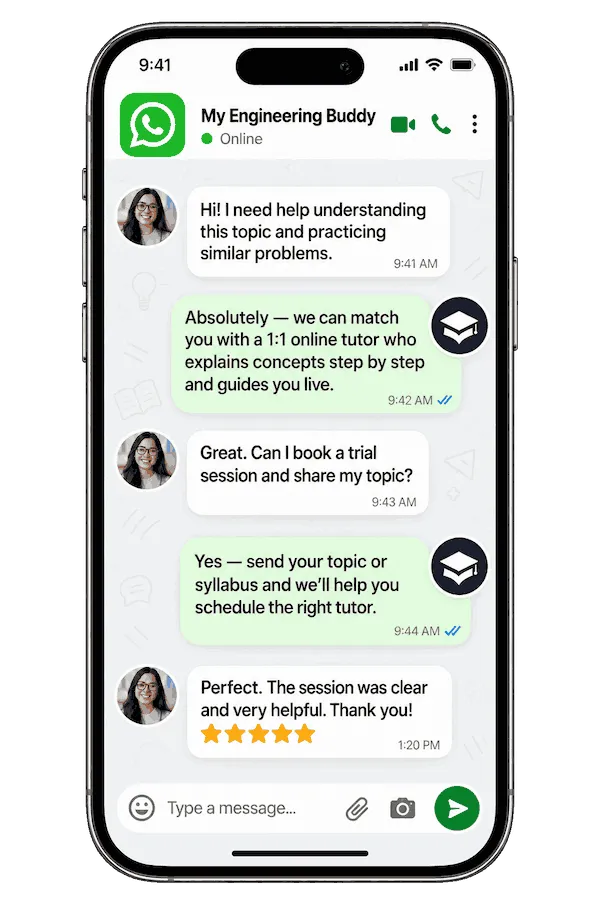
Unlike platforms where you fill out a form and wait, MEB responds in under a minute, 24/7. Tutor match takes under an hour. The $1 trial means you test before you commit. Everything runs over WhatsApp — no logins, no intake forms.
Study Plans (Pick One That Matches Your Goal)
After your diagnostic session, the tutor builds the specific sequence. But here are the three plans most BJT students run: Catch-up (1–3 weeks) — intensive focus on DC bias and small-signal models before an upcoming exam, skipping topics your tutor confirms you’ve already absorbed. Exam prep (4–8 weeks) — full syllabus coverage from fundamentals through frequency response, with past paper questions worked in the final two weeks. Weekly support — one or two sessions per week aligned to your lecture schedule, so homework and problem sets don’t pile up between classes.
Pricing Guide
BJT tutoring starts at $20/hr for standard undergraduate courses and runs to $40/hr for advanced analogue design or device physics work. Specialist tutors with research or industry backgrounds in semiconductor design are available at higher rates for students targeting roles at firms like Texas Instruments, Analog Devices, or Qualcomm, or for doctoral-level coursework. Rate factors include your course level, topic complexity, how tight your timeline is, and tutor availability at your preferred hours.
Availability gets tight during semester finals periods — particularly May/June and November/December. If your exam is within six weeks, book sooner rather than later.
For students aiming at graduate programmes or professional semiconductor roles, tutors with industry or research backgrounds in analogue IC design are available at premium rates — share your specific goal and MEB will match the tier to what you need.
Start with the $1 trial — 30 minutes, no registration, no commitment. WhatsApp MEB for a quick quote.
FAQ
Is BJT hard?
BJT is consistently rated one of the more difficult topics in introductory electronics. The DC analysis is manageable, but the small-signal models — especially when frequency effects are added — trip up students who haven’t fully internalised the DC operating point first.
How many sessions are needed?
Most students close a single-topic gap — say, common-emitter gain derivation — in two to three sessions. A full BJT syllabus from DC bias through frequency response typically takes eight to twelve hours of 1:1 work, depending on starting level.
Can you help with practice exercises?
Yes. MEB tutoring is guided learning — you understand the work, then submit it yourself. The tutor explains the method and checks your reasoning, not your answer. See our Academic Integrity policy and Why MEB page for full details on what we help with and what we don’t.
Will the tutor match my exact syllabus or exam board?
Yes. Share your course outline, textbook, or university module code when you contact MEB. The tutor is matched to your specific syllabus — not a generic electronics curriculum — before the first session.
What happens in the first session?
The tutor runs a short diagnostic — usually one or two unseen problems — to find exactly where your understanding breaks down. That diagnostic shapes the rest of the session and the plan going forward. Nothing is wasted.
Is online tutoring as effective as in-person?
For circuit analysis subjects like BJT, yes. The digital pen-pad replicates whiteboard work accurately. Students consistently report that being able to share their own attempted work on screen and get live corrections is at least as useful as sitting beside a tutor in a room.
Can I get BJT help at short notice — including late at night?
MEB operates around the clock. WhatsApp a request at any hour and you’ll typically have a response within minutes. Tutor matching for a first session usually completes within the hour, even outside standard business hours.
What if I don’t connect well with my assigned BJT tutor?
Tell MEB on WhatsApp. A replacement tutor is matched within the day, at no extra cost. The $1 trial exists precisely so you can check fit before committing to a longer block of sessions.
Do you offer group BJT sessions?
MEB focuses on 1:1 sessions. Group tutoring is not part of the standard service. If you and a study partner both need BJT help, each gets their own tutor matched to their individual gaps — which is typically more efficient than sharing a session.
What is the difference between BJT and MOSFET, and does MEB cover both?
BJTs are current-controlled devices; MOSFETs are voltage-controlled. Most analogue electronics courses cover both in sequence. MEB tutors who cover BJT also cover MOSFET analysis — you can get semiconductor physics tutoring that spans both device families in the same session plan.
How do I know which BJT configuration — common-emitter, base, or collector — my exam will focus on?
It depends on your course and exam board. Most undergraduate electronics finals weight the common-emitter configuration most heavily, followed by common-collector. Share your past papers with MEB when you get in touch and the tutor will confirm exactly which configurations to prioritise.
How do I get started?
Contact MEB on WhatsApp, share your syllabus and timeline, and you’ll be matched with a verified BJT tutor — usually within the hour. Your first session is the $1 trial: 30 minutes of live tutoring, or one homework question explained in full. Three steps: WhatsApp → matched → start trial.
Trust & Quality at My Engineering Buddy
Every MEB tutor goes through screening that includes a live demo evaluation, a subject-knowledge assessment at the level they’ll teach, and ongoing review based on student session feedback. BJT tutors hold degrees in electrical engineering, electronics, or closely related fields — many have professional experience in analogue or mixed-signal IC design. Rated 4.8/5 across 40,000+ verified reviews on Google.
MEB tutoring is guided learning — you understand the work, then submit it yourself. For full details on what we help with and what we don’t, read our Academic Integrity policy and Why MEB.
MEB has served 52,000+ students across the US, UK, Canada, Australia, the Gulf, and Europe since 2008 — across 2,800+ subjects. In Physics and electronics, that includes subjects like BJT, engineering physics, and condensed matter physics. The IEEE, through publications like IEEE Transactions on Neural Networks and Learning Systems, documents the ongoing research context for advanced electronics subjects — the same rigorous device understanding MEB tutors bring to 1:1 sessions.
Our experience across thousands of sessions shows that students who arrive with a specific problem — a biasing question they’ve attempted twice, a gain derivation that won’t resolve — make faster progress than those who arrive and say “I don’t understand BJT.” Specificity is the starting point for every effective session.
Explore Related Subjects
Students studying BJT often also need support in:
- Applied Physics
- Electricity and Magnetism
- Electromagnetism and Electrodynamics
- Quantum Mechanics
- Modern Physics
- Optical Amplifier
- Laser Physics
Next Steps
When you contact MEB, have these ready:
- Your exam board, university module code, or course textbook
- A recent problem set or homework question you’ve already attempted
- Your exam or submission deadline and your available hours per week
MEB matches you with a verified BJT tutor — usually within 24 hours, often within the hour. The first session opens with a diagnostic so every minute counts from the start.
Before your first session, have ready: your course syllabus or module outline, a recent past paper attempt or problem set you struggled with, and your exam or deadline date. The tutor handles the rest.
Visit www.myengineeringbuddy.com for more on how MEB works.
WhatsApp to get started or email [email protected].
Reviewed by Subject Expert
This page has been carefully reviewed and validated by our subject expert to ensure accuracy and relevance.




