




~1 min
Average Reply Time
~1 hour
To Be Matched With A Tutor
30 Min Trial
75% Find Their Tutor On The 1st Trial
$20-35+/hr
Premium Yet Affordable Learning
Your socket code compiles. It runs. Nothing connects — and the assignment is due in 48 hours.
Sockets Programming Tutor Online
Sockets programming is a method of inter-process communication that enables data exchange between applications over a network using TCP or UDP protocols, equipping students to build client-server systems, handle concurrent connections, and implement low-level network communication in languages such as C, Python, or Java.
If you’re searching for a Sockets Programming tutor near me, MEB connects you with expert tutors who know this subject at the OS layer — not just the API surface. Whether you’re stuck on blocking vs non-blocking I/O, struggling to get a multi-threaded server running, or debugging a race condition at 11 pm, a 1:1 Computer Science tutor from MEB will work through your exact code with you, live. Sessions run from $20/hr, and your first 30 minutes costs $1.
- 1:1 online sessions aligned to your course syllabus and programming language
- Expert-verified tutors with real systems and networking experience
- Flexible time zones — US, UK, Canada, Australia, Gulf
- Structured learning plan built after a diagnostic session
- Ethical homework and assignment guidance — you understand before you submit
52,000+ students across the US, UK, Canada, Australia, and the Gulf have used MEB since 2008 — including students in Computer Science subjects like Sockets Programming, Computer Networking, and Network Protocols.
Source: My Engineering Buddy, 2008–2025.
How Much Does a Sockets Programming Tutor Cost?
Most Sockets Programming tutoring sessions run $20–$40/hr. Graduate-level or real-time systems work can reach $100/hr depending on tutor depth and deadline urgency. Your first session is available as a $1 trial — 30 minutes live or one homework question explained in full.
| Level / Need | Typical Rate | What’s Included |
|---|---|---|
| Undergraduate (intro level) | $20–$35/hr | 1:1 sessions, code walkthrough, homework guidance |
| Advanced / Systems-level | $35–$70/hr | Expert tutor, concurrent systems, protocol design |
| Graduate / Research support | Up to $100/hr | Deep systems expertise, thesis-level debugging |
| $1 Trial | $1 flat | 30 min live session or one homework question explained |
Tutor availability tightens during end-of-semester project submission windows — book early if your deadline is within two weeks.
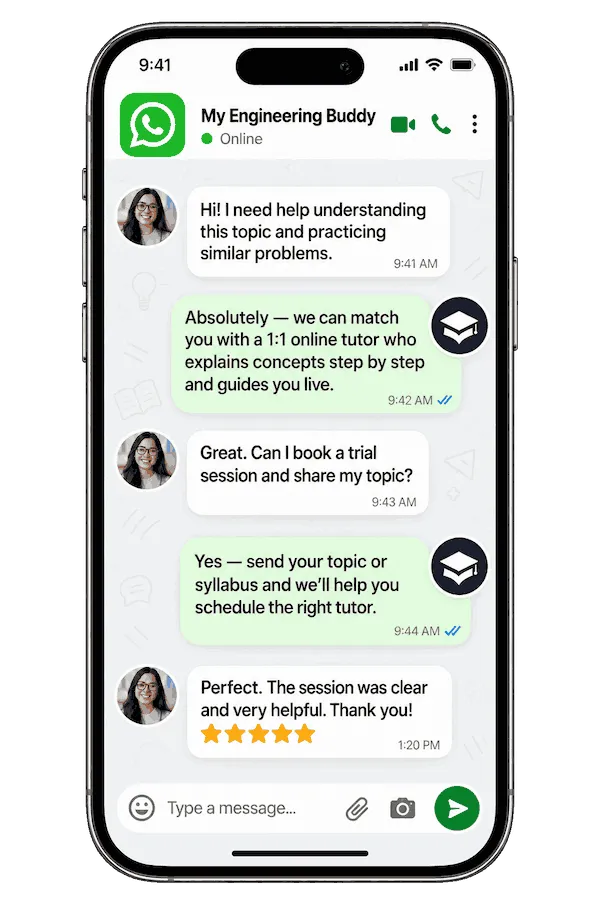
WhatsApp MEB for a quick quote — average response time under 1 minute.
Who This Sockets Programming Tutoring Is For
Sockets programming trips up students who are comfortable writing application code but haven’t had to think below the API level before. The jump from calling a library function to managing file descriptors, handling partial reads, and reasoning about TCP state machines is steep.
- Undergraduate CS and software engineering students taking a Networks or Systems Programming course
- Students whose socket server compiles but drops connections, hangs, or returns garbled data
- Students retaking after a failed first attempt at an OS or Networking module
- Graduate students building distributed systems who need to get the socket layer right before anything else works
- Students with a project submission deadline approaching and a server that still won’t accept more than one client
- Parents watching a strong student struggle with a course that suddenly feels like a different language
Students come from universities across the US, UK, Canada, and Australia — including those enrolled at institutions like MIT, Georgia Tech, University of Toronto, University of Melbourne, Imperial College London, and Carnegie Mellon. If your course uses Beej’s Guide, Stevens’ Unix Network Programming, or a departmental lab manual, your MEB tutor will know it.
1:1 Tutoring vs Self-Study vs AI vs YouTube vs Online Courses
Self-study works if you can debug your own mental model — most students can’t when the bug is in how they’re thinking about sockets. AI tools like ChatGPT give fast answers but can’t watch you misread a recv() return value live and stop you before it costs marks. YouTube is good for conceptual overviews of TCP handshakes, but it stops the moment your specific select() implementation breaks. Online courses give structure but run at a fixed pace that ignores where you actually are. With a 1:1 Concurrent Programming tutor from MEB, the session runs at your pace, through your code, correcting the exact error you’re making in real time.
Outcomes: What You’ll Be Able To Do in Sockets Programming
After working with an MEB Sockets Programming tutor, you’ll be able to write and debug both TCP and UDP client-server programs from scratch without relying on copied boilerplate. You’ll be able to explain what happens at each stage of a three-way handshake and why a TIME_WAIT state appears in your connection logs. You’ll be able to implement non-blocking I/O using select() or poll() and handle multiple simultaneous clients without spawning a thread per connection. You’ll be able to apply socket options — SO_REUSEADDR, SO_KEEPALIVE, send/receive buffer sizes — and explain the tradeoff in each case. And you’ll be able to present your network code in a lab report or viva with the confidence that comes from actually understanding what each line does.
Based on feedback from 40,000+ sessions collected by MEB from 2022 to 2025, 58% of students improved by one full grade after approximately 20 hours of 1:1 tutoring in subjects like Sockets Programming. A further 23% achieved at least a half-grade improvement.
Source: MEB session feedback data, 2022–2025.
Try your first session for $1 — 30 minutes of live 1:1 tutoring or one homework question explained in full. No registration. No commitment. WhatsApp MEB now and get matched within the hour.
What We Cover in Sockets Programming (Syllabus / Topics)

Track 1: Core Socket APIs and TCP/UDP Fundamentals
- Socket creation:
socket(),bind(),listen(),accept(),connect() - TCP three-way handshake, connection teardown, TIME_WAIT state
- Sending and receiving data:
send(),recv(), handling partial reads and writes - UDP datagram sockets:
sendto(),recvfrom(), connectionless communication - Byte ordering:
htons(),ntohs(),htonl(),ntohl() - Address structures:
sockaddr_in,sockaddr_in6, IPv4 vs IPv6 - Error handling:
errno,perror(), graceful failure in network code
Core texts for this track include W. Richard Stevens’ Unix Network Programming, Vol. 1 and Brian “Beej” Hall’s freely available Beej’s Guide to Network Programming — both are standard course references across US and UK university networking modules.
Track 2: Concurrent Servers and I/O Multiplexing
- Iterative vs concurrent server models
- Fork-based concurrency: handling multiple clients with child processes
- Thread-per-client model: pthreads, shared state, race conditions
- I/O multiplexing:
select(),poll(),epoll()(Linux) andkqueue(BSD/macOS) - Non-blocking sockets:
fcntl(),O_NONBLOCK, event-driven architecture basics - Socket options:
SO_REUSEADDR,SO_KEEPALIVE,TCP_NODELAY, buffer sizing - Shutdown vs close: half-close,
shutdown(), lingering connections
Key references: Unix Network Programming Chapters 6 and 16 (Stevens), and Michael Kerrisk’s The Linux Programming Interface for Linux-specific epoll coverage.
Track 3: Protocol Design, Security, and Debugging
- Application-layer protocol design: framing messages over a stream socket
- TLS/SSL integration over sockets: OpenSSL basics, certificate verification
- Common socket vulnerabilities: buffer overflows, improper input validation, DoS via half-open connections
- Debugging with Wireshark: reading packet captures, identifying handshake failures
- Using
netstat,ss, andlsofto inspect live socket state - Cross-platform considerations: Windows Winsock vs POSIX sockets
Recommended: Computer Networks: A Systems Approach by Peterson and Davie for protocol framing concepts, and the SSL/TLS tutoring page for students integrating secure channels into socket applications.
Platforms, Tools & Textbooks We Support
Sockets programming is taught across multiple languages and environments. MEB tutors support C/C++ on Linux and macOS (POSIX sockets), Python’s socket module, Java’s java.net package, and Windows Winsock. Common IDEs covered include VS Code, CLion, Eclipse, and terminal-based GCC/GDB workflows. Debugging tools include Wireshark, netstat, tcpdump, and strace.
- Languages: C, C++, Python, Java
- Platforms: Linux (Ubuntu, Debian), macOS, Windows (Winsock)
- Tools: Wireshark, GDB, tcpdump, netstat, ss, lsof, strace
- IDEs: VS Code, CLion, Eclipse, terminal + GCC
- References: Beej’s Guide, Stevens’ UNP, Kerrisk’s TLPI
What a Typical Sockets Programming Session Looks Like
The tutor opens by checking the previous topic — usually whatever error the student hit after the last session, such as a recv() returning zero unexpectedly or a server that stops accepting after the first client disconnects. From there, the student shares their screen and the tutor reads through the code live, asking questions rather than just correcting. They work through specific problems: fixing a broken concurrent server, adding select()-based multiplexing to replace a blocking loop, or tracing a Wireshark capture to find where a connection is being reset. The tutor uses a digital pen-pad to annotate the TCP state diagram or draw the client-server message flow. By the end, the student has either fixed the bug or built the component from scratch and explained it back. A concrete task is set — usually one small feature to implement before the next session — and the next topic is noted.
How MEB Tutors Help You with Sockets Programming (The Learning Loop)
Diagnose: In the first session, the tutor asks you to walk through a piece of your own code or attempt a small problem live. This reveals immediately whether you’re confused about the API, about TCP semantics, about concurrency, or about all three — and the session plan adjusts accordingly.
Explain: The tutor doesn’t just tell you what’s wrong. They work through a parallel example on the digital pen-pad — drawing the socket lifecycle, annotating the system call sequence, writing a minimal working server from scratch — so you see the correct reasoning before you touch your own code again.
Practice: You attempt the task with the tutor watching. Not watching silently — watching and asking “what does accept() return if the connection was interrupted?” before you type the wrong assumption into your code.
Feedback: Every error gets explained at the level it actually occurred. If you wrote a loop that reads until recv() returns 0 but forgot that 0 means the peer closed the connection — not “no data yet” — the tutor explains exactly why that logic fails and what the correct sentinel is.
Plan: After each session, the tutor notes what clicked, what still needs reinforcement, and what comes next. For most students, the progression runs: blocking TCP → UDP → non-blocking I/O → concurrent servers → protocol design → security.
Sessions run over Google Meet. The tutor uses a digital pen-pad or iPad with Apple Pencil to draw diagrams live. Before your first session, share your course syllabus or assignment brief, a recent piece of code you’re stuck on, and your deadline. The first session doubles as a diagnostic — so every subsequent minute is used precisely. Start with the $1 trial — 30 minutes of live tutoring that also serves as your first diagnostic.
At MEB, we’ve found that most students arrive thinking their socket bug is a syntax error. In almost every case, it’s a conceptual one — a wrong mental model of what a blocking call does, or what TCP guarantees. Fix the model first. The code sorts itself out.
Tutor Match Criteria (How We Pick Your Tutor)
Not every systems programmer makes a good tutor for sockets programming. MEB matches on four specific factors.
Subject depth: The tutor must have hands-on experience with POSIX socket programming at the level your course operates — not just awareness that sockets exist. For advanced concurrency or protocol design work, MEB prioritises tutors with professional or research backgrounds in Distributed Systems or systems software.
Tools: Every MEB tutor uses Google Meet and a digital pen-pad or iPad with Apple Pencil. No whiteboards photographed on a phone. No passive screen-shares.
Time zone: Matched to your region — US, UK, Gulf, Canada, or Australia — so sessions don’t require either party to be awake at 3 am.
Goals: Whether you need to pass a module, complete a specific project, or understand concurrent server design at a deep level, the tutor is briefed on your actual goal before the first session.
Unlike platforms where you fill out a form and wait, MEB responds in under a minute, 24/7. Tutor match takes under an hour. The $1 trial means you test before you commit. Everything runs over WhatsApp — no logins, no intake forms.
Study Plans (Pick One That Matches Your Goal)
After the first diagnostic session, your tutor builds the specific sequence. Broadly: a catch-up plan (1–3 weeks) covers the critical gaps before a project deadline or exam — blocking sockets, basic client-server, and whichever advanced topic is being assessed. An exam prep plan (4–8 weeks) works through the full syllabus systematically, including protocol design and concurrent server models. Weekly ongoing support aligns to your semester schedule, tracking assignments and reinforcing each topic as it’s introduced in lectures.
Pricing Guide
Standard Sockets Programming tutoring runs $20–$40/hr. Systems-level and graduate work, tight deadlines, or specialist topics like epoll-based architecture or TLS integration over raw sockets can reach $100/hr. Rate depends on the level, the topic complexity, your timeline, and tutor availability.
For students targeting roles at companies that interview on systems design — or graduate programmes with a strong networking component — tutors with professional distributed systems or network engineering backgrounds are available at higher rates. Share your specific goal and MEB will match the tier to your ambition.
Tutor availability shrinks fast in the two weeks before end-of-semester project deadlines. Book earlier than feels necessary.
Start with the $1 trial — 30 minutes, no registration, no commitment. WhatsApp MEB for a quick quote.
Students consistently tell us that the first session is where they realise they were debugging the wrong thing entirely. The socket wasn’t the problem. The assumption about what
recv()returns on a slow network was. That’s what a diagnostic is for.
FAQ
Is Sockets Programming hard?
It’s harder than most students expect because it requires understanding both the API and the underlying TCP/UDP behaviour simultaneously. Students who struggle usually have a gap in one of those two areas. A tutor identifies which one in the first session.
How many sessions are needed?
Most students need 6–12 sessions to move from basic TCP client-server to competent concurrent socket programming. Students with a specific deadline — one assignment or project — often see the issue resolved in 2–4 targeted sessions.
Can you help with homework and assignments?
Yes. MEB tutoring is guided learning — you understand the work, then submit it yourself. The tutor explains the concept and works through similar examples with you. See our Academic Integrity policy and Why MEB page for full details on what we help with and what we don’t.
Will the tutor match my exact syllabus or exam board?
Yes. Before matching, MEB asks for your course name, university, and the specific topics or assignment brief. The tutor is selected based on that — not assigned at random from a pool of generic CS tutors.
What happens in the first session?
The tutor reviews a piece of your code or sets a small live problem to see exactly where your understanding breaks down. The session plan is then built around that — not around a generic sockets curriculum.
Is online tutoring as effective as in-person?
For sockets programming specifically, online is often better. Screen sharing lets the tutor read your actual code. The digital pen-pad lets them annotate it live. No in-person session offers both simultaneously.
Do you support Python sockets as well as C?
Yes. MEB tutors cover C (POSIX), Python’s socket module, Java’s java.net, and Windows Winsock. Tell MEB your language when you make contact and the tutor is matched accordingly.
What if I’m stuck on a race condition in a multi-threaded socket server?
That’s one of the most common advanced issues MEB tutors work through. The tutor will ask you to reproduce the condition, then walk through thread scheduling, shared state, and synchronisation primitives like mutexes or condition variables to find the exact failure point.
Can I get Sockets Programming help at midnight?
Yes. MEB operates 24/7 across all major time zones. WhatsApp response averages under a minute. Tutor availability at midnight depends on your region, but matches are typically confirmed within the hour even late at night.
What if I don’t like my assigned tutor?
Tell MEB over WhatsApp and a replacement is arranged. The $1 trial exists precisely so you can test the match before committing to a full session block. No argument, no process.
What is the difference between TCP and UDP sockets, and which does my course focus on?
TCP sockets are connection-oriented and reliable; UDP is connectionless and faster but with no delivery guarantee. Most undergraduate courses start with TCP. Share your assignment brief with MEB and the tutor confirms which protocol your course emphasises before the first session.
How do I get started?
Start with the $1 trial: 30 minutes of live tutoring or one homework question explained in full. Three steps: WhatsApp MEB, get matched with a verified tutor within the hour, then start your trial session.
Trust & Quality at My Engineering Buddy
Every MEB tutor goes through subject-specific vetting before being assigned to a student. For Sockets Programming, that means demonstrating working knowledge of POSIX socket APIs, concurrent server design, and at least one of C, Python, or Java at the systems level. Tutors submit to a live demo evaluation and are reviewed continuously through session feedback. Rated 4.8/5 across 40,000+ verified reviews on Google. MEB has been running since 2008 and has served over 52,000 students across more than 2,800 subjects.
MEB tutoring is guided learning — you understand the work, then submit it yourself. For full details on what we help with and what we don’t, read our Academic Integrity policy and Why MEB.
MEB covers Computer Science and related subjects including Operating Systems tutoring, Cybersecurity tutoring, and Systems Programming help — serving students across the US, UK, Canada, Australia, the Gulf, and Europe since 2008. The platform covers 2,800+ advanced subjects in a single 1:1 format that adapts to your course, your deadline, and your current level.
MEB tutors hold degrees in Computer Science, Electrical Engineering, and related fields. For Sockets Programming and systems subjects, several tutors bring professional experience in network software development, embedded systems, and distributed infrastructure — not just academic teaching backgrounds.
Source: My Engineering Buddy tutor profiles, 2008–2025.
Our experience across thousands of sessions shows that sockets programming students who explain their code out loud — describing what each system call does and why — fix their own bugs faster than students who just read error messages. The tutor’s job is to make you talk through it.
Explore Related Subjects
Students studying Sockets Programming often also need support in:
- IP Addressing
- Routing Protocols
- Firewalls
- Cryptography
- Memory Management and Allocation
- Parallel Computing and Processing
- Wireshark
- VPN
Next Steps
To get matched with the right Sockets Programming tutor, share:
- Your programming language, course name, and the specific topic or assignment you’re stuck on
- Your availability and time zone
- Your deadline or exam date
MEB matches you with a verified tutor — usually within the hour. The first session starts with a diagnostic so no time is wasted covering things you already know.
Before your first session, have ready: your course syllabus or assignment brief, a recent piece of code you’re stuck on or a homework question you couldn’t solve, and your deadline date. The tutor handles the rest.
Visit www.myengineeringbuddy.com for more on how MEB works.
WhatsApp to get started or email [email protected].
Reviewed by Subject Expert
This page has been carefully reviewed and validated by our subject expert to ensure accuracy and relevance.




