~1 min
Average Reply Time
~1 hour
To Be Matched With A Tutor
30 Min Trial
75% Find Their Tutor On The 1st Trial
$20-35+/hr
Premium Yet Affordable Learning
Hire The Best Avionics Tutor



Avionics is keeping students out of aerospace engineering careers — not because they lack ability, but because they can’t get a specialist on demand when a flight control system problem stops making sense at 11 pm.
Avionics Tutor Online
Avionics is the branch of electronics applied to aircraft, spacecraft, and unmanned aerial vehicles, covering flight control systems, navigation, communication, and instrumentation. It equips students to design, analyse, and troubleshoot safety-critical onboard electronic systems.
If you’re searching for an avionics tutor near me, MEB connects you with a verified specialist in under an hour — online, live, and matched to your exact course or syllabus. Our mechatronics tutoring network extends directly into avionics, covering everything from sensor fusion to flight management systems. You won’t get a general electronics tutor handed to you. You get someone who knows avionics specifically.
- 1:1 online sessions tailored to your university module, aerospace engineering programme, or certification pathway
- Expert verified tutors with hands-on avionics and embedded systems knowledge
- Flexible time zones — US, UK, Canada, Australia, Gulf
- Structured learning plan built after a diagnostic session
- Ethical homework and assignment guidance — you understand the work, then submit it yourself
52,000+ students across the US, UK, Canada, Australia, and the Gulf have used MEB since 2008 — including students in Mechatronics subjects like Avionics, Autonomous Systems, and Real-Time Systems (RTOS).
Source: My Engineering Buddy, 2008–2025.
How Much Does an Avionics Tutor Cost?
Most avionics tutoring sessions run $20–$40/hr. Graduate-level or highly specialised topics — fly-by-wire, DO-178C software certification, avionics systems integration — can reach $60–$100/hr. The $1 trial gets you 30 minutes of live tutoring or one full question solved with explanation — no registration required.
| Level / Need | Typical Rate | What’s Included |
|---|---|---|
| Standard (undergrad modules) | $20–$40/hr | 1:1 sessions, homework guidance |
| Advanced / Specialist (grad, certification) | $40–$100/hr | Expert tutor, niche depth |
| $1 Trial | $1 flat | 30 min live session or 1 homework question |
Tutor availability tightens around end-of-semester deadlines and final exam blocks. Book early if your deadline is within three weeks.
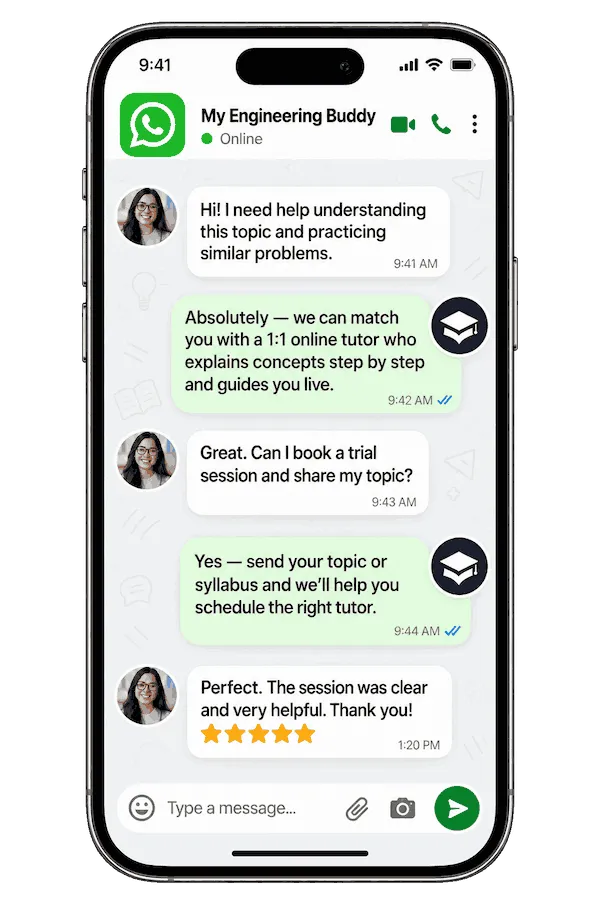
WhatsApp MEB for a quick quote — average response time under 1 minute.
Who This Avionics Tutoring Is For
This isn’t a course for people casually curious about aircraft electronics. MEB avionics tutoring is for students who need to pass, improve, or genuinely understand the material — on a real timeline.
- Undergraduate aerospace, electrical, or systems engineering students with an avionics module they’re struggling to pass
- Graduate students working on flight control, navigation systems, or sensor integration projects
- Students retaking after a failed first attempt — avionics is one of those subjects where one confused semester compounds fast
- Engineers pursuing EASA Part 66 or similar avionics certification who need technical depth, not just exam prep
- Students with a coursework or thesis submission deadline approaching and specific gaps still open
- Parents watching a child’s confidence drop alongside their engineering grades
Students come to MEB from universities including MIT, Georgia Tech, Embry-Riddle Aeronautical University, Cranfield University, TU Delft, RMIT, and the University of Toronto — as well as students progressing toward these institutions from undergraduate aviation programmes.
At MEB, we’ve found that avionics students often arrive with strong maths but a fractured mental model of how subsystems connect — inertial navigation to the FMS, the FMS to autopilot. The first session is almost always about building that picture before touching the problem sets.
1:1 Tutoring vs Self-Study vs AI vs YouTube vs Online Courses
Self-study works if your textbook and lecture notes are clear — avionics textbooks often aren’t. AI tools can explain Kalman filters in general terms but can’t diagnose why your specific filter design is diverging. YouTube handles overviews well; it stops when your simulation throws an unexpected state estimate. Online courses move at a fixed pace with no room for the one section that’s blocking everything else. With a 1:1 avionics tutor online from MEB, you get live correction on your actual work — the ARINC 429 bus protocol question from Tuesday’s lab, not a generic avionics explainer.
Outcomes: What You’ll Be Able To Do in Avionics
After consistent 1:1 avionics tutoring, you’ll be able to analyse flight control loop stability using root locus and Bode plots, solve inertial navigation equations without losing track of reference frames, explain the architecture of a modern Flight Management System under exam conditions, apply DO-254 and DO-178C requirements to hardware/software safety arguments, and present sensor fusion concepts — GPS/INS integration — with the precision an assessor or viva panel expects.
Based on feedback from 40,000+ sessions collected by MEB from 2022 to 2025, 58% of students improved by one full grade after approximately 20 hours of 1:1 tutoring in subjects like Avionics. A further 23% achieved at least a half-grade improvement.
Source: MEB session feedback data, 2022–2025.
Try your first session for $1 — 30 minutes of live 1:1 tutoring or one homework question explained in full. No registration. No commitment. WhatsApp MEB now and get matched within the hour.
What We Cover in Avionics (Syllabus / Topics)

Flight Control and Stability
- Classical control theory: PID, root locus, Bode and Nyquist methods
- State-space representation and modern control design
- Fly-by-wire architecture and redundancy management
- Autopilot modes: altitude hold, heading select, approach coupling
- Flutter, aeroelastic effects, and structural coupling considerations
- Simulation and hardware-in-the-loop (HIL) testing concepts
Key references: Flight Dynamics Principles by M.V. Cook; Automatic Control of Aircraft and Missiles by Blakelock; Modern Control Engineering by Ogata.
Navigation Systems and Sensor Fusion
- Inertial Navigation Systems (INS): accelerometers, gyroscopes, strapdown algorithms
- GPS principles, error sources, RAIM, and differential GPS
- Kalman filtering: linear, extended (EKF), and unscented (UKF) variants
- GPS/INS integration architectures: loosely coupled, tightly coupled
- VOR, ILS, DME, and ADS-B systems
- Radio altimetry and terrain awareness systems (TAWS)
Key references: Global Positioning System: Theory and Applications (AIAA); Strapdown Inertial Navigation Technology by Titterton and Weston; Aided Navigation by Farrell.
Avionics Systems Architecture and Communication
- ARINC 429, ARINC 664 (AFDX), MIL-STD-1553 data bus protocols
- Integrated Modular Avionics (IMA) and federated architectures
- Flight Management System (FMS) design and function
- DO-178C software certification levels and DO-254 hardware assurance
- Cockpit display systems: PFD, ND, EICAS/ECAM
- VHF/UHF communication, ACARS, SELCAL, and satellite datalinks
Key references: Avionics: Development and Implementation by Cary Spitzer; Digital Avionics Handbook (CRC); Introduction to Avionics Systems by Collinson.
For regulatory context on avionics certification standards applicable to European airworthiness, the European Aviation Safety Agency publishes guidance relevant to Part 66 and system design requirements.
What a Typical Avionics Session Looks Like
The tutor opens by checking where you got stuck on the previous topic — usually Kalman filter divergence, or a fly-by-wire redundancy question that didn’t make sense from the lecture slides. From there you work through the problem together on screen: the tutor uses a digital pen-pad to draw the signal flow diagram or walk the state-space derivation step by step. You attempt the next problem yourself while the tutor watches, then explain your reasoning aloud — that’s where the real gaps show up. The session closes with a specific practice problem set for before next time and a note of which topic comes next in your module sequence. Nothing is left vague.
How MEB Tutors Help You with Avionics (The Learning Loop)
Diagnose: The first session identifies exactly where your model breaks down. Is it the maths — matrix exponentials, Laplace transforms? Or the conceptual layer — why the FMS sequences waypoints the way it does? The tutor finds it fast.
Explain: Every concept gets worked live. The tutor doesn’t narrate slides — they derive, sketch, and annotate using a digital pen-pad, building the explanation around your specific misunderstanding rather than a general curriculum script.
Practice: You attempt problems with the tutor present. Not after the session on your own — during it. This is what changes retention. Robotics engineering students and avionics students consistently tell us the same thing: working through it live is different from watching someone else do it.
Feedback: The tutor identifies the exact step where your reasoning went wrong — not just “incorrect” but why, and what examiner rubrics actually reward. For avionics, that often means knowing which DO-178C level to cite or how to frame a stability margin argument.
Plan: Each session ends with a clear next topic, a short task, and a check-in question. Progress is tracked session to session — not left to the student to self-monitor.
Sessions run on Google Meet. The tutor uses a digital pen-pad or iPad with Apple Pencil for all working. Before your first session, send over your module outline, any past exam papers you have, and the specific question or concept that’s blocking you right now. The tutor uses that to set the diagnostic — so the first session is productive from minute one. Start with the $1 trial — 30 minutes of live tutoring that also serves as your first diagnostic.
Students consistently tell us that the shift happens when someone explains avionics system architecture as an interconnected whole — not as isolated topics. That’s the session structure MEB tutors follow from day one.
Source: My Engineering Buddy, 2008–2025.
A common pattern our tutors observe is students who understand individual avionics subsystems but can’t explain how they interact under failure conditions. That integration question is usually worth the most marks — and it’s exactly what the Learning Loop is built to address.
Tutor Match Criteria (How We Pick Your Tutor)
Not every strong engineer is a strong avionics tutor. MEB matches on four criteria specifically.
Subject depth: Tutors are vetted for the specific avionics sub-field relevant to your module — navigation, flight control, or systems architecture. Someone who only knows automation engineering in a general sense isn’t assigned to an avionics student.
Tools: Every tutor works on Google Meet with a digital pen-pad or iPad and Apple Pencil. No whiteboard photos. No typed-only explanations for a subject that requires drawn diagrams.
Time zone: Matched to your region — US, UK, Gulf, Canada, Australia. Evening and weekend slots available across all zones.
Goals: Whether you need exam score improvement, conceptual depth for a viva, or help getting assignments back on track — the tutor is briefed on your specific goal before the first session.
Unlike platforms where you fill out a form and wait, MEB responds in under a minute, 24/7. Tutor match takes under an hour. The $1 trial means you test before you commit. Everything runs over WhatsApp — no logins, no intake forms.
Study Plans (Pick One That Matches Your Goal)
After a diagnostic session, your tutor builds the sequence around your deadline. Catch-up plans (1–3 weeks) prioritise the highest-mark topics first — typically flight control stability and navigation system architecture. Exam prep plans (4–8 weeks) work through past papers systematically with timed practice built in. Weekly ongoing support aligns to your semester schedule, keeping coursework and lab submissions on track as they arrive. The tutor sets the specific session order — you don’t need to come in knowing what to study next.
Pricing Guide
Avionics tutoring starts at $20/hr for standard undergraduate modules. Graduate-level work — advanced control theory, systems integration, DO-178C analysis — runs $40–$100/hr depending on topic complexity, tutor specialisation, and how quickly you need sessions scheduled.
Rate factors: module level, specific sub-field (navigation and sensor fusion tend to draw more specialist tutors), timeline urgency, and tutor availability in your time zone.
For students targeting graduate aerospace programmes at institutions like MIT, Cranfield, or TU Delft, tutors with active research or industry backgrounds in avionics systems are available at higher rates — share your specific goal and MEB will match the tier to your ambition.
Availability tightens significantly in the four weeks before final exams. Book earlier than you think you need to. Start with the $1 trial — 30 minutes, no registration, no commitment. WhatsApp MEB for a quick quote.
FAQ
Is avionics hard?
Yes — it sits at the intersection of control theory, embedded systems, signal processing, and aerospace engineering regulations. Most students don’t struggle with any one part but with how the subsystems interact. A good tutor fixes that faster than any textbook.
How many sessions are needed?
Most students see clear improvement within 6–10 sessions. For exam prep over 4–8 weeks, 2 sessions per week is a common structure. For a single assignment gap, 1–2 focused sessions are often enough. The diagnostic session sets the realistic plan.
Can you help with homework and assignments?
Yes. MEB tutoring is guided learning — you understand the work, then submit it yourself. The tutor explains the method and works through a similar example; you complete and submit your own answer. See our Academic Integrity policy and Why MEB page for full details on what we help with and what we don’t.
Will the tutor match my exact syllabus or exam board?
Yes. Before matching, MEB asks for your university, module code if you have it, and any past paper or coursework brief you can share. The tutor reviews this before session one — no time is wasted recapping your syllabus from scratch.
What happens in the first session?
The tutor runs a short diagnostic — typically a mix of conceptual questions and one worked problem — to locate exactly where your understanding breaks down. From there the session addresses the most urgent gap. Most students leave the first session with a clearer mental model than they had from the full lecture series.
Is online tutoring as effective as in-person?
For avionics, yes. The pen-pad and shared screen replace the whiteboard with no loss of clarity. Students in the Gulf, Canada, and Australia access exactly the same tutor quality as those in the UK or US. The diagnostic and feedback loop work identically online.
What’s the difference between EASA Part 66 avionics and university avionics?
EASA Part 66 is a maintenance engineer licence pathway with structured modules (Module 11 for turbine aircraft, Module 13 for aircraft aerodynamics). University avionics is research and systems-design focused. MEB tutors cover both — specify which pathway you’re on when you get in touch.
Can you help with avionics simulation tools like MATLAB/Simulink or HIL environments?
Yes. Many avionics tutors at MEB have hands-on experience with MATLAB, Simulink, and hardware-in-the-loop simulation used in flight control coursework. Share your specific toolchain and the tutor will be matched accordingly.
Can I get avionics help at midnight or on weekends?
Yes. MEB operates 24/7. Tutors are available across time zones, which means late-night sessions for US students and early-morning sessions for Gulf or Australian students. WhatsApp MEB at any hour — the response time is under a minute on average.
What if I don’t like my assigned tutor?
Request a different one. MEB will rematch you, usually within the hour. The $1 trial exists precisely so you test the fit before committing to a full package of sessions. No pressure, no lock-in.
How do I find an avionics tutor in my city?
You don’t need to. MEB avionics tutoring is fully online — Google Meet, pen-pad, shared screen. Students in Houston, London, Abu Dhabi, Melbourne, and Toronto use the same platform. Location is irrelevant. Time zone match is what matters.
How do I get started?
WhatsApp MEB — share your module name, what you’re stuck on, and your exam or deadline date. MEB matches you with a verified avionics tutor, usually within 24 hours. Your first session starts with a $1 trial: 30 minutes live or one question solved in full.
Trust & Quality at My Engineering Buddy
Every MEB tutor goes through subject-specific vetting — not a general screening form. For avionics, that means demonstrating depth in at least one of the core sub-fields: flight control systems, navigation and sensor fusion, or avionics architecture and certification standards. Tutors complete a live demo evaluation before joining, and ongoing session feedback determines who stays on the platform. Rated 4.8/5 across 40,000+ verified reviews on Google.
MEB tutoring is guided learning — you understand the work, then submit it yourself. For full details on what we help with and what we don’t, read our Academic Integrity policy and Why MEB.
MEB has served 52,000+ students in 2,800+ subjects since 2008 — across the US, UK, Canada, Australia, Gulf, and Europe. Mechatronics and embedded systems are among our most active subject areas, with strong tutor networks in electromechanical systems tutoring, system dynamics help, and PLC tutoring — all adjacent disciplines to avionics. Read more about our approach at our tutoring methodology page.
Since 2008, MEB has matched students to specialist tutors in over 2,800 advanced subjects. The avionics tutor pool draws from aerospace engineering, embedded systems, and flight dynamics — screened for subject depth, not just general teaching ability.
Source: My Engineering Buddy, 2008–2025.
Our experience across thousands of sessions shows that students who share their module outline and a past exam paper before session one make faster progress. The tutor can walk in knowing exactly which avionics topics need the most time — not spend the first 20 minutes figuring it out.
Explore Related Subjects
Students studying avionics often also need support in:
- Microelectromechanical Systems (MEMS)
- SCADA (Supervisory Control and Data Acquisition)
- PIC Microcontroller
- ESP-32
- STM32
- Arduino Uno
- Raspberry Pi
Next Steps
To get matched with a verified avionics tutor, share the following over WhatsApp:
- Your university or programme, module name, and current week of study
- The specific topic or question that’s blocking you right now
- Your exam or submission deadline and your available time zone
Before your first session, have ready: your module outline or syllabus, a recent past paper attempt or homework question you struggled with, and your exam or deadline date. The tutor handles the rest.
MEB matches you with a verified avionics tutor — usually within 24 hours. The first session starts with a short diagnostic so every minute of your time is used well. Visit www.myengineeringbuddy.com for more on how MEB works.
WhatsApp to get started or email [email protected].
Reviewed by Subject Expert
This page has been carefully reviewed and validated by our subject expert to ensure accuracy and relevance.