Geomatics Explained: Careers, Software, and How to Learn It

- Geomatics combines surveying, GIS, mapping, and remote sensing into one discipline.
- The global geospatial analytics market is projected to reach $226.53 billion by 2030.
- ArcGIS Pro runs on Windows only; QGIS is free and cross-platform.
- Coordinate transformations and geodetic datums are the most commonly misunderstood topics.
- One-on-one tutoring consistently produces substantial positive impacts on learning outcomes.
IB MYP tutoring and geomatics tutoring share a common challenge: students need personalised support to bridge the gap between classroom theory and hands-on application. Geomatics tutoring provides students personalised support in surveying, GIS, and mapping. Expert online tutors demystify complex spatial topics, making learning more engaging and improving grades at their own pace.
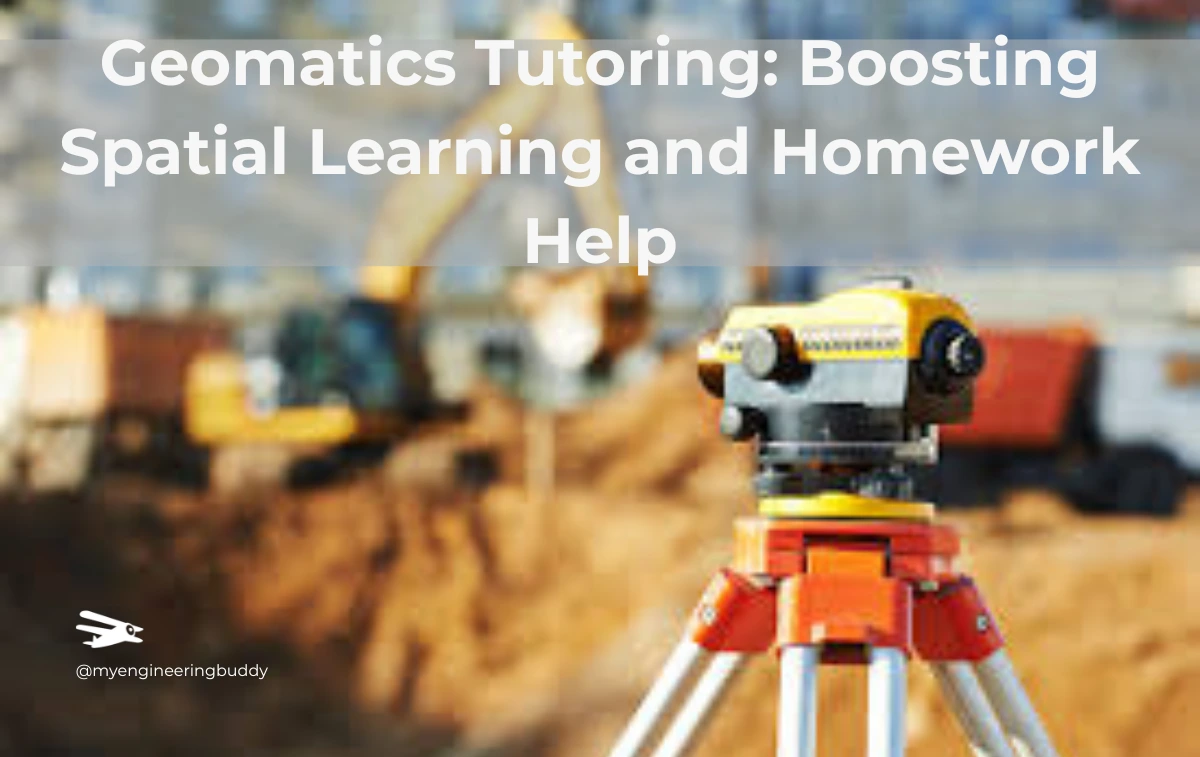
Understanding Geomatics
Geomatics is the study of gathering, storing, and analyzing geographic data. It covers surveying, mapping, GPS, remote sensing, and GIS systems. According to ISO standards, geomatics involves the collection and management of geospatial information. In practical terms, geomatics combines math, computer science, and earth science to describe our world. A geomatics teacher or professor might cover topics like map projections, coordinate systems, and 3D modeling to show how complex projects are planned and built.
To visualize how these diverse fields come together, look at the intersection of these three core disciplines.
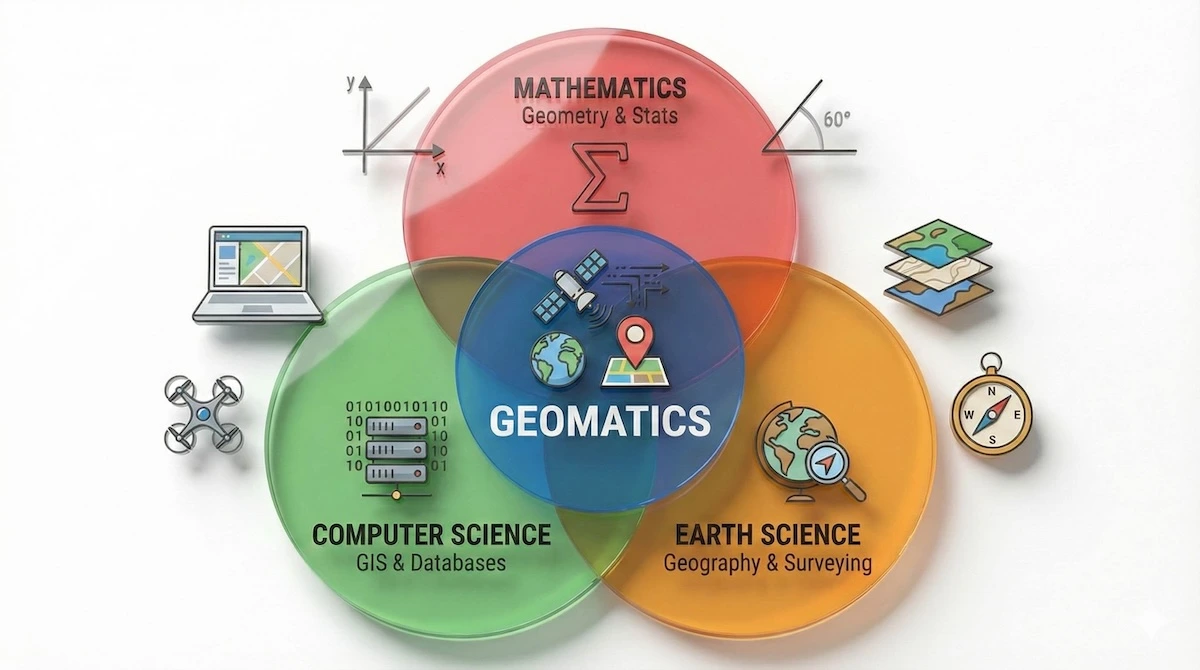
As you can see, Geomatics isn’t just one subject—it’s the ‘sweet spot’ where data analysis, spatial reasoning, and technology meet.
In hands-on labs, students often use total stations, drones, or GIS software to capture real-world data. For example, Georgia Tech students use advanced Leica surveying equipment to map terrain. As one professor noted, “as infrastructure systems become more complex, the ability to monitor and map using these geospatial technologies becomes even more important”. In the words of a geomatics professor, “everything we build or monitor on Earth requires precise spatial coordinates,” highlighting geomatics’ role in engineering and planning.
Why Geomatics Matters
Geomatics skills are in high demand across industries. Civil engineering, construction, environmental science, and even urban planning rely on geomatics for accurate maps and data. Geospatial technology underpins GPS navigation, satellite imaging, and autonomous vehicles. One university program notes that “Geomatics is making a resurgence” with job opportunities described as “plentiful and expanding”.
In the U.S., employment of surveying and mapping technicians is projected to grow 5% from 2024 to 2034, which is faster than average. This growth reflects a need for more technicians and engineers who understand geomatics.
Is this career path worth the effort? The market data paints a very clear picture of the financial potential.
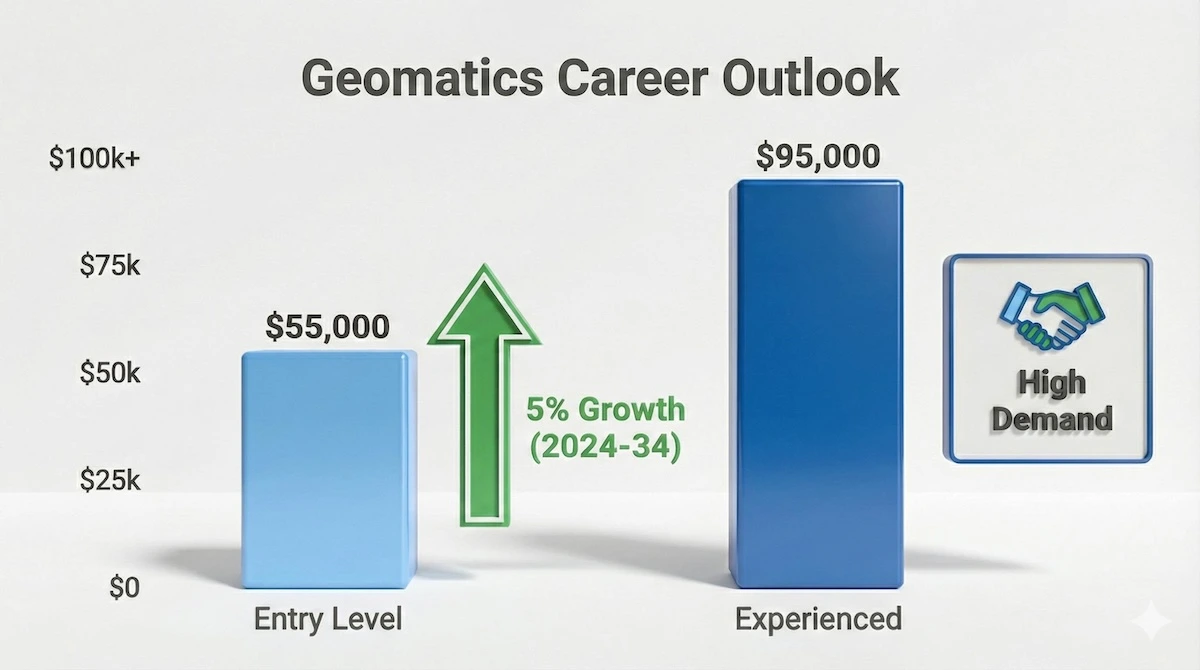
With salaries starting strong and job growth outpacing the average, mastering Geomatics offers excellent return on investment.
With steady growth and strong entry-level salaries, mastering these skills now is a direct investment in your future financial stability.
Geomatics Career Outlook for 2026 and Expected Salaries
Geomatics offers a salary range that scales steeply with role and specialisation and the demand data from the U.S. Bureau of Labor Statistics confirms that growth across every related occupation outpaces the national average. Understanding this landscape before you choose a specialisation is one of the most strategic decisions a geomatics student can make.
Geomatics engineers earn approximately $84,460 as of late 2025, according to ZipRecruiter salary data.
Behind these numbers is a fast-expanding market. The global geospatial analytics market is projected to grow from $114.32 billion in 2024 to $226.53 billion by 2030. For students currently in degree programmes, this trajectory means the market will be significantly larger by the time they enter the workforce — a structural tailwind that most engineering disciplines cannot claim.
Which Geomatics Role Pays the Most and Which Has the Most Open Positions
The salary hierarchy in geomatics is largely driven by the depth of technical specialisation and the licensing requirements of each role. Cartographers and photogrammetrists command the highest median wages among technician-level roles and are also growing the fastest at 6% per decade.
GIS analysts in specialised roles can exceed this range significantly: a recent survey by the Geospatial Professional Network (URISA) reports the average annual salary for geospatial professionals is $91,774, with a median of $87,000.
A useful planning principle: the roles with the highest salaries (GIS developer, geomatics engineer, senior photogrammetrist) require software fluency in ArcGIS Pro, Python scripting, or LiDAR processing on top of the core degree.
Students who use tutoring time to build those software skills early are not just passing their coursework — they are directly building the resume differentiators that push salaries into the $80,000–$100,000+ range. Students working toward professional certifications may also find that Certified Internal Auditor (CIA) tutoring offers a useful model for structured exam-focused preparation.
UK and Gulf Markets: How the Demand Picture Compares
Geomatics demand is not limited to the United States. In the UK, the field remains closely tied to professional accreditation through the Royal Institution of Chartered Surveyors (RICS) and the Chartered Institution of Civil Engineering Surveyors (ICES).
Many UK geomatics degree courses are accredited by both RICS and ICES, meaning graduates achieve partial progress toward full professional qualification alongside their academic degree. The RICS pathway adds licensing value that substantially increases graduate employability and earning power.
| Role | US Median Salary (2024 BLS) | Projected Growth (2024–34) | Key Software Tools |
| Surveying & Mapping Technician | $51,940 | 5% | CAD, GPS, GIS basics |
| Licensed Surveyor | $72,740 | 4% | Total station, GNSS, CAD |
| Cartographer / Photogrammetrist | $78,380 | 6% | ArcGIS Pro, QGIS, LiDAR |
| Geomatics Engineer | ~$84,460 | Varies | Full GIS stack, Python |
| GIS Analyst (senior/specialist) | $87,000–$91,774* | 6%+ | ArcGIS, QGIS, SQL, Python |
*URISA Geospatial Professional Network salary survey, 2025. BLS salary data sourced from Occupational Outlook Handbook, last updated August 2025.
Challenges in Geomatics Learning
Geomatics combines advanced math, technology, and fieldwork, so it can be challenging for students. High school and college courses assume a strong background in geometry, algebra, and physics, and also introduce specialised software like CAD or ArcGIS.
Without extra support, topics like converting coordinates or processing LiDAR scans can feel overwhelming. In many schools, a dedicated geomatics teacher is rare, so students may only see parts of geomatics in other classes.
This gap can make assignments or projects feel daunting, which is when many turn to online tutoring services.
Why do students struggle in lecture halls but thrive with tutors? The difference lies in the learning environment.
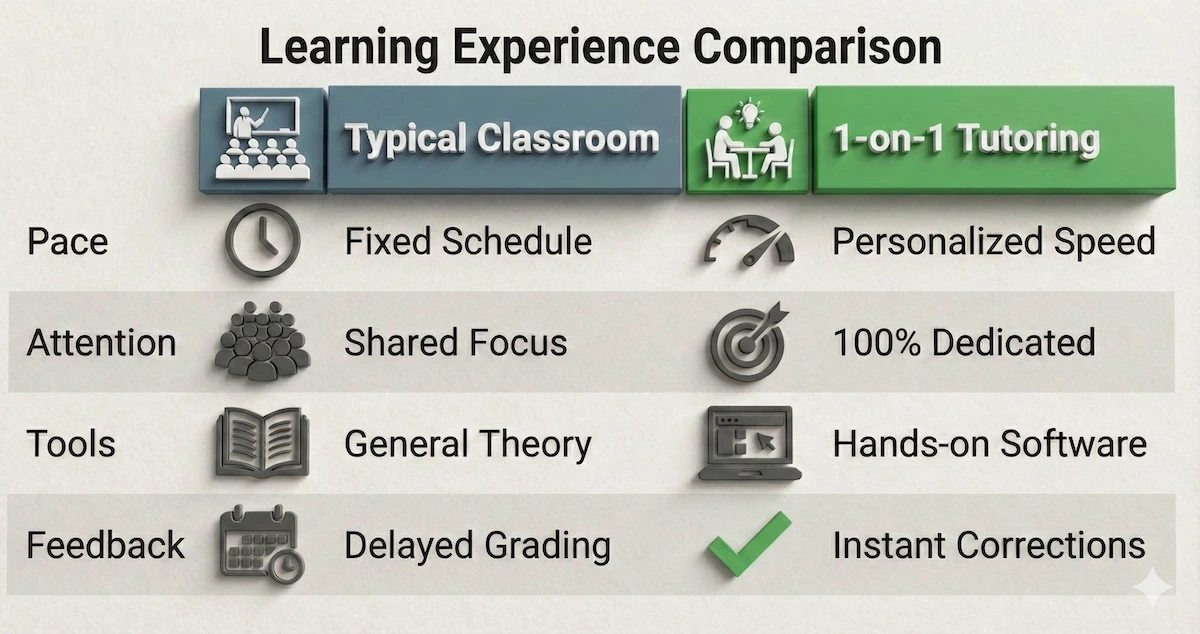
While classrooms provide the theory, one-on-one tutoring offers the personalised pace and instant feedback critical for mastering complex tools.
By switching from a passive classroom listener to an active participant, you close the gap between theory and application. The Socratic method of teaching in online tutoring is one approach that actively engages students in exactly this way.
What Geomatics Courses Cover and Where Students Struggle Most
A geomatics degree programme covers a wide range of interconnected disciplines and understanding the structure before you start is what separates students who pace themselves well from those who are perpetually scrambling.
The typical core of a geomatics undergraduate programme includes: surveying and measurement science (field instruments, angular and distance measurement, levelling), geodesy and coordinate systems (datums, projections, coordinate transformations), GIS and spatial data analysis (data modelling, vector and raster analysis, cartography), photogrammetry and remote sensing (aerial and satellite image interpretation, LiDAR).
Which Modules Trip Students Up the Most
Coordinate transformations and geodetic datums consistently rank among the most confusing early topics in geomatics programmes. The concept that the same physical point can have materially different coordinate values depending on the reference datum (WGS84 vs. NAD83 vs. a local system) is counterintuitive, and the mathematics of datum transformation adds a calculation layer that many students find opaque.
Common Assignment Types and How to Approach Them
Geomatics assignments typically fall into four categories: computational exercises (coordinate calculations, traverse adjustments, area computations), software lab reports (ArcGIS or QGIS workflows documented and analysed), field reports (data collected on-site, processed, and presented), and research or literature review essays. Each demands a different preparation approach.
For computational exercises, the most common error is propagating a calculation mistake through multiple steps without checking intermediate results.
Students who struggle with homework anxiety around these multi-step problems may find useful strategies in this overview of homework anxiety: what causes it, its impact, and what can help.
How Geomatics Tutoring Helps
Personalised tutoring bridges the gap between classroom teaching and understanding. Tutors provide one-on-one attention that classes often cannot. They adapt explanations to a student’s level, replay concepts until clear, and use real-world examples. Research shows that tutoring is a highly effective educational strategy.
A landmark study found one-on-one tutoring to be “one of the most effective tools for enhancing educational outcomes.” Similarly, a systematic review found that tutoring yields “consistent and substantial positive impacts” on learning outcomes. In other words, targeted tutoring in a difficult subject like geomatics can significantly boost a student’s performance.
Many tutoring platforms offer quick-turnaround support for geomatics questions, where students receive prompt guidance on homework within tutoring sessions from subject experts. These services complement regular tutoring by working through specific problems or reviewing homework steps together.
Which GIS Software to Learn First: ArcGIS, QGIS, or AutoCAD
GIS software tutoring is one of the most common reasons geomatics students seek expert help — not because the tools are impossible to learn, but because the choice of which tool to learn first, and how to learn it effectively without falling into common traps, is poorly guided by most course introductions.
ArcGIS Pro, QGIS, and AutoCAD Map 3D each serve distinct purposes, and the right starting point depends on your platform, your institution’s licence, and your intended career path.
The single most important platform difference that textbooks and course pages routinely omit: ArcGIS Pro (Esri) runs on Windows only. QGIS is free, open-source, and runs on Windows, Mac, and Linux. For students on a Mac and for students whose institution does not provide an Esri educational licence, QGIS is not just an alternative — it is the only practical starting point. This matters because students who install QGIS expecting it to behave like ArcGIS, or vice versa, will spend their first week confused by interface differences that have nothing to do with the underlying spatial analysis concepts.
Students who want to understand how different tutoring platforms compare when seeking software-specific help may find this Skooli review covering features, pricing, and alternatives a useful reference point.
ArcGIS Pro: When It Is the Right Choice
ArcGIS Pro is the industry standard for professional geomatics work in North America, government agencies, and large engineering firms. Esri’s software dominates the enterprise market, and for students intending to work in these environments, ArcGIS Pro proficiency is a direct employment credential.
The learning curve is steeper than QGIS, and the toolbox — while comprehensive — requires familiarity with Esri’s specific data model (geodatabases, feature classes, mosaic datasets) before the workflow feels natural.
Esri provides educational licences through its ArcGIS for Student Use programme, which gives enrolled students access to the full software suite at significantly reduced cost. If your institution has this licence, ArcGIS Pro is worth prioritising from Year 1.
The specific skills that pay off most in coursework and employment are: Model Builder (automating workflows without coding), spatial analysis tools (overlay, buffer, raster analysis), and integration with ArcGIS Online for web-based map publishing.
Tutors working with students on ArcGIS Pro assignments most commonly address three bottlenecks: coordinate system and projection errors that silently misalign datasets, geodatabase structure confusion (students used to shapefiles struggling with the feature class model), and geoprocessing error messages that are technically accurate but practically unhelpful. Knowing how to interpret and resolve these errors is a skill that saves hours of frustration per project.
QGIS: The Free, Cross-Platform Starting Point
QGIS is a fully capable open-source GIS platform, and for many spatial analysis tasks — georeferencing, vector editing, thematic mapping, raster analysis — it is functionally equivalent to ArcGIS at no cost. It is particularly strong in cartographic output quality, with a print layout system that many GIS professionals consider superior to ArcGIS’s equivalent.
Students learning simulation-based spatial tools alongside GIS may also benefit from Abaqus tutoring for finite element analysis workflows that complement geomatics fieldwork.
AutoCAD and AutoCAD Map 3D: Where GIS Meets Design
AutoCAD is not a GIS tool — it is a CAD (Computer-Aided Design) tool, and this distinction matters for how you use it. AutoCAD is designed for precise 2D and 3D drawing: architectural plans, site layouts, engineering cross-sections.
AutoCAD Map 3D is the bridge product — it adds GIS data management, coordinate system support, and basic spatial analysis to AutoCAD’s drafting environment.
The table below captures the essential differences at a student-decision level:
| Software | Cost | Platform | Primary Use | Best For |
| ArcGIS Pro | Paid (student licence available) | Windows only | Enterprise GIS, spatial analysis | Professional-track, government/industry roles |
| QGIS | Free (open source) | Windows, Mac, Linux | GIS analysis, cartography | Budget-conscious learners, Mac users, open-source workflows |
| AutoCAD / Map 3D | Paid (student licence available) | Windows | CAD drafting, survey plans, infrastructure | Surveying, cadastral, engineering drawing courses |
Benefits of Geomatics Tutoring
Hiring a geomatics tutor or using online tutoring offers many advantages:
- Customized learning: Tutors tailor lessons to each student’s needs and pace, focusing on troublesome concepts like coordinate math or GIS software.
- Interactive tools: Many tutors use real examples and software (like GIS, CAD, or drone data) to make learning hands-on and clear.
- Homework and assignment guidance: Students get step-by-step guidance on Geomatics projects, from plotting maps to survey data analysis.
- Flexible support: Online sessions mean help is available after school or from home, ensuring concepts are understood before exams.
- Proven results: Studies find that students receiving tutoring see significant gains in understanding and grades.
Building strong study habits alongside tutoring support is equally important; this guide on mastering study skills and key strategies for long-term retention covers complementary techniques.
Online Geomatics Tutoring
Online tutoring has made geomatics education more accessible than ever. A student in any country — USA, UK, Gulf countries, etc. — can now connect with a qualified tutor. In fact, STEM subjects like GIS and surveying drove the online tutoring market: STEM courses accounted for the largest share of online tutoring services in 2024.
Through video chats and shared screens, a geomatics tutor online can demonstrate how to use GIS software or solve math problems in real time.
This means a remote learner gets much the same benefit as an in-person lesson, often at a lower cost. According to industry analysts, the global online tutoring market was about $10.4 billion in 2024 and is projected to more than double by 2030, reflecting high demand for subjects like geomatics.
If you’re wondering how a practical subject like this works remotely, here is the typical workflow for an online session.

This interactive loop — seeing, doing, and correcting instantly — is often more effective than watching a pre-recorded lecture.
Many platforms offer interactive tools specifically for geomatics: tutors can share mapping screens or even drone images during lessons. Parents and students in regions like the Middle East (Gulf countries), Europe, and the UK especially appreciate online geomatics tutoring to meet growing engineering standards. Overall, the convenience of flexible scheduling and a wide tutor selection make online learning a popular choice for Geomatics students of all ages.
Students preparing for language-based components of international programmes may also benefit from IGCSE Hindi as a Second Language tutoring alongside their technical studies.
Choosing a Geomatics Tutor or Teacher
When hiring a Geomatics tutor, look at credentials and experience. Ideally, a tutor has a background in surveying, GIS, or a related engineering field. Some tutors are professional surveyors or GIS analysts. Ask about their experience and if they have helped other students with similar courses. Many services offer trial sessions so you can gauge their teaching style. Fees often range from about $20–$40 per hour (higher for very specialized expertise or rush sessions). Keep in mind that this investment can pay off in better grades and easier project work.
Here are some tips for finding the right tutor:
- Verify the tutor’s qualifications (e.g., surveying certification, GIS experience, or engineering degree).
- Check if they have classroom teaching or industry experience relevant to your curriculum.
- Read reviews or get recommendations to ensure they have a clear teaching style.
- Ensure they cover the topics you need, such as map analysis, CAD skills, or geomatics assignment guidance.
- Confirm their availability and whether their rates ($20–$40/hour) fit your budget.
Ready to hire someone? Use this quick decision checklist to screen potential tutors effectively.
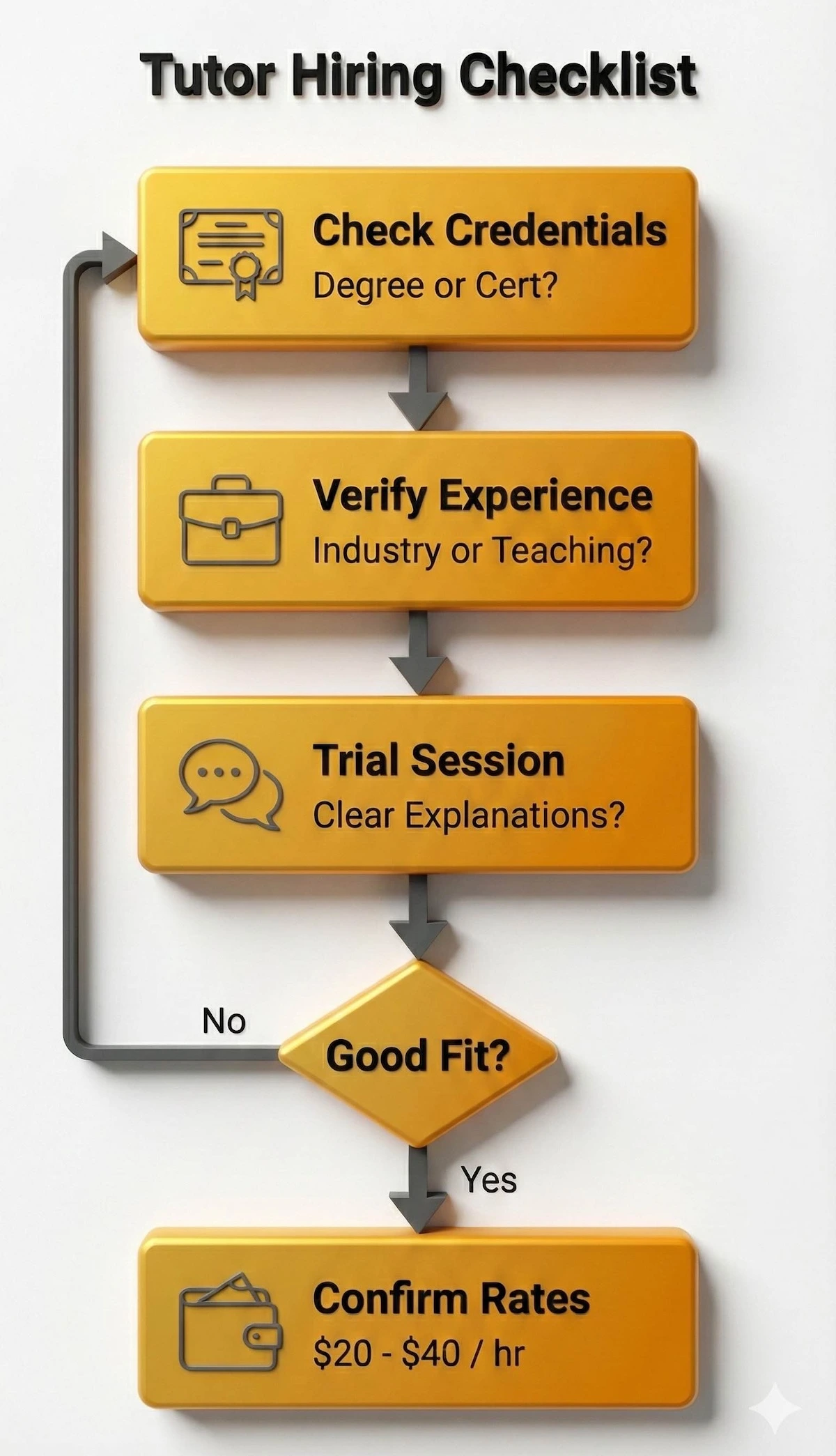
Following these four steps will help you avoid inexperienced tutors and ensure you get value for every dollar spent.
If your school offers a Geomatics course, the classroom teacher covers general topics, but a tutor can reinforce those lessons. If your child needs help with geomatics homework or a specific project, hiring a tutor online can provide that extra attention. You can find tutors through local college job boards, professional societies, or online tutoring platforms that specialize in STEM subjects.
Engineers working with simulation software alongside GIS tools may also benefit from ANSYS tutoring for structural and fluid analysis coursework.
Real-Life Success Stories
Imagine a freshman struggling with his first surveying lab. Concepts like leveling or calculating angles confused him. He found an online Geomatics tutor who used real field data to teach the concepts step by step and helped him with his exam prep. Over a few weeks, his understanding grew. By the next exam, he was solving survey problems confidently and raising his scores.
Another high school senior named Sara improved her grade from a C to an A on a geomatics project after getting focused assignment guidance. These one-on-one tutoring sessions provide support that classroom time often can’t, turning frustration into achievement.
Across the globe — from high school students in the UK plotting contour maps to college cadets in Gulf nations analyzing GIS data — tutoring fills gaps and reinforces learning. Online geomatics tutors make it easy to connect with experts anywhere, so distance or limited local resources are no longer barriers. With practice and guidance, many learners find that geomatics becomes not only manageable but even engaging and fun.
Ultimately, getting help early can prevent students from falling behind. By investing in expert guidance, learners can turn a challenging course into a rewarding experience.
Frequently Asked Questions About Geomatics Tutoring
What is a Geomatics tutor?
A Geomatics tutor is an expert in surveying, GIS, and mapping who provides one-on-one support to help students understand those topics.
Who can benefit from Geomatics tutoring?
Any student struggling with geospatial courses or wanting advanced help (in high school or college) can improve with a Geomatics tutor.
Is Geomatics tutoring available online?
Yes, many tutors offer online sessions via video chat, making Geomatics tutoring online accessible from anywhere.
What subjects does a Geomatics tutor cover?
Geomatics tutors can assist with surveying, GIS, photogrammetry, remote sensing, and related topics, providing guidance on assignments and projects.
How much does Geomatics tutoring cost?
Rates vary, but many tutors charge between $20 and $40 per hour, depending on expertise and location.
How do I hire a Geomatics tutor?
You can hire a Geomatics tutor through educational platforms or tutoring agencies; look for reviews and credentials to find a good match.
Is ArcGIS or QGIS better for students?
Neither is universally better — ArcGIS Pro is the industry standard for professional roles but requires a Windows machine and a paid or institutional licence. QGIS is free, runs on Mac and Linux, and is functionally capable for most coursework and research. Your institution’s software licence and your career goals should guide the choice.
Can a tutor help with a geomatics final-year project or thesis?
Yes. Tutors specialising in geomatics thesis support assist with topic scoping, methodology design, spatial data sourcing, GIS analysis, and dissertation writing including the methodology justification that most students lose marks on.
What free spatial data sources can I use for a geomatics project?
USGS Earth Explorer (Landsat, DEM), ESA Copernicus Hub (Sentinel imagery), OpenStreetMap (global vector data), and NASA EarthData (MODIS, SRTM) are all freely available, properly citable, and appropriate for academic projects.
Related subjects:
ArcGIS and ArcGIS Pro
Geodesy
Geographic Information System (GIS)
Photogrammetry
QGIS
Remote Sensing
Related Reading
******************************
This article provides general educational guidance only. It is NOT official exam policy, professional academic advice, or guaranteed results. Always verify information with your school, official exam boards (College Board, Cambridge, IB), or qualified professionals before making decisions. Read Full Policies & Disclaimer , Contact Us To Report An Error