Electrical FE Exam Review: Topics Covered and Common Student Struggles

- The FE Electrical and Computer exam has 110 questions across 6 hours total.
- The NCEES Reference Handbook is the only resource allowed during the exam.
- Circuits, power systems, and control systems are the highest-weight topic areas.
- Time management and handbook navigation are the most common student struggles.
- Pass rates typically fall between 55% and 70% depending on the testing season.
Preparing for the Electrical FE exam is one of the biggest milestones for aspiring engineers seeking their Professional Engineer license. Many students look for a detailed electrical FE exam review to understand what the exam includes, how difficult it really is, and which topics cause the most trouble.
The FE Electrical and Computer exam tests a wide range of subjects, from math and circuits to signal processing, control systems, communication systems, power, electronics, and engineering economics. Because of this wide scope, students often feel overwhelmed when creating a study plan.
This in-depth review will walk you through every major area covered on the FE Electrical and Computer exam, the exact subjects you need to study, common mistakes students make, and the best ways to overcome weak areas.
Whether you are studying alone, using an FE electrical exam online course, or following a structured FE electrical exam prep program, this guide will help you understand what truly matters for exam day. Many students also rely on expert tutoring support from My Engineering Buddy to strengthen key engineering concepts and stay on track.
Students exploring broader academic support options may also find value in reading this review of Tutoring Club and its alternatives to compare different learning platforms.
Understanding the Electrical FE Exam Format
Before diving into topics, it helps to understand how the exam works. The FE Electrical and Computer exam is a computer-based test offered year-round at Pearson VUE centers. You have 6 hours total, which includes 5 hours and 20 minutes of actual exam time, a tutorial, a break, and a survey. The exam contains 110 questions that mix conceptual knowledge and engineering problem-solving.
Quickly see the exam format, timing, handbook rule, and realistic pass-rate expectations in the visual below.
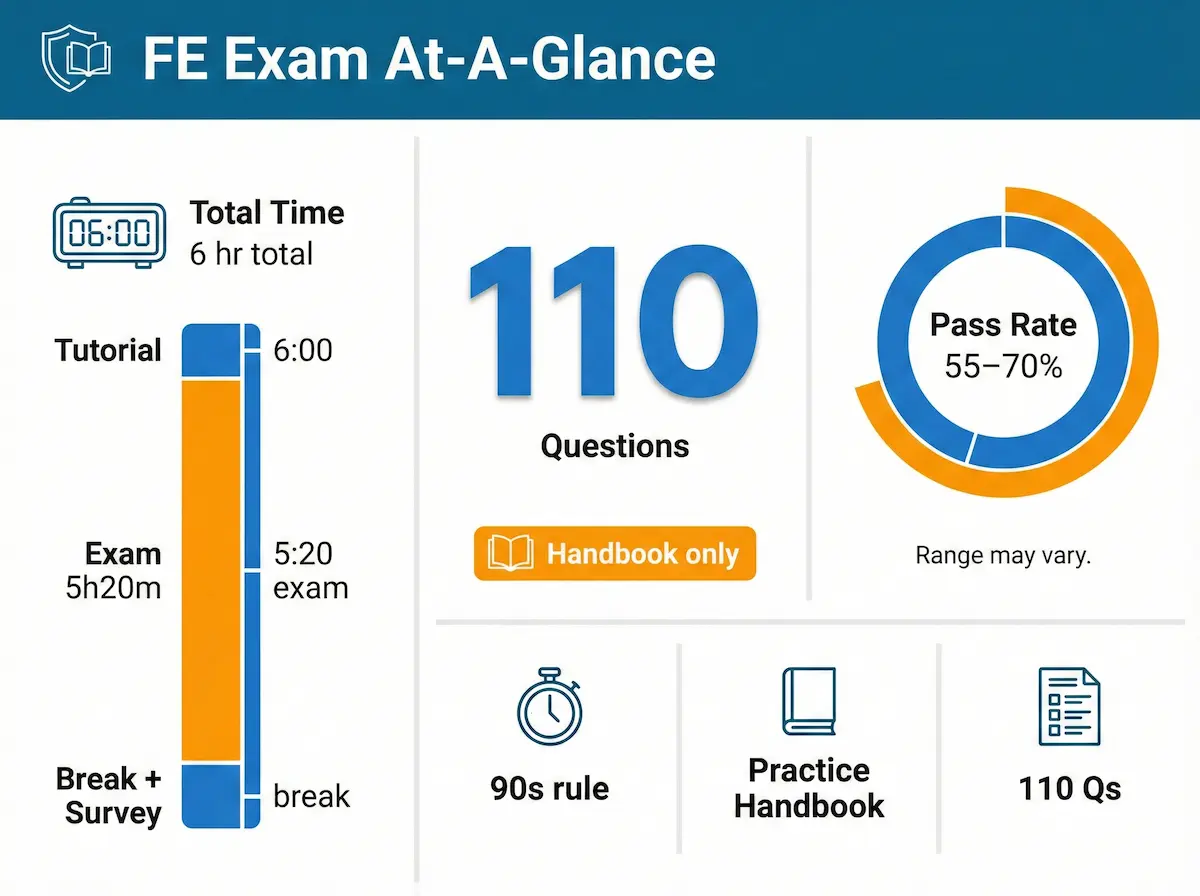
This snapshot helps you plan pacing and expectations for exam day.
The NCEES FE Reference Handbook is the only resource you are allowed to use during the test. Every formula you need appears in this handbook, but knowing how to use it quickly is essential. Many students underestimate the time pressure, because solving 110 questions in less than 6 hours requires speed, accuracy, and familiarity with the reference handbook.
This is why any reliable electrical FE exam review emphasizes practicing with the handbook open. It is not enough to memorize formulas. You must know where each formula is located, how to read the tables, and how to use the units given in each section.
Topics Covered on the FE Electrical and Computer Exam
Here’s a quick visual map of every topic the exam can test — use this to build your topic checklist.
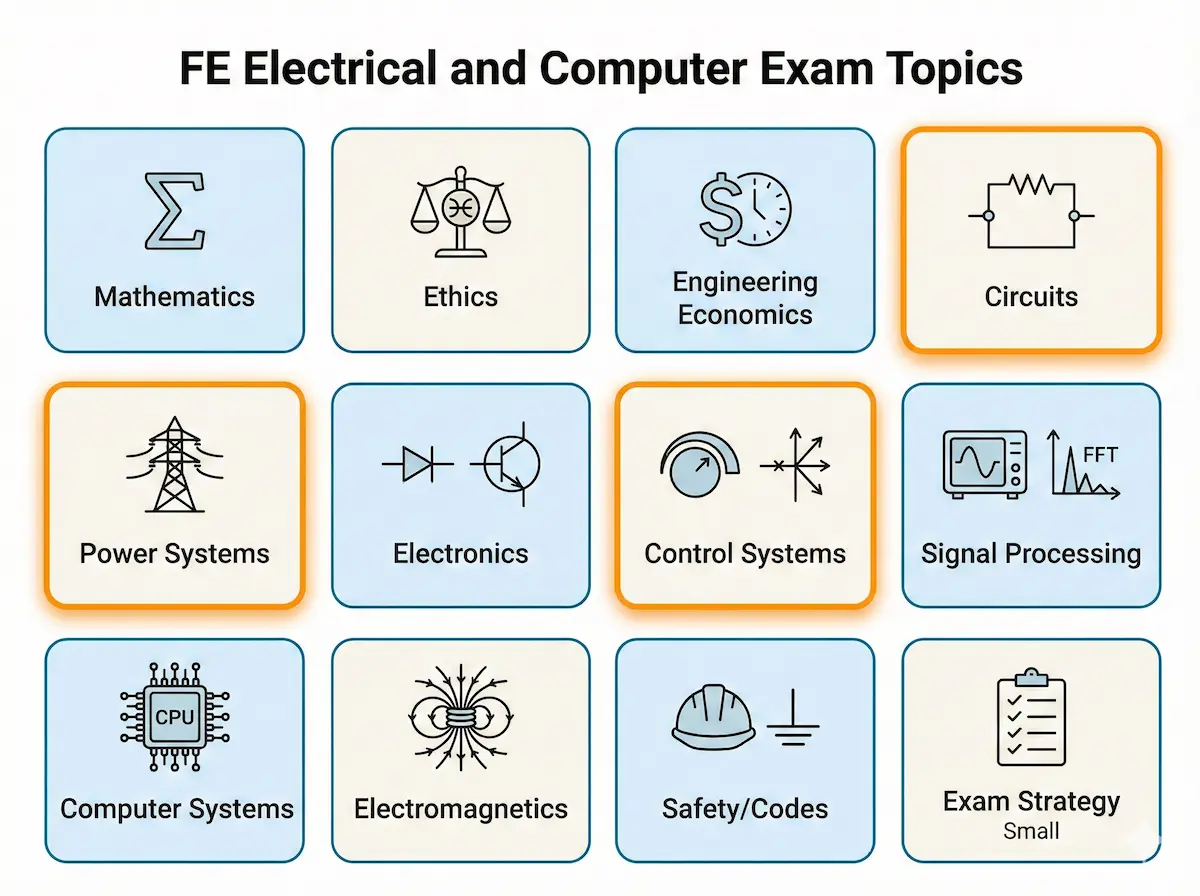
Use the grid to prioritize topic blocks in your study schedule.
The exam covers a wide range of technical and non-technical subjects. NCEES breaks the topics into multiple categories, each with specific subtopics. Here is what you can expect from a complete FE Electrical and Computer exam preparation review.
1. Mathematics
Mathematics makes up a large portion of the exam. You will see questions from:
- Algebra
- Calculus
- Differential equations
- Linear algebra
- Probability
- Statistics
- Complex numbers
Although many students feel comfortable with math, the challenge comes from applying these concepts quickly under time pressure. Knowing how to manipulate equations and perform accurate calculations is essential during your electrical FE exam review.
Common Struggles:
Students often struggle with probability distributions, eigenvalues, Laplace transforms, and differential equations.
2. Ethics and Professional Practice
This section may seem easy, but ethical scenarios can be tricky. Topics include:
- Engineering ethics
- Professional responsibility
- Public health and safety
- Code of conduct
Common Struggles:
Misinterpreting ethical scenarios or overthinking simple questions.
3. Engineering Economics
Every electrical FE exam review includes economics because it is a high-scoring section if you understand the basics. Topics include:
- Time value of money
- Cash flow diagrams
- Interest rates
- Depreciation
- Cost analysis
Common Struggles:
Remembering the correct formula for present worth and future worth, and identifying which cash flow model to use. Students who want deeper grounding in financial concepts can work with a finance tutor to build confidence in time-value-of-money problems.
4. Circuits
Circuit analysis is one of the most important sections of the FE Electrical exam. Topics include:
- Ohm’s law
- Kirchhoff’s laws
- Mesh analysis
- Nodal analysis
- AC steady state
- Power calculations
- Resonance
- Transient circuits
Common Struggles:
Students struggle with phasor diagrams, transient analysis, and power factor calculations.
5. Power Systems
Power systems are heavily tested. Topics include:
- Three phase systems
- Transformers
- Per unit system
- Power generation
- Transmission and distribution
- Fault analysis
Common Struggles:
Understanding per unit conversions, transformer equivalent circuits, and symmetrical fault calculations.
6. Electronics
Electronics questions are common and include topics such as:
- Diodes
- BJTs
- MOSFETs
- Amplifiers
- Operational amplifier circuits
- Logic families
Common Struggles:
Small signal analysis and understanding how biasing affects amplifier gain.
7. Control Systems
Control systems form a significant part of the FE electrical exam prep. You can expect questions from:
- Transfer functions
- Stability
- Root locus
- Frequency response
- PID controllers
- Time domain response
Common Struggles:
Interpreting Bode plots, understanding stability criteria, and solving transfer function problems.
8. Signal Processing
Signal processing topics include:
- Fourier transforms
- Sampling
- Filtering
- Convolution
- Discrete time signals
- Frequency analysis
Common Struggles:
Understanding Fourier transforms, identifying aliasing, and performing convolution operations.
9. Computer Systems
NCEES includes digital logic and computer based questions such as:
- Boolean algebra
- Flip flops
- Number systems
- Microprocessors
- Programming logic
- Data structures
Common Struggles:
Students find Karnaugh maps, number conversions, and logic simplification most challenging.
10. Electromagnetics
EM questions include:
- Electric fields
- Magnetic fields
- Maxwell equations
- Transmission lines
- Waves
Common Struggles:
Transmission line problems, characteristic impedance, and wave propagation.
11. Safety, Codes, and Standards
This topic includes:
- OSHA standards
- Electrical safety
- Grounding
- Arc flash
Common Struggles:
Remembering safety formulas and interpreting NEC-based concepts without overcomplicating the problem.
What Students Struggle With Most on the FE Electrical Exam
After helping thousands of students through various review programs and FE electrical exam online courses, the same weak areas appear repeatedly. Understanding these problem areas can help you plan a stronger study strategy.
1. Using the NCEES Handbook Effectively
This is the number one challenge for most students. Everything you need is in the handbook, but the struggle is knowing where to find it fast. Flipping pages during the exam wastes precious time. You should practice daily with the handbook open until you naturally recognize where each formula or table is located.
Use this step-by-step flowchart to find and apply formulas fast during the exam.
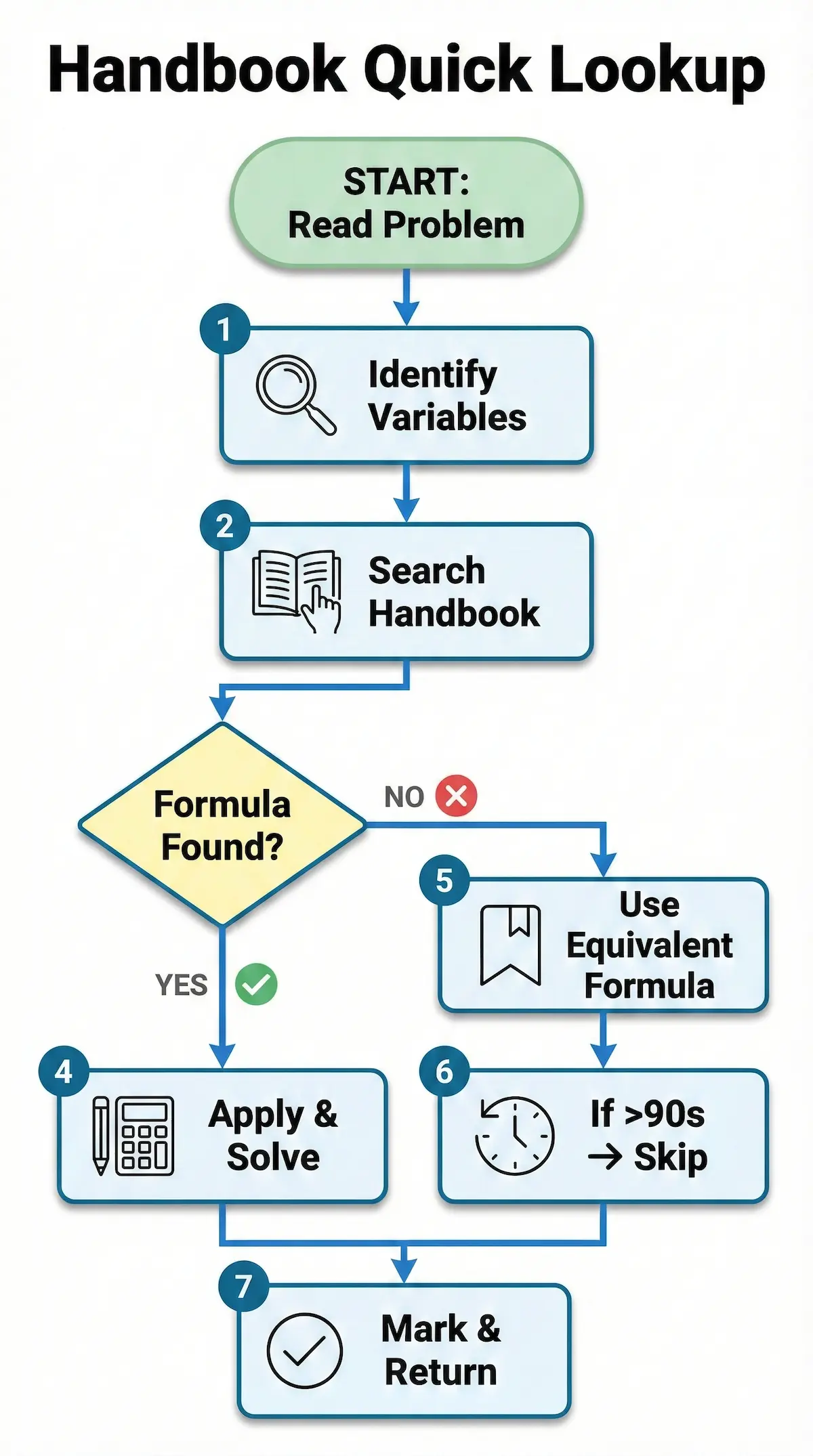
Practice this sequence until it becomes automatic — it saves minutes per question.
2. Time Management and Question Pacing
Students often get stuck on difficult questions in the first 10 to 15 minutes. Once time pressure builds, panic sets in, and accuracy drops. You must practice skipping questions you cannot answer within 90 seconds.
This decision tree clarifies what to do when you hit a tough question on test day.
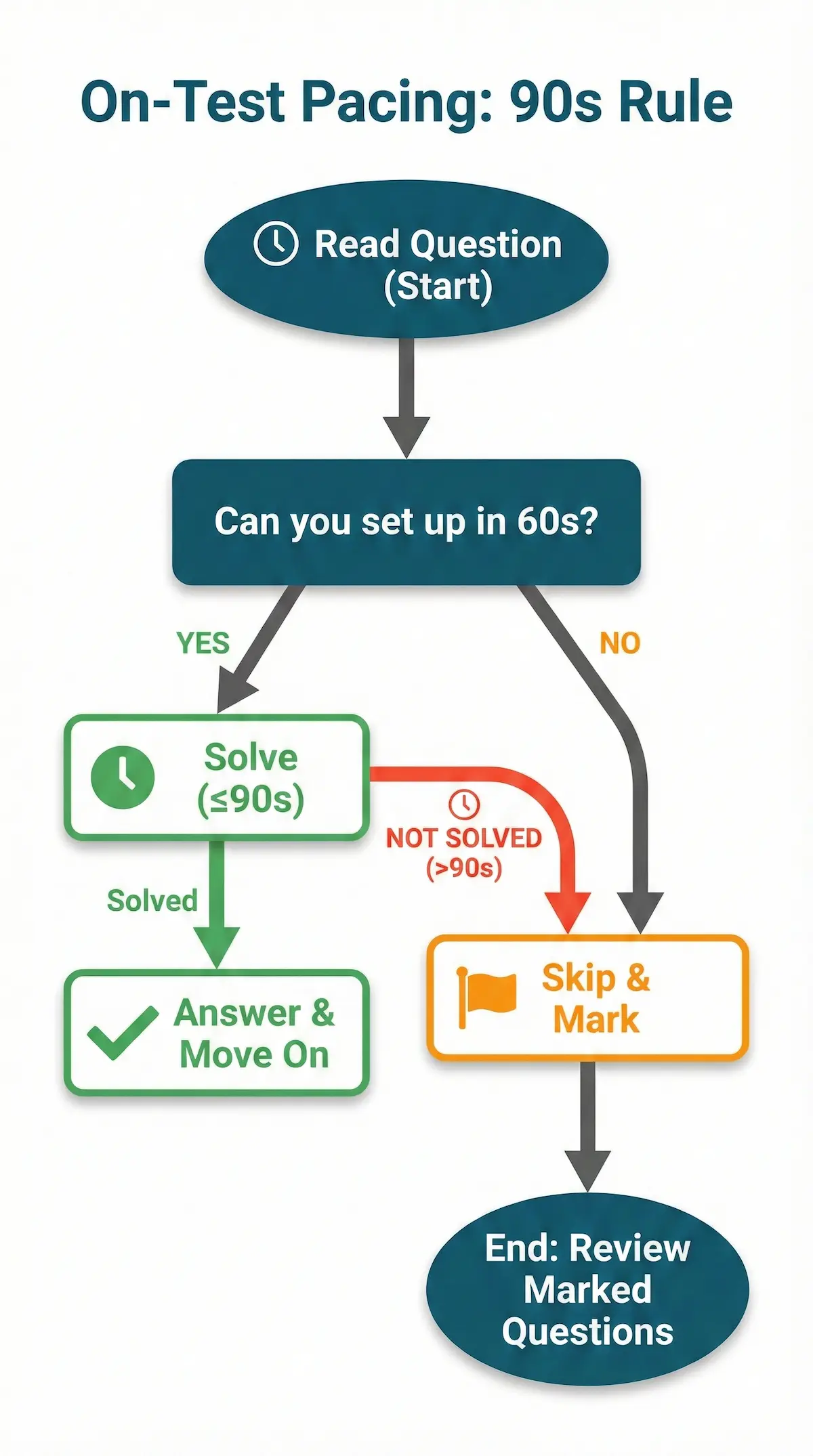
Following this rule reduces panic and improves your overall score pacing.
A strong electrical FE exam review includes timed practice, not slow problem-solving.
3. Weak Foundation in Core Subjects
The subjects that cause the most trouble include:
- Circuits
- Power systems
- Signal processing
- Control systems
- Electronics
- Mathematics
Most students understand the concepts at a basic level, but the FE exam tests applied problem solving, not just definitions.
For students who want structured support navigating complex engineering coursework, a look at Classover’s reviews, alternatives, and pricing may offer useful context on online learning platforms.
4. Misinterpreting Word Problems
Many FE questions are designed to test your understanding of engineering concepts, not just your calculations. Misreading the question can cause you to pick the wrong formula or miss a critical detail.
5. Lack of Practice With Realistic Questions
Studying theory alone will not help you pass. The FE Electrical exam includes specific styles of questions. You must practice:
- Multiple choice problems
- Conceptual questions
- Multi step calculations
- Word problems
- Scenarios based on engineering judgment
Using high-quality practice exams is essential for strong FE Electrical and Computer exam preparation.
6. Not Following a Consistent Study Plan
Many students start strong but lose consistency after a few weeks. An effective study plan must include:
- Daily practice problems
- Weekly review sessions
- Timed practice tests
- Handbook practice
- Concept reinforcement
- Formula identification
This is why many students prefer a structured FE electrical exam online course that sets a clear weekly schedule. If students need additional one-on-one help, My Engineering Buddy offers expert FE tutoring tailored specifically to these weak areas.
Best Tips for Reviewing and Preparing for the FE Electrical Exam
Here are useful strategies that consistently help students improve their scores.
1. Follow the NCEES Exam Specifications
Always review the official NCEES topic list. Do not waste time studying subjects that are not tested.
2. Practice With the NCEES Handbook Open
You should know:
- Where each formula is located
- How tables are organized
- How units are defined
- Which sections contain commonly used references
3. Build Strength in High Weight Areas
Focus on:
- Circuits
- Power
- Control systems
- Electronics
- Signal processing
- Mathematics
These subjects appear regularly across practice exams.
Allocate study hours based on this priority chart to maximize score gains.
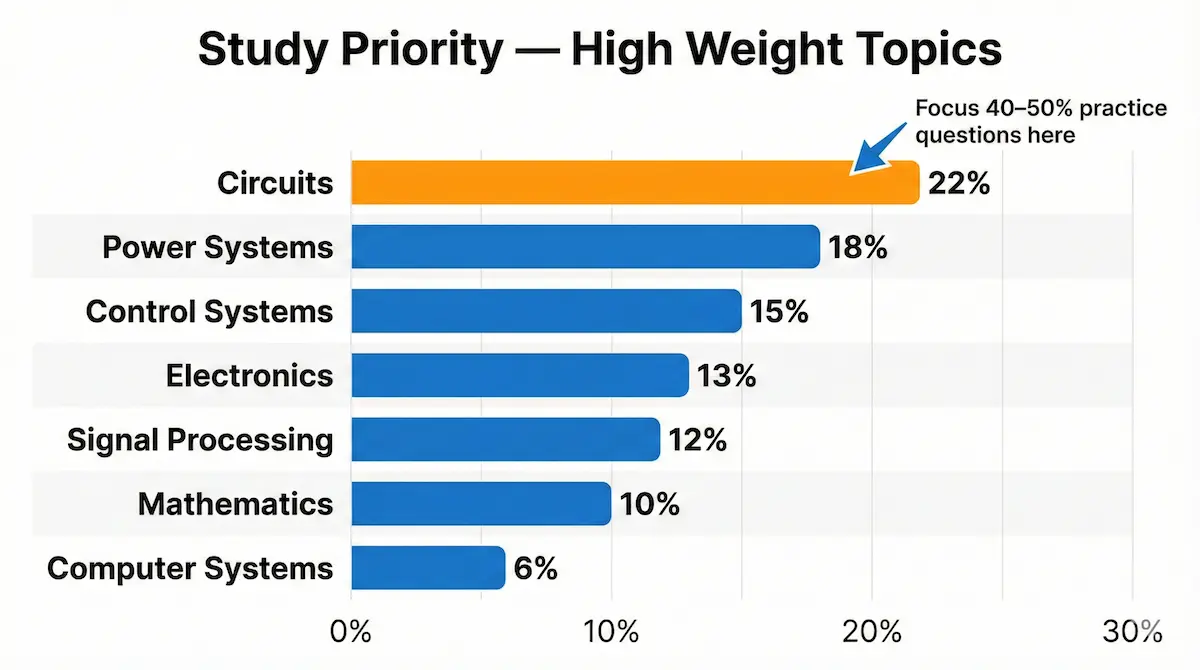
Focus more practice time on the highest-weight bars to see the best returns.
Students who want to understand how other online tutoring platforms approach structured learning can read this review of School Solver, its alternatives, and pricing for a useful comparison.
4. Join a Structured FE Electrical Exam Prep Program
A well designed course can help you build a 90 day study schedule.
Here’s a practical 90-day plan broken into weekly milestones — copy and adapt this schedule.
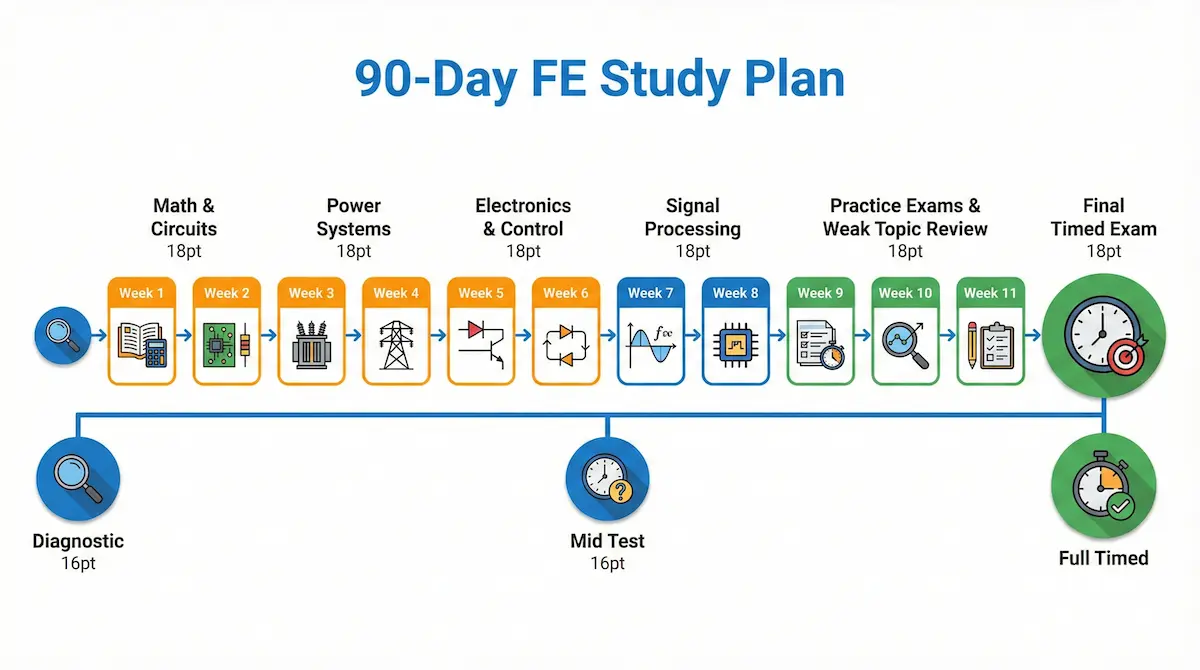
Follow these weekly focus blocks and check progress with scheduled diagnostics.
- Access relevant practice problems
- Learn exam solving strategies
- Improve weak areas with guided reviews
- Understand the exam format
This is why an FE electrical exam online course often produces better results than self study. Those comparing structured prep programs may also find it helpful to review Teach Me 2’s tutoring service, pricing, and comparison as an additional reference point.
Engineers and engineering students who also need to manage project timelines or cost analysis as part of their coursework can benefit from working with a PMP project management tutor to build those complementary skills.
5. Take Multiple Timed Practice Exams
You should take at least:
- One diagnostic exam
- One mid level exam
- One full length timed exam
This helps you track progress and identify problem areas.
6. Review Every Wrong Answer Thoroughly
Do not just check the correct answer. Ask yourself:
- Where did I go wrong
- Was it a formula issue
- Did I misread the question?
- Is this a recurring weak topic
This is one of the best ways to improve accuracy.
7. Stay Consistent Until Exam Day
Studying 1 to 2 hours daily is far more effective than long study sessions with long gaps in between.
Students who want to understand how financial and accounting concepts appear in engineering economics can also explore working with an online tutor for financial accounting to reinforce those fundamentals. For those who need support with cost analysis and related quantitative topics, connecting with an accounts expert can help bridge gaps before exam day.
FAQs About the Electrical FE Exam
How long should I study for the Electrical FE exam?
Most students need 2 to 3 months of consistent preparation, averaging 10 to 15 hours per week.
Is the FE Electrical exam hard?
The FE Electrical exam is challenging because it covers many subjects, but you can pass with a structured plan and consistent practice.
Do I need an FE electrical exam online course to pass?
An FE electrical exam online course is not required but it helps many students stay consistent and learn faster, especially if they struggled with engineering subjects.
What is the pass rate for the FE Electrical exam?
Pass rates for the FE Electrical exam vary, but most published rates fall between 55 percent and 70 percent, depending on the testing season and candidate background.
What is the best way to do an electrical FE exam review?
The best way to do an electrical FE exam review is to use the NCEES handbook during all practice sessions, take timed exams, review mistakes carefully, and focus on high-weight topics.
Conclusion
A solid electrical FE exam review helps you understand what the exam covers and why certain topics feel more challenging than others. Most students struggle with time management, weak fundamentals, and navigating the NCEES Reference Handbook, but these issues improve with consistent practice.
Whether you study independently or through an FE electrical exam online course, focus on high weight subjects, solve realistic problems, and follow a steady FE electrical exam prep plan. With the right strategy and discipline, passing the FE Electrical exam is completely achievable.
Related Reading
******************************
This article provides general educational guidance only. It is NOT official exam policy, professional academic advice, or guaranteed results. Always verify information with your school, official exam boards (College Board, Cambridge, IB), or qualified professionals before making decisions. Read Full Policies & Disclaimer , Contact Us To Report An Error