
A-Level Mechanics: 10 Exam Traps That Cost Students Marks in 2026

Walking out of your A-Level mechanics exam feeling confident, only to lose 15-20 marks on avoidable errors, is frustrating. The difference between a grade B and an A often comes down to exam technique rather than mathematical ability. This guide identifies the 10 most common mechanics traps that trip up students and shows you exactly how to avoid them for your May-June 2026 exams.
Ace your exams & homework with the best Mechanical Engineering Tutors
Understanding Common Mechanics Pitfalls
Mechanics questions consistently cause mark loss across Edexcel, AQA, and OCR exam boards. Recent examiner reports reveal three recurring problems: sign convention errors in forces and moments, incomplete free body diagrams, and missing method marks despite correct final answers.
Sign Convention Errors in Forces and Moments
Sign errors appear in 40-60% of student responses on forces questions. The problem stems from inconsistent direction choices. When resolving forces horizontally and vertically, students must establish a positive direction at the start and maintain it throughout the calculation.
For moments calculations, choosing a pivot point is critical. Taking moments about a point eliminates unknown forces acting at that point, simplifying your equations. However, many students forget to specify whether clockwise or counterclockwise moments are positive. Mark schemes penalize this lack of clarity.
Common Sign Error Example: A beam in equilibrium has a 50 N force acting downward 2 m from point A, and a reaction force R at point A. Students often write the moment equation as 50 × 2 = R × 0 without specifying their sign convention, losing the method mark.
Correct Approach: State clearly: “Taking moments about A, with clockwise positive: R × 0 – 50 × 2 = 0.” This earns the method mark even if the arithmetic contains an error.
A-Level Physics A* Blueprint 2026 | Exam Traps Fixed
Unit Confusion and Dimensional Analysis
Converting between units mid-calculation causes frequent errors. The most common mistakes involve:
- Mixing meters and centimeters in moment calculations
- Using grams instead of kilograms in F = ma
- Forgetting to convert speeds from km/h to m/s for SUVAT equations
Always convert all quantities to SI units (meters, kilograms, seconds, Newtons) before substituting into equations. One unconverted unit can cascade through multi-step problems, costing multiple accuracy marks.
| Common Unit Conversions | SI Unit | Typical Mistake |
| Mass | kg | Using g (divide by 1000) |
| Distance | m | Using cm (divide by 100) |
| Speed | m/s | Using km/h (divide by 3.6) |
| Acceleration due to gravity | 9.81 m/s² | Using 10 m/s² without justification |
Free Body Diagram Essentials
Free body diagrams (FBDs) are the foundation of mechanics problem solving. A correct FBD earns method marks even when subsequent calculations contain errors. However, incomplete or incorrect diagrams immediately lose marks and make the rest of the solution harder.
Step-by-Step FBD Construction
Step 1: Isolate the object. Draw a simple shape (box, dot, or rectangle) representing the object alone, completely separated from all surfaces and connections.
Step 2: Identify all forces. Systematically check for:
- Weight (mg, always acting downward from the center of mass)
- Normal/reaction forces (perpendicular to contact surfaces)
- Tension forces (along strings/cables, pulling away from the object)
- Friction forces (parallel to contact surfaces, opposing motion)
- Applied forces (as specified in the question)
Step 3: Draw force vectors. Each force must:
- Start at the object (not floating nearby)
- Point in the correct direction
- Have an arrowhead clearly showing direction
- Be labeled with standard notation (R, T, F, mg)
Step 4: Show your coordinate system. Mark positive directions with arrows, typically:
- Horizontal: right is positive
- Vertical: up is positive
- For inclined planes: up the slope or perpendicular to the slope
Read More: 7 Smart Ways To Use Predicted Papers Without Risking Your A-Level Physics Grade
Common Free Body Diagram Mistakes in Multi-Body Systems
Connected particle problems cause the most FBD errors. When two masses are connected by a string over a pulley, students often:
- Draw forces on the string instead of on each mass separately
- Show tension pulling in the wrong direction
- Forget that tension is the same throughout a light, inextensible string
- Mix up action-reaction pairs
Critical Rule: In a light, inextensible string over a smooth pulley connecting masses m₁ and m₂, the tension T is identical throughout. Draw T pulling upward on both masses (if vertical) or along the string direction for each mass separately.
Practice with Exam-Style Example
Problem: A 5 kg block rests on a horizontal table. A string attached to the block passes over a smooth pulley at the edge of the table and hangs vertically, supporting a 3 kg mass. The coefficient of friction between the block and table is 0.4. Draw separate FBDs for each mass.
Solution:
For the 5 kg block on the table:
- Weight: 5g downward (where g = 9.81 m/s²)
- Normal reaction: R upward
- Tension: T to the right (toward pulley)
- Friction: F to the left (opposing potential motion)
- Coordinate system: right is positive horizontal, up is positive vertical
For the 3 kg hanging mass:
- Weight: 3g downward
- Tension: T upward
- Coordinate system: up is positive
The key insight: T appears on both diagrams but acts on different objects. This is not a Newton’s third law pair because both tensions are the same force transmitted through the string.
Read More: AP Physics 2026 Changes Fluids in Physics 1 + Exam Secrets
Mark Scheme Decoding for Mechanics
Understanding how examiners award marks transforms your exam strategy. A-Level mechanics mark schemes use three mark types: Method (M), Accuracy (A), and Reasoning (R).
Command Word Interpretation
Specific command words signal what examiners expect:
“Hence”: You must use the previous result as your starting point. Using an alternative method loses marks even if you reach the correct answer. The mark scheme explicitly penalizes ignoring given information.
“Hence or otherwise”: You may use the previous result or employ a different method. Both approaches earn full marks if executed correctly.
“Show that”: You must show every step in your working. The final answer is given, so examiners focus entirely on your method. Skipping steps or using calculator-only methods earns zero marks.
“Determine”: Find the answer using any appropriate method. Full working must be shown, but the specific approach is your choice.
“Calculate”: Use calculations to find a numerical answer. A calculator may be used, but you must show the equation setup and substitution before evaluating.
Securing Hidden Method Marks
Method marks are awarded for applying correct mechanical principles, even if errors occur in arithmetic. To maximize method marks:
- Write the relevant equation before substituting numbers
- Show which mechanical principle you’re applying (resolving forces vertically, taking moments about point A, applying F = ma, etc.)
- State your assumptions clearly (light string, smooth pulley, particle motion, etc.)
Example – Earning Method Marks:
Poor approach (loses method marks): “Force = 30 N”
Good approach (earns method marks): “Resolving horizontally: F = ma F = 5 × 6 = 30 N”
Even if you used the wrong mass or acceleration, you earn the method mark for applying F = ma correctly.
Following Through from Errors
Mark schemes include follow-through provisions. If you make an error in part (a) and use that incorrect result in part (b), you can still earn method and accuracy marks in part (b) if your working is correct based on your earlier answer.
Critical tip: Always show your working even when following through from previous parts. Write “Using my answer from part (a)…” to signal to the examiner that you’re applying follow-through logic.
| Mark Type |
What It Rewards |
How to Earn It |
| M (Method) | Applying correct mechanical principles | Write the equation, state the principle |
| A (Accuracy) | Correct numerical answer | Follow through from method marks |
| R (Reasoning) | Mathematical argument or explanation | Complete logical reasoning, every step shown |
Time Allocation Strategies
A-Level mechanics papers allocate approximately 1.2 minutes per mark. For Edexcel, the mechanics section appears in Paper 3 (2 hours, 100 marks total, with mechanics typically 50-60 marks). Effective time management can add 10-15 marks to your score by ensuring you attempt every question.
Minute-by-Minute Mechanics Section Plan
Minutes 0-3: Paper reconnaissance Read through the entire mechanics section. Identify:
- Total marks available
- Question difficulty levels
- Questions you can answer immediately
- Questions requiring more thought
Minutes 3-50: Question completion phase
- Start with questions worth 4-6 marks that you find straightforward
- Allocate time proportionally: 6-mark question = 7-8 minutes maximum
- If stuck after 1.5 times the mark allocation, mark the question and move on
- Leave 2-3 lines space for questions you skip (you’ll return to them)
Minutes 50-55: Return to incomplete questions
- Tackle skipped questions with remaining time
- Even partial answers earn method marks
- Write down relevant equations even if you can’t complete the solution
Minutes 55-60: Final review
- Check units on all final answers
- Verify you’ve answered what the question asked (to 3 significant figures, in Newtons, etc.)
- Scan for sign errors in multi-step problems
- Ensure all diagrams are labeled
Check Out: Calculus Tutor Cost Guide 2026: What You’ll Pay & 5 Hidden Factors Affecting Rates
Prioritizing High-Mark Questions
Not all marks are equal. Questions worth 6-8 marks typically involve multi-step problem solving where method marks are plentiful. These are often easier to score on than shorter 2-3 mark questions that require precise recall or insight.
Strategic approach:
- Complete all 4-6 mark questions first (high mark density, multiple method marks available)
- Then tackle 7-10 mark questions (these take longer but offer substantial marks)
- Finally, complete 1-3 mark questions (these are often quickest but offer fewer follow-through opportunities)
Final Checks Checklist
With 5 minutes remaining, systematically check:
- [ ] All numerical answers include correct units
- [ ] Answers match the requested accuracy (usually 3 significant figures)
- [ ] Free body diagrams show all forces with directions
- [ ] Sign conventions are stated for forces and moments
- [ ] “Show that” questions display every step
- [ ] Multi-part questions: check if later parts depend on earlier answers
Worked Example: Forces in Equilibrium
Problem: A uniform beam AB has length 4 m and mass 20 kg. The beam rests horizontally on supports at points C and D, where AC = 1 m and DB = 0.5 m. A load of mass 30 kg is placed on the beam at point E, where AE = 3 m. Find the magnitudes of the reactions at C and D.
Solution:
Step 1: Draw a diagram Sketch the beam with labeled points A, C, E, D, B at positions 0 m, 1 m, 3 m, 3.5 m, 4 m respectively from A.
Step 2: Identify forces
- Weight of beam: 20g = 20 × 9.81 = 196.2 N acting at the center (2 m from A)
- Weight of load: 30g = 30 × 9.81 = 294.3 N acting at E (3 m from A)
- Reaction at C: R꜀ upward
- Reaction at D: Rᴅ upward
Step 3: Apply equilibrium conditions For a beam in equilibrium, sum of upward forces equals sum of downward forces, and total moment about any point equals zero.
Resolving vertically: R꜀ + Rᴅ = 196.2 + 294.3 R꜀ + Rᴅ = 490.5 N … (equation 1)
Step 4: Take moments about C Taking moments about C eliminates R꜀ from the equation (clockwise positive): Weight of beam: 196.2 × (2 – 1) = 196.2 × 1 = 196.2 Nm (clockwise) Weight of load: 294.3 × (3 – 1) = 294.3 × 2 = 588.6 Nm (clockwise) Reaction at D: Rᴅ × (3.5 – 1) = Rᴅ × 2.5 (counterclockwise)
For equilibrium: Rᴅ × 2.5 = 196.2 + 588.6 Rᴅ × 2.5 = 784.8 Rᴅ = 313.92 N Rᴅ ≈ 314 N (to 3 sf)
Step 5: Find R꜀ using equation 1 R꜀ = 490.5 – 313.92 R꜀ = 176.58 N R꜀ ≈ 177 N (to 3 sf)
Check: Take moments about D to verify: 196.2 × 1.5 + 294.3 × 0.5 = R꜀ × 2.5 294.3 + 147.15 = R꜀ × 2.5 441.45 = R꜀ × 2.5 R꜀ = 176.58 N ✓
Answer: R꜀ = 177 N, Rᴅ = 314 N
Read More: Best Digital Tools Engineering Students Need for College & Projects
Revision Schedule for May-June 2026
A structured 12-week revision schedule ensures comprehensive coverage across all mechanics topics. This plan works for Edexcel, AQA, and OCR variants with minor adjustments for specification differences.
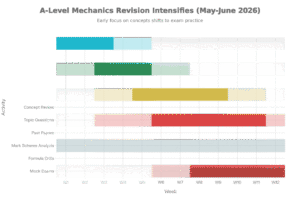
Weeks 1-4: Foundation Building
Week 1-2: Kinematics and SUVAT
- Day 1-2: Review SUVAT equations, displacement-time and velocity-time graphs
- Day 3-4: Practice problems involving vertical motion under gravity
- Day 5-6: Connected particles with constant acceleration
- Day 7: Complete one full past paper section on kinematics
Week 3-4: Forces and Newton’s Laws
- Day 1-2: Newton’s three laws, F = ma applications
- Day 3-4: Resolving forces in two dimensions, equilibrium
- Day 5-6: Friction problems, limiting friction
- Day 7: Mixed practice from past papers
Weeks 5-8: Core Mechanics Topics
Week 5-6: Moments and Equilibrium
- Day 1-2: Taking moments, choosing optimal pivot points
- Day 3-4: Uniform beams, non-uniform objects
- Day 5-6: Tilting and toppling problems
- Day 7: Past paper focus on moments questions
Week 7-8: Connected Particles and Pulleys
- Day 1-2: Simple pulley systems, tension calculations
- Day 3-4: Particles on inclined planes
- Day 5-6: Complex systems with multiple connections
- Day 7: Full mechanics section timed practice
Weeks 9-11: Advanced Topics and Integration
Week 9: Projectile Motion
- Day 1-3: Horizontal and vertical components, time of flight
- Day 4-6: Maximum height, range, trajectory equations
- Day 7: Past paper projectile questions
Week 10: Variable Acceleration
- Day 1-3: Integration and differentiation in kinematics
- Day 4-6: Velocity and acceleration as functions of time
- Day 7: Mixed advanced questions
Week 11: Full Past Papers
- Complete 4-5 full past papers under timed conditions
- Analyze mistakes using mark schemes
- Identify weak topic areas for targeted review
Week 12: Final Preparation
Days 1-3: Rework all questions you previously answered incorrectly Days 4-5: Create formula sheet and quick reference cards Day 6: Light review, focus on common mistakes checklist Day 7: Rest day before exam
Targeted Past Paper Selection by Weakness
Based on your mock exam or practice paper results, prioritize papers containing your weaker topics:
| Weak Area | Recommended Past Papers | Focus Questions |
| Forces resolution | June 2024, Jan 2024, June 2023 | Questions 3, 5, 7 typically |
| Moments | Oct 2024, June 2023, Jan 2023 | Questions 4, 6, 8 typically |
| Connected particles | June 2024, Oct 2023, June 2022 | Questions 6, 7, 9 typically |
| Projectiles | Any paper 2020-2024 | Usually question 8 or 9 |
Access past papers through Physics and Maths Tutor, Save My Exams, or your exam board’s secure website.
Read More: Solving Real Engineering Problems with AI Math Solvers
Quick Formula Retention Tricks
Mechanics relies on a core set of equations. Rather than memorizing by rote, build understanding through application and use memory aids for quick recall under exam pressure.
Essential Mechanics Formulas
SUVAT Equations (constant acceleration only):
- v = u + at
- s = ut + ½at²
- v² = u² + 2as
- s = ½(u + v)t
- s = vt – ½at²
Mnemonic: “Very Unusual Students Avoid Tests” helps remember v, u, s, a, t appear in various combinations.
Newton’s Laws:
- First Law: Object continues in uniform motion unless acted on by resultant force
- Second Law: F = ma (or F = Δ(mv)/Δt for variable mass)
- Third Law: Action and reaction are equal and opposite, acting on different objects
Forces:
- Weight: W = mg (where g = 9.81 m/s²)
- Friction: F ≤ μR (where μ is coefficient of friction, R is normal reaction)
- Moment: M = F × d (where d is perpendicular distance from pivot)
Key Constants:
- g = 9.81 m/s² (use 9.8 only if explicitly told to, or in calculator mode)
- π = 3.14159… (use calculator π button for accuracy)
Read More: 5 Common Mistakes in Cambridge A-Level Computer Science 9618 Exams
Flashcard System for Formula Mastery
Create two-sided flashcards:
Side 1 (Question): “A particle accelerates from rest. What formula relates final velocity to acceleration and displacement?”
Side 2 (Answer): “v² = u² + 2as. Since u = 0, this simplifies to v² = 2as, so v = √(2as)”
Review flashcards using spaced repetition: daily for week 1, every 2 days for week 2, twice weekly thereafter.
Integration with Materials Science Links
Mechanics principles extend into materials science and structural engineering, providing context for abstract equations:
- Hooke’s Law (F = kx): Springs in mechanics connect to stress-strain relationships in materials
- Moment calculations: Directly applicable to beam bending and structural analysis
- Friction coefficients: Real-world values vary by material (steel on steel: μ ≈ 0.6, ice on ice: μ ≈ 0.02)
Understanding these connections helps cement mechanical principles and provides additional retrieval cues during exams.
Common Mistakes Summary Table
| Mistake Category |
Specific Error |
Prevention Strategy |
| Sign conventions | Inconsistent positive directions | State convention at start, mark on diagram |
| Units | Mixing cm and m in calculations | Convert everything to SI units first |
| Free body diagrams | Missing forces or wrong directions | Systematic check: weight, normal, tension, friction, applied |
| SUVAT misuse | Using SUVAT with non-constant acceleration | Check acceleration is constant before applying |
| Moments | Taking moments about wrong point | Choose point that eliminates most unknown forces |
| Command words | Ignoring “hence” and using alternative method | Underline command words, check what’s required |
| Time management | Spending too long on low-mark questions | Allocate 1.2 minutes per mark, move on if stuck |
| Significant figures | Rounding intermediate steps | Use full calculator value until final answer |
Key Takeaways
For exam day success:
- State your sign conventions explicitly on every forces question
- Draw complete free body diagrams with all forces labeled before writing equations
- Show every step of working, even for simple calculations
- Manage time by allocating 1.2 minutes per mark
- Convert all quantities to SI units before starting calculations
- Use “hence” results when instructed, not alternative methods
- Review final answers for correct units and significant figures
- Practice past papers under timed conditions throughout your revision
After reading this article, students will be able to: Avoid the 10 most common A-Level mechanics exam traps through systematic free body diagram construction, explicit sign convention statements, strategic time allocation, and proper mark scheme interpretation, leading to improved exam performance and reduced mark loss in May-June 2026 assessments.
******************************
This article provides general educational guidance only. It is NOT official exam policy, professional academic advice, or guaranteed results. Always verify information with your school, official exam boards (College Board, Cambridge, IB), or qualified professionals before making decisions. Read Full Policies & Disclaimer , Contact Us To Report An Error