How to Write a Literature Review with AnswerThis in 2026 — Step-by-Step With Pricing and Alternative Comparisons

Writing a literature review involves three distinct challenges that most tools address separately: finding relevant papers, evaluating their quality and relevance, and synthesizing claims into a coherent written argument with verifiable citations.
Switching between a database search tool, a reference manager, and a writing environment introduces gaps at every transition lost papers, broken citation chains, and synthesis that loses track of which source supports which claim.
AnswerThis integrates discovery, appraisal, and synthesis into a single platform. This guide covers the complete workflow for building a literature review with AnswerThis in 2026, updated feature capabilities, pricing for the free and Pro tiers, and a direct comparison with the closest alternative tools Elicit, Consensus, and ResearchRabbit.
AI for STEM Learning Using Generative Tools to Make Math and Engineering Concepts Easier
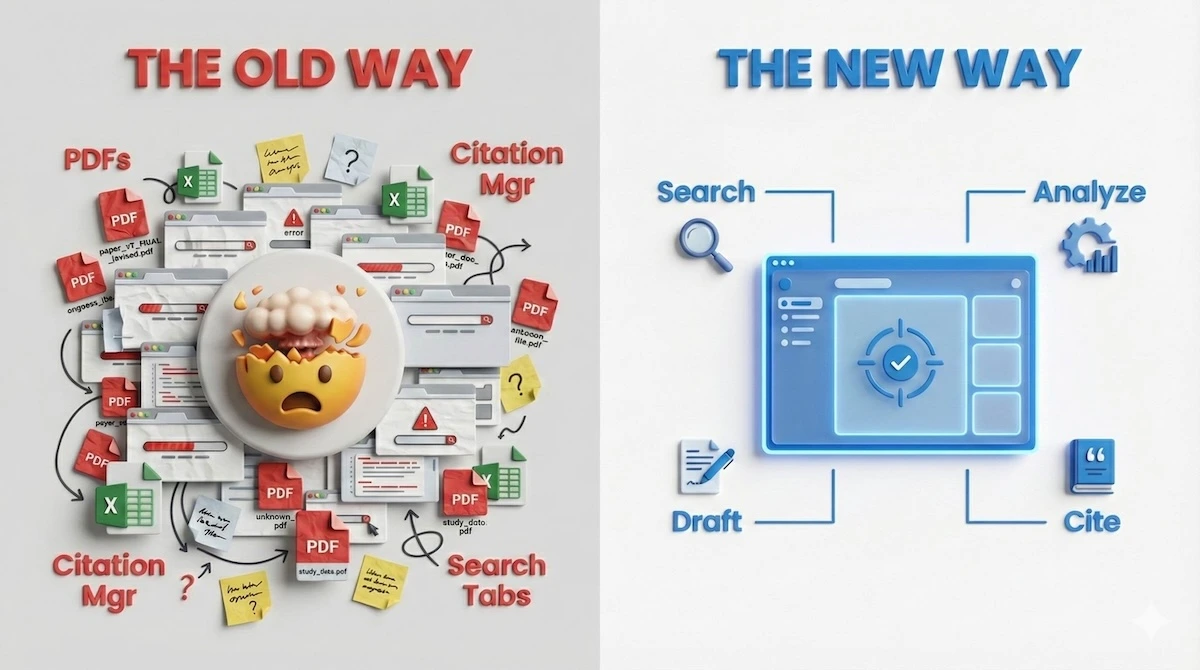
Why Literature Reviews Feel Hard and How AnswerThis Fixes It
A strong literature review requires three things simultaneously: exhaustive discovery (finding all the relevant papers, not just the ones that appear first in a Google Scholar search), careful appraisal (evaluating quality, methodology, and relevance for each source), and clear synthesis (weaving individual findings into a coherent argument that answers a specific research question).
Most students and researchers address these as three separate workflows with three separate tools producing a research process that is fragmented, hard to audit, and prone to losing track of which source supports which claim.
AnswerThis collapses these into a unified canvas. Users search papers, evaluate source quality through visible metadata and abstract access, extract methodological and findings data into structured tables, draft paragraphs with inline citations, and export to preferred formats all within a single interface.
The platform creates a transparent, auditable trail from claim to source that persists through the entire writing process, which is the feature that distinguishes it from general AI writing tools that produce text without preserving the source connection at the sentence level.
The literature review process has not fundamentally changed in what it requires, but the tools available to support it in 2026 have advanced significantly. AnswerThis represents the current generation of tools that integrate the full workflow rather than automating only one stage of it.
What Counts as a High Quality Literature Review
A literature review that withstands academic scrutiny demonstrates five essential characteristics. Understanding these criteria clarifies what AnswerThis is designed to support and where additional human judgment is required.
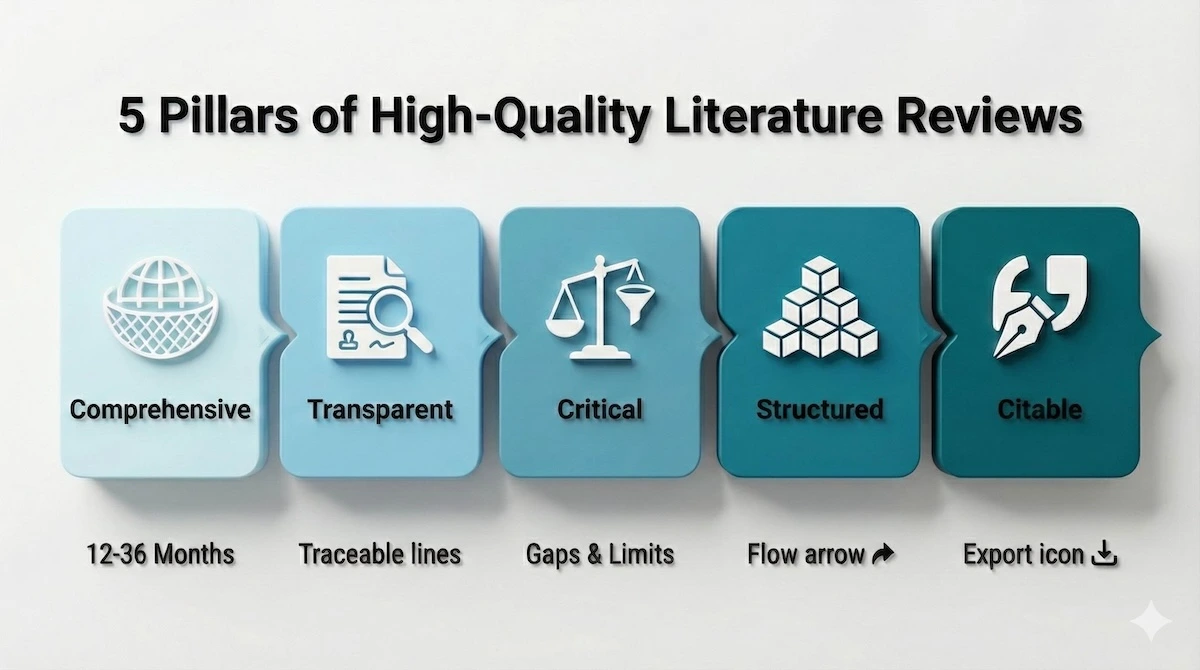
- Comprehensive and current: covering seminal foundational works and material from the last 12–36 months, with no significant relevant strand of the literature omitted.
- Transparent: every factual claim is traceable to a verifiable, identified source. Reviewers should be able to locate the original paper from the citation provided.
- Critical: the review identifies methodological strengths and limitations, conflicts between findings, and gaps in the evidence base not just summarizing what each paper found.
- Structured: moving logically from context through themes or methodology comparison to synthesis of current understanding and identification of future research directions.
- Citable: fully exportable in the citation format required by the target journal, institution, or style guide, with consistent formatting throughout.
AnswerThis directly supports the first, second, and fifth characteristics through its database coverage, inline citation system, and multi-format export.
The third characteristic critical evaluation requires the researcher’s judgment to activate: the platform surfaces methodological data and limitation flags, but determining whether a study’s sample size is appropriate for its claims, or whether conflicting findings are explained by methodological differences, remains a research skill the tool supports but cannot replace.
Lorex vs Hikvision vs Coram: Consumer Cameras vs Enterprise AI Surveillance
Step by Step: How to Build a Literature Review with AnswerThis in 2026
AnswerThis operates through a seven-step process that maps to the standard literature review methodology. Each step is supported by a specific platform feature, and the steps are designed to produce an auditable evidence trail throughout rather than generating output in a single pass that must be manually verified afterward.
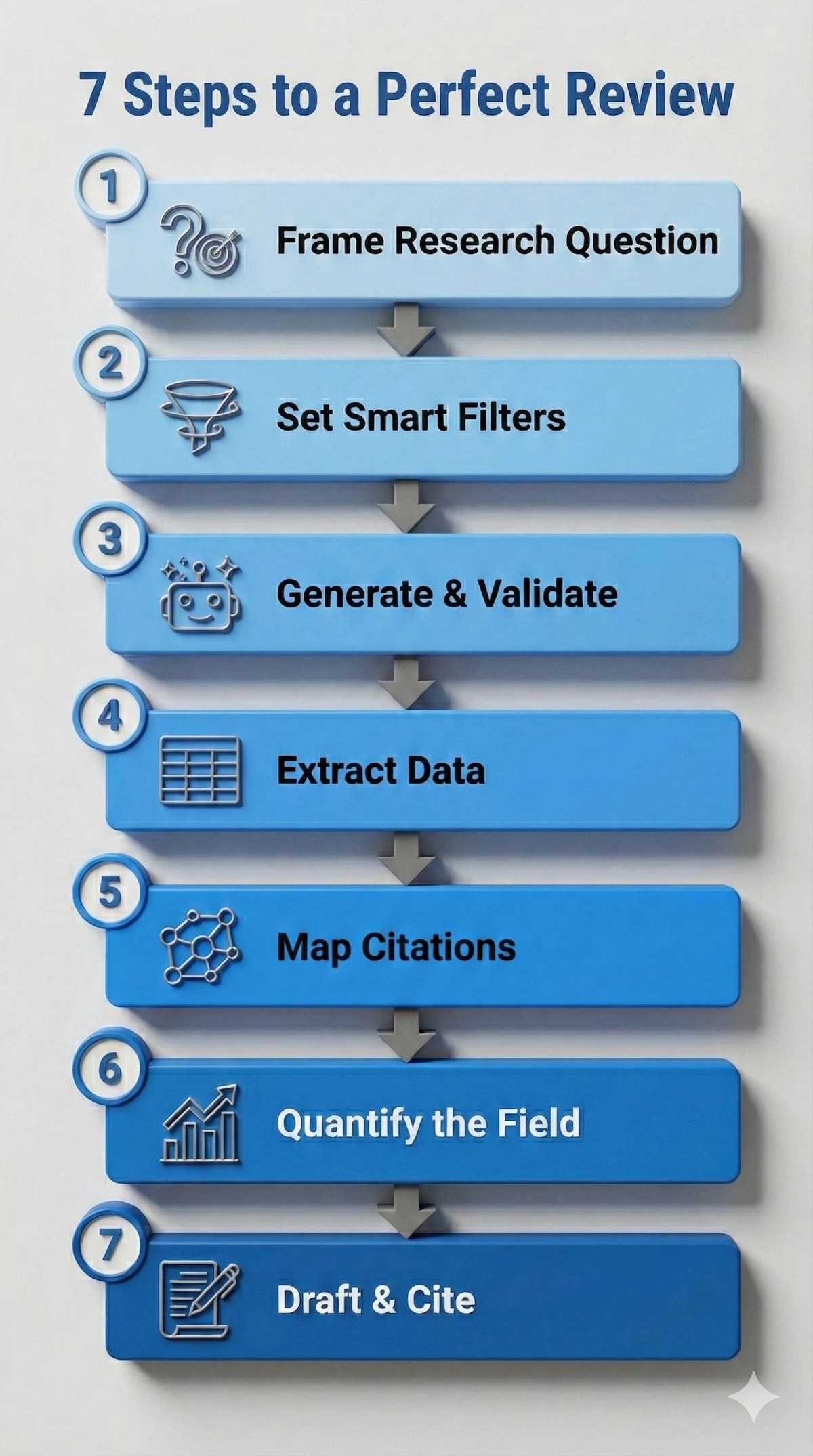
Step 1: Frame a Precise Research Question
Begin in the Literature Review canvas. Select “Full Review” for comprehensive multi-paragraph synthesis with line-by-line citations across multiple sources, or “Quick Q and A” for rapid scoping answers when assessing a topic’s breadth before committing to a full review.
The Prompt Helper offers structured intent options including “Write a literature review,” “Find relevant studies,” “Identify research gaps,” and “Compare methodologies” selecting the matching intent narrows the retrieval and generation logic to the most relevant paper types for your specific task.
Step 2: Set Smart Discovery Filters
Click “More Filters” to define your evidence base before generation. Available filter dimensions include:
- Databases: Semantic Scholar, OpenAlex, PubMed, and arXiv are the four primary databases. Selecting PubMed is essential for clinical and biomedical topics; arXiv is critical for current computer science and physics research where preprints precede journal publication by 12–18 months.
- Journal quality tier: Focus on Q1 journals for systematic reviews requiring highest evidence quality, or include Q1–Q2 for broader topic coverage.
- Citation floor: Set minimum citation counts to surface influential established papers, or disable the filter entirely for cutting-edge topics where recent papers have not had time to accumulate citations.
- Publication date range: Typically 2019 to present for recency in fast-moving fields; adjust to extend back to seminal works for well-established research areas.
- Web sources: Optionally include .gov and .edu resources for policy, regulatory, and institutional documents not indexed in academic databases.
Step 3: Generate the Review and Validate Claims
AnswerThis produces structured reviews with sections for context, scope, methodological landscape, key findings, limitations in the current evidence base, and future directions. Every sentence includes inline citations.
Clicking any citation opens a sources table displaying paper title, authors, venue, year, DOI, abstract, and relevant extracts aligned to the research question. One-click tools add columns for key findings, methods, or research gaps to the sources table for systematic extraction.
This step is where AnswerThis’s core differentiation is most visible: the claim-to-source link is preserved at the sentence level, not just at the paragraph or section level. Every specific assertion can be traced to its originating paper without navigating away from the canvas.
Step 4: Extract What Matters, Fast
The “Manage Columns” feature auto-extracts structured data from papers into the sources table:
- Methodology: study design, data type, sample size, analysis metrics
- Findings: effect sizes, model performance metrics, statistically significant results
- Limitations and biases: internal validity threats, dataset constraints, generalizability issues
- Gaps and opportunities: underexplored subproblems, unstudied populations, methodological improvements the authors recommend
For systematic reviews where PRISMA or similar methodological transparency is required, this extraction layer produces the structured data tables that systematic review protocols mandate without manual construction from individual paper reads.
Step 5: Map How Papers Connect
The Citation Map feature visualizes the citation network around a specific paper. Enter a DOI or title as the origin point and AnswerThis generates a visual map of incoming citations (papers that cite this work) and outgoing citations (papers this work builds on). This functionality surfaces:
- Influence chains showing how foundational papers have been developed or challenged
- Most-cited papers within the network for identifying landmark studies the review must address
- Connected works not retrieved in the initial keyword search that are centrally relevant through citation relationships
The citation mapping step frequently surfaces relevant papers that keyword searches miss, particularly for interdisciplinary topics where the same concept appears under different terminology in different fields.
Step 6: Quantify the Field, Not Just Describe It
Bibliometric analysis provides quantitative evidence about the research landscape rather than relying solely on the researcher’s subjective sense of the field. Available metrics include:
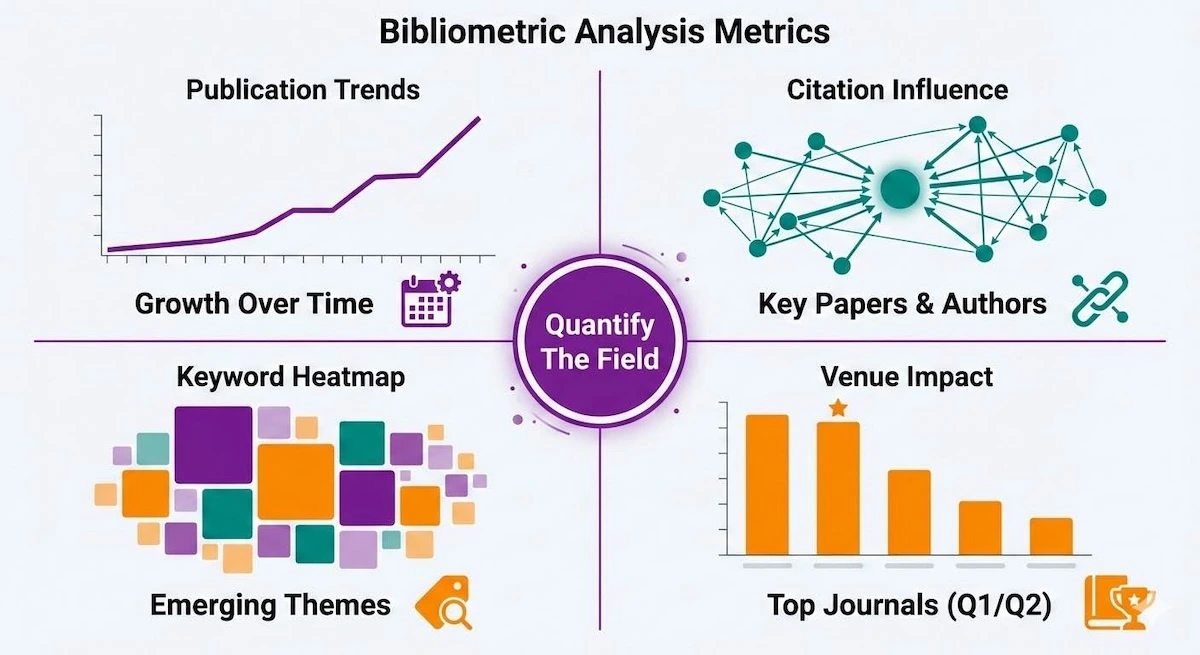
- Publication trends by year: determining whether a topic is emerging (steep recent growth), maturing (plateau), or declining
- Citation trends: identifying landmark studies marked by citation spikes and turning points where field direction shifted
- Volume versus influence: comparing total publication counts with citation-weighted influence to surface highly-cited but not frequently-published contributors
- Keyword frequency: tracking terminology shifts over time to understand how the field’s conceptual framing has evolved
- Author and venue analysis: identifying the most productive researchers and highest-prestige publication venues in the specific sub-field
Including a short bibliometric summary in the methodology section of a literature review demonstrates systematic approach and provides reviewers with evidence that the literature base was mapped quantitatively, not just sampled.
Paraphrasing-tool.ai Reviews, Alternatives, Pricing, & Offerings in 2025
Step 7: Draft, Refine, and Cite Without Leaving the Canvas

Use “Add to Notebook” to collect strong generated passages and personal annotations. The Full Notebook provides:
- Contextual AI editing with citations preserved through revision edited text retains source linkages
- One-click citation style switching across more than 2,600 styles including APA, MLA, Chicago, IEEE, Vancouver, Harvard, and discipline-specific variants
- Plagiarism and AI content detection checks before submission
- Figure, link, and table insertion directly in the draft
- Export to PDF, DOCX, LaTeX, or Markdown with citations properly formatted for each target format
- Reference list export to CSV or BibTeX for reference manager import (Zotero, Mendeley)
A Repeatable Literature Review Workflow You Can Trust
The seven steps above map to a repeatable research cycle that produces an auditable evidence trail from question to submission. The recommended full workflow cycle runs as follows:
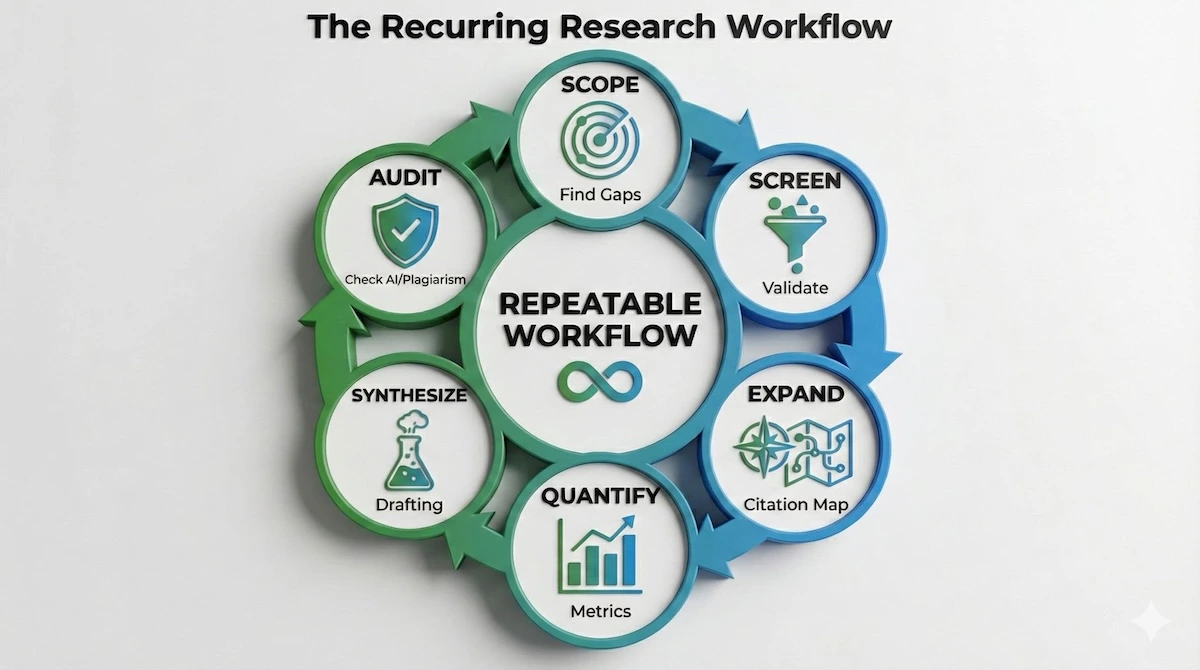
- Scope: run a gaps scan, set database and quality filters, generate full review with inline citations
- Screen: validate citation accuracy against source abstracts, extract methods and findings into structured table columns
- Expand: search additional papers by keyword and author, build citation map around most important papers to surface related works
- Quantify: run bibliometrics for field-level overview, capture publication trend data for methodology section
- Synthesize: draft review sections in notebook with source linkages preserved throughout revision
- Audit: switch citation styles, check plagiarism and AI content signals before submission
- Export and share: PDF for submission, DOCX for supervisor review, LaTeX for journal submission, or shareable links for co-author access
Running this cycle consistently produces literature reviews that are defensible in academic contexts because every stage generates an auditable record. Supervisors and reviewers can trace which papers were included, why they were selected (filter criteria), and what specific evidence supports each claim in the final draft.
Too Many Reports, Not Enough Time: How Executives Are Using AI to Digest Long Documents
AnswerThis vs. Elicit, Consensus, and Other AI Research Tools in 2026
AnswerThis is not the only AI tool designed to support literature review workflows. Understanding where each alternative performs best helps researchers construct a tool stack appropriate to their research type and methodology requirements.
| Tool | Primary Strength | Key Limitation | Pricing (2026) | Best For |
|---|---|---|---|---|
| AnswerThis | Full workflow: discovery + extraction + citation-linked drafting + export | Critical evaluation of source quality still requires researcher judgment | Free (5 reviews); Pro $35/month or $250/year | Graduate students and researchers needing full-workflow synthesis with submission-ready output |
| Elicit | Structured paper table with AI-extracted column data per paper | Limited drafting capability outputs tables, not prose | Free tier; Plus ~$12/month; check elicit.com for current rates | Systematic extraction of specific data points (effect sizes, sample sizes) across many papers |
| Consensus | AI-powered search returning consensus status (supported/mixed/unsupported) for specific claims | Better for factual claim verification than synthesis; limited drafting | Free; Premium ~$9.99/month; check consensus.app for current rates | Quickly checking whether scientific consensus supports a specific claim before writing |
| ResearchRabbit | Visual citation network discovery — “Spotify for papers” | Discovery only no synthesis, drafting, or citation generation | Free | Expanding a known set of papers through citation and recommendation networks |
| Semantic Scholar | Deep academic search database with AI-powered relevance features | Search and organization only no synthesis or citation-linked drafting | Free | Initial paper discovery, particularly for CS, medicine, and biomedical fields |
AnswerThis and Elicit serve overlapping but distinct needs. Elicit excels at systematic data extraction building a structured table of effect sizes, sample sizes, and methodology details from 50–200 papers for a formal systematic review protocol. AnswerThis excels at synthesis moving from a searched paper set to a citation-linked draft that can be directly edited for submission.
For a graduate student writing a standard literature review chapter, AnswerThis covers the full workflow. For a researcher conducting a formal systematic review requiring PRISMA-compliant data extraction tables, combining Elicit for extraction and AnswerThis for synthesis drafting is an effective complementary stack.
Consensus is best used as a claim-verification tool rather than a literature review tool: you have a specific hypothesis (“does exercise reduce anxiety in adults with depression?”) and want to know what the research consensus says before committing to a detailed review.
ResearchRabbit works best as a discovery supplement to AnswerThis when you have a set of core papers and want to find everything cited by and citing those papers before generating the full review.
Best Practices for Stronger Literature Reviews With AnswerThis
Critical source evaluation requires balancing novelty with established influence. Set filters to include both recent papers (2021–present) and a citation-floor filter that captures seminal works from earlier periods that shaped the current field.
Reviews that include only recent papers miss foundational methodological development; reviews that include only high-citation papers miss emerging research that is reframing the question.
State inclusion criteria explicitly in the methodology section: databases searched, date range, publication quality thresholds, language parameters, and any methodological scope restrictions. AnswerThis’s filter settings can be documented directly from the interface, providing a transparent record of the search protocol.
Differentiate between empirical and theoretical contributions when structuring the synthesis. Empirical papers and theoretical frameworks serve different argumentative functions in a review use the methodology extraction columns to separate them before drafting.
Normalize terminology early. Research fields frequently contain multiple terms for the same concept across disciplinary traditions. Use the keyword frequency analysis to identify major terminological variants before drafting, then choose a consistent vocabulary and apply it throughout the review with appropriate cross-reference to alternative terms used in the literature.
Every claim requires a source. This principle is enforced structurally by AnswerThis through the inline citation system, but it requires the researcher’s active attention during revision: when editing generated text for clarity or flow, verify that citation links remain intact after rewording.
Who Benefits Most from AnswerThis for Literature Reviews
AnswerThis provides measurable workflow improvement across four researcher profiles:
- Undergraduates writing seminar papers or thesis chapters who need structure, verifiable citations, and export to required formatting styles without building a full reference management workflow.
- Master’s and PhD researchers conducting systematic or scoping reviews where methodological transparency, structured data extraction, and citation network completeness are requirements rather than advantages.
- Faculty and principal investigators preparing grant application background sections and related work summaries for journal submissions, where speed and citation accuracy are the primary constraints.
- Industry researchers and clinicians requiring quick, citable evidence syntheses for decision support documents, regulatory submissions, or clinical practice guidelines where audit trails are mandatory.
Plus AI vs Slidesgo and 5 Other AI Slide Makers Ranked for 2026
Pricing: Free Tier and Pro Plan in 2026
AnswerThis pricing in 2026 is structured around a free tier for initial evaluation and Pro subscription for sustained use:
| Plan | Price | Literature Reviews | Features |
|---|---|---|---|
| Free | $0 | First 5 reviews | Full workflow access including citation-linked drafting, export, and bibliometrics |
| Pro (Monthly) | $35/month | Unlimited | All features, unlimited citations, priority access, all export formats |
| Pro (Annual) | $250/year (~$20.83/month) | Unlimited | All Pro features at 40% discount versus monthly billing |
The free tier’s five-review allowance is sufficient for a single course paper or thesis chapter it provides a meaningful evaluation of the full workflow before payment commitment. The Pro plan at $250/year positions AnswerThis as competitively priced relative to Elicit’s Plus plan and substantially more capable for synthesis-focused work than Consensus’s premium tier.
Researchers who use the platform for 3–5 literature reviews per year will typically find the annual Pro plan cost-effective; those conducting one substantial review annually (such as a PhD thesis literature review) may find the five free reviews combined with a single month of Pro subscription during the writing phase a lower-cost approach.
Frequently Asked Questions
Is AnswerThis accurate enough to use for academic submissions?
AnswerThis generates citations linked to specific papers, which means accuracy claims can be verified at the source level rather than accepted at face value. The inline citation system allows researchers to click through to the originating paper for any claim, confirm the source actually supports the stated finding, and edit the generated text where the AI’s interpretation differs from the paper’s actual content. This verification step is essential before submission AnswerThis accelerates draft production, but editorial judgment and source verification remain the researcher’s responsibility. The claim-to-source transparency makes this verification faster than with general AI tools, not unnecessary.
Which databases does AnswerThis search?
AnswerThis searches Semantic Scholar, OpenAlex, PubMed, and arXiv. This covers most academic disciplines effectively, though researchers in humanities fields may find the coverage of humanities journals less comprehensive than in STEM and social science fields. For humanities literature reviews, supplementing with manual searches of discipline-specific databases (JSTOR, MLA International Bibliography, ATLA Religion Database) and importing those results into AnswerThis for synthesis may be necessary for complete coverage.
How does AnswerThis handle citation formatting for different journals and institutions?
AnswerThis supports more than 2,600 citation styles with one-click switching between styles throughout the notebook. This means a researcher writing for submission to a journal using APA 7th edition can switch to IEEE format for a conference paper using the same underlying source set without manual reformatting. Export to PDF, DOCX, LaTeX, and Markdown formats applies the selected citation style automatically, and BibTeX export enables import into Zotero or Mendeley for reference library management.
Is AnswerThis appropriate for systematic reviews requiring PRISMA compliance?
AnswerThis supports key elements of PRISMA-compliant systematic review methodology: transparent database and filter documentation, structured data extraction across papers, bibliometric quantification, and citation-linked synthesis. It does not generate a formal PRISMA flow diagram or provide automated risk-of-bias tools. For formal systematic reviews submitted to Cochrane or similar standards, AnswerThis is most effective as a synthesis drafting and data extraction tool, used alongside purpose-built systematic review tools (Covidence, RevMan) for the formal screening and risk-of-bias assessment phases.
Key Takeaways
- AnswerThis integrates paper discovery, quality filtering, structured data extraction, citation-mapped synthesis, and multi-format export into a single auditable workflow eliminating the tab-switching and citation-chain breakdowns of fragmented research tool stacks.
- The platform’s defining feature is claim-to-source transparency: every generated sentence links to a specific verifiable paper, making the output directly editable for submission rather than requiring manual re-attribution.
- The seven-step workflow (scope → screen → expand → quantify → synthesize → audit → export) maps to standard literature review methodology and produces a defensible audit trail from question to submission.
- AnswerThis is best compared to Elicit for systematic extraction, Consensus for claim verification, and ResearchRabbit for citation network discovery each addresses a different stage of the review process, and they can be combined effectively.
- The free tier provides five full-workflow reviews — sufficient for a course paper or thesis chapter evaluation. The Pro plan at $250/year is competitively priced for researchers conducting multiple reviews annually.
- Critical evaluation of source quality and interpretation of evidence gaps remains the researcher’s responsibility AnswerThis accelerates the production workflow but does not substitute for academic judgment in evaluating what the evidence means.
AnswerThis represents the current generation of AI research tools that address the full literature review workflow rather than automating only the discovery or only the writing stage. The platform’s greatest practical advantage is the transparency it creates: a complete record of which papers were searched, how they were filtered, what was extracted, and which specific sources support each claim in the final draft.
For graduate students, faculty, and researchers who need to produce defensible, citation-verified literature reviews efficiently, this audit trail is the capability that makes AnswerThis practically useful rather than merely convenient.
Educational content only. AI-generated citations must be verified against source papers before academic submission. Pricing and feature availability subject to change verify at AnswerThis.io before purchasing.
******************************
This article provides general educational guidance only. It is NOT official exam policy, professional academic advice, or guaranteed results. Always verify information with your school, official exam boards (College Board, Cambridge, IB), or qualified professionals before making decisions. Read Full Policies & Disclaimer , Contact Us To Report An Error