CollegeVine Review: Pricing, Chancing Accuracy, and Alternatives

- CollegeVine’s free tools — chancing calculator, scholarship finder, school list — are reliably useful at no cost.
- The chancing algorithm overestimates chances at schools with acceptance rates below 30%.
- Paid advising averages ~$1,300 with a strict 24-hour refund window; get terms in writing first.
- Mentor quality varies; CollegeVine assigns mentors — students cannot choose their own.
- CollegeVine does not offer subject tutoring; it focuses solely on US college admissions.
CollegeVine is one of the most widely used college admissions platforms in the US — a free chancing calculator built on 100,000+ data points, a scholarship finder, near-peer mentors from top universities, and advising programs priced at roughly one-third the cost of traditional private counselors. Students preparing for IB MYP examinations or other rigorous curricula can find an IB MYP tutor for subject-level support alongside admissions planning tools like CollegeVine. For students using only the free tools, that value proposition holds up well. For students who pay for the mentoring programs, the picture is significantly more complicated.
This review covers what CollegeVine charges, where its chancing tool is reliable and where it breaks down, what independent reviewers report on the paid advising experience, and how CollegeVine compares to alternatives — including free tools that serve some of the same functions at no cost.
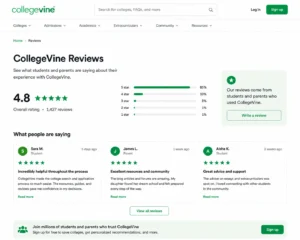
CollegeVine Reviews and Testimonials
Students who rely on CollegeVine’s chancing tool to build a paid admissions program — often because the 4.5/5 Bold.org rating and near-peer mentor pitch feel credible — will find that the chancing algorithm becomes less accurate precisely at the selective schools that justify paying $1,300 for advising. One documented case on both Trustpilot and Scam Detector describes a student with 99th-percentile SAT scores (99% SAT, 98% ACT) spending $6,000 on CollegeVine advising, following the platform’s Safe/Target/Possible college list, and being rejected by 16 of 18 schools — with CollegeVine offering only a partial refund and no explanation.
According to a CollegeVine community Q&A (2024), a separate student was given a 40% chancing on NYU ED II and did not receive admission, with forum context confirming the chancing engine underweights holistic factors at schools with acceptance rates below 30%.
The rating gap across platforms reflects two genuinely different populations. Bold.org aggregates 1,076 student testimonials at 4.5/5 — users praising the free college list, scholarship search, and the comfort of having structured admissions data. Trustpilot’s 63 reviews average 3.8/5, with the negative reviews concentrated among students who paid for mentoring services.
One Trustpilot reviewer canceled paid sessions after two weeks and lost approximately $800, describing the advice received as “study more” and “make pro/con charts” from a mentor three years older than themselves. They noted they subsequently gained admission to an Ivy League institution using guidance from friends, family, and teachers instead.
A third distinct complaint category involves platform reliability. One Trustpilot reviewer in 2026 described CollegeVine’s AI-assisted platform deleting information when attempting to share access between student and parent accounts, and flagged an inaccurate submission deadline for Dartmouth (CollegeVine listed an ED II round that does not exist). The reviewer described support responses as “vague suggestions” with no resolution.
The picture that emerges from independent reviews: CollegeVine’s free tools are widely valued and reliably useful for early-stage college list building. The paid mentoring experience varies significantly by mentor, and the most serious complaints relate to chancing inaccuracy at selective schools combined with a refund policy that makes it difficult to exit when the service does not deliver.
CollegeVine Chancing Accuracy: Where It Works and Where It Doesn’t
The chancing tool is CollegeVine’s most-used feature and the foundation of its value proposition. Understanding where the algorithm is reliable — and where it breaks down — matters more than any single rating score, because it directly determines whether the paid advising program is built on sound guidance.
CollegeVine’s chancing engine uses GPA, test scores, extracurricular activities, demographics, and other holistic factors across 100,000+ data points. That breadth gives it a genuine advantage over Naviance, which focuses primarily on GPA and test scores from a student’s specific high school. For schools with acceptance rates above 40%, independent forum feedback suggests the chancing produces reasonable directional estimates — one user confirmed accuracy for “less competitive schools.”
The documented failure mode is at selective schools. At schools with acceptance rates below 30%, the chancing algorithm has been independently described as overestimating chances and misclassifying reach schools as targets or safeties. One Trustpilot reviewer described Northeastern — which now carries a sub-15% acceptance rate — appearing as a “safety school” in the chancing results. The CollegeVine forum itself contains the admission that the tool “becomes a little more inaccurate as the admission standards of the school increase.”
Students preparing for language examinations alongside college applications — for instance, those sitting IGCSE Hindi as a Second Language — will find CollegeVine’s tools focused on US admissions rather than international curriculum support.
| School Selectivity Tier | Acceptance Rate Range | Chancing Reliability (per independent feedback) | Key Limitation |
|---|---|---|---|
| Broad-access / regional | >50% | Generally reliable | Minimal — admissions largely stats-driven at this tier |
| Selective | 30–50% | Reasonable directional estimate | Holistic factors weighted; use as a range, not a precise figure |
| Highly selective | 15–30% | Increasingly unreliable | Extracurricular weighting imprecise; may overestimate chances |
| Most selective (Ivy / T20) | <15% | Documented overestimation in multiple cases | Holistic admissions at this tier involves factors no algorithm captures reliably |
The practical implication: the chancing tool is most useful — and most reliable — for building the broad structure of a college list (separating clearly out-of-reach schools from genuinely attainable ones). It is least reliable exactly where it is most consequential: helping students decide whether to apply Early Decision to a selective school, or whether a school is a genuine safety. Students using CollegeVine to plan applications to highly selective schools should treat the chancing as a starting estimate and cross-reference with their school counselor and the school’s published Common Data Set.
CollegeVine Pricing
A student choosing between CollegeVine’s free tools and its ~$1,300 average advising program will find that the free chancing calculator and scholarship search deliver the platform’s most reliable value — while Trustpilot reviewers who paid for mentoring describe losing $800 after two weeks of sessions that produced advice no more specific than “study more” and “make pro/con charts.” According to CollegeVine’s Trustpilot record (2026), the 24-hour refund window is the operative constraint: one reviewer lost $800 to the strict cancellation policy, and a separate family lost access to meaningful recourse after a platform error left their student without viable college options for an entire application year.
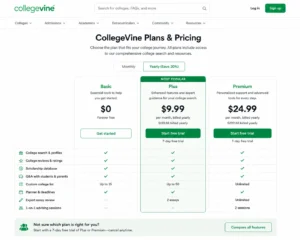
CollegeVine operates on a pay-per-service model rather than a monthly subscription. Core pricing:
| Service | Cost (USD) | What’s Included | Refund Window |
|---|---|---|---|
| Free Tools | $0 | Chancing calculator, school list generator, scholarship finder, peer Q&A forum, peer essay review | N/A |
| Expert Essay Review | ~$60/essay | Written feedback from CollegeVine expert (college student/recent alum) | 24-hour window after purchase |
| Advising Programs | ~$1,300 average | Multi-session mentoring (application strategy, essays, resume); mentor matched by CollegeVine | 24-hour window after purchase; strict after that |
| Full Premium Programs | Up to ~$6,000+ (documented) | Comprehensive multi-month advising | Partial refund at company discretion |
The refund policy is CollegeVine’s most consistently criticised feature in independent reviews. The 24-hour window is shorter than industry standard for professional services of this value. There is no published refund policy on the CollegeVine website — students must ask directly before paying to confirm current terms. If you cannot get the refund terms in writing before payment, treat the purchase as non-refundable.
Payment is accepted via credit card or PayPal. No subscription fee applies to free tools. CollegeVine does not advertise discounts for low-income students, though its mission language emphasises access — a tension that has drawn criticism from reviewers who found the pricing and refund policy inconsistent with the accessibility mission.
CollegeVine Free Tools vs. Paid Services: The Practical Decision
The most actionable question for most students is not “is CollegeVine worth it?” but “which parts of CollegeVine are worth using?” The answer from independent review data is consistent: the free tools are the reliable product; the paid mentoring is where value varies sharply by mentor assignment.
The free chancing calculator, school list generator, and scholarship finder represent genuine value at $0. They are praised across Bold.org, Trustpilot positive reviews, and forums. The peer essay review (also free) allows community members to critique an essay without cost — a lower-stakes alternative to the paid expert review that many students use effectively as a first pass before investing in paid feedback.
The paid expert essay review at ~$60 per essay falls within market range and is appropriate for students who want structured written feedback before a final submission. The risk is modest given the per-essay pricing.
The paid advising programs at $1,300+ carry a different risk profile: the mentor is assigned by CollegeVine (not chosen by the student), the mentor is typically a current college student or recent graduate rather than a credentialled professional admissions counselor, and the 24-hour refund window means there is effectively no trial period.
Students whose primary goal is managing the application process with strong free tools — chancing, school list, scholarship search, Q&A — will get that from CollegeVine at no cost. Students who need deeper essay guidance or application strategy at a price point below traditional private counselors ($3,000–$10,000+) should request to review a mentor’s background and prior student outcomes before committing to the $1,300+ program, and confirm refund terms in writing before payment.
Students also exploring other review-based platforms may find it useful to read about Photomath’s pricing and alternatives for a comparable look at how edtech platforms structure their free and paid tiers.
CollegeVine Alternatives
Students exploring alternatives to CollegeVine typically fall into one of two groups: those who want different or better admissions tools, and those who need academic subject help that CollegeVine does not provide. The alternatives below address both categories.
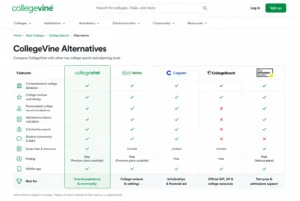
| Platform | Focus | Price | Best For | Key Limitation vs. CollegeVine |
|---|---|---|---|---|
| CollegeVine (free tools) | Admissions planning | Free | Chancing, school list, scholarships | N/A — free tier is the reliable product |
| Naviance | School-based admissions data | Via high school (no student cost) | Your own school’s historical GPA/SAT data per college | No extracurricular weighting; older data; less holistic |
| College Confidential | Peer community / forums | Free | Real-time peer insight, application results | No chancing algorithm; highly subjective |
| Chegg | Homework help / STEM Q&A | ~$15–$20/month | Textbook solutions, quick homework answers | No admissions tools; no essay feedback |
| Wyzant | Tutoring marketplace | $30–$100+/hr | One-on-one subject tutoring; first lesson free | No admissions tools; quality varies |
| Course Hero | Study materials library | ~$10–$40/month | Notes, textbook solutions, reference material | No live tutoring; user-contributed quality varies |
| My Engineering Buddy | 1:1 STEM tutoring | From ~$20/hr; no subscription | College-level engineering, physics, math, CS | No admissions tools; STEM-only focus |
| Tutor.com | Live online tutoring (Princeton Review) | Monthly plans or pay-per-session | School and SAT/ACT prep; vetted tutors | No admissions tools; higher cost than MEB for STEM |
For students who need admissions tools specifically, the free tier of CollegeVine remains the most comprehensive single-platform option at no cost — the chancing calculator, scholarship finder, and school list tool are genuinely difficult to replicate for free elsewhere. Naviance (if available through your school) adds a useful data layer based on your specific high school’s historical outcomes and complements CollegeVine’s broader algorithm.
For students who need help with the academic subjects that appear on college applications — SAT/ACT math, AP physics, engineering coursework — CollegeVine does not offer subject tutoring. Political science tutoring is one example of the breadth of subjects available through specialist platforms for students whose applications involve humanities coursework alongside STEM.
Students comparing online tutoring platforms more broadly may also find the Sherpa Online review covering features, pricing, and alternatives a useful reference point.
How CollegeVine Works
For Students
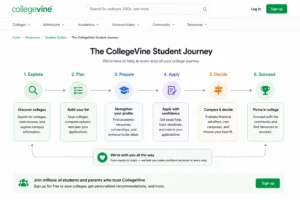
Students create a free CollegeVine account and enter academic details — GPA, test scores, extracurricular activities, and interests — to build a profile. The free chancing calculator and school list tools are immediately available.
For paid services, students select a service (essay review or advising program), pay at checkout, and are matched with a mentor by CollegeVine. Mentor matching is done by the platform, not by the student — this is the single factor most often cited in negative paid reviews, since students cannot pre-select a mentor based on their own assessment of fit or expertise.
All sessions are conducted online via video or chat. CollegeVine’s calendar tool manages scheduling. Students who need to communicate between sessions use the platform’s messaging system.
For Tutors
Mentors (called consultants) on CollegeVine are typically current college students or recent graduates. Applications go through an online form, followed by a profile and background review, and an interview process.
Accepted mentors are paid a fixed rate per session set by CollegeVine; they cannot set their own rates. This model keeps costs lower than traditional admissions consultants, but it also means the depth of expertise varies with the individual mentor’s experience — a first-year college student mentoring a high school junior and a recent Harvard graduate mentoring the same student are both “CollegeVine mentors” at the same rate.
Company Information
CollegeVine was founded in 2013 (incorporated January 2016 as Canopy Education, Inc.) by Johan Zhang, Zack Perkins, and Vinay Bhaskara while at Harvard and UChicago. It began as a near-peer mentoring network called Admissions Hero.
According to Tracxn (2026), CollegeVine has raised $30.7M across three funding rounds, with its most recent Series B in April 2019 from Morningside and Fidelity Investments. As of its last disclosed headcount, CollegeVine employed 43 people. Zack Perkins serves as CEO.
CollegeVine’s platform has reached over 2.3 million students through institutional partnerships. In late 2024, the company expanded into AI-driven tools for university recruitment, including an AI Recruiter and AI Advisor product aimed at higher education institutions — a pivot that signals CollegeVine repositioning itself as a B2B platform alongside its direct-to-student consumer products.
Students interested in professional certification pathways alongside their college planning — such as those pursuing a Certified Internal Auditor (CIA) qualification — will find CollegeVine’s tools focused exclusively on undergraduate admissions rather than professional exam preparation.
CollegeVine’s Unique Selling Points
The free chancing calculator is CollegeVine’s most defensible differentiator. No competing free platform integrates GPA, test scores, extracurricular activities, demographics, and coursework rigor into a single admission probability estimate. For students in the early stages of building a college list, this is genuinely useful.
The near-peer mentor model keeps pricing below traditional counselors — $1,300 versus the $3,000–$10,000+ charged by independent certified educational planners. For students who cannot access private counseling at traditional rates, CollegeVine’s network represents a real access benefit. The scholarship finder and community Q&A forum add further free utility that independent reviewers consistently praise.
CollegeVine’s 2024 AI expansion also positions it as one of the few college planning platforms with active institutional partnerships — universities using the platform have access to CollegeVine’s student data for recruitment purposes, which in theory improves the quality of college-specific data feeding the chancing algorithm over time.
CollegeVine Drawbacks
The chancing algorithm’s documented overestimation at selective schools is the most consequential drawback for students targeting T20 or Ivy institutions. A student who builds an entire paid advising engagement around a college list that CollegeVine classified as Safe/Target/Possible, and then applies to 18 schools with 99th-percentile test scores and is rejected by 16, has not made an isolated poor decision — they followed the platform’s core product and it produced a misleading outcome. That case is documented in public reviews; CollegeVine offered a partial refund and no explanation.
The mentor quality variance follows directly from the model: a network of current college students will always include both excellent and mediocre mentors, and CollegeVine’s platform assignment (not student selection) means quality is not predictable in advance. Students who received advice of “study more” and “make pro/con charts” in paid sessions — specific language appearing in a Trustpilot review — were not getting advice proportionate to the $800+ they paid.
The 24-hour refund window is shorter than what the service’s price point warrants. At $60 for an essay review, a 24-hour window is inconvenient. At $1,300 for a multi-session advising program, it effectively eliminates the student’s ability to exit if the first session reveals a poor mentor match. CollegeVine does not publish this policy prominently before payment.
Finally, CollegeVine is strictly US-focused on the student side. International students can join, but the tools — chancing calculator, school list, Common App guidance — target the US admissions process. The free tools offer limited utility for students applying to UK, Canadian, or European universities.
Students comparing tutoring and edtech platforms may also find the Spires review covering pricing and alternatives a useful reference when evaluating online learning options. For technology-focused learning programs, the iD Tech tutoring overview for students covers a different segment of the edtech market. Students interested in how project management skills factor into college coursework can also explore resources on project management as an academic subject.
Comparison with My Engineering Buddy
My Engineering Buddy (MEB) and CollegeVine address different problems. CollegeVine helps students navigate the college application process. MEB helps students succeed in college-level STEM coursework. They are not direct substitutes — a student can use CollegeVine’s free tools to plan applications while using MEB for help with AP Physics, calculus, or engineering coursework.
The structural comparison that matters: CollegeVine’s paid mentoring assigns a mentor and operates under a 24-hour refund window. MEB operates pay-per-session with no subscription, no assignment lock, and published per-session pricing. Students who experienced CollegeVine’s strict refund policy frequently contrast it with pay-as-you-go platforms where financial risk is bounded to a single session.
Customer Support and Policies
CollegeVine provides email support and a help center. Independent reviewers consistently describe slow or absent responses to complaints — several Trustpilot reviews explicitly note that CollegeVine “hasn’t replied to negative reviews,” suggesting the company does not actively monitor or respond to public feedback.
The refund policy is not clearly published on the site; users must ask directly before payment to establish current terms. Payments are accepted via credit card or PayPal; there is no self-serve cancellation dashboard for mentoring programs.
Global Reach and Localization
CollegeVine is primarily US-focused. Its tools centre on the US college admissions process, Common App, and US scholarship data. In 2024, CollegeVine expanded its AI agent platform with support for 30+ languages, primarily for its institutional B2B products.
The company now reports partnerships with schools in over 20 countries and claims 2.3 million students globally through institutional channels. However, the student-facing free tools remain most useful for students applying to US colleges.
CollegeVine’s Future Plans
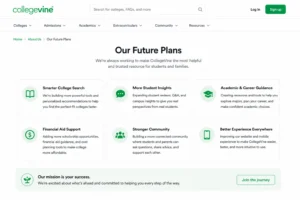
CollegeVine’s 2024 product expansion into autonomous AI agents for university recruitment signals a strategic pivot toward the B2B institutional market. Products like the AI Recruiter and AI Advisor are aimed at universities and colleges rather than directly at students. This positions CollegeVine as infrastructure for admissions offices, with the student-facing platform serving as a demand-generation channel for the institutional product.
The student-facing product roadmap includes expanded data-driven tools and additional institutional partnerships (notably the 2023 partnership with General Assembly reaching 2.3 million students). Whether the AI expansion improves the chancing algorithm’s accuracy at selective schools — the most consequential gap in the current product — has not been publicly addressed.
For most students, the right CollegeVine strategy is: use everything that’s free, and treat paid mentoring as an optional add-on only after confirming refund terms and reviewing your specific mentor’s background. The free chancing calculator, scholarship search, and school list tools alone justify creating a CollegeVine account — and for many students, that is all they will need.
Need help with the STEM coursework behind your college applications — AP Physics, Calculus, Computer Science, or college-level engineering? My Engineering Buddy connects students with specialist tutors at transparent per-session rates with no subscription or cancellation risk.
FAQs About CollegeVine
How does CollegeVine compare to My Engineering Buddy?
CollegeVine helps students navigate college admissions — chancing calculator, school list, essay review, and mentoring. My Engineering Buddy provides 1:1 STEM tutoring for college-level engineering, physics, and mathematics. They address different problems and can be used together. CollegeVine operates on a pay-per-service model with a strict 24-hour refund window; MEB operates pay-per-session with no subscription lock-in.
Is CollegeVine free to use?
The core tools — chancing calculator, scholarship finder, school list generator, peer essay review, and Q&A forum — are free. Paid services include expert essay reviews (~$60/essay) and advising programs (~$1,300 average). No subscription fee applies to free access.
Who is CollegeVine designed for?
CollegeVine is designed for US high school students applying to four-year universities, primarily juniors and seniors. The free tools are useful from sophomore year onward. International students can use the platform, but the tools target the US admissions process and have limited utility for UK, Canadian, or European applications.
Is CollegeVine’s chancing tool accurate?
For schools with acceptance rates above 40%, independent feedback suggests CollegeVine’s chancing tool produces reasonable directional estimates. For highly selective schools (below 15–20% acceptance rate), multiple independent reviewers — including on CollegeVine’s own forum — describe the algorithm as overestimating chances. One Trustpilot case documents a student with 99th-percentile test scores being rejected by 16 of 18 schools classified as Safe or Target by CollegeVine’s chancing. Use the tool as a starting estimate, not a precise prediction, and cross-reference with your school counselor for selective schools.
What is CollegeVine’s refund policy?
CollegeVine’s refund window is approximately 24 hours after purchase. After that, refunds are at company discretion and multiple reviewers describe them as effectively unavailable. The policy is not published prominently on the site — confirm terms in writing before paying for any service above the free tier.
Can CollegeVine guarantee college admission?
No. CollegeVine provides guidance and tools but cannot guarantee admission to any school. The company highlights historical acceptance statistics, but these are not guarantees and reflect a self-selected population of students who used the platform.
How do I start using CollegeVine?
Sign up for a free account at collegevine.com, enter your GPA, test scores, and extracurricular details, and the chancing calculator and school list tools are immediately available. Paid services require selecting a program and paying at checkout; you are then matched with a mentor by CollegeVine.
Related Reading
******************************
This article provides general educational guidance only. It is NOT official exam policy, professional academic advice, or guaranteed results. Always verify information with your school, official exam boards (College Board, Cambridge, IB), or qualified professionals before making decisions. Read Full Policies & Disclaimer , Contact Us To Report An Error