
Education Tutoring: Personalized Learning and Online Teaching for Students

Education tutoring provides personalized, one-on-one instruction that significantly improves student learning and confidence. Studies show that the majority of students experience major grade improvements with tailored tutoring. This applies to both in-person and online tutoring across various subjects, making it a powerful tool for anyone needing extra academic support beyond the classroom.
What is Education Tutoring?
Imagine a high school student struggling to keep up in chemistry. For example, 10th grader Maria had fallen behind in algebra and felt confused by her textbook. When her parents arranged an education tutor to work with her one-on-one after school, things began to change. Each tutoring session, Maria’s tutor patiently reviewed difficult problems, adjusted lessons to her pace, and answered all her questions. Over a few weeks, Maria’s confidence grew along with her understanding of math concepts, and she began to earn better grades on her assignments and tests.
Tutoring itself means one-on-one academic help outside of regular class hours. An education tutor might meet a student at home, at a learning center, or online to reinforce classroom lessons and fill gaps. Unlike a classroom education teacher, who must follow a set curriculum and manage many students at once, a tutor focuses entirely on one student’s needs and learning style. This targeted attention means that if a student has specific challenges—like solving equations or understanding a science concept—the tutor can spend extra time on those topics until they are mastered. In this way, tutoring fills gaps that traditional classes may leave, providing a customized learning pathway for each student.
To visualize the fundamental difference between these two approaches, consider how a standard classroom compares to a personalized tutoring journey.
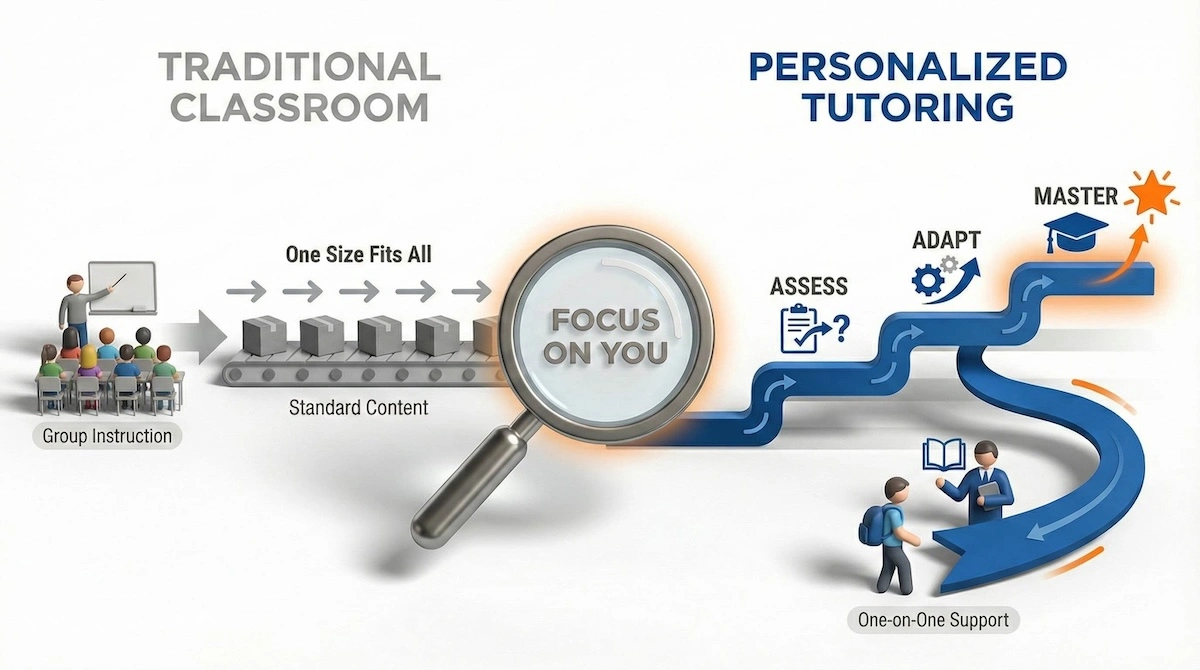
Personalized tutoring adapts the learning journey to your specific pace, unlike the rigid structure of traditional classrooms.
As shown above, while the classroom follows a rigid linear track, tutoring adapts in real-time to your unique pace and learning style.
Benefits of Education Tutoring
Tutoring offers several advantages that make learning easier and more effective:
- Personalized Learning: Tutors tailor lessons to each student’s pace and style. Research shows this individual focus leads to dramatically improved outcomes compared to one-size-fits-all classroom instruction.
- Academic Improvement: One-to-one tutoring often accelerates progress. In one study, 75% of students improved by up to three grade levels with sustained, personalized help. Consistent support can turn weak subjects into strengths over time.
- Greater Confidence: Working at their own pace helps students feel more confident. In fact, 90% of students who built confidence through tutoring also saw their grades improve. This boost in self-esteem encourages them to participate more in class and tackle harder problems.
The impact of this confidence boost is measurable. Recent data highlights the direct correlation between emotional support and academic performance.
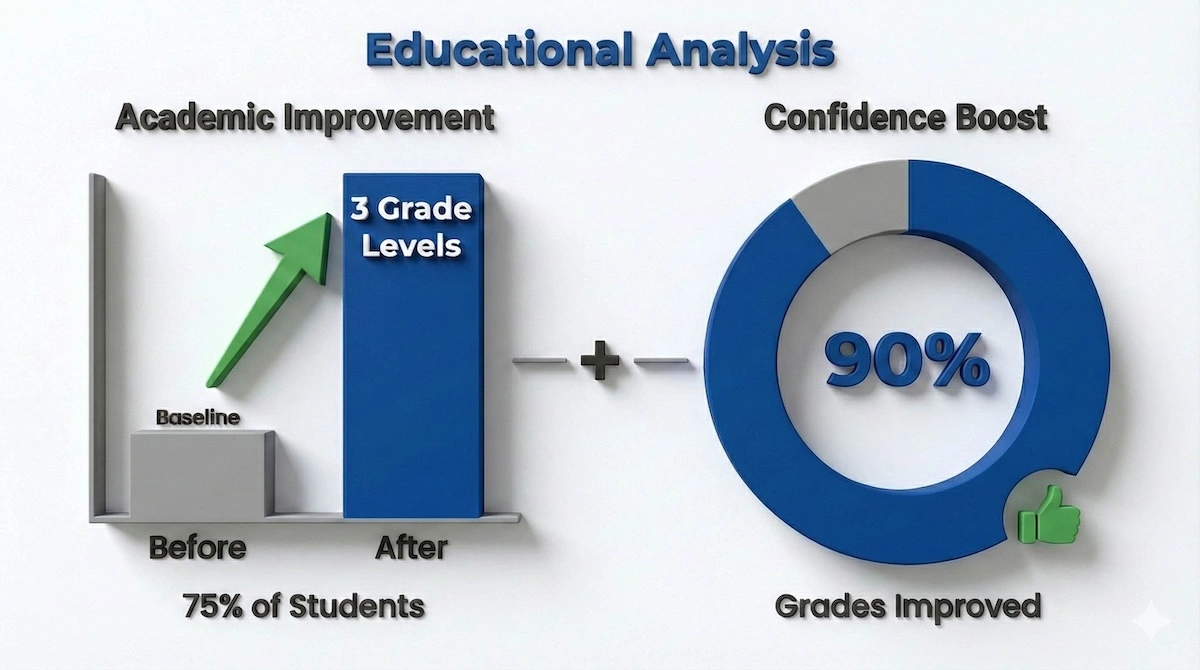
Studies show a direct link between personalized tutoring, increased confidence, and significant grade improvements.
With 90% of students reporting higher confidence, it is clear that the psychological benefits of tutoring are just as vital as the academic ones.
- Flexible Support: Tutors can target specific weaknesses and provide extra practice. High-impact tutoring has been shown to be many times more effective than standard models, helping students catch up and fill gaps that classroom settings may miss. Tutors also make homework and exam prep more manageable by focusing directly on what the student needs.
- Study Skills: Tutors often teach students how to organize their study time, take effective notes, and use problem-solving strategies. Learning these skills builds long-term habits that help students even when they are working alone later.
Education Tutoring Online
Online education tutoring uses the internet to connect students with tutors anywhere in the world. With a computer or tablet, a student can log in to a virtual classroom and meet a tutor via video call. Many online platforms (like MEB) include interactive whiteboards, shared document editing, and chat features, making lessons engaging and nearly as interactive as in-person tutoring. This technology also allows students in any location (for example in rural areas or Gulf countries) to access top tutors who might not be available locally.
For example, a student in a small town could learn calculus from a university Math major in another country. Evidence shows digital tutoring can reduce costs while broadening access to experts. Sessions can be scheduled at convenient times, even evenings or weekends. Tutors often share recorded videos, practice quizzes, or digital worksheets online, so students can review materials at their own pace. In practice, online tutoring has become more common and effective: studies indicate that virtual tutoring can match in-person tutoring in learning outcomes. In short, online tutoring is an effective option for many students and families.
If you are wondering how remote sessions can replicate the in-person experience, here is a breakdown of the modern online learning cycle.
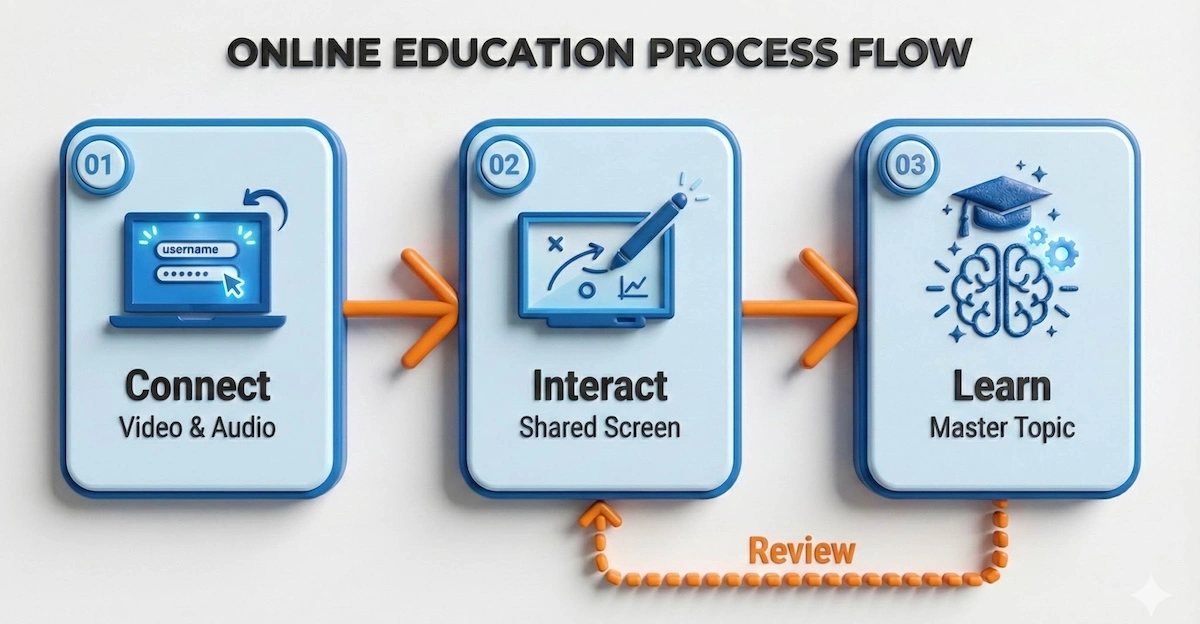
Modern online tutoring connects students and experts instantly, using interactive tools to replicate the classroom experience.
This seamless loop of connection, interaction, and mastery ensures that geography never limits your access to expert education.
Many families discovered online tutoring during the COVID-19 pandemic and continue to use it because it proved effective. Students often appreciate the convenience of studying from home and the ability to use digital tools. Educational research shows that learning with online tutors can achieve results comparable to face-to-face tutoring, while offering flexible scheduling. Overall, for busy families or remote learners, education tutoring online provides flexibility without sacrificing quality.
Education Teacher vs Education Tutor
Teachers and tutors are both educators but serve different roles. A teacher in a classroom delivers a curriculum to many students at once, following set schedules and standards. An education tutor, on the other hand, works one-on-one (or in a very small group) focusing entirely on one student’s challenges. This one-on-one setting lets tutors customize lessons: if a student already understands most of the material, the tutor can move faster; if not, the tutor reviews the basics and uses new examples or hands-on activities to reinforce learning. For instance, a tutor might use a visual model to explain a topic that the student missed in class. These engaging techniques complement traditional lessons and keep students motivated.
Ideally, these two roles work in tandem. The table below outlines the distinct responsibilities and focus areas for teachers versus private tutors.
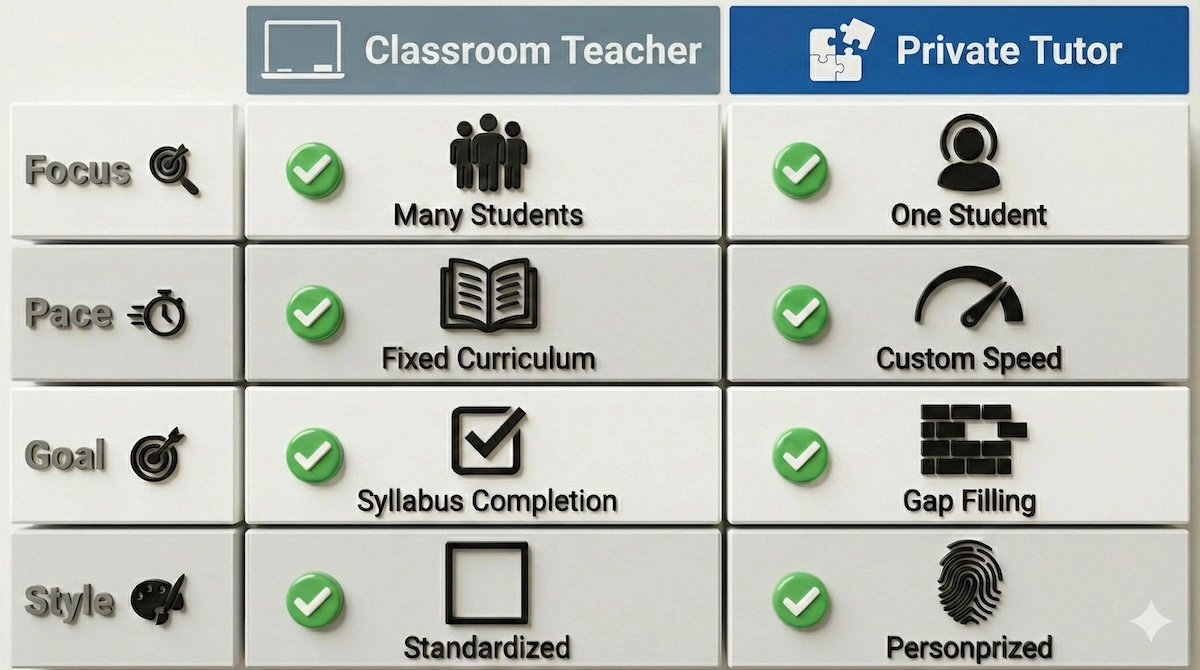
While teachers manage the curriculum for the whole class, tutors focus exclusively on your specific learning gaps and pace.
Understanding these distinctions helps parents set realistic expectations: teachers build the foundation, while tutors reinforce and repair specific cracks in that foundation.
Many tutors are actually certified teachers or graduate students who know how to explain concepts clearly. Unlike in class, where a teacher may not have time to revisit a missed topic, a tutor can spend as long as needed until the student grasps it. Some tutors even coordinate with classroom teachers to align their sessions with what is being taught in school. In this way, tutoring complements traditional education by giving extra support where it’s needed. Tutors often apply modern education teaching techniques—like interactive simulations or real-life scenarios—to engage students.
Homework and Assignment Help
Tutors are often hired to provide expert assistance with homework and assignments. Whether it’s a nightly math worksheet or a semester-long research project, having a tutor makes the workload manageable. Tutors clarify instructions, demonstrate problem-solving steps, and coach students through tricky questions. For example, a math tutor might explain each step of a difficult equation that a student struggled with. A writing tutor could help outline an essay and suggest improvements. This guidance turns homework time into actual learning rather than frustration.
Students often report that homework sessions with a tutor turn frustration into learning. Instead of guessing answers or copying solutions, they ask “why” and “how,” and the tutor explains step by step. Over time, this builds strong study habits. For instance, after weekly math tutoring, one student said she no longer feared her homework because she understood the process.
By guiding students through actual assignments, tutors teach how to learn effectively. They review completed homework, point out errors, and ensure that the student understands the correct solutions. Over time, students often become more independent: they pick up study techniques and organizational skills during these sessions, which helps them tackle future assignments on their own.
- Education homework help: Tutors review and explain class assignments in detail. For example, a tutor might walk a student through each step of a tough math problem to ensure they understand the concepts.
- Education assignment help: Tutors assist with projects and essays by guiding students on structuring their work and improving study skills. They teach how to research topics and organize answers, so students learn as they complete the assignment.
- Exam preparation: Tutors provide practice tests and review key concepts to prepare students for quizzes and final exams. This focused review boosts confidence and readiness for the real tests.
Finding and Hiring a Tutor
Choosing the right tutor requires some research and consideration. Here are some tips when you are ready to hire someone:
For example, some parents ask friends or search social media for recommended tutors. It’s important to verify the tutor’s background and ask about their experience with your child’s grade level and curriculum. Consider whether you want in-person tutoring at home or online meetings. In-person tutors can meet face-to-face if needed, while online tutors offer a wider reach and flexible hours.
- Hire a Education tutor: Search for tutors on reputable online tutoring platforms or through local agencies that specialize in academic help. These services match you with tutors who fit your subject and grade level needs.
- Check qualifications: Look for tutors with relevant experience or credentials, such as teaching certificates or advanced studies in the subject. Read reviews from other students or ask for references. Many tutors offer a free trial lesson or consultation so you can see if their teaching style is a good fit.
- Compare rates and schedules: Tutoring rates vary by subject and expertise. In many places, experienced tutors charge around $20–$40 per hour for quality personalized instruction. Make sure the tutor’s availability fits your schedule and that you feel comfortable with the fee before committing to regular lessons.
Ready to find the perfect match? Follow this four-step checklist to navigate the hiring process with confidence.
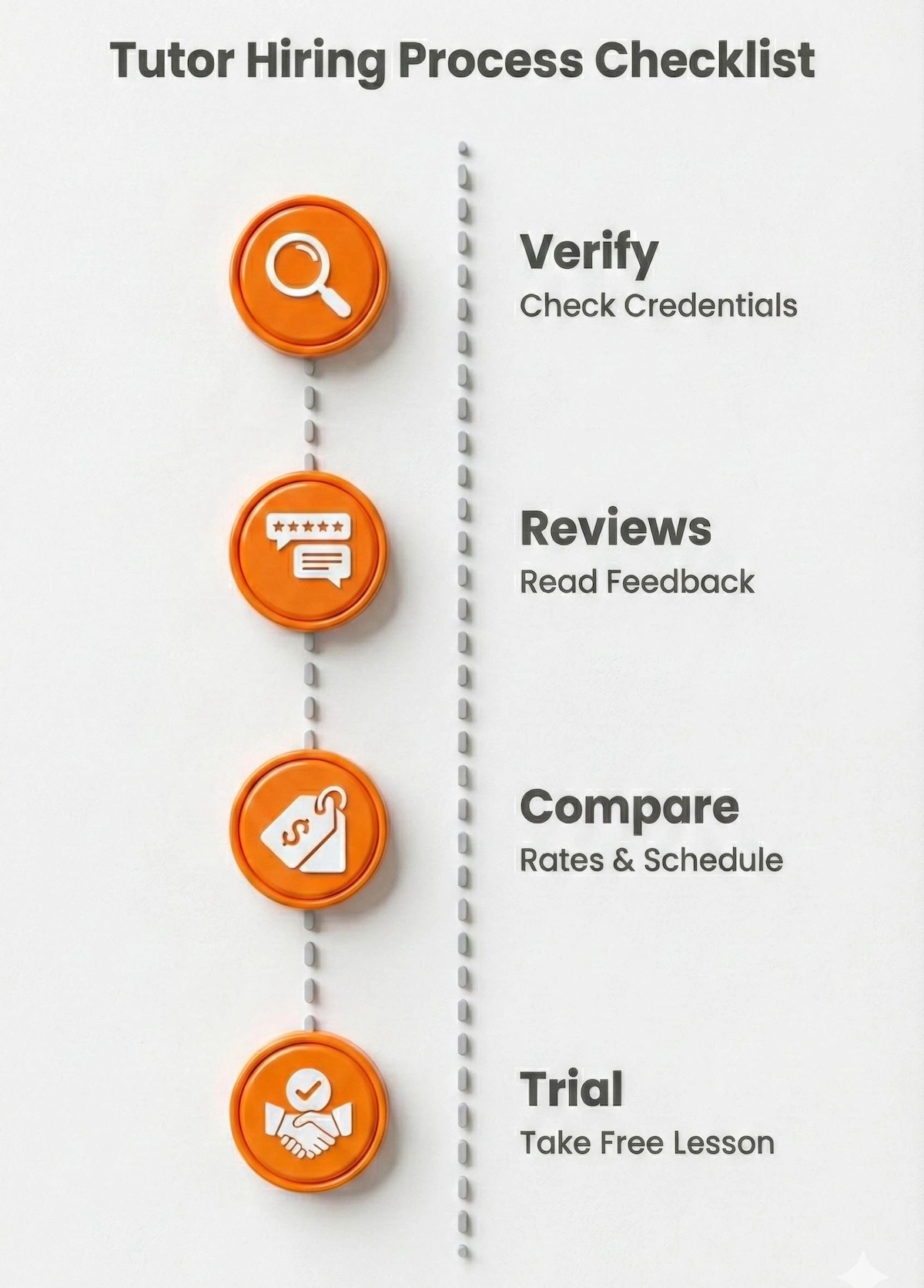
Follow these four essential steps—Verify, Review, Compare, and Trial—to ensure you find the perfect tutor for your needs.
By following this sequence—especially the trial lesson—you eliminate the risk and ensure a good personality fit before making a financial commitment.
Tutoring Trends in the US, UK and Gulf
Tutoring has become an established part of education in many countries. In the United States, tutoring has been widely expanded as a learning-recovery tool: for example, in 2023, over 80% of U.S. public schools reported offering some form of tutoring to students. This reflects the growing belief that extra teaching help can close learning gaps caused by missed school time or uneven progress. In Gulf countries like Qatar, private tutoring is also very common. Studies show roughly 40% of students in Qatar use supplementary tutoring. In the UK, tutoring demand has grown as well, with many students taking private lessons for exam preparation and to catch up on material after pandemic disruptions.
Even beyond catch-up, many students use tutors for enrichment. Surveys in the UK and across Europe found that 75% of students with personalized tutors boosted their grades significantly. In the UK, tutoring became much more common after pandemic lockdowns, and now many parents see tutors as a normal part of their child’s education. In this way, tutors act as both teachers and mentors, supporting learning wherever it happens.
Frequently Asked Questions
Q1 What is education tutoring?
Education tutoring is personalized academic instruction (one-on-one or in small groups) that targets a student’s specific learning needs outside of regular classroom teaching.
Q2 How does education tutoring online work?
It uses video conferencing and digital tools to let students and tutors interact live from different locations, simulating an in-person lesson experience.
Q3 Why should I hire an education tutor?
A tutor provides individualized support and clarification in subjects you find difficult, which can lead to improved grades, understanding, and confidence.
Q4 Can an education tutor help with my homework and assignments?
Yes, tutors offer education homework help and education assignment help by guiding you step-by-step through your school work and projects.
Q5 How do I hire an education tutor online?
You can hire an education tutor online through reputable tutoring websites or agencies that match you with qualified tutors in your subject area.
Q6 What subjects can an education tutor teach?
Education tutors typically cover core subjects (like math, science, English, etc.) and many electives, adapting to nearly any grade level or college course.
Related Subjects
Education policy
Humanities
Instructional design
Physical Education
Special education
STEM
******************************
This article provides general educational guidance only. It is NOT official exam policy, professional academic advice, or guaranteed results. Always verify information with your school, official exam boards (College Board, Cambridge, IB), or qualified professionals before making decisions. Read Full Policies & Disclaimer , Contact Us To Report An Error