
Informatics Tutoring and Homework Help: Expert Support for Students

Informatics tutoring gives students personalized help with coding and data topics, often improving grades and confidence. Studies show tutoring can yield large learning gains, and teachers report significant score boosts.
Understanding Informatics
Informatics (often tied to computer science) is about using technology to transform data into useful knowledge. It “harnesses the power and possibility of digital technology to transform data and information into knowledge that people use every day”. In practical terms, informatics courses cover topics like programming, information systems, algorithms, and data management. As one source notes, informatics “broadly describes the study, design, and development of information technology” for the benefit of people and society.
At its core, informatics “studies the intersection of people, information, and technology systems”. This means students learn how to collect, process, and present data in ways that make sense to others. A typical informatics class might include learning coding languages, database design, network fundamentals, and human-computer interaction. These are all the foundational skills behind modern computing tools and apps.
Ideally, we can visualize this field as a triad. The diagram below illustrates how informatics bridges the gap between raw data and human users.
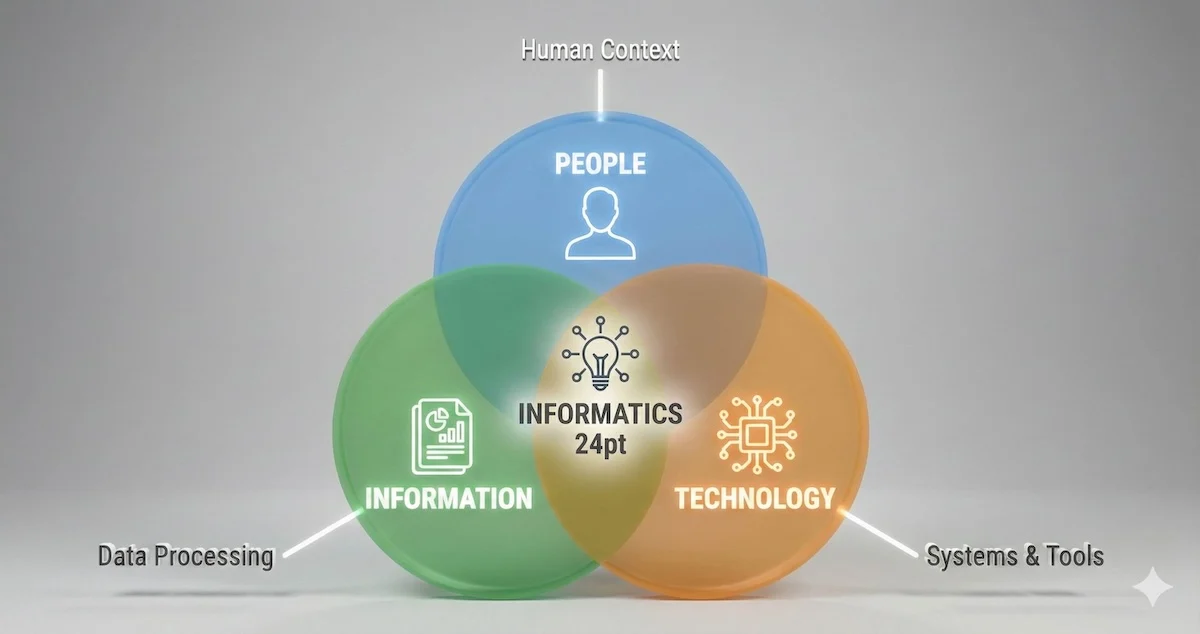
Informatics sits at the intersection of people, data, and technology to create useful knowledge.
As shown above, the ‘magic’ happens at the center where these three elements converge.
Why Informatics Education Matters
Today’s economy increasingly values computing and data skills. U.S. job statistics show that computer and IT occupations are projected to grow much faster than average through 2034. In fact, the Bureau of Labor Statistics notes about 317,700 new openings each year in these fields, with a median annual wage of around $105,990 (versus $49,500 for all jobs). In short, students with strong informatics and computer science backgrounds can pursue high-paying, in-demand careers.
The financial incentives for mastering these skills are significant. Let’s look at how informatics salaries compare to the national average.
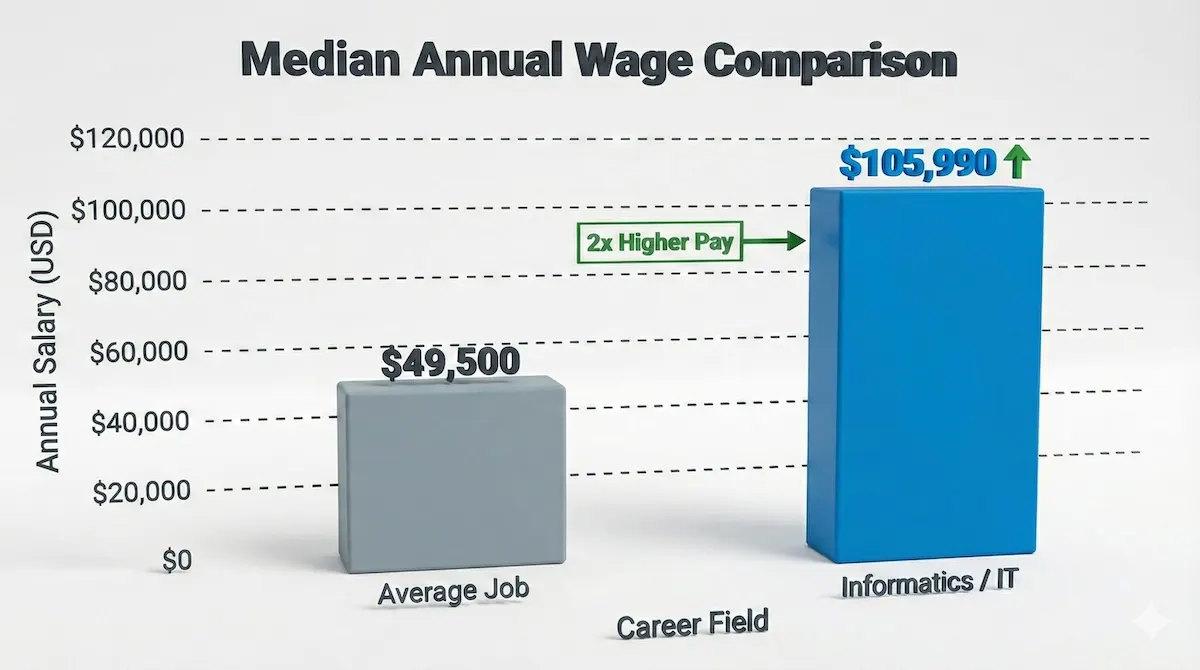
Careers in informatics and computing offer salaries more than double the national average.
With earning potential nearly double the average, investing in informatics education offers a high return on investment.
Yet relatively few students take formal computing classes in school. For example, Code.org reports that roughly 60% of U.S. high schools offer an introductory computer science (CS) course, but only about 6.4% of students actually enroll in those courses. Even globally, many school curricula are still expanding computing and data classes. At the same time, the rise of artificial intelligence and data-driven technology makes informatics knowledge more important than ever. As Code.org explains, “learning fundamental computer science concepts gives students a deeper insight into how AI systems work” and helps create more “diverse, critical creators and consumers of AI”. In other words, understanding programming and data can benefit students across all fields – from science and healthcare to business and the arts.
Common Challenges in Informatics Education
Despite its importance, many students find informatics topics challenging. Concepts like algorithms or data structures can seem abstract, and programming often involves trial-and-error that can frustrate beginners. In a typical classroom, a student may not get enough individual attention to fully grasp tricky topics. For example, imagine a high schooler who stays after class to debug a program but finds the teacher busy. Without extra help, the student might fall behind or lose confidence.
Homework and assignments can be particularly hard. Writing code that runs correctly on the first try is rare; most students will encounter bugs or logic errors they don’t know how to fix. Topics like information theory or computing theory may also seem confusing without concrete examples. In short, students often need more one-on-one support than a crowded classroom can provide.
What is Informatics Tutoring?
Informatics tutoring means working one-on-one or in small groups with an expert who helps you learn computer science and information technology concepts. A tutor might be a college student, experienced teacher, or industry professional who understands informatics. Unlike a classroom teacher who must address many students at once, a tutor tailors explanations to the individual learner’s needs. Tutors can slow down when necessary, use different examples, and answer every question in detail.
Many tutoring services are now offered online, allowing students across the USA, UK, Gulf region and beyond to connect with experts. Sessions often happen via video chat with shared screens or interactive whiteboards, so the tutor can walk through code or diagrams step-by-step. The goal is to make complex topics clearer. Research supports this approach: for example, one meta-analysis found that tutoring (even by peer tutors) can produce an “impressive” 0.36 standard-deviation gain in student achievement. In other words, structured one-on-one help can significantly boost learning outcomes.
Why choose a private tutor over just studying harder in class? This comparison highlights the structural differences in learning environments.
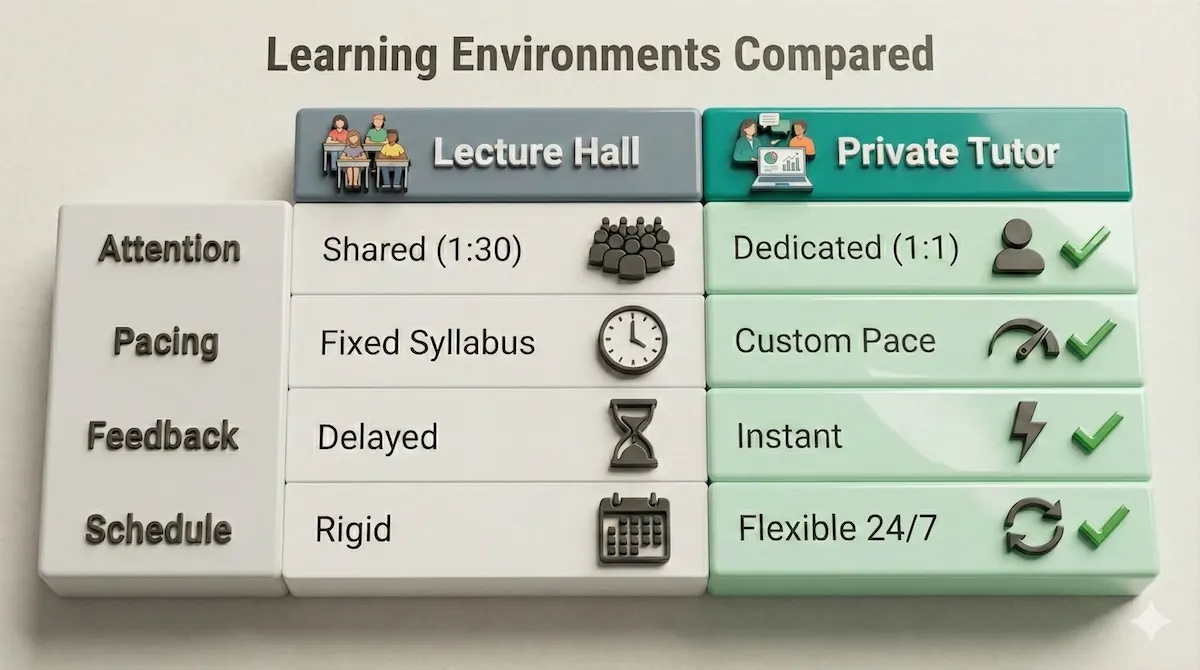
Private tutoring offers personalized attention and instant feedback that crowded classrooms cannot match.
The personalized pace and instant feedback shown in the right column are key drivers of the 0.36 standard deviation improvement in grades.
Benefits of Informatics Tutoring
- Customized Learning: Tutors adapt lessons to the student’s pace and focus on exactly what the student finds difficult. This personalized approach can make challenging topics click much faster than self-study or lectures.
- Homework & Assignment Help: Students get step-by-step support on informatics homework, projects help, and exam prep. For example, a tutor can guide a student through writing and debugging code for a programming assignment, ensuring the student understands each part.
- Improved Performance: Personalized tutoring often translates into better grades. Meta-analytic research shows that students receiving tutoring see substantial gains – in one review, students in peer-led tutoring programs improved their scores by about 0.36 standard deviations. That is roughly equivalent to moving many students from a “C” to a “B” or “B” to “A” level.
- Boosted Confidence: Gaining mastery over difficult material naturally builds confidence. In a Scottish tutoring program for informatics, teachers noted that several students who were expected to barely pass instead achieved higher grades after tutoring, showing much more confidence and interest in the subject. This kind of success story – a student struggling at first, then excelling – is common with focused tutoring.
- Convenience & Flexibility: Online informatics tutors are available on demand, fitting students’ schedules. You can often find help evenings or weekends, which is ideal for busy high school or college students. And because the help is virtual, you can connect with tutors from anywhere (USA, UK, Gulf, etc.) without commuting.
Overall, informatics tutoring turns frustration into understanding. A student who once dreaded a coding problem can quickly become engaged and proud of solving it with a tutor’s guidance. Over time, this success often encourages students to tackle even more challenging topics on their own.
Online Informatics Tutoring
Online tutoring has opened doors for many learners. With a good internet connection, a student can access a wealth of informatics teachers and resources anytime. Tutors typically use interactive tools like screen sharing, virtual whiteboards, and code editors so that sessions feel as effective as being together in a room. Here are some advantages of online informatics tutoring:
- Anytime Access: Schedule sessions after school, in the evening, or on weekends. Many platforms operate 24/7 or have tutors in different time zones.
- Global Expertise: You aren’t limited to local tutors. Online platforms let you connect with specialists worldwide – so if your course uses a British curriculum or a U.S. one, you can find a tutor with exactly the right background.
- Interactive Tools: Tutors can demonstrate code in real time and watch you code too. They often share resources, sample problems, and recorded session notes, which you can review later.
- Safe, Comfortable Learning: Many students feel at ease learning from home. Especially younger learners or those who are shy, the online setting allows them to ask questions freely without classroom pressure.
Studies also find that well-designed online tutoring can be as effective as in-person help. The key is a qualified tutor and an engaged student, whether the session is face-to-face or virtual. Online sessions simply add convenience and more options.
Finding the Right Informatics Tutor
Not all tutors are the same, so it’s important to choose carefully. Here are steps to find and hire a great informatics tutor:
- Identify Your Needs: Are you studying high school informatics, college computer science, or a specific certification? Pin down what topics or assignments you need help with (e.g. coding homework, database concepts, exam prep).
- Search for Qualified Tutors: Use reputable tutoring platforms or local educational services. Filter by subject – many platforms list “Informatics tutor online” or “Computer Science tutor.” Also ask teachers or friends for recommendations.
- Check Credentials: Look at the tutor’s background. Good tutors often have a degree in computer science or experience teaching/working in the field. Read any student reviews or ask for a brief interview to assess their communication style.
- Try a Demo Session: Many tutors offer a short trial lesson or homework review. This lets you see if the tutor’s teaching style and personality match the student’s learning style.
- Compare Rates and Schedule: Tutoring fees can vary. Online informatics tutors often charge around $20–$40 per hour, depending on experience and student level. Choose someone who fits your budget and availability.
Ready to find help? Use this step-by-step roadmap to ensure you select a high-quality tutor.
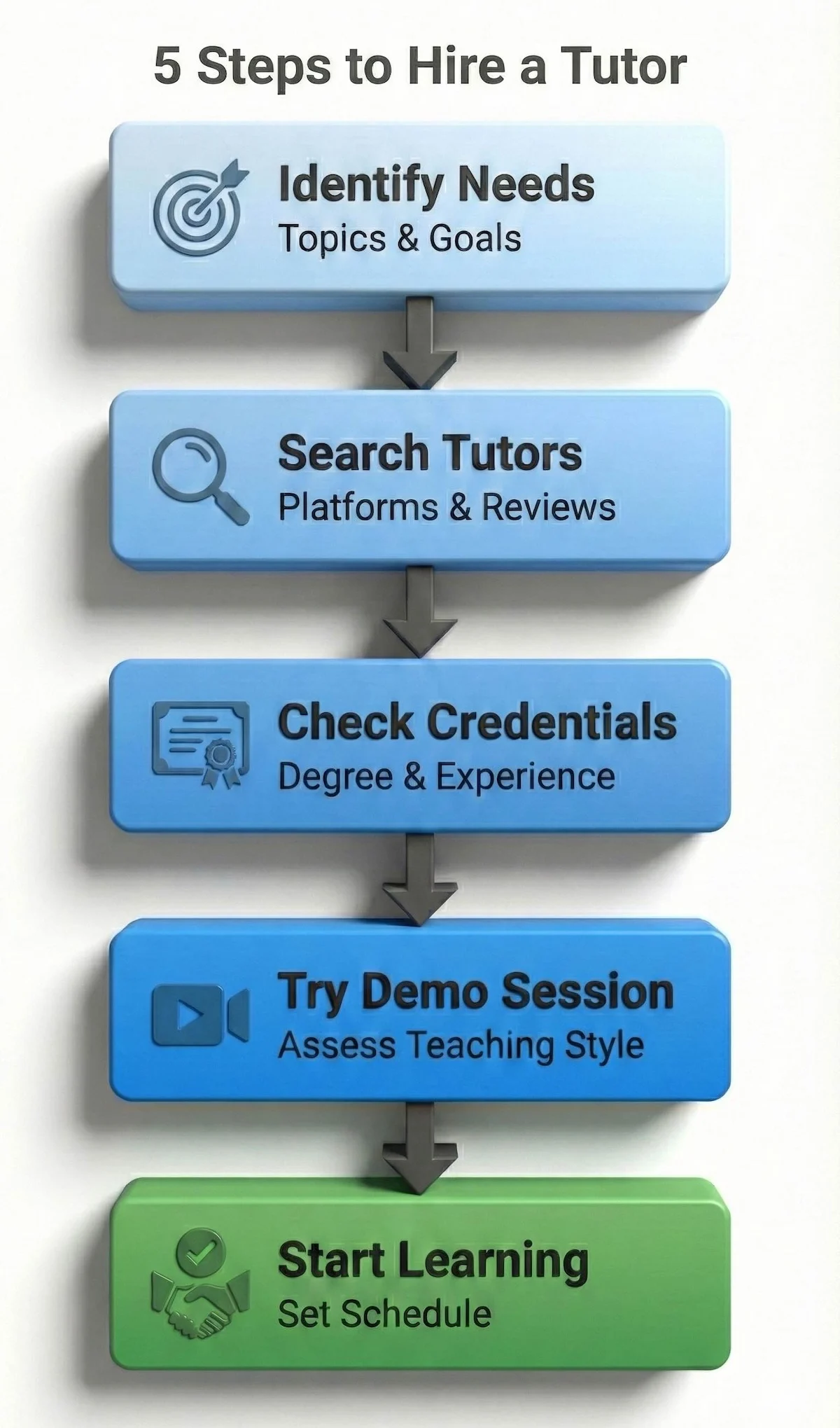
Follow this simple 5-step checklist to find the perfect informatics tutor for your needs.
By following these five steps, you ensure that you hire a mentor who matches both your academic needs and your learning style.
By taking these steps, you can “hire a informatics tutor” who really understands your course and can help you succeed. Remember, the goal is a supportive learning relationship – the right tutor will make you feel comfortable asking questions and will keep you motivated.
FAQs
- What is informatics tutoring?
- It’s one-on-one instruction where a tutor helps a student understand informatics (computer science and IT) concepts and solve related homework or projects.
- How can an informatics tutor help me?
- A tutor explains topics at your pace, answers questions, and guides you through coding or assignments, making tough concepts easier to grasp.
- Do I need an informatics teacher and a tutor?
- A teacher covers the full class syllabus, while a tutor gives extra personalized support. Many students benefit from both – teacher-led classes plus a tutor for homework help.
- Is online informatics tutoring available?
- Yes – many qualified informatics tutors work online, allowing students in the USA, UK, Gulf, and worldwide to connect with experts anytime.
- How much does informatics tutoring cost?
- Rates vary, but most online informatics tutors charge about $20–$40 per hour, depending on their experience and the student’s grade level.
- How do I hire an informatics tutor?
- Search tutoring platforms or agencies for “informatics tutor” and review profiles, then schedule a trial session to find the best fit.
Related Subjects:
Digital Humanities
Game Design & Development
Health Informatics
ICT (Information and Communication Technology)
Information Systems
Information Technology
******************************
This article provides general educational guidance only. It is NOT official exam policy, professional academic advice, or guaranteed results. Always verify information with your school, official exam boards (College Board, Cambridge, IB), or qualified professionals before making decisions. Read Full Policies & Disclaimer , Contact Us To Report An Error