Mathnasium Costs $150–$500/Month in 2026: What Parents Get

- Mathnasium monthly fees range from $150 to $500, with most suburban U.S. centers at $250–$400.
- An enrollment fee of $99–$199 is charged separately before the first session.
- Written cancellation notice is required before the 15th of the month to avoid extra billing.
- Franchise variability means quality depends heavily on the specific center, not the brand overall.
- Mathnasium’s average user rating is approximately 6/10 across independent review platforms.
Mathnasium is one of the most searched math tutoring brands in North America, but the question parents ask most is not “does it work?” it’s “how much does it actually cost, and is it worth it?” Monthly fees range from $150 to $500 depending on your location, before enrollment fees and materials are factored in.
This guide covers the verified 2026 pricing, real parent reviews, a side-by-side alternatives table, and an honest breakdown of what you get for the money. Students who need support beyond K–12 math — including those looking for a differential equations tutor or help with college-level coursework — will find the alternatives section particularly relevant.
If you are comparing Mathnasium against other options or trying to decide whether to enroll, the sections below give you the specific numbers and structured comparisons needed to make that call without wading through promotional content.
Discrete mathematics tutoring and other advanced subjects fall outside Mathnasium’s K–12 scope, so families with older students should weigh the alternatives carefully.
Mathnasium Pricing in 2026
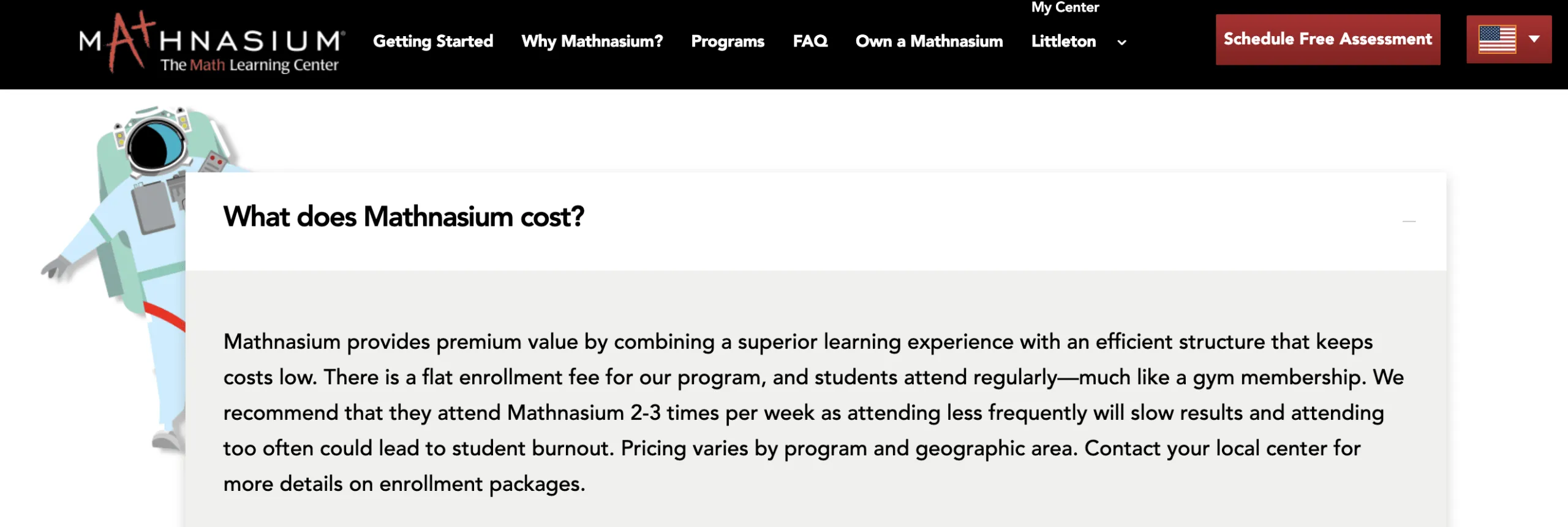
Mathnasium pricing is set at the franchise level, which means every center charges differently. According to tutors.com, the typical monthly range is $250–$400 per month, though costs in higher cost-of-living areas can reach $500 or more.
Brighterly’s cost analysis confirms that fees as high as $400–$500 per month are common in urban centers.
Pricing Range
The table below summarizes verified Mathnasium pricing data from multiple independent sources as of 2026. Session counts and monthly totals vary by center and plan type.
| Plan Type | Sessions per Month | Monthly Cost (Approx.) | Effective Cost per Session | Notes |
|---|---|---|---|---|
| Basic (2x/week) | 8 | $150–$250 | $19–$31 | Low-cost markets; rural areas |
| Standard (2x/week) | 8–10 | $250–$350 | $25–$44 | Most common plan in suburban centers |
| Premium (3x/week) | 12–14 | $350–$500 | $25–$42 | Urban/high cost-of-living markets |
| Mathnasium@home | Varies | $199–$300 | Varies | Online-only option; some centers offer this |
Per-session rates reported by Thinkster’s comparison data range from $25–$75 per session, with higher-end pricing typical of tri-state area and California centers. Some families in high-cost areas have reported paying fees they considered expensive relative to results received.
The lowest documented pricing cited by bestcompany.com puts entry-level plans at around $199 in certain areas. For broader context on what tutoring costs across different formats and subjects, the US tutoring rates guide covering $27–$110 per hour provides a useful benchmark.
What Students and Parents Say About Mathnasium Pricing
Parent sentiment on pricing is split. Those who see measurable grade improvement within the first two to three months tend to view the cost as reasonable. Those who pay for four or more months without visible academic progress describe the service as overpriced relative to alternatives.
One widely cited Reddit thread in the r/Parenting community documented a family reporting that their local center was charging $439 per month, which they found difficult to sustain as a recurring expense. This figure is consistent with the upper end of verified pricing data for suburban U.S. markets.
Mathnasium’s average user rating is around 6/10 according to Brighterly’s aggregated review analysis, with cost and inconsistent instructor quality being the two most frequently cited negatives. Positive reviews consistently mention improved confidence in math and measurable grade improvement, particularly for students in grades 3 through 7.
Hidden Costs
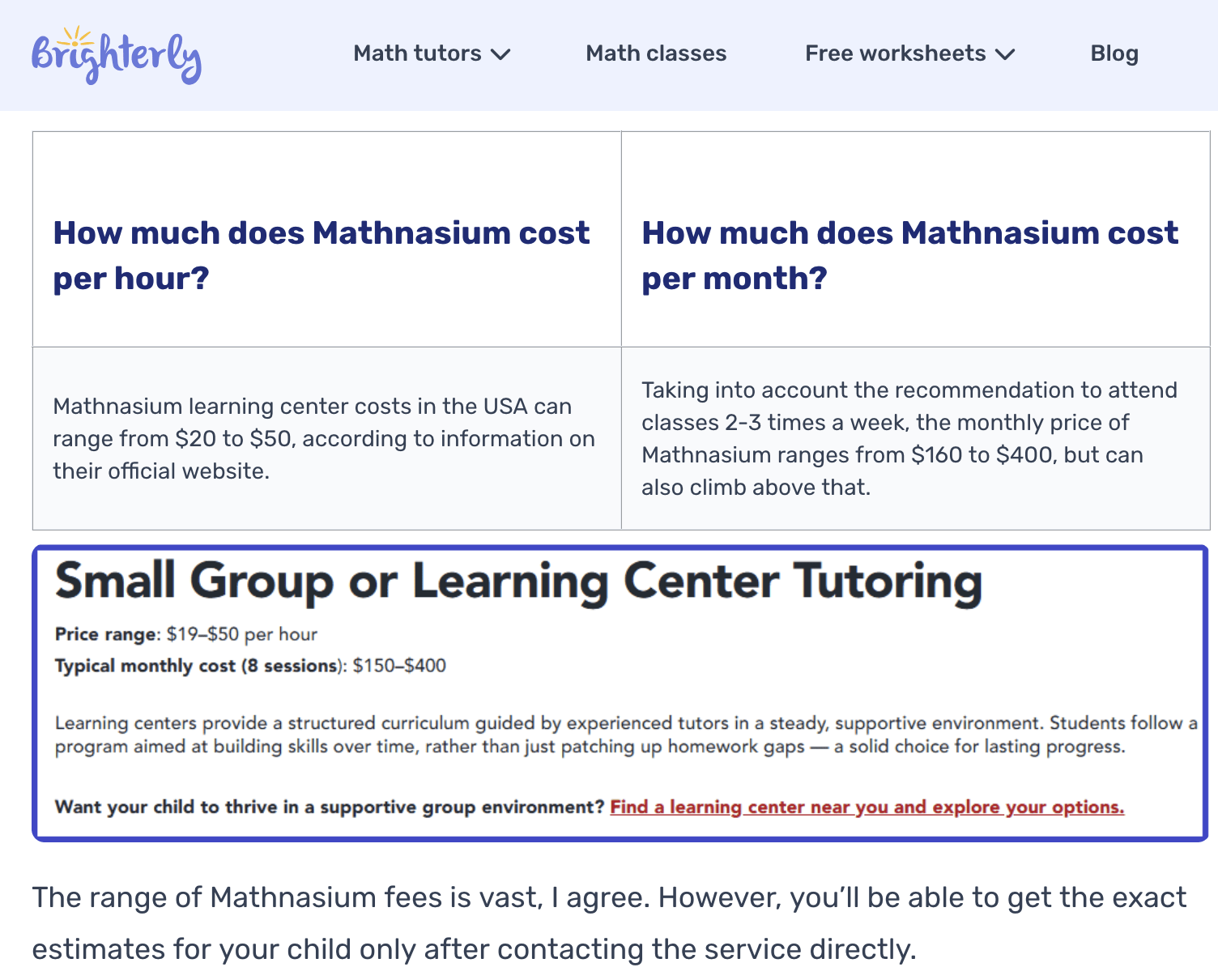
Beyond the monthly membership fee, Mathnasium charges several additional costs that parents consistently flag as underemphasized at the point of enrollment. The most significant is the enrollment or registration fee, which ranges from $99 to $199 at most centers and is charged before the first session.
- Enrollment fee: $99–$199 (one-time, non-refundable at most centers)
- Assessment fee: Charged at initial enrollment; centers that require a re-assessment after a gap in attendance add a $100 re-assessment charge
- Cancellation notice requirement: Most centers require a written cancellation notice submitted before the 15th of the month to avoid being billed for the following month
- Summer program pricing: Some centers charge separately for intensive summer programs at a premium rate
- Materials fees: Occasional supplemental workbooks or materials fees at select centers
The cancellation policy is the most operationally significant hidden cost. Families who cancel mid-month without submitting written notice by the deadline are billed a full additional month. This requirement is documented in enrollment agreements but is often not highlighted during the sales conversation.
How Mathnasium’s Pricing Works
Mathnasium operates on a monthly membership model rather than a pay-per-session model. The monthly fee covers a set number of sessions per week (typically two or three), each lasting approximately 60 minutes.
Sessions are conducted in a small-group center environment with a recommended instructor-to-student ratio of 1:3. Because pricing is set by each franchise owner, two Mathnasium centers in the same city can quote meaningfully different rates.
The standard session duration is 60 minutes, during which students rotate through personalized worksheets prepared from their diagnostic assessment results. Instructors provide guidance rather than direct teaching in most sessions, which is a design decision some parents consider a drawback relative to private tutoring.
Free Trial
Mathnasium offers a free trial session at most centers, which allows a child to experience the center environment before committing to enrollment. Trial availability and structure vary by location. Some centers advertise this prominently, and Mathnasium’s own center pages confirm the risk-free trial session as a standard offering.
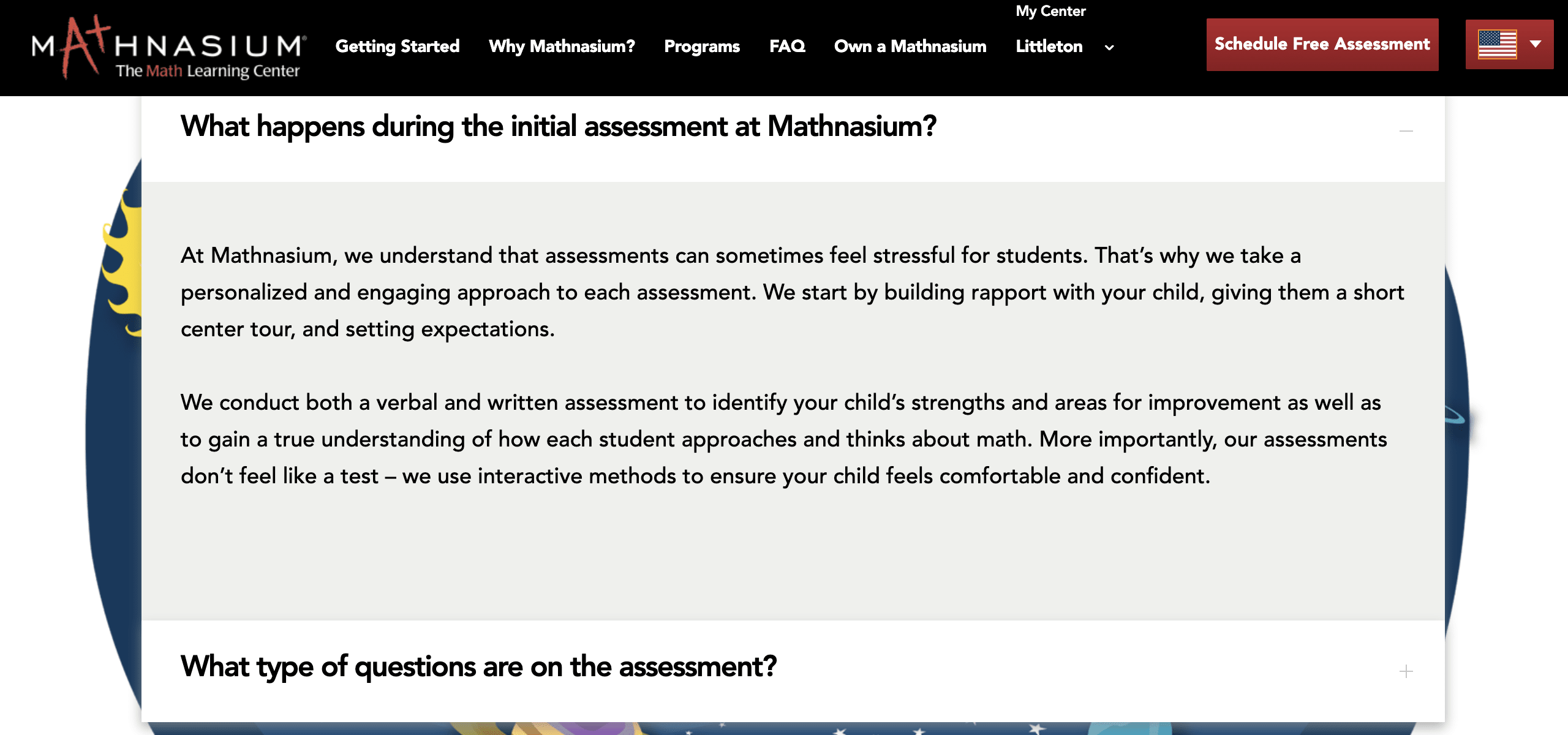
The free trial is meaningful because it includes the initial diagnostic assessment, giving both the parent and child a concrete sense of how the program is structured before any financial commitment is made.
Parents should use the trial session to ask specifically about session frequency options, total monthly cost including the enrollment fee, and the cancellation policy in writing.
Refund Policy
Mathnasium does not advertise a universal refund policy. Refund terms are set at the franchise level, meaning the policy at one center may differ substantially from another. Most centers do not offer pro-rated refunds for unused sessions within a billing month. Parents who cancel mid-cycle typically forfeit the remainder of that month’s fee.
Families seeking a refund after dissatisfaction with service quality are generally directed to resolve the issue through the local franchise owner. Escalation to Mathnasium corporate is possible but not guaranteed to result in a refund.
The BBB profile for Mathnasium has documented cases where corporate intervention resolved billing disputes that local centers did not address.
Mathnasium Reviews and Testimonials
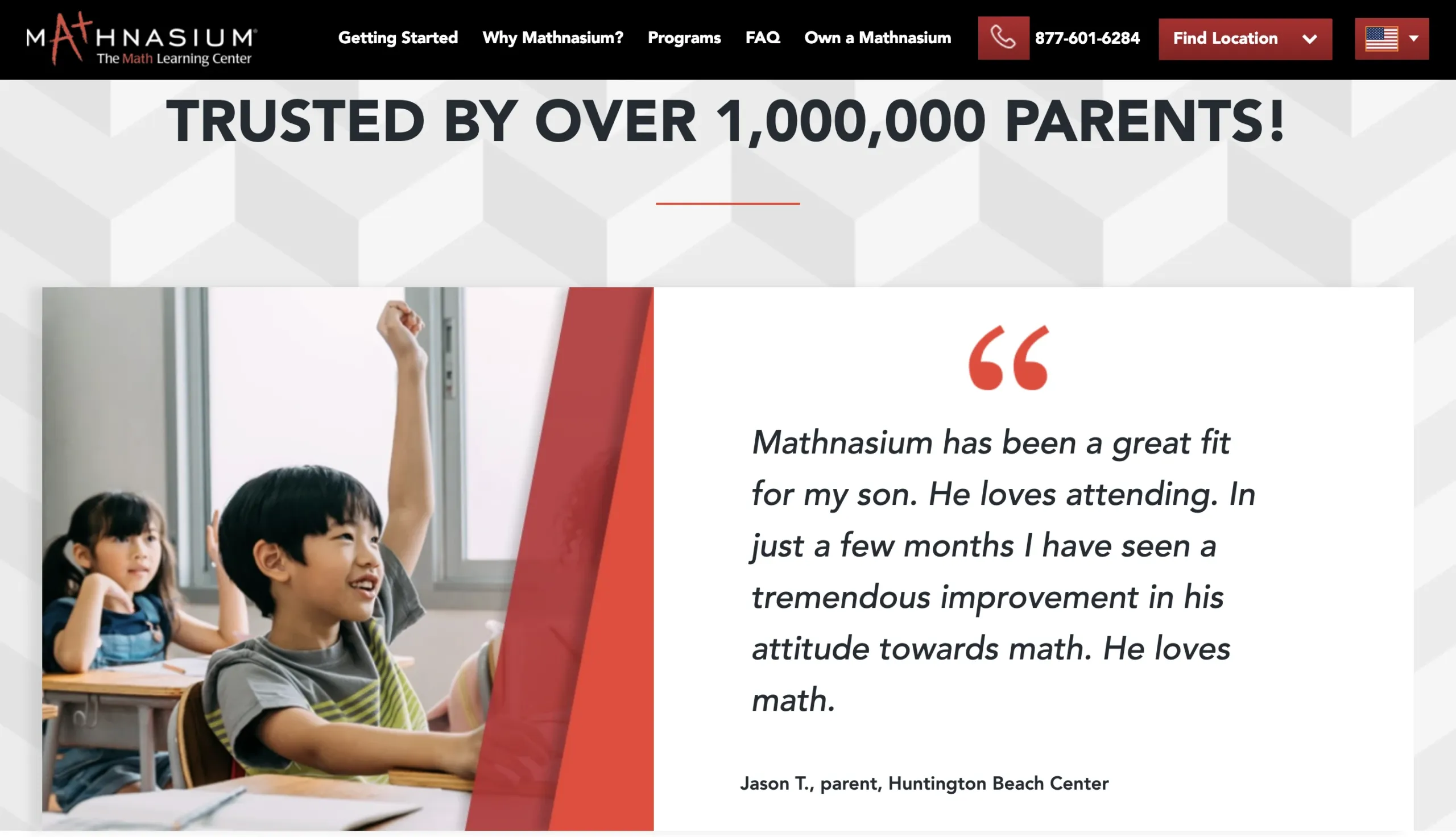
Mathnasium holds a mixed review profile across platforms, with consistent themes in both positive and negative feedback. The 6/10 average user rating cited by Brighterly reflects a pattern where a meaningful minority of families report strong outcomes while a notable segment reports dissatisfaction with cost-to-value ratio and instructor consistency.
On Trustpilot, Mathnasium’s reviews reflect a bimodal distribution: families who experienced measurable improvement within two to three months rate the service highly, while those who did not see improvement within the first semester rate it poorly.
The most common positive themes across review platforms are improved confidence, better understanding of foundational concepts, and engaged instructors at specific centers.
The most common negatives are high cost relative to visible outcomes, inconsistent instructor quality across locations, and frustration with the cancellation notice requirement.
Drawbacks of Mathnasium
The primary structural drawback of Mathnasium is its franchise variability. Because each center operates independently, the quality of instruction, the attentiveness of staff, and the accuracy of the diagnostic assessment depend heavily on the specific franchise owner and their hiring standards. A highly rated Mathnasium in one suburb may be meaningfully different in quality from one two towns over.
Students who specifically need help with school homework or test preparation for a particular curriculum often find that Mathnasium’s proprietary curriculum does not always align with their school’s syllabus.
The program is designed to build foundational math skills progressively, not to track school coursework week by week. This creates a disconnect for students who are enrolled primarily to improve grades on a specific upcoming assessment.
- Group instruction model: students receive guided practice, not direct one-on-one teaching in most sessions
- Curriculum misalignment with school-specific syllabi
- Enrollment and re-assessment fees add significant upfront cost
- Cancellation policy requires advance written notice to avoid additional billing
- Results vary significantly by center and instructor quality
- No homework-specific help guaranteed; curriculum follows Mathnasium’s internal progression
Mathnasium Alternatives
Six well-established alternatives to Mathnasium are compared below, covering price range, format, grade level focus, and the key differentiator for each service. Families who find Mathnasium pricing prohibitive or whose student needs a different instructional format will find at least one option better suited to their situation.
Parents researching the broader landscape of tutoring platforms may also find it useful to read this review of Chegg’s pricing and alternatives or the BYJU’S 2025 review covering pricing and alternatives for additional context.
| Service | Format | Monthly Cost (Approx.) | Grade Level | Key Differentiator |
|---|---|---|---|---|
| Mathnasium | In-center (small group) | $150–$500 | K–12 | Proprietary math-only curriculum; ~1,000 U.S. locations |
| Kumon | In-center (independent worksheet) | $100–$200 | Pre-K–12 | Daily practice model; lower cost; builds calculation fluency |
| Sylvan Learning | In-center or online | $200–$400 | K–12 | Multi-subject tutoring; covers math, reading, and test prep |
| Huntington Learning Center | In-center | $250–$450 | K–12 | Strong test prep focus (SAT/ACT); one-on-one sessions; no hidden costs or subscription commitments |
| Thinkster Math | Online (app + live coaching) | $70–$200 | K–8 | AI-assisted worksheet review; parent progress reports; lower cost than Mathnasium |
| Khan Academy | Online (self-paced video + practice) | Free | K–College | Completely free; strong conceptual videos; no human instructor |
| My Engineering Buddy (MEB) | Online (live 1-on-1) | Pay per session | High school–College | On-demand expert tutoring across math, engineering, and science; no enrollment fees; no subscription lock-in |
The right alternative depends on the student’s grade level, learning style, and the specific gap being addressed. Kumon costs roughly half of Mathnasium’s standard rate but uses an independent practice model that requires significant student self-motivation.
Huntington Learning Center is closer to Mathnasium in price but offers documented one-on-one sessions and no subscription commitment, making it easier to exit if results are not materializing.
For high school and college students dealing with advanced algebra, precalculus, or beyond, online math tutoring at MEB provides live expert instruction without monthly fees or enrollment costs. Students preparing for AP exams can also find targeted support — for example, those needing an AP Human Geography tutor or help with AP Macroeconomics will find subject-specific options outside Mathnasium’s math-only scope.
Comparison with My Engineering Buddy
Mathnasium and My Engineering Buddy serve different student populations with different structural models. Mathnasium is built for K–12 students who need ongoing, structured math skill development delivered in a physical learning center setting.
MEB is designed for high school and college students who need targeted, on-demand help with specific math or engineering problem assignments, exam preparation, or conceptual gaps that are blocking progress on a defined timeline.
| Feature | Mathnasium | My Engineering Buddy (MEB) |
|---|---|---|
| Format | In-center (small group) | Online (live 1-on-1) |
| Grade level | K–12 | High school–College |
| Subject scope | Math only | Math, engineering, science, 2,800+ subjects |
| Pricing model | Monthly membership + enrollment fee | Pay per session; no enrollment fee |
| Cancellation | Written notice required; risk of extra billing | No contract; stop anytime |
| Session type | Guided group practice | Direct expert instruction, 1-on-1 |
| Scheduling | Center hours; pre-scheduled | On-demand; connect via WhatsApp or email |
| Homework alignment | Mathnasium curriculum; not school-specific | Session focused on student’s specific assignment or exam |
Students who are failing or at risk of failing a specific college-level math or engineering course typically benefit more from the targeted, homework-aligned model that MEB offers than from a general enrichment program.
Families deciding between the two should ask one question: does the student need foundational skill building over several months, or do they need expert help with the specific material in front of them right now? The answer determines which service is the correct fit.
College students working through quantitative coursework may also want to explore data science tutoring as an option for applied math and statistics support beyond what Mathnasium covers.
If you need immediate help with a calculus problem set or an engineering assignment, the engineering homework help service at MEB is designed for that specific scenario.
How Mathnasium Works
Mathnasium follows a four-step process from the point of first contact through ongoing enrollment. Understanding this process helps families evaluate whether the program structure fits their student’s situation before committing financially.
For Students
The process for a student enrolling at Mathnasium begins with a diagnostic assessment. This assessment is not a standard grade-level test; it is Mathnasium’s proprietary evaluation designed to identify specific gaps in a student’s mathematical understanding across multiple concept areas simultaneously. The assessment result generates a customized learning plan that the center uses to select worksheets and exercises for each session.
- Initial diagnostic assessment: Identifies specific concept gaps across foundational and grade-level math
- Customized learning plan: Center instructors prepare session materials based on assessment results
- Scheduled sessions: Student attends two to three sessions per week, each approximately 60 minutes
- Ongoing progress review: Centers conduct periodic reassessments to update the learning plan and report progress to parents
Session attendance is the single most important variable in outcomes. The monthly fee covers a fixed number of sessions, and missed sessions are not typically made up or refunded. Students who attend every scheduled session and complete assigned practice between sessions consistently show the strongest improvement in parent-reported outcomes.
For Instructors
Mathnasium instructors are typically part-time employees hired by the local franchise owner. Most centers hire college students or recent graduates with a background in mathematics. Instructors are not required to hold teaching certificates, which keeps staffing costs manageable at the franchise level but contributes to the quality variability that appears repeatedly in negative parent reviews.
Glassdoor has recognized Mathnasium as one of its top-rated employers, which indicates that employees generally report positive working conditions. For parents, this workplace culture signal matters indirectly: centers where instructors are treated well and stay in their roles longer tend to provide more consistent instruction quality than centers with high turnover.

Mathnasium: Company Information
Mathnasium was founded in 2002 by Larry Martinek, an educator, together with entrepreneurs Peter Markovitz and David Ullendorff. Per Wikipedia, Mathnasium is a well-established company founded in 2002 that has grown to nearly 1,000 learning centers operating across 11 countries. The company has served more than one million families since its founding.
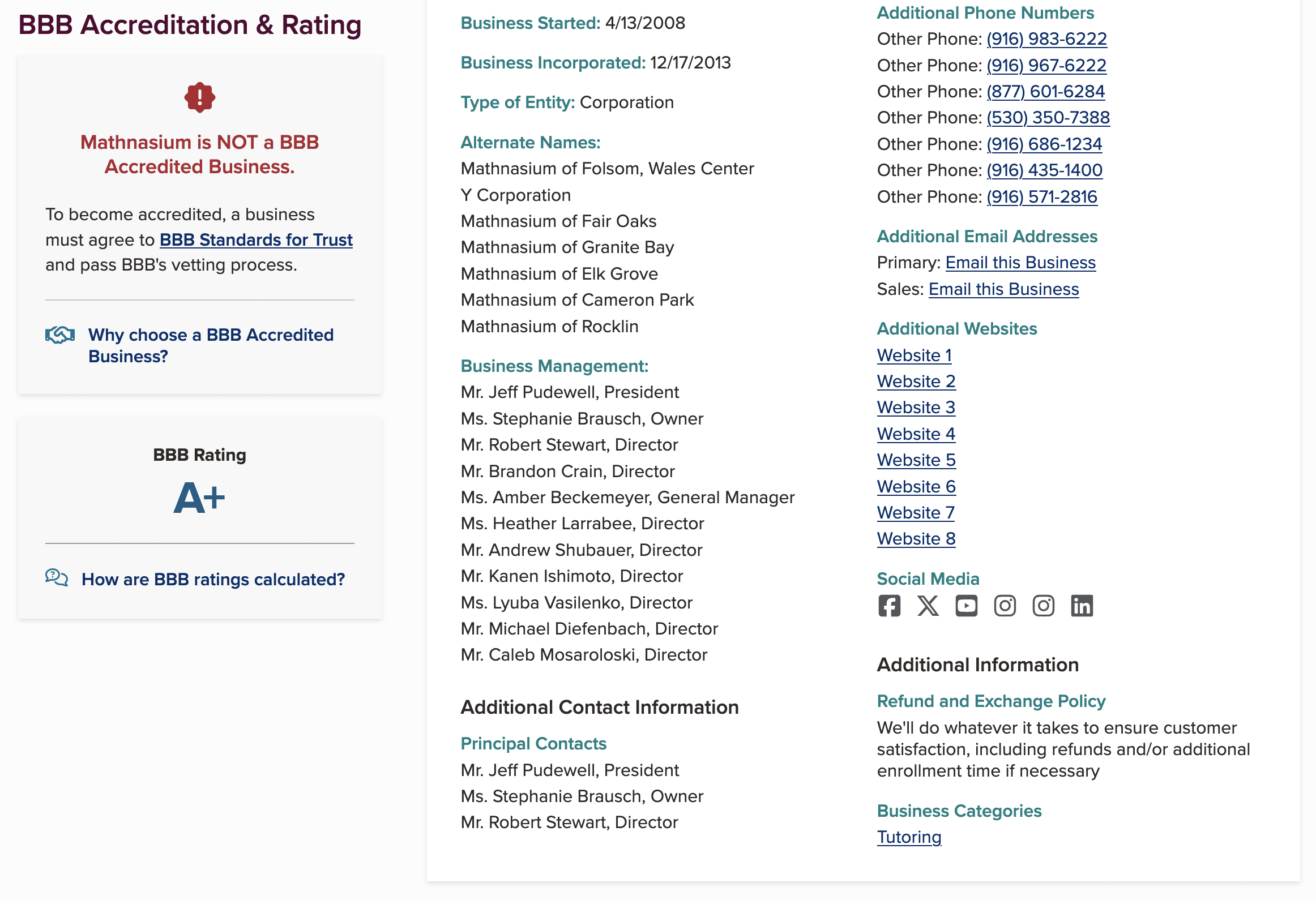
Mathnasium holds an A+ rating from the Better Business Bureau, reflecting the company’s track record of resolving customer complaints. The BBB rating does not reflect service quality directly; it reflects responsiveness to filed complaints. Families who have billing disputes or unresolved service quality issues can file a BBB complaint as a practical escalation path.
Mathnasium’s mission is stated as: “To teach children math so they understand it, master it, and love it.” The company’s instructional philosophy, known as the Mathnasium Method, emphasizes conceptual understanding over rote memorization and builds skills in a defined sequence from foundational arithmetic through pre-calculus.
For a broader look at how online learning tools compare, the Desmos review covering alternatives and pricing offers useful context on digital math tools that complement or contrast with center-based programs like Mathnasium.
Customer Support and Policies
Customer support at Mathnasium operates primarily at the local franchise level. There is no centralized customer service hotline that handles billing disputes, refund requests, or curriculum concerns for all centers. Parents should treat their relationship with the local center director as the primary support channel, and escalate to Mathnasium corporate only after a local resolution attempt has failed.
Key policies to confirm in writing before enrolling include: the total first-month cost including the enrollment fee, the cancellation notice deadline and procedure, the re-assessment fee policy if a student pauses and resumes, and the policy on missed sessions due to illness or family schedule conflicts.
Global Reach and Localization
Mathnasium operates centers in 11+ countries including the United States, Canada, the United Kingdom, Australia, and several Middle Eastern markets. International centers operate under the same franchise model as domestic locations, meaning curriculum is standardized but pricing, enrollment terms, and instructor quality standards are locally managed.
Families in international markets should verify that their local center follows the standard Mathnasium curriculum and assessment approach, as some international franchises have adapted the program in ways that differ from the core U.S. model. This is particularly relevant for families in the UAE and Australia, where the program has expanded rapidly in recent years.
Mathnasium’s Future Plans and the Use of AI
Mathnasium has indicated interest in integrating adaptive learning technology into its curriculum delivery. As of 2026, the company has not deployed a full AI-driven personalization platform at scale, but several franchise operators have begun using diagnostic software tools that provide more granular gap identification than the original paper-based assessment. The Mathnasium@home online option represents the company’s most significant structural shift toward digital delivery.
Parents considering Mathnasium should ask their local center directly whether they use any adaptive software platforms, as the answer will affect how precisely the student’s sessions are targeted to their actual knowledge gaps. Centers that rely entirely on paper diagnostics and instructor judgment provide a different experience than those using digital assessment tools.
Frequently Asked Questions About Mathnasium
The following questions address the most common parent concerns about Mathnasium pricing, program quality, and how it compares to alternatives.
Is Mathnasium legit?
Yes. Mathnasium is a well-established company founded in 2002 that has served more than one million families across nearly 1,000 centers in 11+ countries. Mathnasium holds an A+ rating from the Better Business Bureau. Results vary by center, but Mathnasium has a documented track record of improving math performance for K–12 students, particularly those in elementary and middle school grades.
How much does Mathnasium cost per month in 2026?
Mathnasium monthly fees range from $150 to $500 depending on location and session frequency. Most suburban U.S. centers charge $250–$350 per month for two sessions per week. Urban and high cost-of-living markets frequently reach $400–$500 per month. An enrollment fee of $99–$199 is charged separately at the start of enrollment.
Does Mathnasium offer a free trial?
Most Mathnasium centers offer one free trial session that includes the initial diagnostic assessment. Trial availability is confirmed on a center-by-center basis. Parents should contact their local Mathnasium center directly to confirm availability and what the trial session includes before visiting.
What is Mathnasium’s cancellation policy?
Mathnasium cancellation requires a written notice submitted before the 15th of the month to avoid being billed for the following month. The specific deadline and submission method (email, in-person form, or online portal) varies by franchise. Parents should confirm the exact cancellation procedure in writing at the point of enrollment, not after deciding to leave.
Mathnasium vs. Kumon: which is better?
Mathnasium uses a concept-focused, guided instruction model where instructors work with small groups. Kumon uses an independent worksheet practice model designed to build procedural fluency through daily repetition. Mathnasium is better suited to students who need conceptual explanation and school-year support. Kumon is lower cost ($100–$200/month) and better suited to self-motivated students who benefit from daily structured practice. Neither is universally superior; the correct choice depends on the student’s learning style and specific gaps.
Is Mathnasium worth the cost?
For students who attend every session and have a clear skill-building goal, Mathnasium frequently delivers measurable improvement in confidence and grades within two to three months, making the cost defensible for most families at that timeline. For students who need homework-specific help, curriculum-aligned test preparation, or advanced math beyond precalculus, a targeted service is likely to produce faster results for the same or lower cost.
How does Mathnasium compare to My Engineering Buddy?
Mathnasium serves K–12 students through in-center small-group sessions using a proprietary math curriculum at a fixed monthly fee. My Engineering Buddy provides live, one-on-one online tutoring for high school and college students across math, engineering, and science subjects at a pay-per-session rate with no enrollment fee and no subscription lock-in. The two services address different student populations and different problem types. Mathnasium is appropriate for long-term foundational math development; My Engineering Buddy is appropriate for immediate, targeted help with specific coursework or exam preparation.
This article is for educational purposes only. Pricing and policies vary by Mathnasium franchise location and are subject to change. Verify all fees, cancellation terms, and program details directly with your local center before enrolling.Related Reading
******************************
This article provides general educational guidance only. It is NOT official exam policy, professional academic advice, or guaranteed results. Always verify information with your school, official exam boards (College Board, Cambridge, IB), or qualified professionals before making decisions. Read Full Policies & Disclaimer , Contact Us To Report An Error