
Pharmacology Tutoring Online: Expert Help for Homework and Assignments

Personalized pharmacology tutoring (in-person or online) clarifies complex drug topics and reinforces understanding. Research shows targeted tutoring yields consistent, significant learning gains, helping students improve grades and confidence.
Why Pharmacology Can Be Challenging
Imagine a student named Sarah who just started a college health science program. She feels excited, but is quickly overwhelmed by hundreds of drug names, mechanisms, and side effects. Pharmacology often feels like a maze of abstract concepts far beyond simple memorization. This makes sense: pharmacology spans biology, chemistry and medicine. In fact, the field is growing fast – the FDA used to approve only about 4 new drugs per year before the 1950s, but it’s now around 50 per year.
All this matters because pharmacology is not just another class – it can impact patient safety. About half of U.S. adults (and 85% of seniors) take prescription medications, and studies estimate medication errors cause up to 250,000 deaths per year. Understanding how drugs work and how to use them safely is literally life-and-death important. It’s no wonder students (and their parents) seek help with pharmacology homework and assignments to make the subject less intimidating.
To understand the gravity of the field, consider the rapid explosion of drug development and the critical importance of safety statistics.
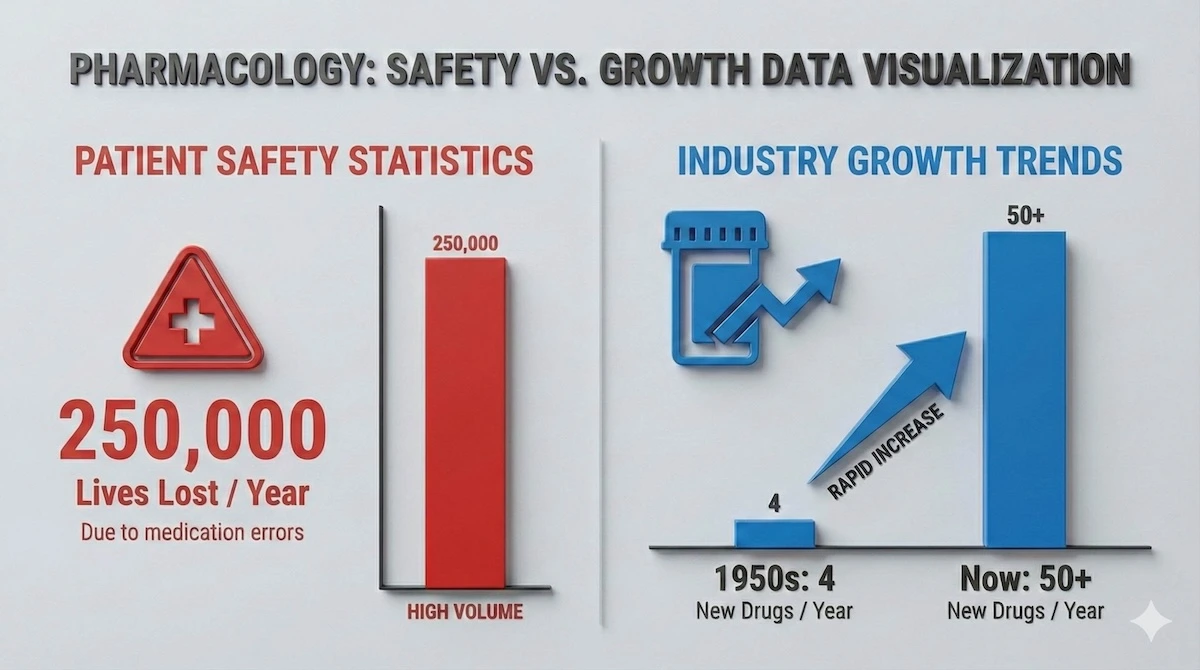
Understanding pharmacology is vital: rising drug complexity and patient safety risks make expert knowledge essential.
These numbers highlight why precision in pharmacology isn’t just academic—it is literally a matter of life and death.
How Tutoring Helps
One-on-one tutoring offers students personalized help to master pharmacology. A skilled pharmacology tutor acts like a personal teacher, adjusting the lesson to the student’s pace and focusing on trouble spots. Tutors use engaging methods – diagrams, real-life examples or analogies – to make drug actions relatable instead of abstract. Importantly, tutoring provides the kind of personalized learning that fills each student’s knowledge gaps.
Deciding between formats often comes down to logistics. Let’s compare the key differences side-by-side to see which fits your schedule.
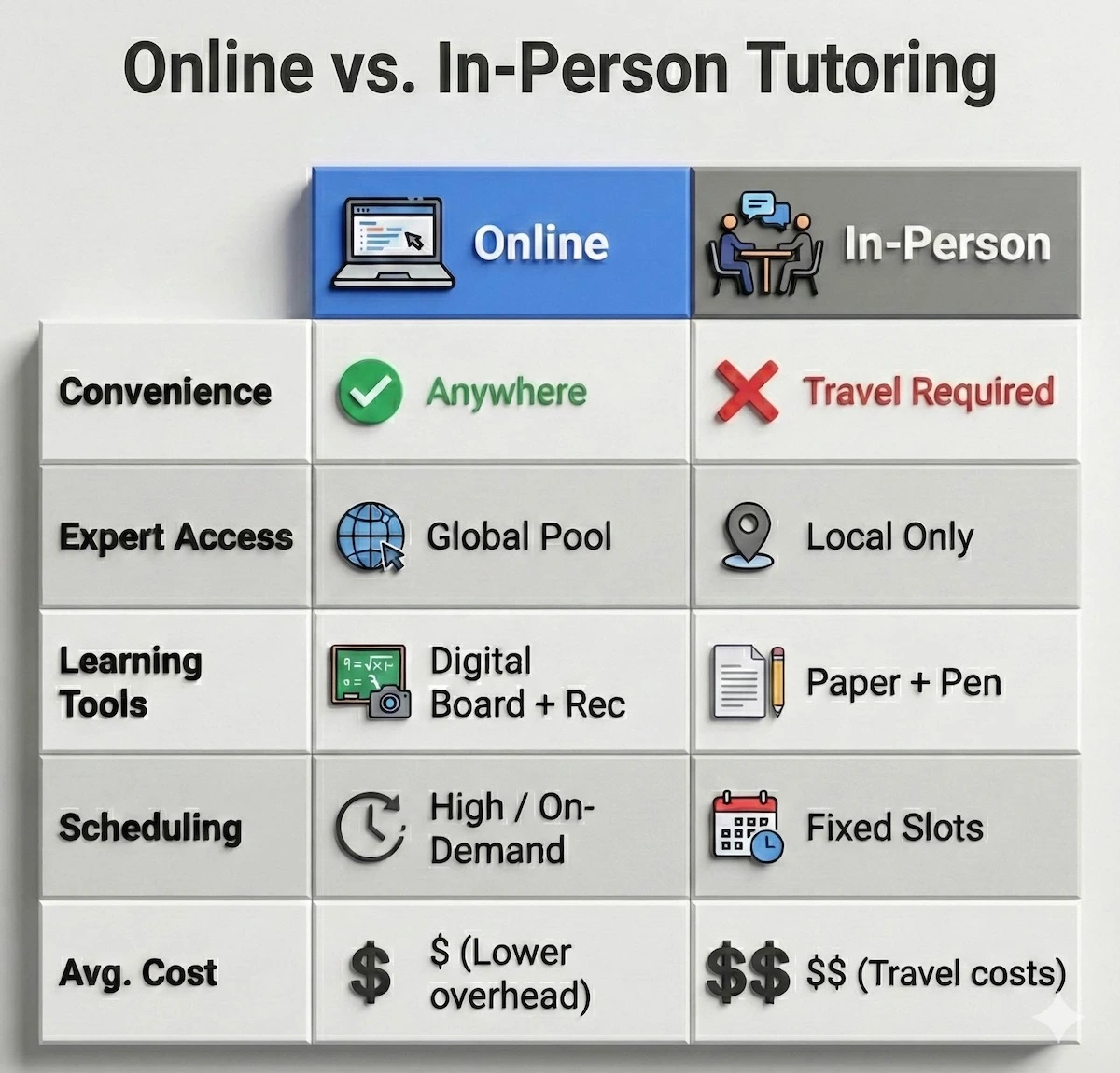
Compare the key differences: Online tutoring often offers greater flexibility and global access to experts compared to traditional methods.
While both formats are effective, online tutoring often offers a distinct advantage in flexibility and access to global experts.
- Personalized attention: Unlike a large classroom, a tutor works with you one-on-one or in a small group. The tutor adapts explanations and examples specifically to your needs, giving you direct pharmacology teaching focused on your questions.
- Clarifying concepts: Tutors break down tough topics into simpler terms. For example, they might turn a complex biochemical pathway into a step-by-step story so the core ideas stick.
- Extra practice: Tutors often provide additional problems, quizzes or flashcards to reinforce material. Working through extra questions under guidance helps move content from “in one ear and out the other” to lasting understanding.
- Homework and assignment help: Getting pharmacology homework help means you can tackle tough questions with a tutor at your side. They guide you through assignments – for instance, writing up a mechanism of action or solving dosing problems – ensuring you learn each step rather than just copy answers.
- Study strategies: A tutor can share memorization tips and study plans. They might teach mnemonic tricks for remembering drug classes or set up a personalized study schedule to prepare for exams.
- Supplement to classroom teaching: A tutor reinforces what the pharmacology teacher covers in class, making sure no question goes unanswered. They can review lecture material in more depth and provide examples beyond the scope of the textbook.
Beyond simple grade improvement, expert tutoring provides a comprehensive support system. Here is how the six core benefits work together:
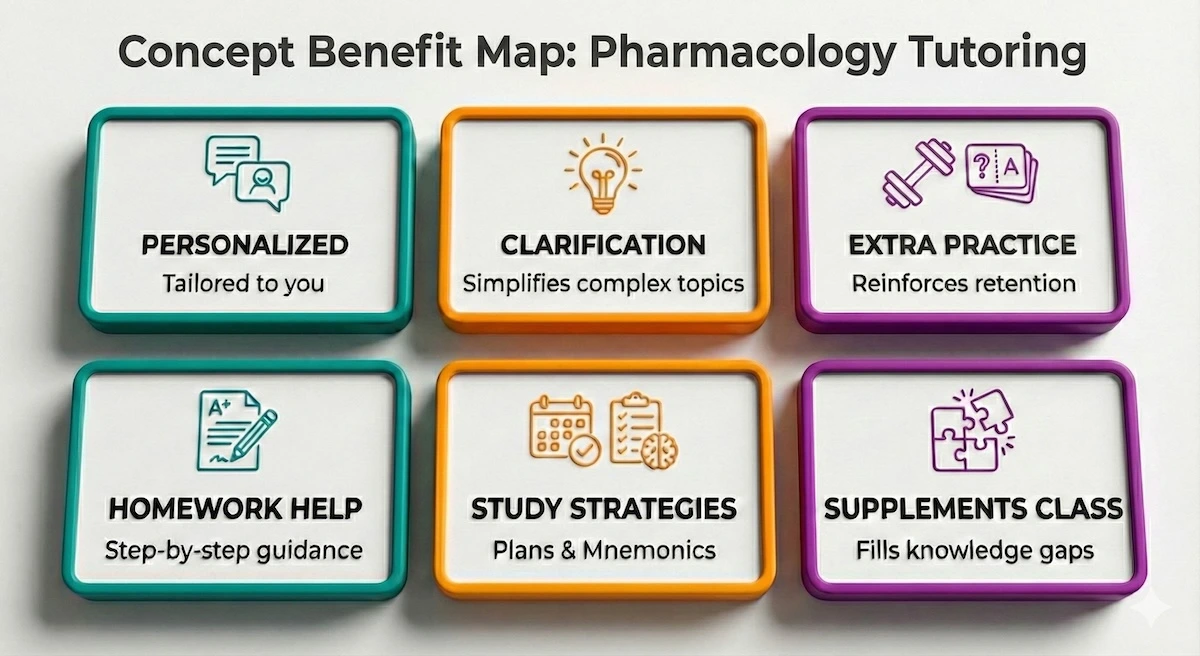
From personalized attention to strategic study plans, a tutor bridges the gap between classroom lectures and deep understanding.
With these six pillars of support, students can move beyond rote memorization to actual mastery of drug mechanisms.
Online vs. In-Person Tutoring
Today you can get pharmacology tutoring online just as easily as in person. Online tutoring connects you to experts via video chat and shared whiteboards, so distance is no barrier. This is great for students in remote areas or busy schedules (for example, in the USA, UK or Gulf countries). The convenience is huge – you simply log in for your session, saving travel time. But is online tutoring effective? Research suggests it can be. One study found that students in an 8-week online tutoring program improved so much that researchers equated their gains to about six extra months of learning. Another found online tutoring significantly boosted students’ test scores, attendance and homework effort.
- Convenience: You can have sessions anywhere you have internet – at home, in a library or even at school. It’s easy to fit a short online session into a busy schedule.
- Access to experts: Online tutoring lets you connect with specialized tutors you might not find locally. For example, searching for a “pharmacology tutor online” can show hundreds of qualified instructors around the world.
- Interactive tools: Tutors use digital whiteboards, screen sharing and apps to draw structures or annotate documents, making the online session as interactive as in-person. Many sessions can also be recorded for later review.
- Cost and flexibility: Without travel, tutors often save time and may charge slightly less than in-person rates. You can also easily switch tutors or join group sessions when needed. Many online tutoring sites list their tutors per hour rates on their pricing page.
Choosing the Right Pharmacology Tutor
With so many tutors available, how do you pick the best one? Start by identifying your needs: Are you in high school or college? Do you need help with a specific exam or curriculum (like AP Biology, nursing pharmacology, or pharmacy school)? Look for tutors who match your course level. Check qualifications – a good pharmacology tutor might be a pharmacist, nurse, medical student, or science graduate who has taught or tutored this subject before. Reading reviews or asking for recommendations can also help.
Here are steps you can follow:
- Define your goals: Decide what you need help with (e.g. homework, test prep, projects). Mention if you need pharmacology homework help or assignment help to improve your grades.
- Search for specialists: Use search terms like “pharmacology tutor online,” “pharmacology teacher,” or “pharmacology homework help.” Filter by expertise, location (if needed), and student level.
- Compare profiles: Look at tutor bios. A tutor with healthcare or science degrees is ideal. Check if they list experience with your specific topics (e.g. pharmacokinetics, drug interactions).
- Read reviews and ratings: Feedback from other students can show if the tutor explains well and has helped others improve.
- Trial session: Many tutors offer a free or low-cost first lesson. Use it to see if the teaching style clicks with you. Ask a few practice questions and see if the tutor’s explanations make sense.
- Confirm availability: Make sure their schedule and rates fit your needs. Note that rates for specialized science tutors often range around $20–$40 per hour.
Ready to find your tutor? Follow this step-by-step roadmap to ensure you select the best candidate for your specific needs.
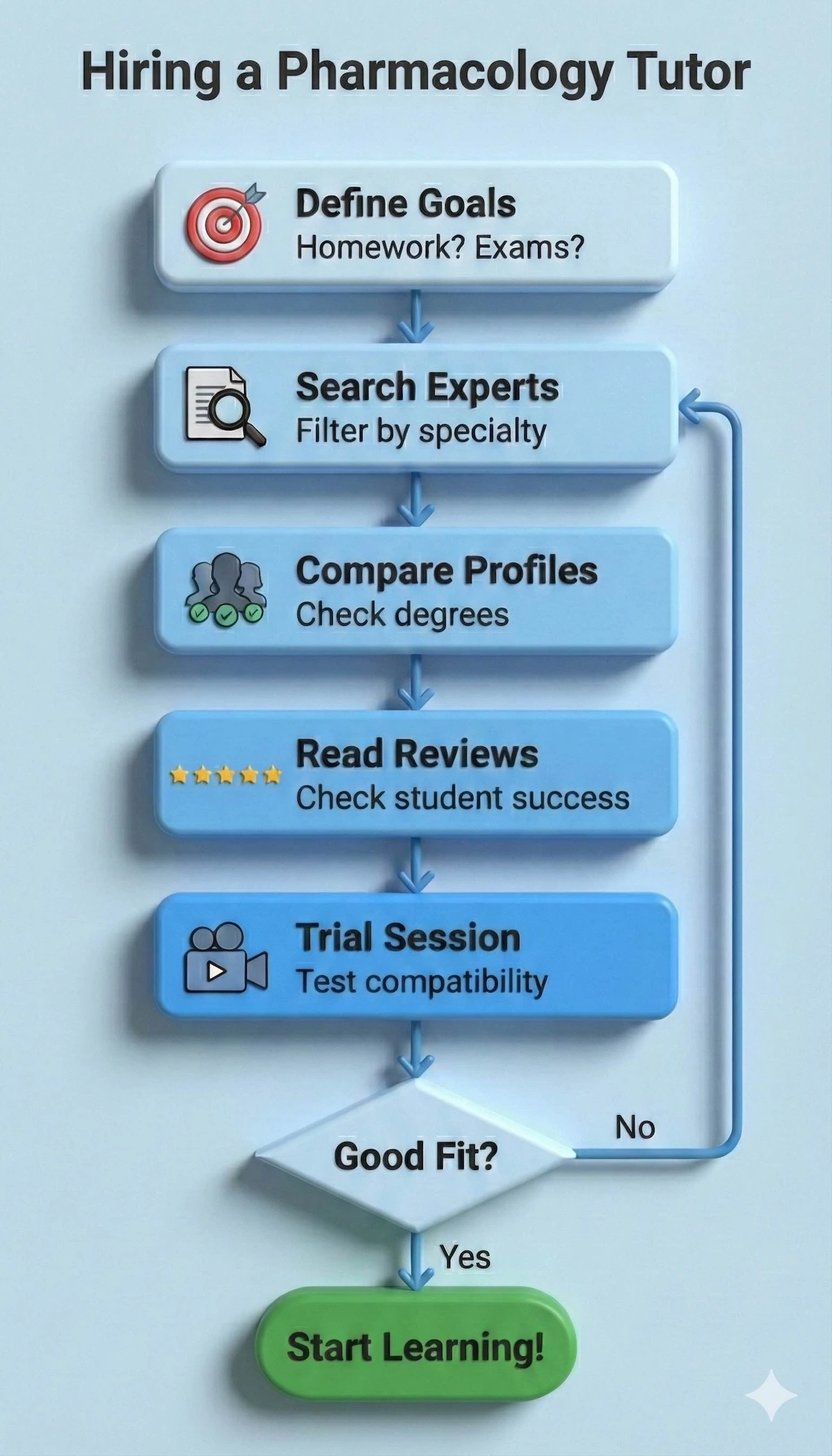
Follow this step-by-step roadmap to ensure you find a tutor who matches your specific academic needs.
Taking these steps systematically ensures you don’t just find a tutor, but the right tutor who matches your learning style.
Many tutoring platforms (like Wyzant or My Engineering Buddy) list thousands of science tutors. You can filter them by subject or use the keywords above. Taking the time to choose carefully ensures you hire a pharmacology tutor who will really help you succeed.
What to Expect in a Tutoring Session
A typical pharmacology session is interactive. Your tutor might begin by asking which topics you find confusing, then review class material or homework together. For example, they might explain how drug metabolism works with a simple analogy, then work through practice questions with you. Tutors often use visuals (like drawing a cell or pathway) and ask you to explain concepts back, so you know you’ve learned them. You’ll have plenty of chances to ask questions until you feel comfortable with the answers.
Importantly, a good session ends with a summary or action plan. The tutor may highlight 2–3 key points you struggled with and suggest follow-up activities (like flashcard review or specific practice problems). Some tutors even send a recap or additional exercises afterward. Over time, this approach builds not only your pharmacology knowledge, but also your study skills and confidence.
If you are wondering what happens during that hour, here is the typical flow of a high-impact session:

A typical session moves from confusion to confidence through a structured cycle of review, explanation, and practice.
This structured cycle ensures that every minute is spent turning confusion into clarity, leaving you with a concrete plan for next steps.
Conclusion
Pharmacology is a challenging subject, but tutoring can make it manageable. By providing customized explanations and practice, tutors turn confusion into confidence. Research confirms that tutoring works: for example, one large review found tutoring consistently produces substantial learning gains. In practice, students who get the right pharmacology homework help or assignment assistance often see their test scores and class grades improve. For busy students, tutoring can turn a daunting subject into one they can handle.
In short, hiring a pharmacology tutor is a smart step if you’re feeling stuck. With one-on-one guidance, even the trickiest drug mechanisms become clear. As one educator noted, tutoring is a proven strategy that education leaders can count on. So reach out early, set clear goals, and watch your understanding of pharmacology – and your grades – grow.
FAQs
What is pharmacology tutoring? Personalized one-on-one instruction from a knowledgeable tutor who helps you understand pharmacology topics and improve your coursework.
What is pharmacology tutoring online? Online pharmacology tutoring means working with a tutor over the internet (via video chat or similar), allowing you to have personalized lessons from anywhere.
Who can benefit from hiring a pharmacology tutor? Any student taking courses involving medications (like nursing, pharmacy or biology) can benefit by getting extra help when the material gets tough.
What can a pharmacology tutor help me with? They can explain drug classes, dosing and interactions, and provide pharmacology homework help and guidance on assignments.
What is the difference between a pharmacology tutor and a pharmacology teacher? A pharmacology teacher provides lectures in a classroom to many students, while a pharmacology tutor offers one-on-one or small-group personalized help tailored to your specific needs.
How much does a pharmacology tutor cost? Rates vary, but many sources report that private tutors charge roughly $20–$40 per hour for advanced science subjects like pharmacology.
Related subjects:
Autism
Clinical Pharmacy
Drug Discovery & Development
Oncology
Pathology
Pharmaceutical
Pharmaceutical Chemistry
Pharmacoeconomics
Pharmacogenomics
Pharmacokinetics
Pharmacy
******************************
This article provides general educational guidance only. It is NOT official exam policy, professional academic advice, or guaranteed results. Always verify information with your school, official exam boards (College Board, Cambridge, IB), or qualified professionals before making decisions. Read Full Policies & Disclaimer , Contact Us To Report An Error