
The Complete Guide to Forensic Science Tutoring: Expert Online Support for Students

Forensic science students face a challenge that students in single-discipline degrees do not: the course draws simultaneously on chemistry, biology, statistics, law, and laboratory technique, and the examiners in each module assess at the standard of that discipline.
A student who manages organic chemistry well may struggle with population genetics interpretation. Someone confident in DNA profiling methodology may find trace evidence statistics counterintuitive.
This guide covers what forensic science students specifically struggle with by course area, how to write a forensic science lab report to the standard examiners require, which top programmes admit students and at what GPA, what the 2026 career and salary outlook looks like, how forensic science tutoring differs from general chemistry or biology support, and which exam preparation strategies are specific to forensic science assessments.
Forensic science is difficult because students are tested across several disciplines at once. This visual shows the overlap that creates the biggest learning pressure.
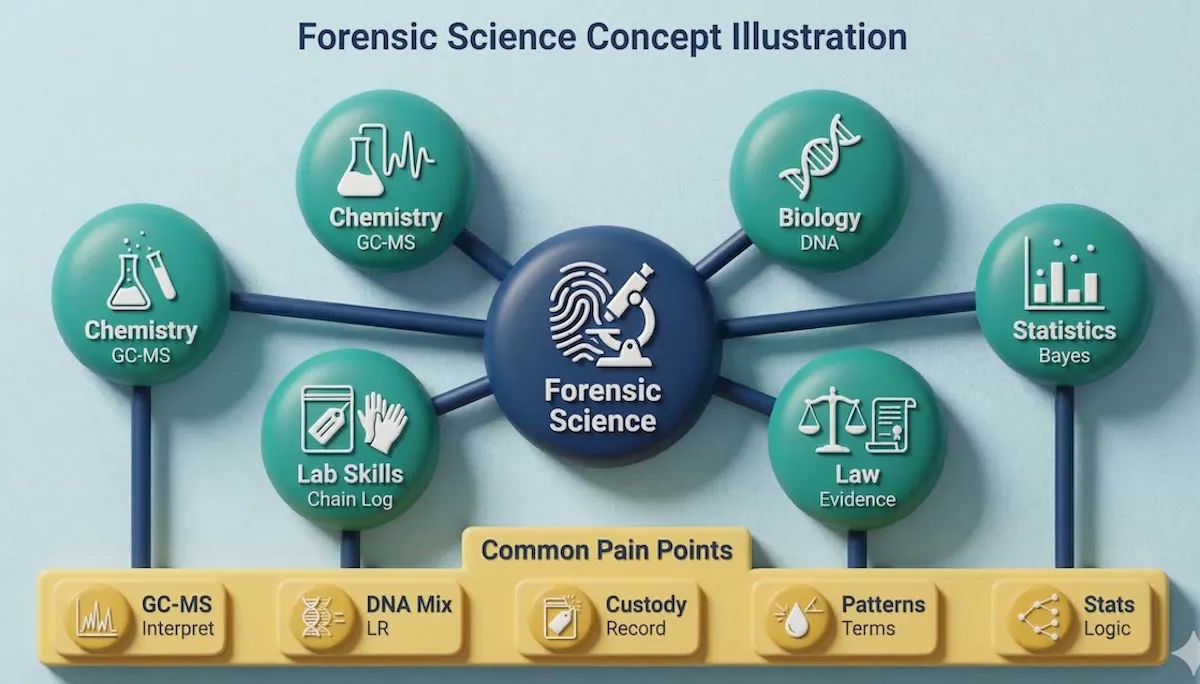
This concept map shows why forensic science students struggle when chemistry, biology, statistics, law, and lab skills overlap.
When students see the subject as an integrated system, their weak points become much easier to target.
Check Out: Get Personalized Online Tutoring
What Do Forensic Science Students Struggle With Most Course by Course?
Forensic science courses typically span six to ten core modules across a three- or four-year programme, and the difficulty profile is uneven. The modules where students most consistently lose marks are not always the ones they expect.
Forensic Chemistry and Toxicology is the module with the highest failure rate across most forensic science programmes.
The challenge is not organic chemistry fundamentals most students arrive with sufficient A-Level or first-year chemistry but the application layer: interpreting gas chromatography mass spectrometry (GC-MS) data from a real sample with matrix effects, understanding how drug metabolism affects blood concentration interpretation, and applying pharmacokinetic principles to back-calculate dose from post-mortem toxicology results.
Students who memorise drug structures without understanding metabolic pathways cannot answer applied toxicology questions correctly.
Forensic DNA Analysis is widely underestimated in its statistical demand. Short tandem repeat (STR) profiling is taught procedurally without difficulty; the conceptual failure point arrives at mixture interpretation and likelihood ratio calculation.
The likelihood ratio the ratio of the probability of the evidence given the prosecution hypothesis to the probability of the evidence given the defence hypothesis is the formal framework for evaluating DNA evidence strength, and it requires probability reasoning that forensic science programmes do not always teach explicitly before expecting it in assessments.
The likelihood ratio is one of the most confusing ideas in forensic statistics and DNA analysis. This visual strips it down to the core logic.
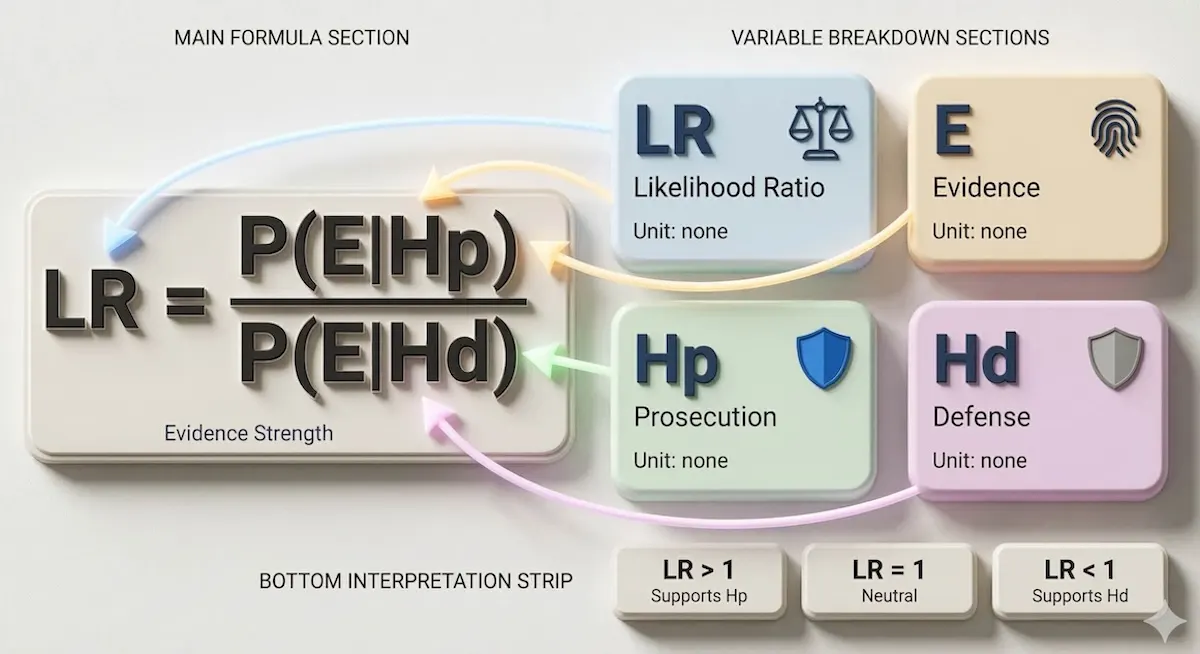
This formula visual explains how likelihood ratio helps forensic science students compare evidence under two competing hypotheses.
Once students understand what each symbol stands for, the wider statistics framework becomes much less intimidating.
Crime Scene Investigation and Evidence Recovery is the module where practical lab skills gap students who have strong theoretical knowledge.
Chain of custody documentation, proper evidence packaging by evidence type, and understanding how contamination affects downstream analysis are procedural competencies that are tested in lab practicals and OSCA-style assessments, not just written exams.
Forensic Biology and Bloodstain Pattern Analysis is conceptually straightforward in its biology content but assessment-difficult because mark schemes reward specific terminology and a defined analytical methodology.
Students who describe bloodstain patterns in informal language rather than using the SWGMAT/IABPA classification framework typically score in the lower band regardless of their observational accuracy.
Forensic Statistics and Evidence Interpretation is the module that most surprises students who entered forensic science expecting primarily laboratory work.
Bayes’ theorem applied to forensic evidence, database match probability, and the prosecutor’s fallacy are conceptually challenging and rarely taught with sufficient depth at A-Level. This is consistently the module where students most benefit from one-to-one tutoring, because the concepts are counter-intuitive until worked through with examples.
| Module | Primary difficulty | Most common student error | What targeted tutoring addresses |
| Forensic Chemistry & Toxicology | Applied interpretation of GC-MS and pharmacokinetics | Memorising drug structures without understanding metabolism | Back-calculation methodology; metabolic pathway reasoning |
| Forensic DNA Analysis | Likelihood ratio calculation; mixture interpretation | Procedural STR knowledge without statistical reasoning | Probability framework; LR construction with worked examples |
| Crime Scene Investigation | Practical chain of custody; contamination control | Theoretical knowledge without procedural application | Evidence packaging by type; documentation standards |
| Bloodstain Pattern Analysis | Formal classification terminology | Informal description instead of SWGMAT/IABPA classification | Framework application; terminology precision |
| Forensic Statistics | Bayes’ theorem; database match probability | Confusing likelihood ratio with posterior probability | Worked Bayesian examples; prosecutor’s fallacy identification |
| Questioned Documents & Trace Evidence | Microscopy interpretation; comparative methodology | Describing observations without applying comparison criteria | Structured comparison methodology; technical vocabulary |
How Do You Write a Forensic Science Lab Report That Gets Full Marks?
Forensic science lab reports are assessed differently from standard chemistry or biology lab reports. The addition of an evidence interpretation layer moving from analytical results to forensic conclusions with appropriate uncertainty qualification is the component that most distinguishes high-scoring from average reports, and it is the section that generic lab report guides do not cover.
A complete forensic science lab report has the following structure, with specific requirements at each stage:
This section is much easier to use when students can see the report structure at a glance. The flowchart below turns the marking logic into a practical checklist.
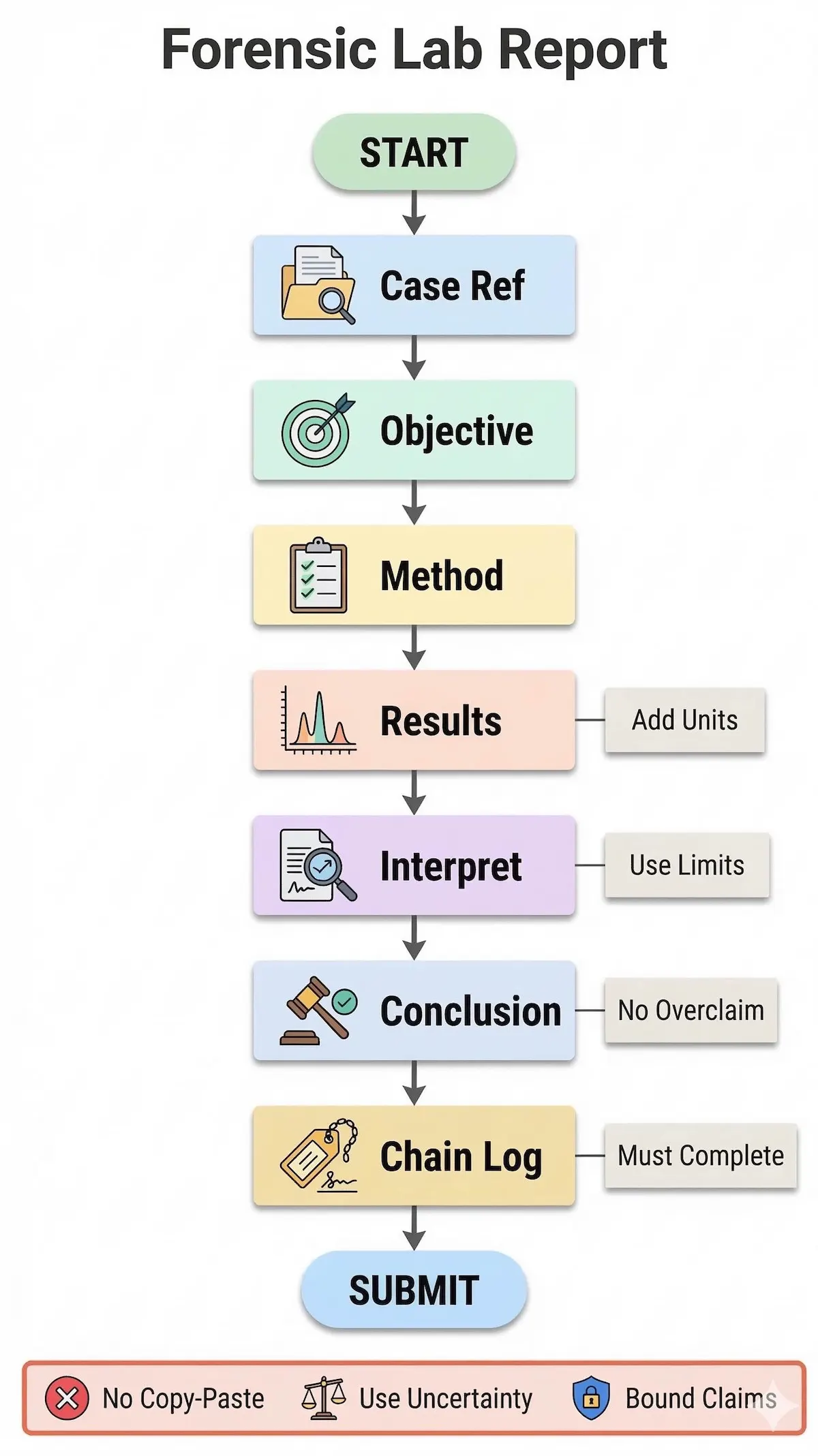
This forensic science lab report flowchart shows the exact order students should follow to improve clarity, accuracy, and marks.
Following this sequence helps students avoid the most common report-writing mistakes.
Title and Case Reference.
Include the case number (or simulated case reference), exhibit numbers, submission date, and the analytical question the report addresses. Examiners assessing forensic science reports expect the framing of a casework document, not a standard experimental write-up.
Objective.
State precisely what analytical question is being answered: not “to analyse the sample” but “to determine whether the white powder in Exhibit 4a contains cocaine and, if so, at what concentration, using GC-MS analysis.” The objective defines the scope of the conclusions section.
Method Summary.
Do not transcribe the practical handout. Summarise the method with sufficient detail that another analyst could repeat it, noting any deviations from standard protocol and justifying them. Examiners penalise students who copy-paste the provided method — this signals lack of procedural understanding.
Results.
Present results in a structured format appropriate to the analytical technique. For chromatographic data: include the chromatogram or relevant extracted data, retention times, comparison to reference standards, and quantitative results with units and appropriate significant figures. Uncertainty values (standard deviation or confidence interval) must be included for any quantitative claim.
Interpretation and Discussion.
This is the section that distinguishes a forensic science report from a general chemistry report. For each result, the student must:
(1) state what the result shows analytically;
(2) interpret its forensic significance in the context of the case;
(3) acknowledge alternative explanations or limitations;
(4) qualify the conclusion with appropriate uncertainty language.
Phrases like “consistent with,” “cannot be excluded,” and “to a reasonable degree of scientific certainty” are not hedging — they are the precise vocabulary of forensic evidence interpretation.
Conclusions.
Conclusions in a forensic report address the analytical question stated in the objective. They must be clearly bounded: do not draw conclusions beyond what the data supports, and explicitly note what the analysis cannot determine. A conclusion that overstates the evidence is a more serious error in forensic science assessment than a conclusion that is conservative.
How Online Tutoring Enhances Test Prep for Standardized Exams
References and Chain of Custody Record.
Include the chain of custody documentation showing who handled the exhibit from receipt to analysis. In assessed practicals, failure to complete the chain of custody record is typically a mandatory fail criterion on the marking rubric.
| Lab report section | Forensic science requirement | Common error | Mark impact |
| Objective | States the specific analytical question for the case | Generic “to identify the substance” | Minor loses framing marks |
| Results | Quantitative data with units, uncertainty, and comparison to reference standards | Results without uncertainty values | Moderate loses quantitative marks |
| Interpretation | Forensic significance + alternative explanations + uncertainty language | Analytical conclusions without forensic context | Major this section carries 30–40% of marks |
| Conclusions | Bounded to what data supports; “consistent with” language | Overclaiming certainty (“proves that…”) | Major examiner flag; marks lost and noted |
| Chain of custody | Complete documentation of exhibit handling | Missing or incomplete record | Can be mandatory fail criterion |
What Is the Forensic Science Career Outlook in 2026 Salaries and Job Growth?
Forensic science career data is frequently misrepresented by television-influenced expectations. The actual employment landscape for 2026 graduates is more nuanced than either the optimistic “CSI effect” narrative or the pessimistic “overcrowded market” concern suggests.
Per the U.S. Bureau of Labor Statistics Occupational Outlook Handbook (2025–2026 edition), forensic science technicians are projected to see employment growth of approximately 11% from 2023 to 2033 — faster than the average for all occupations.
The median annual wage for forensic science technicians in the United States was approximately $63,740 in May 2024, with the top 25% earning above $84,000 and the top 10% above $103,000. Per BLS data, the highest-paying employers are federal government agencies (including FBI, DEA, ATF laboratories) and specialised private forensic laboratories.
In the United Kingdom, per the Chartered Society of Forensic Sciences salary data (2025), entry-level forensic scientists at police force or private laboratory level typically start at £24,000–£29,000.
Senior forensic scientists and specialists in high-demand disciplines (digital forensics, toxicology, DNA) typically reach £35,000–£55,000. Independent forensic experts instructed in legal proceedings earn significantly more on a case fee basis.
Specialisation materially affects both employability and salary. The forensic science disciplines with the highest demand in 2025–2026 are digital forensics, forensic toxicology, forensic DNA analysis, and cybercrime investigation.
Graduates with postgraduate qualifications in these specific areas consistently report shorter time-to-employment and higher starting salaries than generalist forensic science graduates.
| Role / specialisation | US median salary (2025, approx.) | UK salary range (2025, approx.) | Job growth (US, 2023–2033) |
| Forensic science technician (general) | $63,740 | £24,000–£40,000 | +11% |
| Forensic toxicologist | $72,000–$90,000 | £30,000–£55,000 | Above average |
| Digital forensics analyst | $80,000–$110,000 | £35,000–£65,000 | Rapid growth |
| Forensic DNA analyst | $65,000–$85,000 | £28,000–£50,000 | Stable-positive |
| Forensic accountant | $85,000–$120,000 | £40,000–£70,000 | Strong |
| Crime scene investigator (CSI/SOCO) | $55,000–$75,000 | £25,000–£38,000 | Moderate |
| Independent forensic expert (legal) | Variable case fees | £500–£2,500/day (instruction-dependent) | Stable |
Data sources: U.S. Bureau of Labor Statistics Occupational Outlook Handbook 2025–2026; Chartered Society of Forensic Sciences UK career data 2025. Salary figures are approximate and vary by location, employer, and specialisation.
Career data is easier to understand when the numbers are placed side by side. This chart highlights the salary and demand patterns students care about most.
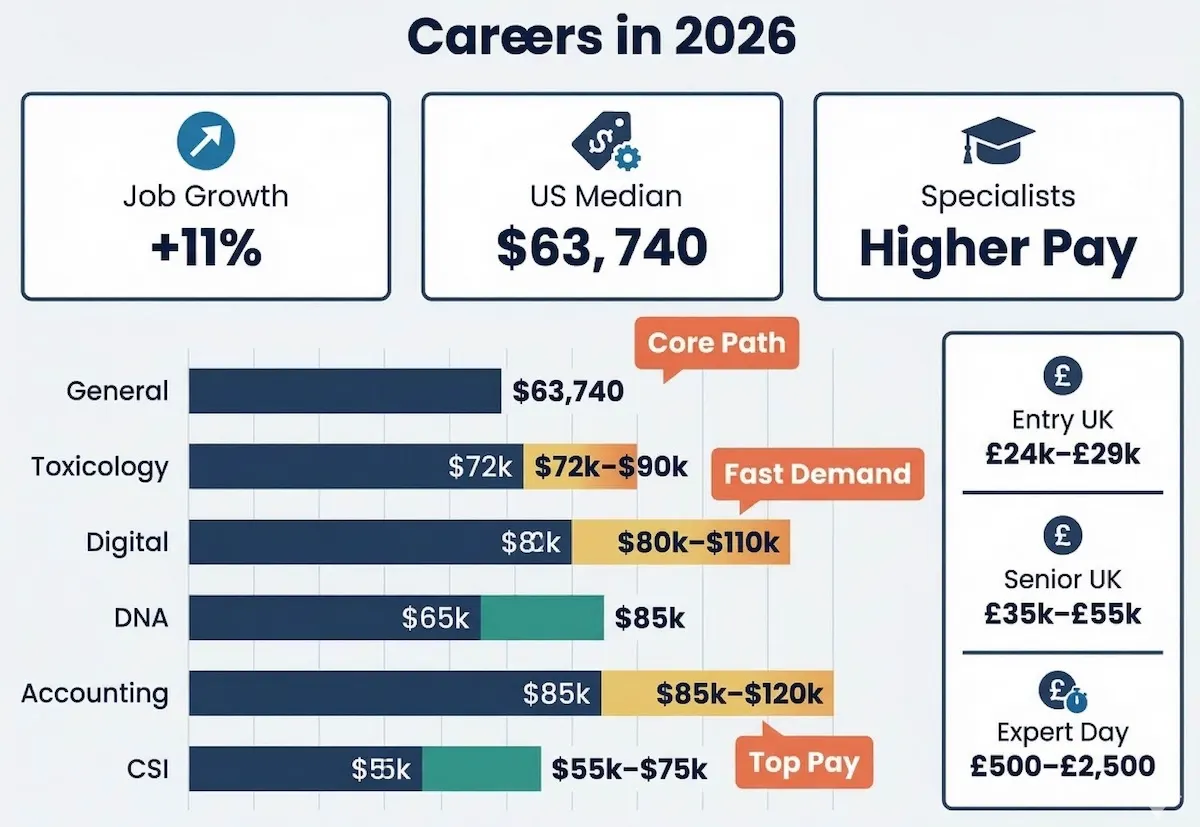
This career chart summarizes forensic science salary ranges, specialist demand, and job growth so students can compare paths quickly.
The big takeaway is that specialization matters more than students often expect.
The graduate school consideration: A significant proportion of competitive forensic science roles particularly at federal agency laboratory level in the US, and at senior scientist level in UK expect or require a postgraduate qualification.
Students making GPA decisions now should factor in whether a masters or PhD is part of their pathway, as GPA thresholds for competitive postgraduate programmes are a downstream consequence of undergraduate performance.
Also Read: 24/7 Premium 1:1 Tutoring For Standardized Tests
Which Top Forensic Science Programs Have the Highest GPA Requirements?
Forensic science programme selectivity varies considerably between institutions and between undergraduate and postgraduate entry. The programmes with the strongest reputations in industry and for postgraduate progression also tend to have the most competitive admissions thresholds.
United States undergraduate forensic science programmes are offered at approximately 150 institutions. The most consistently well-regarded programmes, based on FEPAC (Forensic Science Education Programs Accreditation Commission) accreditation status and graduate employment data, include:
| US institution | Programme | FEPAC accredited | Approximate GPA for competitive admission |
| Michigan State University | BS Forensic Science | Yes | 3.5+ (competitive) |
| University of New Haven | BS Forensic Science | Yes | 3.2+ |
| West Virginia University | BS Forensic & Investigative Science | Yes | 3.0+ |
| John Jay College (CUNY) | BS Forensic Science | Yes | 3.2+ |
| Sam Houston State University | BS Forensic Science | Yes | 2.75+ |
| George Washington University | MS Forensic Science (graduate) | Yes | 3.3+ GPA + relevant UG degree |
FEPAC accreditation note: FEPAC accreditation, administered by the American Academy of Forensic Sciences, is the primary quality marker for forensic science programmes in the US.
Employers including FBI, DEA, and state crime laboratory systems give preference to graduates of FEPAC-accredited programmes. Students applying to forensic science programmes should verify current FEPAC accreditation status directly with AAFS, as accreditations are reviewed periodically.
United Kingdom undergraduate forensic science programmes are primarily offered at post-1992 universities and newer research institutions. The most consistently well-regarded include:
| UK institution | Programme | Typical entry offer |
| King’s College London | BSc Forensic Science | AAA–ABB |
| Anglia Ruskin University | BSc Forensic Science | BBC–BBB |
| University of Huddersfield | BSc Forensic & Analytical Science | BCC–BBC |
| Staffordshire University | BSc Forensic Science | CCC–BCC |
| Northumbria University | BSc Forensic Science | BBC |
For postgraduate (Masters) entry in the UK, most programmes require a 2:1 or above in a relevant science degree. Programmes in digital forensics at specialist institutions (including Cranfield University, University of Strathclyde) require 2:1 and typically competitive personal statements demonstrating technical competency.
Admissions benchmarks are much easier to compare visually than in paragraph form. This table gives students a fast decision-making snapshot.
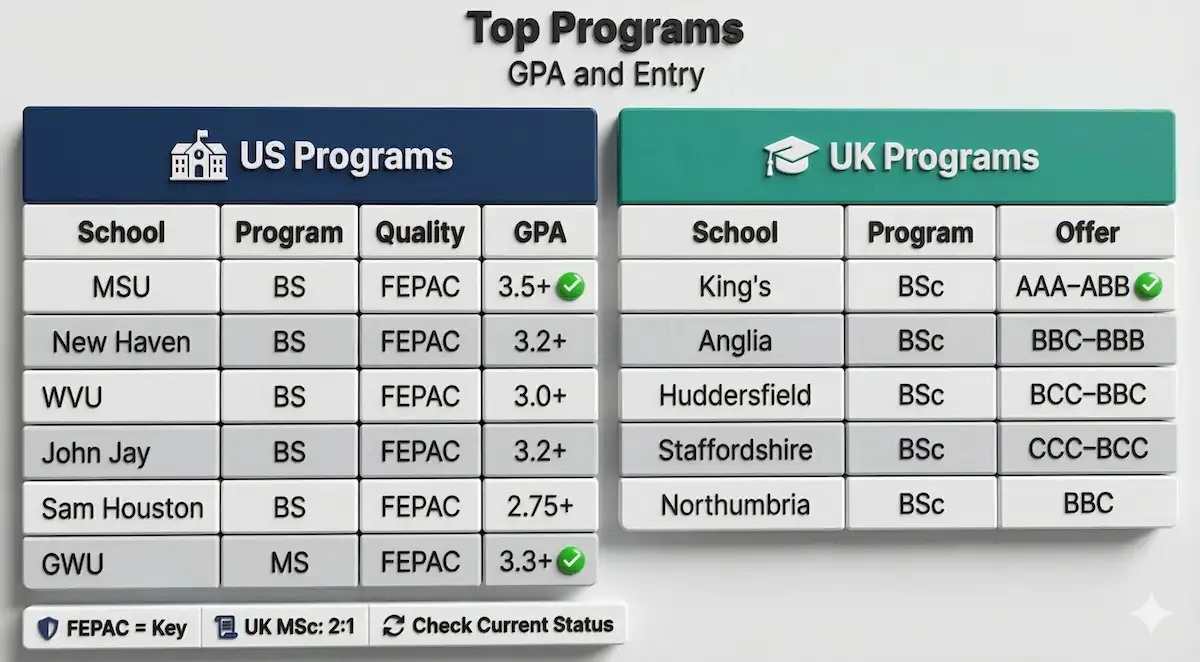
This comparison table helps students quickly review forensic science program selectivity, GPA expectations, and key admissions signals.
Students should still verify current entry requirements directly with each institution before applying.
Read More: StudyX Online Tutoring Review: Features, Pricing, and Alternatives
How Is Forensic Science Tutoring Different From General Chemistry or Biology Tutoring?
Forensic science tutoring differs from general chemistry or biology tutoring in three specific ways, and understanding this distinction matters when a student is deciding what kind of support to seek.
First, forensic science requires applied rather than foundational knowledge. A chemistry tutor can teach GC-MS operating principles without ever addressing how to interpret a chromatogram from a seized drug sample with an unknown matrix. A forensic science tutor works specifically at the application layer the step between understanding the technique and using it correctly in a forensic context. This is not a higher level of the same thing; it is a different task.
Second, forensic science assessments are structured around evidence interpretation, not problem-solving. In chemistry, there is typically a correct answer derivable from known principles. In forensic science, the examined skill is often the ability to reason to a qualified conclusion from incomplete evidence to know what the data supports, what it does not support, and how to communicate that distinction. A general science tutor who has not worked in forensic science contexts will default to the “correct answer” model when the correct approach is “justified, bounded conclusion.”
Third, forensic science has a procedural layer that other sciences do not. Legal admissibility standards, chain of custody requirements, accreditation frameworks (ISO 17025 for forensic laboratories), and the specific vocabulary of expert witness testimony are not taught in chemistry or biology degrees. Students being assessed on these elements need support from someone familiar with forensic science practice, not general scientific methodology.
| Feature | General chemistry/biology tutoring | Forensic science tutoring |
| Knowledge level targeted | Foundational principles and calculations | Applied interpretation in forensic context |
| Assessment model | Correct answer derivation | Justified, bounded conclusion with uncertainty |
| Procedural knowledge | Laboratory technique | Chain of custody, accreditation standards, legal admissibility |
| Vocabulary required | Scientific terminology | Scientific + legal/evidential terminology combined |
| Context for examples | Abstract or industrial applications | Casework scenarios, court-ready reporting |
| Statistics emphasis | Basic descriptive/inferential | Likelihood ratios, Bayesian interpretation, database probabilities |
A student struggling with the statistics of DNA evidence interpretation needs someone who can explain likelihood ratios in a forensic context, not a maths tutor who teaches probability in the abstract. Similarly, a student losing marks on lab reports because their conclusions “overclaim” the evidence needs feedback from someone who understands forensic evidence interpretation standards, not generic scientific writing guidance.
Many students assume any science tutor can help with forensic work. This comparison shows why forensic tutoring solves a different kind of problem.
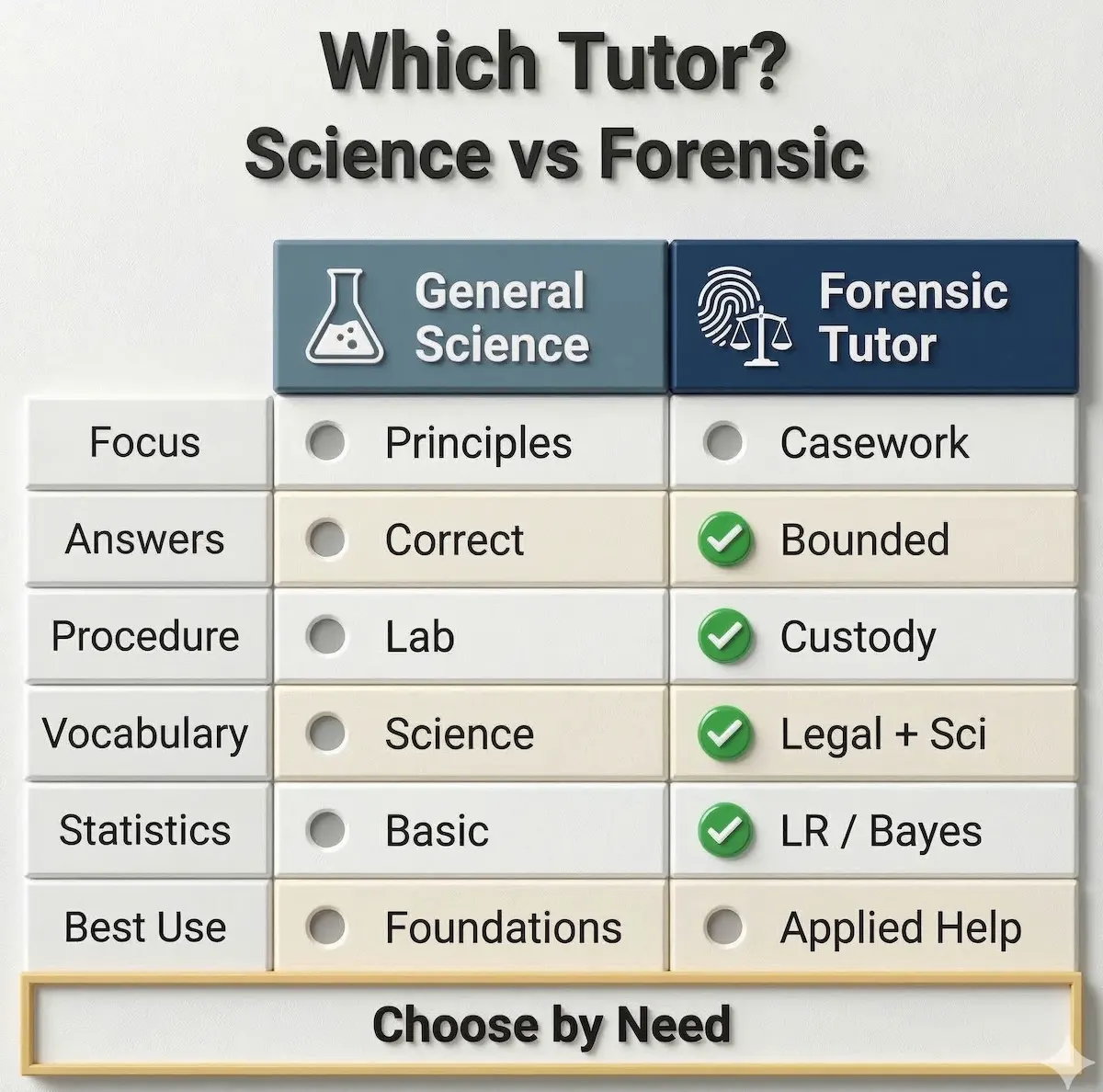
This comparison table shows why forensic science tutoring is better suited to evidence reasoning, procedure, and case-based assessments.
The best tutor choice depends on whether the student needs foundations or forensic application.
Read More: Top 10 Online Tutoring Websites Worldwide
What Exam Preparation Strategies Work Best for Forensic Science Assessments?
Forensic science exam preparation requires a different approach from general science revision because the assessment format combines scientific knowledge with applied reasoning and case-based analysis.
The strategies that work for memorisation-heavy exams are insufficient; those that work are specific to how forensic science questions are constructed.
Strategy 1 Practice with past paper case scenarios, not just topic summaries.
Forensic science exams at degree level frequently present a case scenario and ask the student to apply multiple modules’ knowledge to it. Revising each module in isolation leaves students unable to integrate when the exam question requires it.
Effective preparation includes working through complete case scenarios — ideally past papers — that require drawing on toxicology, statistics, and evidence interpretation in the same question.
Strategy 2 Learn the formal frameworks before the factual content.
The likelihood ratio framework, the Bayesian update structure, and the SWGMAT/IABPA classification systems are the interpretive scaffolding onto which factual content must be hung.
Students who learn facts without frameworks cannot apply them under exam conditions. For each module, identify the core analytical framework first, then populate it with factual knowledge.
Strategy 3 Build a terminology precision list for each module.
Forensic science examiners award marks for specific vocabulary. “Consistent with” and “proves” are not interchangeable; “transfer” and “persistence” are technical terms with defined meanings in trace evidence.
Build a module-by-module glossary that distinguishes precise forensic terminology from everyday synonyms and practise using the precise terms in written answers.
Strategy 4 Practise writing bounded conclusions under time pressure.
The most common exam failure in forensic science is writing conclusions that either overclaim (asserting certainty the data does not support) or underclaim (failing to draw the inference the evidence does support).
Practise writing three-sentence conclusions from data sets: what the data shows, what forensic inference can be drawn, and what the data cannot determine. Timed practice builds the discipline to do this under exam conditions.
Strategy 5 Use worked likelihood ratio examples until the reasoning is automatic.
Likelihood ratio questions appear in DNA, trace evidence, and forensic statistics modules. They are reliably worth significant marks and are reliably answered poorly by students who have not worked through multiple examples.
Three to five worked examples from different forensic disciplines, completed under close-to-exam conditions, typically produce measurable improvement in this question type.
Strategy 6 For practical assessments (OSCAs, lab practicals): simulate the assessment conditions.
Forensic science practical assessments often use OSCA (Objective Structured Crime Scene Analysis) formats where the student rotates through evidence stations with limited time at each. The failure mode is not knowledge it is time management and systematic methodology under pressure.
Practice by timing yourself through mock scenarios, following a defined step-by-step protocol at each station regardless of how confident you feel about the evidence.
The article’s strategy section becomes much more useful when students can follow the order visually. This flowchart turns revision advice into an action plan.
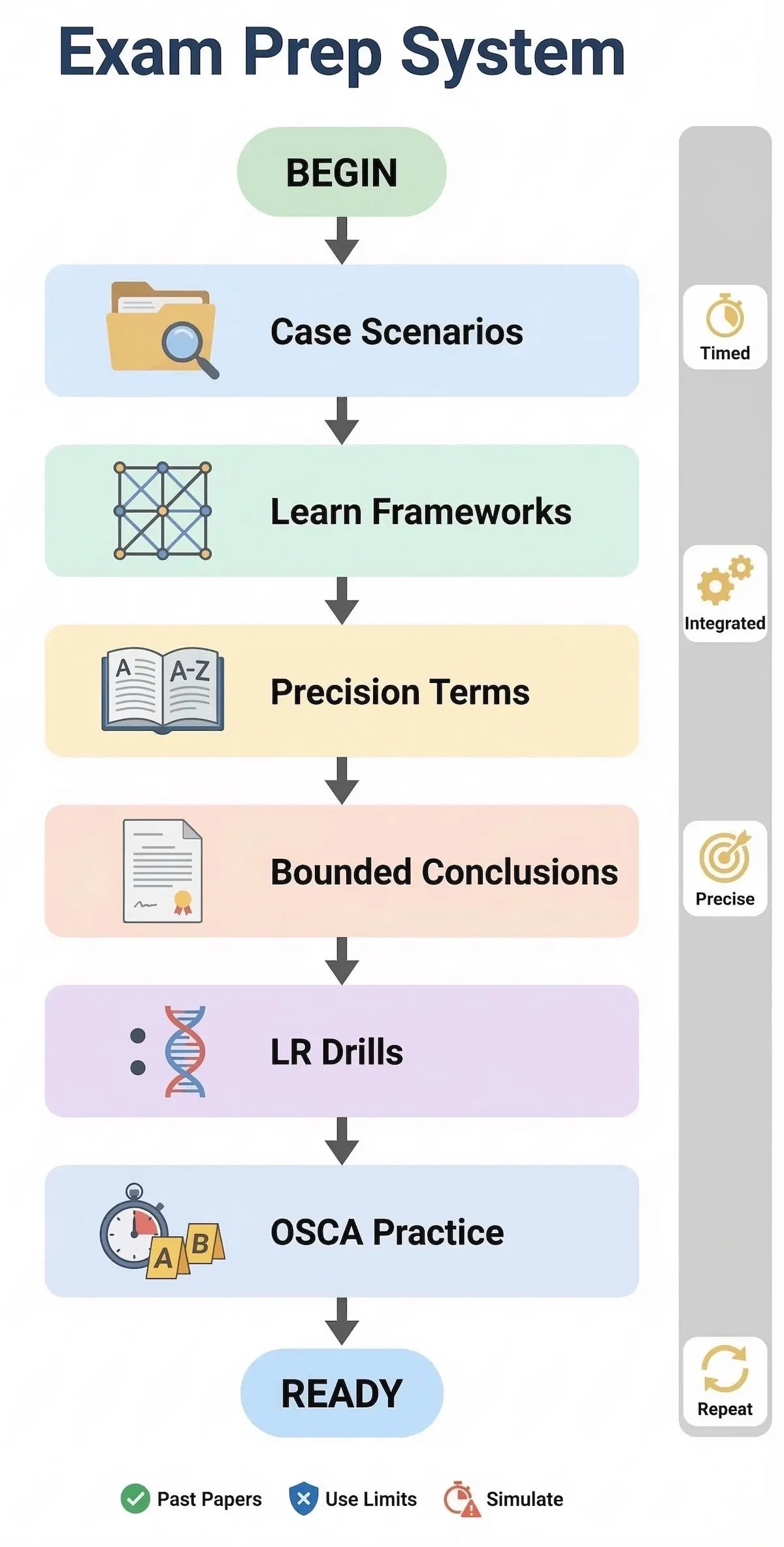
This flowchart turns forensic science exam advice into a six-step system students can use for revision and practical assessment prep.
Students who revise in this sequence are less likely to rely on memorization alone.
Read More: Online Tutoring vs. In-Person Tutoring: Which is Right for You in 2026?
| Assessment type | Primary challenge | Most effective preparation strategy |
| Written case scenario exam | Integrating multiple modules in one answer | Past paper case scenarios under timed conditions |
| Statistical/evidence interpretation exam | Likelihood ratio and Bayesian reasoning | Worked LR examples across multiple forensic disciplines |
| Lab practical / OSCA | Systematic methodology under time pressure | Timed mock scenarios with defined step protocol |
| Lab report assessment | Evidence interpretation and bounded conclusions | Practice writing three-sentence bounded conclusions from data |
| Multiple choice (knowledge recall) | Terminology precision | Module-by-module precision glossary; practice distinguishing synonyms |
Key Takeaways
- Forensic science difficulty is uneven across modules: forensic chemistry/toxicology and forensic statistics are the modules where students most consistently lose marks, and both require applied reasoning skills that memorisation-based revision does not develop.
- A forensic science lab report is assessed differently from a standard science lab report — the interpretation and conclusions section carries 30–40% of marks and requires forensic-specific vocabulary, bounded conclusions, and chain of custody documentation.
- The 2026 career outlook for forensic science graduates is positive in specialist areas (digital forensics, toxicology, DNA) and moderate for generalists. Specialisation at postgraduate level materially improves both employability and starting salary.
- Forensic science tutoring is not interchangeable with chemistry or biology tutoring: the applied interpretation layer, legal admissibility standards, and evidence reasoning framework require a tutor familiar with forensic science practice specifically.
- The most effective forensic science exam preparation strategies are framework-first (learn the analytical structure before the facts), terminology-precise (forensic vocabulary is assessed on exact usage), and scenario-based (integrated case questions require integrated practice).
******************************
This article provides general educational guidance only. It is NOT official exam policy, professional academic advice, or guaranteed results. Always verify information with your school, official exam boards (College Board, Cambridge, IB), or qualified professionals before making decisions. Read Full Policies & Disclaimer , Contact Us To Report An Error