
Unacademy Reviews, Alternatives, Pricing, & Offerings in 2026

Unacademy is a major online learning platform offering live and recorded courses across many subjects. It’s aimed at students preparing for exams or courses. This article provides insights about Unacademy (reviews, pricing, offerings, and alternatives) to help students and parents compare tutoring platforms and make informed decisions.
Unacademy Reviews and Testimonials
Trustpilot: Unacademy has a Trustpilot profile with 15 reviews and a low score (1.9/5). Many reviews are 1-star. Common complaints: no refunds or changes once subscribed, misleading promises on course format, and aggressive sales calls. One reviewer said they paid ~₹13,000 and were refused refund despite complaints. Educators on Trustpilot also report unprofessional behavior, abrupt contract terminations, and pressure to enroll students.
G2: On G2 (a software review site), Unacademy has 38 reviews with an average 4.5/5. These are very positive. Users praise the wide content, flexible live classes, and quality of teachers. For example, one review notes “Easy access to renowned teachers” and “flexibility to learn anywhere”. Another highlights personalized learning and self-paced options. No negative reviews appear on G2, indicating satisfaction with the platform’s offerings.
Slashdot: A tech-review on Slashdot (based on a verified review) rated Unacademy positively. It praised the quality courses and reasonable prices, noting live interaction with instructors and helpful customer support. The reviewer summarized: “Overall, Unacademy is a good platform which provides quality courses at reasonable prices”. This aligns with G2’s view that Unacademy delivers effective content and live classes.
PanelPlace: (Indian users) Platform shows several positive Unacademy testimonials. Students say Unacademy has excellent, knowledgeable teachers and well-structured learning materials. One user noted no ads and a motivating leaderboard feature on the learning app. Many mention low subscription cost and free content compared to peers. (These comments reflect learners who liked Unacademy’s course quality and interface.)
Unacademy Website: Unacademy’s own site highlights success stories and numbers (50M+ learners, 1000+ educators). Testimonials there focus on top educators and student success. (The official site bills itself as the largest platform with interactive classes, test series, and 1:1 mentorship. For example, their trial ad promises “structured classes by India’s top educators”.)
Is Unacademy legit? Yes. Unacademy is a real, established tutoring platform with millions of users. Independent reviews confirm it delivers courses and coaching. However, note mixed feedback: some users report dissatisfaction with refunds or customer service. The presence of many genuine reviews (both positive and negative) indicates Unacademy is operating as a legitimate business.
To see the full picture of student sentiment, it helps to look at the stark contrast between review platforms. The chart below visualizes how satisfaction varies depending on whether students are rating the course content versus the customer support.
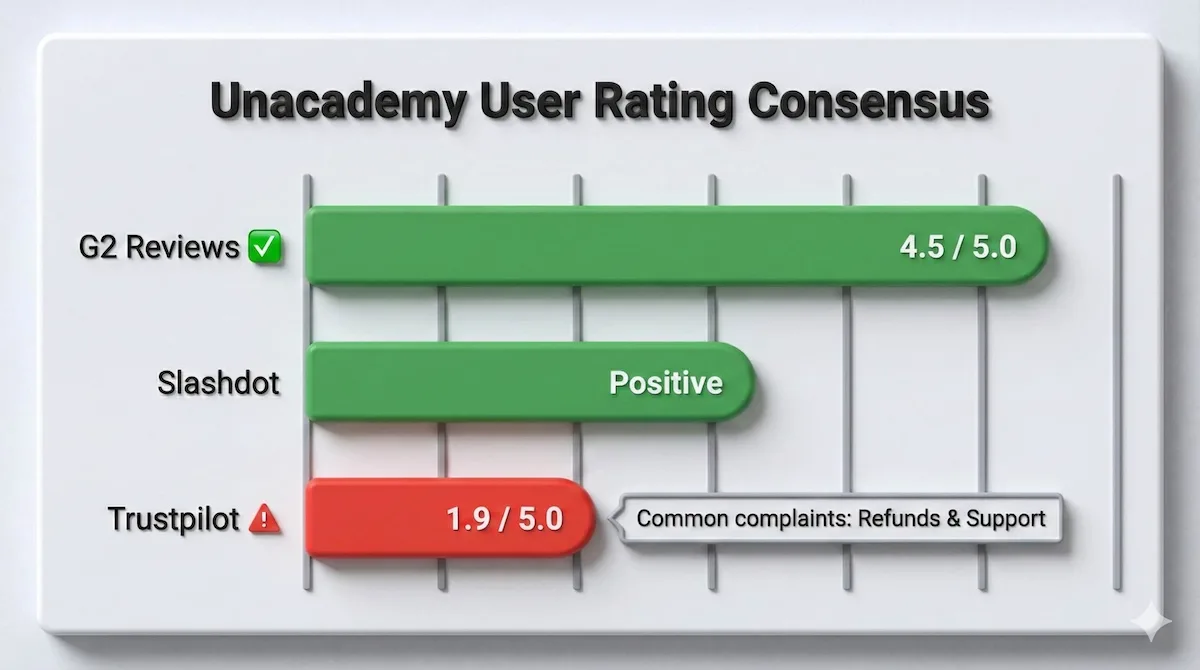
User experiences vary significantly across platforms; while course content is rated highly, support policies drag down scores.
As you can see, while the educational content often gets high marks (G2), the administrative policies pull down the score significantly on sites like Trustpilot.
Summary: Reviews of Unacademy vary. Sites like G2 and Slashdot show mostly positive feedback on course quality, live classes, and teacher expertise. Users appreciate the flexible access and wide course offerings. However, customer-service platforms (Trustpilot) reveal complaints about no-refund policies and aggressive marketing. In about 50 words: Unacademy has strong educational content and teachers, but some users warn about strict terms and support issues. Students often like the live classes and curriculum, but a few report unclear cancellation/refund practices.
Unacademy Pricing
Pricing Range
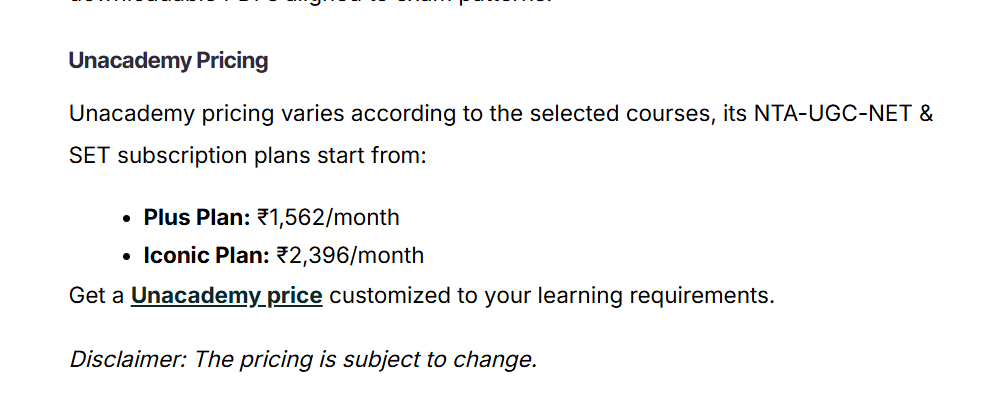
Unacademy operates on a subscription model. Their main paid plans start at about ₹2,083 per month for the Plus plan and ₹3,194 per month for the Iconic plan. (These are roughly $25–$40 per month as of 2025.) There is also a free basic tier with limited access. Plans include unlimited live classes, recorded lectures, practice tests, and some 1:1 mentorship. Pricing can vary by subject goal and package length (longer subscriptions get extra free months). Check Unacademy’s pricing page for details.
Unacademy’s courses span many categories (STEM, exam prep, etc.), but pricing is generally per subscription, not by subject. There is no hourly tutor fee or commission structure – instead learners pay one subscription fee for access. Different services (live classes, doubt solving, mentoring) are all included in subscription tiers. For example, the Iconic plan (highest tier) offers full access and specialized mentorship.
Understanding the value proposition of each tier can be confusing, especially regarding what mentorship is actually included. We’ve broken down the key differences between the Free, Plus, and Iconic plans below.
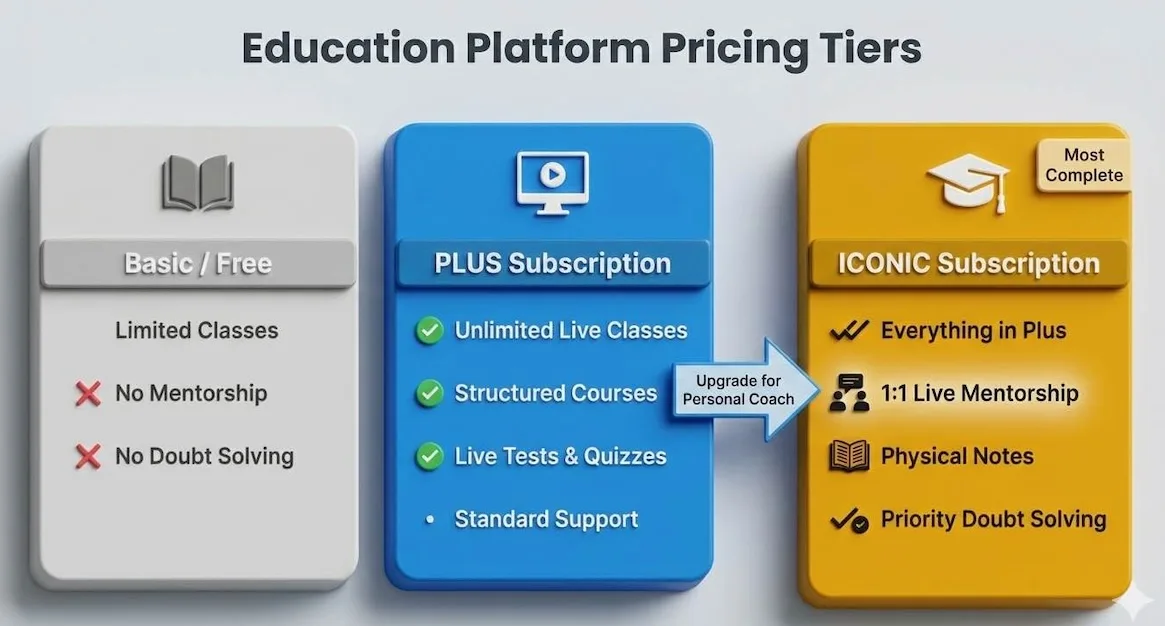
The main difference between Plus and Iconic is the personalized 1:1 mentorship and physical study notes.
Note that the critical ‘1:1 Live Mentorship’ feature—which many students look for—is locked exclusively behind the most expensive Iconic tier.
What Students Say About Pricing
User opinions on pricing are mixed. Some feel the cost is reasonable given unlimited classes and materials, especially for intense exam preparation. Others on forums note free resources and wonder if subscription adds value. Overall, Unacademy’s subscription can be more affordable than many private tutors when used heavily. Compared to typical one-on-one tutoring ($20–$50+ per hour), a few tens of dollars per month is often competitive. (Reviews suggest serious users see subscriptions as worthwhile, but casual users may balk at the price, especially if not fully utilized.)
Hidden Costs
Unacademy has no extra signup or hidden fees. There are no registration or cancellation fees, but important: no refunds are given for paid subscriptions. Once you pay for a plan, the payment is final (their policy states “it shall be final and there cannot be any refund”). Users should plan carefully because even if you stop attending, you won’t get money back. Other than that, there are no known surprise charges.
How Unacademy’s Pricing Works
Payments are typically made by credit card, UPI or other online methods. Plans auto-renew monthly unless cancelled. Unacademy sometimes offers promotional codes or discounts on longer subscriptions. There are group or family plans (like parent accounts) but no standard student or non-profit discounts advertised. In short: you subscribe online, pay upfront, and then gain access for that period. There’s no hourly payment option – all access is controlled by your subscription tier.
Free Trial
Yes – Unacademy often runs 7-day free trials for new subscribers. For example, they promote a 7-day trial batch for exams like IIT-JEE, NEET, etc.. To access it, you activate via their app or a promo link and get a week of full access (live classes, tests) for free. These trials give students a short test drive of the platform before paying.
Refund Policy
Unacademy’s official policy: no refunds or cancellations once a payment is made. Their site clearly states that paid subscriptions “cannot change or cancel” and there “cannot be any refund”. In practice, users on Trustpilot and Reddit report that if they request a refund, it is refused. Many learners complain that even within a short time period, Unacademy did not honor any refund promise. In summary, Unacademy’s refund policy is strict: you should assume you won’t get a refund if you cancel.
Unacademy Alternatives
Students often seek alternatives to Unacademy for reasons like broader tutoring options or different pricing. Here are some popular alternatives, including My Engineering Buddy in the list, summarized in 30-40 words:
Users may look for alternatives if they want different tutoring models (e.g., one-on-one sessions) or specific subjects. Below are some top competitor platforms offering live and online tutoring, along with how they compare to Unacademy.
Choosing between a massive course platform and a personalized tutor depends entirely on your learning style. This comparison matrix highlights the functional differences between Unacademy, My Engineering Buddy, and Chegg.
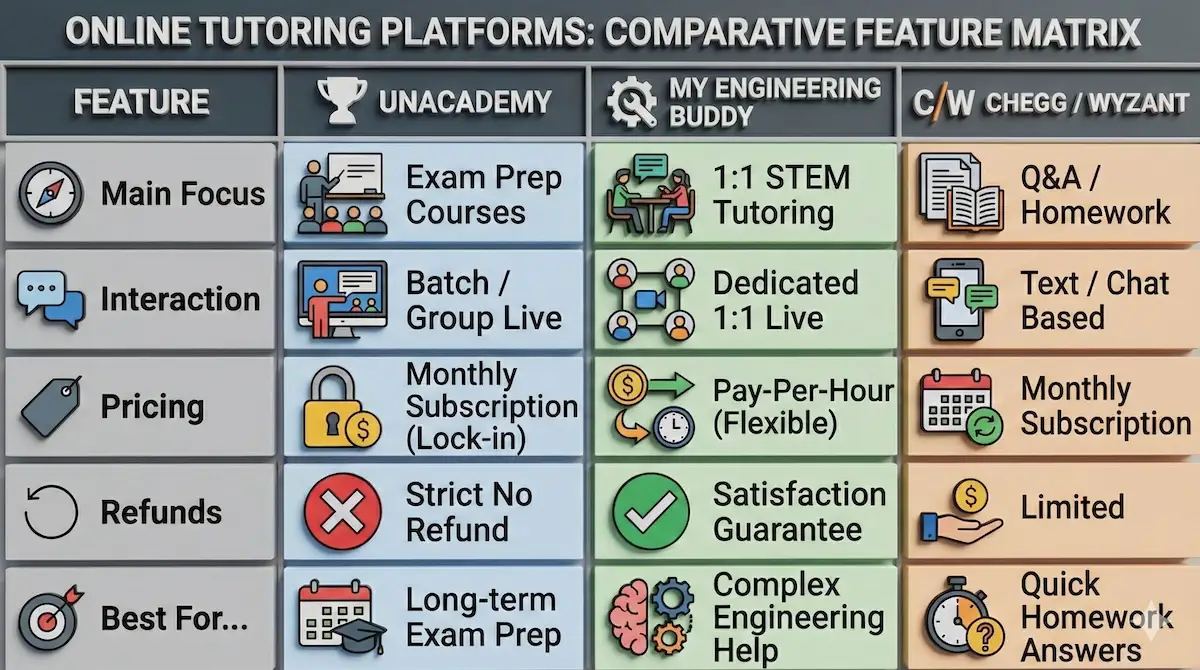
Choose Unacademy for long-term courses, but consider My Engineering Buddy if you need personalized 1:1 engineering support.
If you need specific problem-solving help rather than a broad course, a pay-per-hour service like My Engineering Buddy often provides more flexibility than a locked-in subscription.
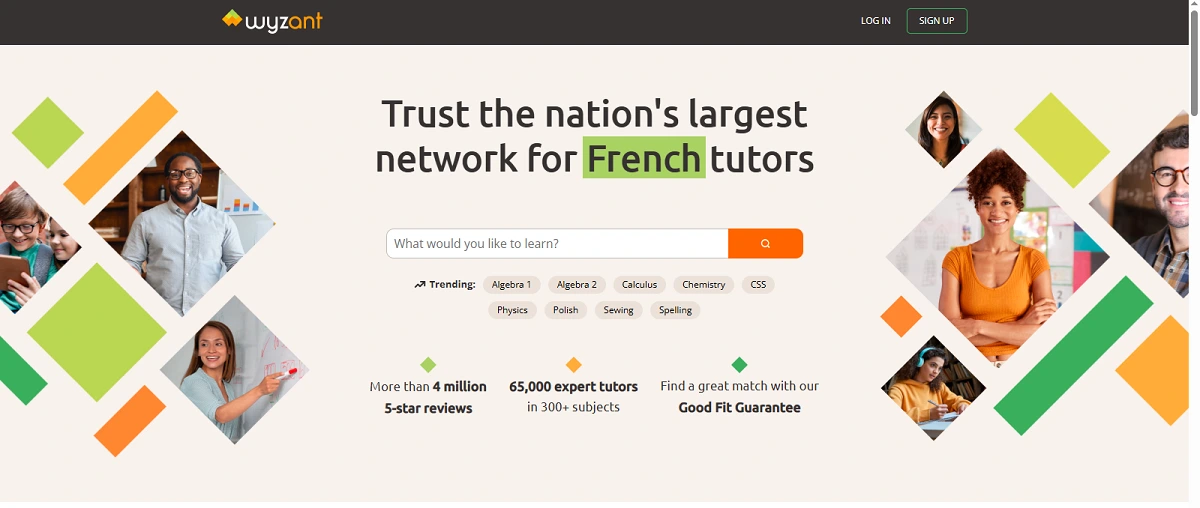
Wyzant
-
Pros: Wide subject range (K-12, college, professional) and flexible per-hour tutoring. Tutors set their own rates, and Wyzant offers a “satisfaction guarantee”. It has many US-based educators, so good for typical US curriculum.
-
Cons: Tutors can be expensive (often $30–$100/hr). No subscription; you pay per lesson, so costs add up if you need many sessions. Fewer structured test-prep courses compared to Unacademy’s exam focus.
My Engineering Buddy
-
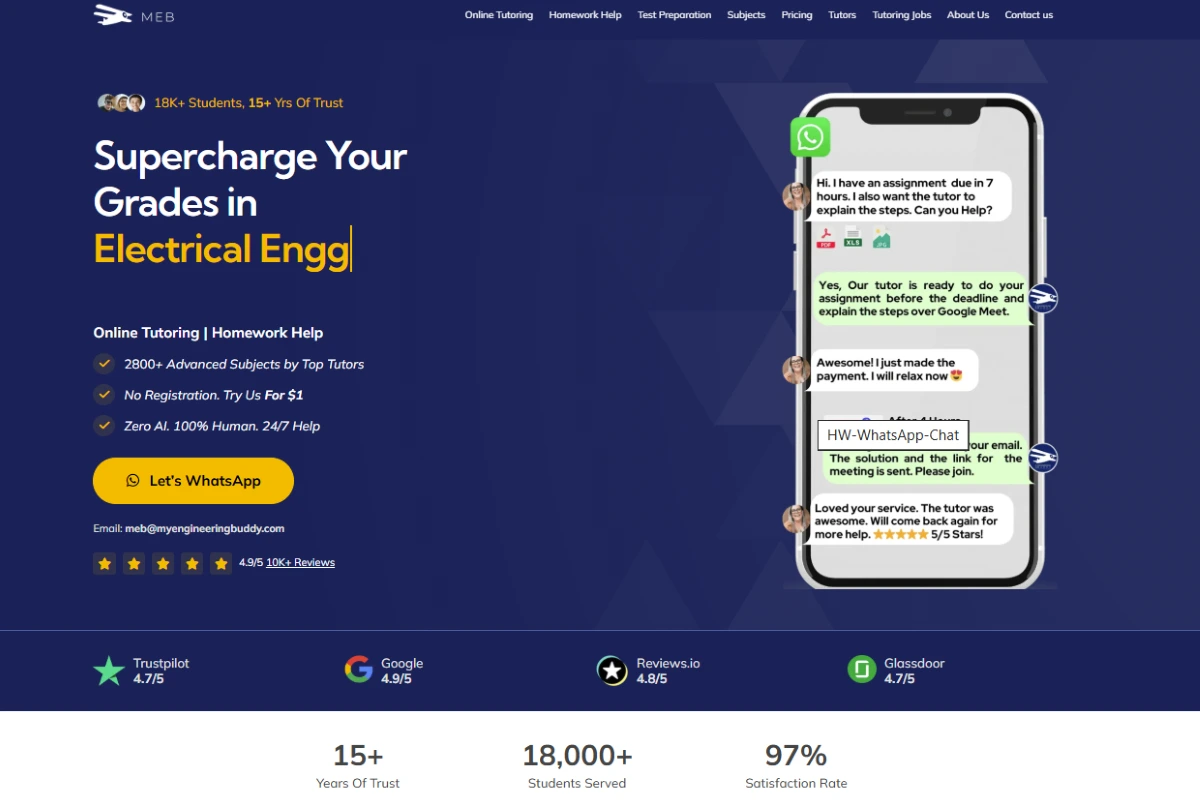
Pros: Specializes in advanced STEM (engineering, maths, physics) with customized 1:1 homework help. Tutor quality is very high (often advanced degrees). Pricing is often flat (e.g., $10–$30/hr), usually lower than private tutors. Offers personalized help and quick doubt solving any time.
-
Cons: Smaller brand (though growing). May have less variety outside engineering topics. Primarily one-on-one help, not mass courses or test-prep classes.
Chegg Tutors
-
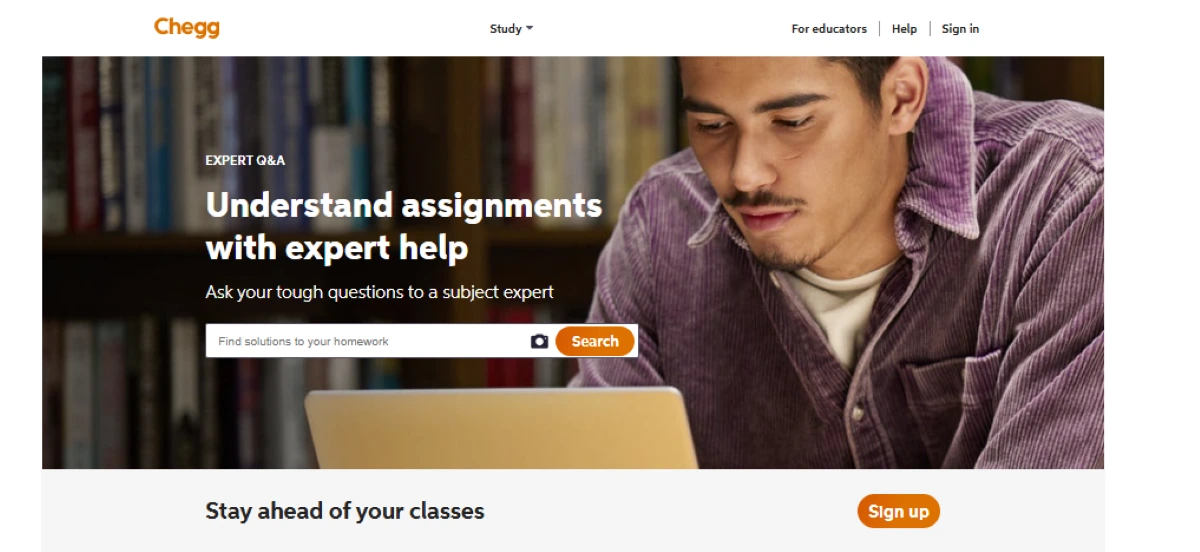
Pros: Known for on-demand homework help and textbook solutions. Offers 24/7 chat with tutors (mostly US/UK tutors). Subscription plans or monthly help packages. Strong in STEM and college subjects.
-
Cons: Focus is homework/problem solving, not live lecture courses. Quality can vary by tutor. Pricing is per session or package, often higher for STEM help. Less emphasis on exam coaching.
Khan Academy
-
Pros: Free, non-profit platform with thousands of lesson videos in math, science, and humanities. Great for self-study and fundamentals, well-known for clear instructional videos. Completely free for students.
-
Cons: No live tutoring or one-on-one help. Content is mostly K-12 level and brief exercises. No personalized coaching or paid educators. Unlike Unacademy, it has no live classes or test-prep courses.
Tutor.com (or similar like TutorMe)
-
Pros: On-demand tutors in many subjects (college algebra to statistics) via an online classroom. Pay by session (credit or subscription). Some offerings include writing center, test review, etc.
-
Cons: Hourly rates can be high. Tutors vary in expertise. Not a course platform, so students must be self-directed. No community or large group classes.
TutorBin
-
Pros: Focuses on homework help in technical subjects (often engineering). Tutoring and doubts are handled via app. Caters to Indian and global engineering students.
-
Cons: Mixed reviews on tutor quality. Less structured than big platforms. May have subscription or question-based pricing. Language and subject range might be limited compared to Unacademy.
How it Works?
A. For Students
Sign Up: Students (or parents) create a free account on Unacademy’s website or mobile app. They then select their goal (exam or subject area) and subscription plan. Personal details and payment info are entered for paid plans. The process is fully online and straightforward.
Connecting with Tutors: After signup, students enroll in courses or live batches for their goal. They can join live classes through the dashboard, where they watch lectures and interact via chat. For doubts, Unacademy provides “Ask-a-Doubt” chat in videos. There is also 1:1 mentorship for some plans. The platform does not pair you directly with a single tutor; instead, you join courses taught by top educators.
Scheduling Sessions: Unacademy’s schedule is set by the educators. Each course has a fixed timetable of live classes (often daily or weekly). Students view the calendar and join classes at the set times. Recorded videos are available anytime after class. Students can plan their study by booking any “batch” or course schedule in advance. There’s no need to individually schedule with each tutor – you simply log in at class times or watch recordings as needed.
For students used to hiring a private tutor, Unacademy’s ‘Batch’ system can feel different. Here is the step-by-step workflow of how you actually attend classes once you subscribe.
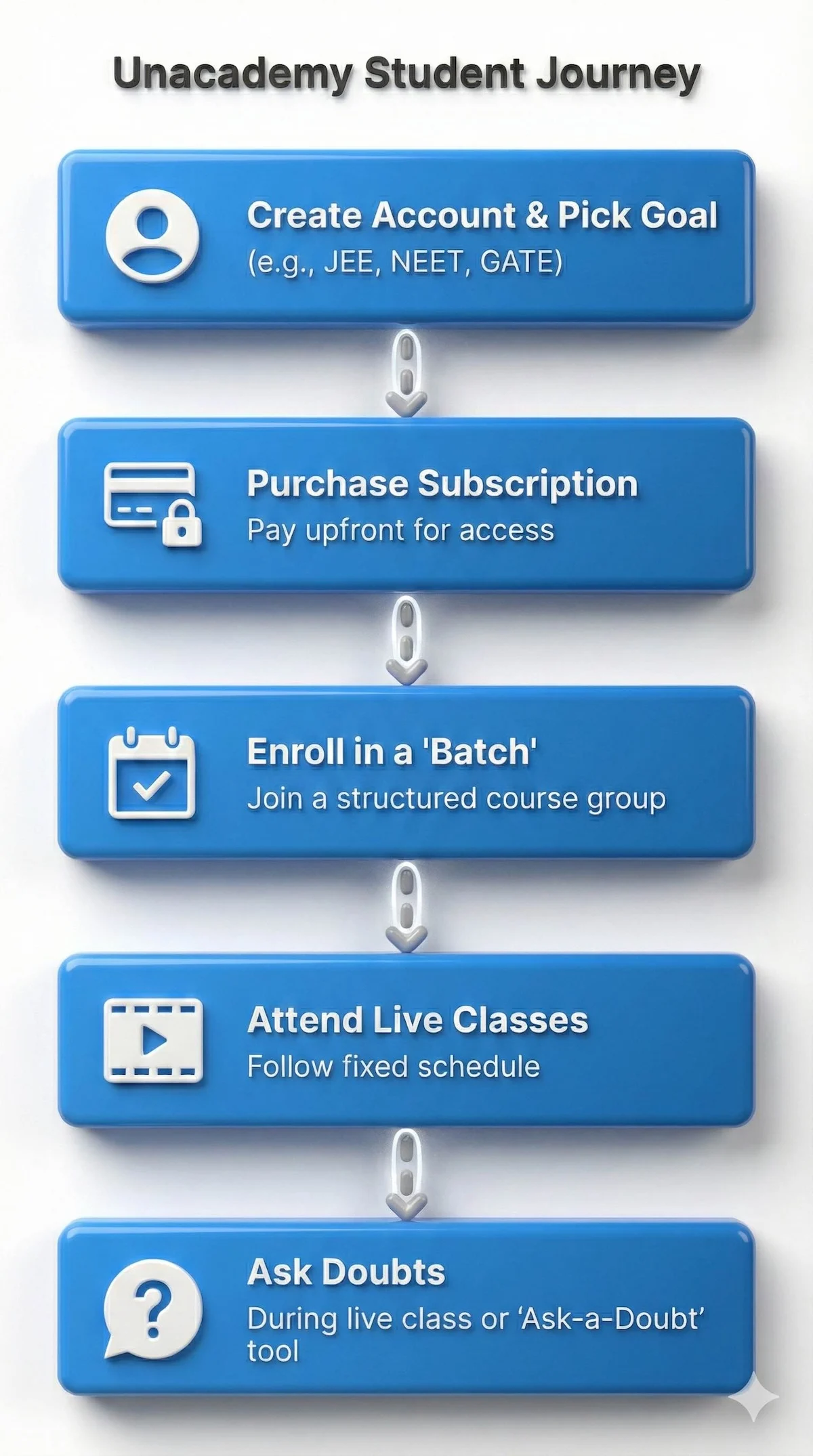
Unlike 1:1 tutoring, Unacademy works on a ‘Batch’ system where you follow a fixed schedule with a group.
Because you are joining a pre-scheduled batch, you must adapt your study routine to their timetable, rather than scheduling sessions when you want them.
B. For Tutors
Unacademy recruits educators (tutors) through an application process. Potential tutors usually apply online with qualifications, teaching samples, and course outlines. Unacademy reviews applications and conducts orientation sessions (there is even a “Become an Educator” training series). Once accepted, educators create and schedule live courses on topics they specialize in. They teach live classes to many students (unlike 1:1 tutoring), and they may also provide doubt-solving sessions. Pay for educators depends on the arrangement (some are salaried or contracted).
If you want to teach, you can start by visiting Unacademy’s Educator recruitment page. The site suggests emailing subject proposals or using their educator app to sign up. (Unacademy provides guides and a help link for new educators.) In general, becoming a tutor involves filling out an educator profile, creating a demo lesson, and awaiting approval by Unacademy’s team.
FAQs
Can tutors set their own fee or is it fixed by the company?
Unacademy’s educators do not set individual hourly rates. Students pay a subscription fee for access to all courses. Tutors earn based on contracts with Unacademy, not per-session fees. In other words, pricing is fixed by the platform’s plans (e.g., Plus/Iconic tiers), and tutors receive payment as agreed with the company.
How much can a tutor expect to earn hourly?
Glassdoor reports that Unacademy educators (in the U.S. context) make on average about $28–$47 per hour. (Some senior educators report higher income.) However, actual earnings vary by subject and contract type. In India, reported pay is lower (tens of thousands of rupees per month). Remember, Unacademy classes are group courses, so “hourly pay” is different than in 1:1 tutoring.
How many hours of work can a tutor get per month?
There is no guaranteed number of hours. Tutors (educators) schedule as many live classes as their courses demand. Some full-time educators teach dozens of hours per month, especially if they run multiple batches. Others may only teach a few hours (e.g., occasional doubt sessions). In practice, top educators often have a full schedule, but new educators may start part-time and ramp up.
Is it easy to get students on Unacademy?
Unacademy is a competitive platform. It features many educators (14,000+) and popular names, so standing out can be challenging. New tutors need to build followings through quality content and promotion. The platform’s marketing may help established educators, but beginners often report it’s hard to attract students unless the tutor already has a reputation (e.g., a YouTuber or known expert). So it’s not necessarily easy to get students quickly.
Tips on how to get more students:
-
Focus on niche expertise: choose subjects where you excel.
-
Promote your profile through social media or sample content.
-
Engage well in doubt-solving chats (good reviews spread by word-of-mouth).
-
Keep classes interactive and clear (positive feedback can attract more sign-ups).
-
Some educators collaborate on live events or use referral codes. In short, building reputation and offering value is key.
What tutors like about Unacademy:
Many educators appreciate the flexibility (work from home, choose topics, and set hours). Indeed reviewers mention good work culture and the ability to work remotely. Some say the platform pays well for part-time hours, especially for interns or small commitments. Teachers also like that Unacademy provides a large pool of students and often takes care of technology (hosting, streaming, payment) so tutors can focus on teaching.
What tutors do not like about Unacademy:
Common complaints include job security and growth limitations. Many educators say there is no guarantee of long-term engagement – contracts can end abruptly with little notice. High performance targets and pressure to recruit students are often cited as downsides. Tutors on review sites note lack of feedback/training for teaching improvement. Some also mention the platform favors already-popular educators over helping newcomers gain audience.
Unacademy: Company Information
-
Founding year and background: Unacademy began as a YouTube channel and became a tech education platform around 2015. It quickly grew by offering structured online classes and test prep. (Sources differ: some say 2015 launch from YouTube roots.)
-
Founders: The company was co-founded by Gaurav Munjal (CEO), Roman Saini, and Hemesh Singh. These entrepreneurs launched Unacademy to expand beyond videos into a full learning platform.
-
Mission and Vision: Unacademy’s mission is “Democratise access to high quality education”. The platform emphasizes making top educators and content available to all. Its vision is to partner with bright educators and “democratize education for everyone looking to learn”, building a vast knowledge repository through technology.
-
Scale of operation: Unacademy is headquartered in Bengaluru, India, but serves students globally. It claims over 50 million active learners and 2,000+ daily live classes. About 14,000 educators teach on the platform. Unacademy operates largely online but has also opened offline centers in recent years (with many becoming profitable). Its services reach multiple countries, though it’s best known in Asia.
-
Types of services: Unacademy offers live online classes, recorded video courses, doubt-clearing sessions, quizzes, and 1:1 mentoring. It primarily focuses on educational coaching and test preparation (e.g., engineering, medical, civil service exams), but also covers school and college curricula.
-
Subjects offered: Major subjects include Mathematics, Science (Physics/Chemistry/Biology), Computer Science, English, Economics and others. It especially covers competitive exam subjects: engineering entrances (e.g., IIT-JEE), medical entrances (NEET), banking and civil service exams. The platform also has content for high school (CBSE), MBA entrance (CAT), professional courses (CA), and more. Overall, there are 200+ goal categories on the site.
-
Unique features: Unacademy advertises structured live classes by top educators, daily doubt-solving, and one subscription for unlimited access. It has interactive features like live polls and chat, and mobile apps for learning anywhere. The platform’s “Ask-A-Doubt” feature lets students post questions during any lesson. Also, Unacademy rewards student engagement (leaderboards, points) as noted by users.
USP of Unacademy:
-
Unlimited access to live and recorded classes: A single subscription covers all courses for that goal. Many users like not paying per class. Reviews say this delivers good value if students use it fully.
-
Top educators and live interaction: Unacademy claims to feature “India’s top educators.” Indeed, some reviewers praise the expert teachers and interactive classes (live quizzes, doubt chat). Actual feedback suggests many educators are experienced, though quality varies.
-
Personalized learning paths (AI-driven): The platform uses AI to tailor recommendations and adapt difficulty. Unacademy highlights adaptive lessons and recommendations to match student progress. This seems genuine: reviews note the content adjusts to the learner’s level.
-
Free trial and promotions: The 7-day free trial is appreciated by users looking to test before paying. In Trustpilot/G2 forums, users often mention trying the trial before subscribing.
-
Gamified learning: Unacademy’s app and site include leaderboards and reward badges (as one student noted), which help engage motivated learners.
Drawbacks of Unacademy:
-
No refunds or cancellations: Official policy is strict on this. Users report being unable to cancel a paid course and get money back. This term is inconvenient if students change plans.
-
Aggressive sales calls: Many students report repeated phone calls to sell plans, even if not interested. This can be annoying.
-
Quality varies by educator: With thousands of educators, not all courses are equal. Some students say popular instructors are very good, but others experienced less effective teachers.
-
Exam focus (not general tutoring): Unacademy’s strength is in exam prep. Students looking for generic tutoring (e.g., continuous course support) may find it less tailored.
-
Strong Indian focus: While the platform is broad, much content is aimed at Indian exams. Some Western subjects or curricula are limited.
Comparison with My Engineering Buddy:
Unacademy and My Engineering Buddy (MEB) serve different niches. Unacademy focuses on broad exam and course content, while MEB provides specialized 1:1 STEM tutoring. MEB excels in personalized attention and homework help for engineering subjects, often at competitive hourly rates (e.g. $10–$30/hr). Unacademy is better for structured course preparation. Testimonials from MEB users often highlight small class sizes, quick doubt resolution, and tutors with advanced degrees. If a student needs deep help with a complex engineering problem or homework, MEB’s personalized model may offer more targeted support than Unacademy’s large lectures.
Customer Support and Policies:
Unacademy’s support has mixed reviews. Some learners report difficulty reaching them and say the platform lacks a clear support email or effective helpline. On Trustpilot, customers complained that there’s no response to queries except sales calls. The refund policy (no refunds) is strictly enforced. My Engineering Buddy, in contrast, prides itself on responsive support, offering chat and email help for customers and clear money-back policies if expectations aren’t met. This can make MEB more user-friendly in terms of support and guarantees.
Global Reach and Localization:
Unacademy’s content is largely in English (with some regional languages on YouTube) and targets students preparing for specific standardized exams (mostly in Asia). It is not heavily localized for non-English-speaking regions beyond India. In contrast, My Engineering Buddy operates globally with tutors from many countries and languages; it caters to diverse curricula (US, UK, etc.) and supports international students. For example, MEB’s website and service are designed for a worldwide audience and offer multilingual support, whereas Unacademy’s strength remains in its original region.
Unacademy’s Future Plans
-
AI and Personalization: Unacademy is integrating more AI to personalize learning. The platform already uses algorithms to recommend courses, adjust difficulty, and provide real-time feedback. Expect further AI-driven features (smart quizzes, chatbots for doubt solving) as they build on their current systems.
-
New Products: The company launched Airlearn (formerly Unacademy Languages) in 2024 – a language-learning app. It’s growing fast (70k daily users, ~$2M ARR). This shows Unacademy is branching into new areas beyond test prep. They may add more verticals (e.g., skill courses, school classes) using the Airlearn model.
-
Focus on Profitability: Leadership has emphasized cost reduction. By 2025 Unacademy aimed to cut losses sharply and make offline centers profitable. While offline centers are not our main concern, this shows a push towards efficiency. They seem committed to self-sustainability rather than aggressive expansion.
-
Global Expansion: Unacademy may leverage AI to reach more learners globally. They could adapt content for other countries’ curricula. Already, the AI and app infrastructure (e.g. personalized recommendations) can be applied worldwide. Plus, Airlearn shows they want to compete with global platforms like Duolingo.
Before you make a final decision, let’s recap the major strengths and weaknesses found in our analysis. This visual summary weighs the educational benefits against the policy drawbacks.
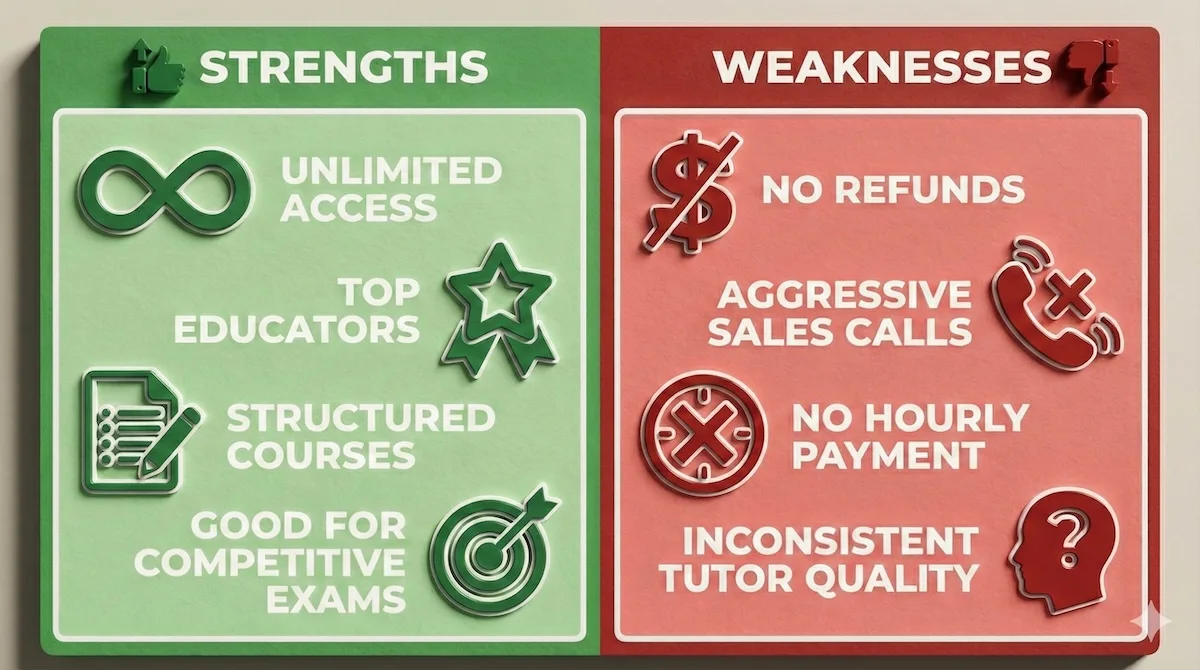
Weigh the benefits of structured courses against the rigid no-refund policy before subscribing.
While Unacademy offers a vast library of content for competitive exams, the strict no-refund policy means you need to be 100% committed before paying.
FAQs About Unacademy
How does Unacademy compare to My Engineering Buddy?
Unacademy offers a wide range of live courses for exam prep (often in Indian curricula), whereas My Engineering Buddy specializes in 1:1 tutoring for STEM subjects. Unacademy runs scheduled classes with many students; MEB provides personalized sessions. Both have experienced tutors, but MEB focuses more on direct homework help and global engineering topics.
Is Unacademy free or paid?
Registration is free, and there is some free content (like sample videos). However, full access to courses and live classes requires a paid subscription. There are occasional free trials, but generally students pay monthly fees to study.
Can I get a refund if I’m not satisfied?
Unacademy’s policy says no refunds or cancellations once a subscription is purchased. Users often report they were not refunded even after requests. So if you subscribe, plan to pay the full cost.
What exams and subjects does Unacademy cover?
Unacademy covers 200+ “goals”, including engineering and medical entrance exams (like IIT-JEE, NEET), banking and civil service exams, MBA entrances, plus high school subjects (e.g. CBSE boards). In short, it focuses on competitive tests and related academics. Other subjects (e.g., general college courses) are less emphasized.
How do I cancel my Unacademy subscription?
According to policy, subscriptions can’t be cancelled or altered once paid. In practice, you can stop future payments by not renewing; contact Unacademy to ensure your subscription won’t auto-renew. But note: even if you cancel, they won’t refund the remaining period.
Does Unacademy have a mobile app?
Yes. There is a Learner app available on iOS and Android. The app allows joining live classes, watching videos, and taking quizzes on mobile devices. It also has an Ask-a-Doubt chat feature and notifications for upcoming lessons. A separate app exists for educators to manage their sessions.
Conclusion
Unacademy’s strengths lie in its wide range of live courses, expert teachers, and tech-driven learning. It offers structured prep for many exams and interactive features (live polls, doubt chat) that students enjoy. However, its weaknesses include a strict no-refund policy and some customer service issues. Users must commit carefully to subscriptions. My Engineering Buddy is a strong alternative for advanced students needing personalized 1:1 help. MEB tutors provide targeted homework assistance and STEM tutoring with flexible scheduling – ideal for complex subjects and projects where Unacademy’s broad courses may not suffice. Thus, while Unacademy is solid for general exam prep, students needing deep, individualized support should consider My Engineering Buddy.
******************************
This article provides general educational guidance only. It is NOT official exam policy, professional academic advice, or guaranteed results. Always verify information with your school, official exam boards (College Board, Cambridge, IB), or qualified professionals before making decisions. Read Full Policies & Disclaimer , Contact Us To Report An Error