
Unlocking Biochemistry Success: Your Complete Guide to Expert Tutoring and Academic Support

Professional biochemistry tutoring combines personalized instruction with proven learning strategies to transform complex molecular concepts into accessible knowledge, significantly improving student performance and confidence.
Picture this: Sarah, a pre-med student at University College London, stares at her biochemistry textbook with mounting frustration. The Krebs cycle diagrams blur together, enzyme kinetics formulas seem written in a foreign language, and her upcoming exam feels like an insurmountable mountain. Sound familiar? You’re not alone. Research reveals that 75% of students face difficulty understanding biochemistry content, with 56% considering it the most challenging first-year subject.
But here’s the encouraging truth: with the right biochemistry tutoring support, students like Sarah can transform their academic trajectory. Studies show that students working with qualified tutors achieve an average 13% improvement in final examinations, with 93% of undergraduate students achieving grade increases.
You don’t just have to take our word for it—the numbers speak for themselves regarding student performance. Let’s look at the measurable impact expert support has on academic outcomes.
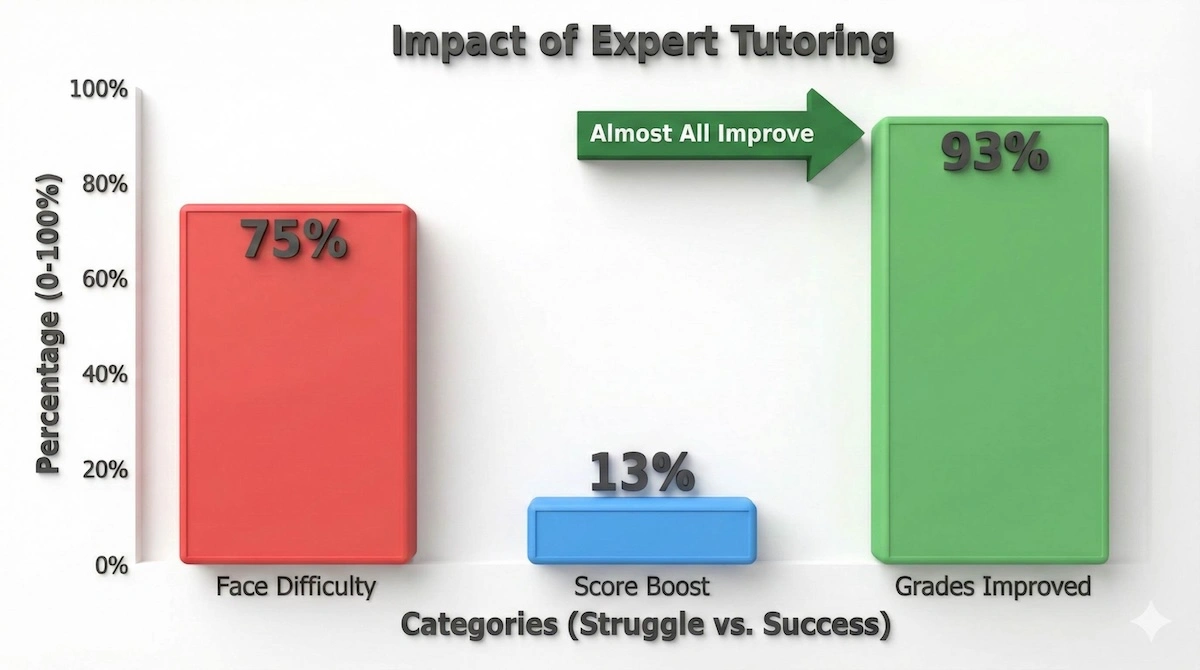
The data is clear: professional tutoring transforms academic struggle into measurable grade improvements.
As shown above, the jump from struggling to succeeding is statistically significant when personalized guidance is applied to your study routine.
Understanding the Biochemistry Challenge
Biochemistry sits at the fascinating intersection of biology and chemistry, demanding students master both disciplines simultaneously. This unique position creates specific learning hurdles that traditional classroom instruction often fails to address adequately.
The subject’s complexity stems from several factors. Students must visualize molecular interactions occurring at microscopic levels while simultaneously understanding their macroscopic effects on living organisms. 14.6% of students report that the time required to understand each step poses a significant challenge, largely because most biochemistry courses remain lecture-heavy and content-dense.
It is often difficult to visualize how invisible molecular reactions translate into the physical functions you see in the human body. The illustration below visualizes this common ‘knowledge gap’ that many students face.
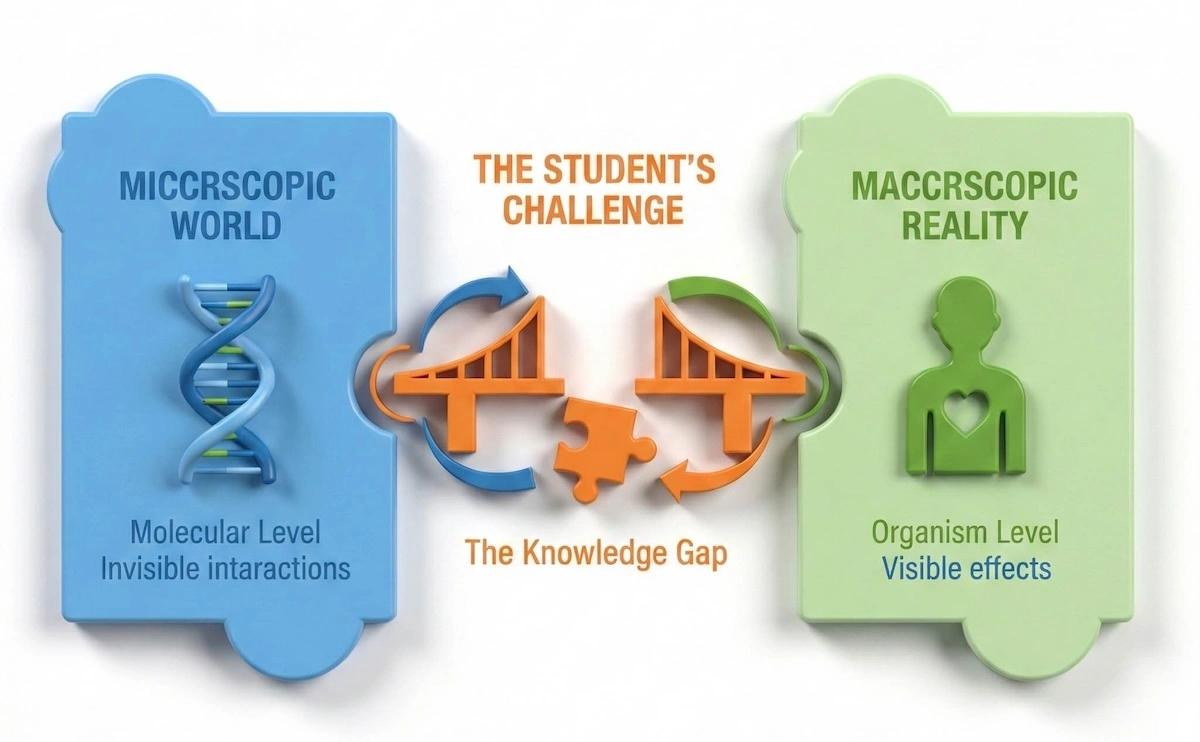
Bridging the gap between molecular interactions and biological functions is the first step to mastering biochemistry.
Bridging this disconnect is the first step toward mastery; once you see the link between the micro and macro worlds, the abstract concepts become concrete realities.
Moreover, biochemistry requires extensive memorization of metabolic pathways, chemical structures, and enzyme mechanisms. Many students resort to rote learning techniques, memorizing pathway sequences just days before examinations. This approach prevents genuine understanding and application of biochemical principles to real-world scenarios.
The Power of Personalized Biochemistry Tutoring
Individual Attention Transforms Learning
Unlike crowded lecture halls where one professor addresses hundreds of students, biochemistry tutoring online provides focused, one-on-one instruction tailored to individual learning styles. Professional tutors can immediately identify knowledge gaps and adjust their teaching approach accordingly.
Research demonstrates that 40% of qualified biochemistry tutors hold PhDs, with 90% possessing postgraduate degrees. These educators bring specialized expertise in molecular biology, organic chemistry, and biochemical processes that enables them to break down complex concepts into digestible components.
Active Learning Replaces Passive Memorization
Effective biochemistry teaching emphasizes active learning techniques over traditional lecture formats. Studies show that interactive methods, including case-based learning and collaborative problem-solving, significantly improve student comprehension. A biochemistry tutor can implement these strategies during personalized sessions, encouraging students to engage with material rather than simply memorize it.
The jigsaw method, for instance, allows students to become experts in specific biochemical topics before teaching others, reinforcing their own understanding while developing communication skills. When 91% of students express preference for interactive biochemistry instruction, personalized tutoring becomes an ideal delivery method.
Digital Revolution in Biochemistry Education
Online Tutoring Accessibility
The biochemistry tutor online model has revolutionized access to expert instruction. Students across the USA, UK, and Gulf countries can now connect with world-class educators regardless of geographical constraints. The UK online tutoring market, valued at £498.5 million in 2023, is projected to reach £1,119.9 million by 2030, reflecting growing demand for digital educational support.
Online platforms offer several advantages over traditional in-person instruction. Students can access recorded sessions for review, utilize interactive digital tools for molecular visualization, and schedule lessons around their existing commitments. The average response time for qualified biochemistry tutors online is typically under 2 hours, enabling rapid support when students encounter challenging concepts.
Technology-Enhanced Learning Tools
Modern biochemistry homework help incorporates sophisticated digital resources that enhance understanding. Three-dimensional molecular modeling software allows students to manipulate protein structures, visualizing conformational changes and binding interactions. Virtual laboratory simulations provide hands-on experience with biochemical techniques without expensive equipment requirements.
E-learning platforms specifically designed for biochemistry education show remarkable effectiveness. Studies indicate that students using interactive digital modules demonstrate better academic performance and increased engagement compared to traditional learning methods.
Addressing Specific Biochemistry Learning Challenges
Metabolic Pathway Mastery
Metabolic pathways represent one of biochemistry’s most challenging topics. Students must understand not only individual reactions but also pathway regulation, interconnections, and physiological significance. A qualified biochemistry teacher can employ visual learning techniques, helping students create mental maps that connect molecular events to biological outcomes.
Research shows that visualization skills are crucial for understanding molecular-level principles. Professional tutors use analogies, flowcharts, and interactive diagrams to make abstract concepts tangible and memorable.
Enzyme Kinetics and Regulation
Enzyme kinetics often intimidates students with its mathematical complexity and mechanistic details. However, biochemistry assignment help can transform this challenging topic into an engaging exploration of molecular efficiency and regulation.
Effective tutoring breaks enzyme kinetics into manageable components: substrate binding, catalytic mechanisms, and regulatory factors. By connecting mathematical equations to biological significance, students develop both computational skills and conceptual understanding.
The Michaelis-Menten equation often looks intimidating at first glance, but it becomes much simpler when you break it down into its component parts. Here is a visual guide to understanding exactly what each variable represents.
![Michaelis-Menten equation breakdown showing the relationship between reaction rate (V), maximum velocity (Vmax), substrate concentration ([S]), and the affinity constant (Km).](https://myengineeringbuddy.com/blog/wp-content/uploads/2025/09/enzyme-kinetics-formula-breakdown-03.webp)
Breaking down the Michaelis-Menten equation reveals the logical relationship between substrate concentration and reaction speed.
Global Perspectives on Biochemistry Education
Academic Standards Across Regions
Biochemistry education standards vary significantly across the USA, UK, and Gulf countries, creating unique challenges for students in each region. American students often encounter biochemistry within broader biology or chemistry programs, requiring integration with prerequisite knowledge. UK students typically experience more specialized biochemistry courses with earlier specialization opportunities.
Gulf countries increasingly emphasize biochemistry education as part of their economic diversification strategies, investing heavily in STEM education and research infrastructure. This regional focus creates growing demand for qualified biochemistry tutoring services that can bridge knowledge gaps and support academic excellence.
Career Prospects Driving Educational Demand
The biochemistry job market shows robust growth, with 8.2% projected increase through 2032. This positive outlook motivates students to excel in their studies, driving demand for comprehensive biochemistry hw help that ensures strong academic foundations.
Biochemistry graduates pursue diverse career paths, from pharmaceutical research to environmental science. In 2023-24, American institutions conferred 8,171 bachelor’s degrees in biochemistry, with 58.6% earned by women. This gender balance reflects the field’s broad appeal and diverse opportunities.
Choosing the Right Biochemistry Support
Evaluating Tutor Qualifications
When seeking to hire a biochemistry tutor, several key factors determine educational effectiveness. Advanced degrees in biochemistry, molecular biology, or related fields provide essential subject expertise. Teaching experience, particularly with your educational level, ensures appropriate instructional techniques.
Professional tutoring services typically accept only 4% of tutor applicants, maintaining rigorous standards for subject knowledge and pedagogical skills. Look for tutors with demonstrated success records, positive student reviews, and familiarity with your specific curriculum requirements.
Matching Learning Styles
Successful biochemistry tutoring online requires alignment between student learning preferences and tutor teaching styles. Visual learners benefit from instructors who emphasize molecular diagrams and pathway illustrations. Kinesthetic learners prefer hands-on activities and physical modeling of biochemical processes.
During initial consultations, discuss your learning preferences and previous biochemistry experiences. Quality tutors adapt their methods to maximize your comprehension and retention, ensuring efficient use of tutoring time.
Finding the perfect tutor is not about picking the first name you see; it requires a strategic approach. Follow this step-by-step decision process to ensure you hire a mentor who matches your specific learning style.
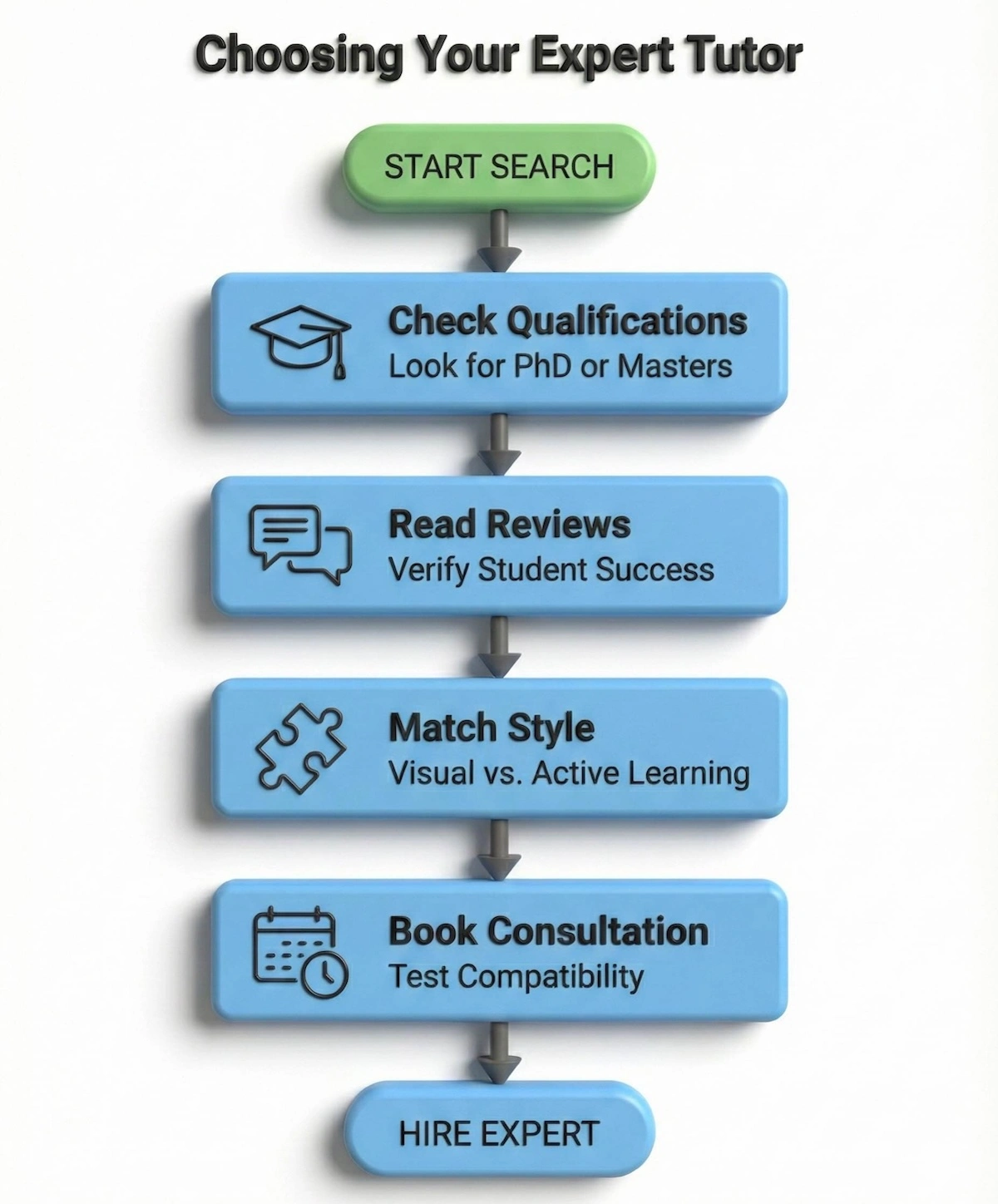
Follow this systematic approach to ensure you partner with a tutor who matches your specific academic needs.
Taking the time to verify qualifications and compatibility during the consultation phase will save you hours of frustration later in the semester.
Maximizing Tutoring Effectiveness
Preparation Strategies
Effective biochemistry assignment help begins with proper preparation. Before each session, review relevant course materials and identify specific questions or challenging concepts. This targeted approach allows tutors to focus on areas requiring greatest attention.
Maintain a biochemistry vocabulary list, noting unfamiliar terms and their definitions. Professional tutors can help you understand not just individual terms but also their relationships within larger biochemical contexts.
Active Participation
Successful tutoring requires active student engagement rather than passive instruction reception. Ask questions, request clarifications, and practice problem-solving during sessions. Studies indicate that students perform 15-20% better when using interactive learning methods compared to traditional instruction.
Take detailed notes during sessions and review them between meetings. This reinforcement helps consolidate new knowledge and identifies areas requiring additional clarification.
To get the most out of your sessions, you must shift your mindset from the passive style of a lecture hall to the active engagement of one-on-one tutoring. The comparison table below highlights the key differences you should embrace.
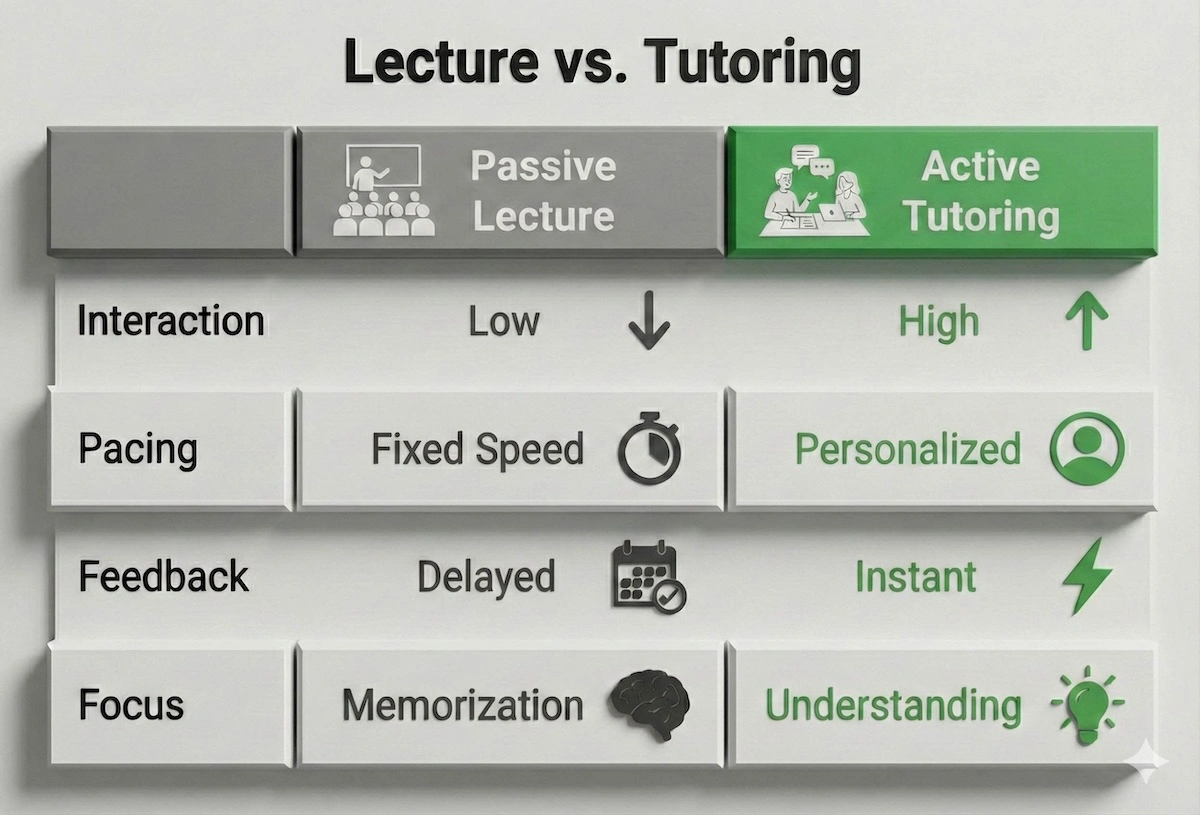
Transitioning from passive listening to active engagement is key to mastering complex biochemical concepts.
Embracing the ‘Active’ column—asking questions and demanding instant feedback—is the secret sauce that accelerates your learning curve.
Building Long-term Success
Study Skill Development
Beyond immediate homework assistance, quality biochemistry tutoring develops essential study skills for long-term academic success. Effective tutors teach you how to analyze primary research literature, interpret experimental data, and connect theoretical knowledge to practical applications.
These transferable skills prove invaluable throughout your academic and professional career, extending tutoring benefits far beyond individual course completion.
Confidence Building
Perhaps most importantly, personalized tutoring builds academic confidence that transforms your approach to challenging subjects. When students understand biochemical principles rather than simply memorizing facts, they develop problem-solving confidence that applies to novel situations.
Research shows that 94% of students working with professional tutors achieve their target grades, with many exceeding their initial expectations. This success builds momentum for continued academic achievement.
The journey through biochemistry education need not be solitary or overwhelming. With proper tutoring support, challenging molecular concepts become fascinating insights into life’s fundamental processes. Whether you’re struggling with metabolic pathways or preparing for medical school entrance exams, professional biochemistry teaching provides the personalized guidance necessary for academic excellence.
Remember Sarah from our opening story? With dedicated tutoring support, she not only passed her biochemistry course but developed a passion for molecular biology that shaped her entire career trajectory. Your success story awaits—the key lies in finding the right educational support to unlock your biochemical potential.
Frequently Asked Questions
Q1 What qualifications should I look for in a biochemistry tutor?
Seek tutors with advanced degrees in biochemistry or related fields, plus proven teaching experience and positive student reviews.
Q2 How effective is online biochemistry tutoring compared to in-person instruction?
Online tutoring offers equal effectiveness with added convenience, flexible scheduling, and access to specialized digital learning tools.
Q3 What topics do biochemistry tutors typically cover?
Professional tutors address all biochemistry areas including metabolic pathways, enzyme kinetics, protein structure, and molecular biology principles.
Q4 How much improvement can I expect from biochemistry tutoring?
Studies show students achieve 13% average grade improvements, with 93% of undergraduates experiencing grade increases through professional tutoring.
Q5 When should I start seeking biochemistry tutoring assistance?
Begin tutoring early in your course to build strong foundations rather than waiting until you’re struggling with advanced concepts.
Q6 What’s the typical cost of professional biochemistry tutoring?
Tutoring rates vary by region and tutor qualifications, typically ranging from £14-39 per hour in the UK and $15-25 per hour in the US.
Related Subjects
Analytical methods in Biochemistry
Carbohydrate metabolism
Clinical Biochemistry
Immunochemistry
Lipid metabolism
Metabolomics
Nutritional Biochemistry
Pharmaceutical Biochemistry
******************************
This article provides general educational guidance only. It is NOT official exam policy, professional academic advice, or guaranteed results. Always verify information with your school, official exam boards (College Board, Cambridge, IB), or qualified professionals before making decisions. Read Full Policies & Disclaimer , Contact Us To Report An Error