




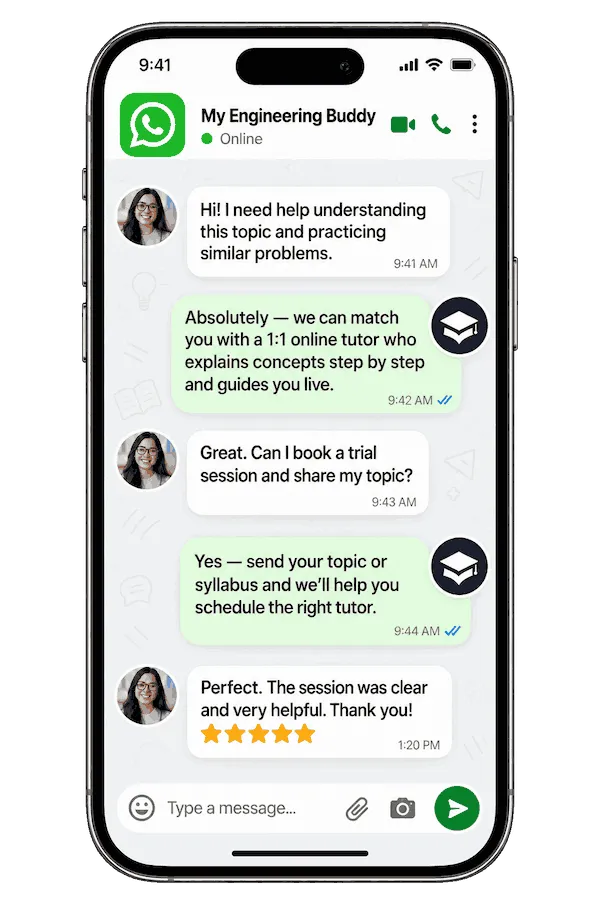
~1 min
Average Reply Time
~1 hour
To Be Matched With A Tutor
30 Min Trial
75% Find Their Tutor On The 1st Trial
$20-35+/hr
Premium Yet Affordable Learning
Most students hit a wall at phytoextraction mechanisms or rhizosphere dynamics — and a textbook alone won’t fix that.
Phytoremediation Tutor Online
Phytoremediation is the use of living plants and their associated microorganisms to remove, degrade, or contain contaminants in soil, water, and air. A Phytoremediation tutor helps students understand plant uptake mechanisms, contaminant pathways, and real-world remediation design at undergraduate to postgraduate level.
MEB offers 1:1 online Phytoremediation tutoring and academic guidance across 2,800+ advanced subjects. Whether you’re searching for a Phytoremediation tutor near me or need flexible online sessions across time zones, MEB matches you with a verified specialist — usually within the hour. Sessions are structured around your exact course, your gaps, and your deadline.
- 1:1 online sessions tailored to your university course or syllabus
- Expert verified tutors with subject-specific knowledge in environmental science and plant biology
- Flexible time zones — US, UK, Canada, Australia, Gulf
- Structured learning plan built after a diagnostic session
- Ethical academic guidance — you understand the material before you submit
52,000+ students across the US, UK, Canada, Australia, and the Gulf have used MEB since 2008 — across 2,800+ subjects, from AP Calculus to A Level Music Technology to Data Science.
Source: My Engineering Buddy, 2008–2025.
How Much Does a Phytoremediation Tutor Cost?
Most Phytoremediation tutoring sessions run $20–$40/hr. Graduate-level and highly specialised topics can reach up to $100/hr. You can test the service first with the $1 trial — 30 minutes of live tutoring or one full homework question explained in detail.
| Level / Need | Typical Rate | What’s Included |
|---|---|---|
| Undergraduate (most levels) | $20–$35/hr | 1:1 sessions, homework guidance |
| Postgraduate / Research-level | $35–$100/hr | Expert tutor, advanced depth |
| $1 Trial | $1 flat | 30 min live session or 1 homework question |
Tutor availability tightens during end-of-semester and dissertation submission periods. Book early if you’re working to a fixed deadline.
WhatsApp MEB for a quick quote — average response time under 1 minute.
Who This Phytoremediation Tutoring Is For
This service is built for students who need more than lecture slides and reading lists. Phytoremediation sits at the intersection of plant physiology, soil science, and environmental engineering — and most courses assume prior depth that not every student has.
- Undergraduate students in environmental science, civil engineering, or biotechnology covering soil contamination modules
- Postgraduate and MSc students with dissertation work involving metal hyperaccumulators or constructed wetlands
- Students with a university conditional offer depending on passing this module — a tutor can close the gap in weeks, not months
- Students who have struggled with rhizosphere chemistry or plant-metal interaction concepts in prior coursework
- Researchers needing a structured refresher before lab rotations or fieldwork
- Students at institutions including the University of Michigan, University of Edinburgh, TU Delft, University of Toronto, and UNSW who need support outside office hours
Students who benefit most often come with a specific problem — a past paper they couldn’t finish, an assignment on phytovolatilisation they don’t understand, or a supervisor who expects more independent reading than the student is ready for. A bioremediation tutor is also available if your course covers both microbial and plant-based approaches.
1:1 Tutoring vs Self-Study vs AI Tools
Self-study works for students who already understand the framework — but in Phytoremediation, it’s easy to memorise plant species lists without ever understanding why a hyperaccumulator sequesters cadmium differently in shoot tissue versus roots. That gap doesn’t show up until the exam. AI tools can produce fast explanations of phytoextraction or phytostabilisation, but they cannot watch you work through a contamination scenario in real time, catch where your reasoning breaks down, or push back when your mechanism diagram is wrong. The subject requires live, annotated problem-solving — drawing translocation pathways, checking units in bioconcentration factor calculations, and building remediation design logic step by step. MEB gives you that, online, with a tutor calibrated to your exact course and timeline.
Outcomes: What You’ll Be Able To Do in Phytoremediation
After working with an online Phytoremediation tutor, you will be able to explain the molecular and physiological mechanisms behind metal uptake in hyperaccumulating species, analyze site-specific variables that determine which phytoremediation strategy — extraction, stabilisation, degradation, or volatilisation — is appropriate. You will apply bioconcentration factor and translocation factor calculations correctly in assignment and exam contexts, model contaminant movement through root-to-shoot pathways with confidence, and present a coherent remediation design rationale for organic pollutants including petroleum hydrocarbons and chlorinated solvents. These are not abstract skills — they are the specific competencies your course assessors are marking against.
Based on feedback from 40,000+ sessions collected by MEB from 2022 to 2025, 58% of students improved by one full grade after approximately 20 hours of 1:1 tutoring in a single subject. A further 23% achieved at least a half-grade improvement.
Source: MEB session feedback data, 2022–2025.
Try your first session for $1 — 30 minutes of live 1:1 tutoring or one homework question explained in full. No registration. No commitment. WhatsApp MEB now and get matched within the hour.
What We Cover in Phytoremediation (Syllabus / Topics)
< >
>
Plant Mechanisms and Contaminant Uptake
- Metal hyperaccumulator species: Thlaspi caerulescens, Arabidopsis halleri, Pteris vittata
- Rhizosphere processes: root exudates, pH modification, microbial interaction
- Symplastic and apoplastic uptake pathways
- Chelation and vacuolar sequestration of heavy metals
- Bioconcentration factor (BCF) and translocation factor (TF) calculations
- Phytovolatilisation of mercury and selenium compounds
Core texts include Pilon-Smits (2005) Annual Review of Plant Biology and Salt, Blaylock & Kumar’s foundational work on metal hyperaccumulators. The US EPA’s science and technology resources provide regulatory context for remediation site assessment.
Remediation Strategies and Site Design
- Phytoextraction: sequential cropping, biomass management, and metal recovery
- Phytostabilisation for tailings and mine-waste sites
- Rhizofiltration for water and leachate treatment
- Phytodegradation of organic contaminants including PCBs and PAHs
- Constructed wetlands and aquatic phytoremediation systems
- Site characterisation: contaminant profiling, soil matrix analysis, plant selection criteria
- Risk assessment and regulatory compliance frameworks (US EPA, EU Soil Framework)
Recommended texts: Chaney et al. on agronomic phytoextraction, and the ITRC technical documentation on phytotechnologies. The EPA science portal supports assignment work on compliance and site standards — see Tier A links for additional subject support including biochemical engineering tutoring and downstream processing help.
Emerging Applications and Research Frontiers
- Genetic engineering of hyperaccumulators: overexpression of metal transporter genes
- Assisted phytoextraction using synthetic chelates (EDTA, DTPA)
- Phytoremediation of emerging contaminants: pharmaceuticals, microplastics, PFAS
- Combined plant-microbial systems (rhizoremediation)
- Life cycle assessment (LCA) of phytoremediation versus conventional remediation
Key references include work by Pilon-Smits and LeDuc on transgenic approaches, and recent reviews in Environmental Science & Technology. Students working on protein engineering or fermentation technology often study these topics in parallel.
What a Typical Phytoremediation Session Looks Like
The tutor opens by checking the previous topic — usually where the student got stuck, for instance translocation factor calculations or the logic behind chelate-assisted extraction. From there, the session moves into the core problem: the student shares their screen or a photograph of their worksheet, and tutor and student work through it together — annotating contaminant pathways, correcting unit errors in BCF calculations, or building a remediation strategy table for a given site scenario. The tutor uses a digital pen-pad to draw root cross-sections or soil profile diagrams in real time. The student then replicates the reasoning or explains it back. By the end, there’s a concrete task set — usually a specific past paper question or a section of the assignment to attempt before the next session — and the next topic is already noted.
How MEB Tutors Help You with Phytoremediation (The Learning Loop)
Diagnose: In the first session, the tutor identifies exactly where understanding breaks down — often it’s the distinction between phytostabilisation and phytoextraction at the mechanistic level, or confusion between BCF and TF in exam contexts. That diagnosis shapes everything that follows.
Explain: The tutor works through live problems using a digital pen-pad — drawing root uptake diagrams, tracing contaminant pathways from rhizosphere to shoot tissue, and walking through site selection logic step by step. No pre-recorded slides. Everything is built for you, in that session.
Practice: The student attempts similar problems while the tutor watches. That means mistakes surface immediately — not three days later when the marked work comes back.
Feedback: The tutor goes through errors in detail: which step failed, why marks would be lost, and what the correct reasoning looks like. This is where most progress happens — not in explanation, but in correction.
Plan: Each session ends with a clear next step — a topic to revisit, a question to attempt, or a reading to complete. The tutor tracks what’s been covered and adjusts the plan if new gaps appear.
Sessions run over Google Meet. The tutor uses a digital pen-pad or iPad with Apple Pencil for annotated diagrams. Before your first session, send over your course outline or module handbook, any assignment or past paper you’ve struggled with, and your deadline. The first session starts with a diagnostic — every minute is used. Start with the $1 trial — 30 minutes of live tutoring that also serves as your first diagnostic.
At MEB, we’ve found that students who struggle with Phytoremediation are rarely missing effort — they’re missing a clear model of how contaminant movement actually works at the cellular level. Once that’s in place, everything else follows faster than they expect.
Tutor Match Criteria (How We Pick Your Tutor)
Not every environmental science tutor has the depth Phytoremediation requires. Here’s what MEB checks.
Subject depth: The tutor must have studied or worked in phytoremediation, environmental biotechnology, or soil remediation at postgraduate level — not just general ecology. Syllabus fit is confirmed before the match is made.
Tools: All sessions run on Google Meet. The tutor uses a digital pen-pad or iPad with Apple Pencil for live diagrams and annotated problem-solving — essential for plant physiology and site design work.
Time zone: MEB covers New York, Los Angeles, Chicago, London, Dubai, Toronto, Sydney, Melbourne, and all standard US, UK, Gulf, Canadian, Australian, and European time zones — evenings and weekends included.
Learning style: Calibrated from the first session. Some students need the mechanism from first principles; others need to drill past paper questions from the first minute. The tutor reads this quickly.
Communication: Clear English, adapted to the student’s level — whether that’s a second-year undergraduate or a doctoral candidate preparing for a literature review.
Goals: The match accounts for what you’re working toward — exam pass, assignment completion, conceptual depth for a dissertation, or research preparation.
Students consistently tell us that what they needed wasn’t more information about phytoremediation — it was someone who could watch them work through a problem and tell them exactly where the logic went wrong. That’s what a matched tutor does.
Study Plans (Pick One That Matches Your Goal)
The tutor builds a specific session sequence after the diagnostic, but most students fall into one of three patterns. A catch-up plan (1–3 weeks) works for students behind on a module with an assignment or exam close. An exam prep plan (4–8 weeks) covers systematic topic revision with past paper practice built in. Weekly ongoing support runs alongside the semester, tied to coursework deadlines and lecture schedules. Share your timeline and the tutor handles the rest.
Pricing Guide
Standard Phytoremediation tutoring runs $20–$40/hr for undergraduate and taught postgraduate levels. Research-intensive or highly specialised sessions — dissertation support, advanced site design, transgenic approaches — run up to $100/hr. Rate factors include topic depth, tutor background, session frequency, and how close the deadline is.
For students working on graduate research with a focus on phytoremediation field applications or emerging contaminant work, tutors with active research or professional environmental consulting backgrounds are available at higher rates. Share your specific project and MEB will match the tier to what you actually need.
Availability tightens sharply around dissertation submission periods and end-of-semester deadlines. Start with the $1 trial — 30 minutes, no registration, no commitment. WhatsApp MEB for a quick quote.
FAQ
Is Phytoremediation hard?
It’s conceptually demanding because it sits across plant biology, soil chemistry, and environmental engineering. Most difficulties come from not having a clear mental model of how contaminants move through plant systems. A tutor addresses that directly, usually within the first two sessions.
How many sessions do students typically need?
For a specific assignment or exam component, 3–5 sessions is typical. For a full module with multiple topics — mechanisms, site design, and emerging contaminants — students usually work with a tutor for 8–15 sessions across a semester. The diagnostic shapes the exact plan.
Can you help with practice exercises?
Yes. MEB tutors explain the concepts, work through the problem-solving process with you, and help you understand what your answer needs to demonstrate — then you write and submit it yourself.
MEB tutoring is guided learning — you understand the work, then submit it yourself. For full details on what we help with and what we don’t, read our Academic Integrity policy and Why MEB.
Will the tutor match my exact syllabus or exam board?
Yes. Before the match is confirmed, MEB checks that the tutor knows your specific course content — whether that’s a UK university environmental science module, a North American civil engineering elective, or a European environmental biotechnology programme. Send your module outline and it’s matched from there.
What happens in the first session?
The first session is a diagnostic. The tutor asks targeted questions, reviews any past work you share, and identifies where the gaps actually are — not where you think they are. From that point, every subsequent session is targeted rather than general.
Is online tutoring as effective as in-person for Phytoremediation?
For this subject, yes — because the core work is conceptual and diagrammatic. Google Meet with a digital pen-pad replicates the whiteboard dynamic fully. Students at institutions across four continents have worked through complex site design problems and plant physiology topics this way without issue.
Can I get Phytoremediation help late at night or on weekends?
Yes. MEB operates across all major time zones and tutors are available evenings and weekends. WhatsApp response time averages under a minute, any time of day. If your deadline is tomorrow morning, message now.
What if I don’t get on with my assigned tutor?
Request a different tutor immediately — no explanation needed, no extra charge. MEB re-matches quickly. The $1 trial exists partly so you can test the fit before committing to a longer block of sessions.
Do you offer help specifically with Phytoremediation dissertation chapters?
Yes. Tutors can support literature review structuring, methodology explanation, results interpretation, and discussion framing for dissertation work involving phytoremediation. This falls under guided learning — the thinking and writing is yours. Check our Academic Integrity policy for what’s covered.
How do I get started?
Three steps: WhatsApp MEB, get matched with a verified Phytoremediation tutor within the hour, then start with the $1 trial — 30 minutes of live tutoring or one full homework question explained. No registration, no intake form, no commitment required.
Trust & Quality at My Engineering Buddy
Every MEB tutor goes through subject-specific screening — a live demo evaluation, degree and background verification, and ongoing review based on student feedback. Tutors covering Phytoremediation hold postgraduate qualifications in environmental science, soil remediation, or related fields, and many have professional or research experience in applied site work. Rated 4.8/5 across 40,000+ verified reviews on Google.
Unlike platforms where you fill out a form and wait, MEB responds in under a minute, 24/7. Tutor match takes under an hour. The $1 trial means you test before you commit. Everything runs over WhatsApp — no logins, no intake forms. Read more about what makes MEB different at Why MEB and review our full tutoring methodology.
MEB tutoring is guided learning — you understand the work, then submit it yourself. For full details on what we help with and what we don’t, read our Academic Integrity policy.
MEB has served 52,000+ students across the US, UK, Canada, Australia, Gulf, and Europe since 2008, across 2,800+ subjects. Students working in adjacent areas often use MEB for bioremediation tutoring, biochemical engineering academic guidance, and animal biotechnology tutoring.
MEB has operated since 2008 — not as a marketplace, but as a matched tutoring service where every tutor is vetted for the specific subject, level, and exam board the student needs. That’s what 18 years of subject-specific tutoring looks like.
Source: My Engineering Buddy, 2008–2025.
A common pattern our tutors observe is that students arrive having read everything and understood nothing — because Phytoremediation requires you to integrate plant physiology, soil chemistry, and engineering design simultaneously. The sessions slow that down and build it back up in the right order.
Explore Related Subjects
Students studying Phytoremediation often also need support in:
- Bioremediation
- Biochemical Engineering
- Fermentation Technology
- Protein Engineering
- Downstream Processing
- Animal Biotechnology
Next Steps
Getting started takes under two minutes. Here’s what to do:
- Share your course outline or module handbook, your hardest topic, and your current deadline
- Share your availability and time zone — MEB covers evenings and weekends across all regions
- MEB matches you with a verified Phytoremediation tutor — usually within 24 hours, often faster
Before your first session, have ready: your exam board and syllabus (or course outline), a recent past paper attempt or homework you struggled with, and your exam or deadline date. The tutor handles the rest.
Visit www.myengineeringbuddy.com to learn more about how MEB matches and supports students.
WhatsApp to get started or email [email protected].
Reviewed by Subject Expert
This page has been carefully reviewed and validated by our subject expert to ensure accuracy and relevance.




