~1 min
Average Reply Time
~1 hour
To Be Matched With A Tutor
30 Min Trial
75% Find Their Tutor On The 1st Trial
$20-35+/hr
Premium Yet Affordable Learning
Struggling to separate theory from process in Downstream Processing? Most students hit the same wall — they understand fermentation, then blank on the purification train.
Downstream Processing Tutor Online
Downstream processing covers the recovery, isolation, and purification of biological products — proteins, enzymes, or antibiotics — from fermentation or cell culture broths, equipping students to design scalable, GMP-aligned separation and purification unit operations.
MEB connects you with a verified Downstream Processing tutor online who knows the subject at process scale — not just textbook diagrams. If you’ve searched for a Downstream Processing tutor near me and found mostly generalists, MEB is different. Our tutors work through centrifugation, chromatography, ultrafiltration, and downstream train design with you, live, step by step. Part of our broader Biotechnology tutoring offering, Downstream Processing sessions are matched to your exact course, syllabus, and timeline.
- 1:1 online sessions tailored to your university module or research project
- Expert-verified tutors with industrial bioprocessing and academic backgrounds
- Flexible time zones — US, UK, Canada, Australia, Gulf covered
- Structured learning plan built after a first-session diagnostic
- Ethical homework and assignment guidance — you understand the work, then submit it yourself
52,000+ students across the US, UK, Canada, Australia, and the Gulf have used MEB since 2008 — including students in Biotechnology subjects like Downstream Processing, Biochemical Engineering, and Fermentation Technology.
Source: My Engineering Buddy, 2008–2025.
How Much Does a Downstream Processing Tutor Cost?
Rates start at $20–$40/hr for most undergraduate and postgraduate levels. Advanced bioprocess or GMP-focused sessions with industry-experienced tutors run up to $100/hr. The $1 trial gives you 30 minutes of live 1:1 tutoring or a full explanation of one homework question — no commitment needed to get started.
| Level / Need | Typical Rate | What’s Included |
|---|---|---|
| Standard (undergraduate) | $20–$40/hr | 1:1 sessions, homework guidance |
| Advanced / GMP / Industry | $40–$100/hr | Expert tutor, process-scale depth |
| $1 Trial | $1 flat | 30 min live session or 1 homework question explained |
Tutor availability tightens in April–May and around semester-end submission windows. WhatsApp MEB for a quick quote — average response time under 1 minute.
Who This Downstream Processing Tutoring Is For
Downstream Processing sits at the intersection of biochemistry, engineering, and regulatory science. Most students who come to MEB are not beginners — they’ve done the lecture content and still can’t connect unit operations into a coherent purification train.
- Undergraduate bioengineering or biochemistry students struggling with chromatography selection and sequencing
- Masters students working through membrane separation, diafiltration, or scale-up calculations
- PhD candidates who need to justify downstream choices in a thesis or research proposal
- Students retaking after a failed first attempt on a bioprocessing module who need to close specific conceptual gaps fast
- Students with a university conditional offer depending on passing this module
- Parents watching a confident science student lose ground when the course shifts from biology to process engineering
Students at institutions including MIT, Imperial College London, ETH Zurich, University of Toronto, UNSW Sydney, and TU Delft have worked with MEB tutors on bioprocessing coursework. The $1 trial is available to all of them.
1:1 Tutoring vs Self-Study vs AI vs YouTube vs Online Courses
Self-study works if you’re disciplined — but Downstream Processing has too many interdependencies to learn purely from notes. AI tools give fast definitions of precipitation or centrifugation but can’t diagnose why your mass balance keeps failing. YouTube covers unit operations at a conceptual level and stops when you need process economics or scale-up logic. Online courses move at a fixed pace and don’t adjust when you’re stuck on protein A chromatography while already three topics ahead. 1:1 tutoring with MEB is calibrated to your exact syllabus, corrects calculation errors in the moment, and connects every unit operation back to the full downstream train.
Outcomes: What You’ll Be Able To Do in Downstream Processing
After working with an MEB online Downstream Processing tutor, you’ll be able to apply mass balance calculations across a multi-step purification sequence, analyse the trade-offs between chromatography modes for a given target protein, solve yield and purity problems for centrifugation and filtration stages, explain the regulatory rationale behind GMP-aligned process design, and present a justified downstream train from harvest to final formulation. These are exam-facing and research-facing capabilities — not surface recall.
Based on feedback from 40,000+ sessions collected by MEB from 2022 to 2025, 58% of students improved by one full grade after approximately 20 hours of 1:1 tutoring in subjects like Downstream Processing. A further 23% achieved at least a half-grade improvement.
Source: MEB session feedback data, 2022–2025.
At MEB, we’ve found that students who struggle with downstream train design almost always have one root gap — they’ve learned unit operations in isolation and never had to sequence them under yield and purity constraints. One session fixing that framing changes how every subsequent topic lands.
What We Cover in Downstream Processing (Syllabus / Topics)

Track 1: Cell Disruption, Clarification, and Primary Recovery
- Mechanical and non-mechanical cell disruption methods
- Centrifugation principles — disc-stack, tubular bowl, and cut-point calculations
- Microfiltration and depth filtration for clarification
- Aqueous two-phase extraction (ATPE) basics
- Harvest yield calculations and mass balance across primary recovery
- Scale-up considerations from bench to pilot
Key texts: Bioprocess Engineering Principles by Pauline Doran; Downstream Processing of Proteins by Mohamed Desai (ed.).
Track 2: Chromatographic Purification
- Ion exchange chromatography — resin selection, gradient elution, binding capacity
- Size exclusion chromatography — column sizing, resolution, plate height theory
- Affinity chromatography — Protein A/G, ligand design, elution strategies
- Hydrophobic interaction chromatography (HIC) — salt selection and step gradients
- Multi-step chromatography train design — capture, intermediate, polishing logic
- Chromatography economics and resin lifetime calculations
- Regulatory expectations for chromatography validation (ICH Q7 context)
Key texts: Protein Purification by Janson and Ryden; Process Chromatography by Subramanian (ed.).
Track 3: Membrane Separation, Formulation, and GMP Context
- Ultrafiltration and diafiltration — MWCO selection, flux, concentration polarisation
- Viral clearance steps — nanofiltration and low-pH inactivation
- Final formulation — excipient selection, fill-finish considerations
- Overall yield and purity calculations across the full downstream train
- GMP principles relevant to downstream process design
- Process Analytical Technology (PAT) basics for downstream monitoring
Key texts: Membrane Technology and Applications by Baker; Biopharmaceutical Processing by Jagschies et al.
What a Typical Downstream Processing Session Looks Like
The tutor opens by checking the previous session’s topic — usually chromatography resin selection or a yield calculation the student attempted. From there, you work through a live problem together: the tutor annotates a purification flowsheet on screen, walks through the mass balance step by step, and asks you to explain the reasoning at each stage. If you’re stuck on why a Protein A capture step precedes ion exchange polishing, the tutor doesn’t just state the answer — they work through the logic of yield vs selectivity trade-offs until it makes sense to you. The session closes with one or two specific problems set for independent practice, and the next topic is noted before you disconnect.
How MEB Tutors Help You with Downstream Processing (The Learning Loop)
Diagnose: In the first session, the tutor identifies whether your gap is conceptual (you don’t understand why steps are sequenced the way they are), mathematical (mass balances and yield calculations break down), or integrative (you can explain each unit operation separately but can’t connect them into a justified downstream train).
Explain: The tutor works through live examples — a three-step purification train for a recombinant protein, or a UF/DF concentration step with specific flux constraints — using a digital pen-pad to annotate flowsheets and equations in real time.
Practice: You attempt the next problem with the tutor present. Not watching. Present — asking the right questions when you stall, not giving the answer before you’ve tried the reasoning.
Feedback: Errors are corrected step by step. The tutor explains where the mark was lost in an exam context and why the same error recurs across different problem types.
Plan: Each session ends with a clear next topic and a short task. Progress is tracked session by session, not left to the student to manage alone.
Sessions run on Google Meet. Tutors use a digital pen-pad or iPad with Apple Pencil. Before your first session, have your course syllabus or module guide, a past exam question or problem set you’ve struggled with, and your submission or exam date ready. The tutor handles the structure from there. Start with the $1 trial — 30 minutes of live tutoring that also serves as your first diagnostic.
Students consistently tell us that the moment downstream processing clicks is when they stop thinking about unit operations as a list and start thinking about them as a sequence of decisions — each one constrained by what the previous step left behind.
Tutor Match Criteria (How We Pick Your Tutor)
Not every biochemistry tutor can teach downstream processing at process scale. MEB matches on four criteria.
Subject depth: The tutor must know your specific level — undergraduate module, Masters bioprocess design, or PhD-level process justification — and the relevant syllabus components, including chromatography train design and GMP-aligned process decisions.
Tools: All tutors use Google Meet with a digital pen-pad or iPad and Apple Pencil. Flowsheets, equations, and mass balance tables are annotated live — no static slides.
Time zone: Matched to your region. US, UK, Gulf, Canada, and Australia are covered across all time zones, including late-night and early-morning slots.
Goals: Whether you need exam preparation, conceptual grounding, homework guidance, or support building a research proposal argument, the tutor is briefed on your specific objective before session one.
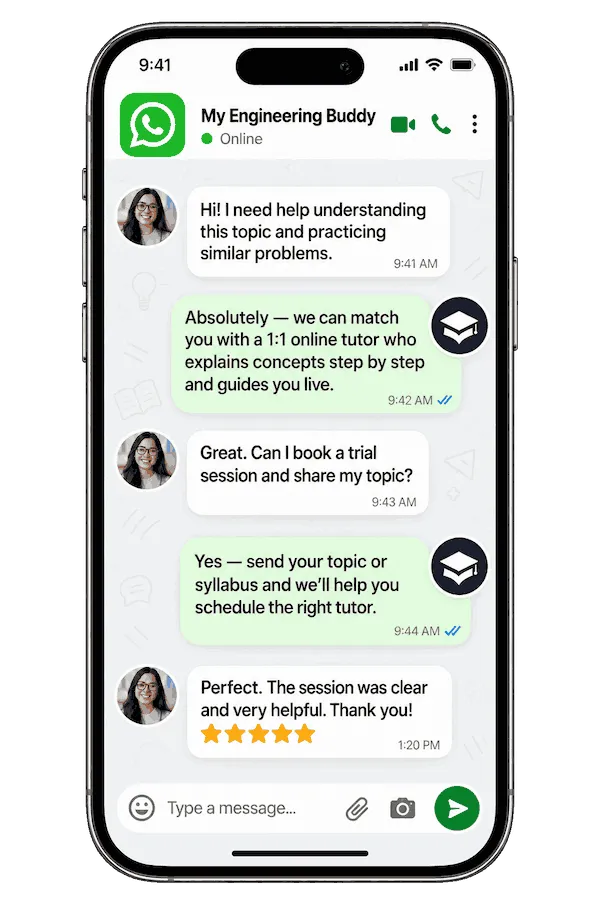
Unlike platforms where you fill out a form and wait, MEB responds in under a minute, 24/7. Tutor match takes under an hour. The $1 trial means you test before you commit. Everything runs over WhatsApp — no logins, no intake forms.
Study Plans (Pick One That Matches Your Goal)
After the diagnostic session, the tutor builds a plan around your actual situation. Catch-up plans (1–3 weeks) close specific unit operation gaps before a submission or resit. Exam preparation plans (4–8 weeks) work through the full downstream train — primary recovery, chromatographic purification, membrane separation, and yield integration — in a structured sequence. Weekly support runs alongside the semester, aligned to coursework deadlines and lab reports. The tutor sets the sequence; you don’t have to figure out what to study next.
Pricing Guide
Most Downstream Processing sessions run at $20–$40/hr. Graduate-level work, GMP-context sessions, or industry-experienced tutors for PhD or professional development are available up to $100/hr. Rate depends on the level of the module, topic complexity, how close your deadline is, and tutor availability.
For students targeting positions in biologics manufacturing, vaccine production, or biopharma process development, tutors with direct industry backgrounds are available at higher rates — share your specific goal and MEB will match the tier to your ambition.
Availability tightens in April–May and around December semester closures. Start with the $1 trial — 30 minutes, no registration, no commitment. WhatsApp MEB for a quick quote.
MEB tutors bring subject-specific depth across 2,800+ fields — from Protein Engineering tutoring to Animal Biotechnology help — backed by 18 years of serving students across the US, UK, and beyond.
Source: My Engineering Buddy, 2008–2025.
FAQ
Is Downstream Processing hard?
It’s technically demanding. The difficulty isn’t any single unit operation — it’s designing a sequence where yield and purity constraints compound across every step. Students who’ve handled biochemistry well often find the process engineering and economic trade-off elements the steepest part of the learning curve.
How many sessions are needed?
Most students close a specific conceptual gap in 3–5 sessions. Full module support from mid-semester through to the exam typically runs 10–15 sessions. The tutor gives a more specific estimate after the first diagnostic session, based on where your gaps actually are.
Can you help with homework and assignments?
MEB tutoring is guided learning — you understand the work, then submit it yourself. The tutor explains the reasoning, works through similar examples, and checks your approach. See our Academic Integrity policy and Why MEB page for full details on what we help with and what we don’t.
Will the tutor match my exact syllabus or exam board?
Yes. When you contact MEB, share your university, module code, and any past papers or problem sets you’re working from. The tutor is briefed on your specific course before session one — not on a generic downstream processing curriculum.
What happens in the first session?
The tutor runs a short diagnostic — asking you to walk through a problem or explain a concept — to identify exactly where the gap is. The session then starts working on that gap directly. You leave with a practice task and a clear plan for subsequent sessions.
Is online tutoring as effective as in-person?
For Downstream Processing, yes. The pen-pad annotation on flowsheets, mass balance tables, and chromatography diagrams replicates what a whiteboard session delivers. Most students report that being able to share their own screen — showing their attempted calculations — makes feedback faster than in-person.
Can I get Downstream Processing help at midnight or on weekends?
Yes. MEB tutors span multiple time zones and late-evening or early-morning slots are available across US, Gulf, and Asia-Pacific regions. WhatsApp MEB with your availability and a tutor is matched, often within the hour, regardless of the time of day.
What if I don’t connect with my assigned tutor?
Let MEB know after the trial session. Tutor reassignment is straightforward — no forms, no delay. The goal is a working relationship, not an administrative process. Most mismatches are resolved within 24 hours by switching to a different tutor from the same subject pool.
What’s the difference between upstream and downstream processing, and does MEB cover both?
Upstream covers cell line development and bioreactor operation. Downstream covers everything from harvest onward — clarification, purification, formulation. MEB tutors in Biochemical Engineering and Fermentation Technology help can cover upstream; dedicated downstream tutors handle the purification train.
How do I get started?
Three steps: WhatsApp MEB with your subject, level, and deadline. MEB matches you with a verified tutor — usually within the hour. Your first session is the $1 trial: 30 minutes live or one full homework question explained. No registration required.
Do Downstream Processing tutors understand GMP and regulatory context, or only the academic theory?
MEB matches tutors by background. If your module includes GMP-aligned process design, ICH Q7 context, or viral clearance validation, request a tutor with industry or regulatory experience. This is specified at match stage — not assumed from a generic bioengineering background.
Can a tutor help me design and justify a full downstream train for a thesis or research proposal?
Yes. PhD-level and postgraduate research support is available. The tutor works through the process logic with you — resin selection rationale, yield modelling, scale-up constraints — so the justification in your proposal is grounded in your reasoning, not a template lifted from a textbook.
Trust & Quality at My Engineering Buddy
Every MEB tutor is screened for subject-specific knowledge before their first session. Screening includes a live demo evaluation in the subject area, degree and professional background verification, and ongoing review of session feedback. For Downstream Processing, this means tutors must demonstrate working knowledge of chromatography train design, mass balance calculations, and — where relevant — GMP and regulatory context. Rated 4.8/5 across 40,000+ verified reviews on Google.
MEB tutoring is guided learning — you understand the work, then submit it yourself. For full details on what we help with and what we don’t, read our Academic Integrity policy and Why MEB.
MEB has served 52,000+ students since 2008 across the US, UK, Canada, Australia, Gulf, and Europe in 2,800+ subjects. Within Biotechnology, this includes students working on Bioremediation tutoring, Phytoremediation help, and Downstream Processing at every level from second-year undergraduate through to doctoral research. The Biomedical Engineering Society provides additional professional context for students working at the interface of bioprocessing and biomedical applications. Read more about our approach at MEB’s tutoring methodology.
Try your first session for $1 — 30 minutes of live 1:1 tutoring or one homework question explained in full. No registration. No commitment.
WhatsApp MEB now
and get matched within the hour.
Explore Related Subjects
Students studying Downstream Processing often also need support in:
From Fermentation Technology tutoring to advanced chromatography support, MEB covers the full bioprocessing curriculum — 18 years, 52,000+ students, one consistent standard.
Source: My Engineering Buddy, 2008–2025.
Next Steps
Ready to work with a verified Downstream Processing tutor? Here’s what to do.
- Share your university, module name, exam board or course outline, and current timeline
- Share your availability and time zone — tutors are matched across US, UK, Gulf, Canada, and Australia
- MEB matches you with a verified tutor, usually within 24 hours
- First session starts with a diagnostic so every minute is used well
Before your first session, have ready: your syllabus or module guide (or course outline), a recent past paper attempt or homework question you struggled with, and your exam or deadline date. The tutor handles the rest.
- Your exam board and syllabus (or course outline)
- A recent past paper attempt or problem you got stuck on
- Your exam or submission deadline date
Visit www.myengineeringbuddy.com for more on how MEB works.
WhatsApp to get started or email [email protected].
Reviewed by Subject Expert
This page has been carefully reviewed and validated by our subject expert to ensure accuracy and relevance.