




~1 min
Average Reply Time
~1 hour
To Be Matched With A Tutor
30 Min Trial
75% Find Their Tutor On The 1st Trial
$20-35+/hr
Premium Yet Affordable Learning
Hire The Best Food Engineering Tutor

Your Food Engineering grade isn’t failing because the subject is too hard — it’s failing because mass balance problems and heat transfer calculations need live correction, not a textbook re-read.
Food Engineering Tutor Online
Food Engineering applies chemical engineering, thermodynamics, and microbiology principles to food processing, preservation, and safety. It equips students to design and analyse industrial food systems, from heat exchangers to packaging lines.
If you’re searching for a Food Engineering tutor near me, MEB connects you with a specialist online within hours — not days. Our 1:1 online tutoring and academic guidance covers the full engineering discipline spectrum, from undergraduate food process engineering modules through to graduate-level food systems design. One verified tutor. Your exact syllabus. No switching between three different people each week.
- 1:1 online sessions tailored to your course and institution’s syllabus
- Expert-verified tutors with food science and process engineering backgrounds
- Flexible time zones — US, UK, Canada, Australia, Gulf, Europe
- Structured learning plan built after a diagnostic session
- Ethical academic guidance — you understand before you submit
52,000+ students across the US, UK, Canada, Australia, and the Gulf have used MEB since 2008 — including students in Engineering subjects like Food Engineering, Chemical Engineering, and Bioengineering.
Source: My Engineering Buddy, 2008–2025.
How Much Does a Food Engineering Tutor Cost?
Most Food Engineering tutoring sessions run $20–$40/hr depending on level and topic complexity. The $1 trial gets you 30 minutes of live 1:1 tutoring or one homework question explained in full — no registration needed.
| Level / Need | Typical Rate | What’s Included |
|---|---|---|
| Undergraduate (most modules) | $20–$35/hr | 1:1 sessions, homework guidance |
| Advanced / Graduate Level | $35–$100/hr | Expert tutor, niche depth, research support |
| $1 Trial | $1 flat | 30 min live session or 1 homework question |
Tutor availability tightens significantly during end-of-semester submission periods. Book early if you have a project or exam deadline approaching.
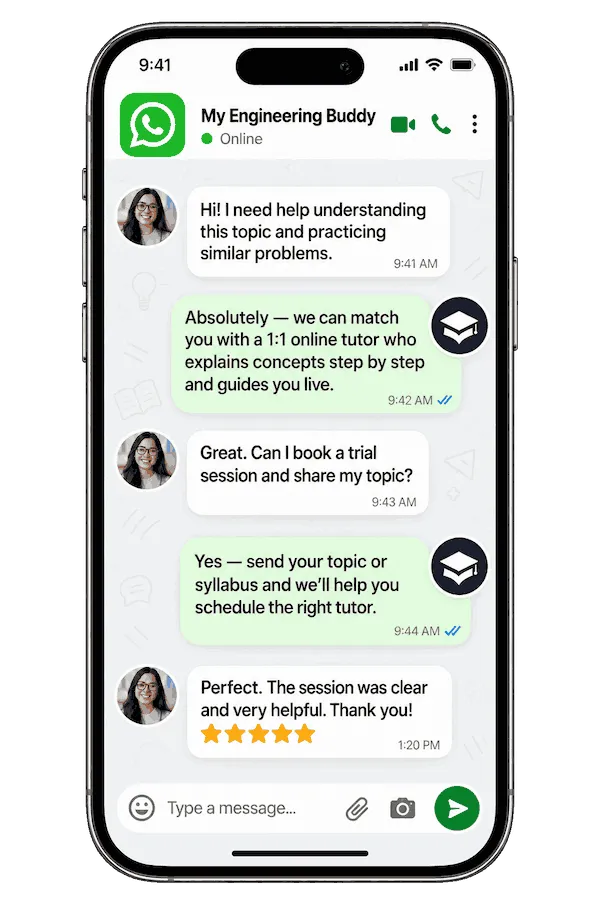
WhatsApp MEB for a quick quote — average response time under 1 minute.
Who This Food Engineering Tutoring Is For
Food Engineering sits at the crossroads of chemistry, physics, and microbiology. That combination catches a lot of students off guard — especially when process calculations meet food safety regulations in the same assignment.
- Undergraduate students struggling with heat transfer, mass balance, or fluid mechanics in food systems
- Students with a university conditional offer depending on passing this module
- Graduate students working through food rheology, thermal processing design, or packaging engineering coursework
- Students retaking after a failed first attempt at a food process engineering module
- Parents watching a child’s confidence drop alongside their grades in a demanding STEM programme
- Students at Cornell, UC Davis, Wageningen, University of Reading, Purdue, McGill, or similar programmes needing subject-specific support
Whether you need help with a single assignment or weekly support through an entire semester, MEB works around your schedule and your exact module content. Start with the $1 trial to see if the tutor is the right fit before committing to anything.
1:1 Tutoring vs Self-Study vs AI vs YouTube vs Online Courses
Self-study works if you’re disciplined — but food engineering calculations have too many failure points for no feedback. AI tools explain concepts quickly but can’t watch you set up a psychrometric chart and catch where your units went wrong. YouTube covers evaporation and pasteurisation at a survey level, then stops exactly when the problem gets specific to your data set. Online courses move at a fixed pace that doesn’t wait for your exam deadline. With a 1:1 Food Engineering tutor from MEB, every session is live, calibrated to your actual course content, and corrects errors before they compound — whether that’s a Reynolds number calculation or a HACCP plan structure.
Outcomes: What You’ll Be Able To Do in Food Engineering
After focused 1:1 work, you’ll be able to solve energy balance problems across food processing unit operations — evaporation, drying, refrigeration — without freezing at the setup stage. You’ll analyse rheological behaviour of food fluids and apply the correct viscosity model for a given system. You’ll model thermal death time curves and apply them to pasteurisation and sterilisation design problems. You’ll explain food packaging material selection in terms of water vapour transmission rates and modified atmosphere requirements. You’ll present a complete HACCP analysis for a processing line, identifying critical control points with confidence.
Based on feedback from 40,000+ sessions collected by MEB from 2022 to 2025, 58% of students improved by one full grade after approximately 20 hours of 1:1 tutoring in subjects like Food Engineering. A further 23% achieved at least a half-grade improvement.
Source: MEB session feedback data, 2022–2025.
Supporting a student through Food Engineering? MEB works directly with parents to set up sessions, track progress, and keep coursework on schedule. WhatsApp MEB — average response time is under a minute, 24/7.
What We Cover in Food Engineering (Syllabus / Topics)

Food Process Engineering
- Mass and energy balances in food processing systems
- Heat transfer: conduction, convection, and radiation in food equipment
- Fluid mechanics and flow behaviour of food materials
- Evaporation, drying, and dehydration unit operations
- Refrigeration cycles and cold chain engineering
- Mixing, size reduction, and separation processes
- Psychrometrics applied to food drying and storage
Core texts include Introduction to Food Engineering by Singh & Heldman and Food Process Engineering and Technology by Berk.
Food Safety, Microbiology & Quality Systems
- Thermal death time and decimal reduction (D-value, z-value, F-value)
- Pasteurisation and sterilisation process design
- HACCP principles and critical control point identification
- Water activity and its role in microbial stability
- Food safety regulations: FDA, EFSA, and Codex Alimentarius frameworks
- Good Manufacturing Practice (GMP) and sanitation systems
Reference texts include Principles of Food Safety by Marriott and Food Microbiology: Fundamentals and Frontiers by Doyle & Buchanan.
Food Rheology, Packaging & Product Development
- Rheological characterisation: viscosity, viscoelasticity, yield stress
- Food texture analysis and sensory engineering
- Packaging materials: barrier properties, WVTR, OTR
- Modified atmosphere packaging (MAP) design
- Product formulation and shelf-life engineering
- Emerging processing technologies: high-pressure, ultrasound, pulsed electric fields
Texts include Rheology of Fluid, Semisolid, and Solid Foods by Rao and Food Packaging: Principles and Practice by Robertson.
What a Typical Food Engineering Session Looks Like
The tutor opens by checking your last topic — usually a heat transfer calculation or a HACCP plan element you were working through. You pull up your assignment or past paper on screen. The tutor uses a digital pen-pad to work through the problem step-by-step: setting up the energy balance correctly, tracking units, and flagging the exact point where your approach diverged from the correct method. Then it’s your turn — you replicate the calculation while the tutor watches, asking why at each step rather than just accepting the answer. For food microbiology content, the same method applies: D-value and z-value problems get treated the same way as a heat exchanger calculation. The session closes with two or three practice problems set for before next time, and the next topic noted so the tutor can prepare worked examples specific to your course.
How MEB Tutors Help You with Food Engineering (The Learning Loop)
Diagnose: In the first session, the tutor identifies where your understanding breaks down — whether that’s the setup of an energy balance, misapplied Reynolds number criteria, or confusion between sterilisation and pasteurisation conditions. Most students have one or two foundational gaps causing most of their lost marks.
Explain: The tutor works through live problems using a digital pen-pad, showing the full solution process — not just the answer. For food engineering, this typically means walking through a complete drying calculation or a HACCP critical limit derivation from first principles.
Practice: You attempt the next problem with the tutor present. Not after the session. Not alone. The tutor watches how you set up the problem and intervenes early if the approach is wrong.
Feedback: Every error gets a precise correction — not “that’s wrong” but “here’s why the unit conversion failed at step two and why it cost you marks.” Students learn faster from corrected mistakes than from re-reading correct solutions.
Plan: Each session ends with a clear next topic, a short task, and a progress note. The tutor tracks what’s been covered and adjusts the plan if an exam or submission date shifts.
Sessions run on Google Meet with a digital pen-pad or iPad and Apple Pencil. Before your first session, have your course syllabus or module outline, a recent assignment you struggled with, and your exam or submission date ready. Start with the $1 trial — 30 minutes of live tutoring that also serves as your first diagnostic.
At MEB, we’ve found that food engineering students who struggle with process calculations almost always have the same root issue: they’re applying the right formula to the wrong system boundary. One session spent on setting up control volumes correctly tends to unlock three or four topics at once.
Tutor Match Criteria (How We Pick Your Tutor)
Not every engineering tutor covers food systems. MEB matches based on four factors.
Subject depth: Tutors are matched to your specific module — undergraduate food process engineering, graduate food systems design, or food safety regulation — not just “engineering” in general.
Tools: Every Food Engineering tutor uses Google Meet plus a digital pen-pad or iPad and Apple Pencil. Calculations need to be shown, not described.
Time zone: Matched to your region — US, UK, Gulf, Canada, or Australia — so sessions fit your schedule, not ours.
Goals: Whether you need to pass one assignment, close a gap before finals, or build research-level depth for a graduate thesis, the tutor is matched to that specific aim.
Unlike platforms where you fill out a form and wait, MEB responds in under a minute, 24/7. Tutor match takes under an hour. The $1 trial means you test before you commit. Everything runs over WhatsApp — no logins, no intake forms.
Study Plans (Pick One That Matches Your Goal)
After the diagnostic session, the tutor builds a sequence specific to your timeline. A catch-up plan (1–3 weeks) targets the highest-priority gaps before an upcoming submission. An exam prep plan (4–8 weeks) works through past papers and key calculation types systematically. Weekly ongoing support aligns to your semester schedule and coursework deadlines. Food Engineering modules often have both a written exam and a design project component — the tutor accounts for both in the plan.
Pricing Guide
Food Engineering tutoring starts at $20/hr for standard undergraduate modules. Graduate-level work, food systems modelling, or research support runs $35–$100/hr depending on tutor background and topic complexity.
Rate factors: year of study, specific topic (thermal processing design costs more than basic mass balance), how quickly you need a tutor, and the tutor’s professional or research experience in the food industry.
For students targeting competitive graduate programmes at institutions like Wageningen University, Cornell, or UC Davis — or preparing for roles requiring regulated food safety certification — tutors with food industry or research backgrounds are available at higher rates. Share your specific goal and MEB will match the tier to your situation.
Start with the $1 trial — 30 minutes, no registration, no commitment. WhatsApp MEB for a quick quote.
Students consistently tell us that the hardest part of Food Engineering isn’t the biology or the chemistry in isolation — it’s when the calculation requires both at once. That’s exactly where live 1:1 work pays off fastest.
FAQ
Is Food Engineering hard?
It’s demanding because it draws on thermodynamics, fluid mechanics, microbiology, and chemistry simultaneously. Most students find heat transfer and energy balance calculations the steepest hurdle. With targeted 1:1 support, those blocks tend to clear faster than students expect.
How many sessions are needed?
For a specific assignment or calculation type, one or two sessions often resolves the problem. To close meaningful gaps before a final exam, most students need 8–15 hours spread over 4–6 weeks. The diagnostic session gives a clearer estimate for your specific situation.
Can you help with practice exercises?
Yes. MEB tutoring is guided learning — you understand the work, then submit it yourself. The tutor explains the method, works through a similar example, then guides you through your own problem. See our Academic Integrity policy and Why MEB page for full details on what we help with and what we don’t.
Will the tutor match my exact syllabus or exam board?
Yes. Before matching, MEB asks for your institution, module name, and any specific topics or assessment types you’re working on. Tutors are selected based on that information — not just the subject title.
What happens in the first session?
The tutor runs a short diagnostic — asking you to walk through a calculation or explain a concept — to identify exactly where your understanding gaps are. The remaining time starts on the highest-priority topic. No generic overview. No time wasted on things you already know.
Is online tutoring as effective as in-person?
For calculation-heavy subjects like Food Engineering, yes — because the digital pen-pad replicates whiteboard working precisely. Screen-sharing means the tutor sees your work in real time. Many students find the recorded session option more useful than notes from an in-person lesson.
Can you help with food engineering design projects and lab reports?
Yes. Tutors help with process flow diagram interpretation, equipment sizing calculations, and structuring lab reports around experimental data. The guidance focuses on your understanding of the method — you write and submit the work yourself.
What’s the difference between food science and food engineering?
Food science focuses on the chemistry, biology, and sensory properties of food. Food engineering applies engineering principles — thermodynamics, fluid mechanics, process design — to food manufacturing systems. Many degree programmes overlap both, but the calculation-heavy engineering modules are where most students seek tutoring support.
Do you cover food safety regulations like HACCP and FDA requirements?
Yes. Tutors cover HACCP plan structure, critical control point identification, FDA and EFSA regulatory frameworks, and Codex Alimentarius principles as they apply to food processing design. This is especially relevant for students with coursework involving regulatory compliance submissions.
Can I get Food Engineering help at short notice — including evenings or weekends?
Yes. MEB operates 24/7 across all time zones. WhatsApp MEB with your topic and availability — most students are matched with a tutor and have a session confirmed within the hour, including evenings and weekends.
How do I get started?
Three steps: WhatsApp MEB with your module name and the topic you’re stuck on. MEB matches you with a verified Food Engineering tutor — usually within the hour. Your first session starts with the $1 trial: 30 minutes of live tutoring or one complete homework question explained.
Trust & Quality at My Engineering Buddy
Every MEB tutor goes through subject-specific screening before taking a session. That includes a live demo evaluation, degree and qualification verification, and ongoing review based on student feedback. Tutors covering Food Engineering hold degrees in food engineering, chemical engineering, food science, or related disciplines — and most have professional or research experience in food processing or food safety systems. Rated 4.8/5 across 40,000+ verified reviews on Google.
MEB tutoring is guided learning — you understand the work, then submit it yourself. For full details on what we help with and what we don’t, read our Academic Integrity policy and Why MEB.
MEB has served 52,000+ students across the US, UK, Canada, Australia, the Gulf, and Europe since 2008 — across 2,800+ subjects. Within Engineering, that includes subjects like Food Engineering, chemical engineering tutoring, industrial engineering help, and materials science and engineering tutoring. The platform was built by engineers, for students who need more than a generic tutor list. See our tutoring methodology for how the learning loop is structured.
Our experience across thousands of sessions shows that food engineering students make the fastest progress when they stop treating each topic as separate and start seeing the subject as a connected system — energy in, product out, constraints everywhere. That’s what good 1:1 tutoring makes visible.
Explore Related Subjects
Students studying Food Engineering often also need support in:
- Biomedical Engineering
- Mechanical Engineering
- Systems Engineering
- Quality Control
- Nuclear Engineering
- Textile Engineering
- Metallurgical Engineering
Next Steps
Getting started takes less than two minutes.
- Share your exam board or institution, the module or topic you’re stuck on, and your current deadline or exam date
- Share your availability and time zone — MEB covers US, UK, Canada, Australia, Gulf, and Europe
- MEB matches you with a verified Food Engineering tutor, usually within the hour
- Your first session begins with a diagnostic — every minute is used on your actual gaps
Before your first session, have ready:
- Your module syllabus or course outline
- A recent assignment or past paper question you struggled with
- Your exam or submission deadline date — the tutor handles the rest
Visit www.myengineeringbuddy.com for more on how MEB works.
Try your first session for $1 — 30 minutes of live 1:1 tutoring or one homework question explained in full. No registration. No commitment. WhatsApp MEB now and get matched within the hour.
Food Engineering is one of the most calculation-dense engineering disciplines at undergraduate level — and one of the most under-served by generic tutoring platforms. MEB has specialist tutors ready, 24 hours a day, across every time zone.
Source: My Engineering Buddy, 2008–2025.
WhatsApp to get started or email [email protected].
Reviewed by Subject Expert
This page has been carefully reviewed and validated by our subject expert to ensure accuracy and relevance.




