~1 min
Average Reply Time
~1 hour
To Be Matched With A Tutor
30 Min Trial
75% Find Their Tutor On The 1st Trial
$20-35+/hr
Premium Yet Affordable Learning
Most students who struggle with fabric engineering aren’t weak in engineering — they’ve never had someone explain fibre-to-fabric mechanics at the level their course actually requires.
Fabric Engineering Tutor Online
Fabric engineering is the applied study of how fibres, yarns, and textile structures are designed, manufactured, and tested — covering weave geometry, knit mechanics, non-woven processes, and fabric performance evaluation for industrial and consumer applications.
If you’ve searched for a fabric engineering tutor near me, MEB offers 1:1 online tutoring and academic guidance across 2,800+ advanced subjects, including engineering disciplines at undergraduate, postgraduate, and research level. Whether your course focuses on woven structures, composite textiles, or functional fabric design, a verified fabric engineering tutor works through your exact syllabus — not a generic version of it. Students typically see meaningful improvement within 8–12 targeted sessions.
- 1:1 online sessions tailored to your course module and university syllabus
- Expert-verified tutors with textile and materials engineering backgrounds
- Flexible time zones — US, UK, Canada, Australia, Gulf
- Structured learning plan built after a diagnostic session
- Ethical academic guidance — you understand before you submit
52,000+ students across the US, UK, Canada, Australia, and the Gulf have used MEB since 2008 — including students in Engineering subjects like fabric engineering, textile engineering, and materials science and engineering.
Source: My Engineering Buddy, 2008–2025.
How Much Does a Fabric Engineering Tutor Cost?
Online fabric engineering tutoring at MEB starts at $20–$40/hr for most undergraduate modules. Specialist postgraduate or research-level topics reach up to $100/hr. The $1 trial gets you 30 minutes of live 1:1 tutoring or a full explanation of one homework question — no registration needed.
| Level / Need | Typical Rate | What’s Included |
|---|---|---|
| Undergraduate (most modules) | $20–$35/hr | 1:1 sessions, homework guidance |
| Postgraduate / Research-level | $40–$100/hr | Expert tutor, specialist depth |
| $1 Trial | $1 flat | 30 min live session or 1 homework question |
Tutor availability tightens significantly during end-of-semester submission periods. Book early if you have a deadline within four weeks.
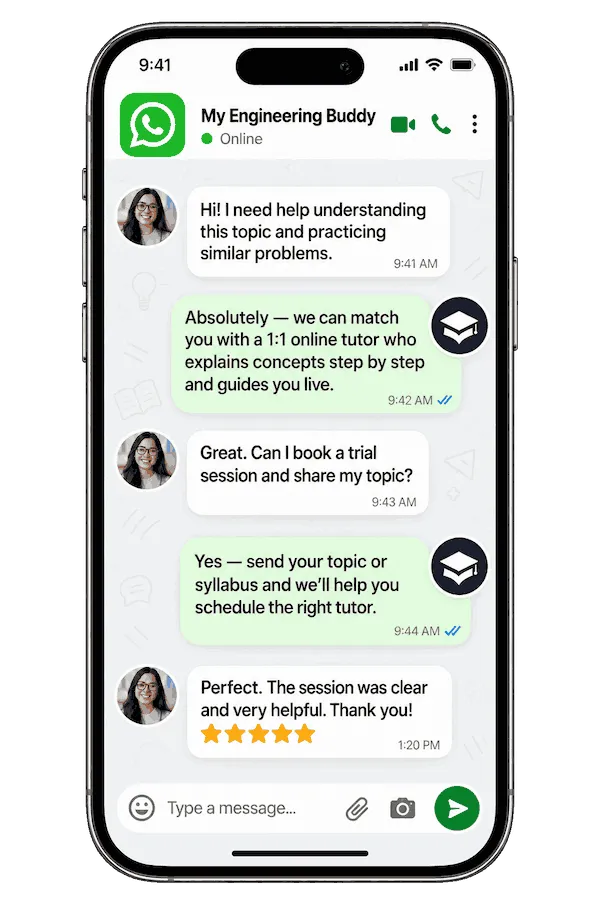
WhatsApp MEB for a quick quote — average response time under 1 minute.
Who This Fabric Engineering Tutoring Is For
This is for students who know the topic exists on their syllabus but haven’t connected the theory to what they’re being asked to calculate, design, or evaluate. Fabric engineering covers a wide range of structural and functional concepts — and most courses move faster than lectures can support.
- Undergraduate students in textile, materials, or chemical engineering programmes covering fabric structure modules
- Postgraduate students researching smart textiles, technical fabrics, or composite structures
- Students retaking after a failed first attempt — especially those who passed neighbouring modules but dropped marks specifically on fabric mechanics or fibre science
- Students with a coursework or portfolio submission deadline approaching and significant gaps still to close
- Students who need structured assignment guidance — understanding the brief, the calculations, and the write-up approach
- Students at universities including the University of Manchester, North Carolina State University, Georgia Tech, RMIT, Heriot-Watt, Ghent University, and TU Dresden
If you’re unsure whether your module qualifies, WhatsApp MEB with your course outline. The answer usually comes back in under a minute.
1:1 Tutoring vs Self-Study vs AI vs YouTube vs Online Courses
Self-study works if you’re disciplined — but fabric engineering involves layered calculations where one misunderstood variable compounds across the whole problem set. AI tools give fast definitions but can’t diagnose whether you’re misapplying the Peirce model or confusing warp and weft count conventions. YouTube covers introductory textile concepts reasonably well, then stops when you’re working through a specific weave geometry derivation. Online courses are structured but fixed-pace — they don’t pause when you get the mechanics wrong. 1:1 tutoring with MEB is live, built around your exact module, and corrects errors in the moment before they calcify into exam-day habits.
Outcomes: What You’ll Be Able To Do in Fabric Engineering
After targeted sessions with an online fabric engineering tutor, you’ll be able to analyse woven and knitted structures using correct geometric models, apply yarn count systems (Tex, Denier, English count) accurately across problem types, evaluate fabric performance parameters such as tensile strength, pilling resistance, and air permeability against standard test methods, model non-woven fabric properties in relation to fibre orientation and bonding mechanisms, and present technical fabric specifications in reports and coursework that meet engineering standards. These aren’t abstract skills — they map directly to the calculations and written components where most marks are lost.
Based on feedback from 40,000+ sessions collected by MEB from 2022 to 2025, 58% of students improved by one full grade after approximately 20 hours of 1:1 tutoring in subjects like fabric engineering. A further 23% achieved at least a half-grade improvement.
Source: MEB session feedback data, 2022–2025.
Supporting a student through fabric engineering? MEB works directly with parents to set up sessions, track progress, and keep coursework on schedule. WhatsApp MEB — average response time is under a minute, 24/7.
What We Cover in Fabric Engineering (Syllabus / Topics)
MEB tutors cover the full range of fabric engineering modules taught at undergraduate and postgraduate level. Three core tracks reflect the most common course structures.

Track 1: Woven Fabric Structure and Geometry
- Peirce geometric model — crimp, thread spacing, fabric thickness
- Weave interlacing patterns: plain, twill, satin, and derivatives
- Warp and weft count, cover factor, and sett calculations
- Fabric weight (GSM) determination and prediction
- Loom mechanics and their effect on fabric structure
- Dimensional stability and relaxation behaviour under tension
Core texts include Woven Textile Design by Bridget Harvey and Mechanics of Woven Fabrics by Pollock and Hu.
Track 2: Knitted and Non-Woven Fabric Engineering
- Weft knitting vs warp knitting — loop geometry and fabric formation
- Stitch density, Wales and courses per cm, run-in ratio
- Non-woven production routes: spunbond, meltblown, needlepunch, hydroentanglement
- Bonding mechanisms and their effect on tensile and bending properties
- Permeability, filtration efficiency, and barrier performance testing
- Applications in technical textiles: geotextiles, medical non-wovens, filtration media
Commonly referenced texts: Knitting Technology by David Spencer and Nonwoven Fabrics edited by Wilhelm Albrecht.
Track 3: Fabric Performance, Testing, and Technical Textiles
- Standard test methods: tensile (BS EN ISO 13934), tear, bursting strength
- Comfort properties: thermal resistance, moisture vapour transmission, air permeability
- Functional fabric design: moisture management, UV protection, antimicrobial treatment
- Smart and e-textiles: conductive yarns, sensor integration, wearable applications
- Composite textile structures and their role in aerospace engineering and automotive sectors
- Quality standards and compliance testing for industrial engineering applications
Relevant references include High Performance Textiles and Their Applications edited by C. A. Lawrence and Technical Textile Yarns edited by Alagirusamy and Das.
At MEB, we’ve found that fabric engineering students lose the most marks not on theory recall but on calculation setup — specifically, misapplying cover factor or GSM formulae in multi-step problems. A tutor who has worked through your exact module catches this in session one and corrects it before it compounds.
What a Typical Fabric Engineering Session Looks Like
The tutor opens by checking where you left off — usually woven fabric geometry or a test method calculation you flagged as unclear. You share your screen or the specific problem set, and the tutor works through it live using a digital pen-pad, showing exactly how to set up the crimp angle calculation or apply the correct Tex conversion before any numbers go in. You replicate the method, or explain back the reasoning, so the tutor can catch the exact point where your working diverges from the correct approach. The session closes with a specific practice problem on the next topic — fabric cover factor, stitch density, or a performance parameter interpretation — and a clear note on what to prepare before the following session.
How MEB Tutors Help You with Fabric Engineering (The Learning Loop)
Diagnose: In the first session, the tutor identifies exactly where understanding breaks down — whether it’s the geometric model for woven structures, yarn count system conversions, or the interpretation of standard test data. This is not a general assessment. It’s specific to your module and your current work.
Explain: The tutor works through live examples using a digital pen-pad — showing the full calculation for GSM prediction, the correct application of Peirce’s model, or how to structure a technical fabric specification report. You see every step, not just the answer.
Practice: You attempt the next problem with the tutor present. No waiting. No submitting and hoping. Errors surface immediately, in context, while the reasoning is still visible on screen.
Feedback: The tutor explains exactly why a step was wrong — which formula was misapplied, which assumption was incorrect, which part of the answer structure would lose marks. Specific. Not “try again.”
Plan: At the end of each session, the tutor sets the next topic, identifies any remaining gaps, and adjusts the sequence if your deadline has moved. The plan is yours — not a generic syllabus walk.
Sessions run on Google Meet. The tutor uses a digital pen-pad or iPad with Apple Pencil. Before your first session, share your module guide or course outline, any past paper or assignment you’ve already attempted, and your exam or submission date. The first session covers the diagnostic and at least one full topic area.
Start with the $1 trial — 30 minutes of live tutoring that also serves as your first diagnostic.
Try your first session for $1 — 30 minutes of live 1:1 tutoring or one homework question explained in full. No registration. No commitment. WhatsApp MEB now and get matched within the hour.
Tutor Match Criteria (How We Pick Your Tutor)
Not every engineering tutor can teach fabric engineering at module level. Here’s what MEB checks before making a match.
Subject depth: The tutor must have studied or taught fabric structure, textile testing, or technical textiles at the level of your course — not just adjacent engineering disciplines.
Tools: Every tutor uses Google Meet with a digital pen-pad or iPad and Apple Pencil. Live written working is non-negotiable for a calculation-heavy subject.
Time zone: Matched to your region — US Eastern through Gulf Standard Time, UK and European students accommodated without unsociable start times.
Goals: Whether you need exam preparation, assignment explanation, conceptual depth on smart textiles, or research-level support for a Masters or PhD thesis, the tutor is selected for that specific goal — not reassigned from a general engineering pool.
Unlike platforms where you fill out a form and wait, MEB responds in under a minute, 24/7. Tutor match takes under an hour. The $1 trial means you test before you commit. Everything runs over WhatsApp — no logins, no intake forms.
Study Plans (Pick One That Matches Your Goal)
The tutor builds a specific session sequence after your first diagnostic. Three common structures: Catch-up (1–3 weeks, for students behind on a specific topic cluster before a submission deadline), Exam prep (4–8 weeks, structured revision across all fabric engineering components with past-paper practice built in), and Weekly support (ongoing, aligned to your semester schedule and coursework deadlines). If your timeline doesn’t fit neatly, say so. The tutor adjusts.
Pricing Guide
Fabric engineering tutoring runs $20–$40/hr for most undergraduate modules. Postgraduate, research, and highly specialised topics — composite textiles, smart fabric systems, advanced non-woven modelling — reach up to $100/hr. Rate depends on level, topic complexity, timeline pressure, and tutor availability.
For students targeting top textile and materials programmes at institutions like the University of Manchester, NC State, or Heriot-Watt, tutors with research or industry backgrounds in technical textiles are available at higher rates — share your specific goal and MEB matches the tier to your ambition.
Tutor availability is tightest in November and April, when semester deadlines and exam periods converge. Book early to secure consistent weekly slots.
Start with the $1 trial — 30 minutes, no registration, no commitment. WhatsApp MEB for a quick quote.
MEB has been running since 2008. In that time, the platform has supported students through undergraduate and postgraduate fabric engineering, yarn engineering, and metallurgical engineering — across more than 2,800 advanced subjects and 52,000+ students worldwide.
Source: My Engineering Buddy, 2008–2025.
FAQ
Is fabric engineering hard?
It’s technically demanding. The combination of structural geometry, yarn mechanics, and performance testing creates a subject where errors compound quickly. Students who struggle typically have gaps in the geometric model fundamentals or misapply yarn count conversion systems under exam conditions.
How many sessions are needed?
Most students close specific topic gaps in 4–6 sessions. Full exam preparation across all fabric engineering components typically takes 12–20 sessions, depending on starting level and how much of the syllabus needs covering.
Can you help with practice exercises?
Yes. MEB tutoring is guided learning — you understand the work, then submit it yourself. The tutor explains the method, the calculation setup, and the structure of a correct answer. See our Academic Integrity policy and Why MEB page for full details on what we help with and what we don’t.
Will the tutor match my exact syllabus or exam board?
Yes. Share your module guide or course outline over WhatsApp before the first session. The tutor reviews it and aligns the session content to your specific assessment components — not a generic textile engineering curriculum.
What happens in the first session?
The tutor runs a diagnostic — identifying which fabric engineering topics you’ve covered, where the gaps are, and what your deadline pressure looks like. At least one full topic area is covered in the same session. You leave with a clear next step.
Is online tutoring as effective as in-person?
For calculation-based subjects like fabric engineering, yes. The digital pen-pad replicates the whiteboard experience, and screen sharing means the tutor sees exactly what you’re writing. Many students report clearer explanations than they received in face-to-face seminars.
Can I get fabric engineering help late at night or at weekends?
Yes. MEB operates 24/7 across time zones. Students in the Gulf, Australia, and North America regularly book sessions outside standard UK or European working hours. WhatsApp MEB any time — a response typically comes back within a minute.
What if I don’t get on with my assigned tutor?
Request a switch over WhatsApp. MEB will rematch you with a different fabric engineering tutor, usually within the same day. The $1 trial is specifically designed to let you check the fit before committing to a package of sessions.
What’s the difference between fabric engineering and textile engineering?
Textile engineering covers the full chain from raw fibre to finished product, including fibre science, spinning, and dyeing. Fabric engineering focuses specifically on the structure, mechanics, and performance of fabric constructions — woven, knitted, and non-woven — and is often a specialist module within a broader textile or materials engineering programme.
Can MEB help with smart textiles and e-textile coursework?
Yes. Smart textile topics — conductive yarn integration, sensor-embedded fabrics, wearable electronics — are increasingly part of advanced fabric engineering modules. MEB has tutors with research and industry backgrounds in these areas, available at specialist rates.
How do I get started?
WhatsApp MEB, share your course outline and deadline, and you’ll be matched with a verified fabric engineering tutor within the hour. The first session is your $1 trial — 30 minutes of live tutoring or one full homework explanation. Three steps: WhatsApp, match, start.
Students consistently tell us that fabric engineering is one of those subjects where the gap between understanding and being able to apply that understanding to a problem set is surprisingly wide. The tutor’s job is to close that gap — not just explain the theory again, but walk through the problem mechanics until the method is yours.
Trust & Quality at My Engineering Buddy
Every fabric engineering tutor on MEB is screened for subject-specific knowledge at the level they teach — not just a general engineering background. The process includes qualification verification, a live demo evaluation, and ongoing review of student session feedback. Tutors must demonstrate working knowledge of the specific modules, test standards, and calculation methods used in undergraduate and postgraduate fabric engineering programmes. Rated 4.8/5 across 40,000+ verified reviews on Google.
MEB tutoring is guided learning — you understand the work, then submit it yourself. For full details on what we help with and what we don’t, read our Academic Integrity policy and Why MEB.
MEB has served 52,000+ students across the US, UK, Canada, Australia, Gulf, and Europe since 2008, covering 2,800+ advanced subjects. The Engineering category includes fabric engineering alongside mechanical engineering tutoring and biomedical engineering help. Tutors are matched to subject, level, and exam board — not allocated from a general pool. See our tutoring methodology for how sessions are structured from diagnostic to final review.
The American Institute of Chemical Engineers recognises textile and fibre-related process engineering as a distinct technical discipline — an acknowledgment of how closely fabric engineering intersects with chemical and process engineering at the advanced level.
Source: American Institute of Chemical Engineers (AIChE).
Our experience across thousands of sessions shows that students who bring a specific problem — a calculation they couldn’t finish, an assignment question they misread — make faster progress than those who ask for a general topic overview. Come with something concrete. The session will be more useful.
Explore Related Subjects
Students studying fabric engineering often also need support in:
- Food engineering
- Systems engineering
- Quality control
- Bioengineering
- Nuclear engineering
- Computer-aided design
- Mining engineering
Next Steps
Getting started takes less than two minutes. Share your exam board or module guide, your hardest topic or the assignment you’re stuck on, and your deadline or exam date. Include your time zone and availability.
MEB matches you with a verified fabric engineering tutor — usually within the hour, never longer than 24 hours. The first session starts with a diagnostic so every minute is used well.
Before your first session, have ready:
- Your module guide or course outline (or the specific assignment brief)
- A recent past paper attempt or a homework question you struggled with
- Your exam or submission deadline date
The tutor handles the rest. Visit www.myengineeringbuddy.com for more on how MEB works.
WhatsApp to get started or email [email protected].
Reviewed by Subject Expert
This page has been carefully reviewed and validated by our subject expert to ensure accuracy and relevance.