~1 min
Average Reply Time
~1 hour
To Be Matched With A Tutor
30 Min Trial
75% Find Their Tutor On The 1st Trial
$20-35+/hr
Premium Yet Affordable Learning
Hire The Best Mining Engineering Tutor

Most students who fail their Mining Engineering module don’t fail because the subject is too hard — they fail because no one ever showed them how rock mechanics, ventilation calculations, and mine planning fit together as one system.
Mining Engineering Tutor Online
Mining Engineering is the applied discipline covering extraction of mineral resources from the earth, encompassing rock mechanics, mine design, ventilation, drilling, blasting, and mine safety — preparing graduates to operate, plan, and manage surface and underground mining operations.
If you’re searching for a Mining Engineering tutor near me, MEB connects you with verified subject specialists for 1:1 online tutoring and homework help across every major university Mining Engineering programme. Whether you’re an undergraduate wrestling with geomechanics or a graduate student working through mine systems design, the right engineering tutor makes a measurable difference to your grade. Our tutors cover the full spectrum of Mining Engineering tutoring — from first-year rock mechanics to final-year mine planning projects.
- 1:1 online sessions tailored to your university course and syllabus
- Expert-verified tutors with Mining Engineering degrees and field experience
- Flexible time zones — US, UK, Canada, Australia, Gulf
- Structured learning plan built after a diagnostic session
- Ethical homework and assignment guidance — you understand before you submit
52,000+ students across the US, UK, Canada, Australia, and the Gulf have used MEB since 2008 — including students in Engineering subjects like Mining Engineering, Petroleum Engineering, and Metallurgical Engineering.
Source: My Engineering Buddy, 2008–2025.
How Much Does a Mining Engineering Tutor Cost?
Most Mining Engineering sessions run $20–$40/hr. Graduate-level or highly specialised topics — rock burst prediction, stochastic mine planning, tailings geotechnics — can reach $70–$100/hr depending on tutor depth. Start with the $1 trial: 30 minutes of live 1:1 tutoring or one homework question explained in full.
| Level / Need | Typical Rate | What’s Included |
|---|---|---|
| Undergraduate (most courses) | $20–$40/hr | 1:1 sessions, homework guidance |
| Graduate / specialist niche | $40–$100/hr | Expert tutor, advanced depth |
| $1 Trial | $1 flat | 30 min live session or 1 homework question |
Tutor availability tightens during final exam periods — particularly April–May and November–December. Book early if your submission deadline is within four weeks.
WhatsApp MEB for a quick quote — average response time under 1 minute.
Who This Mining Engineering Tutoring Is For
Mining Engineering draws students from civil, chemical, geological, and mechanical backgrounds. The crossover is heavy, and university courses often assume prior knowledge you may not have. That gap compounds fast.
- Undergraduates stuck on rock mechanics, stress analysis, or ventilation circuit calculations
- Graduate students working through stochastic mine planning, slope stability, or tailings management
- Students who failed or narrowly passed a module and need to resit
- Students who received a conditional university offer and need this grade to hold it
- Students 4–6 weeks from finals with significant syllabus gaps still to close
- Parents watching a child’s confidence drop alongside their grades in a demanding engineering programme
Students have come to MEB from programmes at Colorado School of Mines, University of Queensland, Camborne School of Mines (Exeter), McGill University, University of Alberta, Curtin University, and KFUPM. The tutor MEB assigns will know your course context and your exam pressure.
At MEB, we’ve found that Mining Engineering students often hit a wall at the same three topics: ventilation network calculations, rock mass classification (RMR/Q-system), and slope stability analysis. Identifying which of these is your specific block — and in which order to tackle them — is the single biggest thing a diagnostic session does for you.
1:1 Tutoring vs Self-Study vs AI vs YouTube vs Online Courses
Self-study works if you’re disciplined, but Mining Engineering has too many interdependent systems for isolated reading to be reliable. AI tools give fast definitions — they can’t check whether your ventilation calculation is using the correct friction factor or diagnose why your slope stability model keeps diverging. YouTube handles overviews well; it stops at the point where your specific assignment question begins. Online courses are structured but fixed-pace — they don’t adjust when you’re lost on a specific derivation mid-module. With MEB, a tutor works through your exact problem set in real time, catches errors in your reasoning before they calcify, and keeps pace with your actual course schedule.
Outcomes: What You’ll Be Able To Do in Mining Engineering
After consistent 1:1 work with an MEB tutor, you’ll be able to solve ventilation circuit problems using the Hardy Cross method, analyse rock mass quality using RMR and Q-system classifications, model open-pit and underground mine geometries for stability, apply blasting design parameters to fragmentation calculations, and present a mine plan with cost scheduling that holds up to academic scrutiny. These are the specific competencies that determine your grade — not general understanding.
Based on feedback from 40,000+ sessions collected by MEB from 2022 to 2025, 58% of students improved by one full grade after approximately 20 hours of 1:1 tutoring in subjects like Mining Engineering. A further 23% achieved at least a half-grade improvement.
Source: MEB session feedback data, 2022–2025.
Try your first session for $1 — 30 minutes of live 1:1 tutoring or one homework question explained in full. No registration. No commitment. WhatsApp MEB now and get matched within the hour.
What We Cover in Mining Engineering (Syllabus / Topics)

Track 1: Rock Mechanics and Geomechanics
- Stress and strain in rock — uniaxial, triaxial, and shear conditions
- Rock mass classification: RMR, Q-system, GSI
- Underground excavation support design — rockbolts, shotcrete, steel sets
- Slope stability analysis: limit equilibrium and numerical methods
- Rock failure criteria: Mohr-Coulomb, Hoek-Brown
- In-situ stress measurement and interpretation
- Pillar design and crown pillar stability
Core texts include Rock Mechanics for Underground Mining by Brady & Brown and Rock Engineering by Evert Hoek — both standard on most programmes.
Track 2: Mine Design, Planning, and Operations
- Open-pit design: pit optimisation using Lerchs-Grossmann algorithm
- Underground mining methods: room-and-pillar, cut-and-fill, longwall, block caving
- Drilling and blasting design: burden, spacing, powder factor, fragmentation
- Mine ventilation: network analysis, Hardy Cross method, fan selection
- Mine scheduling and production planning
- Equipment selection and fleet management
- Mine cost estimation and economic evaluation
Key references: SME Mining Engineering Handbook (Darling, ed.) and Open Pit Mine Planning and Design by Hustrulid, Kuchta & Martin — used across Colorado School of Mines, McGill, and Curtin programmes.
Track 3: Mine Safety, Environment, and Tailings
- Mine hazard identification: gas, dust, heat, ground control
- Tailings storage facility design and failure mechanisms
- Acid mine drainage: prediction, prevention, treatment
- Mine closure planning and land rehabilitation
- Environmental impact assessment for mining projects
- Regulatory frameworks — varies by jurisdiction (US MSHA, Australian DMIRS, UK HSE)
The American National Standards Institute maintains standards relevant to mine safety and environmental compliance that tutors cross-reference when covering US-based regulatory content.
Track 4: Mineral Processing and Extractive Metallurgy
- Comminution: crushing, grinding, size reduction fundamentals
- Concentration methods: flotation, gravity separation, magnetic separation
- Hydrometallurgy: leaching, solvent extraction, electrowinning
- Pyrometallurgy basics: smelting, roasting, refining
- Process plant design and mass balance calculations
- Ore characterisation and geometallurgy
Standard texts: Mineral Processing Technology by Wills & Napier-Munn and Introduction to Mineral Processing and Hydrometallurgy by Shing — both widely assigned at postgraduate level. Students needing deeper Metallurgical Engineering help will find MEB covers that as a separate subject too.
What a Typical Mining Engineering Session Looks Like
The tutor opens by checking the previous session’s topic — say, your Hardy Cross ventilation network calculation from last week. They ask you to walk through your reasoning before touching anything new. From there, the session moves to the current problem: maybe a slope stability analysis using Bishop’s simplified method, or a cut-and-fill stope design with support specification. You work through it on screen together. The tutor uses a digital pen-pad to annotate diagrams, show free-body diagrams, and mark where your calculation diverged. You replicate the method on a similar problem while the tutor watches. Before the session ends, they set a specific practice problem — one ventilation network problem using given duct resistances — and note the next topic: fan selection and characteristic curves.
How MEB Tutors Help You with Mining Engineering (The Learning Loop)
Diagnose: In the first session, the tutor identifies where your understanding breaks down — whether that’s the rock failure criteria, the ventilation equations, or the mine cost modelling. They look at your past papers, assignments, or lecture notes to find the specific gaps, not just the symptoms.
Explain: The tutor works through live problems using a digital pen-pad — showing the derivation of the Hoek-Brown criterion, annotating a pit optimisation diagram, or stepping through a blasting design calculation from burden to powder factor. Not a lecture. A worked example with you watching every decision.
Practice: You attempt the next problem while the tutor stays present. They don’t jump in immediately — they let you work through it and note where your approach stalls or diverges.
Feedback: The tutor explains exactly where marks would be lost and why. Whether it’s a unit error in a ventilation pressure drop calculation or a missing assumption in a slope stability model, feedback is step-by-step and specific to the method your examiner expects.
Plan: Each session closes with a clear next topic, a specific practice task, and a checkpoint for the following session. The sequence is built around your exam date or assignment deadline — not a generic syllabus order.
Sessions run on Google Meet with a digital pen-pad or iPad and Apple Pencil. Before your first session, share your course outline, any past papers you’ve attempted, and your exam or submission date. Start with the $1 trial — 30 minutes of live tutoring that also serves as your first diagnostic. Whether you need a two-week exam catch-up or ongoing weekly support through the semester, the tutor maps the session plan after that first diagnostic.
Students consistently tell us that the moment a Mining Engineering concept clicks isn’t when they read it — it’s when they’ve had to explain their method out loud and a tutor has pointed to the exact line where their reasoning went wrong. That correction, in the moment, is what 20 hours of self-study often can’t replicate.
Tutor Match Criteria (How We Pick Your Tutor)
Not every Mining Engineering tutor is right for every student. MEB matches on four criteria.
Subject depth: The tutor must have Mining Engineering at the level you’re studying — undergraduate rock mechanics is different from a graduate mine systems design course. MEB verifies academic background and field experience before assigning anyone.
Tools: Every tutor uses Google Meet plus a digital pen-pad or iPad with Apple Pencil. No whiteboard apps that freeze mid-calculation.
Time zone: Matched to your region — US Mountain Time for Colorado School of Mines students, AEST for Queensland, Gulf Standard Time for UAE and Saudi students.
Goals: Whether you need exam score recovery, conceptual depth in geomechanics, assignment guidance, or research support for a graduate thesis on tailings management — the tutor is briefed on your specific objective before session one.
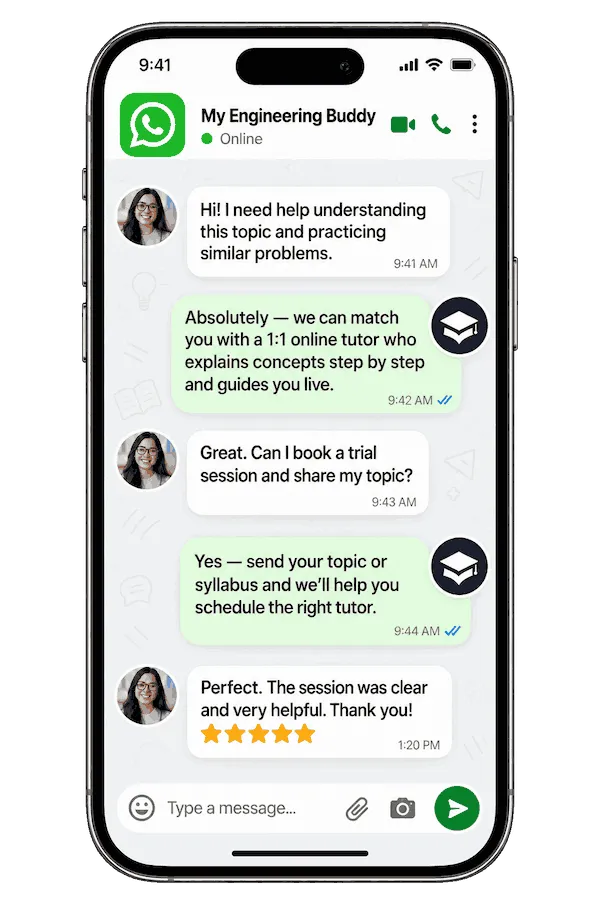
Unlike platforms where you fill out a form and wait, MEB responds in under a minute, 24/7. Tutor match takes under an hour. The $1 trial means you test before you commit. Everything runs over WhatsApp — no logins, no intake forms.
Study Plans (Pick One That Matches Your Goal)
Catch-up (1–3 weeks): students behind on ventilation or rock mechanics with an exam in weeks — the tutor prioritises the highest-yield topics first. Exam prep (4–8 weeks): structured revision across all tracks, past paper practice, timed question sets, and weekly progress checks. Weekly support: ongoing sessions aligned to your university semester, covering new lecture content as it’s assigned. After the diagnostic, the tutor builds the specific sequence — not a template.
Pricing Guide
Most Mining Engineering tutoring runs $20–$40/hr for undergraduate-level work. Graduate topics — stochastic optimisation, advanced geomechanics, mineral processing plant design — typically fall in the $50–$100/hr range depending on tutor specialisation and timeline urgency.
Rate factors: academic level, topic complexity, how quickly you need sessions scheduled, and tutor availability in your time zone.
For students targeting programmes at Tier 1 mining universities or working toward professional certifications (SME, AusIMM), tutors with active industry backgrounds in mine planning or process engineering are available at higher rates — share your specific goal and MEB will match the tier to your ambition.
Peak periods — April–May and November–December — see reduced tutor availability. Book before the crunch. Start with the $1 trial — 30 minutes, no registration, no commitment. WhatsApp MEB for a quick quote.
18 years. 52,000+ students. 4.8/5 on Google. Mining Engineering is one of the most technically demanding disciplines MEB covers — and one of the most requested among graduate engineering students in the US, Canada, and Australia.
Source: My Engineering Buddy, 2008–2025.
FAQ
Is Mining Engineering hard?
Yes — it combines rock mechanics, fluid dynamics, thermodynamics, economics, and environmental science. Most students find ventilation calculations and slope stability analysis the steepest early hurdles. With a tutor working through the method with you, those topics become manageable within a few sessions.
How many sessions are needed?
Students covering specific exam gaps typically need 6–12 sessions. Those seeking semester-long support attend weekly. The diagnostic session gives a clearer estimate — your tutor will tell you after session one what a realistic plan looks like.
Can you help with homework and assignments?
Yes. MEB tutoring is guided learning — you understand the work, then submit it yourself. The tutor explains the method, checks your approach, and clarifies where you’ve gone wrong. See our Academic Integrity policy and Why MEB page for full details on what we help with and what we don’t.
Will the tutor match my exact syllabus or exam board?
Yes. Before the first session, share your course outline and university name. MEB tutors are briefed on your specific programme — whether that’s a Colorado School of Mines undergraduate syllabus, a Curtin University postgraduate unit, or an AusIMM certification module.
What happens in the first session?
The tutor reviews your course outline, asks you to walk through a recent problem you struggled with, and identifies where your understanding breaks down. From that diagnostic, they build the session sequence. Nothing is wasted.
Is online tutoring as effective as in-person?
For Mining Engineering specifically, online tutoring with a digital pen-pad is often more effective — diagrams, stress Mohr circles, ventilation networks, and pit cross-sections can all be annotated live on screen. Students report less travel friction and faster session scheduling.
What’s the difference between surface and underground mining engineering — and does MEB cover both?
Surface mining covers open-pit design, strip mining, and quarrying. Underground covers room-and-pillar, longwall, cut-and-fill, and block caving. MEB tutors cover both, including the geomechanical and ventilation differences that examiners specifically test. Tell us your focus area when you make contact.
Can a tutor help with mine design software like Vulcan, Surpac, or Whittle?
Yes — MEB has tutors with hands-on experience in Vulcan, Surpac, Deswik, and Whittle. Software sessions focus on your specific task: pit shell generation, mine scheduling, or ore body modelling. Share the software and the assignment brief when you first WhatsApp.
Do you offer help for AusIMM or SME professional certification preparation?
Yes. MEB supports students preparing for professional body requirements through AusIMM and SME, including competency area review, technical writing support, and guided study through the relevant knowledge domains. Share your certification level and timeline when you reach out.
Can I get Mining Engineering help at midnight or on weekends?
Yes. MEB operates 24/7 across time zones. Gulf and Australian students routinely start sessions at times that would be midnight US Eastern. WhatsApp MEB at any hour — the average response time is under one minute regardless of when you message.
What if I don’t get along with my assigned tutor?
Request a swap via WhatsApp. No forms, no delays. MEB matches you with a different tutor — usually within the same day. The $1 trial exists specifically so you can test the fit before committing to a full session block.
How do I get started?
Three steps: WhatsApp MEB with your course name and current challenge, get matched with a verified Mining Engineering tutor within the hour, then start with the $1 trial — 30 minutes of live tutoring or one homework question explained in full. No registration required.
Trust & Quality at My Engineering Buddy
Every MEB tutor goes through subject-specific vetting before being assigned a student. That means a live demo session evaluation, academic credential verification, and review of their ability to explain Mining Engineering problems — not just solve them. Rated 4.8/5 across 40,000+ verified reviews on Google. MEB has been running since 2008 and serves students across the US, UK, Canada, Australia, and the Gulf.
MEB tutoring is guided learning — you understand the work, then submit it yourself. For full details on what we help with and what we don’t, read our Academic Integrity policy and Why MEB.
MEB covers 2,800+ subjects across Engineering, Science, and related disciplines. In Engineering specifically, the platform supports students in Mining Engineering and closely related areas including Civil Engineering tutoring, Chemical Engineering help, and Geomatics tutoring — all of which overlap with Mining Engineering coursework at the undergraduate and graduate levels. The tutoring methodology is described in detail on our tutoring methodology page.
Our experience across thousands of sessions shows that Mining Engineering students who come in with a specific problem — a past paper question, an assignment they can’t start, a concept the lecture didn’t make clear — make faster progress than those who arrive with a general sense of being behind. Come in with a specific question. The tutor will handle the rest.
MEB has supported engineering students across 2,800+ subjects since 2008. In Mining Engineering, tutors have covered everything from first-year rock mechanics to graduate-level mine systems design — and every niche topic in between.
Source: My Engineering Buddy, 2008–2025.
Explore Related Subjects
Students studying Mining Engineering often also need support in:
- Geological Engineering — not available; using next available unused URL
Students studying Mining Engineering often also need support in:
- Materials Science and Engineering
- Mechanical Engineering
- Nuclear Engineering
- Petroleum Engineering
- Systems Engineering
- Industrial Engineering
- Environmental Engineering
Next Steps
When you WhatsApp MEB, share three things: your exam board or university, the topic or assignment you’re stuck on, and your exam or deadline date. That’s all the tutor needs to get started.
MEB matches you with a verified Mining Engineering tutor — usually within the hour. The first session opens with a diagnostic so every minute is used on what actually matters for your grade.
Before your first session, have ready:
- Your course outline or university syllabus
- A recent past paper attempt or homework question you struggled with
- Your exam date or assignment submission deadline
The tutor handles the rest. Visit www.myengineeringbuddy.com for more on how MEB works.
WhatsApp to get started or email [email protected].
Reviewed by Subject Expert
This page has been carefully reviewed and validated by our subject expert to ensure accuracy and relevance.