
The Comprehensive Guide to IB Tutoring: Subjects, Online Help, and Homework Support in 2025

Tailored IB tutoring—online or in-person—gives students expert help in every IB subject. It boosts grades, confidence and study skills, making IB homework, assignments and exam prep more manageable.
What Is the International Baccalaureate (IB)?
The International Baccalaureate® (IB) Diploma Programme is a rigorous two-year curriculum (for grades 11–12) that emphasizes critical thinking, research and a global perspective. Students in the IB DP study six subjects (one from each of six groups: studies in language and literature, language acquisition, individuals and societies, sciences, mathematics, and the arts). The programme also includes core components like the 4,000-word Extended Essay and Theory of Knowledge (TOK). This rigorous approach readies students for top universities and beyond. As of 2024, about 1.95 million students worldwide are enrolled in IB programmes across 5,900+ schools. Completing the IB often leads to college credit and higher college graduation rates for DP graduates, reflecting its global recognition.
To truly understand the rigor of the program, it helps to visualize the curriculum. The diagram below illustrates how the six subject groups surround the essential core requirements.
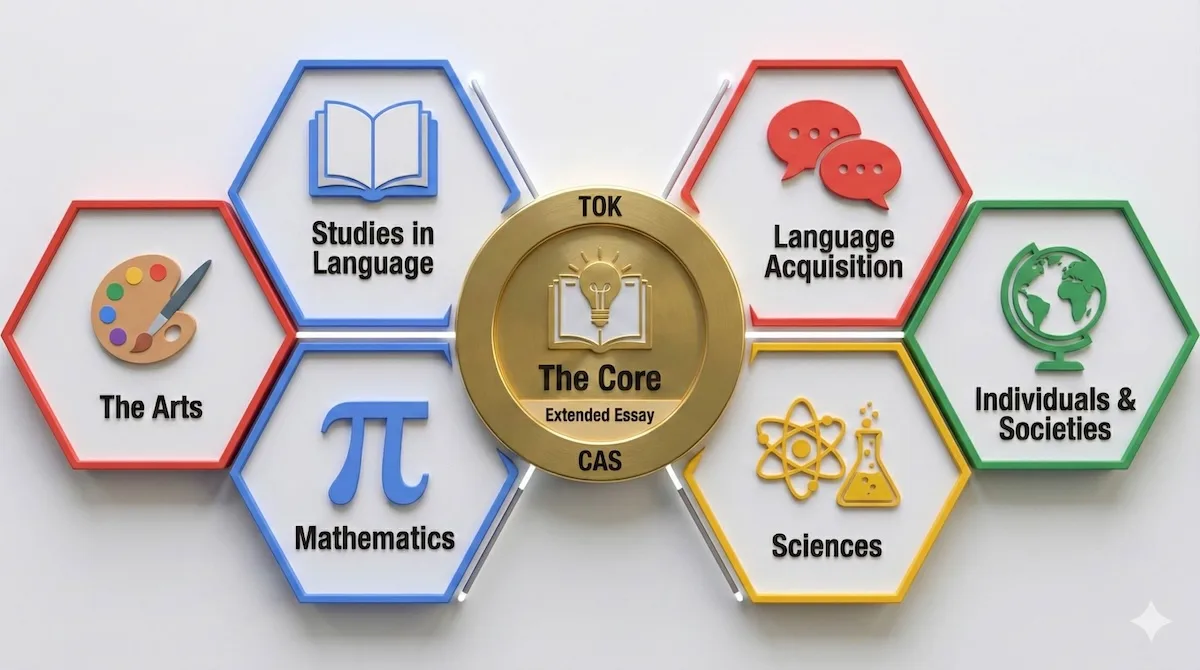
The IB Diploma combines six subject groups with three core requirements for a holistic education.
As you can see, the ‘Core’ elements—Theory of Knowledge (TOK), Extended Essay (EE), and CAS—are central to connecting all the subject groups together.
Why Consider IB Tutoring?
Many students find the IB workload intense. For example, Rohan, a junior in an IB school, struggled to balance IB Math HL, Chemistry SL and a busy extracurricular schedule. He fell behind on homework until his parents arranged for an IB tutor online. With one-on-one guidance, Rohan turned confusion into understanding and his grades began to improve. Tutors often use IB-approved methods, encouraging inquiry and real-world examples rather than rote learning, so students connect concepts rather than just memorize facts.
Research backs this up: one study found that students receiving tutoring saw an average 12% jump in test scores and outperformed peers in 45 out of 52 subjects. In fact, 8 of 10 students with tutors earned higher grades than those without. Another survey reported 85% of parents saw grade improvements after online tutoring sessions.
The data supports these success stories overwhelmingly. Recent educational studies highlight just how effective personalized intervention can be for IB students.
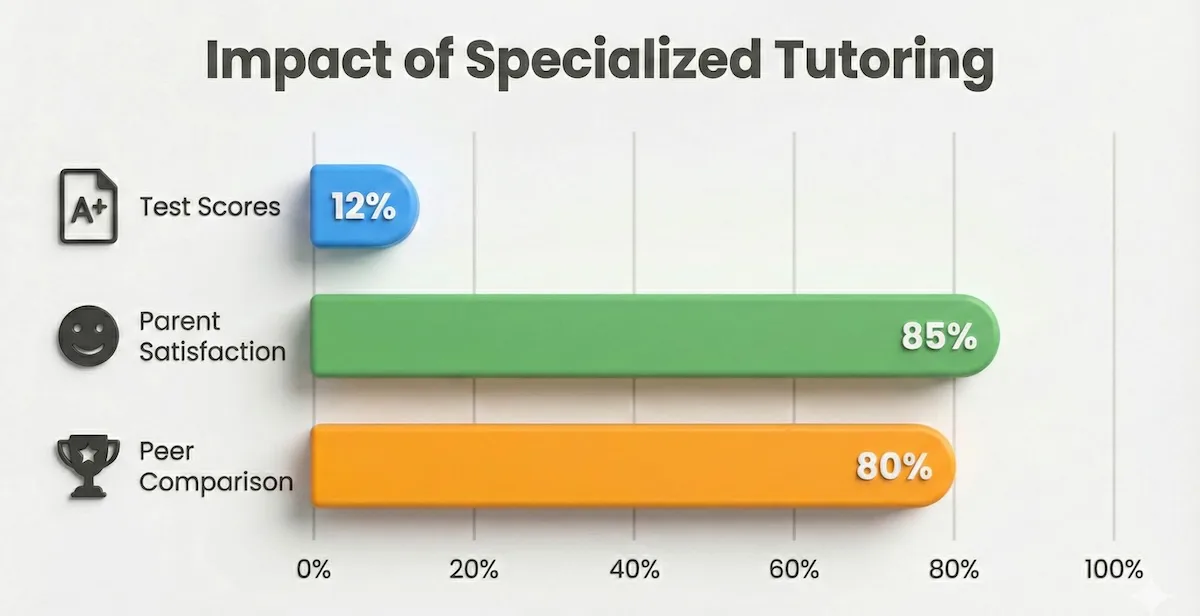
Research confirms that specialized tutoring significantly boosts IB grades and student confidence.
With 80% of tutored students outperforming their non-tutored peers, the advantage of having expert guidance is statistically clear.
In short, personalized IB homework help and review sessions fill learning gaps and build confidence, preparing students to succeed in the IB’s demanding curriculum.
The demand for such support is growing. The global private tutoring market is projected to grow from about $57.9 billion in 2023 to over $132 billion by 2032, reflecting how many families seek expert help. Whether it’s preparing for IB exams, tackling a tricky calculus problem, or completing a chemistry lab report, IB tutors provide targeted assistance that keeps students on track academically.
For instance, Maya from London was struggling with IB Business until her tutor used real-world examples to explain concepts. She went from barely passing practice tests to confidently tackling exam questions, raising her Business grade by two levels. Amy in New York was initially intimidated by IB Physics HL, but after a few tutor sessions re-explaining the basics, she said she finally “got it.” This new understanding boosted her confidence. These breakthroughs illustrate how having expert support can turn frustration into success for IB students.
Online IB Tutoring: Learning Anytime, Anywhere
Online tutoring has made IB support more accessible than ever. Students can connect with qualified IB tutors from anywhere via video chat and shared whiteboards. Studies show online tutoring is as effective as in-person help (and sometimes even more effective). For example, one study found that students receiving online math tutoring were 15% more likely to pass their state exam. Similarly, 85% of parents reported that their child’s grades improved after online tutoring sessions.
Online sessions are highly convenient. You can schedule help after school activities, on weekends, or late at night, fitting learning into a busy IB schedule. Most online platforms let students record lessons and save notes or whiteboard diagrams, so they can revisit tough concepts anytime. This flexibility often makes online tutoring more affordable. The Fordham Institute notes private tutors typically charge $11–$30 per hour, and many online services offer package deals or subscriptions to suit different budgets.
It can benefit a wide range of learners, from those who need to catch up to those seeking enrichment. Online tutors can challenge gifted students with advanced problems and critical thinking exercises, while also offering extra time and patience for students who need it. For many families, this means crossing time zones is no barrier. An IB student in Singapore, for example, can schedule evening sessions with a qualified IB tutor in Canada, receiving math tutoring after dinner without leaving home. Online tutoring bridges distances, giving IB learners worldwide access to expert help on their schedule.
If you are unsure whether digital learning fits your needs, consider how it stacks up against traditional methods. This comparison highlights the key differences in flexibility and focus.
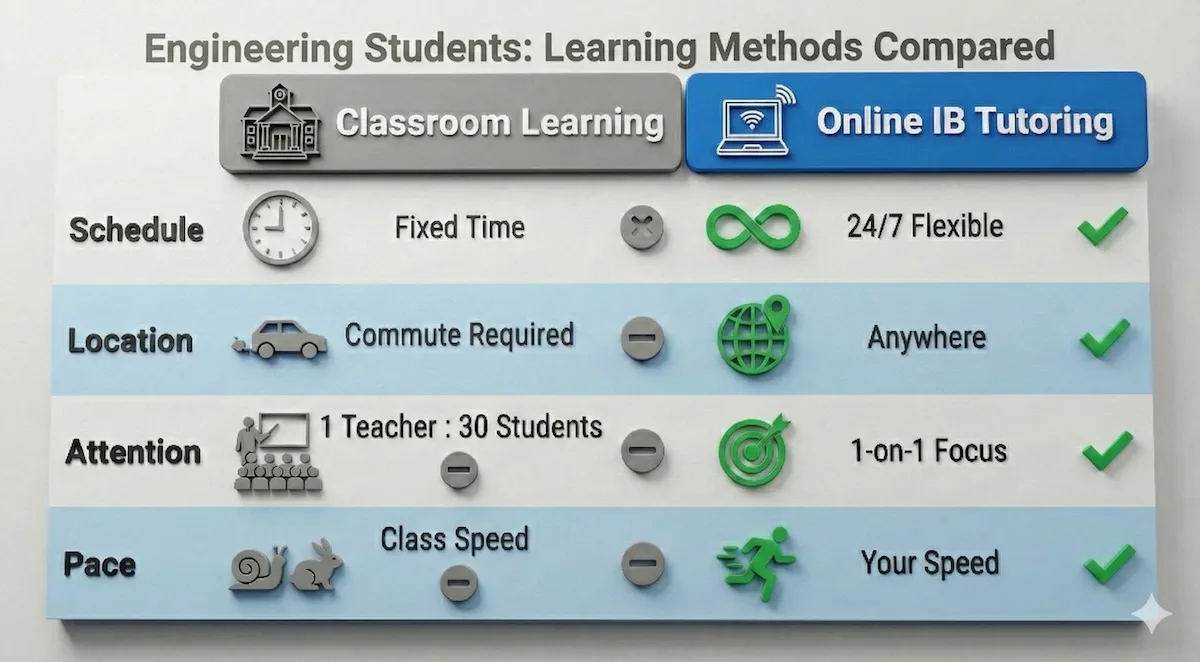
Online tutoring offers superior flexibility and personalized attention compared to traditional classroom settings.
While classroom learning offers social interaction, the 24/7 flexibility of online tutoring is often the deciding factor for busy IB students balancing CAS projects and exams.
IB Subjects Covered by Tutoring
IB tutors can help with every subject in the programme. Students choose one course from each of the six subject groups in the IB DP, so tutoring must cover a broad range. In practice, tutors cover even the less-common IB courses as well. For example, you’ll find tutors for IB Computer Science, Environmental Systems & Societies (ESS), and newer courses like Global Politics or Film Theory. No matter the topic—whether it’s Mandarin Ab Initio or IB Chemistry HL—a specialized IB tutor can help students succeed.
Sciences & Mathematics
In the science tutors and math tutors, tutors cover subjects like IB Physics, Chemistry, Biology, ESS, and the two math tracks (Analysis & Approaches, Applications & Interpretation). An experienced IB tutor can explain complex concepts step by step. For example, a tutor might guide a student through an IB Chemistry calculation or clarify the theory behind a physics experiment. In IB Math, tutors help solve calculus or statistics problems and advise on tackling IB-style multi-part questions under timed conditions. They often share exam strategies, so students learn not just formulas but how to approach each type of math question.
Languages & Literature
IB language courses include subjects like English A (Language & Literature or Literature) and second languages like Spanish B or French B (including Ab Initio). Tutors in this area focus on reading, writing and communication skills. For instance, an IB English A tutor can teach how to structure a strong comparative essay (Paper 2), highlighting key literary techniques. An IB language B tutor might conduct conversational drills and grammar reviews to build fluency. Tutors also help students practice writing under timed conditions (as needed for IB exams) and improve their editing skills, ensuring essays and assignments meet the IB standard.
Individuals, Societies & The Arts
Group 3 subjects include Economics, History, Geography, Psychology, Business Management and more. An IB History tutor, for example, helps students construct evidence-based essays and master historical analysis. In IB Economics, tutors explain economic models and help solve supply-and-demand graph problems. Group 6 (the Arts) courses like Visual Arts or Music are covered too: tutors can guide art projects, critique portfolios, or coach performances. Tutors even cover interdisciplinary courses like Environmental Systems & Societies (ESS).
Beyond those specific subjects, IB tutors also guide students through the core requirements of the Diploma. They assist with tasks like refining an Extended Essay outline, brainstorming CAS project ideas, and practicing a TOK presentation. In short, no matter what your IB subject or assignment, specialized tutors provide the tailored support you need. This includes IB homework help and IB assignment help across all topics.
Finding the Right IB Tutor or Teacher
Choosing a quality tutor is important. Look for tutors who have direct IB experience—often former IB teachers or top IB graduates. Many tutoring services vet their tutors, highlighting those with years of classroom experience and deep knowledge of IB exams. You can ask about a tutor’s background in the specific IB syllabus you need (for example, SL vs HL) and read reviews from other students. Many families check qualifications like university degrees in the subject, teaching certificates, or experience as IB examiners. A good tutor not only understands IB content but also communicates with empathy. Finding someone who is patient and supportive can reduce stress and keep students motivated during the demanding IB journey.
- Specialized IB expertise: Tutors should understand the unique IB curriculum. As one tutoring provider notes, specialized IB tutors know exactly how the IB differs from other programs and can offer the precise guidance needed.
- Subject proficiency: Find a tutor who excels in your required subject—ideally someone who earned a grade 7 or comparable distinction in that IB course.
- Teaching style: A good tutor communicates clearly and adjusts to your learning style. They should encourage questions, explain patiently, and give practice problems similar to real IB exams.
- Availability and fit: Ensure the tutor’s schedule and rates work for you. Many online platforms let you filter tutors by subject, experience and availability so you can hire an IB tutor who fits your needs.
- Credentials and trial: Look for tutors with strong qualifications and good reviews. Consider asking for a trial session or references so you can assess their teaching style and fit before committing.
Ready to find a tutor but don’t know where to start? We have broken down the vetting process into five simple steps to ensure you hire the best match.
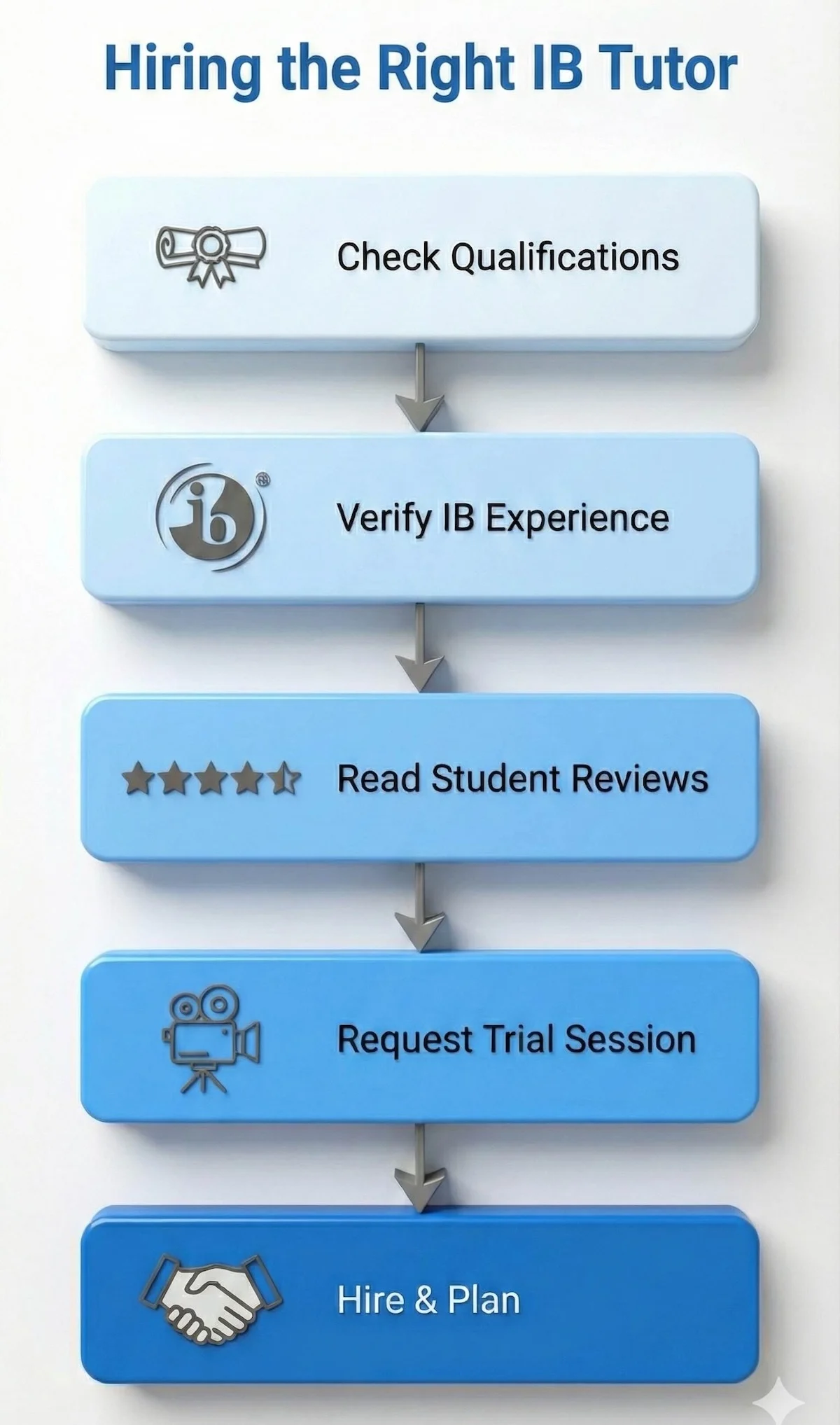
Follow this five-step checklist to ensure you find a qualified tutor who fits your learning style.
Following this sequence protects you from unqualified instructors and ensures you get a trial session before making any financial commitment.
IB Homework and Assignment Help
IB homework help means expert guidance, not just answers. A great tutor acts like a coach: when you’re stuck on a math problem or a lab report, they explain each step and ask guiding questions rather than simply giving you the solution. This approach turns homework into a learning opportunity.
- Concept review: Tutors clarify challenging topics and show how they apply to your assignments, strengthening your understanding.
- Writing feedback: For essays and projects (like the Extended Essay or Internal Assessments), tutors review drafts and suggest improvements—teaching you how to structure arguments and improve style.
- Study skills: Tutors often advise on managing study time and preparing for exams. They might share strategies for tackling IB problem sets or memorizing formulas.
- Practice resources: Many tutors provide extra practice questions and mock exams to simulate real IB testing conditions, which builds confidence for quizzes and final exams.
Used correctly, IB assignment help empowers independent learning. With a tutor’s support, each homework session solidifies your knowledge. When it’s time to hand in work, you’ve genuinely mastered the material—turning homework into a positive part of the learning process.
It is important to note that a good tutor does not just do the work for you. Our coaching methodology is designed to build your independence through a specific three-stage cycle.
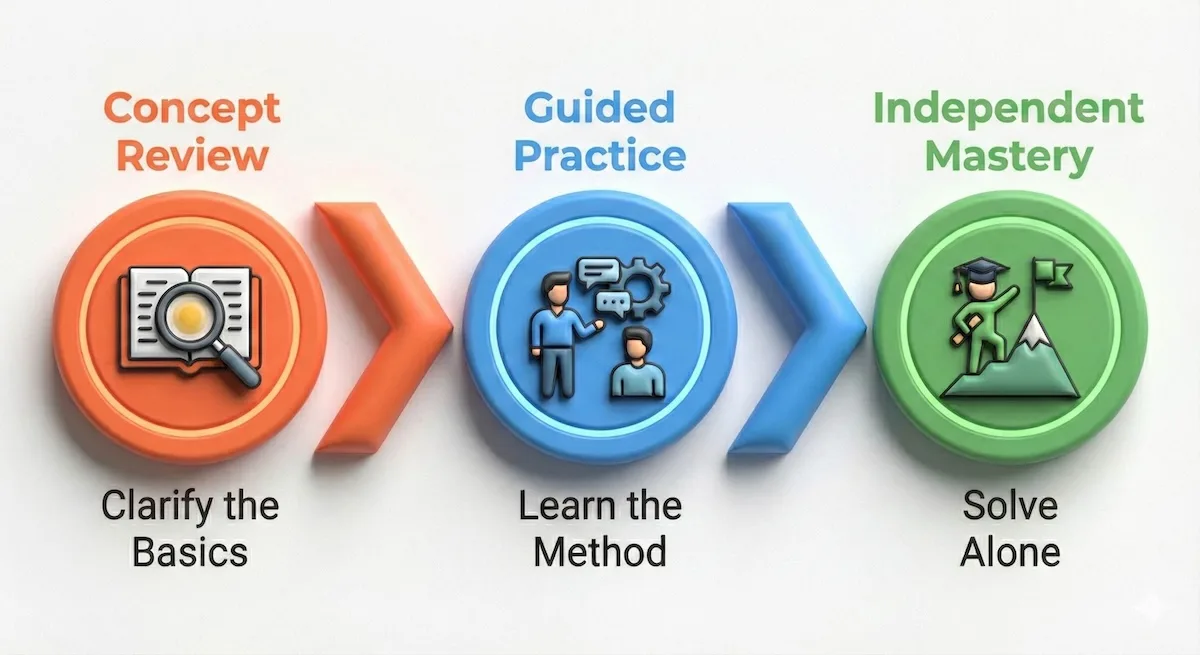
Effective tutoring guides you from confusion to independence using this three-stage coaching method.
By moving from guided practice to independent mastery, you ensure that you are ready to solve similar problems on the final exam without assistance.
FAQs
- What is IB tutoring? IB tutoring is personalized one-on-one academic assistance for students in the International Baccalaureate program.
- How does IB tutoring online work? It connects students with expert tutors via video calls and online tools for real-time IB homework help and review.
- Which IB subjects can a tutor help with? All IB subjects: math, sciences, languages, humanities, arts and even core areas like TOK and the Extended Essay.
- How can IB homework help improve my grades? Tutoring clarifies difficult concepts and guides you through assignments, making study time more effective and boosting performance.
- How is an IB teacher different from an IB tutor? An IB teacher instructs classes at school, whereas an IB tutor provides extra individualized support and exam prep outside of class.
- How do I hire an IB tutor? Use online tutoring platforms or referrals to find a qualified IB tutor in your subject and schedule sessions at your convenience.
Conclusion
The IB Diploma is challenging, but students don’t have to go it alone. IB tutoring—whether IB tutoring online or in-person—offers personalized support in every subject. With experienced IB teachers or tutors at your side, you can conquer tough material, refine your essay-writing and improve exam technique. This support often translates into better grades, higher confidence and less stress. For college-bound high schoolers, professional IB homework and assignment help can make a significant difference. Even a few tutoring sessions can clarify confusing topics and build study habits that last. If the IB ever feels overwhelming, consider this extra support as a strategic study boost: hiring an IB tutor can turn confusion into clarity and help you reach your full academic potential.
Related Subjects are below:
IB Biology HL/SL
IB Business management HL/SL
IB CAS (Creativity Activity Service)
IB Chemistry HL/SL
IB Classical languages HL/SL
IB Computer science HL/SL
IB Dance HL/SL
IB Design technology HL/SL
IB Digital society HL/SL
IB Economics HL/SL
IB ESS Environmental systems and societies SL
IB Film HL/SL
IB French HL/SL
IB Further Mathematics HL/SL
IB Geography HL/SL
IB German HL/SL
IB Global politics HL/SL
IB History HL/SL
IB Language A: language and literature HL/SL
IB Language A: literature HL/SL
IB Language Ab initio SL
IB Language acquisition HL/SL
IB Language B HL/SL
IB Latin HL/SL
IB Literature and performance HL/SL
IB Math HL/SL
IB Mathematics HL/SL
IB Mathematics: Analysis and approaches HL/SL
IB Mathematics: Applications and interpretation HL/SL
IB Music HL/SL
IB MYP
IB MYP Arts
IB MYP Design
IB MYP Individuals and societies
IB MYP Interdisciplinary Learning
IB MYP Language acquisition
IB MYP Language and literature
IB MYP Mathematics
IB MYP Physical and health education
IB MYP Sciences
IB Philosophy HL/SL
IB Physics HL/SL
IB Psychology HL/SL
IB PYP
IB Social and cultural anthropology HL/SL
IB Spanish HL/SL
IB Sports exercise and health science HL/SL
IB The Extended Essay
IB Theatre HL/SL
IB TOK (Theory of knowledge)
IB Visual arts HL/SL
IB World religions HL/SL
IBCP
IBCP Language Development
IBCP Personal and Professional Skills
IBCP Reflective Project
IBCP Service Learning
IBDP
******************************
This article provides general educational guidance only. It is NOT official exam policy, professional academic advice, or guaranteed results. Always verify information with your school, official exam boards (College Board, Cambridge, IB), or qualified professionals before making decisions. Read Full Policies & Disclaimer , Contact Us To Report An Error