~1 min
Average Reply Time
~1 hour
To Be Matched With A Tutor
30 Min Trial
75% Find Their Tutor On The 1st Trial
$20-35+/hr
Premium Yet Affordable Learning
Most IB Design Technology students lose marks on the HL extension topics and the Design project — not because they lack ability, but because nobody walked them through the iterative design cycle properly.
IB Design Technology HL/SL Tutor Online
IB Design Technology HL/SL is an International Baccalaureate Diploma Programme subject examining product design, material science, and innovation. It equips students to analyse, design, and evaluate human-centred solutions across both Standard and Higher levels.
Finding a strong IB Design Technology HL/SL tutor near me who actually knows the IB syllabus — the design cycle, HL extension material, internal assessment, and Paper 1 case study — is harder than it sounds. MEB has covered IB subjects since 2008, matching students to vetted tutors who know the exact assessment criteria and where marks are typically lost. One session can shift how a student frames a design question entirely.
- 1:1 online sessions tailored to the current IB Design Technology HL/SL syllabus
- Expert-verified tutors with subject-specific IB knowledge
- Flexible time zones — US, UK, Canada, Australia, Gulf
- Structured learning plan built after a diagnostic session
- Ethical academic guidance — you understand the work, then submit it yourself
52,000+ students across the US, UK, Canada, Australia, and the Gulf have used MEB since 2008 — including students in IB subjects like IB Design Technology HL/SL, IB Computer Science, and IB Visual Arts.
Source: My Engineering Buddy, 2008–2025.
How Much Does an IB Design Technology HL/SL Tutor Cost?
Most IB Design Technology HL/SL tutoring sessions run $20–$40/hr. HL-specific and niche design-engineering topics may go higher. The $1 trial gives you 30 minutes of live 1:1 tutoring or one full homework question explained — no registration needed.
| Level / Need | Typical Rate | What’s Included |
|---|---|---|
| SL — Core Topics | $20–$30/hr | 1:1 sessions, homework guidance |
| HL — Extension Topics & IA | $30–$50/hr | Expert tutor, HL depth, IA support |
| $1 Trial | $1 flat | 30 min live session or 1 homework question |
Tutor availability tightens during the May and November IB exam windows. Book early if you’re within eight weeks of your exams.
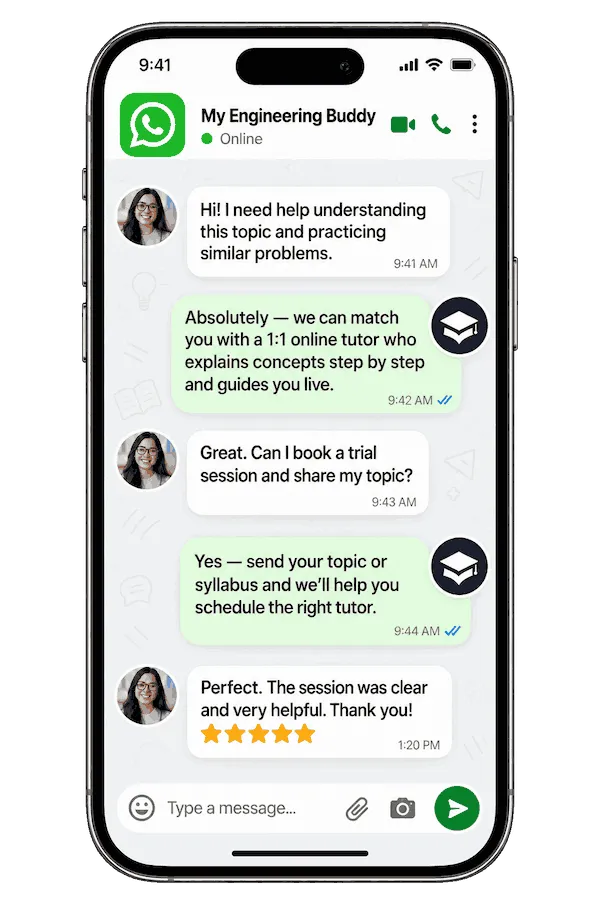
WhatsApp MEB for a quick quote — average response time under 1 minute.
Who This IB Design Technology HL/SL Tutoring Is For
This tutoring suits students who are serious about their IB score and have identified specific gaps — whether that’s the iterative design cycle, material properties, or HL-only innovation topics. It also suits parents who want structured, accountable support rather than vague “general help.”
- Students with a university conditional offer depending on this IB grade
- Students 4–6 weeks from the May or November exam with gaps still to close
- HL students struggling with the extension topics not covered at SL
- Students whose Design project (internal assessment) is off track or lacking depth
- Parents watching a child’s confidence drop alongside their grades
- Students who need academic guidance framed around the IB assessment criteria
MEB has worked with IB students heading to universities including University of Toronto, University of Melbourne, Imperial College London, McGill, and NYU — a strong IB score in a subject like Design Technology can be the differentiator in a competitive application.
Not sure whether the $1 trial is worth it? That single session will tell you exactly where your marks are going and what to fix first.
1:1 Tutoring vs Self-Study vs AI vs YouTube vs Online Courses
Self-study works if you’re disciplined, but the IB Design Technology mark scheme is specific — no feedback loop means you won’t know you’re misreading a question until the exam. AI tools explain concepts quickly but can’t assess your actual design drawings or tell you where your IA argument breaks down. YouTube covers the basics well and stops there. Online courses follow a fixed pace and won’t adjust to your exact exam board release. 1:1 tutoring with MEB is live, calibrated to the current IB Design Technology syllabus, and corrects your reasoning in the moment — not after you’ve already submitted.
Outcomes: What You’ll Be Able To Do in IB Design Technology HL/SL
After structured 1:1 sessions, students can apply the iterative design cycle correctly across Paper 1 and Paper 2 questions, analyse material properties and manufacturing processes with the precision the mark scheme demands, and evaluate design solutions against human factors and sustainability criteria. At HL, students gain the ability to explain innovation and product evolution arguments clearly. They can present their Design project (IA) with a logical, evidence-backed design rationale — the section where most marks are lost or won.
Supporting a student through IB Design Technology HL/SL? MEB works directly with parents to set up sessions, track progress, and keep the internal assessment on schedule. WhatsApp MEB — average response time is under a minute, 24/7.
Based on feedback from 40,000+ sessions collected by MEB from 2022 to 2025, 58% of students improved by one full grade after approximately 20 hours of 1:1 tutoring in subjects like IB Design Technology HL/SL. A further 23% achieved at least a half-grade improvement.
Source: MEB session feedback data, 2022–2025.
What We Cover in IB Design Technology HL/SL (Syllabus / Topics)
The IB Design Technology syllabus runs across core topics shared by HL and SL, plus three HL extension topics that significantly raise the conceptual load. The internal assessment (Design project) runs across both levels and carries substantial weight.
Track 1: Core Topics (HL and SL)
- Human factors and ergonomics — anthropometric data, user-centred design
- Resource management and sustainable production — life cycle assessment, cradle-to-grave analysis
- Modelling — physical, computer-aided, and mathematical models
- Raw materials to final product — properties of metals, polymers, composites, and smart materials
- Innovation and design — design movements, form vs function, planned obsolescence
- Classic design — icons of design history, the influence of culture and technology
Core texts: Design Technology Course Companion (Attwood & Gijzen, Oxford IB), Design and Technology (Katterfeldt, Pearson).
Track 2: HL Extension Topics
- User-centred design (UCD) — iterative processes, prototyping, user testing at scale
- Sustainability — circular economy models, design for disassembly, extended producer responsibility
- Innovation and markets — technology transfer, open-source design, patent systems
- Commercialisation — product life cycle, market readiness, intellectual property
- Systems and control — feedback loops, open and closed systems in designed products
Additional HL resource: IB Design Technology HL Study Guide (OSC Publications), past paper markschemes from the IB store.
Track 3: Internal Assessment — Design Project
- Identifying a design opportunity — client brief, problem framing
- Design specifications — measurable, testable criteria
- Design development — annotated sketches, CAD, material selection rationale
- Creation — process documentation, manufacturing decisions
- Evaluation — testing against specifications, critical self-assessment
- HL extension: Innovation section requiring broader product context and justification
IA reference: Design Technology Internal Assessment Guide (IBO), moderator commentary from past sessions.

The IB also publishes subject reports after each exam session — these are one of the best resources for understanding exactly where marks are lost, and MEB tutors use them directly in session preparation. The American Institute of Aeronautics and Astronautics offers engineering design resources that HL students targeting aerospace or product-engineering degrees often find useful as broader context.
At MEB, we’ve found that IB Design Technology students often arrive with solid design ideas but weak written justification. The mark scheme rewards explicit reasoning — not just good sketches. Getting that translation right, from a design decision to a written argument, is usually what shifts a 4 to a 6.
What a Typical IB Design Technology HL/SL Session Looks Like
The tutor opens by checking the previous session’s topic — usually a specific Paper 2 question type or a section of the Design project the student was working on. They’ll ask the student to explain their thinking first, rather than correcting straight away. From there, the session works through the current problem on screen: annotating a design brief, walking through material property comparisons, or building out an IA evaluation section. The tutor uses a digital pen-pad to mark up the student’s work directly — showing exactly how the examiner reads an answer, where the marks sit, and what’s missing. The student then rewrites or explains the reasoning back. The session closes with a concrete task: a timed Paper 1 case study response or a specific IA section to draft before the next session.
How MEB Tutors Help You with IB Design Technology HL/SL (The Learning Loop)
Diagnose: In the first session, the tutor identifies which topics are genuinely understood and which are surface-level. For Design Technology, this usually means checking whether the student can apply design cycle terminology correctly under exam conditions — not just recall it.
Explain: The tutor works through live examples on screen using a digital pen-pad. For Paper 2 extended-response questions, this means modelling a complete answer — annotating the reasoning step by step, showing why one phrase earns marks and another doesn’t.
Practice: The student attempts the next question or IA section with the tutor present. No drafts disappear into a void — feedback comes while the thinking is still live.
Feedback: The tutor goes through the attempt line by line, identifying where marks would be lost under the actual mark scheme. This is the part self-study can’t replicate.
Plan: At the end of each session, the tutor sets the next topic and specific practice task. Progress is tracked across sessions so nothing drifts.
Sessions run over Google Meet with a digital pen-pad or iPad and Apple Pencil for annotation. Before your first session, have your current IA draft or a recent past paper attempt ready — the tutor uses it as the starting diagnostic. Start with the $1 trial — 30 minutes of live tutoring that also serves as your first diagnostic.
Whether you need a quick catch-up before the May exam, structured revision over 4–8 weeks, or ongoing weekly support through the year, the tutor maps the session plan after the first diagnostic. Students who need help with their IB Extended Essay or IB Theory of Knowledge alongside Design Technology can arrange combined support through MEB.
Students consistently tell us that the biggest shift happens when they stop thinking of the Design project as an art portfolio and start treating it as a structured argument. Every design decision needs written justification. The tutor’s job is to make that instinctive before the IA deadline.
Tutor Match Criteria (How We Pick Your Tutor)
Not every tutor who knows design can teach IB Design Technology. MEB matches on specifics.
Subject depth: tutors hold degrees in product design, engineering, industrial design, or a related field — and know the IB syllabus at the level being assessed, HL or SL.
Tools: every session runs over Google Meet with a digital pen-pad or iPad and Apple Pencil — annotation is central to Design Technology tutoring.
Time zone: matched to your region — US, UK, Gulf, Canada, or Australia — so sessions don’t run at unreasonable hours.
Goals: whether the focus is exam scores, IA depth, HL extension topics, or general concept fluency, the match reflects the student’s actual need.
Unlike platforms where you fill out a form and wait, MEB responds in under a minute, 24/7. Tutor match takes under an hour. The $1 trial means you test before you commit. Everything runs over WhatsApp — no logins, no intake forms.
Pricing Guide
IB Design Technology HL/SL tutoring starts at $20/hr for SL core topics. HL extension sessions and IA-focused support typically run $30–$50/hr depending on tutor background and timeline pressure. Graduate-level or specialist design-engineering tutors go up to $100/hr for students targeting top architecture or engineering programmes.
Rate factors include: level (HL vs SL), topic complexity, how close the exam or IA deadline is, and tutor availability. Availability drops sharply in April–May and October–November.
For students targeting top universities with a competitive IB score, tutors with professional product design or engineering backgrounds are available at higher rates — share your specific goal and MEB will match the tier to your ambition.
Start with the $1 trial — 30 minutes, no registration, no commitment. WhatsApp MEB for a quick quote.
IB Design Technology is one of the few IB subjects where the internal assessment, not the written exams, determines whether a student crosses a grade boundary. Getting IA support early — not two weeks before the deadline — is what separates a 5 from a 7.
Source: My Engineering Buddy, tutor observations, 2022–2025.
FAQ
Is IB Design Technology HL/SL hard?
It’s demanding if you treat it as a pure art subject. The written papers require precise use of design terminology and structured arguments. HL adds three extension topics with significant conceptual depth. Students who engage with the design cycle as a rigorous framework — not just a creative process — tend to score well.
How many sessions are needed?
Most students see a meaningful shift in 8–12 sessions of focused 1:1 work. Students starting 4–6 weeks before an exam typically need 10–15 hours. Those working on the IA over a semester benefit from weekly sessions aligned to each IA section deadline.
Can you help with practice exercises?
MEB tutoring is guided learning — you understand the work, then submit it yourself. The tutor explains the mark scheme, walks through your reasoning, and helps you develop the answer. See our Academic Integrity policy and Why MEB page for full details on what we help with and what we don’t.
Will the tutor match my exact syllabus or exam board?
Yes. IB Design Technology runs under the International Baccalaureate Organisation. MEB tutors are matched to the current syllabus and your level — HL or SL. They know which topics are HL-only and how the mark scheme differs across Paper 1, Paper 2, and the IA.
What happens in the first session?
The tutor runs a diagnostic — usually reviewing a recent past paper attempt or a section of your IA draft. They identify the highest-priority gaps and set a session plan from there. You won’t spend the first session on background the tutor could have figured out beforehand.
Is online tutoring as effective as in-person?
For IB Design Technology, yes — the digital pen-pad annotation and screen-sharing replicates in-person mark-up closely. Tutors can review your IA drawings, annotate exam answers, and model Paper 2 responses in real time. Most students find the recorded screen view easier to revisit than handwritten notes.
Can you help me at midnight if my IA is due the next morning?
MEB operates 24/7. Tutors are available across time zones, so late-night sessions for students in the US, UK, Gulf, or Australia are standard — not exceptional. WhatsApp MEB and the response comes back in under a minute regardless of the hour.
What’s the difference between HL and SL in Design Technology?
SL covers the six core topics and the Design project. HL adds three extension topics — user-centred design at depth, sustainability frameworks, and innovation and markets — plus an additional HL section in the IA. HL students sit Papers 1, 2, and 3; SL students sit Papers 1 and 2 only.
How do I find an IB Design Technology tutor if I’m not near a major city?
Location is irrelevant. All MEB sessions run online over Google Meet. Students in rural Canada, Gulf cities, or regional Australia get the same tutor pool as those in London or New York. The match is based on syllabus fit and time zone, not geography.
Do you offer group IB Design Technology sessions?
MEB focuses on 1:1 sessions. Group sessions are not currently offered. The reason is straightforward: IB Design Technology IA feedback and exam technique work is too individualised for a shared session to be useful. Every student’s design project is different.
How do I get started?
WhatsApp MEB with your level (HL or SL), your closest exam date or IA deadline, and your hardest current topic. MEB matches you to a tutor — usually within the hour. The $1 trial is your first 30 minutes: live tutoring or one question explained in full. No forms, no waiting.
What if my IA is already submitted — can you still help for the written exams?
Absolutely. Once the IA is done, the focus shifts entirely to Papers 1, 2, and 3 (HL). MEB tutors run through past paper questions, mark scheme analysis, and timed practice across all remaining components. Plenty of marks are still available in the written exams.
Trust & Quality at My Engineering Buddy
Every MEB tutor is screened before their first session — not just for subject knowledge, but for the ability to teach it. The process includes a subject-specific vetting check, a live demo evaluation, and ongoing review based on student session feedback. Tutors hold relevant degrees in product design, engineering, industrial design, or related disciplines. Rated 4.8/5 across 40,000+ verified reviews on Google.
MEB tutoring is guided learning — you understand the work, then submit it yourself. For full details on what we help with and what we don’t, read our Academic Integrity policy and Why MEB.
MEB has served 52,000+ students across the US, UK, Canada, Australia, Gulf, and Europe in 2,800+ subjects since 2008. Within the IB programme, this includes Design Technology HL/SL, IB Physics tutoring, and IB Mathematics Analysis and Approaches help. The MEB tutoring methodology — diagnostic first, structured practice, explicit feedback — is what separates a productive session from an hour of re-reading notes.
Explore Related Subjects
Students studying IB Design Technology HL/SL often also need support in:
- IB MYP Design
- IB Digital Society HL/SL
- IB Environmental Systems and Societies SL
- IB Mathematics Applications and Interpretation HL/SL
- IB Chemistry HL/SL
- IB CAS — Creativity, Activity, Service
- IB AI and Machine Learning HL/SL
Next Steps
Ready to start? Here’s what to do:
- Share your level (HL or SL), your hardest current topic, and your exam or IA deadline
- Share your availability and time zone
- MEB matches you with a verified tutor — usually within the hour
- First session starts with a diagnostic so every minute is used well
Before your first session, have ready: your IB Design Technology syllabus and current IA draft (or a recent past paper attempt), a specific question or section you’re stuck on, and your exam or deadline date. The tutor handles the rest.
Visit www.myengineeringbuddy.com for more on how MEB works.
WhatsApp to get started or email [email protected].
Try your first session for $1 — 30 minutes of live 1:1 tutoring or one homework question explained in full. No registration. No commitment. WhatsApp MEB now and get matched within the hour.
A common pattern our tutors observe is that students spending hours on design sketches neglect the written evaluation entirely. In IB Design Technology, the examiner reads your words, not your drawings. One session focused on written justification alone can recover significant marks.
Our experience across thousands of sessions shows that the Paper 1 case study catches students off guard more than any other component. It rewards students who practise reading unseen design contexts quickly and applying the design cycle terminology with precision — not those who memorise theory.
Reviewed by Subject Expert
This page has been carefully reviewed and validated by our subject expert to ensure accuracy and relevance.