




~1 min
Average Reply Time
~1 hour
To Be Matched With A Tutor
30 Min Trial
75% Find Their Tutor On The 1st Trial
$20-35+/hr
Premium Yet Affordable Learning
Hire The Best Astrochemistry Tutor


Most students hit a wall at interstellar reaction networks — the maths looks like physics, the chemistry looks like astrophysics, and no YouTube video covers both at once.
Astrochemistry Tutor Online
Astrochemistry is the study of chemical elements, molecules, and reactions occurring in space environments — including interstellar clouds, protoplanetary disks, stellar atmospheres, and comets — and equips students to model how chemical complexity arises beyond Earth.
If you’ve searched for an Astrochemistry tutor near me and found nothing useful locally, that’s exactly why MEB exists. We offer 1:1 online Chemistry and Astrochemistry tutoring and academic guidance across 2,800+ advanced subjects — pairing you with a specialist who knows the molecular spectroscopy, reaction kinetics, and astrophysical context your course demands. No generic science tutors. No guesswork.
- 1:1 online sessions tailored to your exact course or syllabus
- Expert-verified tutors with graduate-level subject knowledge
- Flexible time zones — US, UK, Canada, Australia, Gulf
- Structured learning plan built after a diagnostic session
- Ethical academic guidance — you understand the work before you submit
52,000+ students across the US, UK, Canada, Australia, and the Gulf have used MEB since 2008 — including students in Chemistry subjects like Astrochemistry, physical chemistry tutoring, and quantum chemistry help.
Source: My Engineering Buddy, 2008–2025.
How Much Does an Astrochemistry Tutor Cost?
Most Astrochemistry tutoring sessions run $20–$40/hr. Graduate-level or highly specialised work — reaction network modelling, radiative transfer, astrochemical code interpretation — can reach $100/hr. Start with the $1 trial: 30 minutes of live tutoring or one homework question explained in full.
| Level / Need | Typical Rate | What’s Included |
|---|---|---|
| Undergraduate (standard) | $20–$35/hr | 1:1 sessions, homework guidance |
| Graduate / Research Level | $35–$100/hr | Expert tutor, niche depth, code support |
| $1 Trial | $1 flat | 30 min live session or 1 homework question |
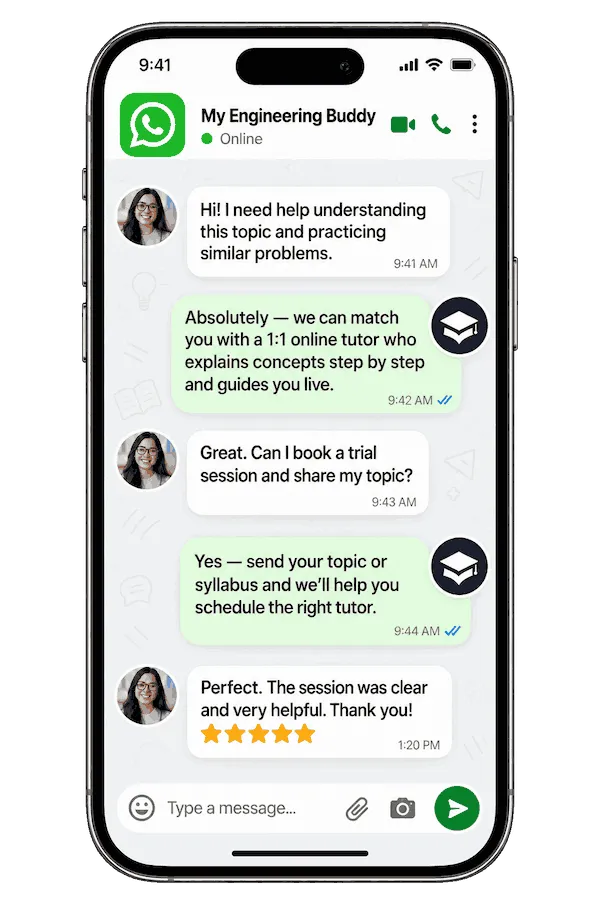
Tutor availability tightens at semester start and around exam periods — if you have a deadline coming, book early. WhatsApp MEB for a quick quote — average response time under 1 minute.
Who This Astrochemistry Tutoring Is For
Astrochemistry sits at the intersection of physical chemistry, quantum mechanics, and astrophysics. Most students need support not because the chemistry is beyond them, but because no single course has given them all three foundations at once.
- Undergraduate students taking an Astrochemistry elective for the first time
- Graduate students building reaction networks or modelling interstellar molecular abundances
- Students 4–6 weeks from an exam with significant gaps still to close
- PhD candidates who need help interpreting computational chemistry outputs in an astrophysical context
- Students with a coursework or research submission deadline approaching
- Parents watching a child’s confidence drop alongside their grades in a combined physics-chemistry module
MEB has supported students at institutions including MIT, Caltech, University of Cambridge, University of Toronto, ETH Zurich, Australian National University, and the University of Amsterdam — all in specialist chemistry and astrophysics programmes.
1:1 Tutoring vs Self-Study vs AI vs YouTube vs Online Courses
Self-study works if you’re disciplined, but astrochemistry problems don’t give feedback when your rate equation is wrong. AI tools explain quickly but can’t spot whether your interstellar medium assumptions are physically justified. YouTube is useful for overviews of molecular clouds — it stops when you need to work through a specific photodissociation region calculation. Online courses are structured but fixed-pace, with no adjustment for your exact syllabus gaps. 1:1 tutoring with MEB is live, calibrated to your specific course, and corrects errors in the moment — particularly useful in a subject where a single wrong assumption about gas-phase versus grain-surface chemistry cascades through every subsequent answer.
Outcomes: What You’ll Be Able To Do in Astrochemistry
After working with an MEB Astrochemistry tutor, students can solve rate equations for gas-phase reactions in diffuse and dense interstellar clouds, analyze rotational and vibrational spectra to identify molecular species, model the formation pathways of complex organic molecules on grain surfaces, explain the role of photodissociation in regulating molecular abundance in stellar nurseries, and apply thermochemical data to evaluate reaction feasibility under extreme low-pressure, low-temperature space conditions. These are the outcomes students actually report — not a guarantee, but a realistic trajectory with consistent 1:1 support.
At MEB, we’ve found that students who struggle most with astrochemistry are those who learned gas-phase kinetics in isolation — without connecting it to the radiation environments and grain-surface processes that dominate real interstellar chemistry. One session fixing that conceptual split often unlocks three or four problem types at once.
Based on feedback from 40,000+ sessions collected by MEB from 2022 to 2025, 58% of students improved by one full grade after approximately 20 hours of 1:1 tutoring in subjects like Astrochemistry. A further 23% achieved at least a half-grade improvement.
Source: MEB session feedback data, 2022–2025.
Supporting a student through Astrochemistry? MEB works directly with parents to set up sessions, track progress, and keep coursework on schedule. WhatsApp MEB — average response time is under a minute, 24/7.
What We Cover in Astrochemistry (Syllabus / Topics)

Track 1: Interstellar and Circumstellar Chemistry
- Composition of the interstellar medium (ISM) — atomic, molecular, and ionised phases
- Formation and destruction of H₂ and CO in diffuse and dense clouds
- Ion-molecule reactions and neutral-neutral reactions in cold gas
- Complex organic molecule (COM) detection and formation routes
- Photodissociation regions (PDRs) and UV-driven chemistry
- Circumstellar envelopes around AGB stars — chemical gradients and shock chemistry
- Molecular line emission: rotational transitions and abundance derivation
Core texts for this track: Molecular Astrophysics by T. W. Hartquist and D. A. Williams; Astrochemistry: From Astronomy to Astrobiology by Andrew M. Shaw.
Track 2: Grain-Surface Chemistry and Solid-State Processes
- Structure and composition of interstellar dust grains
- Accretion, diffusion, and reaction on grain surfaces at low temperatures
- Formation of water ice, methanol, and ammonia mantles
- Thermal and non-thermal desorption mechanisms (UV photodesorption, cosmic-ray processing)
- Laboratory analogues — ice matrix experiments and their astrophysical interpretation
- Grain-surface reaction networks and rate-equation vs stochastic models
Core texts: The Physics and Chemistry of the Interstellar Medium by A. G. G. M. Tielens; Laboratory Astrochemistry edited by Schlemmer, Mutschke, Giesen, and Hübers.
Track 3: Spectroscopy, Quantum Foundations, and Observational Techniques
- Rotational spectroscopy: rigid rotor model, centrifugal distortion, line identification
- Vibrational modes and infrared spectroscopy of interstellar molecules
- Electronic transitions and UV/visible spectroscopy in diffuse clouds
- Radio telescope data interpretation — column densities and excitation temperatures
- Connecting quantum chemistry principles to observational line assignments
- Use of databases: CDMS, JPL Molecular Spectroscopy, KIDA reaction network
Core texts: Spectra of Atoms and Molecules by Bernath; Rotational Spectroscopy of Diatomic Molecules by Brown and Carrington.
What a Typical Astrochemistry Session Looks Like
The tutor opens by checking the previous topic — usually wherever the student got stuck on rate equations for ion-molecule reactions or struggled to interpret a molecular column density derivation. From there, student and tutor work through problems on screen together: building a photodissociation region chemistry model, stepping through the Langmuir-Hinshelwood mechanism on grain surfaces, or unpacking rotational line assignments from a radio spectrum. The tutor uses a digital pen-pad to annotate equations in real time. The student replicates the reasoning, not just the answer — the tutor asks them to explain each step out loud. The session closes with a concrete practice problem set around the next topic, usually grain-surface desorption mechanisms or circumstellar abundance gradients, and a note on what to tackle before the next session.
How MEB Tutors Help You with Astrochemistry (The Learning Loop)
Diagnose: In the first session, the tutor identifies exactly where understanding breaks down — whether that’s the physical chemistry foundations (reaction kinetics, thermochemistry), the quantum mechanical basis for spectroscopy, or the astrophysical context that ties both together. Most students have at least one of these three weak, often without realising it.
Explain: The tutor works through live problems on Google Meet using a digital pen-pad or iPad with Apple Pencil — writing out reaction networks, energy diagrams, and column density calculations step by step, not just narrating a slide.
Practice: The student attempts the next problem with the tutor present. This matters more in astrochemistry than in most subjects because the failure mode is usually a wrong physical assumption, not a maths error — and the tutor catches it immediately.
Feedback: Every error gets a specific correction — not “that’s wrong” but “you’ve assumed LTE here, and here’s why that breaks down in a PDR at this density.” Students learn to spot their own assumption errors.
Plan: The tutor maps the next session topic based on what was covered and what’s coming up in the course — keeping pace with the syllabus, not racing ahead or falling behind.
Sessions run on Google Meet. Share your course outline or problem set before the first session, and the tutor arrives already familiar with your specific syllabus structure. Start with the $1 trial — 30 minutes of live tutoring that also serves as your first diagnostic. Whether you need a quick catch-up before an exam, structured revision over 4–8 weeks, or ongoing weekly support through the semester, the tutor maps the session plan after that first session.
Students consistently tell us that astrochemistry is the subject where they most needed someone to say “stop — here’s the physical picture before we touch the equations.” That reorientation, done live, is something a textbook or recorded lecture can’t replicate. It usually takes one session. Sometimes less.
Tutor Match Criteria (How We Pick Your Tutor)
Not every chemistry tutor can handle astrochemistry. MEB matches on four criteria.
Subject depth: The tutor must have graduate-level training in physical or theoretical chemistry, astrophysics, or a directly adjacent discipline — with demonstrated familiarity with interstellar chemistry topics, not just general chemistry.
Tools: Every session runs on Google Meet with a digital pen-pad or iPad and Apple Pencil. No static slides. Equations are written live.
Time zone: Matched to your region — US, UK, Gulf, Canada, or Australia — so sessions happen at sensible hours without you staying up at 2am.
Goals: Whether you’re targeting exam performance, deepening conceptual understanding, getting analytical chemistry support for a research project, or working through assignment problems, the tutor is briefed on your specific goal before session one.
Unlike platforms where you fill out a form and wait, MEB responds in under a minute, 24/7. Tutor match takes under an hour. The $1 trial means you test before you commit. Everything runs over WhatsApp — no logins, no intake forms.
Study Plans (Pick One That Matches Your Goal)
After the diagnostic session, the tutor builds your sequence. Most Astrochemistry students fall into one of three plans: Catch-up (1–3 weeks, closing specific topic gaps before an exam or submission), Exam prep (4–8 weeks, structured revision across the full syllabus with past-paper practice), or Weekly support (ongoing, aligned to your semester schedule and assignment deadlines). The tutor decides which fits after seeing your starting point.
Pricing Guide
Standard Astrochemistry tutoring runs $20–$40/hr. Graduate-level work involving reaction network simulation, spectral data interpretation, or research-adjacent support reaches up to $100/hr. Rate factors include course level, topic complexity, how quickly you need to start, and tutor availability.
Availability drops during peak exam periods at US and UK universities — if your exam is within four weeks, don’t wait.
For students targeting research programmes at institutions like Caltech, Cambridge, or ETH Zurich, tutors with active or recent research backgrounds in astrochemistry and physical chemistry are available at higher rates — share your specific goal and MEB matches the tier to your ambition.
Start with the $1 trial — 30 minutes, no registration, no commitment. WhatsApp MEB for a quick quote.
MEB has served 52,000+ students since 2008 across Chemistry and adjacent subjects — from atmospheric chemistry tutoring to photochemistry help — with tutors holding advanced degrees in the exact subjects they teach.
Source: My Engineering Buddy, 2008–2025.
FAQ
Is Astrochemistry hard?
It draws on physical chemistry, quantum mechanics, and astrophysics simultaneously — most students find it hard not because any single component is impossible, but because no prior course connected all three. An MEB tutor identifies which foundation is weakest and fixes it first.
How many sessions are needed?
Students with targeted gaps typically see clear progress in 4–6 sessions. Those building from scratch or covering a full semester syllabus usually work across 15–25 sessions. The diagnostic session gives the tutor enough information to give you a realistic estimate.
Can you help with practice exercises?
MEB tutoring is guided learning — you understand the work, then submit it yourself. The tutor explains the method, works through similar problems, and checks your reasoning. See our Academic Integrity policy and Why MEB page for full details on what we help with and what we don’t.
Will the tutor match my exact syllabus or exam board?
Yes. Share your course outline, institution, and exam format when you contact MEB. The tutor is briefed on your specific syllabus before session one — not given a generic astrochemistry overview.
What happens in the first session?
The tutor runs a diagnostic: working through a few problems with you to identify where understanding breaks down. By the end of the first session, both of you know the priority topics and the plan for subsequent sessions.
Is online tutoring as effective as in-person?
For a subject like Astrochemistry where the work is equation-heavy and diagram-intensive, a digital pen-pad on Google Meet is often clearer than a whiteboard in a room. Students consistently report that online sessions are at least as effective — frequently more so, due to recorded annotations and flexible scheduling.
Can you help with the difference between gas-phase and grain-surface chemistry?
Yes — this is one of the most commonly confused distinctions in astrochemistry courses. The tutor walks through the reaction mechanisms, the conditions under which each dominates, and how to apply the correct model in assignment and exam contexts.
Do you support students using astrochemical databases like KIDA or the CDMS?
MEB tutors familiar with KIDA, the CDMS, and the JPL Molecular Spectroscopy database can help students interpret reaction rate data, identify molecular line assignments, and use these resources correctly within coursework and research projects.
Can I get Astrochemistry help at midnight?
Yes. MEB operates 24/7 across time zones. WhatsApp the team at any hour — average response time is under a minute. If your tutor isn’t available immediately, a match is usually confirmed within the hour.
What if I don’t like my assigned tutor?
Request a different tutor via WhatsApp. No friction, no forms. MEB rematch turnaround is typically under 24 hours, and the $1 trial is specifically designed to let you test the fit before committing to ongoing sessions.
How do I get started?
Three steps: WhatsApp MEB, get matched with a verified Astrochemistry tutor within the hour, then start your $1 trial — 30 minutes of live tutoring or one question explained in full. No registration, no commitment required.
Trust & Quality at My Engineering Buddy
Every MEB tutor goes through subject-specific screening — not a general interview. For Astrochemistry, that means verifying graduate-level training in physical chemistry, theoretical chemistry, astrophysics, or a directly adjacent field. Tutors complete a live demo session evaluated by MEB’s academic team, and ongoing session feedback is reviewed to catch any drop in quality. Rated 4.8/5 across 40,000+ verified reviews on Google.
MEB tutoring is guided learning — you understand the work, then submit it yourself. For full details on what we help with and what we don’t, read our Academic Integrity policy and Why MEB.
MEB has been serving students in the US, UK, Canada, Australia, Gulf, and Europe since 2008 — across 2,800+ subjects. The Chemistry subject area includes physical chemistry has been removed — using plain text instead: physical chemistry, inorganic chemistry tutoring, and organic chemistry help alongside Astrochemistry. Every tutor holds an advanced degree in the subject they teach — no generalists covering subjects outside their training.
Our experience across thousands of sessions shows that the students who get the most from astrochemistry tutoring are those who come in willing to say exactly where they got lost — even if it feels like a basic question. There are no basic questions in a subject this specialised. There are only questions worth answering properly.
Explore Related Subjects
Students studying Astrochemistry often also need support in:
- Chemical Kinetics
- Thermochemistry
- Mass Spectrometry
- Chemical Bonding
- Atomic Structure
- Chemical Equilibrium
- Surface Chemistry
Next Steps
Before your first session, have ready: your course outline or syllabus, a recent problem set or assignment you struggled with, and your exam or submission deadline. The tutor handles the rest.
- Share your exam board or course structure, your hardest topic, and your current timeline
- Share your availability and time zone
- MEB matches you with a verified Astrochemistry tutor — usually within the hour
The first session starts with a diagnostic so every minute is used well. Visit www.myengineeringbuddy.com for more on how MEB works.
WhatsApp to get started or email [email protected].
Try your first session for $1 — 30 minutes of live 1:1 tutoring or one homework question explained in full. No registration. No commitment. WhatsApp MEB now and get matched within the hour.
Reviewed by Subject Expert
This page has been carefully reviewed and validated by our subject expert to ensure accuracy and relevance.




