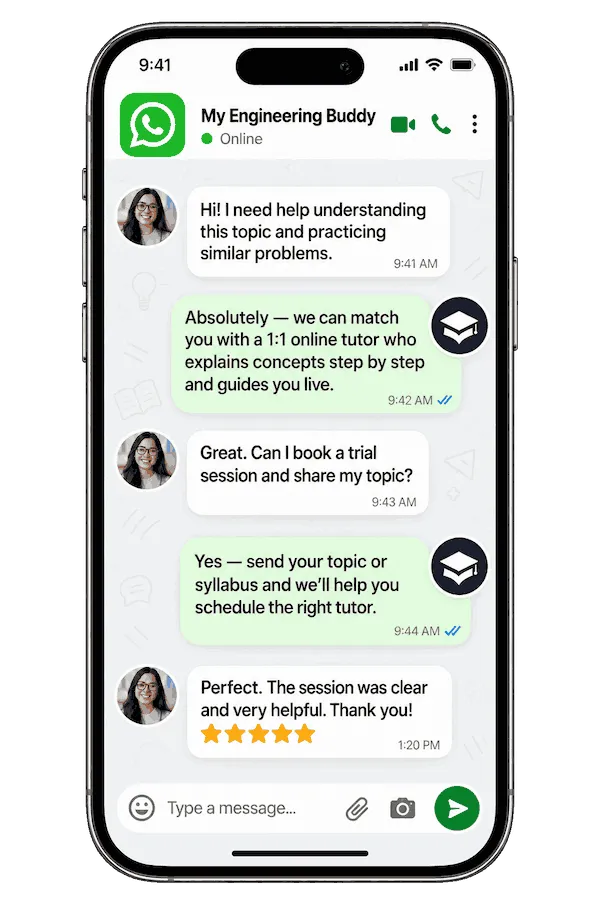
~1 min
Average Reply Time
~1 hour
To Be Matched With A Tutor
30 Min Trial
75% Find Their Tutor On The 1st Trial
$20-35+/hr
Premium Yet Affordable Learning
Most students don’t fail Linear Systems because they lack effort. They fail because state-space, eigenvalues, and controllability problems pile up with no one to catch the errors in their working.
Linear Systems Tutor Online
Linear Systems is the study of mathematical models describing how inputs, outputs, and internal states evolve over time — covering state-space representation, stability analysis, frequency response, and controllability. It equips students to analyse and design dynamic systems in engineering and applied mathematics.
If you’ve searched for a Linear Systems tutor near me and landed here, MEB offers 1:1 online Linear Systems tutoring and homework help across 2,800+ advanced subjects. Our verified tutors work through your exact course — whether that’s an undergraduate control systems module, a graduate-level treatment of LTI systems, or anything between. You’ll leave sessions able to work problems independently, not just follow a worked example.
- 1:1 online sessions tailored to your course syllabus and level
- Expert verified tutors with subject-specific Linear Systems knowledge
- Flexible time zones — US, UK, Canada, Australia, Gulf
- Structured learning plan built after a diagnostic session
- Ethical homework and assignment guidance — you understand the material before you submit
52,000+ students across the US, UK, Canada, Australia, and the Gulf have used MEB since 2008 — across 2,800+ subjects, from AP Calculus to A Level Music Technology to Data Science.
Source: My Engineering Buddy, 2008–2025.
How Much Does a Linear Systems Tutor Cost?
Most Linear Systems sessions run $20–$40/hr. Graduate-level and specialist topics — robust control, nonlinear extensions, advanced state-space — can reach $70–$100/hr. The $1 trial gets you 30 minutes of live 1:1 tutoring or a full explanation of one homework problem, no registration needed.
| Level / Need | Typical Rate | What’s Included |
|---|---|---|
| Undergraduate (most modules) | $20–$35/hr | 1:1 sessions, homework guidance |
| Advanced / Graduate-level | $35–$100/hr | Expert tutor, niche depth |
| $1 Trial | $1 flat | 30 min live session or 1 homework question |
Tutor availability tightens during end-of-semester exam periods — particularly November–December and April–May. Book early if your finals are approaching.
WhatsApp MEB for a quick quote — average response time under 1 minute.
Who This Linear Systems Tutoring Is For
This is for students who know the definitions but freeze when a problem mixes state-space with Laplace transforms and asks them to prove stability. It’s also for students who’ve fallen behind and need to close real gaps before a final.
- Undergraduate electrical, mechanical, aerospace, or chemical engineering students in a control systems or signals module
- Graduate students in systems theory, applied mathematics, or robotics needing rigorous treatment of LTI systems
- Students with a university conditional offer depending on this grade — one failed module can jeopardise progression
- Students working through linear equations tutoring who are ready to move into dynamic systems
- Students retaking after a failed first attempt who need a different explanation, not more of the same
- Parents supporting an engineering student whose grades dropped after the course shifted from circuits to state-space
Students who go on to study at MIT, Caltech, Imperial College London, ETH Zurich, Georgia Tech, the University of Toronto, and UNSW often encounter Linear Systems in their first or second year — it’s a gateway subject, and gaps compound quickly.
1:1 Tutoring vs Self-Study vs AI Tools
Self-study works for motivated students, but Linear Systems has a particular trap: you can follow a solution step by step and still not know which step to take first on a new problem. AI tools give fast explanations and can walk through algebra, but they cannot watch you attempt a Bode plot, catch the moment you misread a transfer function’s poles, or redirect your approach in real time. That kind of live correction — specific to the exact computation you just made — is where a 1:1 Linear Systems tutor adds something neither a textbook nor a chatbot replicates. MEB combines online flexibility with a structured feedback loop calibrated to your exact module and exam format.
Outcomes: What You’ll Be Able To Do in Linear Systems
After consistent sessions with an online Linear Systems tutor, students solve state-space problems from scratch — building the A, B, C, D matrices and extracting transfer functions without prompting. They analyse stability using eigenvalue conditions and Routh-Hurwitz criteria applied to their own coursework problems. They model physical systems — mass-spring-damper, RC circuits, thermal processes — and translate them into block diagrams. They explain controllability and observability conditions in their own words, not just reproduce definitions. They write frequency-domain responses and interpret Bode plots in the context of exam questions their course actually sets.
Supporting a student through Linear Systems? MEB works directly with parents to set up sessions, track progress, and keep coursework on schedule. WhatsApp MEB — average response time is under a minute, 24/7.
Based on feedback from 40,000+ sessions collected by MEB from 2022 to 2025, 58% of students improved by one full grade after approximately 20 hours of 1:1 tutoring in a single subject. A further 23% achieved at least a half-grade improvement.
Source: MEB session feedback data, 2022–2025.
What We Cover in Linear Systems (Syllabus / Topics)

State-Space and System Representation
- State-space form: A, B, C, D matrices and their physical meaning
- Converting between transfer functions and state-space representations
- Linearisation of nonlinear systems around an equilibrium point
- Block diagram algebra and signal flow graphs
- Canonical forms: controllable, observable, diagonal
- Impulse response and zero-state / zero-input decomposition
Core texts: Linear Systems Theory by Hespanha; Modern Control Engineering by Ogata; Introduction to Dynamic Systems by Luenberger.
Stability, Controllability, and Observability
- Eigenvalue-based stability analysis for continuous and discrete-time systems
- Routh-Hurwitz and Lyapunov stability criteria
- Controllability and observability matrices — rank conditions
- Pole placement via state feedback design
- Observer design and the separation principle
- BIBO stability and its relationship to pole locations
- Discrete-time stability: z-plane pole conditions
Core texts: Linear Control System Analysis and Design by D’Azzo and Houpis; Feedback Control of Dynamic Systems by Franklin, Powell, and Emami-Naeini.
Frequency Domain and Response Analysis
- Laplace transform methods and transfer function derivation
- Bode plots: magnitude and phase construction from first principles
- Nyquist criterion and gain/phase margin analysis
- Frequency response of first- and second-order systems
- Root locus: construction rules and design implications
- Step and ramp response characteristics — rise time, settling time, overshoot
Core texts: Control Systems Engineering by Nise; Signals and Systems by Oppenheim and Willsky; Modern Control Systems by Dorf and Bishop.
At MEB, we’ve found that students who struggle with Linear Systems almost always hit the same wall — they can reproduce a solved example but can’t start a blank problem. Every session is built around reversing that: the student leads the problem, the tutor intervenes only where reasoning breaks down.
What a Typical Linear Systems Session Looks Like
The tutor opens by checking where you left off — usually the previous week’s state-space or Bode plot problem. You share your attempted solution on screen; the tutor works through it using a digital pen-pad, annotating directly on your work to show where the matrix construction or pole identification went wrong. Then you tackle a new problem together: something from your actual course materials, not a generic example. You attempt the eigenvalue calculation or the transfer function derivation first; the tutor watches, asks targeted questions, and corrects your reasoning at the exact step where it drifts. The session closes with a specific practice problem set for before next time, and the tutor notes the next topic — often frequency response or controllability — so the sequence stays tight.
How MEB Tutors Help You with Linear Systems (The Learning Loop)
Diagnose: In the first session, the tutor identifies which specific area is causing the most damage — usually one of three: confusion between time-domain and frequency-domain thinking, weak matrix algebra, or incorrect application of stability criteria. This shapes everything that follows.
Explain: The tutor works through live problems on a digital pen-pad — not slides, not a pre-recorded video. You see the reasoning as it happens, including the decision points that textbooks skip.
Practice: You attempt the next problem with the tutor present. Not after the session. Right there, while feedback is immediate.
Feedback: The tutor goes step by step through what you got wrong and why it costs marks. “Your eigenvalue calculation is correct but you applied the wrong stability criterion for discrete-time” is useful. A red cross is not.
Plan: Each session ends with a clear next topic, a practice task, and a checkpoint question the tutor will open with next time. Nothing is left vague.
Sessions run over Google Meet with a digital pen-pad or iPad and Apple Pencil for annotation. Before your first session, share your course syllabus or module outline and one problem set you found difficult. Start with the $1 trial — 30 minutes of live tutoring that also serves as your first diagnostic. Whether you need a quick catch-up before finals, structured revision over 4–8 weeks, or ongoing weekly support through the semester, the tutor maps the session plan after that first diagnostic.
Students consistently tell us that the moment things click in Linear Systems isn’t when they read the right explanation — it’s when they get a problem wrong in front of someone who can show them exactly which line broke down and why it matters for the next five questions.
Tutor Match Criteria (How We Pick Your Tutor)
Not every tutor who knows control theory is the right match for your specific module. Here’s what MEB looks for.
Subject depth: The tutor must have worked with Linear Systems at your level — undergraduate module, graduate course, or research-adjacent. Syllabus fit matters: a tutor strong in classical control is not automatically the right match for a state-space-heavy graduate course.
Tools: Every Linear Systems tutor uses Google Meet combined with a digital pen-pad or iPad and Apple Pencil. Problems get worked in real time on screen — not described verbally.
Time zone: MEB covers New York, Los Angeles, Chicago, London, Dubai, Toronto, Sydney, Melbourne, and all major European time zones. Evenings and weekends available.
Learning style: Calibrated from the first session — some students need the theory first, others need a worked example before the definition makes sense. The tutor adapts, not the student.
Communication: Clear English, adapted to your level. Graduate students get a different register than second-year undergraduates.
Goals: Exam scores, homework completion, conceptual depth for a thesis or research project — the tutor is briefed on your specific target before session one.
Unlike platforms where you fill out a form and wait, MEB responds in under a minute, 24/7. Tutor match takes under an hour. The $1 trial means you test before you commit. Everything runs over WhatsApp — no logins, no intake forms.
Study Plans (Pick One That Matches Your Goal)
After the diagnostic, the tutor builds a session sequence around your actual deadline. For students behind with two or three weeks left, sessions focus on the highest-yield topics first — typically stability analysis and state-space problem structure. For students preparing over four to eight weeks, the tutor works through each topic block systematically with past-paper practice built in. For students wanting ongoing weekly support through a semester, sessions align with lecture pace so nothing accumulates. The plan is specific, not generic.
Pricing Guide
Linear Systems tutoring runs $20–$40/hr for most undergraduate modules. Graduate-level work — advanced state-space, robust control, optimal control — typically runs $50–$100/hr depending on topic depth and tutor background. Rate factors include your level, the complexity of your specific topics, how close your deadline is, and tutor availability at your preferred times.
Availability is limited during peak exam periods in November–December and April–May. If your final is within six weeks, don’t wait.
For students targeting programmes at competitive engineering schools or preparing for graduate research with Linear Systems as a foundation, tutors with research and industry backgrounds in control systems are available at higher rates — share your specific goal and MEB will match the tier to what you actually need.
Start with the $1 trial — 30 minutes, no registration, no commitment. WhatsApp MEB for a quick quote.
MEB has supported engineering and applied mathematics students across the US, UK, Canada, Australia, and the Gulf — from first-year modules to PhD-level systems theory — with tutors available across every major time zone, seven days a week.
Source: My Engineering Buddy, 2008–2025.
FAQ
Is Linear Systems hard?
It’s one of the more conceptually demanding engineering modules because it requires strong simultaneous command of linear algebra, differential equations, and Laplace transforms. Students who struggle usually have a gap in one of those foundations, not a general inability to handle the subject.
How many sessions does it typically take?
Students with specific exam gaps usually need six to ten sessions. Those building from a weak foundation or covering the full module typically benefit from twelve to twenty sessions spread across a semester. The first diagnostic session determines the realistic timeline for your situation.
Can you help with homework and assignments?
Yes — tutors explain the method, work through a similar problem with you, and guide you to the solution. You produce and submit your own work.
MEB tutoring is guided learning — you understand the work, then submit it yourself. For full details on what we help with and what we don’t, read our Academic Integrity policy and Why MEB.
Will the tutor match my exact syllabus or exam board?
Yes. Before matching, MEB reviews your course outline, university, and module level. Tutors are selected for syllabus fit — not just general subject knowledge. If your course uses a specific textbook or set of past papers, share them before session one.
What happens in the first session?
The tutor runs a short diagnostic — usually a mix of questions across topics you’ve already covered — to locate exactly where understanding breaks down. From that, they build the session sequence. No time is spent on material you’ve already mastered.
Is online tutoring as effective as in-person?
For a subject like Linear Systems, the digital pen-pad on Google Meet replicates what a whiteboard does in a physical session — often more precisely, since the tutor can annotate directly on your own work. Most students report no meaningful difference after the first session.
Can I get Linear Systems help late at night or on weekends?
Yes. MEB operates 24/7 across all major time zones. Students in the US, Gulf, Australia, and Europe regularly book evening and weekend sessions. WhatsApp response time is typically under one minute regardless of when you message.
What if I don’t connect with my assigned tutor?
Say so on WhatsApp and MEB will rematch you — usually within the hour. The $1 trial exists specifically to let you evaluate fit before committing to a longer block of sessions. No obligation, no awkward process.
Do you offer help with advanced topics like optimal control or robust control?
Yes. Graduate-level tutors with research or industry backgrounds in control systems are available for topics including LQR, H-infinity control, Kalman filtering, and model predictive control. Share your specific module content when you message MEB.
How do I get started?
Three steps: WhatsApp MEB with your course level and the topic you need help with first — you’ll be matched with a verified Linear Systems tutor, usually within an hour. Your first session is the $1 trial: 30 minutes of live 1:1 tutoring or one assignment question explained in full.
Trust & Quality at My Engineering Buddy
Every MEB tutor goes through subject-specific screening — including a live demo evaluation — before being matched with students. Tutors hold degrees in relevant engineering or mathematics disciplines and are reviewed after each session through student feedback. Rated 4.8/5 across 40,000+ verified reviews on Google. That number reflects ongoing tutor performance, not just initial selection.
MEB tutoring is guided learning — you understand the work, then submit it yourself. For full details on what we help with and what we don’t, read our Academic Integrity policy and Why MEB.
MEB has served 52,000+ students since 2008 across the US, UK, Canada, Australia, Gulf, and Europe — covering 2,800+ subjects from undergraduate engineering modules to PhD-level research support. If you need help with foundational topics alongside this subject, MEB also offers advanced algebra tutoring, linear equations help, and quadratic congruence equation tutoring.
Since 2008, MEB has matched students with verified subject tutors across 2,800+ advanced topics — covering every major time zone and every level from A Level to doctoral research.
Source: My Engineering Buddy, 2008–2025.
Try your first session for $1 — 30 minutes of live 1:1 tutoring or one homework question explained in full. No registration. No commitment. WhatsApp MEB now and get matched within the hour.
Explore Related Subjects
Students studying Linear Systems often also need support in:
- Advanced Algebra
- Linear Equations
- ACCUPLACER Elementary Algebra
- Quadratic Congruence Equation
- Ramanujan-Nagell Equation
- Reeds-Sloane Algorithm
Next Steps
Getting started takes less than two minutes. Here’s what to have ready before your first session:
- Your course syllabus or module outline (or exam board and paper code)
- A recent homework set or past-paper attempt you struggled with
- Your exam date or submission deadline
Share your availability and time zone when you message — MEB matches you with a verified Linear Systems tutor, usually within 24 hours. The first session starts with a diagnostic so every minute is used on what actually needs work.
Visit www.myengineeringbuddy.com to read more about how MEB matches tutors and structures sessions across all subjects.
WhatsApp to get started or email [email protected].
Reviewed by Subject Expert
This page has been carefully reviewed and validated by our subject expert to ensure accuracy and relevance.