~1 min
Average Reply Time
~1 hour
To Be Matched With A Tutor
30 Min Trial
75% Find Their Tutor On The 1st Trial
$20-35+/hr
Premium Yet Affordable Learning
Most students who struggle with GCSE Classical Greek do so in one place: unseen translation. A single tutor session can change that.
GCSE Classical Greek Tutor Online
GCSE Classical Greek is a qualification offered by OCR at GCSE level in England and Wales, covering ancient Greek language, grammar, and set literary texts. It equips students to translate unseen and set passages with accuracy.
MEB provides 1:1 online tutoring and homework help in 2,800+ advanced subjects — including a full GCSE subject range. If you’ve searched for a GCSE Classical Greek tutor near me and found nobody local, you’re not alone. MEB matches students in the US, UK, Canada, Australia, and the Gulf with verified tutors who know the OCR syllabus in detail — and who can turn a shaky grammar foundation into a grade you’re actually proud of.
- 1:1 online sessions tailored to your OCR syllabus and exam paper
- Expert verified tutors with subject-specific classical language knowledge
- Flexible time zones — US, UK, Canada, Australia, Gulf
- Structured learning plan built after a diagnostic session
- Ethical homework and assignment guidance — you understand before you submit
52,000+ students across the US, UK, Canada, Australia, and the Gulf have used MEB since 2008 — including students in GCSE subjects like Classical Greek, GCSE Latin tutoring, and GCSE Ancient History.
Source: My Engineering Buddy, 2008–2025.
How Much Does a GCSE Classical Greek Tutor Cost?
Most GCSE Classical Greek tutoring sessions run $20–$40/hr. Tutors with specialist papyrology or classical scholarship backgrounds may charge more. Start with the $1 trial — 30 minutes of live tutoring or one full homework question explained.
Availability is tighter in the 6–8 weeks before OCR exam windows. Book early if your exam date is set.
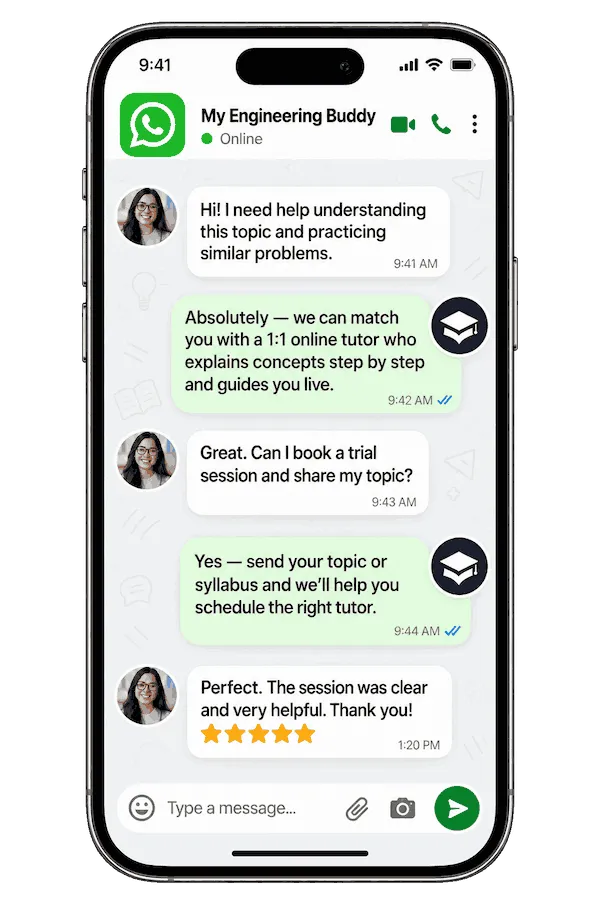
WhatsApp MEB for a quick quote — average response time under 1 minute.
Who This GCSE Classical Greek Tutoring Is For
GCSE Classical Greek is a small-cohort subject. Most schools don’t offer it at all, which means students are often self-studying, using a correspondence course, or following an independent school curriculum with limited class time. If that’s your situation, a 1:1 online Latin tutor or Classical Greek tutor is not a luxury — it’s the only realistic way to keep pace.
- Students working through OCR GCSE Classical Greek with minimal classroom support
- Students 4–6 weeks from an exam with significant grammar or vocabulary gaps still to close
- Students retaking after a failed first attempt — particularly those who lost marks on unseen translation
- Students with a conditional university offer that depends on their classical languages grade
- Parents watching a child’s confidence drop alongside their grades in a subject with no local tutor available
- Home-educated students preparing independently for OCR classical language qualifications
Students who go on to study Classics, Ancient History, or Theology at Oxford, Cambridge, Durham, St Andrews, and Exeter often name GCSE Classical Greek as the subject where early 1:1 support made the difference.
Students consistently tell us that the turning point in Classical Greek is almost never vocabulary — it’s when the grammar system clicks as a whole. Paradigms, case endings, and verb forms start to feel like a logic puzzle rather than a memorisation task. That shift usually takes one or two focused sessions with the right tutor.
1:1 Tutoring vs Self-Study vs AI vs YouTube vs Online Courses
Self-study works if you’re disciplined, but Ancient Greek grammar requires live correction — a wrong habit embedded early costs marks across every paper. AI tools explain rules quickly but can’t catch why your translation of a specific aorist form is wrong. YouTube covers the alphabet and basic nouns well; it stops short when you hit the dual or the optative. Online courses give you structure at a fixed pace with no personalisation. 1:1 tutoring with MEB is live, calibrated to your exact OCR paper, and corrects errors the moment they form — before they become habits.
Outcomes: What You’ll Be Able To Do in GCSE Classical Greek
After structured 1:1 sessions, students consistently report measurable shifts in what they can do — not just what they know. Translate unseen OCR prose passages at speed without reaching for the lexicon every other line. Analyse set texts from authors like Euripides or Homer with enough grammatical confidence to write full-mark commentary answers. Apply all five Greek noun declensions and core verb conjugations under timed conditions. Explain scanning choices in a hexameter line and name the metrical feet. Present a coherent argument about a literary passage in the context of Greek culture — the kind of answer that lifts a Grade 5 to a Grade 7.
Supporting a student through GCSE Classical Greek? MEB works directly with parents to set up sessions, track progress, and keep coursework on schedule. WhatsApp MEB — average response time is under a minute, 24/7.
Based on feedback from 40,000+ sessions collected by MEB from 2022 to 2025, 58% of students improved by one full grade after approximately 20 hours of 1:1 tutoring in subjects like GCSE Classical Greek. A further 23% achieved at least a half-grade improvement.
Source: MEB session feedback data, 2022–2025.
What We Cover in GCSE Classical Greek (Syllabus / Topics)
OCR offers GCSE Classical Greek under two specifications: J292 (GCSE Classical Greek) and the related option within the broader classical languages suite. Both include language and literature components. The table below shows the core assessment structure.
| Component | Format | Typical Weighting |
|---|---|---|
| Language Paper (Set Text + Unseens) | Written exam | ~50% |
| Literature and Culture Paper | Written exam | ~50% |
Check the UK Department for Education for current qualification updates affecting classical language GCSEs.
Track 1: Greek Language and Grammar
- The Greek alphabet — reading, writing, breathing marks, accents
- Noun declensions (1st, 2nd, 3rd) — nominative, accusative, genitive, dative, vocative
- Verb conjugation — present, imperfect, aorist, perfect, future in active and middle/passive
- Participles and infinitives — recognition and translation in context
- Common syntactic constructions — indirect statement, purpose clauses, conditions
- The dual number and the optative mood — often the last grammar hurdles before the exam
- Vocabulary building for OCR defined vocabulary list
Core texts used: Greek: An Intensive Course by Hansen & Quinn; Reading Greek by the Joint Association of Classical Teachers (JACT).
Track 2: Set Text Translation and Comprehension
- Prepared translation of OCR-prescribed passages (changes each exam cycle)
- Homer’s Odyssey or Iliad — selected books in Greek (varies by specification)
- Euripides — selected scenes requiring both language and dramatic context
- Line-by-line translation technique — avoiding over-literal rendering
- Comprehension questions — selecting evidence from the Greek text, not just the English
- Use of the Perseus Digital Library for exploring source texts independently
Supplementary reading: OCR-issued set text booklets and teacher support materials available via the OCR website.
Track 3: Literature, Culture, and Context
- Greek literary forms — epic, tragedy, history, philosophy
- Cultural context of set texts — religion, politics, society in classical Athens and archaic Greece
- Metre and scansion — dactylic hexameter, recognition of spondees and dactyls
- Comparative literature questions — linking two passages within a theme
- Essay technique for the Literature and Culture paper — structure, evidence, argument
- Key authors and their historical contexts: Homer, Euripides, Herodotus, Thucydides
Recommended background reading: The Greeks by H.D.F. Kitto; Greek Tragedy in Action by Oliver Taplin.

What a Typical GCSE Classical Greek Session Looks Like
The tutor opens by checking the previous session’s focus — say, 3rd declension nouns or the aorist passive paradigm. The student attempts two or three short translation sentences on screen; the tutor watches in real time via Google Meet and marks up errors immediately using a digital pen-pad. If a genitive absolute keeps going wrong, the tutor stops, reworks the construction from the principle verb backwards, and has the student retranslate it before moving on. The session might then shift to a set text passage — a dozen lines of Homer — where the student translates aloud and the tutor queries word choices. By the end, the student has a concrete task: translate a specific unseen passage from last year’s OCR paper, mark it with the provided mark scheme, and note every error before the next session.
How MEB Tutors Help You with GCSE Classical Greek (The Learning Loop)
Diagnose: In the first session, the tutor runs through a short grammar audit — noun endings, a verb conjugation, one prose sentence. Within 20 minutes, the tutor knows which paradigms are solid and which are half-learned. That shapes every session that follows.
Explain: The tutor works through a live example — a real OCR-style sentence or a set text line — writing it up on the pen-pad step by step. No abstract rules without immediate application. You see the grammar working in actual Greek before you try it yourself.
Practice: You translate with the tutor present. Not alone, not later. The tutor is watching for the moment you pause on a form — that pause is where the real teaching happens.
Feedback: Every translation error gets corrected on the spot with an explanation: which rule was missed, which mark-scheme criterion it touches, what the OCR examiner is specifically looking for in that component.
Plan: The session closes with a clear note on what was covered, what’s next, and one specific task to complete before the following session. Vocabulary drills, a timed unseen, a set text commentary paragraph — always concrete, always tied to your exam date.
Sessions run on Google Meet with a digital pen-pad or iPad and Apple Pencil for live annotation. Before your first session, have your OCR specification number, your set text, and a recent past paper or homework attempt ready to share. The first session is both diagnostic and productive — you will translate actual Greek before it ends. Start with the $1 trial — 30 minutes of live tutoring that also serves as your first diagnostic.
Try your first session for $1 — 30 minutes of live 1:1 tutoring or one homework question explained in full. No registration. No commitment. WhatsApp MEB now and get matched within the hour.
A common pattern our tutors observe is students arriving with most of their vocabulary memorised but no systematic understanding of how case endings shift meaning. Grammar is the multiplier — once it clicks, vocabulary retention accelerates.
Source: MEB tutor observations, 2022–2025.
Tutor Match Criteria (How We Pick Your Tutor)
Not every classicist is a good fit. MEB matches on four dimensions.
Subject depth: The tutor must have studied Ancient Greek to at least A Level or university level and must know the OCR GCSE J292 specification specifically — not just classical languages in general.
Tools: Every tutor uses Google Meet with a digital pen-pad or iPad and Apple Pencil. No static PDFs passed back and forth.
Time zone: Matched to your region — UK afternoon, US evening, Gulf morning. Your schedule drives the match, not tutor convenience.
Goals: Whether you need exam preparation, grammar catch-up, help with GCSE English Literature tutoring alongside your classical texts, or deeper literary analysis — the tutor’s approach is shaped by your specific target.
Unlike platforms where you fill out a form and wait, MEB responds in under a minute, 24/7. Tutor match takes under an hour. The $1 trial means you test before you commit. Everything runs over WhatsApp — no logins, no intake forms.
Study Plans (Pick One That Matches Your Goal)
After the first diagnostic session, the tutor builds a sequence specific to your OCR paper and exam date. Three common patterns: catch-up (1–3 weeks) for students who have significant grammar gaps and need rapid triage before the exam; exam prep (4–8 weeks) for structured revision working through set texts, unseen technique, and literature essay practice; and weekly support for students managing the full GCSE Classical Greek course alongside other subjects throughout the academic year. The tutor adapts the plan after each session — nothing is fixed.
Pricing Guide
GCSE Classical Greek tutoring starts at $20/hr. Tutors with undergraduate or postgraduate Classics backgrounds, or those covering both the language and literature components in depth, typically charge $35–$60/hr. Rates above that are reserved for tutors with professional research or publishing backgrounds in classical studies.
Rate factors: your current level, which OCR components you need help with, how close your exam date is, and tutor availability. Peak exam season — typically April to June — means fewer slots. Book before that window if you can.
For students targeting Classics at Oxford, Cambridge, or St Andrews, tutors with undergraduate or postgraduate classical languages research backgrounds are available at higher rates — share your specific goal and MEB will match the tier.
Start with the $1 trial — 30 minutes, no registration, no commitment. WhatsApp MEB for a quick quote.
At MEB, we’ve found that the students who improve fastest in Classical Greek are those who come to each session with a specific problem — a sentence they couldn’t parse, a passage they lost marks on. Bring one real difficulty per session and the tutor can do something concrete with it in under 10 minutes.
FAQ
Is GCSE Classical Greek hard?
It’s genuinely challenging — the grammar system is more complex than Latin and the alphabet adds an initial barrier. Most students find the noun declension and verb conjugation system the hardest part. With consistent 1:1 tutoring, most students close major gaps within 8–12 hours of targeted sessions.
How many sessions are needed?
It depends on your starting point and exam date. Students with 6+ weeks and moderate grammar knowledge typically need 10–15 sessions. Students in the final 2–3 weeks before their OCR exam usually focus on 4–6 intensive sessions targeting unseen technique and set text recall.
Can you help with homework and assignments?
Yes — MEB tutoring is guided learning. You understand the translation or grammar exercise, then submit it yourself. See our Academic Integrity policy and Why MEB page for full details on what we help with and what we don’t.
Will the tutor match my exact syllabus or exam board?
Yes. GCSE Classical Greek is offered primarily by OCR (specification J292). Your tutor will know which set texts are prescribed for your exam year and which vocabulary list applies, and will structure sessions around those specific components — not a generic ancient Greek curriculum.
What happens in the first session?
The tutor runs a short grammar audit — noun endings, a verb form, a short prose sentence. This identifies exactly where your knowledge breaks down. The rest of the session begins targeted work immediately. You translate actual Greek before the session ends.
Is online tutoring as effective as in-person?
For classical language tutoring, yes — most of the work is text on screen. Google Meet with a digital pen-pad replicates a whiteboard session closely. Students typically stop noticing it’s online after the first two sessions.
How do I get started?
Start with the $1 trial — 30 minutes of live tutoring or one homework question explained in full. Three steps: WhatsApp MEB, get matched with a verified GCSE Classical Greek tutor (usually within an hour), and begin your trial session.
Can I get GCSE Classical Greek help at midnight?
Yes. MEB operates 24/7 across time zones. Students in the Gulf or US can WhatsApp at midnight UK time and get a response within minutes. Tutor session slots vary, but the matching process starts the moment you message — any hour, any day.
What if I don’t like my assigned tutor?
Tell MEB. There’s no penalty and no awkward conversation to manage. WhatsApp the team, describe what wasn’t working, and a new match is arranged — typically within the same day. The $1 trial exists specifically so you can test the fit before committing to paid sessions.
How does GCSE Classical Greek differ from GCSE Latin, and can I study both?
Both are offered by OCR and share some grammatical principles, but Classical Greek adds an entirely separate alphabet, additional verb moods, and a different set literary tradition. Many students study both — MEB can support GCSE Latin help alongside Classical Greek with the same or different tutors depending on availability.
Which set texts come up in the OCR GCSE Classical Greek exam?
OCR prescribes specific set texts per exam cycle — typically selections from Homer and either a dramatist or historian. The prescribed texts change between specification updates. Your tutor will confirm the current cycle’s set texts in the first session and tailor all literary analysis work to those passages specifically.
Trust & Quality at My Engineering Buddy
Every MEB tutor goes through a subject-specific vetting process — degree or professional qualification in classical languages or Classics, a live demo session reviewed by the MEB team, and ongoing feedback monitoring after each student engagement. Rated 4.8/5 across 40,000+ verified reviews on Google. That rating reflects 18 years of matching students to tutors who actually know the subject at the level required.
MEB tutoring is guided learning — you understand the work, then submit it yourself. For full details on what we help with and what we don’t, read our Academic Integrity policy and Why MEB.
MEB has served 52,000+ students across the US, UK, Canada, Australia, Gulf, and Europe since 2008 — across 2,800+ subjects. Within the GCSE subject range, classical languages including GCSE History tutoring and GCSE English help sit alongside Classical Greek as some of the most frequently requested humanities subjects. Tutors are matched to your specific exam board specification, not assigned generically.
Our experience across thousands of sessions shows that GCSE Classical Greek students who bring a specific past paper question to each session progress roughly twice as fast as those who ask tutors to decide what to cover. Own the agenda — the tutor does the rest.
Source: MEB tutor feedback, 2022–2025.
Explore Related Subjects
Students studying GCSE Classical Greek often also need support in:
Next Steps
Ready to start? Here’s what to have ready before your first session:
- Your OCR specification number (J292 or as confirmed by your school) and your set text
- A recent past paper attempt or a homework translation you struggled with
- Your exam date or coursework deadline
Share your availability and time zone. MEB matches you with a verified GCSE Classical Greek tutor — usually within 24 hours. The first session begins with a diagnostic so no time is wasted on topics you already know.
Visit www.myengineeringbuddy.com for more on how MEB works.
WhatsApp to get started or email [email protected].
Reviewed by Subject Expert
This page has been carefully reviewed and validated by our subject expert to ensure accuracy and relevance.