




~1 min
Average Reply Time
~1 hour
To Be Matched With A Tutor
30 Min Trial
75% Find Their Tutor On The 1st Trial
$20-35+/hr
Premium Yet Affordable Learning
Most students who struggle with GCSE German aren’t bad at languages. They’ve just never had someone explain how the case system actually works — or why they keep dropping marks on the writing paper.
GCSE German Tutor Online
GCSE German is a UK Key Stage 4 qualification assessed by boards including AQA, Edexcel, and OCR, covering reading, writing, listening, and speaking. It equips students to communicate in German across everyday, academic, and cultural contexts.
MEB’s GCSE tutoring connects you with a verified GCSE German tutor online who knows your exact exam board — whether that’s AQA, Edexcel, or OCR. If you’ve been searching for a GCSE German tutor near me and coming up short on good options, a live 1:1 session online with MEB matches what an in-person tutor offers, without the geography problem. Tutors help you close specific gaps — case endings, subjunctive mood, listening comprehension — not just review textbook content you could read yourself.
- 1:1 online sessions tailored to your specific exam board and syllabus
- Expert-vetted tutors with subject-specific German language knowledge
- Flexible time zones — US, UK, Canada, Australia, Gulf
- Structured learning plan built after a diagnostic session
- Ethical homework and assignment guidance — you understand the work, then submit it yourself
52,000+ students across the US, UK, Canada, Australia, and the Gulf have used MEB since 2008 — including students in GCSE Modern Languages subjects like GCSE French, GCSE Spanish, and GCSE German.
Source: My Engineering Buddy, 2008–2025.
How Much Does a GCSE German Tutor Cost?
Most GCSE German tutoring at MEB runs $20–$40 per hour. Your first session costs $1 — 30 minutes of live tutoring or one full homework question explained from start to finish, no registration needed.
| Level / Need | Typical Rate | What’s Included |
|---|---|---|
| Foundation / Higher (most students) | $20–$35/hr | 1:1 sessions, grammar and writing guidance |
| Advanced / Exam Board Specialist | $35–$60/hr | Native-level fluency, speaking exam coaching |
| $1 Trial | $1 flat | 30 min live session or one full question explained |
Tutor availability tightens around May and November exam windows — book early if your paper date is approaching.
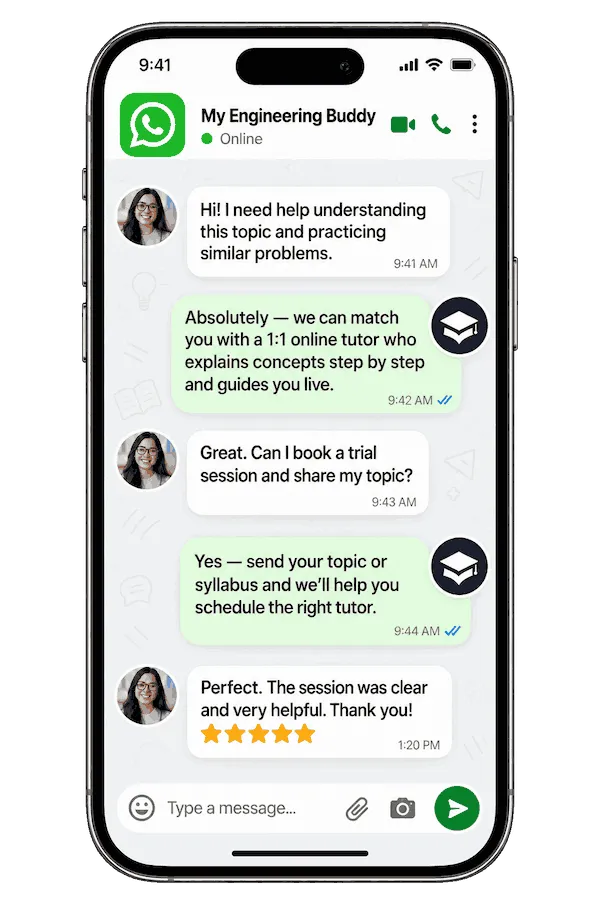
WhatsApp MEB for a quick quote — average response time under 1 minute.
Who This GCSE German Tutoring Is For
GCSE German tutoring at MEB works for a wide range of students — from those just starting to build confidence in the language to students weeks out from their final paper who need focused, efficient revision. If you know exactly what’s tripping you up, the tutor can work on that immediately. If you don’t, the diagnostic session sorts it out fast.
- Students retaking after a failed first attempt who need a different approach, not just more of the same
- Students with a university conditional offer depending on their GCSE German grade
- Students 4–6 weeks from their AQA, Edexcel, or OCR exam with gaps in grammar, speaking, or writing
- Students whose school has limited German teaching time and who are effectively self-teaching whole topics
- Parents watching a child’s confidence drop alongside their grades — particularly with the writing and speaking components
- International students in the US, Canada, or Gulf sitting IGCSE German who need a tutor familiar with that specific variant
Students progress to A Level German, International Baccalaureate language courses, or degrees at universities including the University of Edinburgh, UCL, King’s College London, the University of Toronto, and McGill — all of which value a strong GCSE or equivalent language qualification at entry.
At MEB, we’ve found that GCSE German students who struggle most are rarely weak at languages overall — they’ve just never had the case system (nominative, accusative, dative, genitive) explained in a way that actually clicked. One session on that alone can unlock grammar across the whole paper.
1:1 Tutoring vs Self-Study vs AI vs YouTube vs Online Courses
Self-study works if you’re disciplined, but German grammar gives no feedback when you conjugate wrong. AI tools explain rules quickly but can’t hear your speaking exam attempt or diagnose why your essay keeps losing marks. YouTube covers vocabulary and basic phrases well — it stops when you need someone to correct your word order in a subordinate clause. Online courses are structured but move at a fixed pace regardless of where your actual gaps are. With a 1:1 GCSE German tutor from MEB, sessions are calibrated to your specific AQA, Edexcel, or OCR paper — errors are caught live, not discovered after the exam.
Outcomes: What You’ll Be Able To Do in GCSE German
After consistent 1:1 sessions, you’ll be able to write accurately across all three tenses — present, past, and future — in extended essay responses without defaulting to the same five safe phrases. You’ll be able to apply the four German cases correctly in both written and spoken work, which alone accounts for a significant chunk of marks in AQA and Edexcel assessments. Analyse and respond to reading comprehension texts confidently, including those with unfamiliar vocabulary. Present and discuss your chosen theme or role-play scenario in the speaking exam without freezing on verb endings. Apply listening strategies — including inference — to the harder second-half questions that most Foundation students drop marks on.
Supporting a student through GCSE German? MEB works directly with parents to set up sessions, track progress, and keep coursework on schedule. WhatsApp MEB — average response time is under a minute, 24/7.
Based on feedback from 40,000+ sessions collected by MEB from 2022 to 2025, 58% of students improved by one full grade after approximately 20 hours of 1:1 tutoring in subjects like GCSE German. A further 23% achieved at least a half-grade improvement.
Source: MEB session feedback data, 2022–2025.
What We Cover in GCSE German (Syllabus / Topics)

Grammar and Language Systems
- The four cases: nominative, accusative, dative, genitive — with articles and adjective endings
- Verb conjugation across all tenses: present, simple past (Imperfekt), perfect, future
- Modal verbs (können, müssen, dürfen, sollen, wollen, mögen) in all required contexts
- Word order rules: verb-second, subordinate clause inversion, coordinating vs subordinating conjunctions
- Separable and inseparable verbs — one of the most common sources of lost marks
- Subjunctive II (Konjunktiv II) for Higher tier, including conditional sentences
- Reflexive verbs and accusative/dative reflexive pronoun distinction
Key resources: Klett Stimmt! 3 and 4 (AQA/Edexcel editions), Wir! 3 for Foundation, and the Modern Language Association style guidance for written annotation tasks.
Themes, Topics, and Vocabulary
- Theme 1: Identity and culture — family, relationships, social media, German-speaking traditions and festivals
- Theme 2: Local, national, international, and global areas of interest — town, environment, travel
- Theme 3: Current and future study and employment — school life, career plans, work experience
- High-frequency vocabulary lists per exam board — AQA, Edexcel, and OCR all differ
- Opinions and justifications — extending answers beyond single-clause responses
- Idiomatic expressions that appear in reading and listening papers at Higher tier
Key resources: Edexcel GCSE German Foundation and Higher Student Books, AQA official vocabulary list (downloadable from the AQA website), Der, Die, Das: The Secrets of German Gender for targeted support.
Skills: Reading, Writing, Listening, and Speaking
- Reading comprehension strategies — dealing with unknown vocabulary through context inference
- Writing tasks: structured essays, photo descriptions, translation into German (Higher)
- Translation into English — Higher tier only, commonly underrevised
- Listening comprehension: Foundation and Higher paper strategies, including gap-fill and multiple choice
- Speaking exam format: role-play, photo card, general conversation — each requires a different preparation strategy
- Pronunciation and spontaneity coaching for the speaking component
Key resources: CGP GCSE German Complete Revision & Practice, past papers from AQA, Edexcel, and OCR (available on each board’s website), Oxford GCSE German Grammar.
Students consistently tell us that the speaking exam is the component they feel least prepared for — not because their German is weak, but because school practice time for it is often minimal. MEB tutors simulate the exact role-play and general conversation format so students walk in having already done it five or six times.
What a Typical GCSE German Session Looks Like
The tutor opens by reviewing the previous session’s task — often a written paragraph on a Theme 2 topic like the environment, or a translation exercise from the most recent past paper. If the student got it mostly right, the session moves immediately to the next gap. If there were errors — usually case endings or word order — those get addressed first with a worked example on the digital pen-pad. The student then attempts two or three similar sentences live, with the tutor correcting in real time. The second half of the session typically covers a listening or reading comprehension segment from an official AQA or Edexcel past paper, with the tutor walking through exactly how marks are awarded. The session closes with a specific task: one writing prompt or a vocabulary set to review, tied directly to what the next session will build on.
How MEB Tutors Help You with GCSE German (The Learning Loop)
Diagnose: In the first session, the tutor identifies your weakest components — grammar accuracy, vocabulary range, or exam technique. For most GCSE German students this is either the writing paper or the speaking exam, though the causes differ significantly between the two.
Explain: The tutor works through a live example on a digital pen-pad or shared screen — demonstrating how an AQA examiner marks a written task or how to structure a Higher-tier translation correctly. Not theory. An actual worked example from a real past paper.
Practice: You attempt a similar task while the tutor watches. That’s not comfortable at first, but it’s the only way errors surface before the real exam does the same job.
Feedback: The tutor walks through every mistake step by step — not just marking it wrong, but showing exactly which mark scheme criteria you failed and why. This is where most self-study and AI tools fall short.
Plan: Each session ends with a concrete next step — one specific topic, one practice task, one vocabulary set. The tutor tracks progress across sessions so revision doesn’t loop back to content you’ve already secured.
Sessions run on Google Meet with a digital pen-pad or iPad and Apple Pencil. Before your first session, share your exam board, your most recent practice paper or writing task, and your exam date. The first session starts with a diagnostic — the tutor takes 10 minutes to assess where you actually are, then gets to work. Start with the $1 trial — 30 minutes of live tutoring that also serves as your first diagnostic.
Tutor Match Criteria (How We Pick Your Tutor)
Every GCSE German tutor at MEB is matched on four specific criteria.
Subject depth: Tutors are matched to your exact exam board — AQA, Edexcel, or OCR — not just “GCSE German” generically. Syllabus differences between boards are real and the tutor knows them.
Tools: All tutors work on Google Meet with a digital pen-pad or iPad and Apple Pencil — essential for annotating written work and demonstrating grammar rules visually.
Time zone: Matched to your region — US Eastern, UK, Gulf Standard Time, Canadian, or Australian time zones depending on where you are.
Goals: Whether you need grade improvement on a resit, speaking exam preparation, or structured support through a full term, the tutor is matched to that specific outcome.
Unlike platforms where you fill out a form and wait, MEB responds in under a minute, 24/7. Tutor match takes under an hour. The $1 trial means you test before you commit. Everything runs over WhatsApp — no logins, no intake forms.
Study Plans (Pick One That Matches Your Goal)
After the diagnostic session, your tutor builds the session sequence — but these are the common patterns. Catch-up (1–3 weeks): students who are behind and need to close specific grammar or vocabulary gaps before the paper. Exam prep (4–8 weeks): structured revision targeting each skill in turn — writing, speaking, reading, listening — timed to your actual exam date. Weekly support: ongoing through the academic year, aligned to school deadlines, mock exams, and coursework submissions. The tutor maps the specific sequence after the first diagnostic — these plans don’t run on a fixed template.
Pricing Guide
GCSE German tutoring at MEB starts at $20/hr for Foundation and standard Higher tier sessions. Specialist tutors with native-level German fluency or extensive speaking exam coaching experience are available at higher rates — share your specific target grade and exam board, and MEB will match accordingly.
Rate factors include: Higher vs Foundation tier, distance from exam date, topic complexity (grammar depth vs skills practice), and tutor availability during peak May/November windows. For students targeting top A Level pathways or university conditional offers, tutors with advanced German language backgrounds are available — let MEB know your goal.
Start with the $1 trial — 30 minutes, no registration, no commitment. WhatsApp MEB for a quick quote.
MEB has matched students with verified GCSE language tutors since 2008 — across German, French, Spanish, and Latin. The same matching process, the same diagnostic-first approach, every time.
Source: My Engineering Buddy, 2008–2025.
FAQ
Is GCSE German hard?
It’s demanding compared to most GCSE subjects because it requires accurate grammar as well as vocabulary recall. The case system and word order rules trip up most students. With structured 1:1 support targeting those specific points, it becomes manageable quickly.
How many sessions are needed to improve?
Most students see meaningful improvement in 8–12 sessions of focused 1:1 work. Students with 4–6 weeks before their exam and clear gaps to close often see grade movement faster — the diagnostic session identifies where to spend every available hour.
Can you help with homework and assignments?
MEB tutoring is guided learning — you understand the work, then submit it yourself. The tutor explains the grammar, walks through examples, and checks your reasoning. See our Academic Integrity policy and Why MEB page for full details on what we help with and what we don’t.
Will the tutor match my exact exam board?
Yes. AQA, Edexcel, and OCR each have different vocabulary lists, writing task formats, and speaking exam structures. MEB matches your tutor to your specific board — not just to GCSE German in general. IGCSE (Cambridge) is also covered.
What happens in the first session?
The tutor spends the first 10 minutes on a diagnostic — reviewing a recent past paper attempt or written task to identify where marks are being lost. The remaining time goes directly to working on those gaps. Nothing is wasted on topics you’ve already secured.
Is online GCSE German tutoring as effective as in-person?
For grammar explanation and written work, yes — a digital pen-pad on Google Meet replicates a whiteboard session accurately. Speaking practice is equally effective online; the tutor can hear pronunciation clearly and give immediate corrective feedback in real time.
What’s the difference between AQA and Edexcel GCSE German?
AQA uses a set vocabulary list students are expected to know exactly; Edexcel provides a broader topic framework with more flexibility. Marking weighting across the four skills also differs. Your tutor is matched to your specific board from the start.
How does the GCSE German speaking exam actually work?
It has three parts: a role-play, a photo card description and discussion, and a general conversation. The general conversation draws from your chosen theme. MEB tutors run full simulation practice for all three formats — most students have done too few mock runs before the real thing.
Can I get GCSE German help at short notice — a few days before my exam?
Yes. MEB matches tutors within hours, not days. For emergency exam prep, share your paper date, your exam board, and your two or three weakest areas. The tutor builds a focused session plan around exactly those points. WhatsApp is the fastest route.
Do you offer help with the GCSE German translation tasks?
Yes — translation into English and translation into German (Higher tier only) are both covered. The into-German direction is the one most students underrevise. Tutors work through mark-scheme examples and explain exactly how the examiner awards marks for accuracy vs communication.
How do I get started?
WhatsApp MEB with your exam board, your hardest component, and your exam date. MEB matches you with a verified GCSE German tutor — usually within the hour. Your first session is the $1 trial: 30 minutes of live tutoring or one question explained in full.
A common pattern our tutors observe is that GCSE German students spend revision time on vocabulary lists but ignore grammar accuracy — then lose marks on writing and translation tasks that vocabulary alone can’t fix. Grammar work first, vocabulary consolidation second.
Trust & Quality at My Engineering Buddy
Every MEB tutor goes through screening, a live demo evaluation, and ongoing session feedback review before being matched with students. Tutors hold relevant degrees and, for GCSE German specifically, demonstrate accurate spoken and written German at a level well above the qualification they’re teaching. Subject-specific vetting — not just general language ability — is the standard. Rated 4.8/5 across 40,000+ verified reviews on Google.
MEB tutoring is guided learning — you understand the work, then submit it yourself. For full details on what we help with and what we don’t, read our Academic Integrity policy and Why MEB.
MEB has served 52,000+ students across the US, UK, Canada, Australia, Gulf, and Europe since 2008, covering 2,800+ subjects. GCSE Modern Languages — including German, GCSE French tutoring, and GCSE Spanish help — is one of MEB’s strongest subject areas, with tutors matched to specific exam boards and year groups. Students preparing for GCSE English tutoring or needing GCSE History support alongside German can be matched simultaneously. See MEB’s tutoring methodology for how sessions are structured from first diagnostic to final exam.
MEB tutors cover AQA, Edexcel, and OCR GCSE German — matched to your exact board, not a generic syllabus. Session one starts with a diagnostic. Every session after that is targeted.
Source: My Engineering Buddy, 2008–2025.
Try your first session for $1 — 30 minutes of live 1:1 tutoring or one homework question explained in full. No registration. No commitment. WhatsApp MEB now and get matched within the hour.
Explore Related Subjects
Students studying GCSE German often also need support in:
- GCSE Classical Greek
- GCSE Latin
- GCSE Italian
- GCSE English Literature
- GCSE Media Studies
- GCSE Sociology
- GCSE Religious Studies
Next Steps
Ready to get started? Here’s what to do.
- Share your exam board (AQA, Edexcel, OCR, or IGCSE), your hardest component, and your exam or deadline date
- Share your availability and time zone — MEB covers US, UK, Canada, Australia, and Gulf
- MEB matches you with a verified GCSE German tutor — usually within 24 hours
- First session starts with a 10-minute diagnostic so every remaining minute is used well
Before your first session, have ready:
- Your exam board and syllabus (or most recent school scheme of work)
- A recent past paper attempt or a piece of written work you struggled with
- Your exam or coursework deadline date
The tutor handles the rest. Visit www.myengineeringbuddy.com for more on how MEB works.
WhatsApp to get started or email [email protected].
Reviewed by Subject Expert
This page has been carefully reviewed and validated by our subject expert to ensure accuracy and relevance.




