




~1 min
Average Reply Time
~1 hour
To Be Matched With A Tutor
30 Min Trial
75% Find Their Tutor On The 1st Trial
$20-35+/hr
Premium Yet Affordable Learning
Most students who fail GCSE French don’t lack ability — they’ve never had someone explain grammar rules in the order the exam actually tests them.
GCSE French Tutor Online
GCSE French is a nationally assessed qualification at Key Stage 4 in England, Wales, and Northern Ireland, typically examined at grades 9–1. It covers speaking, listening, reading, and writing across core themes, equipping students to communicate in French at an intermediate level.
MEB offers 1:1 online tutoring and homework help in 2,800+ advanced subjects — including a full range of GCSE tutoring options. If you’ve been searching for a GCSE French tutor near me and finding generic results, MEB connects you with a verified specialist who knows your exam board, your mark scheme, and where students typically drop marks. Sessions start from $20/hr, and you can try everything for $1 before you commit to anything.
- 1:1 online sessions tailored to your AQA, Edexcel, or OCR syllabus
- Expert-verified tutors with subject-specific knowledge of GCSE French
- Flexible time zones — US, UK, Canada, Australia, Gulf
- Structured learning plan built after a diagnostic session
- Ethical homework and assignment guidance — you understand before you submit
52,000+ students across the US, UK, Canada, Australia, and the Gulf have used MEB since 2008 — including students in GCSE subjects like GCSE Spanish tutoring, GCSE German help, and GCSE French.
Source: My Engineering Buddy, 2008–2025.
How Much Does a GCSE French Tutor Cost?
Most GCSE French tutoring sessions at MEB run $20–$40/hr. Advanced or specialist tutors — for students targeting grade 9 or working with complex spoken French components — can go up to $100/hr. Not sure where you land? Start with the $1 trial: 30 minutes of live 1:1 tutoring, or one homework question explained in full.
| Level / Need | Typical Rate | What’s Included |
|---|---|---|
| Standard (Foundation & Higher) | $20–$35/hr | 1:1 sessions, grammar and vocabulary support, homework guidance |
| Advanced / Grade 8–9 Target | $35–$70/hr | Expert tutor, extended writing, speaking exam coaching |
| $1 Trial | $1 flat | 30 min live session or one homework question explained fully |
Tutor availability tightens significantly in March–May, when exam-season demand peaks. Book early if your exams are within 8 weeks.
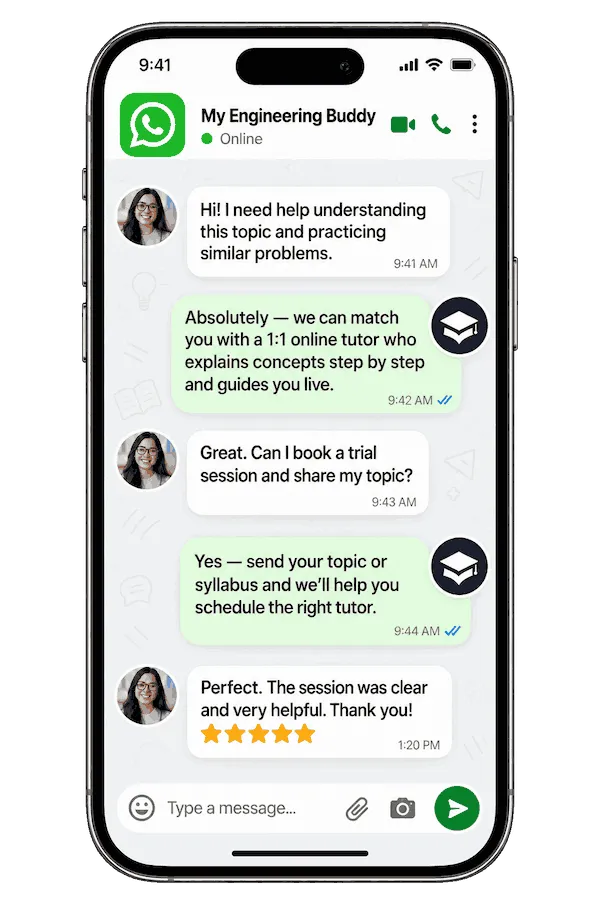
WhatsApp MEB for a quick quote — average response time under 1 minute.
Who This GCSE French Tutoring Is For
GCSE French tutoring at MEB suits students at all stages — those building foundations in Year 10, and those cramming in the final weeks before exams. It also suits parents who want to see structured, accountable progress rather than just hoping grades improve on their own.
- Students who find writing tasks or grammar rules overwhelming
- Students retaking after a failed first attempt and needing a different approach
- Students with a conditional university offer that depends on hitting a specific GCSE grade
- Students 4–6 weeks from the exam with the speaking or writing component still poorly prepared
- Parents watching a child’s confidence drop alongside their grades
- Students needing structured homework and assignment guidance so they understand — not just copy — the answers
Past MEB students preparing for GCSE French have gone on to A Level French and Spanish programmes at schools across the UK, Australia, and the US. We don’t name individual schools, but the trajectory is consistent: students who understand the grammar system, not just the vocabulary lists, move forward with confidence.
1:1 Tutoring vs Self-Study vs AI vs YouTube vs Online Courses
Self-study works if you’re disciplined, but GCSE French has specific speaking and writing mark schemes that self-study rarely addresses. AI tools explain rules quickly — they can’t hear your accent or catch the exact error in your subjunctive use. YouTube covers themes well but stops when you’re stuck on a specific past-paper question. Online courses follow a fixed pace that ignores your weakest component. 1:1 tutoring with MEB is live, calibrated to your AQA, Edexcel, or OCR syllabus, and corrects your exact errors in the moment — not a week later.
At MEB, we’ve found that GCSE French students lose the most marks not from vocabulary gaps but from predictable grammar errors — tense confusion, gender agreement, and missing accents — that a tutor catches and corrects in the first session.
Outcomes: What You’ll Be Able To Do in GCSE French
After consistent 1:1 sessions, you’ll be able to write structured responses across the three GCSE themes — identity and culture, local and global world, and current and future study or employment — without reverting to English when the grammar gets complex. You’ll apply tense formation accurately across present, perfect, imperfect, and future. You’ll present spoken responses on familiar topics with the fluency and accuracy the speaking component rewards. You’ll analyse unseen French texts in the reading paper and extract meaning without translating word-by-word. These aren’t guarantees — they’re the consistent outcomes students report after working through their weakest components with a tutor who knows exactly where the marks are.
Supporting a student through GCSE French? MEB works directly with parents to set up sessions, track progress, and keep coursework on schedule. WhatsApp MEB — average response time is under a minute, 24/7.
“Based on feedback from 40,000+ sessions collected by MEB from 2022 to 2025, 58% of students improved by one full grade after approximately 20 hours of 1:1 tutoring in subjects like GCSE French. A further 23% achieved at least a half-grade improvement.”
Source: MEB session feedback data, 2022–2025.
Try your first session for $1 — 30 minutes of live 1:1 tutoring or one homework question explained in full. No registration. No commitment. WhatsApp MEB now and get matched within the hour.
What We Cover in GCSE French (Syllabus / Topics)

Track 1: Grammar and Language Foundations
- Present tense — regular and irregular verbs (avoir, être, aller, faire)
- Perfect tense — avoir and être auxiliaries, past participle agreement
- Imperfect and future tense formation and usage
- Negation, pronouns (direct, indirect, reflexive), and relative clauses
- Gender and adjectival agreement across noun phrases
- Subjunctive introduction and conditional structures for Higher tier
- Accent and spelling accuracy (grave, acute, circumflex, cedilla)
Recommended texts: AQA GCSE French Higher Student Book (Hodder), Edexcel GCSE French Grammar Workbook (Pearson), Complete French Grammar (Harrap’s).
Track 2: Themes and Vocabulary — Identity, Society, and the Wider World
- Theme 1: Identity and culture — family, relationships, technology, free time
- Theme 2: Local, national, international, and global areas of interest — travel, environment, social issues
- Theme 3: Current and future study and employment — school life, career plans
- Topic-specific vocabulary building and retention strategies
- Using context clues for unseen vocabulary in reading and listening papers
- Applying opinion phrases and justification structures to writing tasks
Recommended texts: AQA GCSE French Revision Guide (CGP), Edexcel GCSE French Vocabulary Book (Pearson), GCSE French: The Revision Guide (CGP Higher).
Track 3: Exam Components — Speaking, Listening, Reading, Writing
- Speaking exam — role play, photo card description, general conversation preparation
- Writing component — structured task and translation into French
- Reading paper — comprehension questions, gap fill, translation into English
- Listening paper — multiple choice, open-response, dictation (Higher)
- Mark scheme awareness — what examiners reward and what loses marks
- Past paper technique and timed practice under exam conditions
Recommended texts: Collins GCSE French Complete Revision and Practice, Oxford GCSE French for AQA Student Book, past papers from AQA, Edexcel, and OCR exam boards directly.
MEB tutors covering GCSE Spanish, GCSE Italian tutoring, and GCSE French use the same structured approach — board-specific, mark-scheme-aware, exam-component focused from session one.
Source: My Engineering Buddy, 2008–2025.
What a Typical GCSE French Session Looks Like
The tutor opens by checking the previous topic — usually a specific grammar point or a past-paper writing task the student attempted. If tense formation was the focus last time, the tutor asks the student to explain a sentence they constructed, rather than just marking it right or wrong. From there, the session moves into the day’s core work: speaking practice on a photo card topic, a translation exercise into French, or a listening comprehension with error analysis. The tutor uses a digital pen-pad to annotate directly — correcting gender agreement on the spot, marking where accents are missing, showing how a sentence restructures when the tense changes. The student then replicates or reworks the example without prompting. The session closes with a specific task set for before next time — one past-paper section, one vocabulary list, one grammar drill — and the next topic is noted so both sides arrive prepared.
How MEB Tutors Help You with GCSE French (The Learning Loop)
Diagnose: In the first session, the tutor identifies which of the four components — speaking, listening, reading, or writing — is costing the most marks, and which grammar structures are producing the most errors. This shapes every session that follows.
Explain: The tutor works through live examples using a digital pen-pad — showing how perfect tense agreement works, how to frame an opinion for the writing component, or how to decode a listening extract with unfamiliar vocabulary.
Practice: The student attempts a question or task with the tutor present. Not after the session. Not as homework to mark next week. Live, in real time, where errors can be caught before they become habits.
Feedback: The tutor goes through every error step by step — explaining exactly why a phrase loses marks, where the tense should have shifted, and how to rewrite it. Students leave each session knowing why, not just what.
Plan: The tutor sets the next topic, notes progress, and adjusts the sequence if a component needs more time. No fixed script — the plan updates as the student’s gaps close.
Sessions run on Google Meet. The tutor uses a digital pen-pad or iPad with Apple Pencil to write, annotate, and correct in real time. Before the first session, share your exam board (AQA, Edexcel, or OCR), your current grade or predicted grade, and any recent past-paper work you’ve attempted. The first session doubles as your diagnostic. Start with the $1 trial — 30 minutes of live tutoring that also serves as your first diagnostic.
Students consistently tell us that the speaking component is where GCSE French confidence collapses fastest. Practising with a tutor who can respond in French, prompt you when you stall, and score your responses against the real mark scheme is a different experience from practising alone in front of a mirror.
Tutor Match Criteria (How We Pick Your Tutor)
MEB doesn’t assign tutors randomly. Every match is made against four criteria.
Subject depth: The tutor must know the specific exam board — AQA, Edexcel, or OCR — not just French in general. GCSE French mark schemes differ between boards, and the tutor needs to know which one you’re sitting.
Tools: Every tutor works on Google Meet with a digital pen-pad or iPad and Apple Pencil. No exceptions. Annotation-based teaching is core to how MEB sessions run for language subjects.
Time zone: Matched to where you are — UK, US, Gulf, Canada, or Australia. Evening sessions are available across all regions.
Goals: Whether you need to move from a grade 4 to a 6, crack the speaking component, or write extended answers confidently, the match factors in your target and your timeline.
Unlike platforms where you fill out a form and wait, MEB responds in under a minute, 24/7. Tutor match takes under an hour. The $1 trial means you test before you commit. Everything runs over WhatsApp — no logins, no intake forms.
Study Plans (Pick One That Matches Your Goal)
After the diagnostic session, your tutor builds a specific sequence — but here’s the general shape. Catch-up (1–3 weeks): fast focus on the highest-yield grammar topics and the components most likely to appear in your paper. Exam prep (4–8 weeks): structured revision by component — one week per paper, timed practice, mark-scheme analysis. Weekly support: ongoing across the academic year, aligned to school deadlines, assessments, and speaking exam windows. The tutor adjusts the plan after every session based on what’s closing and what isn’t.
Pricing Guide
GCSE French tutoring at MEB starts at $20/hr. Most students pay $20–$40/hr depending on their level, the component they’re focusing on, and how quickly they need to progress. Niche or intensive work — for example, daily sessions in the two weeks before the speaking exam — runs higher.
Rate factors include: tier (Foundation vs Higher), complexity of the component, timeline pressure, and tutor availability. For students targeting grade 8–9 or with a conditional offer that requires a specific grade, tutors with A Level French teaching backgrounds or native-speaker fluency are available at higher rates — share your goal and MEB will match you to the right level.
Availability tightens in April and May. Don’t assume a slot will be open the week before your exam.
Start with the $1 trial — 30 minutes, no registration, no commitment. WhatsApp MEB for a quick quote.
FAQ
Is GCSE French hard?
It depends on which component you mean. Grammar and writing are consistently the most challenging for English-speaking students. The speaking exam catches many students off guard. With a tutor who knows the mark scheme, the difficulty becomes manageable — it’s a predictable exam with predictable mark patterns once you know them.
How many sessions are needed?
Students with 6–8 weeks before their exam typically see the clearest grade movement after 10–15 sessions. Students starting earlier, with weekly support over a full term, build more durable understanding. The first diagnostic session determines the realistic timeline for your specific gaps.
Can you help with homework and assignments?
Yes — MEB tutoring is guided learning. You understand the work, then submit it yourself. The tutor explains how to construct an answer, walks through the grammar involved, and checks your reasoning — not your final draft. See our Academic Integrity policy and Why MEB page for full details on what we help with and what we don’t.
Will the tutor match my exact syllabus or exam board?
Yes. AQA, Edexcel, and OCR all have different question formats, mark schemes, and topic weightings. Your tutor is matched to your specific board — not to GCSE French in general. Confirm your board when you contact MEB and the match reflects that from session one.
What happens in the first session?
The tutor runs a diagnostic — asking you to attempt a past-paper task or a grammar exercise, then identifying exactly where marks are being lost. By the end of the first session, you’ll have a clear picture of which components need the most work and in what order.
Is online tutoring as effective as in-person?
For GCSE French, yes — and for speaking practice specifically, online tutoring removes the social pressure some students feel face-to-face. The digital pen-pad replicates everything a whiteboard does. Students consistently report the same level of engagement once they’ve run one session and seen how it works.
Can I get GCSE French help late at night?
MEB operates 24/7 across time zones. Students in the UK, Gulf, Australia, and the US all access sessions at times that work for school schedules. WhatsApp MEB at any hour — response time is typically under a minute regardless of when you message.
What if I don’t get on with my assigned tutor?
Request a different match. It happens occasionally, and MEB replaces tutors without friction. The $1 trial is specifically designed so you experience a real session before committing. If it isn’t right, you haven’t lost anything beyond $1.
Do you offer group GCSE French sessions?
No — MEB is 1:1 only. Group sessions dilute the diagnostic precision that makes the sessions effective. Every session is calibrated to one student’s specific gaps, exam board, and timeline. That’s the model, and it’s what the outcome data reflects.
How do I get started?
Three steps: WhatsApp MEB with your exam board and current grade, get matched to a verified GCSE French tutor — usually within the hour — then start your $1 trial session. Thirty minutes of live tutoring or one question explained in full, no registration required.
What’s the difference between Foundation and Higher tier GCSE French, and does it affect tutoring?
Foundation tier covers grades 1–5; Higher tier covers grades 4–9. Higher introduces subjunctive structures, more complex translation tasks, and a harder listening paper. Your tutor is matched to your tier specifically. If you’re borderline between tiers, the diagnostic session helps clarify which is the right target.
How do MEB tutors approach the GCSE French speaking exam specifically?
The speaking exam — role play, photo card, general conversation — has a specific mark scheme that rewards range of vocabulary, tense variety, and fluency. MEB tutors rehearse each task format under timed conditions, score responses against the actual mark scheme, and train students to recover when they lose their thread mid-answer. This component is coachable. Most students underestimate how much structured practice changes their score.
Trust & Quality at My Engineering Buddy
Every MEB tutor is screened before they take a session — subject knowledge check, live demo evaluation, and ongoing feedback review after each session. Tutors covering GCSE French hold degrees in French, Modern Languages, or related disciplines, and many have direct GCSE or A Level teaching experience. Rated 4.8/5 across 40,000+ verified reviews on Google. Since 2008, MEB has served 52,000+ students across the US, UK, Canada, Australia, and the Gulf.
MEB tutoring is guided learning — you understand the work, then submit it yourself. For full details on what we help with and what we don’t, read our Academic Integrity policy and Why MEB.
MEB covers 2,800+ subjects, including the full range of GCSE qualifications. Students working on GCSE English tutoring, GCSE History help, and GCSE Mathematics tutoring use the same tutor-matching and diagnostic process as students on GCSE French — board-specific, grade-targeted, and structured from session one. Find everything at MEB’s tutoring methodology page.
A common pattern our tutors observe is that students who arrive for GCSE French help thinking vocabulary is the issue leave the first session realising it’s tense accuracy. Fixing the grammar system unlocks vocabulary application — not the other way around.
Explore Related Subjects
Students studying GCSE French often also need support in:
- GCSE Latin
- GCSE Classical Greek
- GCSE English Literature
- GCSE Geography
- GCSE Religious Studies
- GCSE Sociology
- GCSE Drama
Next Steps
Before your first session, have ready: your exam board and syllabus (AQA, Edexcel, or OCR), a recent past paper attempt or homework you struggled with, and your exam or deadline date. The tutor handles the rest.
- Share your exam board, hardest component, and current timeline
- Share your availability and time zone
- MEB matches you with a verified GCSE French tutor — usually within 24 hours
- First session starts with a diagnostic so every minute is used well
Visit www.myengineeringbuddy.com for more on how MEB works.
WhatsApp to get started or email [email protected].
Reviewed by Subject Expert
This page has been carefully reviewed and validated by our subject expert to ensure accuracy and relevance.




