~1 min
Average Reply Time
~1 hour
To Be Matched With A Tutor
30 Min Trial
75% Find Their Tutor On The 1st Trial
$20-35+/hr
Premium Yet Affordable Learning
Most students hit a wall at the intersection of plant physiology and microgravity — here’s how to get past it.
Astrobotany Tutor Online
Astrobotany is the scientific study of how plants grow, adapt, and survive in space environments, including microgravity and radiation exposure. An Astrobotany tutor equips students to apply plant biology, physiology, and space science principles to real research questions in off-Earth agriculture and life support.
Looking for an Astrobotany tutor near me who actually knows the field? MEB connects you with verified tutors who cover plant physiology in microgravity, space crop research, and related graduate-level coursework. Sessions are 1:1, online, and built around your course — not a generic biology syllabus. You won’t just keep up; you’ll understand the material well enough to apply it.
- 1:1 online sessions tailored to your specific Astrobotany course or research module
- Expert verified tutors with subject-specific knowledge in plant biology and space science
- Flexible time zones — US, UK, Canada, Australia, Gulf
- Structured learning plan built after a diagnostic session
- Ethical academic guidance — you understand the work before you submit it
52,000+ students across the US, UK, Canada, Australia, and the Gulf have used MEB since 2008 — across 2,800+ subjects, from AP Calculus to A Level Music Technology to Data Science.
Source: My Engineering Buddy, 2008–2025.
How Much Does an Astrobotany Tutor Cost?
Most Astrobotany tutoring sessions run $20–$40/hr. Graduate-level and specialist research support can reach up to $100/hr depending on topic depth and tutor background. The $1 trial gives you 30 minutes of live 1:1 tutoring or a full explanation of one homework question — no registration needed.
| Level / Need | Typical Rate | What’s Included |
|---|---|---|
| Standard (undergraduate modules) | $20–$35/hr | 1:1 sessions, homework guidance |
| Advanced / Graduate / Research | $35–$100/hr | Expert tutor, specialist depth, thesis support |
| $1 Trial | $1 flat | 30 min live session or 1 homework question explained |
Tutor availability tightens significantly at the start of semester and around research submission deadlines. Book early if you’re working to a fixed timeline.
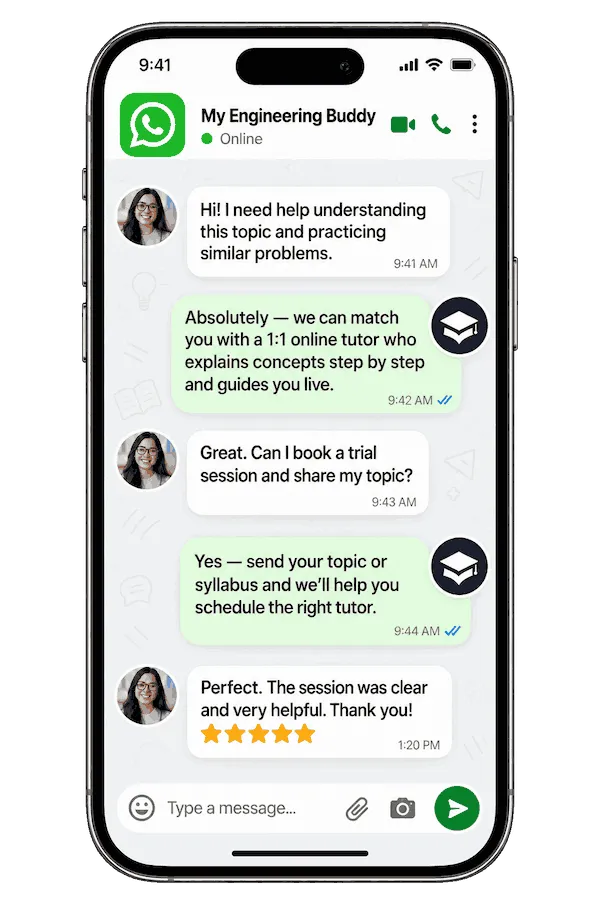
WhatsApp MEB for a quick quote — average response time under 1 minute.
Who This Astrobotany Tutoring Is For
Astrobotany sits at a genuinely unusual intersection — you need solid plant biology alongside enough space science to reason about conditions no field trip will ever replicate. Students come to MEB when their course notes stop being enough.
- Undergraduate students in botany, biology, or aerospace life sciences with an Astrobotany module
- Graduate and PhD students working on space crop systems, plant stress responses, or life support research
- Students with a dissertation or thesis chapter deadline approaching who have unresolved gaps in microgravity physiology or growth chamber experimental design
- Researchers and postdocs needing a structured refresher before a grant proposal or publication
- Students who need plant physiology academic guidance as a foundation before tackling space-specific content
- Parents supporting a student through a first-year or second-year biology degree with an Astrobotany component
Students come from programmes at institutions including Cornell, UC Davis, the University of Florida, Wageningen University, the University of Edinburgh, and the University of Queensland — among many others where space biology and plant science intersect.
1:1 Tutoring vs Self-Study vs AI Tools
Self-study works for motivated students, but Astrobotany requires you to connect plant physiology mechanisms to space environment variables — and without feedback, it’s easy to build a mental model that’s slightly wrong and never notice. AI tools can explain what phototropism is or summarise a paper on root growth in microgravity in seconds, but they can’t watch you work through an experimental design problem, spot where your reasoning breaks down, and correct it in real time. When a question asks you to predict how a specific stressor — say, ionising radiation — affects a plant’s antioxidant response at the cellular level, you need a tutor who can follow your logic step by step and redirect it. MEB combines online flexibility with that structured, live feedback loop, calibrated to your exact course and its assessment demands.
Outcomes: What You’ll Be Able To Do in Astrobotany
After working with an MEB Astrobotany tutor, you’ll be able to analyze how microgravity alters plant gravitropism and explain the cellular mechanisms involved. You’ll apply knowledge of radiation biology to predict stress responses in space-grown crops. You’ll model plant growth chamber conditions for a controlled experiment and present the rationale clearly in writing. You’ll solve problems involving gas exchange and water use efficiency under altered atmospheric pressure. You’ll write up methods and results sections for Astrobotany research assignments with the precision your assessors expect.
Supporting a student through Astrobotany? MEB works directly with parents to set up sessions, track progress, and keep coursework on schedule. WhatsApp MEB — average response time is under a minute, 24/7.
Based on feedback from 40,000+ sessions collected by MEB from 2022 to 2025, 58% of students improved by one full grade after approximately 20 hours of 1:1 tutoring in a single subject. A further 23% achieved at least a half-grade improvement.
Source: MEB session feedback data, 2022–2025.
What We Cover in Astrobotany (Syllabus / Topics)

Plant Biology in Space Environments
- Gravitropism, phototropism, and thigmotropism under microgravity conditions
- Root and shoot architecture changes in space-grown plants
- Cell wall mechanics and structural adaptation in low gravity
- Circadian rhythms and light signalling without Earth’s natural photoperiod
- Seed germination and dormancy under space conditions
- Reactive oxygen species production and antioxidant defence under ionising radiation
Core texts for this track include Plant Physiology and Development by Taiz et al. and selected NASA Technical Reports on plant biology in spaceflight experiments.
Space Crop Systems and Life Support
- Bioregenerative life support systems — oxygen production and CO2 removal
- Hydroponic and aeroponic growing systems adapted for spacecraft and lunar habitats
- Nutrient cycling and substrate selection for closed-loop agriculture
- Crop species selection for caloric yield, growth rate, and resilience
- Water use efficiency and transpiration management in sealed environments
- Contamination control and microbial interaction in space growing chambers
Useful references include Astrobotany course materials from NASA’s Advanced Life Support programme and ESA’s MELiSSA project documentation, available through the European Space Agency Education portal.
Research Methods and Experimental Design
- Designing controlled experiments for simulated microgravity using clinostats and random positioning machines
- Data collection from plant growth chambers — sensors, imaging, and phenotyping
- Statistical analysis of growth rate, biomass, and stress marker data
- Writing methods and results for Astrobotany research reports and dissertations
- Interpreting published spaceflight experiment data from ISS plant biology studies
Students at this level regularly reference Biological Research in Space edited by Moore et al. and primary literature accessed through PubMed.
What a Typical Astrobotany Session Looks Like
The tutor opens by checking where you got to with gravitropism or whichever topic was set the previous session — not to quiz you, but to find the exact point the explanation stopped making sense. From there, you and the tutor work through problems on screen together: it might be walking through how a clinostat simulates microgravity and why that matters for your experimental design, or unpacking a published ISS plant growth study to understand how the authors controlled for variables you need to replicate. The tutor uses a digital pen-pad to annotate diagrams and draw out cellular pathways in real time; you’re expected to replicate the reasoning, not just watch. By the end, you have a specific practice task — a short write-up, a dataset to interpret, or a past assignment question to reattempt — and the next topic is already mapped.
How MEB Tutors Help You with Astrobotany (The Learning Loop)
Diagnose: In the first session, the tutor identifies exactly where your understanding breaks down — whether that’s the cellular mechanics of gravitropism, the engineering constraints of a closed life support loop, or the statistical treatment of phenotyping data. Nothing is assumed.
Explain: The tutor works through problems live, using a digital pen-pad to annotate diagrams, draw metabolic pathways, and mark up your draft methods sections. You see the thinking, not just the answer.
Practice: You attempt problems while the tutor is present — experimental design questions, data interpretation tasks, or short written responses. The point is to catch errors before they become habits.
Feedback: The tutor goes through your reasoning step by step, identifying exactly where marks would be lost and why. Corrections are tied to specific concepts, not general advice.
Plan: Each session ends with a clear next step — which topic comes next, what to review, and what you’ll attempt before you meet again. Progress is tracked across sessions.
Sessions run over Google Meet. The tutor uses a digital pen-pad or iPad with Apple Pencil for live annotation. Before your first session, share your course syllabus or module outline and any recent work you’ve struggled with. The first session covers your diagnostic and sets the plan for everything that follows. Start with the $1 trial — 30 minutes of live tutoring that also serves as your first diagnostic.
Students consistently tell us that the moment things click in Astrobotany isn’t when they memorise a process — it’s when they can predict what happens to a plant under a condition they’ve never seen described before. That’s what we build toward in every session.
Tutor Match Criteria (How We Pick Your Tutor)
Not every biology tutor can teach Astrobotany. Here’s what MEB checks before a match is made.
Subject depth: Tutors are matched to your specific level — undergraduate module, graduate research, or dissertation support — and must demonstrate knowledge of both plant physiology and space biology, not just one or the other.
Tools: All sessions use Google Meet with a digital pen-pad or iPad and Apple Pencil for annotating diagrams and working through experimental designs in real time.
Time zone: MEB covers New York, Los Angeles, Chicago, London, Dubai, Toronto, Sydney, Melbourne — evenings and weekends included. If you’re in the Gulf or Europe, sessions are scheduled to fit your hours.
Learning style: The tutor calibrates pace and approach from the first session — some students need the mechanism explained from first principles; others need targeted practice on a specific assessment type.
Communication: Tutors communicate in clear English, adjusted to the student’s level — whether that’s a second-year undergrad or a PhD candidate preparing a defence.
Goals: Whether you’re targeting a specific assignment grade, completing a research chapter, or closing a conceptual gap before an oral exam, the tutor structures sessions around that outcome.
Unlike platforms where you fill out a form and wait, MEB responds in under a minute, 24/7. Tutor match takes under an hour. The $1 trial means you test before you commit. Everything runs over WhatsApp — no logins, no intake forms.
Study Plans (Pick One That Matches Your Goal)
Catch-up (1–3 weeks): for students with specific gaps to close before a submission or oral. Exam prep (4–8 weeks): structured revision across all Astrobotany topics with past question practice built in. Weekly support: ongoing sessions aligned to your semester schedule and coursework deadlines. After the first diagnostic, the tutor builds the specific session sequence around your timeline and current level.
Pricing Guide
Standard Astrobotany tutoring runs $20–$40/hr for most undergraduate modules. Graduate-level and research support — including dissertation chapter review, experimental design, and ISS data interpretation — is priced at the specialist tier, up to $100/hr. Rate factors include your level, topic complexity, how quickly you need sessions, and tutor availability.
For students targeting research positions, doctoral programmes, or roles within space agencies and biotech firms working on closed-loop agriculture, tutors with active research or professional backgrounds in plant biology and space science are available at higher rates — share your specific goal and MEB will match the tier to your ambition.
Availability tightens at the start of semester and around dissertation submission windows. Start with the $1 trial — 30 minutes, no registration, no commitment. WhatsApp MEB for a quick quote.
At MEB, we’ve found that students who arrive with a specific question — even a badly framed one — make faster progress than students who arrive saying they need help with “everything.” The diagnostic session turns vague anxiety into a concrete list. That list becomes the plan.
Source: My Engineering Buddy tutoring methodology.
FAQ
Is Astrobotany hard?
It’s challenging because it combines two demanding fields — plant physiology and space science — and asks you to apply both simultaneously. Students who struggle most are usually missing a foundation in one of the two. A tutor identifies which one quickly and fills that gap directly.
How many sessions are needed?
Students closing a single conceptual gap often need 3–5 sessions. Those working through a full module or preparing a research chapter typically benefit from 10–20 hours over a semester. The tutor maps this out after the first diagnostic session.
Can you help with practice exercises?
Yes — MEB tutors explain concepts, work through problems with you, and help you understand the reasoning behind your answers. You do the work and submit it yourself. MEB tutoring is guided learning — you understand the work, then submit it yourself. For full details on what we help with and what we don’t, read our Academic Integrity policy and Why MEB.
Will the tutor match my exact syllabus or exam board?
Yes. Share your course outline, module code, or university name when you get in touch and MEB will match you with a tutor who knows that specific syllabus. Astrobotany curricula vary significantly between institutions, so this step matters.
What happens in the first session?
The tutor runs a short diagnostic — identifying which topics you’ve covered, where your understanding is solid, and where the gaps are. From there, a session-by-session plan is built. No time is spent on material you already know.
Is online tutoring as effective as in-person?
For Astrobotany, yes. The subject is diagram-heavy and concept-driven, and a digital pen-pad on Google Meet replicates the whiteboard experience well. Students working remotely often find they get more focused time with a specialist than they would in a face-to-face setting.
Can I get Astrobotany help at midnight or on weekends?
Yes. MEB operates 24/7 across all time zones. WhatsApp response time averages under one minute. If you’re in the US, Gulf, or Australia and need a session outside standard business hours, that’s normal for MEB — not an exception.
What if I don’t like my assigned tutor?
Tell MEB via WhatsApp. A new tutor is matched, usually within the hour. The $1 trial exists precisely so you can test the fit before committing to a full session block. No awkward process — one message and it’s sorted.
How do I find an Astrobotany tutor in my city?
All MEB sessions are online, so location doesn’t limit who you’re matched with. Students in New York, London, Dubai, Toronto, and Sydney all access the same pool of specialist tutors. A tutor in your time zone is matched regardless of your city.
How do I get started?
Start with the $1 trial — 30 minutes of live 1:1 tutoring or one Astrobotany question explained in full. Three steps: WhatsApp MEB, get matched within the hour, start your trial session. No registration, no commitment required.
Trust & Quality at My Engineering Buddy
Every MEB tutor goes through subject-specific screening before taking a session. That includes a live demo evaluation, degree and qualification verification, and ongoing review based on student feedback. Tutors covering Astrobotany are assessed on both plant biology depth and space science knowledge — not just one. Rated 4.8/5 across 40,000+ verified reviews on Google.
Our experience across thousands of sessions shows that the biggest driver of progress isn’t how many hours a student puts in — it’s whether each hour targets the right gap at the right level of difficulty. That’s what a well-matched tutor does, and what no amount of re-reading achieves on its own.
Source: My Engineering Buddy tutoring methodology.
MEB tutoring is guided learning — you understand the work, then submit it yourself. For full details on what we help with and what we don’t, read our Academic Integrity policy and Why MEB.
MEB has served 52,000+ students across the US, UK, Canada, Australia, the Gulf, and Europe since 2008, covering 2,800+ subjects. Students working in adjacent plant sciences have also used MEB for plant pathology tutoring, plant anatomy academic guidance, and 1:1 plant evolution tutoring. Read more about the MEB approach at our tutoring methodology page.
Explore Related Subjects
Students studying Astrobotany often also need support in:
Next Steps
Getting started takes less than two minutes.
- Share your course name, the hardest topic you’re currently stuck on, and your deadline or exam date
- Share your time zone and available hours — evenings and weekends are fine
- MEB matches you with a verified Astrobotany tutor, usually within 24 hours
Before your first session, have ready: your syllabus or course outline, a recent assignment or problem you struggled with, and your submission or exam date. The tutor handles the rest.
Visit www.myengineeringbuddy.com to read more about how MEB works, or go straight to WhatsApp now.
WhatsApp to get started or email [email protected].
Try your first session for $1 — 30 minutes of live 1:1 tutoring or one homework question explained in full. No registration. No commitment. WhatsApp MEB now and get matched within the hour.
Reviewed by Subject Expert
This page has been carefully reviewed and validated by our subject expert to ensure accuracy and relevance.