




~1 min
Average Reply Time
~1 hour
To Be Matched With A Tutor
30 Min Trial
75% Find Their Tutor On The 1st Trial
$20-35+/hr
Premium Yet Affordable Learning
Struggling with forest ecology or silviculture assignments? Most Forestry students hit a wall in their third semester — here’s how to break through it.
Forestry Tutor Online
Forestry is the science and management of forests, covering tree biology, ecosystem ecology, silviculture, and land stewardship. It equips students to assess, conserve, and sustainably manage forest resources for ecological and economic benefit.
Finding a reliable Forestry tutor online matters when your course moves from basic plant biology into stand dynamics, timber valuation, or wildfire risk modelling. MEB connects you with a verified Forestry tutor near me — wherever you are — for 1:1 online tutoring and academic guidance in Botany and applied environmental sciences. Sessions are calibrated to your exact syllabus, not a generic textbook.
- 1:1 online sessions tailored to your university course or programme syllabus
- Expert-verified tutors with degrees and fieldwork experience in forestry and ecology
- Flexible time zones — US, UK, Canada, Australia, and Gulf students all covered
- Structured learning plan built after a diagnostic session
- Ethical academic guidance — you understand the work before you submit
52,000+ students across the US, UK, Canada, Australia, and the Gulf have used MEB since 2008 — including students in Botany subjects like Forestry, Dendrology, and Plant Ecology.
Source: My Engineering Buddy, 2008–2025.
How Much Does a Forestry Tutor Cost?
Most Forestry tutoring sessions run $20–$40/hr. Graduate-level courses covering forest carbon accounting or advanced GIS-based land assessment can reach $60–$100/hr depending on tutor background. Start with the $1 trial — 30 minutes of live 1:1 tutoring or a full explanation of one homework question, no registration needed.
| Level / Need | Typical Rate | What’s Included |
|---|---|---|
| Standard (undergraduate) | $20–$40/hr | 1:1 sessions, homework guidance |
| Advanced / Graduate | $40–$100/hr | Expert tutor, specialist depth |
| $1 Trial | $1 flat | 30 min live session or 1 homework question |
Tutor availability tightens around semester-end and dissertation submission windows — early booking matters. WhatsApp MEB for a quick quote — average response time under 1 minute.
Who This Forestry Tutoring Is For
Forestry draws students from biology, geography, environmental science, and natural resource management. The course content shifts significantly between years — what worked in first year often doesn’t prepare you for what comes in third.
- Undergraduate students in BSc Forestry, Environmental Management, or Natural Resource Science programmes
- Graduate students working on forest carbon, land use policy, or ecosystem services dissertations
- Students retaking a failed module in silviculture, forest mensuration, or ecology
- Students with coursework or field report submission deadlines approaching fast
- Students needing help with GIS mapping assignments, forest inventory calculations, or lab reports
- Parents supporting a student whose grades have dropped alongside their confidence in the subject
MEB tutors work with students at universities including the University of British Columbia, Oregon State University, University of Edinburgh, University of Melbourne, and Wageningen University — among many others across North America, Europe, and Australia.
1:1 Tutoring vs Self-Study vs AI vs YouTube vs Online Courses
Self-study works if you’re disciplined, but Forestry involves integrating ecology, statistics, and field data — no feedback loop means errors compound. AI tools give fast definitions but can’t walk through your specific forest mensuration dataset or explain why your basal area calculation is off. YouTube covers silviculture basics but stops when the problem gets specific to your course. Online courses run at a fixed pace with no adjustment for where you’re stuck. With MEB, a 1:1 online Forestry tutor sees your actual assignment, identifies the gap, and corrects it in the session — not three days later.
Outcomes: What You’ll Be Able To Do in Forestry
After working with an MEB Forestry tutor, students can solve forest inventory calculations with confidence, analyze stand dynamics using growth models, apply silvicultural systems to real management scenarios, explain succession ecology in written assessments, and present GIS-based land analysis results accurately. These aren’t abstract skills — they map directly to exam questions, lab reports, and dissertation chapters that Forestry students at undergraduate and graduate level are assessed on.
Supporting a student through Forestry? MEB works directly with parents to set up sessions, track progress, and keep coursework on schedule. WhatsApp MEB — average response time is under a minute, 24/7.
Based on feedback from 40,000+ sessions collected by MEB from 2022 to 2025, 58% of students improved by one full grade after approximately 20 hours of 1:1 tutoring in subjects like Forestry. A further 23% achieved at least a half-grade improvement.
Source: MEB session feedback data, 2022–2025.
What We Cover in Forestry (Syllabus / Topics)

Forest Ecology and Ecosystem Science
- Forest succession — primary and secondary succession models
- Nutrient cycling: carbon, nitrogen, and phosphorus in forest systems
- Biodiversity indices and species richness assessments
- Forest hydrology and watershed management principles
- Disturbance ecology — fire, windthrow, and pest dynamics
- Climate change effects on boreal, temperate, and tropical forest biomes
Core texts include Forest Ecology by Kimmins and Ecology of a Changing Planet by Bush — both standard across North American and European forestry programmes.
Silviculture and Forest Management
- Silvicultural systems — clear-cut, shelterwood, selection, and coppice
- Stand structure and density management using thinning schedules
- Regeneration ecology — natural versus artificial regeneration
- Forest mensuration: tree height, DBH, basal area, and volume calculations
- Timber harvesting methods and road layout planning
- Certification frameworks: FSC and PEFC standards in managed forests
Standard references include The Silviculture of Trees by Evans and Forest Measurements by Avery and Burkhart — widely used in UK, Canadian, and Australian programmes.
Forest Policy, Economics, and GIS Applications
- Forest valuation — timber, carbon credits, and ecosystem services
- Land use policy and tenure systems across major jurisdictions
- REDD+ frameworks and international forest governance
- GIS-based forest mapping: ArcGIS and QGIS applications for stand delineation
- Remote sensing tools: LiDAR data interpretation and canopy analysis
- Forest inventory design and statistical sampling methods
Students regularly reference Forest Resource Management by Davis, Johnson, and Bettinger alongside OECD environmental outlook reports for policy-facing coursework.
At MEB, we’ve found that Forestry students who struggle with mensuration calculations almost always have the same root issue — they’re applying formulas without understanding what the field measurements represent. Fixing that one conceptual gap typically unlocks three or four dependent topics at once.
What a Typical Forestry Session Looks Like
The tutor opens by checking how the previous topic landed — usually silvicultural system selection or a stand density calculation from the week before. From there, the session moves into whatever is most pressing: it might be working through a forest mensuration problem set, interpreting a LiDAR canopy dataset, or unpacking a forest succession case study for an upcoming written assessment. The tutor uses a digital pen-pad to work through calculations and diagrams on screen while the student follows and then replicates the method independently. By the end, there’s a specific practice task — a calculation to complete, a diagram to annotate, or a paragraph outline to draft — and the next topic is already mapped. No session ends without a clear forward step.
How MEB Tutors Help You with Forestry (The Learning Loop)
Diagnose: In the first session, the tutor identifies exactly which concepts are causing the grade problem — whether it’s basal area calculations, writing up ecology practicals, or interpreting forest policy frameworks. They don’t assume; they test. You can get plant pathology help through the same diagnostic approach if your course overlaps into disease ecology.
Explain: The tutor works through live problems on a digital pen-pad — drawing succession diagrams, running through volume equations, or annotating GIS outputs. Explanations are connected to your actual course material, not a generic textbook example.
Practice: You attempt the next problem while the tutor watches. This is where most of the learning happens. Errors surface in real time, not after the assignment is already submitted.
Feedback: Step-by-step correction after each attempt. The tutor explains exactly where the reasoning broke down and what the marker would have penalised — that specificity is what changes grades.
Plan: Before the session ends, the tutor maps the next topic, sets a practice task, and notes any upcoming deadlines. Progress is tracked across sessions — not reset each time you log on.
Sessions run on Google Meet. The tutor uses a digital pen-pad or iPad with Apple Pencil for live worked examples. Before your first session, have your course outline, a recent assignment or past paper attempt, and your submission or exam date ready. The first session is diagnostic — it sets the direction for everything that follows. Start with the $1 trial — 30 minutes of live tutoring that doubles as your first diagnostic session.
Students consistently tell us that the shift from passive reading to active problem-solving under a tutor’s watch is where Forestry finally starts to make sense — especially when the topics cross between ecology, statistics, and field application in the same assessment.
Source: MEB tutor and student feedback, 2022–2025.
Try your first session for $1 — 30 minutes of live 1:1 tutoring or one homework question explained in full. No registration. No commitment. WhatsApp MEB now and get matched within the hour.
Tutor Match Criteria (How We Pick Your Tutor)
Every Forestry tutor at MEB is matched to your session on four criteria.
Subject depth: The tutor holds a degree in Forestry, Ecology, Environmental Science, or a closely related field — and has worked with students at your specific level and programme type. Need agronomy tutoring alongside your forestry modules? MEB can cover both.
Tools: Every tutor uses Google Meet and a digital pen-pad or iPad with Apple Pencil. No session runs on a shared document and a voice call.
Time zone: Matched to your region — US, UK, Gulf, Canada, or Australia. Late-night sessions are available.
Goals: Whether you need to pass a resit, close a gap before dissertation submission, or build week-by-week understanding through the semester, the tutor match reflects that — not a one-size approach.
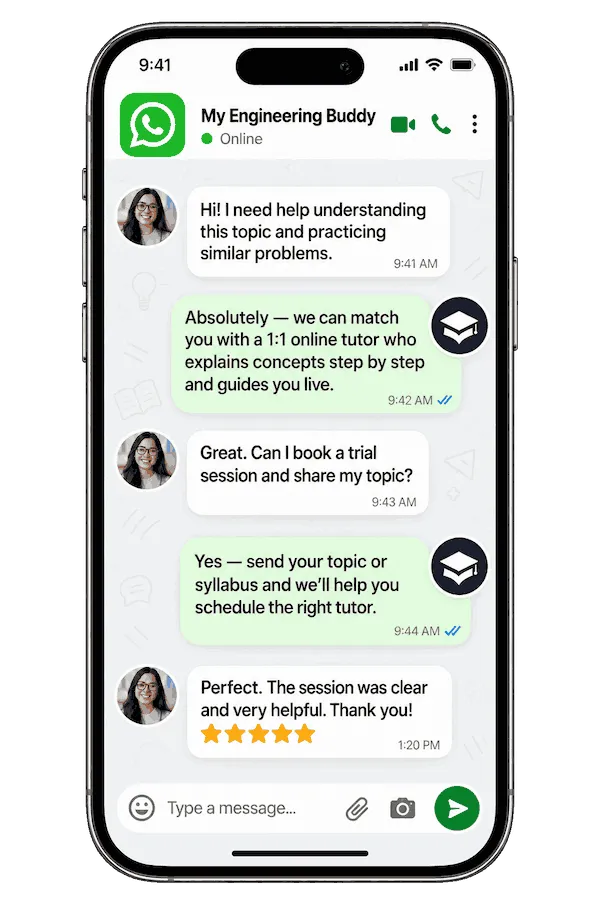
Unlike platforms where you fill out a form and wait, MEB responds in under a minute, 24/7. Tutor match takes under an hour. The $1 trial means you test before you commit. Everything runs over WhatsApp — no logins, no intake forms.
Study Plans (Pick One That Matches Your Goal)
MEB tutors build a specific session sequence after the diagnostic — but most Forestry students fall into one of three patterns. Catch-up (1–3 weeks): targeted sessions for students behind on a single module or facing a resit with gaps to close. Exam prep (4–8 weeks): structured revision aligned to your assessment schedule, covering high-weight topics first. Weekly support: ongoing sessions matched to your semester timetable and coursework deadlines. The tutor maps the exact sequence after your first diagnostic session — nothing is assumed in advance.
Pricing Guide
Forestry tutoring runs $20–$40/hr for most undergraduate levels. Graduate-level work — forest carbon modelling, advanced remote sensing, dissertation supervision — can reach $60–$100/hr depending on tutor background and topic complexity. Rate factors include your programme level, specific topic, timeline, and tutor availability.
For students targeting roles in forest conservation agencies, international NGOs, or research positions at institutions where Forestry expertise is a differentiator, tutors with professional forestry or environmental consulting backgrounds are available at higher rates — share your specific goal and MEB will match the tier to your ambition.
Availability narrows around semester-end and field season assessment windows. Start with the $1 trial — 30 minutes, no registration, no commitment. WhatsApp MEB for a quick quote.
MEB has worked with Forestry and environmental science students across 2,800+ subjects since 2008 — rated 4.8/5 across more than 40,000 verified reviews. The tutors are practitioners and graduates, not generalists.
Source: My Engineering Buddy platform data, 2008–2025.
FAQ
Is Forestry hard?
It gets harder in years two and three when silviculture, mensuration calculations, and GIS work converge in the same semester. Students who struggled in ecology often find the quantitative elements catch them off-guard. A 1:1 online Forestry tutor helps you close those gaps before they compound.
How many sessions are needed?
Most students see measurable improvement in 6–10 sessions — enough to cover core topic gaps and build exam technique. Students using MEB for ongoing weekly support typically run sessions throughout the semester, aligned to their coursework submission schedule.
Can you help with Forestry practice exercises?
MEB tutoring is guided learning — you understand the work, then submit it yourself. The tutor explains methods, works through similar examples, and checks your reasoning. See our Academic Integrity policy and Why MEB page for full details on what we help with and what we don’t.
Will the tutor match my exact syllabus or exam board?
Yes. Before matching, MEB asks for your university, course code, and current topic. The tutor assigned has covered that content before — they are not learning your syllabus at the same time you are.
What happens in the first session?
The first session is diagnostic. The tutor works through a set of questions with you to identify exactly where understanding breaks down — not just what topics you haven’t revised. That shapes every session that follows. Nothing is wasted.
Is online tutoring as effective as in-person?
For Forestry, yes — the digital pen-pad replaces a whiteboard, and Google Meet handles the rest. Students in Australia, Canada, and the Gulf use MEB for exactly this reason: expert tutors they wouldn’t access locally are available online within the hour.
Can you help with GIS assignments in ArcGIS or QGIS?
Yes. MEB tutors support GIS-based Forestry coursework including stand delineation, canopy analysis, and forest inventory mapping in both ArcGIS and QGIS. Share your assignment brief and data files before the session so the tutor can prepare.
Do you cover forest carbon and REDD+ policy topics?
Yes. Tutors with environmental policy and land use backgrounds cover carbon accounting frameworks, REDD+ governance structures, and ecosystem services valuation — topics that appear increasingly in graduate-level Forestry programmes across North America, Europe, and Australia.
Can I get Forestry help at midnight?
Yes. MEB operates 24/7. If you’re in the Gulf, Australia, or working late before a submission deadline, WhatsApp MEB at any hour. Average response time is under one minute. Tutor match happens the same day.
What if I don’t get on with my assigned tutor?
Tell MEB and a different tutor is matched — no argument, no extra charge. The $1 trial exists specifically so you can test the match before committing to a full session block. Most students confirm within the first session.
How do I get started?
Three steps: WhatsApp MEB, get matched to a verified Forestry tutor — usually within the hour — then start your $1 trial. Thirty minutes of live tutoring or one homework question explained in full. No forms, no registration, no commitment beyond the dollar.
Trust & Quality at My Engineering Buddy
Every MEB Forestry tutor goes through a structured screening process: qualification check, live demo evaluation, and subject-specific vetting against the most common course structures in their discipline. Tutors are not accepted on credentials alone — they demonstrate teaching quality in the demo before being matched to students. Ongoing session feedback from students feeds directly into tutor performance reviews. Rated 4.8/5 across 40,000+ verified reviews on Google.
MEB tutoring is guided learning — you understand the work, then submit it yourself. For full details on what we help with and what we don’t, read our Academic Integrity policy and Why MEB.
MEB has served 52,000+ students across the US, UK, Canada, Australia, the Gulf, and Europe in 2,800+ subjects since 2008. In Botany and environmental sciences, that includes students needing plant taxonomy tutoring, horticulture help, and plant anatomy academic guidance — alongside core Forestry modules. The MIT OpenCourseWare Ecology resource is one MEB tutors reference regularly when students need additional worked examples beyond their course notes. Learn more about how MEB tutors are selected and how sessions are structured at our tutoring methodology page.
Explore Related Subjects
Students studying Forestry often also need support in:
A common pattern our tutors observe is that Forestry students arrive with strong field instincts but underestimate the statistical rigour their written assessments require. The students who close that gap fastest are the ones who bring a real assignment — not a generic question — to the first session.
Next Steps
Getting started takes less than five minutes.
- Share your course, exam board or university, hardest topic, and current timeline
- Share your availability and time zone — MEB covers US, UK, Canada, Australia, and the Gulf
- MEB matches you with a verified Forestry tutor — usually within the hour
- First session opens with a diagnostic so every minute counts
Before your first session, have ready: your syllabus or course outline, a recent assignment or past paper attempt you struggled with, and your exam or submission deadline date. The tutor handles everything from there.
Students consistently tell us that the first session feels different from anything they’ve tried before — because the tutor already knows what the specific assessment requires and builds the session around that, not around a generic topic list.
Visit www.myengineeringbuddy.com for more on how MEB works.
WhatsApp to get started or email [email protected].
Reviewed by Subject Expert
This page has been carefully reviewed and validated by our subject expert to ensure accuracy and relevance.




